

CSVgo vs SignalHire: Different Tools, Different Jobs
You exported 5,000 leads from Apollo, loaded them into your sequencer, and watched 22% bounce on the first send. Now you're shopping for a fix - and you've landed on CSVgo vs SignalHire. Here's the thing: these two tools don't compete with each other. One cleans lists you already have. The other finds contacts you don't. Comparing them is like comparing a dishwasher to a grocery store.
About 28% of B2B emails sit on catch-all domains, which most verifiers mark as "unknown" and leave you guessing. Email list data also decays at roughly 28% annually - a separate but compounding problem. Push hard bounces past ~2% and you're risking your domain reputation. That's the context that makes this comparison worth having.
30-Second Verdict
- Choose CSVgo if you already have a lead list and need to clean, verify, and segment it before launching a cold email campaign.
- Choose SignalHire if you need to find contact data - emails, phone numbers - from scratch, starting with a company or person name.
What Each Tool Actually Does
CSVgo: List Cleanup and Verification
CSVgo isn't a contact database. It's a processing layer that sits between your lead source and your sequencer. You upload a CSV, map your columns, and CSVgo runs verification, catch-all analysis, and ESP detection in one pass.
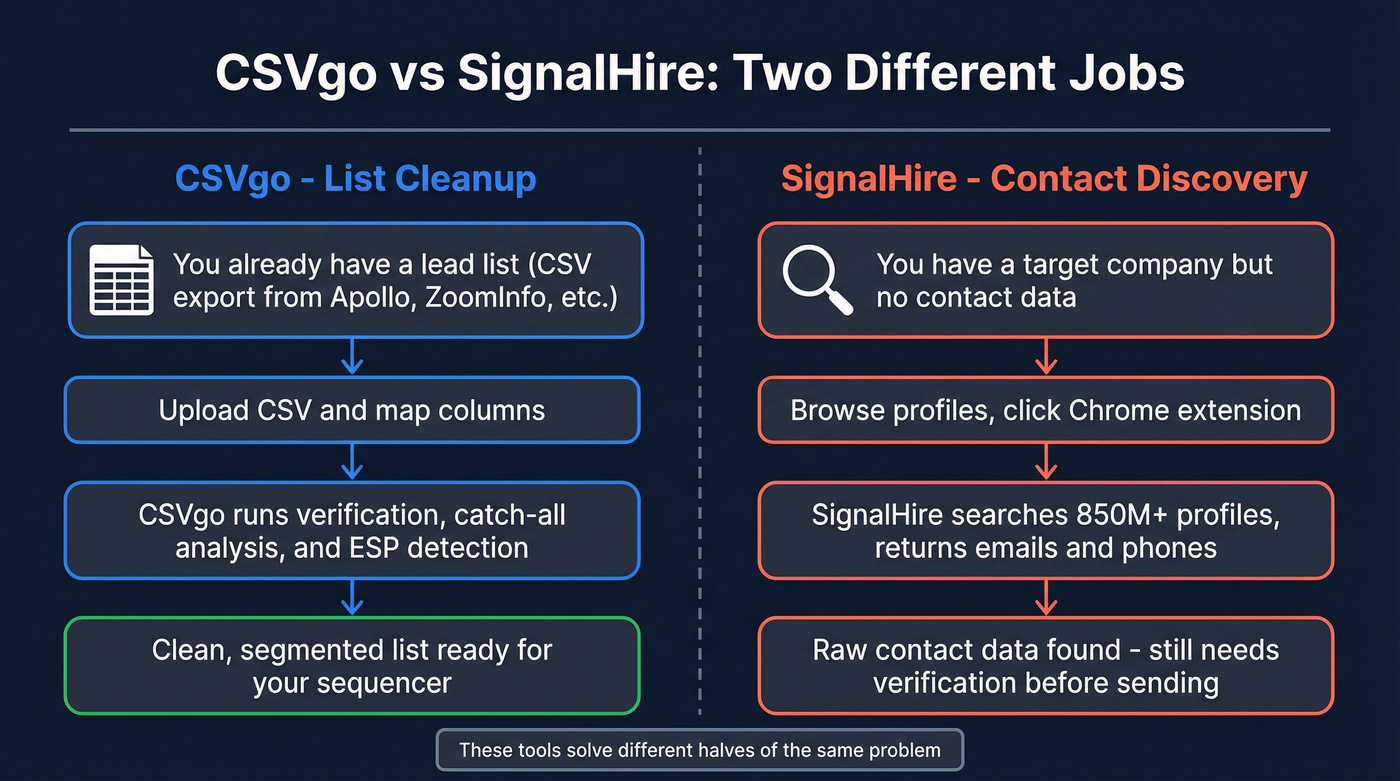
The catch-all handling is the real differentiator. Most verifiers flag catch-all emails as "unknown" and leave you stuck. CSVgo gives actionable go/no-go verdicts - which matters when roughly 28% of your list sits on catch-all domains. A Hunter benchmark of 15 verifiers found that even top tools only hit ~70% accuracy once you factor in unknowns and accept-alls. That's the gap CSVgo targets.
The ESP detection feature groups contacts by Gmail, Outlook, and SMTP providers, which helps with deliverability tuning. Practitioners on Reddit report it replaces four tools and finds 30% more usable leads than standard verifiers - driven by the catch-all recovery that other tools leave on the table.
SignalHire: Contact Discovery
SignalHire is a contact finder, not a list cleaner. It covers 850M+ profiles and works primarily through a Chrome extension - browse a professional profile, click the extension, get emails and phone numbers with real-time verification at lookup. All paid plans include unlimited users, which is genuinely useful for teams.

On G2, SignalHire sits at 3.7/5 with 56 reviews, and the vendor profile hasn't been active for over a year. Users praise the extension workflow and ease of use. One reviewer reported bounces dropping from 22% to under 5% after switching. But the complaints are consistent: credits feel expensive, and contact data is sometimes outdated. A third-party review noted that accuracy varies by geography and phone number hit rates are inconsistent.
Look - SignalHire runs real-time verification at lookup, but users still report bounces on exported data. We've seen this pattern across dozens of tools: any list over 2,000 contacts needs a dedicated verification pass before sending, no matter where the data came from. If you're running cold email at scale, you'll need a second tool anyway.
Feature Comparison
These tools overlap less than you'd think.
| Feature | CSVgo | SignalHire |
|---|---|---|
| Primary function | List cleanup | Contact finding |
| Database | Your lists | 850M+ profiles |
| Email verification | Yes + catch-all | At-lookup |
| Catch-all handling | Actionable go/no-go verdicts | Not emphasized |
| ESP detection | Yes | No |
| Chrome extension | No | Yes |
| Bulk CSV processing | Core function | Available on higher tiers |
| Team access | Not public | Unlimited users |
| CRM integrations | Limited | ATS/CRM |
Who wins each row depends entirely on what job you're hiring the tool for. CSVgo dominates post-enrichment cleanup. SignalHire dominates contact discovery. They don't really compete.

CSVgo cleans lists. SignalHire finds contacts. Prospeo does both - 300M+ profiles, 5-step verification with catch-all handling, and a 7-day data refresh cycle. No more stitching two tools together and praying your bounces stay under 2%.
One platform, 98% email accuracy, starting at $0.01 per lead.
Pricing Breakdown
These tools use completely different cost models, so direct comparison requires some translation.
| SignalHire | CSVgo | |
|---|---|---|
| Free tier | 5-10 credits/mo | Not public |
| Entry paid | $69/mo emails only | Est. $3-10/1K verifications |
| Mid tier | $139/mo emails + phones | Est. $6-15/1K (full suite) |
| Cost model | Per-credit finding | Per-verification cleaning |
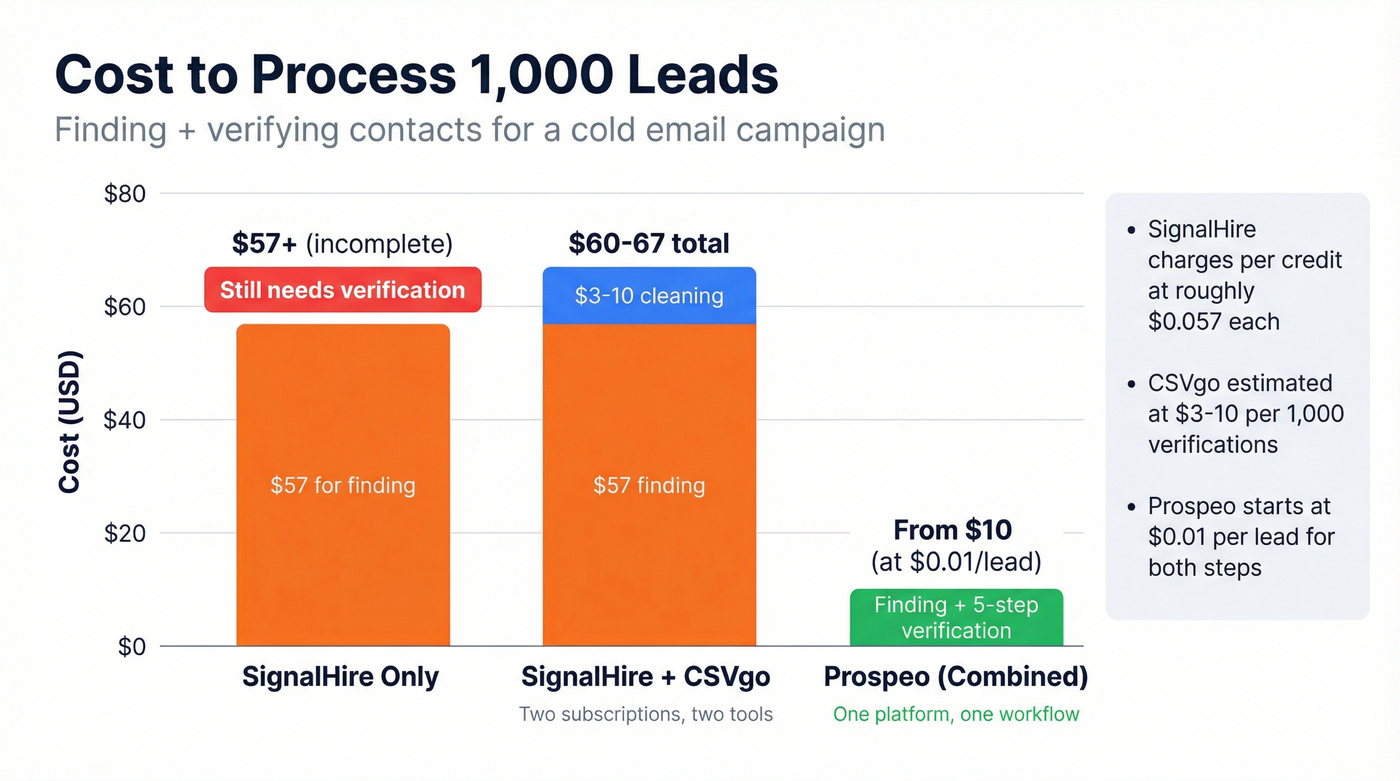
SignalHire's "unlimited" packaging comes with a fair usage policy that caps usage at 2,000 credits/month. On the Emails plan at $69/mo, you're paying roughly $0.057 per credit - and annual billing drops that to $57/mo with 10,800 credits/year. The combined Emails & Phones plan runs $139/mo, or $110/mo annually.
CSVgo doesn't publish pricing, which is frustrating for what should be a self-serve product. Based on comparable verification tools like ZeroBounce, NeverBounce, and Bouncer, expect $3-10 per 1,000 verifications.
When to Use Which
CSVgo makes sense when you've already exported leads from Apollo, ZoomInfo, or another database and need to clean, verify, and segment before sending. Your lists exist - they just aren't campaign-ready.
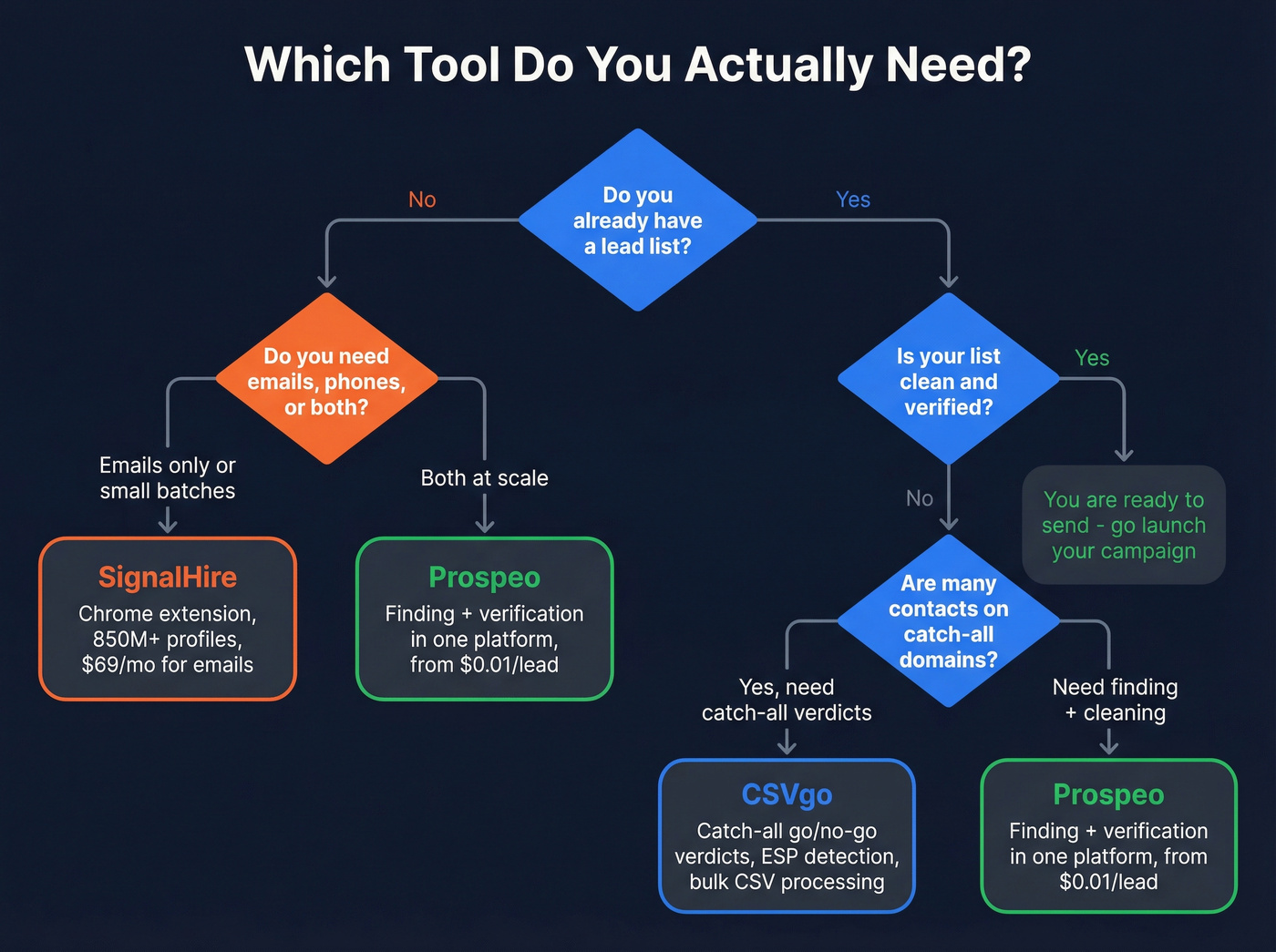
SignalHire makes sense when you have a target company list but no contact data. You need to find emails and phone numbers from scratch, one profile at a time or in small batches.
Let's break this down with a worked example. Run 1,000 leads through CSVgo and expect ~720 verified, ~280 catch-all with go/no-go verdicts - total cost around $3-10. Run the same 1,000 names through SignalHire and expect ~600 matches at ~$0.057 each, costing $34.20 - but you still need to verify before sending. The tools solve different halves of the same problem.
One Platform Instead of Two
If you're stitching together a contact finder and a list verifier, you're managing two subscriptions, two data formats, and two failure points. We've tested this workflow ourselves and it gets old fast.
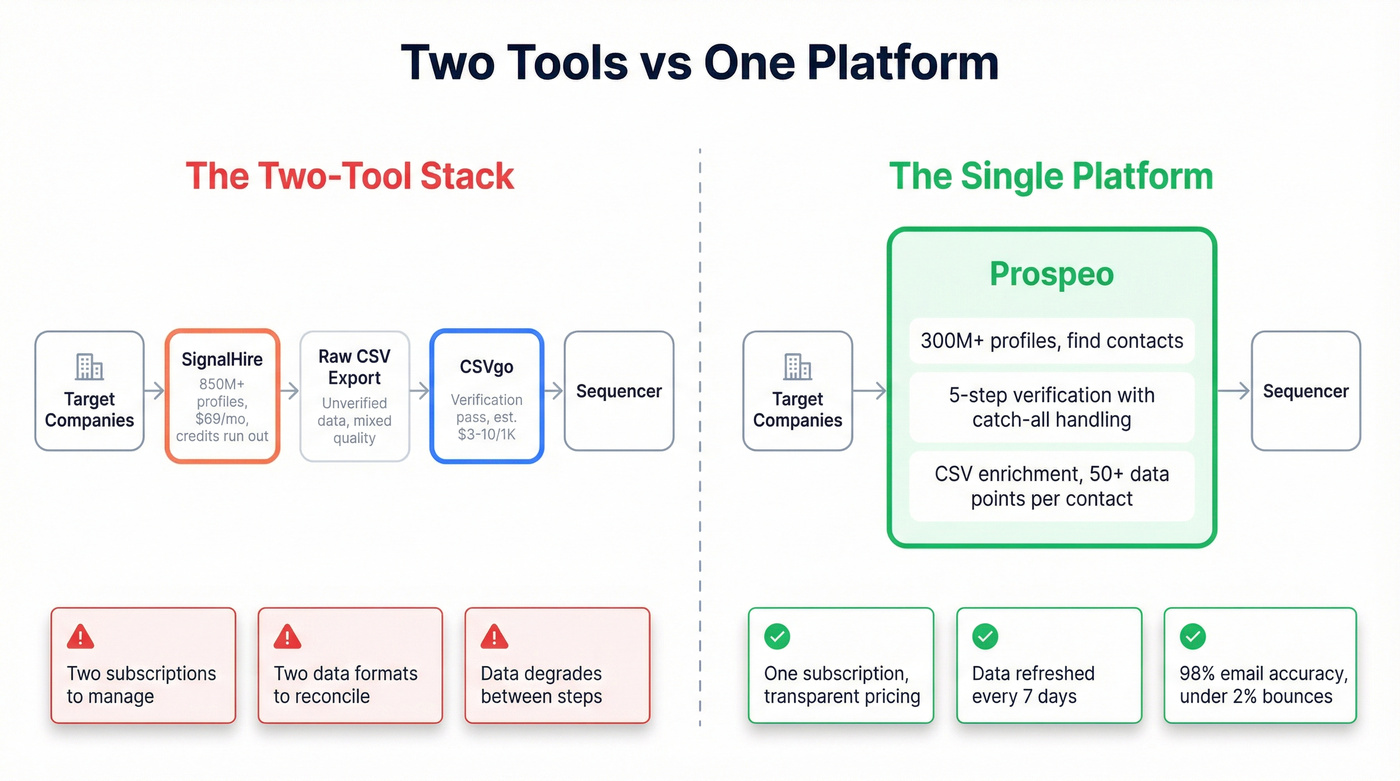
Prospeo covers 300M+ profiles with 143M+ verified emails, runs a 5-step verification process with catch-all handling, and refreshes data every 7 days. The Chrome extension has 40K+ users, CSV enrichment returns 50+ data points per contact with a 92% API match rate, and the whole thing starts free - 75 emails plus 100 extension credits per month, no credit card required.
For teams running deals under $15K ACV where every dollar of tooling spend matters, consolidating your stack into a single platform with transparent per-credit pricing beats juggling CSVgo and SignalHire separately.
You're about to pay $69/mo for SignalHire credits and still need a verifier on top. Prospeo gives you 143M+ verified emails, catch-all verdicts, and CSV enrichment returning 50+ data points - all in one subscription with transparent per-credit pricing.
Stop managing two subscriptions for one workflow.
FAQ
Can I use CSVgo and SignalHire together?
Yes - find contacts with SignalHire, then clean the exported list with CSVgo before sending. They solve different problems and work well in sequence. If you'd rather handle both steps in one platform, Prospeo eliminates the handoff with built-in finding and 5-step verification.
Does SignalHire verify emails?
SignalHire runs real-time verification at lookup, but users still report bounces on exported data. For cold email campaigns where you need to stay under 2% total bounces, running a dedicated verification pass before sending is safer - especially on lists over 2,000 contacts.
Is CSVgo or SignalHire better for cold email?
Neither is a complete cold email solution on its own. CSVgo handles cleaning; SignalHire handles finding. For cold email you need both capabilities, which is why combined platforms exist to cover the full pipeline.
What's a catch-all email and why does it matter?
A catch-all domain accepts all emails regardless of whether the specific address exists. About 28% of B2B emails sit on catch-all domains. Most verifiers mark them "unknown" - which is useless. Tools like CSVgo give actionable go/no-go verdicts instead, recovering leads that other verifiers would discard.