


CUFinder vs TrueVerify: Different Tools, Different Jobs
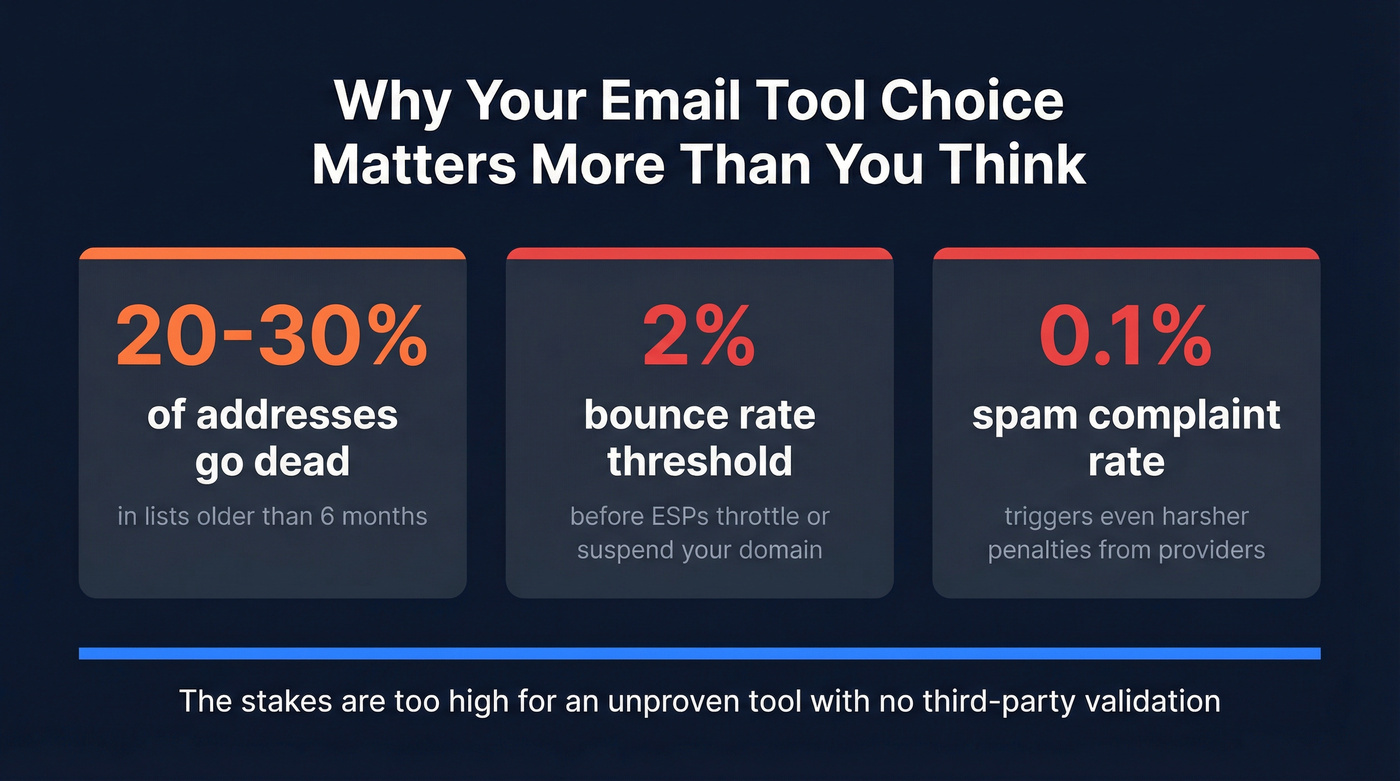
The CUFinder vs TrueVerify question comes up because both tools touch email data - but that's where the similarity ends. You're comparing a full sales intelligence platform to an email verification product with almost no public footprint. That distinction matters because bad email data costs real money: lists older than six months typically contain 20-30% dead addresses, and once your bounce rate crosses 2%, ESPs start throttling or suspending your domain.
We've seen teams torch their sender reputation over exactly this kind of unverified tool choice. So let's break down what each one actually does and whether either deserves your budget.
30-Second Verdict
Use CUFinder if you need an all-in-one prospecting, enrichment, and verification platform with a proven review track record and a free tier to test.
Use TrueVerify if you specifically need a standalone email verifier - but know that its near-zero public review footprint makes it a gamble.
Feature Comparison at a Glance
| Feature | CUFinder | TrueVerify |
|---|---|---|
| Category | Sales intelligence | Email verification |
| Core function | Prospecting + enrichment | List verification |
| Pricing | Free-$299/mo | Not public |
| G2 rating (early 2026) | 4.8/5 (988 reviews) | Listed on G2; no visible rating |
| Capterra rating | 4.9/5 (22 reviews) | No listing found |
| Chrome extension | Yes | Not documented |
| CRM integrations | 10+ (including Salesforce, HubSpot) | None documented |
| Database size | Large B2B contact + company database | N/A (verifier only) |
| GDPR/CCPA compliance | Yes | No public compliance info |
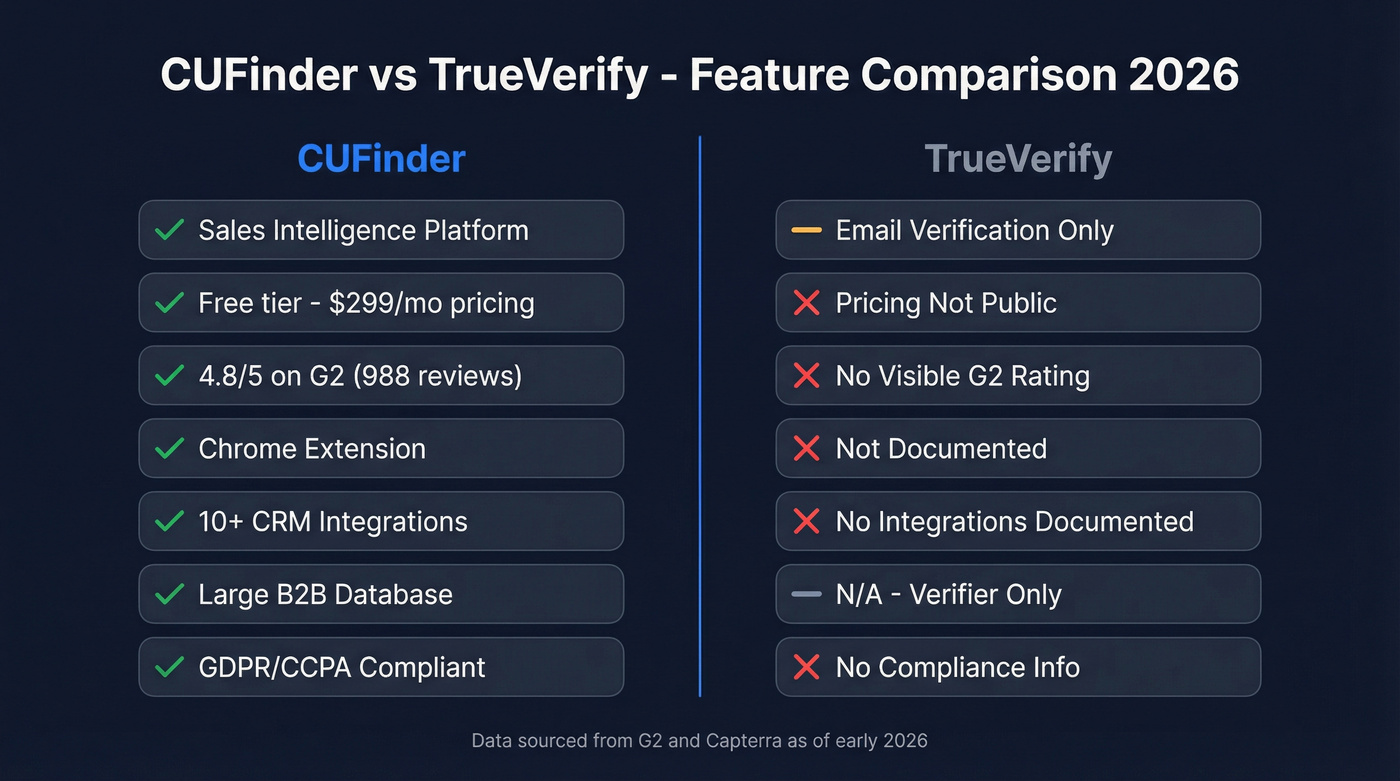
These aren't close competitors. CUFinder is a platform; TrueVerify is a point solution with very little public information.
What CUFinder Does Well
CUFinder's Capterra reviews consistently praise its Chrome extension and CRM integration. Reviewers call the setup "simple and user-friendly," and the bulk company-to-domain matching is genuinely impressive - one reviewer noted it worked "almost too perfectly," returning subsidiary domains that required some cleanup but showed a depth most tools can't match.
Pricing is straightforward. The free tier gives you 50 credits/month. Growth runs $49/month for 1,000 credits, Premium is $129/month for 3,000, and Unlimited hits $299/month for 10,000. Higher tiers unlock API access, advanced filters, and CRM integrations. CUFinder also advertises GDPR and CCPA compliance, which matters if you're prospecting into EU or California contacts.

CUFinder charges $49/mo for 1,000 credits. TrueVerify won't even show you pricing. Prospeo gives you 300M+ profiles, 5-step verification with catch-all handling, and 98% email accuracy - starting at $0.01/email with a free tier that requires no credit card.
Stop comparing two compromises when a better option exists.
The TrueVerify Problem
TrueVerify is listed on G2 under Email Verification Software. That's about all we can confirm. The G2 page doesn't show a star rating or review count, there's no public pricing page, no Capterra listing, and our community research didn't surface any TrueVerify mentions on Reddit or sales forums.
G2 lists alternatives including Apollo.io, ZeroBounce, RocketReach, Wiza, and Saleshandy - all tools with extensive public track records.
Here's the thing: you shouldn't have to do detective work to figure out if your verification tool actually works. When a bounce rate above 2% can tank your domain reputation and spam complaints above 0.1% trigger even harsher penalties, the stakes are too high for an unproven tool with no third-party validation. The lack of public evidence is itself the strongest signal you need.
Why Verification Accuracy Is Hard to Judge
Before you trust any vendor's accuracy claims, consider the benchmarks. A Hunter-run test of 15 verifiers across 3,000 real business emails found the top overall accuracy was 70% in their methodology. That's the best performer in a methodologically transparent test - not the 99% you see plastered across marketing pages.
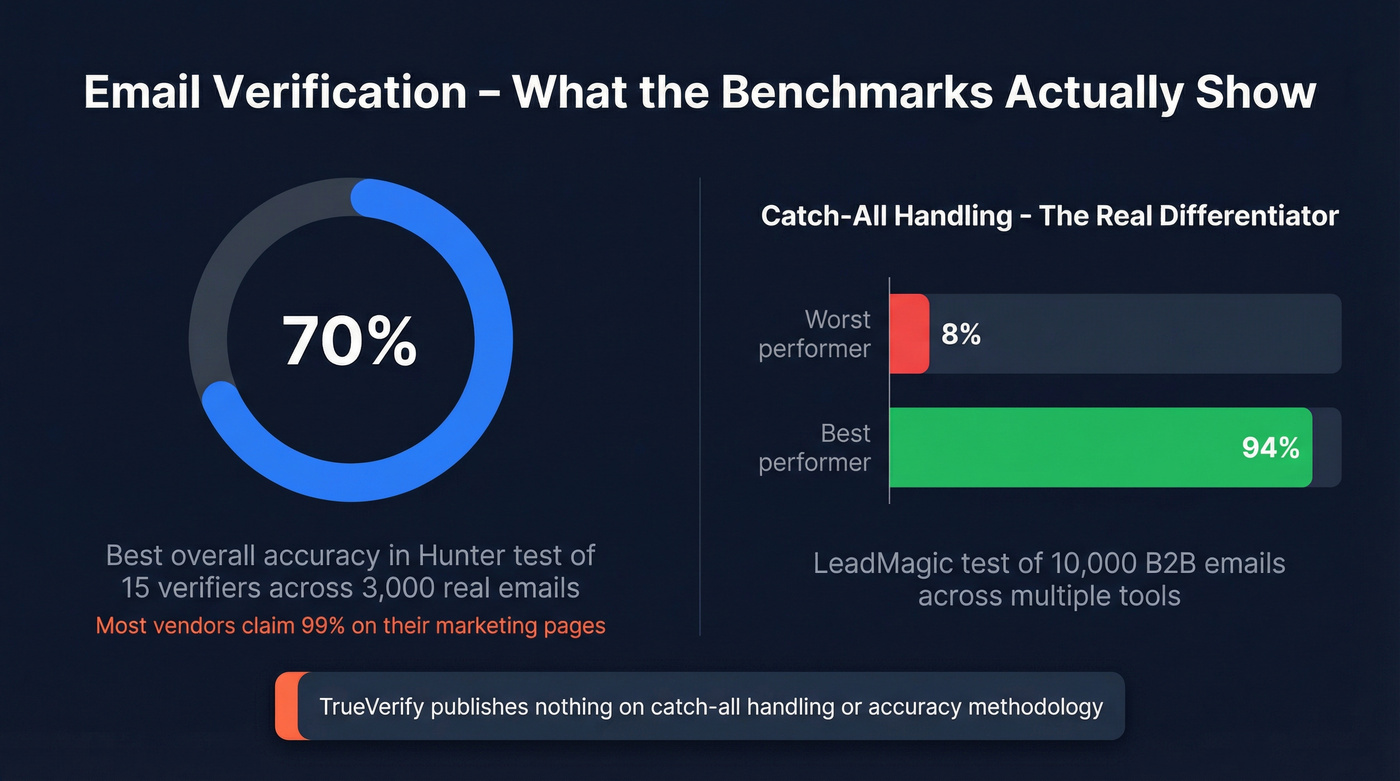
The real differentiator is catch-all handling. A LeadMagic test of 10,000 B2B emails showed catch-all resolution rates ranging from 8% to 94% across tools. That's an enormous spread, and it's the single metric that separates serious verifiers from checkbox features. Any vendor claiming "99% accuracy" without specifying how they handle catch-all domains deserves serious scrutiny - and TrueVerify publishes nothing on this front.
A Stronger Third Option
If you're weighing CUFinder against TrueVerify because you need both prospecting and verification, there's a cleaner path. Prospeo covers 300M+ professional profiles with 30+ search filters and runs every email through a 5-step verification process that includes catch-all handling, spam-trap removal, and honeypot filtering.
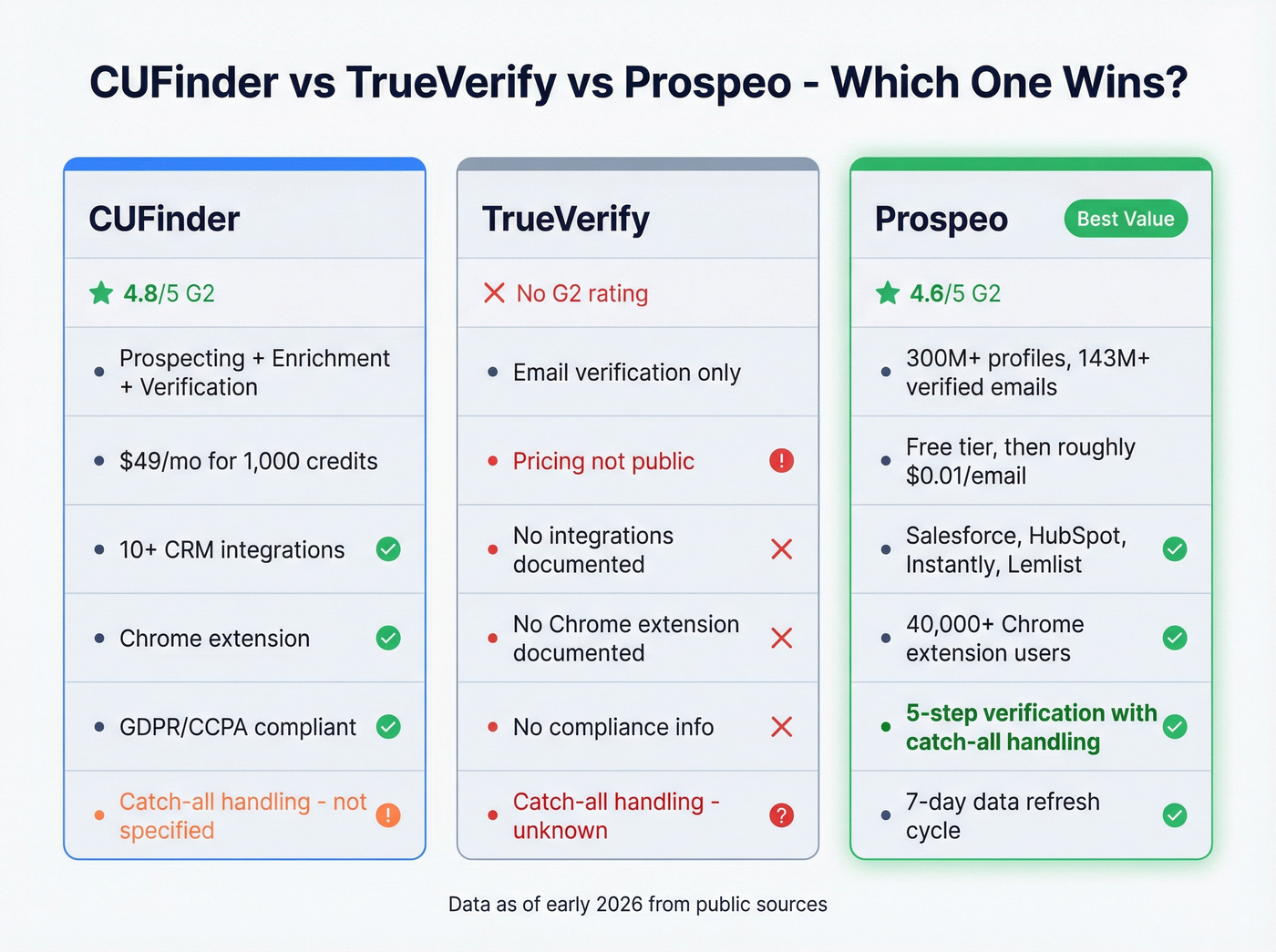
The numbers speak for themselves: 143M+ verified emails, 98% email accuracy, and a 7-day data refresh cycle versus the 6-week industry average. The Chrome extension has 40,000+ users, and native integrations with Salesforce, HubSpot, Instantly, and Lemlist mean you're not stitching tools together with Zapier workarounds. The free tier gives you 75 verified emails/month with no credit card required, and paid plans work out to roughly $0.01/email.
For teams spending $49+/month on CUFinder or gambling on TrueVerify's unverified claims, that's a hard combination to beat.
Catch-all handling is the real accuracy test - and most tools fail it. Prospeo's proprietary 5-step verification includes catch-all resolution, spam-trap removal, and honeypot filtering on a 7-day refresh cycle. That's why 15,000+ companies trust it over tools with unverifiable claims.
Verification you can actually trust at scale - test it free today.
CUFinder vs TrueVerify: FAQ
Does CUFinder include email verification?
Yes. CUFinder verifies emails as part of its prospecting workflow - not as a standalone verifier. You get verification bundled into a full sales intelligence platform with enrichment, a Chrome extension, and CRM integrations. It's a solid choice if you need prospecting and verification in one tool, though the $49/month entry point is steep for small teams just getting started.
Is TrueVerify free?
TrueVerify doesn't publish pricing publicly. Based on email verification category norms, expect entry-level plans somewhere around $15-30/month. For a genuinely free alternative, Prospeo offers 75 verified emails/month at no cost - with catch-all handling and spam-trap removal included.
What's the most accurate email verifier in 2026?
Independent benchmarks vary by methodology and list quality. Hunter's transparent test across 15 verifiers and 3,000 real business emails topped out at 70% overall accuracy, while vendor-run tests publish much higher numbers. Catch-all handling is where tools diverge most - it's usually the deciding factor between adequate verification and verification you can actually trust at scale.