

Curiosity in Sales: Stop Being Told to "Ask Better Questions" - Here's How
Your manager pulled you aside after a lost deal and said "you need to ask better questions." You nodded. But nobody told you what "better" means - no framework, no drill, no rubric. Just a vague directive and a pat on the back.
Curiosity in sales isn't a personality trait. It's a system, and this is the playbook.
Consider what happened to sales consultant Bob Marsh. Mid-call, the prospect was checked out - short answers, zero engagement. Instead of pushing features, Marsh asked one question: "What's the biggest misconception people have about the work your team does?" The prospect paused, then talked for twelve minutes straight. That single question flipped the entire deal. The difference wasn't charisma. It was structured curiosity.
What You Need (Quick Version)
Three things you can use on your next call:
- Use the SPIN framework to give your questioning structure. It's backed by 35,000+ sales calls - actual research, not a listicle.
- Aim for 8-12 discovery questions per call. Fewer and you're skimming. More and you're interrogating.
- Train weekly with constrained roleplays and call reviews - not once-a-year kickoff slides everyone forgets by Tuesday.
Why Curious Reps Are a Survival Skill
69% of buyers have already made their decision before they talk to a rep. Once they do engage, 57% expect positive ROI within three months. That's not a buying cycle - that's a sprint.
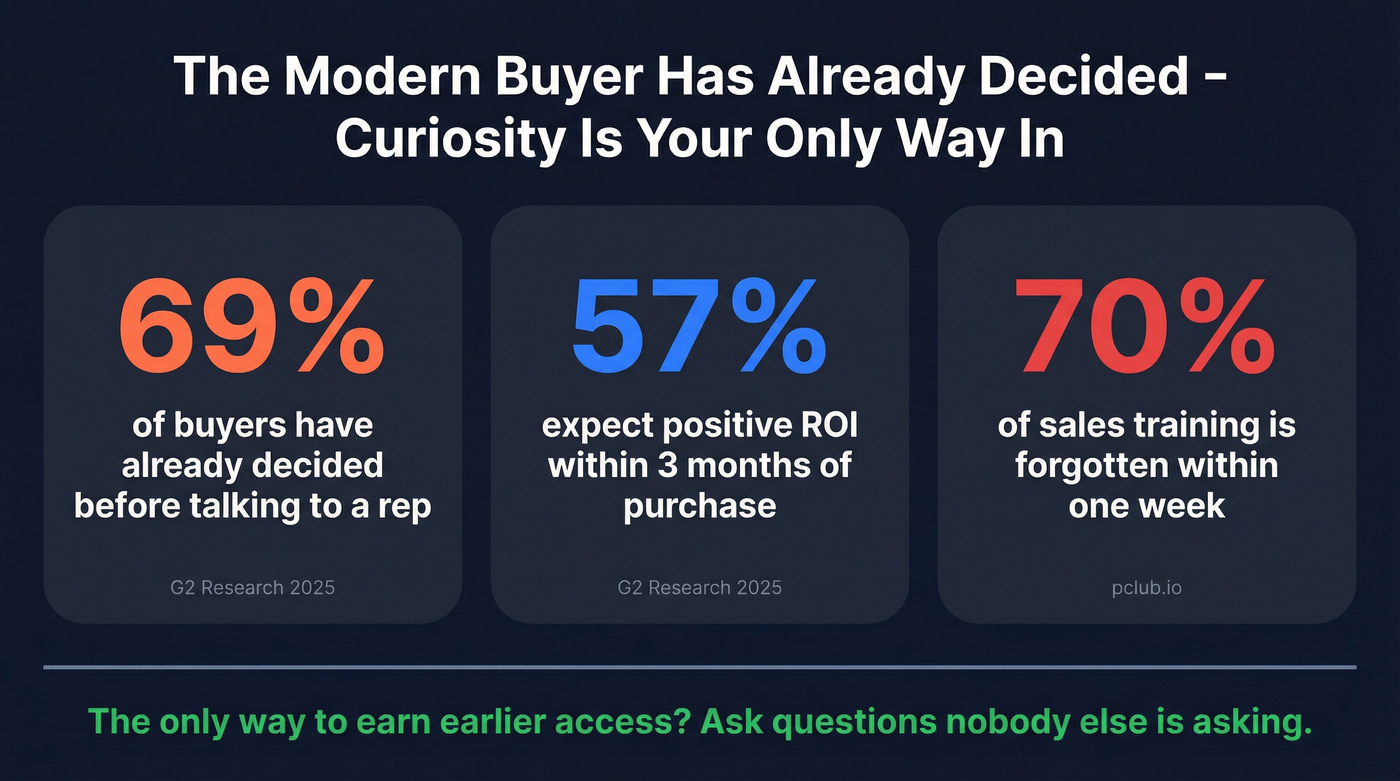
If the prospect has already done the research, already compared vendors, already built a mental shortlist, the only way to earn earlier access is to be the rep who asks questions nobody else is asking. Genuine interest is the lever that gets you into the conversation before the decision is made.
What Curiosity Actually Is (and Isn't)
Plenty of articles on this topic will tell you it "activates the amygdala" or "triggers dopamine pathways." That's sloppy neuroscience borrowed from pop-psychology blogs.
Here's what the research says. George Loewenstein's information-gap theory frames curiosity as an aversive feeling - a gap between what you know and what you want to know that creates a pull toward information-seeking. Kang et al. (2009) found that people are most curious when they're moderately confident about an answer - not too sure, not completely lost. That's the sweet spot for discovery calls: you know enough about the prospect's world to ask sharp questions, but you're genuinely uncertain about the specifics of their situation.
The biggest myth? That it's a fixed personality trait. Treating it as something you either have or you don't lets managers skip the hard work of coaching it. SPIN proves you can systematize questioning - and the data backs that up across tens of thousands of calls.
How to Practice It on Sales Calls
Give Your Questions Structure (SPIN)
Curiosity without structure is just nosiness. The SPIN framework - Situation, Problem, Implication, Need-Payoff - gives it a backbone. Neil Rackham's team analyzed 35,000+ sales calls and found that top performers ask roughly 4x more Implication questions than average reps.
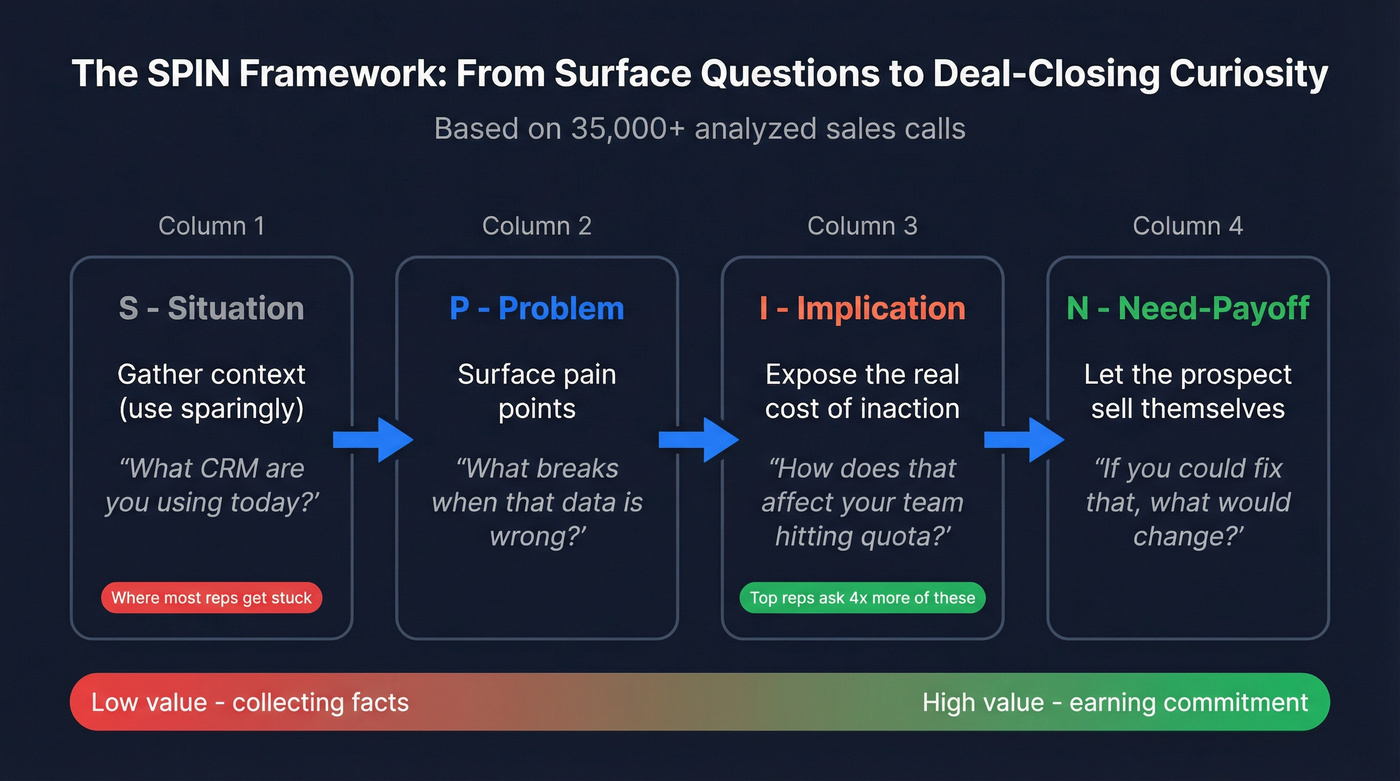
Most reps get stuck in Situation mode. "How many reps do you have? What CRM are you using?" Those questions feel productive but they're collecting facts the prospect expects you to already know.
The real value is in Implication questions: "What happens when that data is wrong?" "How does that affect your team's ability to hit quota?" That's where genuine inquiry earns trust. In our experience, reps who shift more of their questions from Situation to Implication see immediate improvement in deal progression - sometimes within a single week. SPIN replaces the hard close with earned commitment. You ask questions so good the prospect convinces themselves.
A Starter Question Bank
Highspot recommends 8-12 thoughtful questions per call. Not a checklist you read top to bottom - a flexible bank you pull from based on what the prospect actually says. Here's a starter set sourced from real reps on r/sales:
- "Why now?" - simple, devastating, reveals urgency or lack of it.
- "Walk me through how you're currently solving this."
- "Have you tried to fix this before? What happened?"
- "Who feels the pain most?"
- "If you didn't solve it, could you live with that?"
These map cleanly to SPIN's Problem, Implication, and Need-Payoff categories. Notice what's missing: qualification questions. "What's your budget?" and "Who's the decision-maker?" matter, but they aren't discovery. Discovery exposes impact, urgency, and the deeper why.
When you hear hesitation or vagueness, test with a soft hypothesis: "It sounds like this might be causing more friction than the team is letting on - is that fair?" That's how you surface hidden pains without interrogating.

Curiosity gets you the insight. But you still need to reach the right person. Prospeo gives you 98% accurate emails and 125M+ verified mobile numbers so your best discovery questions land with actual decision-makers - not dead inboxes.
Stop wasting sharp questions on bad contact data.
When Asking Questions Backfires
Curiosity isn't automatically good. Done wrong, it's worse than a standard pitch. We've reviewed a lot of discovery calls, and these failure modes from Sales Gravy show up constantly.
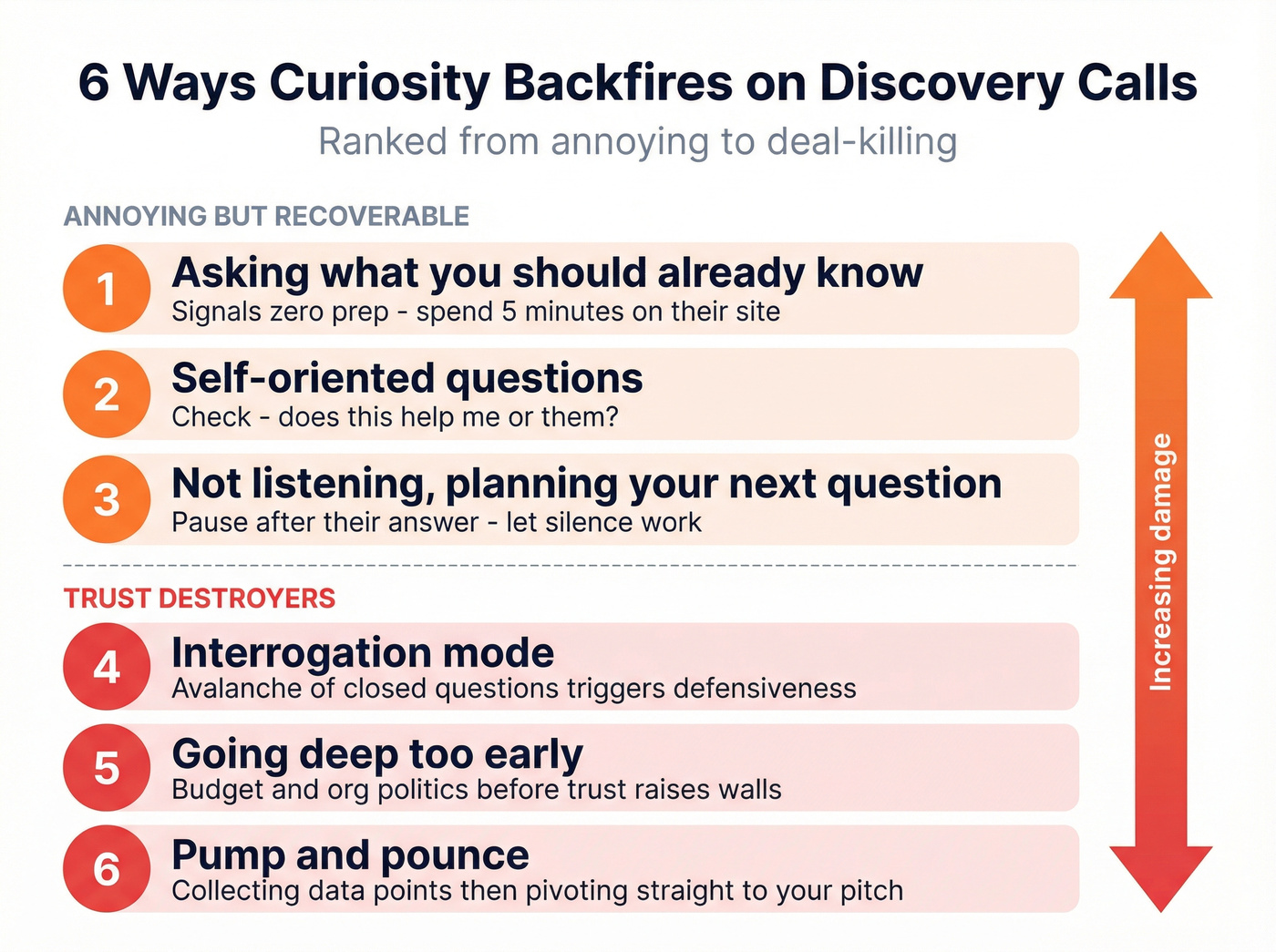
Asking what you should already know. "So, what does your company do?" signals zero prep. Spend 5 minutes on their website before the call.
Self-oriented questions. Before asking, check - does this help me or them?
Not listening because you're planning your next question. Pause after their answer. Let silence do the work.
Here's the thing: the next three are far more damaging, because they feel like good selling while actively destroying trust.
Interrogation mode. An avalanche of closed questions triggers defensiveness. Ask one open question, then follow the thread.
Going deep too early. Asking about budget or org politics before you've earned trust raises walls. Show you understand their world first.
Pump and pounce. Collecting a few data points then immediately pivoting to your pitch. Stay in discovery mode for two-thirds of the call. If you catch yourself reaching for a feature slide before the 20-minute mark, stop. You aren't done listening.
How Managers Build Curious Teams
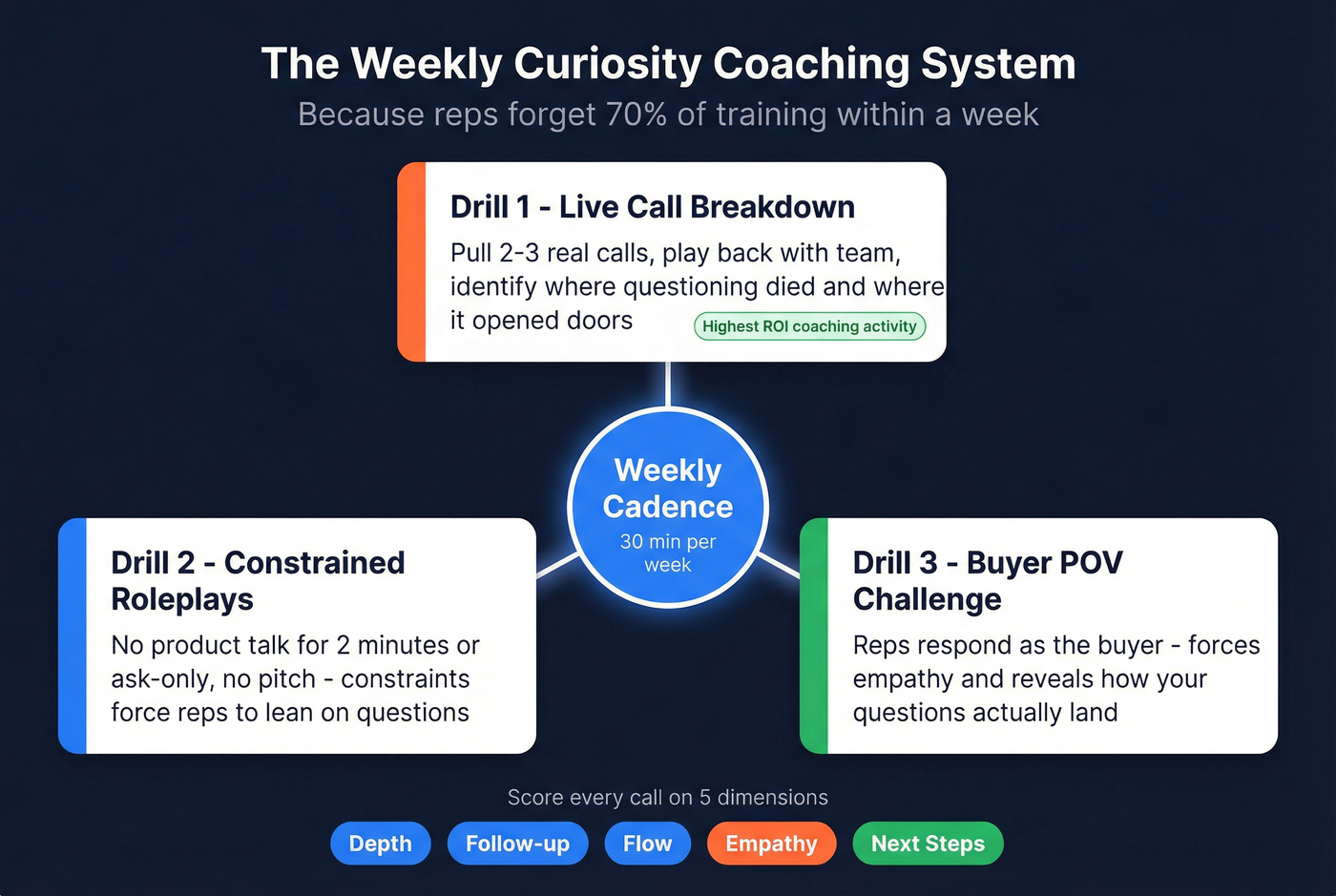
Every sales kickoff has a slide about "being more curious." Nobody follows it with a drill, a rubric, or a weekly cadence. That's why nothing changes - B2B reps forget 70% of training within a week, and after three months, only 16% sticks.
Let's be honest: if your coaching plan is a quarterly workshop and a Slack reminder, you don't have a coaching plan.
Three drills that actually build the muscle:
Live call breakdown (film-room style). Pull 2-3 real calls, play them back with the team, identify where questioning died and where it opened doors. This is the single highest-ROI coaching activity we've seen - nothing else comes close.
Micro-roleplays with constraints. "No product talk for 2 minutes" or "ask-only, no pitch." Constraints force reps to lean on questions instead of features.
Buyer POV challenge. Reps respond as the buyer. Forces empathy and reveals how your questions actually land.
Use this scoring rubric to make feedback concrete:
| Dimension | What to Score | Red Flag |
|---|---|---|
| Depth | Rep goes 2-3 layers deep | Stays surface-level |
| Follow-up | Asks "why" unprompted | Only pre-written Qs |
| Flow | Problem -> Impact -> Gap | Jumps randomly |
| Empathy | Acknowledges emotion first | Ignores cues |
| Next steps | Ties findings to action | Vague "I'll send info" |
Hiring for Intellectual Curiosity
GPAs don't predict sales performance. Laszlo Bock, Google's former SVP of People Operations, confirmed it - what predicts performance is rigor, which Koru defines as being analytical and knowing what questions to ask of data and tools.
The golden rule from Adecco's hiring framework: curious candidates ask follow-up questions throughout the interview, not just pre-planned ones at the end. Two questions that reliably separate inquisitive reps from scripted ones:
- "How do you handle different perspectives?" Tests intellectual flexibility.
- "What's your approach when facing a challenging obstacle?" Tests how they think under pressure.
Skip candidates who only ask about comp and territory. That's not disqualifying on its own, but if they show zero curiosity about your product, your customers, or the problems you solve during the interview itself, they won't suddenly develop it on discovery calls.
Great Questions Need Accurate Data
You can master every framework on this page and still fail if your outreach never reaches the right person. The best discovery question in the world doesn't matter if it bounces off an invalid email or hits a gatekeeper's voicemail.
Prospeo's 98% email accuracy and 7-day data refresh cycle mean your prep actually connects to a real inbox. The free tier gives you 75 verified emails a month with no contract - enough to test whether better data changes your connect rate before you commit a dollar.
To tighten your discovery process end-to-end, use a discovery framework and keep a discovery call script you can review before every meeting.
You just built a discovery framework that earns trust. Now make sure you're using it on prospects who are actually in-market. Prospeo tracks 15,000 intent topics so you can target buyers already researching your category - and show up with the right questions at the right time.
Pair genuine curiosity with buyer intent signals that tell you who's ready to talk.
FAQ
Is curiosity in sales a skill you can learn?
Yes - it's a trainable skill, not an innate gift. The SPIN framework systematizes it into four question types you can drill weekly. Framing it as talent lets managers off the hook for coaching. Anyone improves with structure and repetition.
How many questions should I ask on a discovery call?
Aim for 8-12 thoughtful questions per call. Fewer means you're skimming the surface; more risks turning the conversation into an interrogation. Quality and follow-up depth matter more than raw count - one great thread beats five shallow questions.
What's the difference between curiosity and interrogation?
Curiosity sounds like a conversation - you listen, react, and follow threads. Interrogation sounds like a checklist - rapid-fire questions with no acknowledgment of answers. The test: are you asking the next question because of what they just said, or despite it?
What tools help reps prepare for better discovery calls?
Research the prospect's company, role, and recent activity before the call. Use a B2B data platform to verify you're reaching the right decision-maker - bad contact data wastes the prep work you just did. A 7-day refresh cycle and verified emails mean your outreach actually lands.