

Customer Intelligence Platforms: What They Are, What They Cost, and Which Type You Actually Need
Ask five people what a customer intelligence platform does and you'll get six answers. A product manager thinks Amplitude. A CX director thinks Qualtrics. A sales leader thinks Outreach. A support VP points at Zendesk and says "we already have one." Meanwhile, 91% of service leaders are under executive pressure to implement AI across customer operations this year, and 70% of organizations are actively investing in tools that capture and analyze customer intent signals. Everyone's buying. Nobody agrees on what they're buying.
Quick Recommendations
B2B revenue team? Start with Outreach or a stack of Amplitude + Gong + a data enrichment layer. Enterprise CX or VoC team? Qualtrics XM or Sprinklr. DTC team drowning in unstructured feedback across tickets, reviews, and returns? Dovetail or Unwrap.
But most people looking into customer intelligence software are confused about what the category even means. That's where we start.
What Is a Customer Intelligence Platform?
A customer intelligence platform collects behavioral, transactional, and conversational data about your customers, unifies it across silos, and uses AI/ML to surface patterns that help you act - not just report. The "360-degree customer view" is the pitch. The reality is more nuanced.
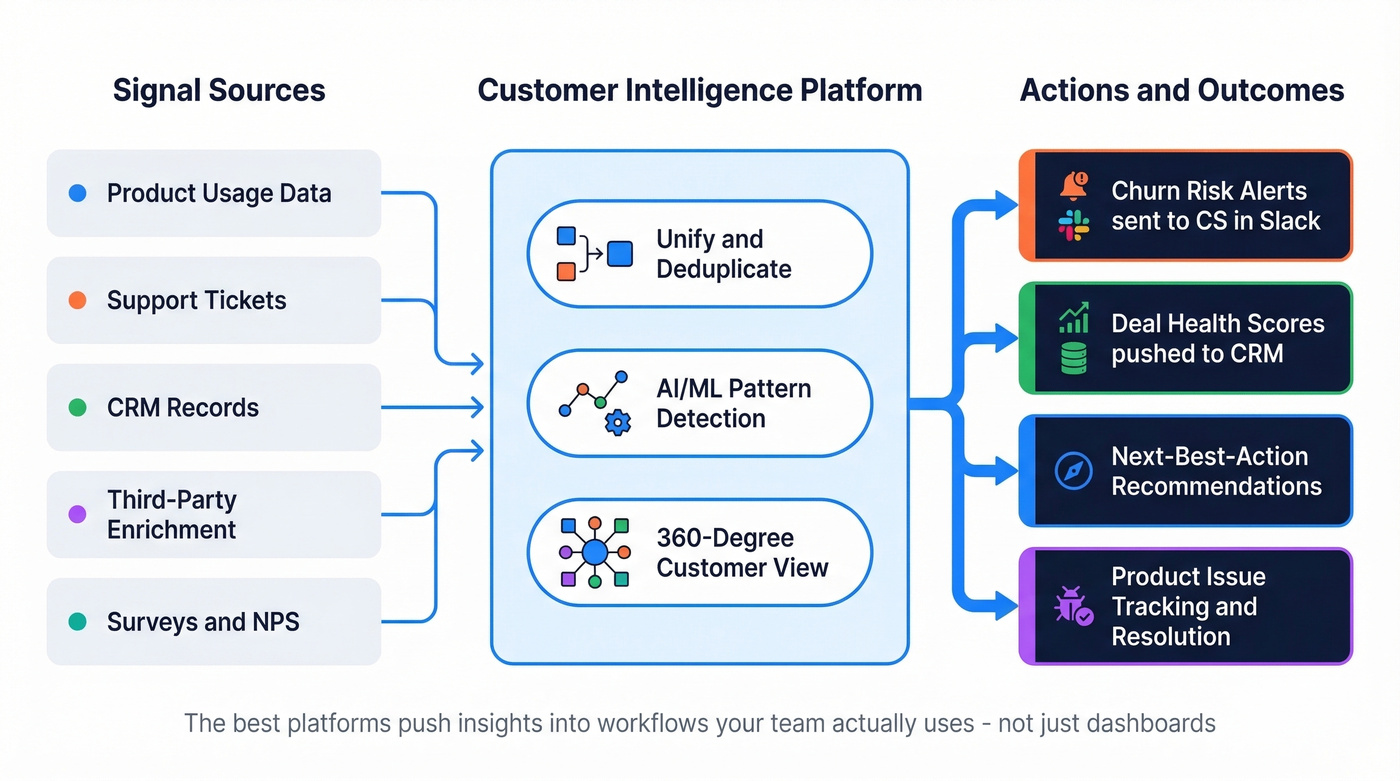
Most platforms in this category pull signals from product usage, support tickets, CRM records, and third-party sources into one place. Many score things like churn risk, deal health, and next-best actions. The best push those insights into workflows your team actually uses - tracking whether a product issue declines after you ship a fix, not just showing you a dashboard about it.
Here's the thing: the category confusion is partly by design. Vendors redefine "customer intelligence" to match whatever they sell. Zendesk calls its support analytics a CIP. Outreach calls its revenue execution engine a CIP. Amplitude calls its behavioral analytics a CIP. They're all partially right and completely self-serving. The market's growing fast, so everyone wants a piece of the label. As one practitioner on r/SaaS put it, "everyone seems to mean something slightly different."
That pressure is reshaping teams, too. Gartner found that 58% of organizations plan to upskill service agents into knowledge management specialists - a sign that customer intelligence isn't just a software category but a workforce shift.
CIP vs CDP vs CRM
These three acronyms get thrown around interchangeably. They shouldn't be.
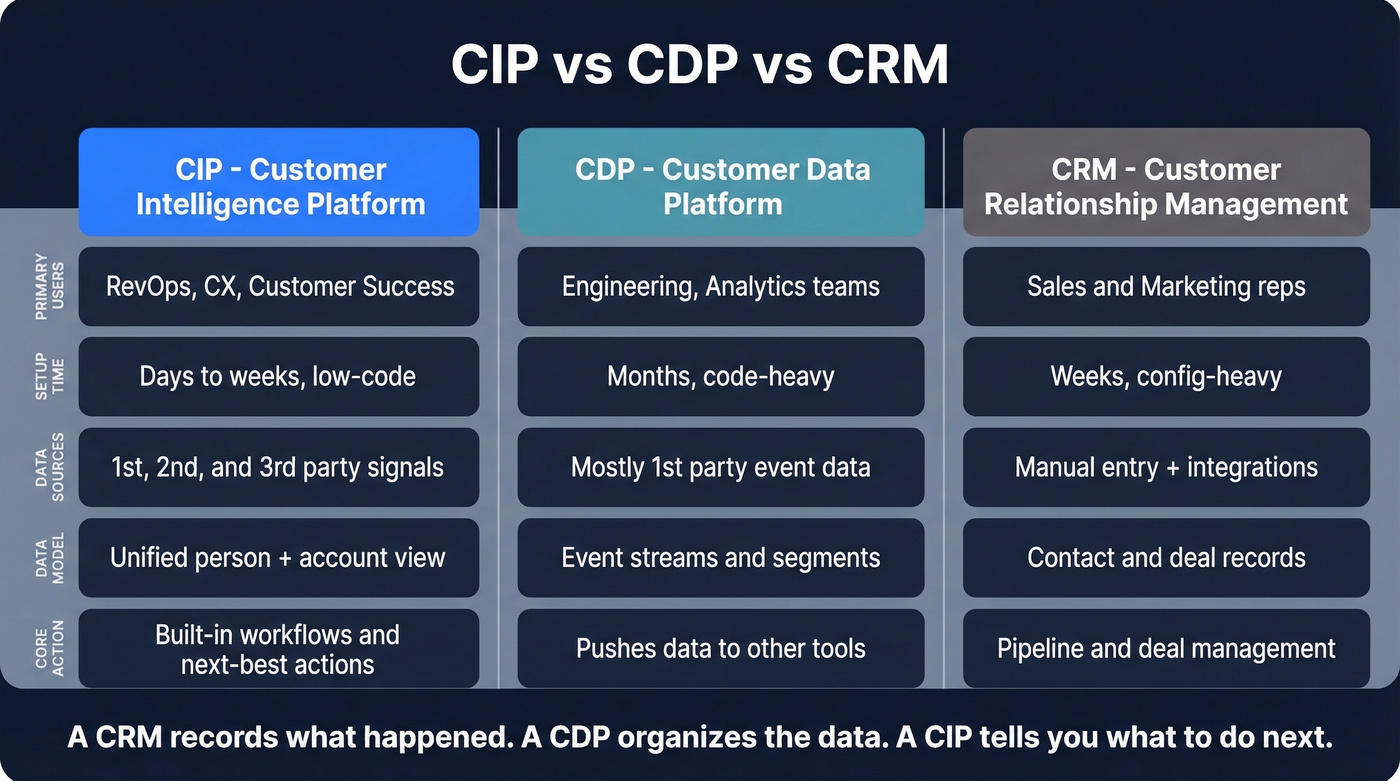
| Dimension | CIP | CDP | CRM |
|---|---|---|---|
| Primary users | RevOps, CX, CS | Engineering, analytics | Sales, marketing |
| Implementation | Low-code, days-weeks | Code-heavy, months | Config-heavy, weeks |
| Signal sources | 1st, 2nd, 3rd party | Mostly 1st party | Manual + integrations |
| Data model | Unified person + account | Event streams | Contact/deal records |
| Action layer | Built-in workflows | Pushes to other tools | Pipeline management |
A CDP, as David Raab of the CDP Institute defines it, is a marketing system that unifies customer data to enable modeling and optimizing the timing and targeting of communications. Think of it as a fancy data bus - it collects and federates first-party data, then pushes standardized records to downstream tools.
A CIP goes further. Using Common Room's framework, a CIP helps GTM teams unify buying signals, understand the person and account behind those signals, and take action with context - all in one place. It spans first-, second-, and third-party data, offers waterfall enrichment out of the box, and includes signal-to-play workflows like "add to outbound sequence" or "alert CSM in Slack."
A CRM records what happened. A CDP organizes the data. A CIP tells you what to do next.
Five Types of CIPs
The category breaks into five distinct buckets. Most teams end up combining two or three.
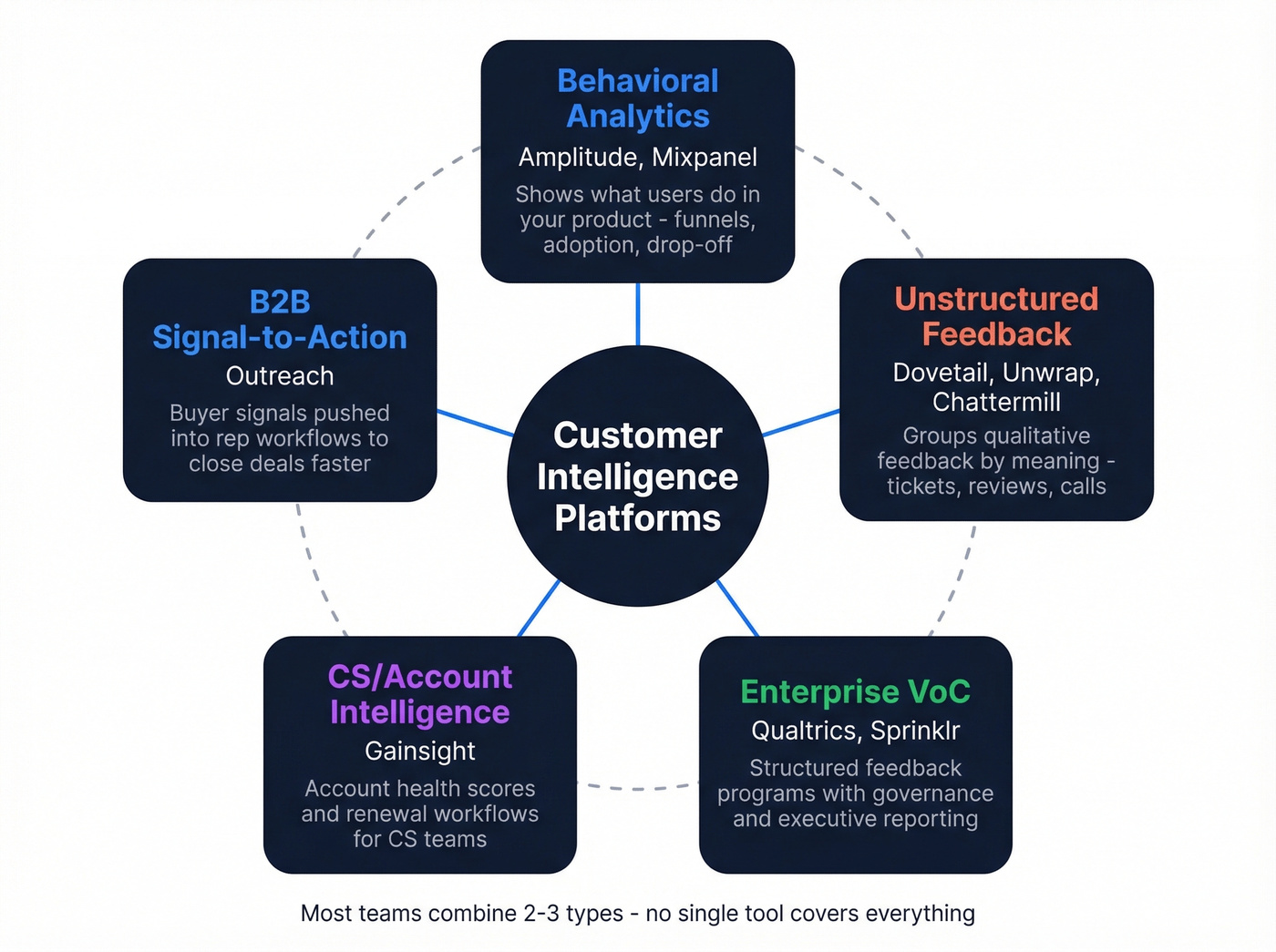
Behavioral analytics - Amplitude, Mixpanel. Shows what users do inside your product: funnels, adoption curves, drop-off points. Answers "what" but not "why."
Unstructured feedback intelligence is a different animal entirely. Tools like Dovetail, Unwrap, Chattermill, and SentiSum group qualitative feedback by meaning - not keywords - across tickets, reviews, surveys, call transcripts, and NPS responses. The DTC teams on r/CRM struggling to track themes across channels? This is what they need. Done well, this category captures voice of customer intelligence - the raw, unfiltered signal that tells you what people actually think, not what your survey questions assume they think.
Enterprise VoC - Qualtrics, Sprinklr. Structured feedback programs with governance, survey design, and executive reporting. Powerful but deliberate. They won't tell you what customers are angry about this morning.
CS/account intelligence platforms like Gainsight aggregate signals into account health scores and renewal workflows. They're purpose-built for customer success teams managing hundreds of accounts, and they're overkill for teams with 50.
B2B signal-to-action - Outreach. Processes buyer signals across the pipeline and pushes them into rep workflows. Less about understanding customers broadly, more about closing deals faster.
The stack approach is what practitioners actually do. Pretending one tool covers everything is vendor thinking.

A customer intelligence platform is only useful if it reaches the right people. Prospeo feeds your CIP with 300M+ verified profiles, 143M+ emails at 98% accuracy, and 125M+ mobile numbers - refreshed every 7 days, not every 6 weeks like most providers.
Turn customer intelligence into customer conversations. Start at $0.01 per email.
Best CIPs in 2026
B2B Signal-to-Action
Outreach
Outreach processes 33 billion interaction signals weekly with 90+ native integrations across Salesforce, HubSpot, Snowflake, and Databricks. For B2B revenue teams, it's the closest thing to a unified intelligence layer - buyer sentiment analysis, deal health scoring, and engagement measurement all feed directly into rep workflows. We've seen teams cut their deal review prep time in half just by having Outreach surface the right signals before pipeline meetings.
Where it falls short is anything outside the revenue org. Need product analytics or VoC? You're pairing it with something else. Typical mid-market pricing lands around $100-150/user/month.
Enterprise VoC
Qualtrics XM
Use this if you're running structured experience programs at scale - employee experience, customer satisfaction, brand tracking - and need governance, compliance, and executive-ready reporting. Skip this if you need real-time unstructured feedback analysis or you're a team under 50. Typical contracts run $30-75K/year depending on modules and seats.
Behavioral Analytics
Amplitude
Free up to 50,000 monthly tracked users - the obvious starting point for product-led teams that want behavioral intelligence without a budget fight. Paid plans start at $49/month, with Growth and Enterprise tiers on custom pricing. The platform excels at showing exactly where users drop off, which features drive retention, and how cohorts behave over time. Pair it with Dovetail to answer the "why" behind the "what."
Support Analytics
Zendesk
Let's be honest: Zendesk is a support tool with analytics features, not a customer intelligence platform in the way an enterprise buyer means it. Calling it a CIP is like calling Excel a BI platform - technically true, practically misleading. That said, its analytics layer has improved. Plans start at $55/agent/month, scaling to $115/agent/month for Professional. Already on Zendesk? The built-in analytics might be enough. Need cross-channel intelligence? Look elsewhere.
Unstructured Feedback
Dovetail
Plans typically start around $29/user/month, with a free tier. Dovetail groups feedback by meaning rather than keywords - a genuine differentiator when you're sifting through thousands of unstructured inputs. SOC 2, GDPR, and ISO 27001 aligned, and it supports secure data transfer including modern protocols such as TLS 1.3. That matters because compliance gaps cause delayed adoption and extended security reviews in enterprise procurement.
CS/Account Intelligence
Gainsight
Typical pricing runs $2,500-10,000/month depending on accounts and modules. Worth every dollar if CS is a revenue function at your company. Gainsight aggregates product usage, support tickets, and NPS into account health scores, then triggers workflows when accounts go red. Not a general-purpose CIP - a CS ops platform. For teams managing fewer than 100 accounts, it's more firepower than you need.
Audience Intelligence Tools
Audiense - One of the more specialized audience intelligence tools on the market, Audiense segments social audiences by psychographics, interests, and affinities rather than just demographics. Typical pricing lands around £6,672/year. Best for brand and marketing teams that need to understand who their customers are, not just what they do.
Sprinklr - Enterprise omnichannel VoC with social listening and real-time monitoring. Sprinklr Advanced starts at $299/seat/month. Built for large CX teams across 30+ digital channels.
Brandwatch - Consumer and social intelligence for brand teams. Typical contracts land around $1,000-5,000/month. Strong for competitive monitoring, less useful for B2B account intelligence.
Intercom - Conversational support tool that surfaces onboarding friction through chat data. $39/seat/month. Useful for in-app signals, but calling it a CIP stretches the definition.
Meltwater - Media and social intelligence with PR analytics. Typical annual pricing runs $15,000-45,000/year. Overlaps with Brandwatch but adds earned media tracking.
What a CIP Actually Costs
Most tools in this space hide their pricing behind "contact us" forms. We tracked down real numbers where we could and estimated the rest from public sources and community reports.
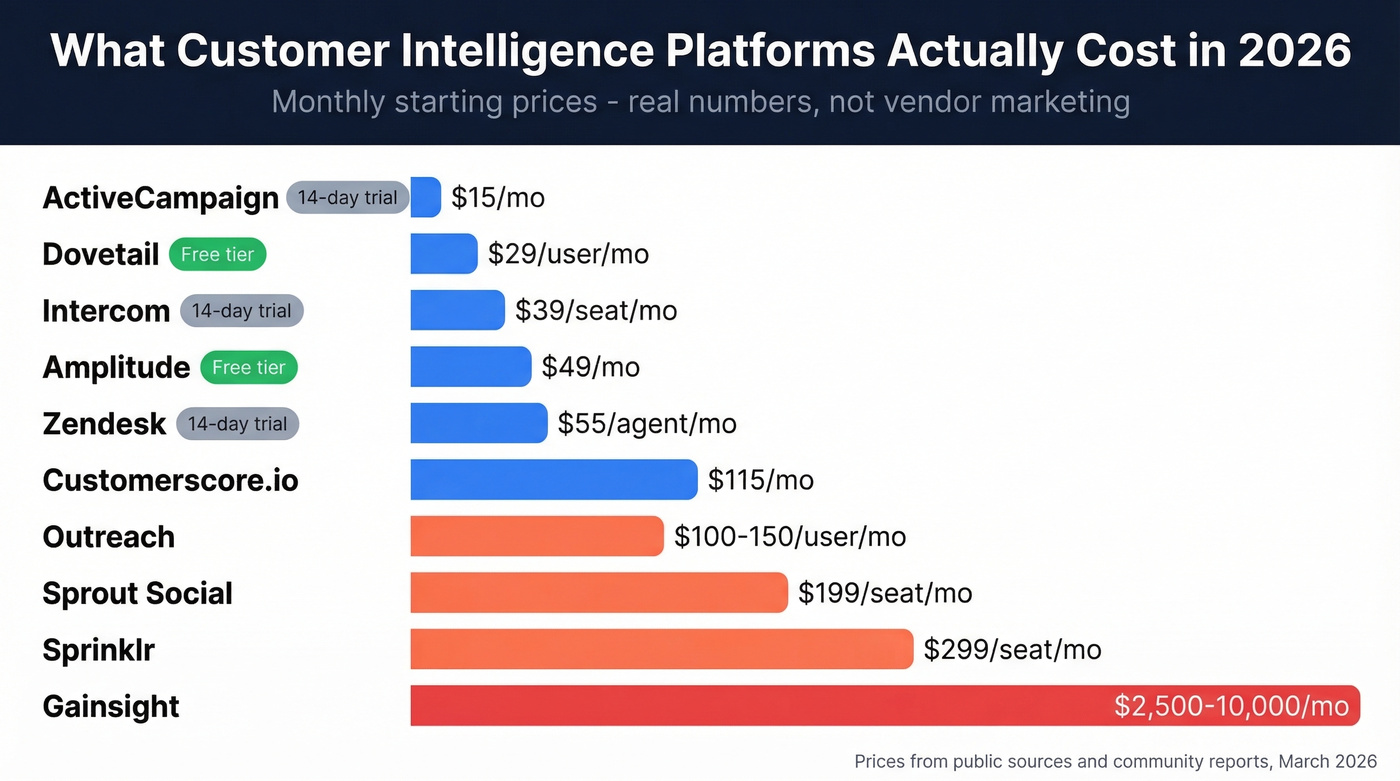
| Tool | Starting Price | Free Tier/Trial | Best For |
|---|---|---|---|
| ActiveCampaign | $15/mo | 14-day trial | Marketing automation + CI |
| Amplitude | Free / $49/mo+ | Free to 50K users | Product analytics |
| Dovetail | ~$29/user/mo | Free tier | Qualitative research |
| Intercom | $39/seat/mo | 14-day trial | In-app support |
| Zendesk | $55/agent/mo | 14-day trial | Support analytics |
| Customerscore.io | $115/mo | Demo | Churn prediction |
| Sprout Social | $199/seat/mo | 30-day trial | Social intelligence |
| Sprinklr | $299/seat/mo | 30-day trial | Omnichannel VoC |
| Gainsight | ~$2,500-10,000/mo | Demo only | CS/account health |
| Outreach | ~$100-150/user/mo | Demo only | B2B revenue signals |
| Brandwatch | ~$1,000-5,000/mo | Demo only | Social/brand intelligence |
| Meltwater | ~$15,000-45,000/yr | Demo only | Media monitoring |
| Audiense | ~£6,672/year | Free trial | Audience intelligence |
| Qualtrics XM | ~$30-75K/year | Demo only | Enterprise VoC |
| SAS CI 360 | ~$50-100K/year | Demo only | Enterprise analytics |
The range is enormous - from free to six figures annually. That's because "customer intelligence platform" isn't one category. It's five categories wearing a trench coat.
If your average deal size is under $15K, you don't need a six-figure enterprise CIP. Amplitude's free tier plus a ~$29/month Dovetail plan will get you 80% of the insight at 2% of the cost. The enterprise platforms exist for enterprise problems - don't buy one because a vendor demo impressed your VP.
Mistakes That Kill Implementations
Bad data foundation. Small errors in customer data replicate into larger downstream errors - what researchers call data cascades. Your CIP's AI models are only as good as the records feeding them. Garbage in, confidently wrong insights out.
Buying before defining the problem. Go back to the five-type taxonomy. Are you solving a behavioral analytics problem? A qualitative feedback problem? A CS ops problem? Buying a $50K enterprise VoC platform when you need a $49/month product analytics tool is a mistake we've seen more than once.
Ignoring unstructured data. Nvidia estimates that 90% of enterprise customer data is unstructured - call transcripts, chat logs, open-ended survey responses. If your CIP only analyzes structured fields, you're missing most of the signal. The best voice of customer intelligence programs treat unstructured data as the primary source, not an afterthought.
Creepy personalization. 81% of Americans believe their data will be used with AI in ways that make them uncomfortable. The line between "helpful" and "invasive" is thinner than your marketing team thinks.

Skipping upstream data hygiene. Every intelligence tool is only as good as the data feeding it. If 30% of your email addresses bounce, every insight you build on top is sand. B2B enrichment tools that refresh contact data on a weekly cycle - rather than the 6-week industry average - make the difference between a CIP that delivers and one that hallucinates about customers who left six months ago.
How to Choose the Right CIP
Audit your data quality first. Before you spend a dollar on intelligence tooling, find out how much of your existing data is stale. Run your contact list through an enrichment tool and see how much of your foundation needs repair. McKinsey estimates GenAI can boost sales productivity 3-5% and marketing productivity 5-15%, but only if the underlying data is clean.
Match your team to the taxonomy. Revenue team? Outreach. Product team? Amplitude. CX team? Qualtrics or Sprinklr. Research team? Dovetail. Brand or audience team? Consider audience intelligence tools like Audiense or Brandwatch. Don't buy a platform that serves a team you don't have.
Start with one category, expand later. Most practitioners combine two or three tools, but deploying all of them simultaneously is how implementations stall. Pick the highest-pain category, prove value, then layer on. GDPR, SOC 2, and ISO 27001 are table stakes for enterprise procurement - verify before you sign.
In our experience, the teams that get the most from a CIP aren't the ones with the biggest budget. They're the ones that spent a week cleaning their data before they ever opened the new tool.
Building a signal-to-action stack? The enrichment layer is where most teams break. Prospeo's API returns 50+ data points per contact at a 92% match rate - plug it into Salesforce, HubSpot, Clay, or any workflow tool your CIP depends on.
Stop feeding stale data into your intelligence stack. Prospeo refreshes every 7 days.
FAQ
What's the difference between customer intelligence and business intelligence?
Customer intelligence focuses on individual behavior and signals to predict future actions - like why a specific account might churn. BI covers broader operational and financial metrics, such as quarterly revenue trends. CI is predictive and person-level; BI is retrospective and aggregate.
Do I need a CIP if I already have a CRM?
A CRM records past interactions; a customer intelligence platform analyzes signals to predict future behavior and recommend actions. Think of your CRM as a filing cabinet and a CIP as an analyst who reads every file and tells you what to do next. Most teams need both.
How long does a CIP take to show ROI?
Dashboards surface within weeks. Measurable impact - churn reduction, conversion lift, faster deal cycles - typically takes 3-9 months depending on data readiness. Teams with clean, enriched data on day one see results on the shorter end.
Can small teams afford customer intelligence software?
Absolutely. Amplitude is free up to 50,000 tracked users. Dovetail has a free tier. Prospeo offers 75 free email credits per month for upstream data hygiene. You don't need a six-figure budget - you need clarity on which type of intelligence you're missing.