

How to Increase Sales Productivity: 10 Strategies That Actually Move the Needle
Your team sent 5,000 emails last quarter. 600 bounced. A chunk of the rest landed in spam because those bounces torched your domain reputation. The reps who didn't bounce spent half their week updating CRM fields instead of talking to buyers.
The problem isn't effort - it's infrastructure. If you want to increase sales productivity, you need to fix the foundation first.
Here's the short version:
- Audit where your reps' time actually goes. Most teams overestimate selling time by 22 percentage points.
- Fix your data before you fix your process. 22.5% of contact data decays every year, and bad data costs the average org $15M annually.
- Cut your tool stack aggressively and invest in the 3-4 tools that actually integrate with each other.
The 2026 Productivity Crisis
This isn't a motivation problem. It's a structural one.
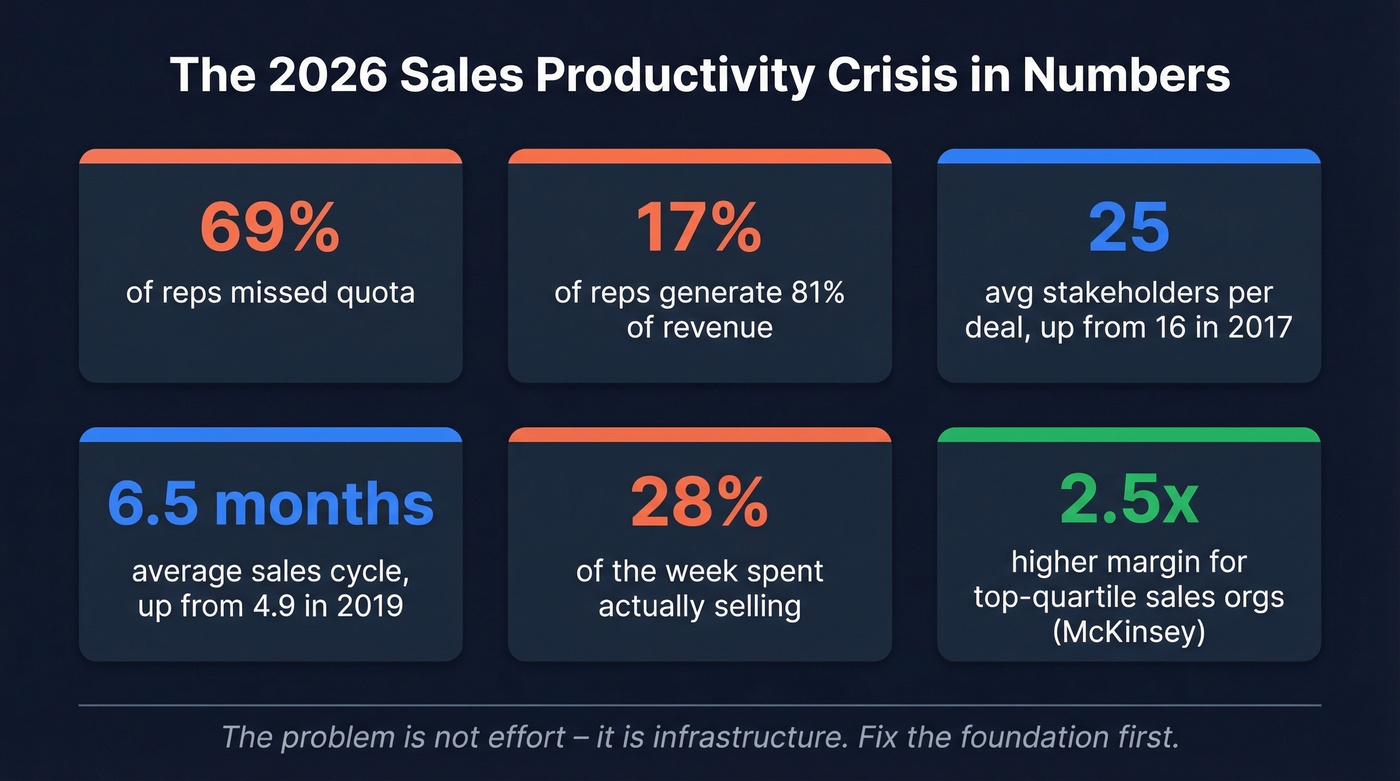
69% of reps missed quota in recent benchmarks, and the distribution is brutal: 17% of reps generate 81% of revenue. That's not a bell curve - it's a cliff. Rep turnover sits between 22% and 36%, which means you're constantly retraining people into a system that wasn't working for the people who left.
The selling environment has gotten harder across every major dimension. Buying committees now average 25 stakeholders, up from 16 in 2017. Average sales cycles have stretched to 6.5 months from 4.9 in 2019. Reps navigate more complexity with more tools - an average of 10 per team - and 66% say they feel overwhelmed by the fragmentation.
Telling reps to "work harder" in this environment is like telling someone to run faster in quicksand. The gains come from removing the quicksand - fixing the data, cutting the tool bloat, and redesigning processes so reps can actually sell.
A survey of 7,700+ sales professionals found reps spend just 28% of their week selling. The other 72% goes to admin, data entry, internal meetings, and prospecting research that should've been automated years ago. McKinsey's research adds another lens: top-quartile sales organizations generate roughly 2.5x higher gross margin per dollar invested in sales than bottom-quartile ones. The gap isn't talent. It's operating efficiency.
Where Rep Time Actually Goes
You think you're selling more than you are. Everyone does.
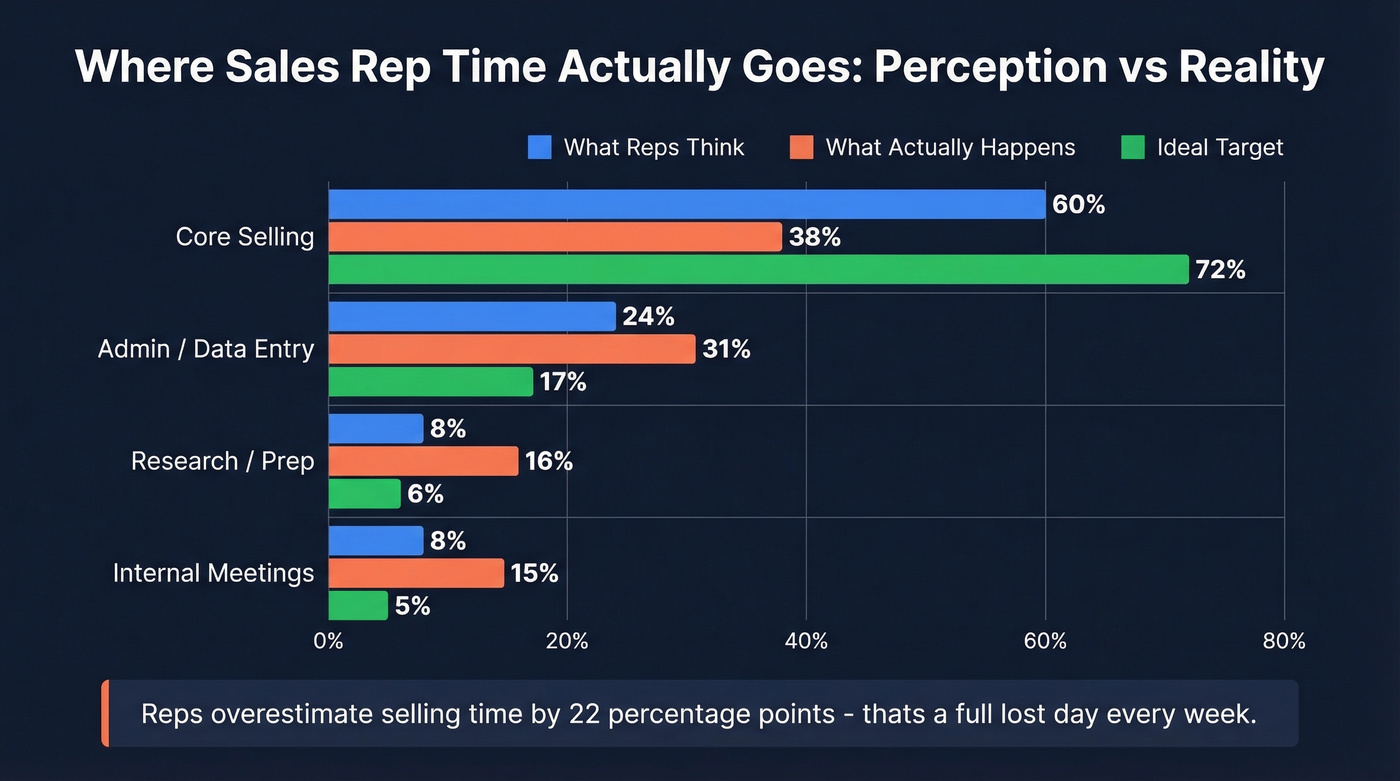
A Proudfoot Consulting study across 800 reps in 19 countries measured what reps actually do versus what they think they do. The gap is staggering:
| Activity | What Reps Think | What Actually Happens | Ideal Target |
|---|---|---|---|
| Core selling | 60% | 38% | 72% |
| Admin / data entry | 24% | 31% | 17% |
| Research / prep | 8% | 16% | 6% |
| Internal meetings | 8% | 15% | 5% |
Reps overestimate their selling time by 22 percentage points. That's not a rounding error - it's a full day per week that reps believe they're selling but aren't. Whether you measure it at 28% or 38%, the conclusion is the same: your reps spend less than two days a week on the activity that generates revenue.
Admin and data entry are the biggest culprits, but internal meetings are the silent killer. They don't feel like waste because they feel like work. Every 30-minute pipeline review that could've been an async Loom is 30 minutes a rep isn't prospecting.
The fix starts with measurement. If you don't track where time goes, you'll overestimate selling time - just like the 800 reps in that study did.

Your reps spend 72% of their week not selling - and bad data makes it worse. Every bounced email triggers CRM cleanup, domain repair, and wasted follow-ups. Prospeo's 98% email accuracy and 7-day data refresh cycle eliminate the cascade before it starts. Snyk's 50 AEs cut their bounce rate from 35% to under 5% and added 200+ opportunities per month.
Stop losing selling time to data that should have been verified yesterday.
10 Strategies to Improve Sales Productivity
These are ordered by impact, not alphabetically. Start at the top and work down. The first three will move the needle more than the last seven combined.
1. Audit and Eliminate Non-Selling Activities
Before you automate anything, figure out what shouldn't exist at all.
Bain's research makes the critical distinction here: automating existing processes yields only micro-gains. If your reps spend 45 minutes per day on manual CRM updates, automating that saves 45 minutes. But if you redesign the process so the CRM auto-populates from email and call data, you eliminate the task entirely. Redesign first, then automate what's left.
Catalog every recurring task your reps do weekly - CRM updates, report generation, internal syncs, data entry, quote approvals, pipeline reviews - then sort them into three buckets: eliminate, automate, or delegate. We've found that most teams can kill 20-30% of recurring tasks outright, no automation needed.
2. Fix Your Data Before Your Process
This is the strategy most productivity guides skip entirely, and it's the one with the highest ROI.
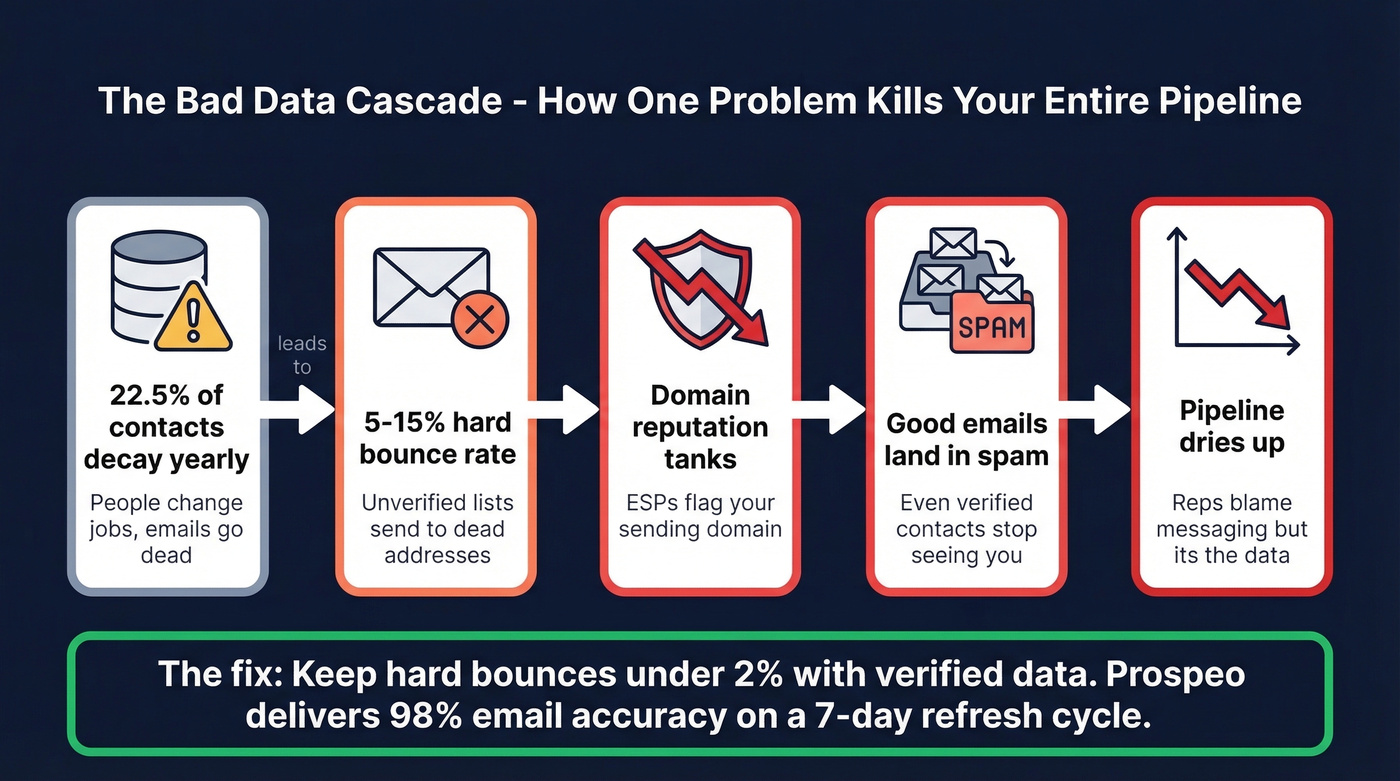
22.5% of your contact database decays every year. People change jobs, companies get acquired, emails go dead. Gartner estimates bad data costs organizations $15M per year on average. But the real damage isn't the cost - it's the cascade effect. When your outbound list has a 5-15% hard bounce rate, those bounces damage your domain reputation. Once your domain reputation drops, even your good emails start landing in spam. Your reps think their messaging is the problem. It's not. It's the data.
Prospeo addresses this at the source: 98% email accuracy across 143M+ verified addresses on a 7-day data refresh cycle. Snyk's 50-person AE team ran this playbook - their bounce rate dropped from 35-40% to under 5%, AE-sourced pipeline jumped 180%, and they generated 200+ new opportunities per month.
The math is simple. Keep hard bounces under 2%. Unverified lists bounce 5-15%. That gap is the difference between a healthy domain and one that's slowly dying. (If you want the benchmarks and fixes, start with bounce rate and email deliverability.)
3. Consolidate Your Tech Stack
The average sales team uses 10 tools. 94% of sales ops teams plan to simplify their stack. A Forrester TEI study found that consolidation alone saved one composite enterprise $1.3M in tech costs.
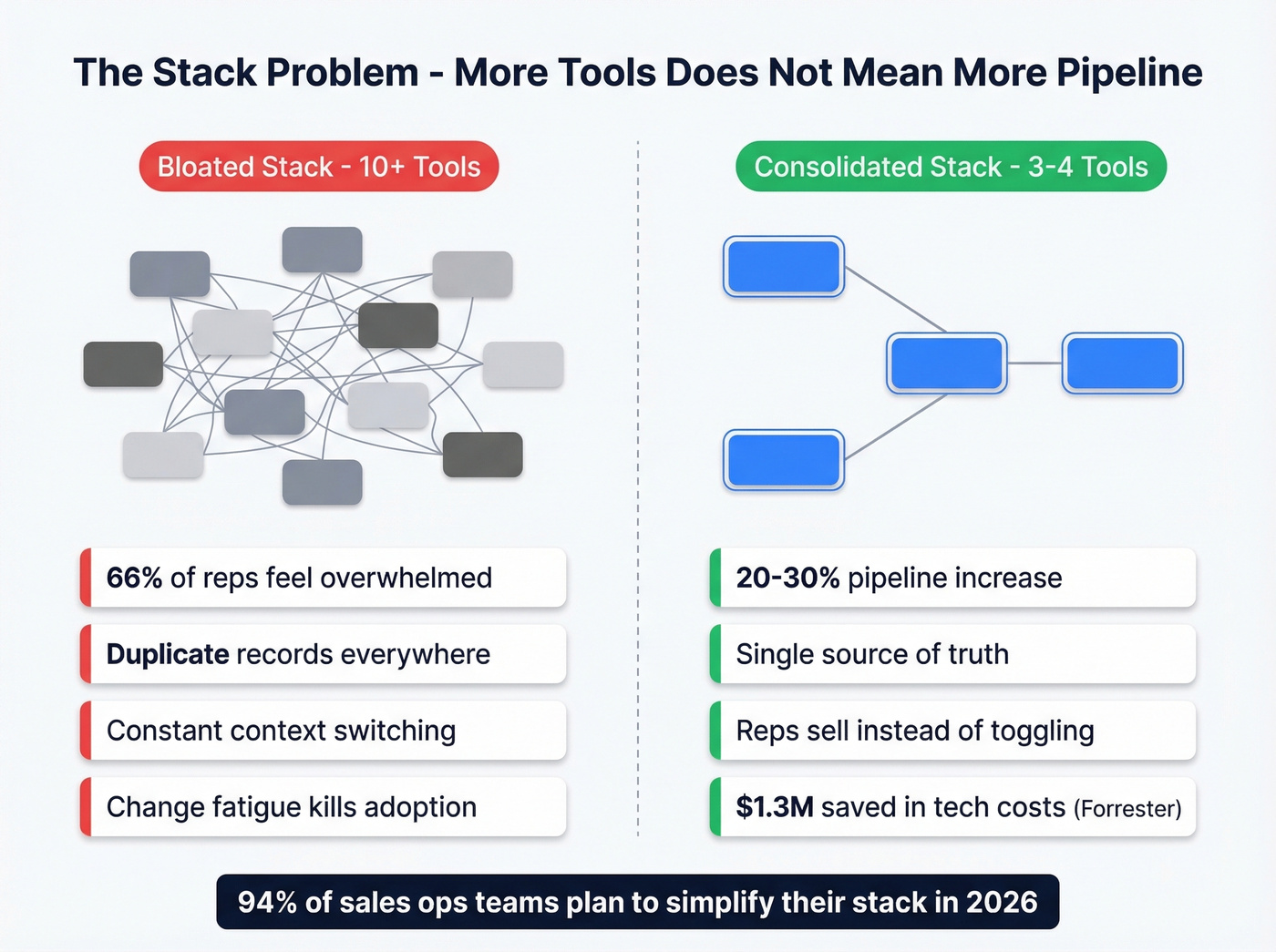
Here's the thing: your stack isn't too big, it's too dirty. Ten tools with rotten data produce worse results than three tools with verified contacts. We've seen teams rip out half their stack and watch pipeline increase 20-30% - not because the tools were bad, but because fewer tools meant fewer data conflicts, fewer duplicate records, and less time switching between dashboards.
Change fatigue is the hidden cost. Every new tool you add requires onboarding, habit changes, and workflow adjustments. Reps who are constantly adapting to new software aren't selling - they're learning. Before you consolidate, audit your integrations. If two tools don't share data natively, one of them needs to go. (If you're mapping what stays vs goes, use a sales engagement platform checklist.)
4. Deploy AI on 2-3 Use Cases, Not 10
The AI hype cycle in sales has peaked. Smart teams are doubling down on what works and cutting what doesn't.
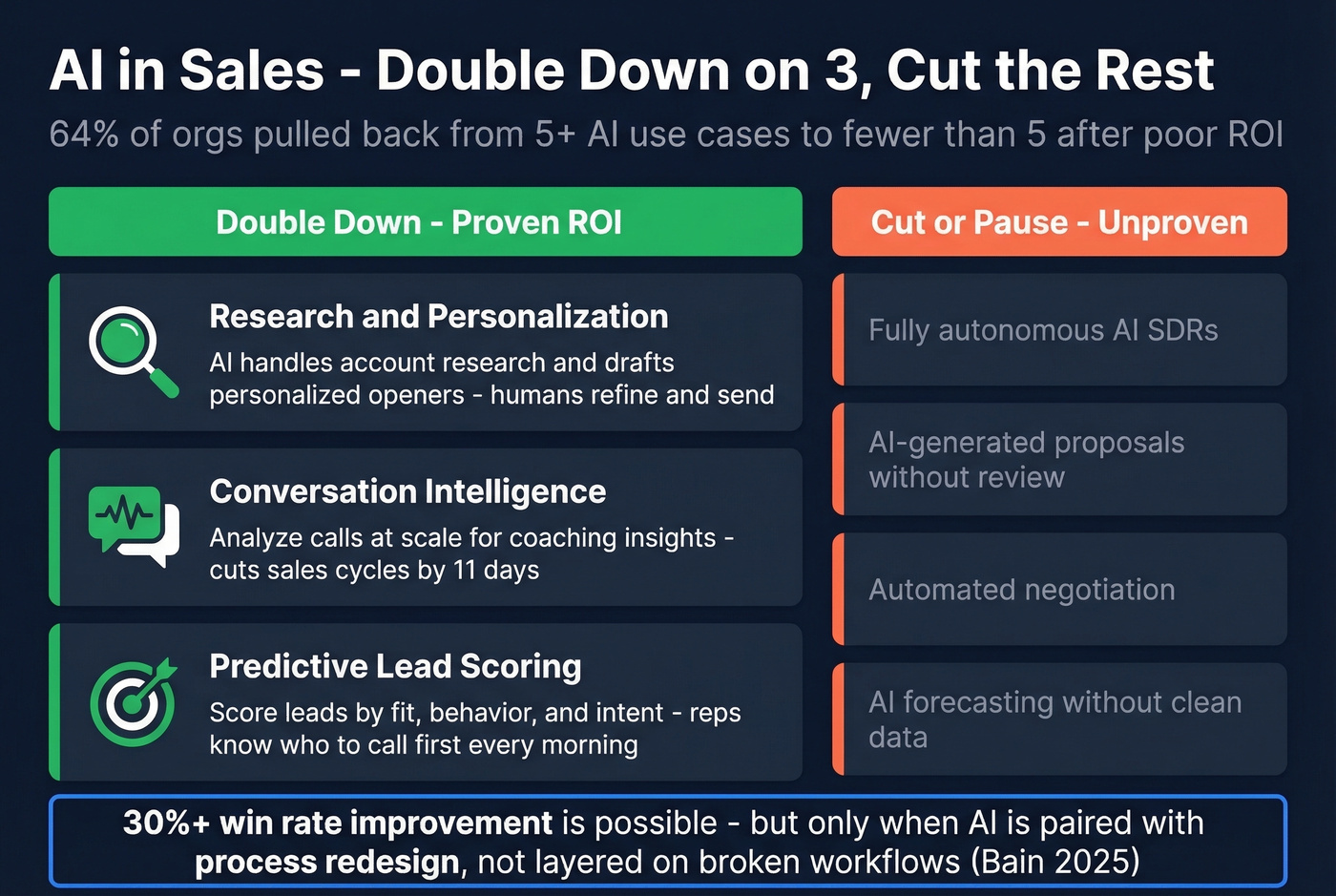
Alexander Group's research shows the shift clearly: in 2024, 63% of organizations were implementing 5+ AI use cases. By 2025, 64% had pulled back to fewer than five. The scatter-shot approach wasn't delivering ROI.
Bain's Technology Report found that 30%+ win rate improvements are possible - but only when AI is paired with process redesign, not just layered on top of broken workflows. The teams seeing real results use AI for research and personalization, conversation intelligence for coaching, and predictive lead scoring. Three use cases, executed well. (For a practical stack, see generative AI sales tools.)
45% of teams have already adopted a hybrid AI-SDR model. If you haven't, start there - AI handles research and initial personalization, humans handle the conversation. The consensus on r/sales is consistent: AI is a force multiplier for good reps, not a replacement for bad process.
5. Implement Lead Scoring and Account Prioritization
Every hour a rep spends chasing a prospect who was never going to buy is an hour they didn't spend on someone who would.
Build a scoring model that combines firmographic fit, behavioral signals like website visits and content downloads, and intent data. Layer that with job change alerts and headcount growth filters, and your reps start every morning knowing exactly who to call first. Prospeo's intent data tracks 15,000 Bombora topics, which gives you a real-time signal on which accounts are actively researching solutions in your category. (If you need a framework, start with lead scoring and an ideal customer profile.)
Use this if your reps complain about "not enough good leads." Skip this if your total addressable market is under 500 accounts - at that size, just work them all.
6. Build Omnichannel Sequences as Default
The practitioner voice on r/sales is clear: just hitting the phones isn't enough anymore. Cold calling connect rates feel materially worse than they did in 2019-2020, and reps are frustrated.
Omnichannel isn't a competitive advantage in 2026 - it's the baseline. Every outbound sequence should combine calls, email, and social touches. Teams using social selling see 16% higher win rates and create 45% more opportunities. Build your default sequence with 8-12 touches across three channels over 14-21 days. Test the ratio, but start with something rather than debating the perfect cadence. (If you want a starting point, use these sales prospecting techniques and sequence management basics.)
7. Align Sales and Marketing on Shared Metrics
If marketing is measured on MQL volume and sales is measured on closed revenue, you've built a system that optimizes for conflict. Marketing floods the funnel with low-quality leads to hit their number. Sales ignores 80% of them. Both teams blame each other.
The fix is a shared pipeline metric. Both teams own pipeline contribution - marketing is measured on how much qualified pipeline their programs generate, and sales is measured on how efficiently they convert it. When both teams stare at the same number, the finger-pointing stops. (This is easier with clear funnel metrics and pipeline health definitions.)
8. Coach with Data, Not Gut Feel
Only 26% of reps receive weekly one-on-one coaching. That's a problem, because coaching is the highest-leverage activity a sales manager has.
Conversation intelligence tools have changed what's possible here. Outreach's data shows their Kaia product shaves 11 days off sales cycles and boosts win rates by up to 10 percentage points on deals over $50K. The direction is consistent with what we see across teams: data-driven coaching beats "I listened to one call and have some feedback" every time. The key is framing conversation intelligence as a coaching tool, not a surveillance tool. Reps who feel monitored disengage. Reps who get specific, actionable feedback from their own call data improve fast. (If you're building the operating cadence, pair this with sales performance management.)
9. Verify Prospect Data Before Every Campaign
A typical SDR sends 50-80 emails per day with a 5-10% reply rate. On an unverified list with a 5-15% hard bounce rate, that's 4-12 wasted emails per day - plus the cumulative domain damage that makes every subsequent email less likely to land.
The fix takes five minutes: run your list through verification before any campaign launches. Target a hard bounce rate under 2%. Anything above that is actively hurting your deliverability. (If you need options, compare Bouncer alternatives or use an AI email checker.)
10. Protect Selling Time Ruthlessly
If you don't measure it, you'll overestimate it - just like the 800 reps in the Proudfoot study.
Three tactics that work: time-block prospecting and discovery calls into uninterrupted 2-hour windows; audit internal meetings monthly and cut 30% of recurring ones (most can be async); set a "no meetings before 10 AM" policy so reps start the day with outbound activity, not status updates.
Burnout is the other side of this coin. Mental health and wellbeing rank among the top productivity pitfalls in recent research. Protecting selling time isn't just about efficiency - it's about making sure reps have enough energy to be effective during the hours that matter.
Sales Productivity Metrics That Matter
Sales productivity = revenue / number of reps. That's the macro formula. But to actually improve it, you need to track the leading indicators:
| Metric | What to Track | 2026 Benchmark |
|---|---|---|
| Win rate (<50 days) | Deals closed within 50 days | 47% |
| Quota attainment | % of reps hitting target | Top teams: 60%+ |
| Selling time ratio | Selling hours / total hours | Target: 40%+ |
| Email bounce rate | Hard bounces / emails sent | Under 2% |
| Pipeline velocity | Opps x Win % x ACV / Cycle | 5-10% QoQ improvement |
| Rep ramp time | Days to first closed deal | 3-6 months (mid-market) |
The most underrated metric on this list is deal velocity by time bracket. Opportunities closed within 50 days convert at 47%, while deals that drag past that threshold drop to roughly 20%. If your average cycle is stretching, that's not just a speed problem - it's a win rate problem.
Trend direction matters more than any single snapshot. Measure monthly, compare quarterly, and don't panic over one bad week. Small improvements in these leading indicators stack over time.
The Real ROI of Getting This Right
The numbers from teams that've executed on these strategies are hard to argue with.
A Forrester TEI study modeled the composite impact of sales productivity improvements: 3.3x ROI over three years, 12% higher close rates, 40% increase in selling activity without adding headcount, and $12.4M in profit gains. Bain's research corroborates this - 30%+ win rate improvements are achievable when you combine better tools with process redesign.
On the data quality side, the results are even more dramatic. Meritt tripled their pipeline from $100K to $300K per week after fixing their data foundation. Bounce rates dropped from 35% to under 4%. Connect rates tripled to 20-25%. That's not incremental improvement - that's a step change.
In our experience, the teams that fix data quality first see results 2-3x faster than those that start with process changes. None of these strategies are revolutionary in isolation. The compounding effect is what matters: clean data flowing into consolidated tools, reps spending 40%+ of their time selling, AI handling the research grunt work, and managers coaching from data instead of gut feel. That's how you increase sales productivity in a way that sustains - not a one-quarter spike, but a permanent shift in how your team operates.
You don't need 10 tools - you need one source of truth with clean data. Prospeo replaces your email finder, phone database, and enrichment tool with 300M+ verified profiles, 125M+ mobile numbers, and native integrations to Salesforce, HubSpot, and every major sequencer. At $0.01 per email, it costs 90% less than ZoomInfo.
Cut your stack in half and watch pipeline go up, not down.
FAQ
What's the sales productivity formula?
Sales productivity equals total revenue divided by number of reps, or revenue per selling hour for a more granular view. The goal is generating more pipeline from the same team size - not just adding headcount. Track leading indicators like win rate, selling time ratio, and bounce rate alongside the top-line number.
How much time do sales reps actually spend selling?
Reps spend just 28-38% of their week on actual selling activities, depending on the study. Most overestimate their selling time by 22 percentage points. The rest goes to admin, CRM updates, and internal meetings - tasks that should be eliminated or automated.
What's the biggest killer of rep efficiency?
Bad contact data. When 22.5% of your database decays annually, reps waste hours on dead-end contacts while bounced emails destroy domain reputation. A 7-day data refresh cycle and 98% email accuracy eliminate this problem - Snyk cut bounces from 35-40% to under 5% after making the switch.
Does AI actually help sales teams sell more?
Yes, but only when focused on 2-3 use cases with process redesign. Research automation, conversation intelligence, and predictive lead scoring deliver 30%+ win rate improvements per Bain's data. Spreading AI across 10+ use cases dilutes ROI - 64% of orgs pulled back to fewer than five by 2025.
How quickly can teams see results from these changes?
Teams that fix data quality first typically see measurable pipeline improvement within 4-6 weeks. Meritt tripled weekly pipeline from $100K to $300K after cleaning their contact data. Process-first teams take 2-3x longer to see equivalent gains.