

Data-Driven Sales: Metrics, Tools, and the Playbook That Actually Works
Sales reps spend 60% of their time on non-selling tasks](https://www.salesforce.com/sales/state-of-sales/sales-statistics/). That's not a productivity problem - it's a data problem. Your SDR team loads 5,000 contacts into a sequence, 34% bounce on the first send, connect rates crater to 8%, and the campaign is dead before it starts. The fix isn't more activity. It's better data feeding better decisions at every stage of the funnel, and that's what data-driven sales actually means: fixing the foundation before scaling the volume.
The Compressed Version
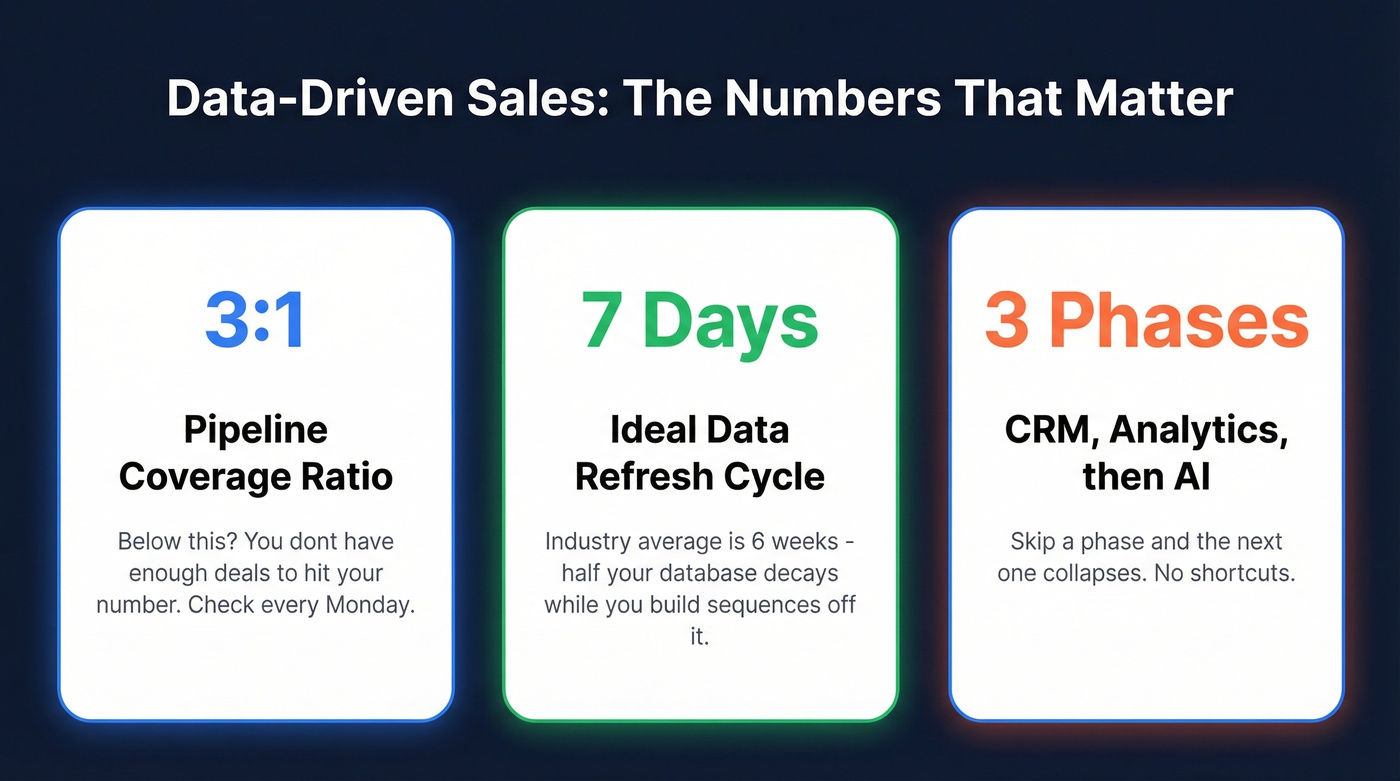
- The one metric to check every Monday: Pipeline coverage ratio. Below 3:1 (pipeline value / quota target) means you don't have enough deals to hit your number. No amount of coaching fixes a coverage gap.
- The foundation most teams skip: Data quality and freshness. A 7-day refresh cycle is the standard worth targeting - the industry average is still six weeks, which means half your database is decaying while you build sequences off it.
- The 3-phase adoption path: CRM hygiene, then analytics and dashboards, then AI integration. Skip a phase and the next one collapses.
What Is Data-Driven Sales?
Data-driven sales is a decision-making framework where metrics - not gut instinct - determine how you forecast, allocate resources, prioritize accounts, and coach reps. It's not a reporting exercise. You don't become data-driven by building more dashboards.
The distinction matters because plenty of orgs have dashboards nobody looks at. Real data-based selling means your territory plans, hiring decisions, and deal reviews all start with numbers. Intuition still plays a role, but it's the tiebreaker, not the starting point.
Why It Matters in 2026
Three forces are converging that make a data-driven sales strategy non-optional this year.
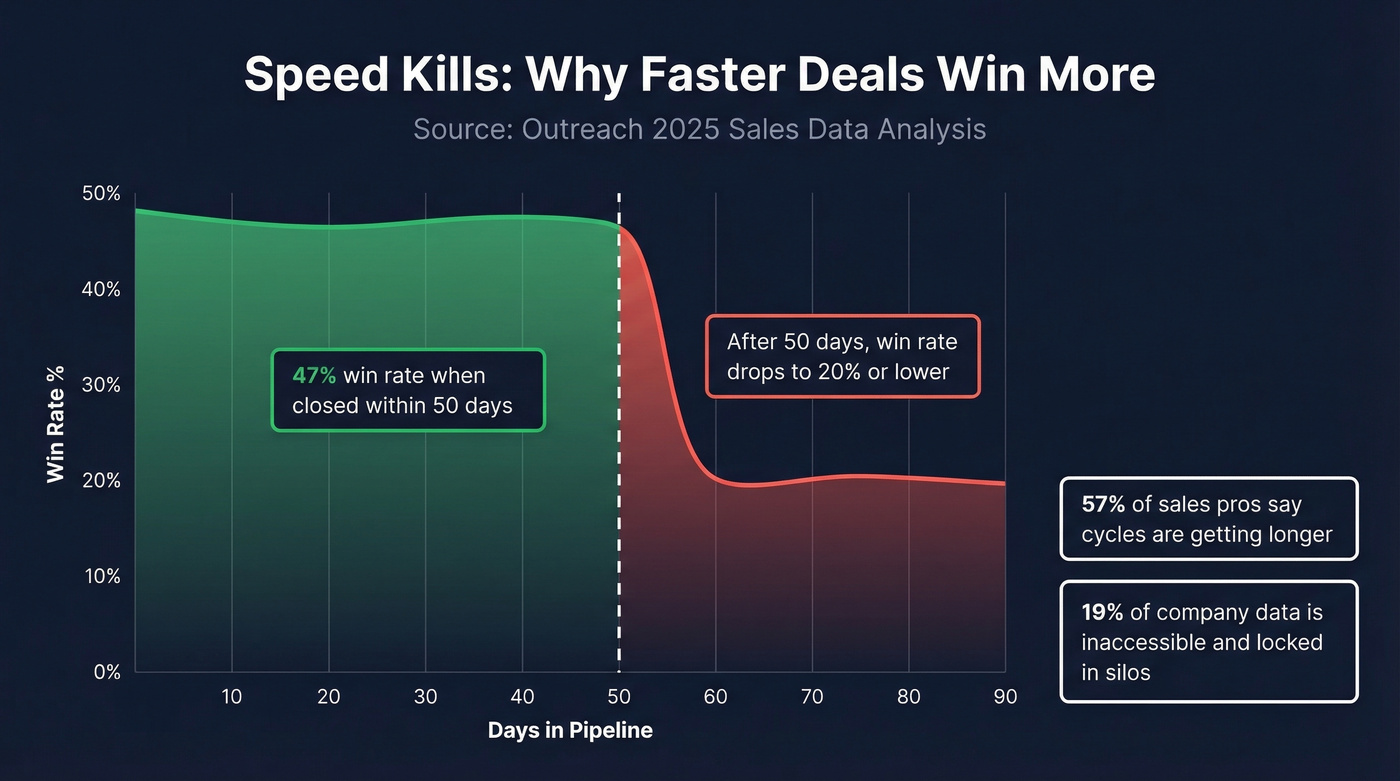
Sales cycles are stretching. 57% of sales professionals say cycles are getting longer, and 34% of revenue teams report average cycles of one to two full quarters. When deals take that long, you need earlier signals to know which ones are worth pursuing. Gut feel doesn't scale across a 90-day pipeline.
Data accessibility is still broken. Sales leaders estimate that 19% of their company's data is inaccessible - locked in silos, buried in spreadsheets, or sitting in tools nobody's integrated. That's nearly a fifth of your intelligence just gone.
And buyer expectations have shifted hard. Deals closed within 50 days show a 47% win rate. After 50 days, that drops to 20% or lower. Speed kills - and speed requires knowing exactly which deals to push, which to nurture, and which to walk away from. Teams that shorten cycles with reliable data consistently outperform those relying on rep intuition alone.
Metrics That Actually Matter
Most "data-driven" articles throw 30 metrics at you and call it a day. Here's the thing: tracking too many metrics is worse than tracking too few. You end up with dashboards that look green while quota attainment is red. Focus on the ones that actually drive decisions.
Pipeline and Revenue Formulas
These are the metrics your CRM should surface weekly, with the formulas so you can build them yourself:
| Metric | Formula | Benchmark |
|---|---|---|
| Pipeline Coverage | Pipeline Value / Quota | 3:1 minimum |
| Pipeline Velocity | (Opps x Win Rate x Avg Deal) / Cycle Length | Track trend, not absolute |
| Win Rate | Closed-Won / Total Opps x 100 | 15-30% common B2B |
| Lead-to-Close | Closed Deals / Total Leads x 100 | Varies by source |
| CLV | (Avg Purchase x Frequency) x Lifespan | Compare to CAC |
| Quota Attainment | Actual Sales / Quota x 100 | 60-70% common; 70%+ strong |
Pipeline coverage at 3:1 is the single most important number on this list. If you're below that threshold on Monday morning, the rest of the week is triage. Everything else - win rate, velocity, CLV - helps you diagnose why you're above or below, but coverage tells you whether you have enough at-bats to hit the number.
That 47% win rate within 50 days is worth pinning to your wall. It's a concrete reminder that speed isn't just nice to have - it's the difference between a 47% and a 20% close rate.
One nuance worth flagging: if your product has low login frequency or long contract cycles, don't mistake sparse usage data for churn risk. Tie metrics to outcomes like renewal rate and expansion revenue, not session counts. B2B measurement is harder than SaaS dashboards make it look.
Rep-Level Activity Metrics
Pipeline metrics tell you what's happening. Activity metrics tell you why. The key ones: dials per day, connect rate, average call duration, and call disposition tracking.
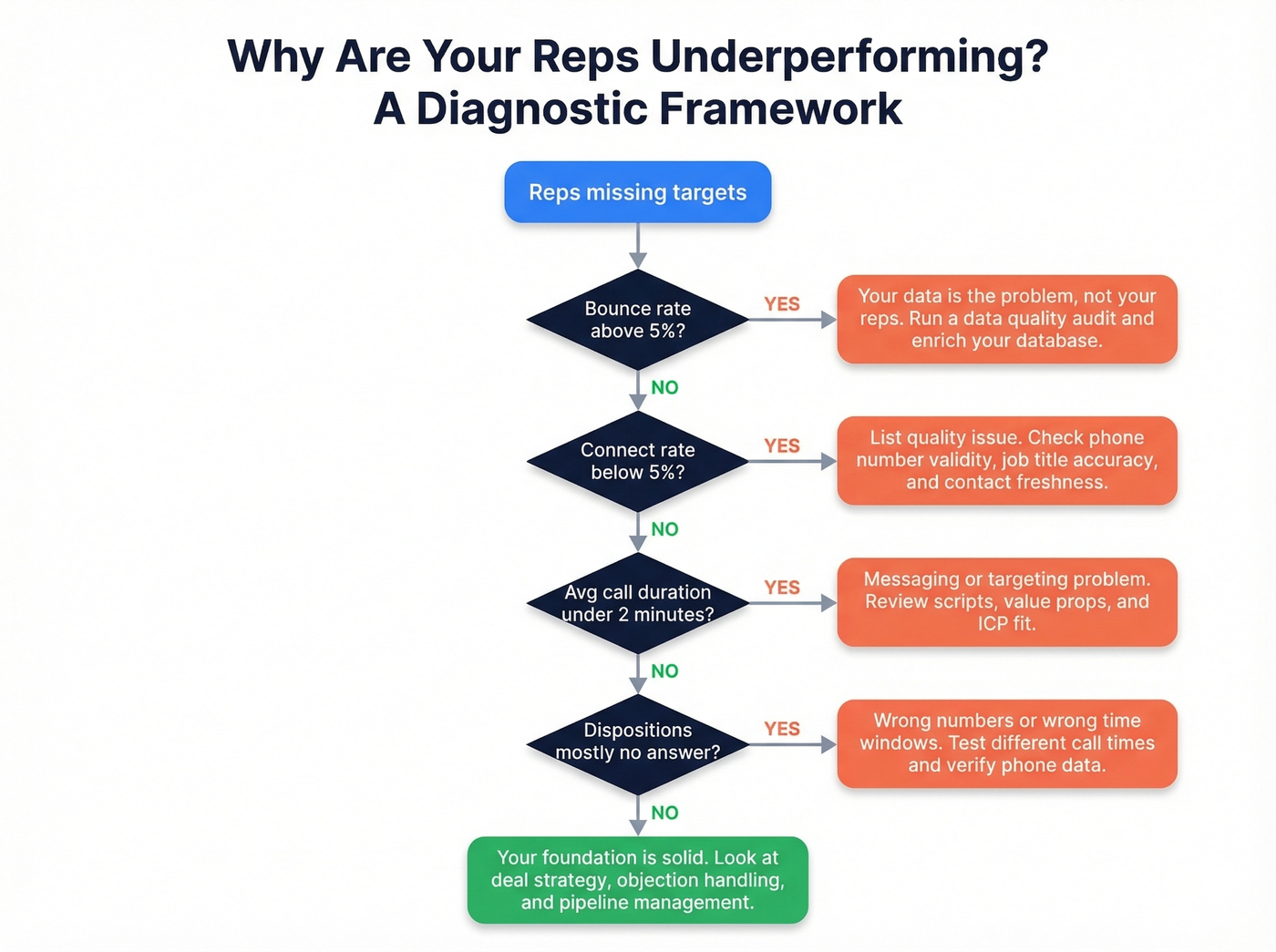
The diagnostic framework is simple. If your connect rate is below 5%, your list quality is the problem - not your reps' effort. If reps can't keep prospects on the phone past two minutes, it's a messaging or targeting issue. If dispositions skew heavily toward "no answer," you're calling the wrong numbers or the wrong time windows.
And if bounce rates exceed 5%, the fix isn't more activity - it's better data. We've seen this pattern dozens of times: teams blame reps for low output when the real culprit is a database that hasn't been refreshed in months.

You just read it: bounce rates above 5% mean your data is the problem, not your reps. Prospeo's 5-step verification delivers 98% email accuracy and refreshes every 7 days - not the 6-week industry average your current provider is hiding behind. Snyk cut bounce rates from 35% to under 5% and grew AE-sourced pipeline 180%.
Fix the foundation before you scale the volume.
The Sales Intelligence Tech Stack
Choosing Tools in 2026
How teams evaluate sales intelligence tools is shifting from database-driven to signal-driven. Database size used to be the differentiator. Now it's accuracy, freshness, and the ability to detect signals - hiring surges, funding rounds, tech stack changes - that indicate buying intent.
You need four to five tools that talk to each other, not fifteen that create data silos.
Tool Comparison
| Category | Tool | Starting Price | Best For |
|---|---|---|---|
| Data Enrichment | Prospeo | Free; ~$0.01/email | Email/mobile accuracy |
| CRM (Enterprise) | Salesforce | $25/user/mo | At-scale orgs |
| CRM (SMB) | HubSpot Sales Hub | Free-$150+/user/mo | Teams getting started |
| CRM (SMB) | Pipedrive | $14/user/mo | Small teams, simplicity |
| BI / Dashboards | Tableau | $15/user/mo | Advanced visualization |
| BI / Dashboards | Zoho Analytics | $24/mo | Budget-friendly BI |
| Revenue Intel | Gong | ~$1,000-$1,600/user/year | Call analytics, deals |
| Revenue Intel | Clari | ~$60-$120/user/mo | Forecasting accuracy |
| Engagement | Outreach | ~$100-$180/user/mo | Sequence analytics, AI |
Why Data Quality Is the Foundation
The numbers back this up. Snyk had 50 AEs prospecting four to six hours per week with bounce rates running 35-40%. After switching to Prospeo, bounce rates dropped under 5%, AE-sourced pipeline jumped 180%, and the team generated 200+ new opportunities per month. Segment saw a 200% increase in outbound email conversion by focusing on data quality before scaling volume.
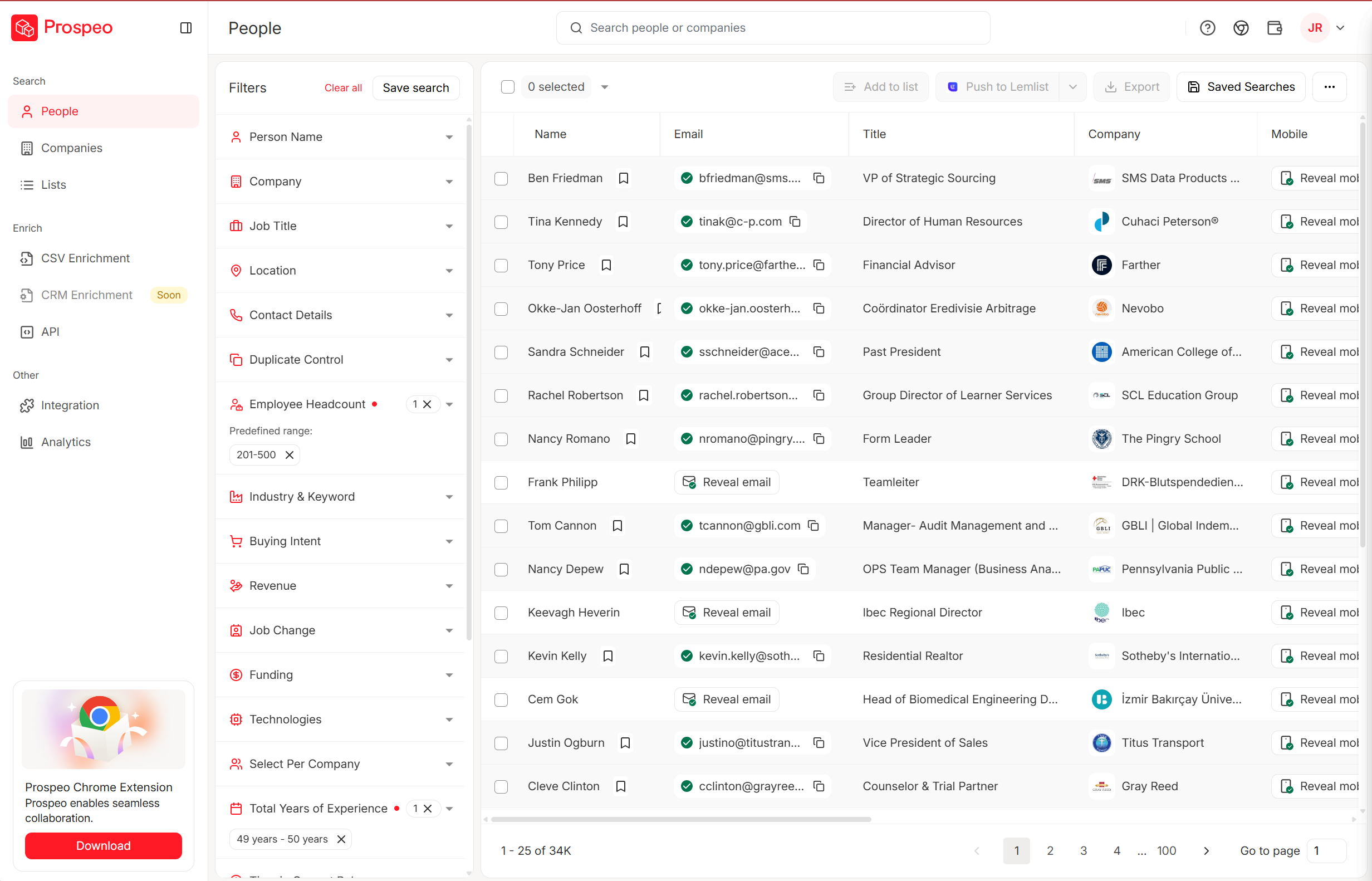
Garbage in, garbage out isn't a cliche - it's the most expensive mistake in sales operations. Every bad email costs you sender reputation, every wrong phone number costs you rep time, and every stale contact costs you pipeline. We've watched teams burn through entire domains in a single quarter because nobody audited the data before hitting send.
How to Implement a Data-Driven Sales Strategy
Phase 1 - Foundation (Months 0-6)
Start with CRM cleanup and adoption. Get every rep logging activities consistently. If you're a small team, Pipedrive plus a dashboard tool like Plecto gets you visibility fast without enterprise overhead.
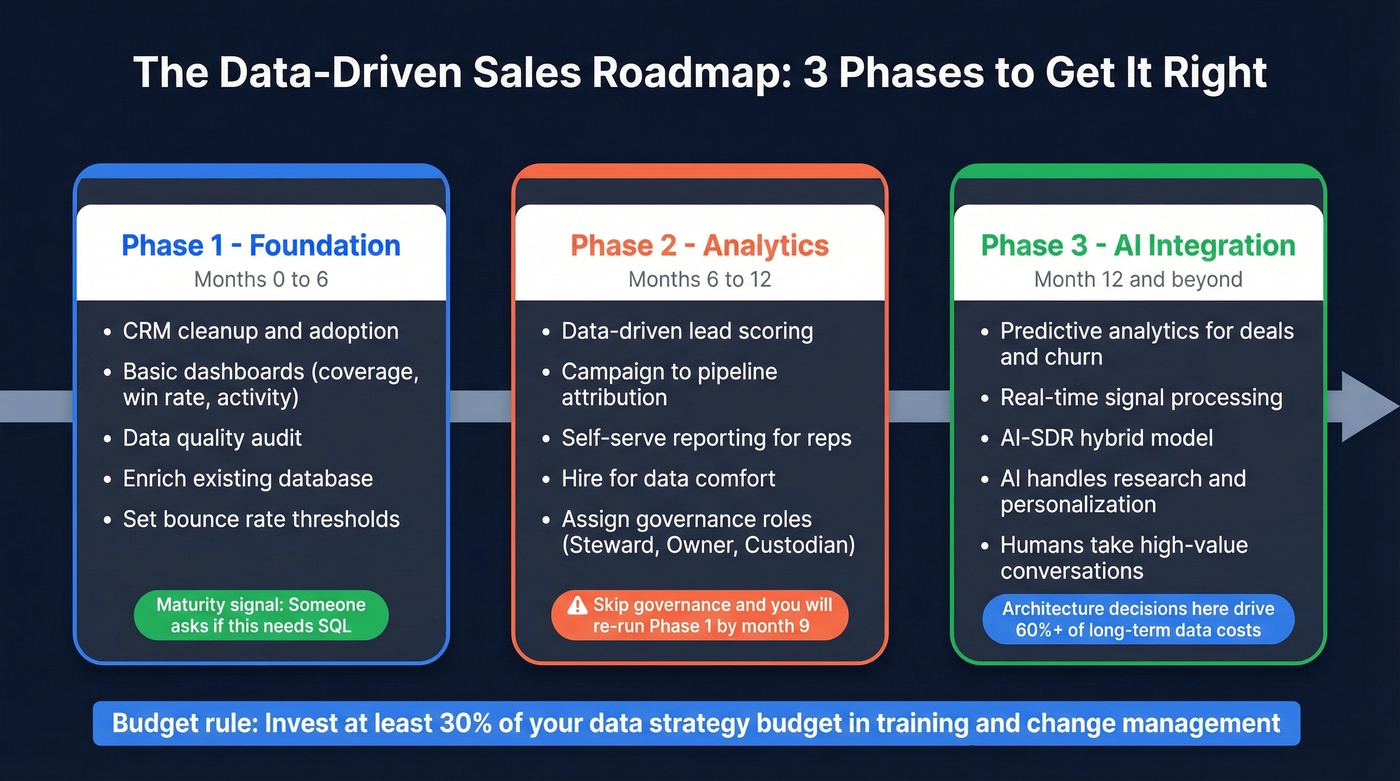
Build basic dashboards covering pipeline coverage, win rate, and activity metrics - visible to the whole team, updated daily. Then run a data quality audit: how many contacts have valid emails? Valid phones? When was the last refresh? If you can't answer these questions, that's your starting point.
Run your existing database through an enrichment workflow. You'll be surprised how much has decayed.
A useful maturity signal: if someone on your team asks "does this need to be in SQL?" - meaning, should we move beyond dashboard tools to a real data model - you're probably ready for Phase 2. If that question hasn't come up yet, you've still got foundational work to do.
Phase 2 - Analytics (Months 6-12)
Move beyond manual lead scoring rules and let the data tell you which leads convert. Connect your campaigns to pipeline outcomes - this is where CRM + BI + marketing platform integration pays off. Reps and managers should be able to pull their own reports without waiting for ops.
Hire for data comfort. Reps who can self-serve insights will outperform those who wait for ops to build every dashboard.
Assign governance roles: a Data Steward for quality, a Data Owner for business accountability, and a Data Custodian for technical maintenance. Without clear ownership, data quality degrades within weeks. We learned this the hard way - skip governance and you'll be re-running Phase 1 by month nine.
Phase 3 - AI Integration (Month 12+)
This phase covers predictive analytics for deal outcomes and churn risk, real-time processing that moves from batch reporting to live signals, and the AI-SDR hybrid model where AI handles research, personalization, and low-score lead qualification while humans take high-value conversations.
Architecture decisions made in this phase determine over 60% of your long-term data management costs. Don't rush it.
The Budget Rule Nobody Follows
Invest at least 30% of your data strategy budget in training and change management. Every team we've seen skip this step ends up with expensive tools that nobody uses. The technology is the easy part. Getting 50 reps to actually change how they work is where the real investment goes.
Why Data-Driven Sales Fails
Five anti-patterns kill these initiatives. Let's be honest - they're almost always preventable, and they almost always come down to people, not technology.
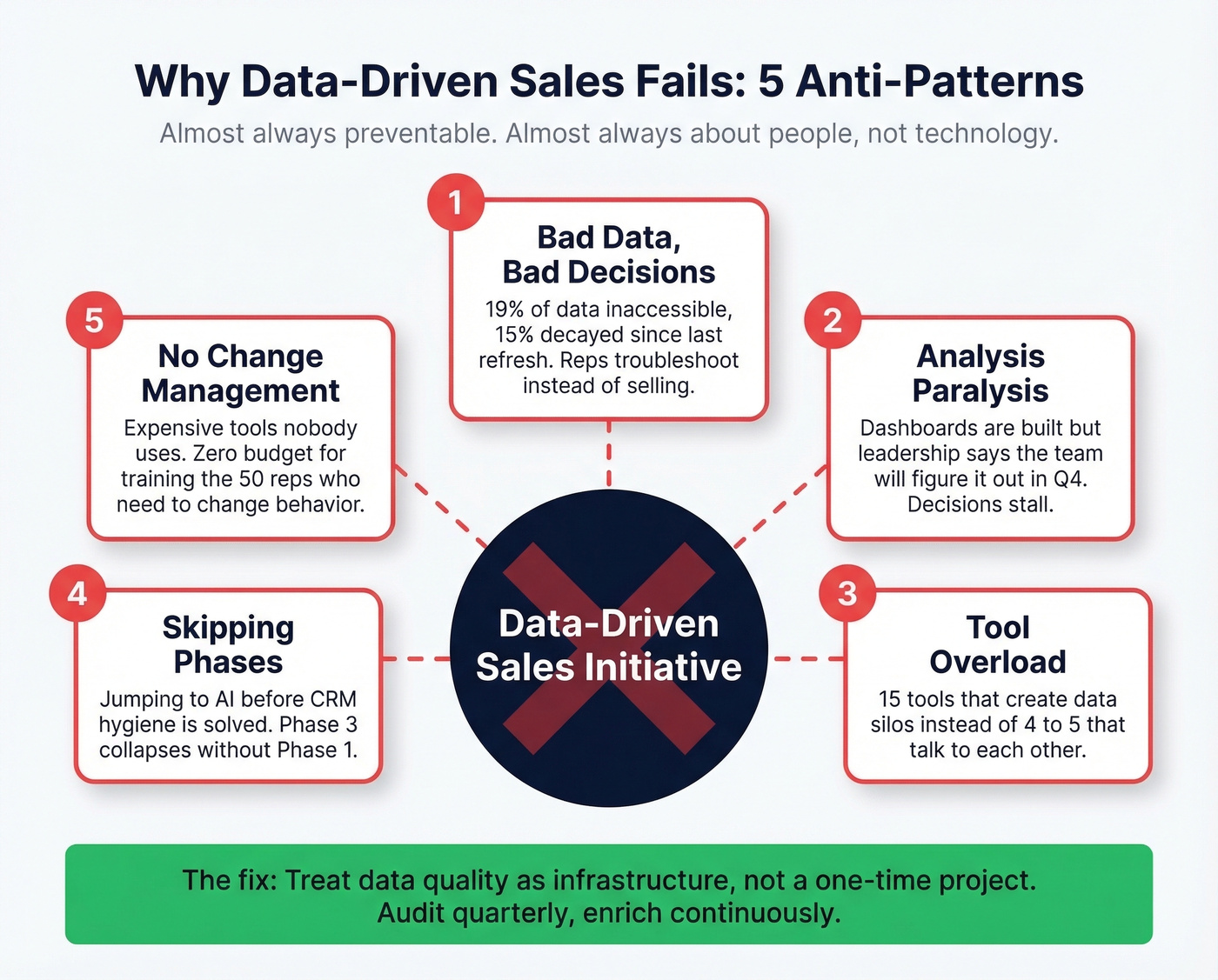
1. Bad Data, Bad Decisions
Your CRM says you have 50,000 contacts. But 19% of your data is inaccessible, another 15% has decayed since the last refresh, and your team is troubleshooting inaccuracies instead of selling. Treat data quality as infrastructure, not a one-time cleanup project. Audit quarterly, enrich continuously, and set a hard bounce-rate threshold that triggers action.
2. Analysis Paralysis
The data is accurate. The dashboards are built. And your CRO says "the team will figure it out in Q4."
This pattern shows up constantly in r/datascience threads - leaders ask for data-driven decisions, then request another cut when the data says something uncomfortable. The fix: pre-commit to decision criteria before running the analysis. "If pipeline coverage drops below 2.5:1, we hire two SDRs" is a decision. "Let's look at the numbers again next quarter" is not.
3. Vanity Metrics Everywhere
Your dashboard shows 10,000 emails sent this week. Green across the board. But pipeline velocity is flat and quota attainment is at 58%. Emails sent is a vanity metric. Pipeline generated per rep is a decision metric.
For every metric on your dashboard, ask "what decision does this drive?" If the answer is "none," remove it. The best data-driven sales techniques are often about subtraction - removing noise so the signal is clear.
4. Data Silos Kill Context
51% of sales leaders with AI say tech silos delay or limit their AI initiatives. But silos don't just block AI - they block basic analysis. When marketing data lives in HubSpot, sales data lives in Salesforce, and product usage lives in Amplitude, nobody can connect the dots. The fix: integration-first tool selection. Every new tool must have a native or API connection to your CRM.
5. No Change Management
"People often think that data alone has value, and that is an expensive misconception." That line from BYU's research on data-driven pitfalls is worth memorizing. Remember the 30% budget rule. Tools without adoption are just expense lines.
AI in Sales - What's Real in 2026
74% of sales teams with AI are prioritizing data hygiene to support it - because AI trained on bad data produces confidently wrong answers. That single stat tells you everything about where AI actually stands.
45% of teams are using a hybrid AI-SDR model, and the results are real but narrow. Outreach's Kaia shaves 11 days off sales cycles on average and delivers up to a 10 percentage point win-rate lift on deals over $50K. Salesforce deployed an SDR agent on low-score leads and created 3,200 opportunities in four months - proof that AI works best on the high-volume, low-complexity tasks that burn out human reps fastest.
Look, AI is real and overhyped at the same time. The teams getting results use it for lead scoring, research automation, and personalization at scale - not replacing reps. And the blocker nobody talks about: 51% of sales pros say data security concerns halt AI initiatives entirely. If your data isn't clean, integrated, and governed, AI is a liability, not an accelerator.
Get Phase 1 and Phase 2 right before you chase AI. The teams winning with AI in 2026 aren't the ones who adopted fastest - they're the ones who built the data foundation first.
A data-driven sales strategy collapses when 19% of your intelligence is locked in silos and your contact database decays every week. Prospeo gives you 300M+ profiles with 30+ filters - buyer intent, technographics, funding, headcount growth - starting at $0.01 per email. No contracts, no sales calls, no stale records.
Stop building sequences on a database that expired last month.
FAQ
What's the difference between data-driven and data-informed sales?
Data-informed uses data as one input alongside intuition and experience. Data-driven makes metrics the primary decision driver - forecasts, territory plans, and resource allocation all flow from numbers. Most teams that call themselves data-driven are actually data-informed, which is fine as long as you're honest about it.
Which metric should a sales leader check first every Monday?
Pipeline coverage ratio. Below 3:1 means you don't have enough deals to hit your number, and no amount of coaching or sequence optimization fixes that gap. Fix the top of the funnel first, then optimize conversion rates downstream.
How long does it take to become a data-driven sales org?
Expect 6 months for foundational CRM hygiene and dashboards, 12 months for advanced analytics and lead scoring, and 18+ months for meaningful AI integration. The biggest variable is change management - teams that skip training typically stall at Phase 1 indefinitely.
What's a good free tool to start with?
HubSpot's free CRM handles basic pipeline tracking, and Prospeo's free tier gives you 75 verified emails plus 100 Chrome extension credits per month - enough to validate your contact data before scaling. Pair those two and you've got CRM visibility plus clean data without spending a dollar.
What are the highest-impact data-driven sales strategies?
Start with pipeline coverage monitoring to ensure you have enough at-bats, then layer in lead scoring based on historical conversion data, and finally use intent signals to prioritize accounts showing active buying behavior. Each layer compounds the one before it - coverage times conversion times timing is the formula.