

Dear vs Hi in Email: Which Greeting to Actually Use
You're staring at a blank email to someone you've never met. "Dear" feels like a letter to your grandmother. "Hi" feels too casual. You delete one, type the other, delete again, and somehow burn two minutes on a single word.
Here's the answer, then the nuance.
The 15-Second Answer
"Hi {Name}" is the correct default for most professional emails in 2026. Use "Dear" for cover letters, academia, cross-cultural uncertainty, and formal first contact in regulated or traditional industries. Use "Hello" as a half-step up in formality. Use "Hey" only if they used it first.
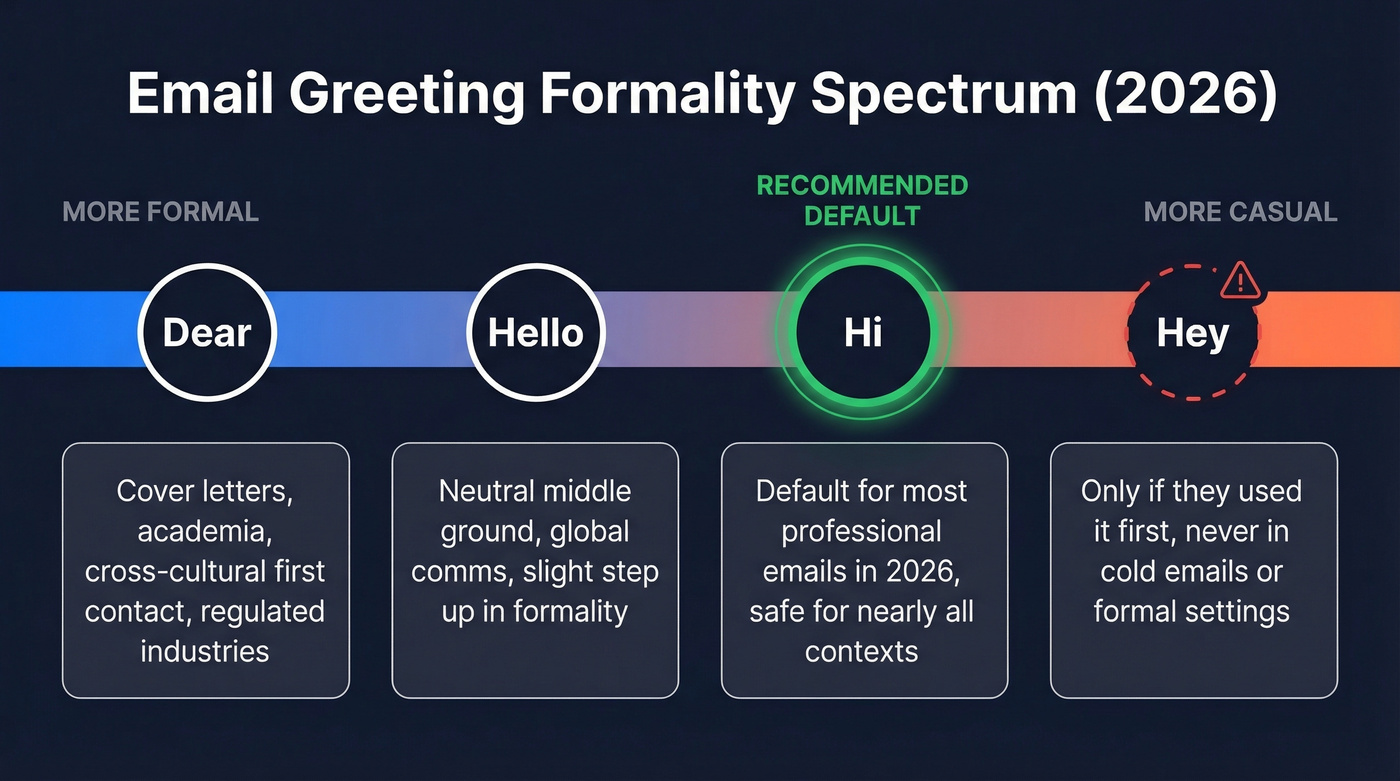
| Greeting | When to Use | When to Avoid |
|---|---|---|
| Dear {Name} | Cover letters, academia, formal first contact | Casual teams, internal threads |
| Hello {Name} | Neutral middle ground, global comms | Internal reply chains, Slack-era teams |
| Hi {Name} | Default for most professional emails | Very formal industries, first cold outreach to senior execs in Asia/MENA |
| Hey {Name} | Only if they used it first | Cold emails, anyone you don't know well |
That developer in India whose manager called "Hi" unprofessional - even though "Dear" made them cringe? That UK jobseeker who doesn't feel comfortable writing "Dear" to a stranger? Both are right in their context. The table handles both. Some guides suggest a 5-question decision tree. You don't need one.
Why "Dear" Is Dying (But Not Dead)
A Wall Street Oasis poll of 95 finance professionals found 73% prefer "Hi," 12% prefer "Hello," and just 16% prefer "Dear." One commenter put it bluntly: "Don't use 'Dear.' You're not talking to your grandma." That's finance - the industry that still wears suits.
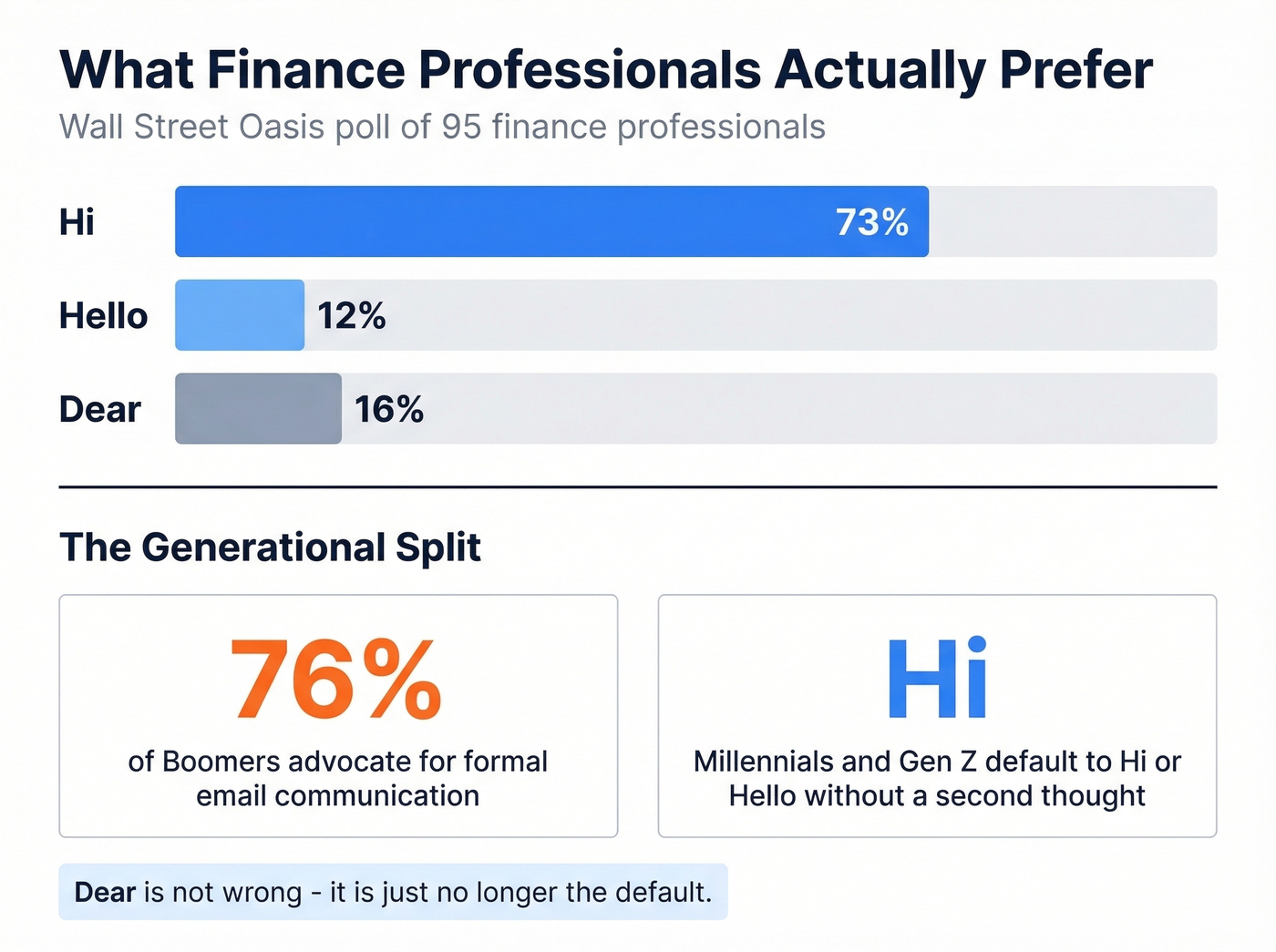
The generational split matters too. 76% of Boomers advocate for formal email communication, and 60% believe slang damages brand image. But Boomers aren't the majority of your inbox anymore. Millennials and Gen Z default to "Hi" or "Hello" without a second thought. We've watched "Dear" go from universal default to deliberate choice in under a decade, and the shift isn't slowing down.
"Dear" isn't wrong. It's just no longer the default. It signals either high formality or unfamiliarity with modern norms - and you don't control which one the recipient perceives.
When "Dear" Is Still the Right Call
Don't abandon it entirely. "Dear" earns its place in specific situations:
- Cover letters and job applications. The traditional convention is "Dear Ms. Wilson:" with a colon. No name? "Dear Hiring Manager" works.
- Academia and medicine. "Dear Professor Chen" or "Dear Dr. Patel" shows you respect the credential. Calling a PhD "Mr." is a real slight.
- Cross-cultural uncertainty. Emailing someone in Germany, Japan, or South Korea for the first time? Default to a formal greeting with their title and surname. Relax later.
- C-suite first contact in regulated industries. Even lawyers are second-guessing "Dear" in internal threads, but for first contact with opposing counsel or a judge's clerk, it's still the safe call.
- When the recipient uses it. Mirror their tone. If they write "Dear {Your Name}," match it.

You just spent two minutes choosing between "Dear" and "Hi." Don't waste that effort on an invalid address. Prospeo's 5-step verification delivers 98% email accuracy so your carefully chosen greeting actually reaches the recipient.
Find and verify any professional email for about $0.01 each.
Regional Email Greeting Cheat Sheet
With 306 billion emails sent daily worldwide and 74% of professionals preferring email for cross-cultural business communication, getting the greeting right across borders matters.
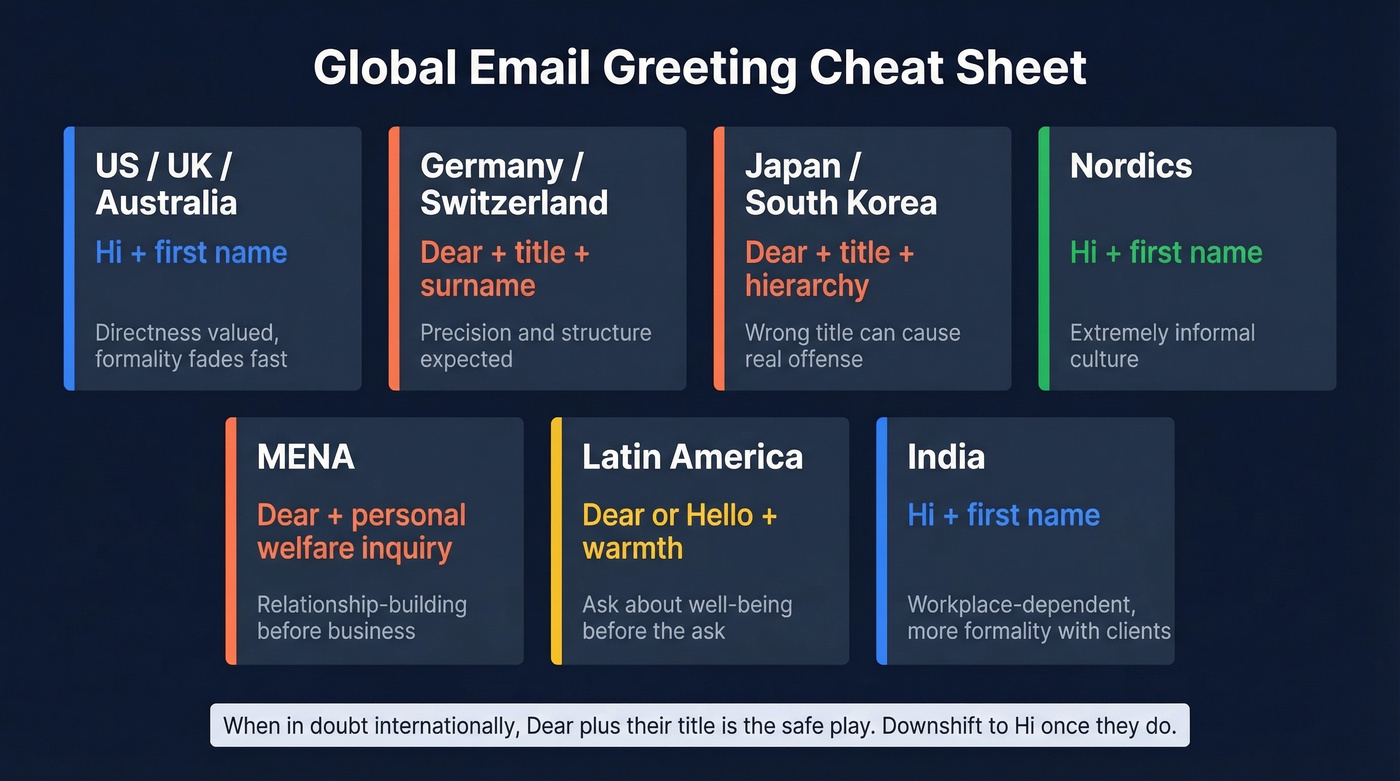
| Region | Recommended Greeting | Key Note |
|---|---|---|
| US / UK / Australia | Hi + first name | Directness valued; formality fades fast |
| Germany / Switzerland | Dear + title + surname | Precision and structure expected |
| Japan / South Korea | Dear + title + hierarchy | Wrong title can cause real offense |
| Nordics | Hi + first name | Extremely informal culture |
| MENA | Dear + personal welfare inquiry | Relationship-building before business |
| Latin America | Dear/Hello + warmth | Ask about well-being before the ask |
| India | Hi + first name | Workplace-dependent; many teams expect more formality with clients |
When in doubt internationally, "Dear" plus their title is the safe play. Downshift to "Hi" once they do.
Mistakes That Matter More Than Your Salutation
Let's be honest: the real email etiquette mistake isn't choosing "Hi" over "Dear." It's agonizing over the greeting while getting the recipient's name wrong. These errors do actual damage:
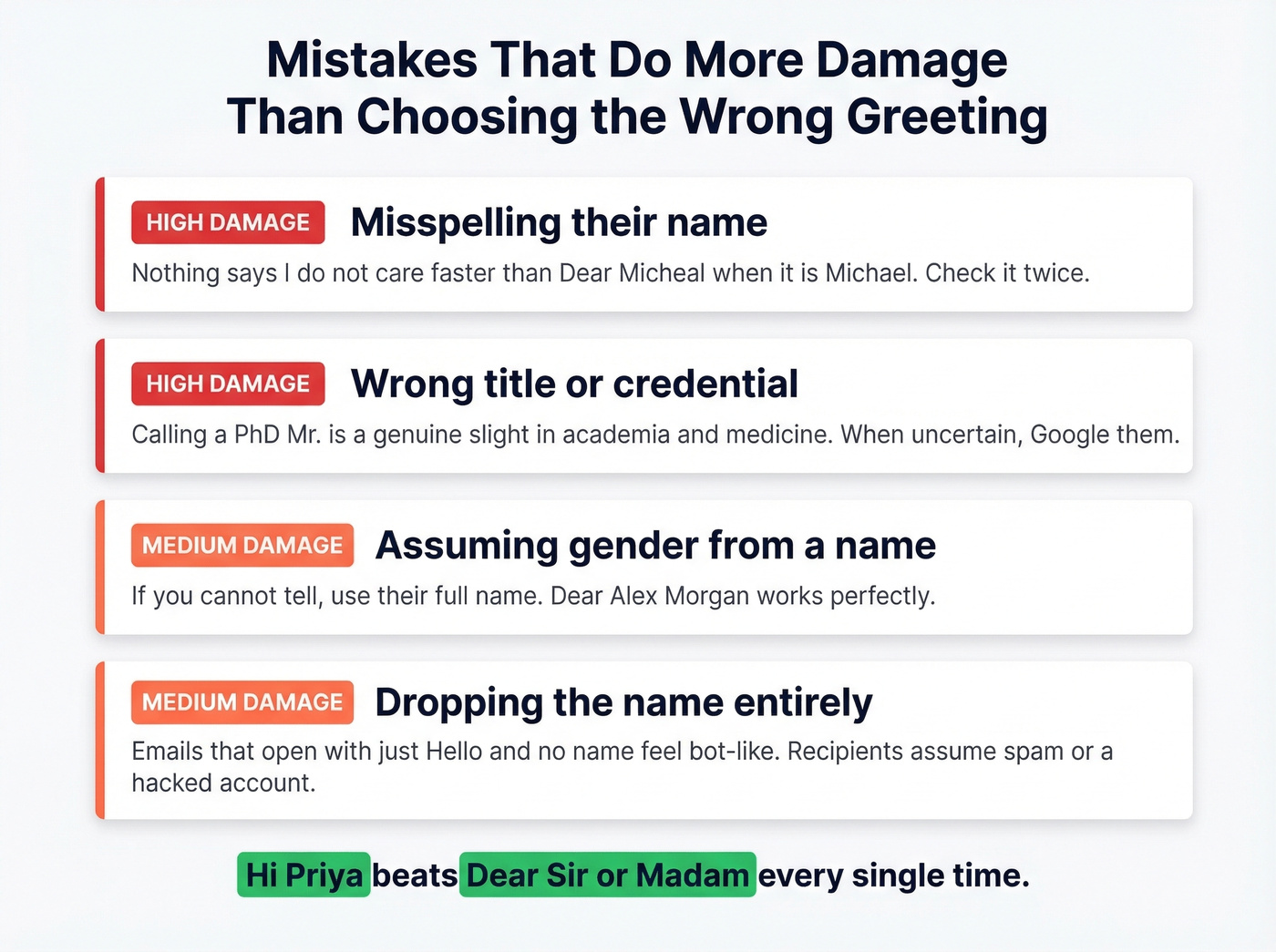
Misspelling their name. Nothing says "I don't care" faster than "Dear Micheal" or "Hi Sara" when it's "Sarah." Check it twice.
Wrong title. Calling a PhD "Mr." is a genuine slight in academia and medicine. When you're uncertain, Google them.
Gender assumptions. If you can't tell from the name, use their full name. "Dear Alex Morgan" works perfectly.
Dropping the name entirely. A Reddit thread on r/GenZ flagged this: emails that open with just "Hello," and no name feel "bot-like." The poster's first instinct was spam or a hacked account. That's the opposite of what you want.
"Hi Priya" beats "Dear Sir or Madam" every single time.
Dear or Hi in Cold Emails
For outbound sales, the calculus is simpler. "Hi {first_name}" works for 90% of cold emails. "Dear Sir or Madam" gets you in the trash folder. "Hey" is a gamble unless you're selling to a creative agency.
Belkins analyzed 16.5 million cold emails across 93 business domains and found a 5.8% average reply rate, with the best-performing emails running 6-8 sentences. Their biggest levers were length, relevance, and timing - not whether you wrote "Dear" or "Hi."
Here's the thing nobody in the etiquette articles mentions: your greeting is irrelevant if the email bounces. We've seen teams spend hours perfecting copy only to discover half their list was invalid. Prospeo verifies email addresses in real time with 98% accuracy, so your carefully crafted opening actually reaches a human inbox. The free tier covers 75 emails per month - enough to test whether your list is clean before you burn your domain reputation. If you're building outbound at scale, pair that with a tighter cold email sequence so your tone stays consistent across touches.
Cold email reply rates depend on relevance, timing, and reaching a real inbox - not whether you wrote "Dear" or "Hi." Prospeo gives you verified emails refreshed every 7 days, so your outreach lands instead of bouncing.
Stop perfecting greetings for emails that never arrive.
FAQ
Is "Hey" Ever Okay in a Professional Email?
Only if the recipient used it first. Mirroring their tone is safe; leading with "Hey" signals over-familiarity. Skip it entirely in law, finance, or government - stick with "Hi" or "Hello" until you've built rapport.
Comma or Colon After the Greeting?
Use a colon for cover letters and formal contexts: "Dear Ms. Wilson:" Use a comma for everything else: "Hi Alex," Many professionals now skip punctuation entirely after the greeting, and that's widely accepted in 2026.
What About Group Emails?
"Hi team," "Hello everyone," or "Hi all" are your safe options. For external groups where you know names, list up to three: "Hi Sarah, James, and Priya." Beyond that, "Hi all" saves everyone's time.
How Do I Verify the Right Name Before Emailing?
Look them up on the company website or a professional profile, then cross-reference with a tool like Prospeo's Chrome extension to pull verified contact details - name, title, and email - in one click. It's the fastest way to avoid the "Dear Sir or Madam" trap and personalize your greeting with the right name.