


DialerAI Pricing, Reviews, Pros and Cons: The Only Honest Breakdown
Most coverage lumps DialerAI in with Mojo Dialer or lightweight sales dialers. That misses the point entirely. DialerAI is call-center infrastructure - not a sales engagement tool - and this breakdown treats it that way.
30-Second Verdict
Port-based pricing makes DialerAI dramatically cheaper than Five9 or NICE at scale, but it's overkill for a five-person SDR team.
| Metric | Detail |
|---|---|
| Rating | 4.8/5 (Capterra, 5 reviews) |
| Starting Price | $299/mo (25 ports) |
| Best For | High-volume call centers, BPOs, white-label resellers |
| Free Trial | Yes, all plans |
The 4.8 is strong, but it's based on only five reviews. G2 still shows zero. Software Advice and GetApp echo the same 4.8/5 average from the same five reviewers, so you're working with a tiny - though consistent - dataset.
Even Reddit threads on auto-dialers rarely mention DialerAI. That's how niche this tool is.
What Is DialerAI?
DialerAI is a predictive dialer and voice broadcasting platform built for operations measuring call volume in the tens of thousands per day. It handles predictive dialing, auto-dialing, press-1 campaigns, SMS, and inbound IVR from a web-based agent interface with a built-in WebRTC phone, so remote agents work directly in the browser without installing anything.
The real differentiator is multi-tenant architecture with built-in billing and white-labeling. If you're a telecom reseller or BPO selling dialer services to your own clients, this was built for exactly that use case. It scales from 25 concurrent channels up to 10,000 simultaneous calls.
DialerAI Pricing Breakdown
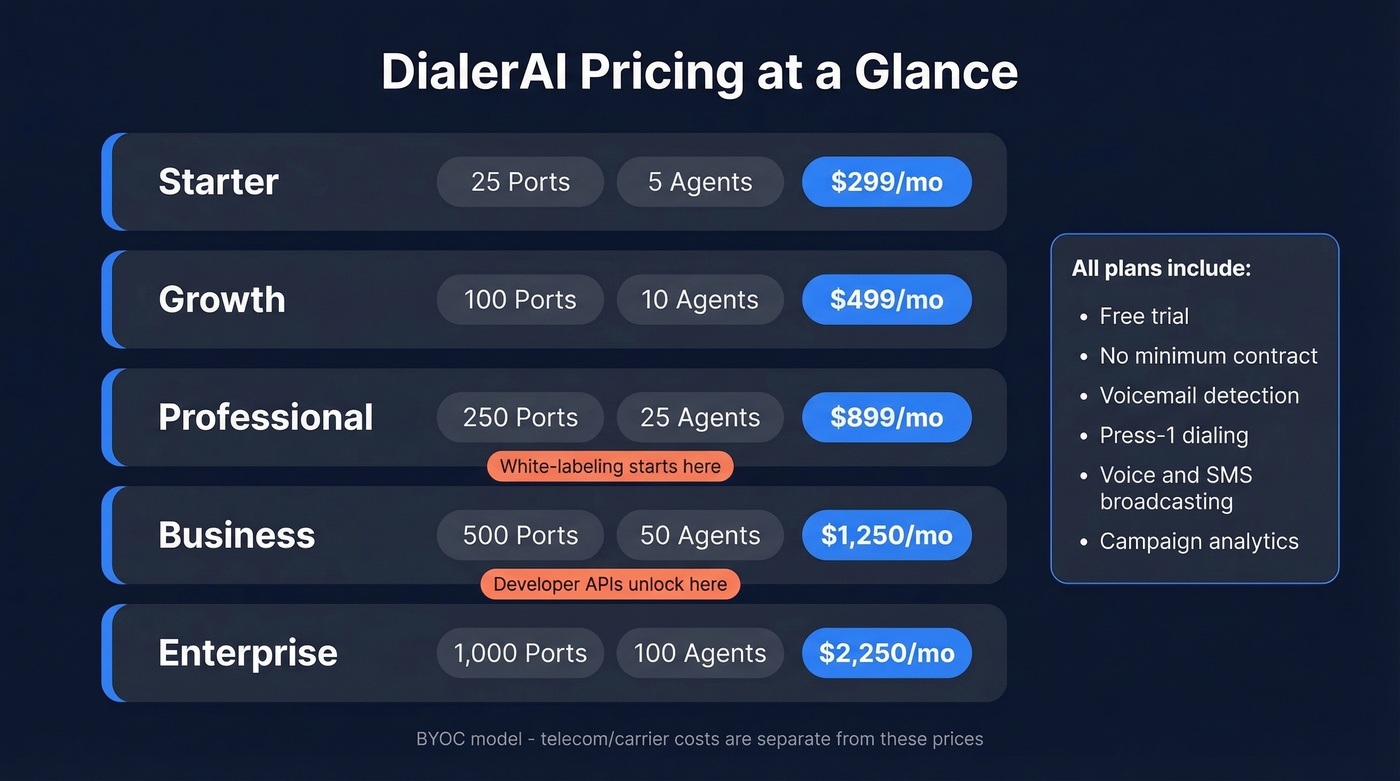
Here's the full plan lineup:
| Plan | Ports | Agents | Price |
|---|---|---|---|
| Starter | 25 | 5 | $299/mo |
| Growth | 100 | 10 | $499/mo |
| Professional | 250 | 25 | $899/mo |
| Business | 500 | 50 | $1,250/mo |
| Enterprise | 1,000 | 100 | $2,250/mo |
Think of ports like phone lines - 25 ports means 25 calls happening at once. This is fundamentally different from per-seat pricing. You're paying for call capacity, not individual agent licenses.
White-labeling starts on the 250-port tier. Developer APIs kick in at 500 ports. All plans include support and training, no minimum term contract, voicemail detection, press-1 dialing with live transfers, voice/SMS broadcasting, and detailed campaign analytics.
One critical detail: DialerAI is BYOC (bring your own carrier). Telecom costs are separate. You'll connect your own SIP/VoIP provider, which gives you control over per-minute rates but means $299/mo isn't your total cost. Budget for carrier charges on top.

DialerAI charges by the port - every call to a dead number is wasted capacity. Prospeo's 125M+ verified mobile numbers deliver a 30% pickup rate, so your agents spend time on live conversations instead of voicemails and disconnects. At $0.10 per mobile number, it's the cheapest way to maximize your dialer investment.
Stop burning ports on bad data. Load verified contacts first.
Is DialerAI Expensive?
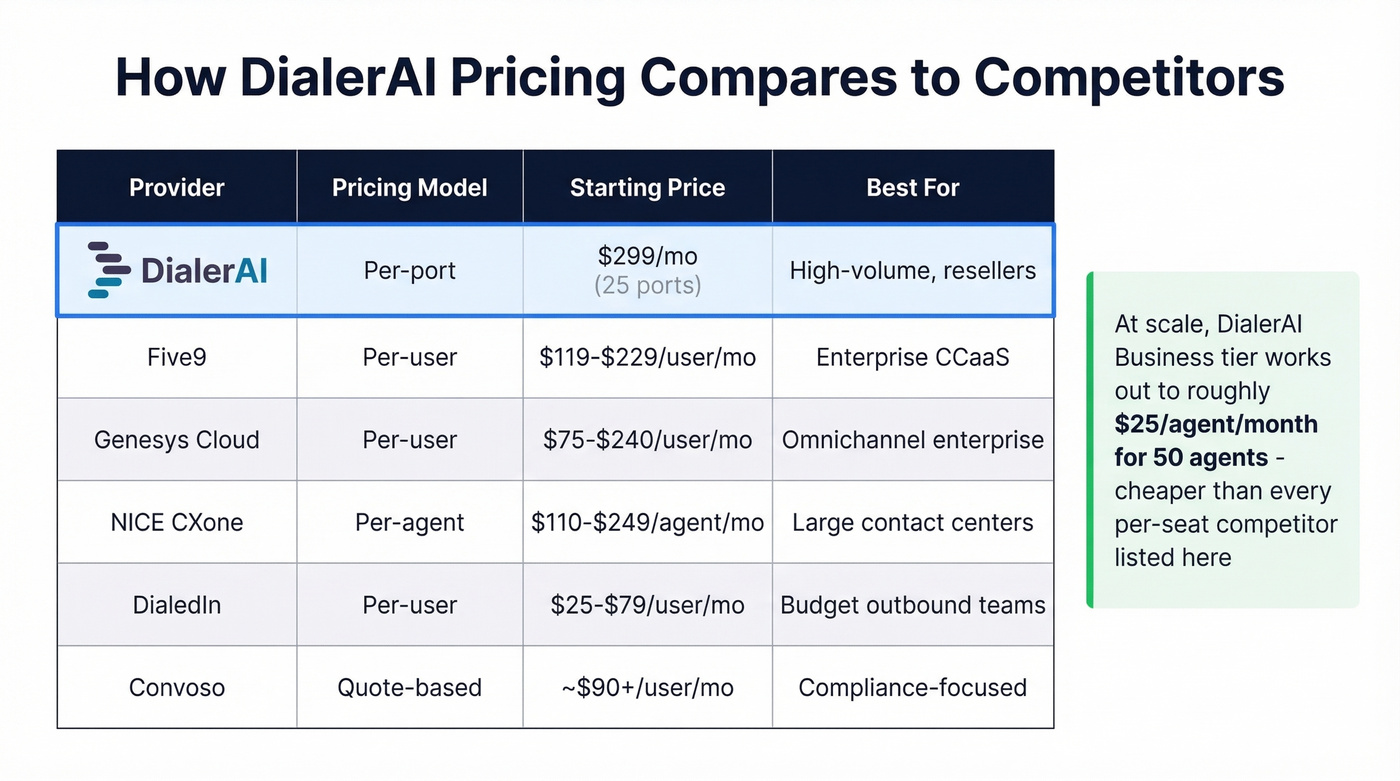
Compared to enterprise CCaaS platforms like Five9, Genesys Cloud, or NICE CXone, it's cheap. Compared to lightweight sales dialers, it's more expensive - but it solves a completely different problem.
| Provider | Pricing Model | Starting Price | Best For |
|---|---|---|---|
| DialerAI | Per-port | $299/mo (25 ports) | High-volume, resellers |
| Five9 | Per-user | $119-$229/user/mo | Enterprise CCaaS |
| Genesys Cloud | Per-user | $75-$240/user/mo | Omnichannel enterprise |
| NICE CXone | Per-agent | $110-$249/agent/mo | Large contact centers |
| DialedIn | Per-user | $25-$79/user/mo | Budget outbound teams |
| Convoso | Quote-based | ~$90+/user/mo | Compliance-focused |
The port model gets absurdly cost-effective when you're running lots of agents and keeping those ports busy. At the Business tier you're paying $1,250/mo for up to 50 agents - an effective $25/agent/month, even though you're really buying ports, not seats. Most CCaaS tools on this list start well above that per user.
For very small teams, DialedIn starts at $25/user/month and is purpose-built for budget outbound operations.
Pros and Cons of DialerAI
Pros:
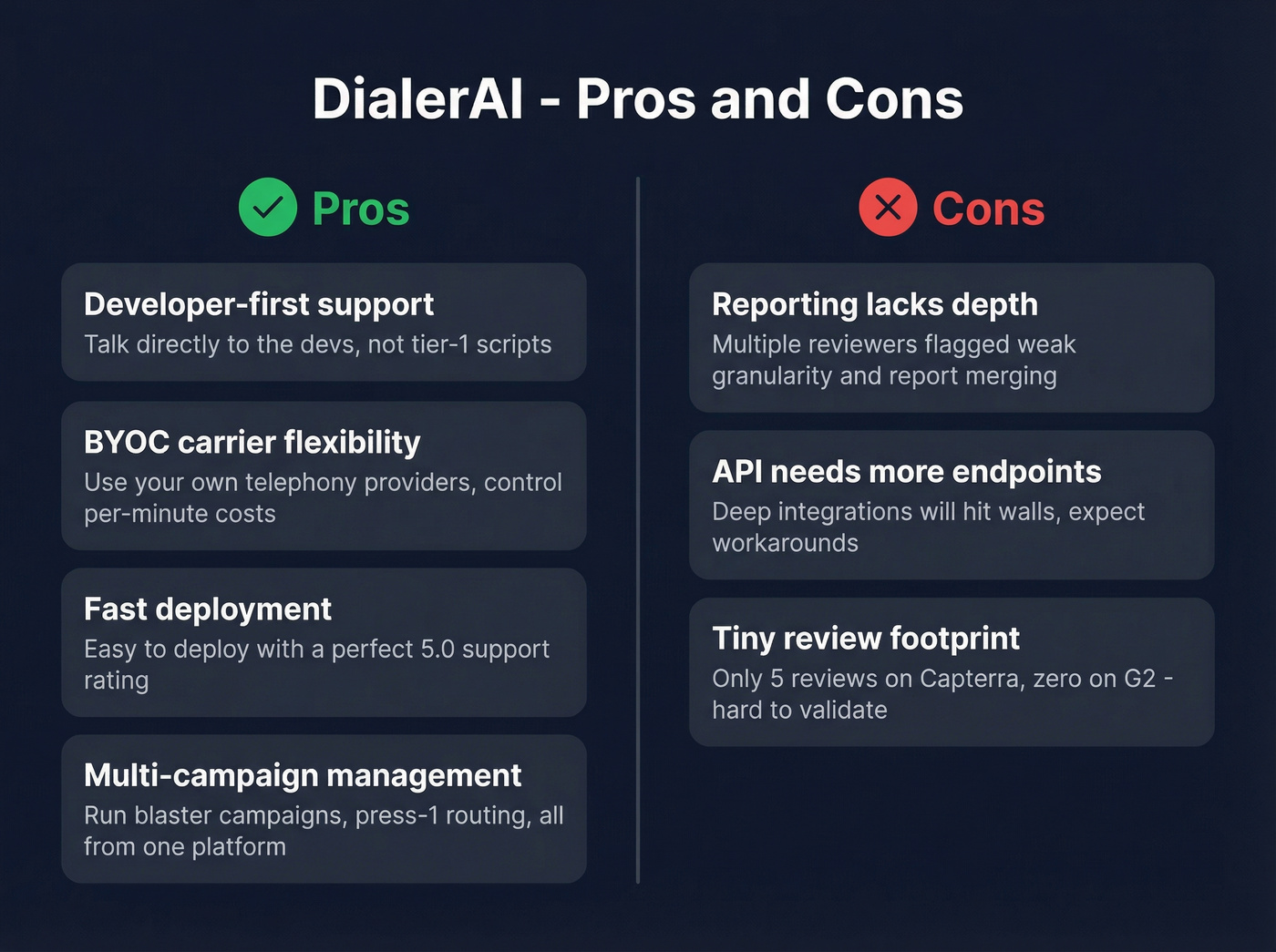
Developer-first support. Reviewer Adam S. called out the "great API" and the fact that you get "support directly from the developers" - not a tier-1 help desk reading scripts.
BYOC flexibility. Jetash R. praised the ability to "use my own telephony providers" and "write back results to my CRM." Carrier independence is a real cost lever at scale.
Fast deployment. Douglas H. described it as "easy to deploy" with "fantastic" support. Customer Service holds a perfect 5.0 sub-rating across the review dataset.
Multi-campaign management. Run blaster campaigns, activate multiple call campaigns simultaneously, and handle press-1 routing from one platform. Cons:
Reporting lacks depth. Both Jetash R. and Douglas H. flagged this independently - reports need more granularity and better merging. For a data-heavy operation, that's a real gap.
API needs more endpoints. Frans S. noted it "could use additions for endpoint options." If you're building deep integrations, expect to hit walls.
Razor-thin review footprint. Five reviews across the main sites and zero on G2. There just isn't a big pool of third-party feedback to lean on, which makes due diligence harder.
Who Should Use DialerAI?
Use this if:
- You're running an outbound call center doing 50,000+ calls/day
- You're a telecom reseller or BPO wanting white-label dialer services with built-in tenant billing
- You run political campaigns, debt collection, or appointment reminders needing press-1/IVR
- You have developer resources and want API-first customization with BYOC carrier flexibility
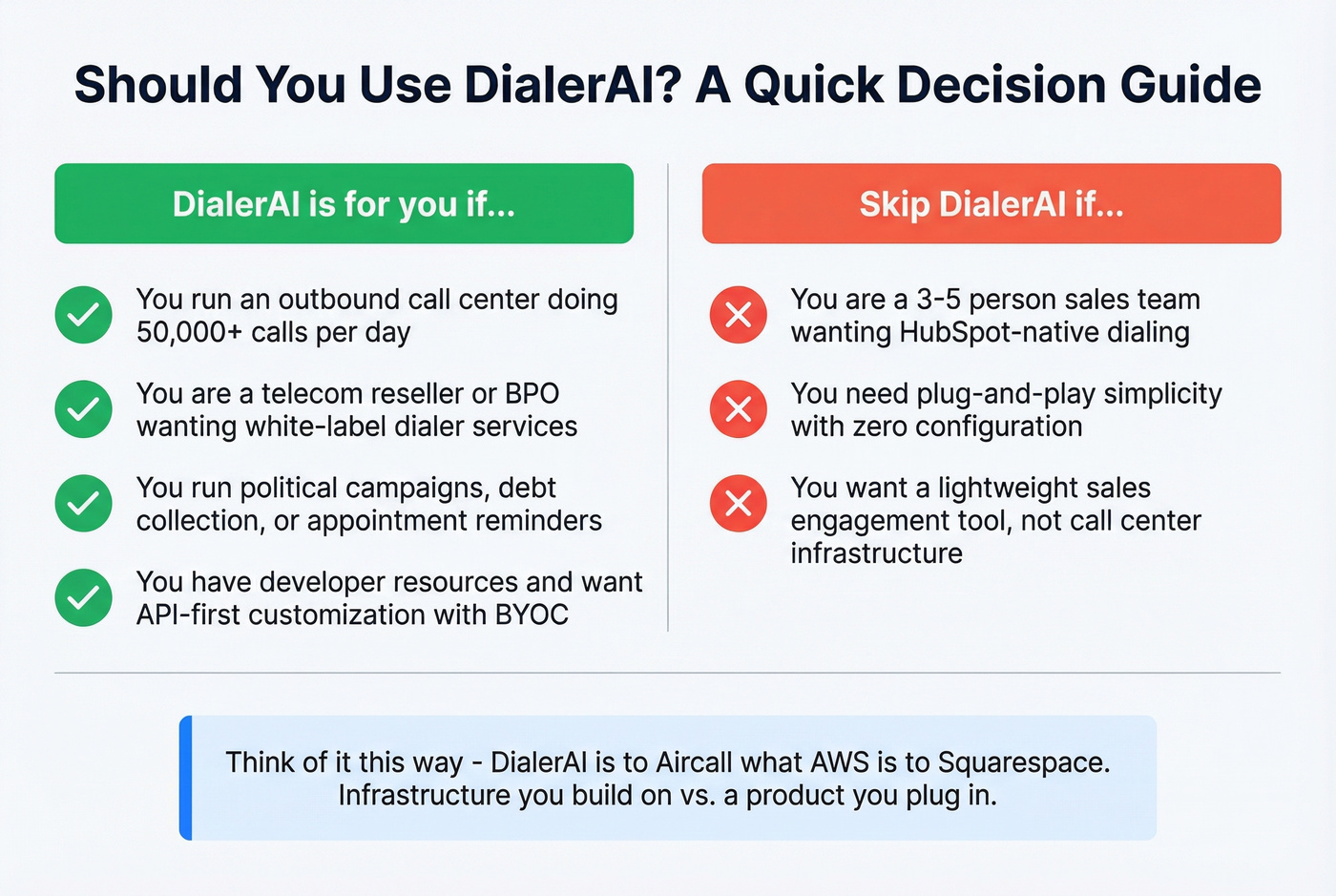
Skip this if you're a 3-5 person sales team wanting HubSpot-native dialing. Look at Kixie or Aircall instead. And if you need plug-and-play simplicity with zero configuration, this isn't your tool.
Comparing DialerAI to Aircall is like comparing AWS to Squarespace. They exist in different categories. DialerAI is infrastructure you build on. Aircall is a product you plug in.
The Part Nobody Talks About: Data Quality
Here's the thing most teams searching for "predictive dialer" actually need - better data, not more ports. We've seen this pattern over and over in our work with outbound teams: a dialer is only as good as the numbers you feed it. If your contact lists are full of dead numbers, no predictive dialer will fix your connect rates. You'll just burn ports faster.
This is where pairing your dialer with verified contact data makes a measurable difference. Prospeo's database includes 125M+ verified mobile numbers with a 30% pickup rate, which directly cuts wasted capacity and agent idle time. At DialerAI's port-based pricing, every dead number you dial is money wasted on an occupied port that could've connected a live conversation.
If you're building lists from multiple sources, data enrichment and lead enrichment can help standardize fields before you upload to a dialer.
No predictive dialer fixes a bad contact list. Prospeo's database pairs 125M+ verified mobiles with 30+ filters - buyer intent, technographics, headcount growth - so you're not just dialing real numbers, you're dialing the right people. Data refreshes every 7 days, not the 6-week industry average.
Feed your dialer numbers that actually pick up.
FAQ
Does DialerAI offer a free trial?
Yes - all five plans include a free trial with access to predictive dialing, voice broadcasting, and the WebRTC agent interface. Sign up directly on dialerai.com with no credit card required.
What does port-based pricing mean?
A port equals one simultaneous call. Twenty-five ports means 25 calls at once. This model confuses buyers used to per-seat SaaS, but the math rewards scale - at 50 agents on the Business plan, you're paying an effective $25/agent/month.
How does contact data quality affect dialer performance?
DialerAI dials numbers - it doesn't source them. Your connect rates depend entirely on list quality. Pairing verified mobile data with a predictive dialer is the fastest way to improve talk-time ratios and reduce wasted ports. For context, the FCC's TCPA guidelines also mean bad numbers don't just waste money - they create compliance risk when you're hitting wrong-party contacts at scale.