

Differences Between B2B and B2C Sales: What the Data Actually Shows
Your SDR just sent 500 cold emails. 180 bounced. The VP of Sales wants to know why the pipeline is empty, and the honest answer is that B2B selling is a fundamentally different animal than the B2C world most people understand intuitively. The global B2B eCommerce market hit $32.1 trillion in 2025 - about 4.7x the $6.86 trillion in total global eCommerce. That gap tells you everything about where the money, complexity, and opportunity actually live.
The Quick Version
Three distinctions that matter most:
- Cycle length: A sub-$1K B2B deal closes in ~25 days. A $500K+ deal takes 270 days. B2C transactions happen in minutes.
- Buying committees: B2B purchases now involve 8-13 stakeholders. B2C has one buyer, maybe two.
- Win rates: The average B2B win rate sits at 20-21%. Deals closed within 50 days hit 47% - after that, the number craters.
Core B2B vs B2C Differences
1. Sales Cycle Length
This is the difference that shapes everything else. In B2C, someone sees a product, wants it, and buys it - often in the same session. In B2B, you're navigating procurement, legal review, budget cycles, and a committee that can't agree on lunch.
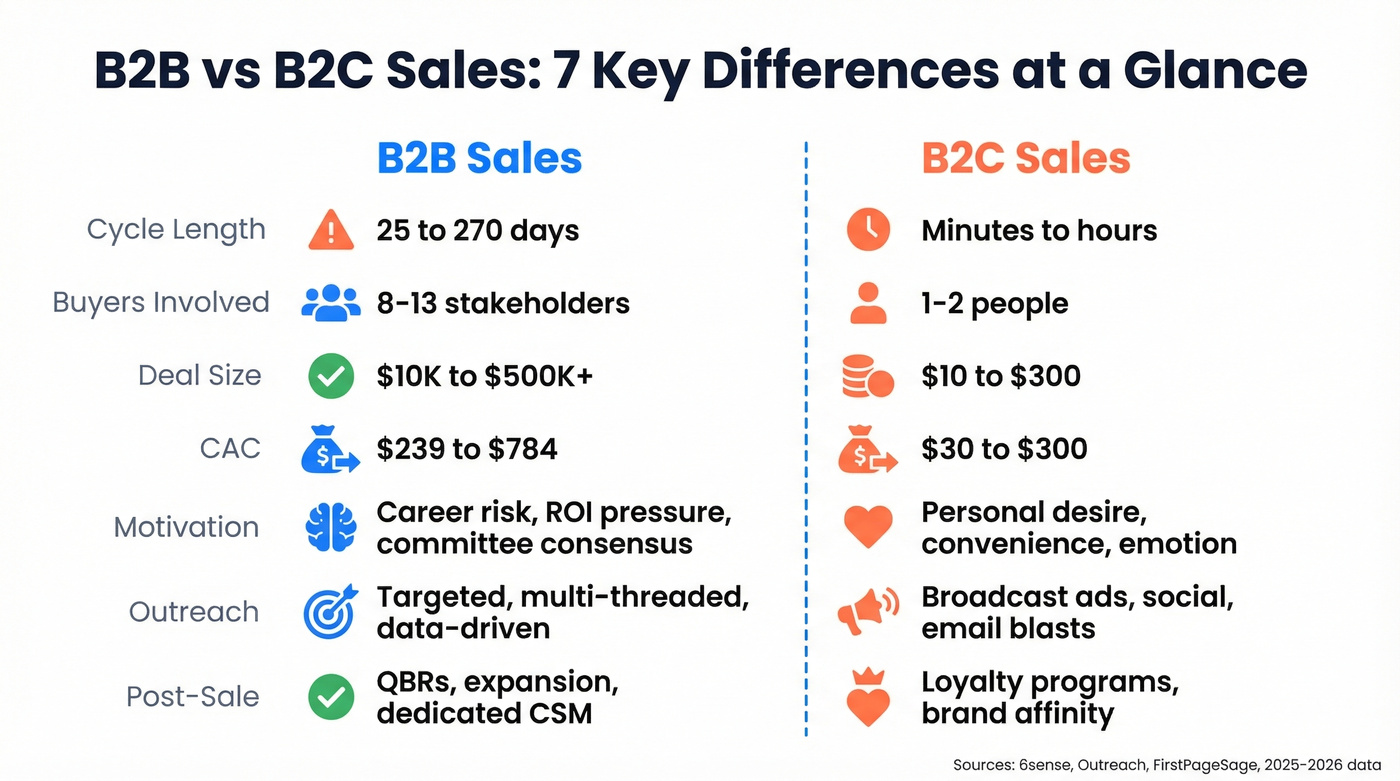
The average B2B cycle stretched from 4.9 months in 2019 to 6.5 months by 2023 before the compression we're seeing now. Here's how it breaks down:
| Dimension | Segment | Cycle Length |
|---|---|---|
| By Industry | Software | 90 days |
| By Industry | Manufacturing | 130 days |
| By Industry | Energy | 155 days |
| By Deal Size | Under $1K | 25 days |
| By Deal Size | $50K-$100K | 120 days |
| By Deal Size | Over $500K | 270 days |
| By Company Size | 1-10 employees | 38 days |
| By Company Size | 1,001-5,000 | 135 days |
| By Company Size | 10,001+ | 185 days |
Channel matters too - referral-sourced deals close in 20-60 days depending on complexity, while cold outbound takes 60-110 days.
Here's the thing: speed matters more than most teams realize. Opportunities closed within 50 days carry a 47% win rate. Push past that threshold and you're looking at roughly 20% or lower. Every week a deal lingers, your odds deteriorate. B2C doesn't have this problem - there's no "stale deal" in a checkout cart.
2. Buying Committees vs Individual Buyers
The trendline is brutal. In 2015, the average B2B purchase involved 5.4 stakeholders. By 2017, that climbed to 6.8. Industry estimates put it at 8.2 by 2023. Today, depending on deal complexity and company size, you're looking at 8-13 stakeholders who need to say yes before anything moves forward.
Even when you reach all of them, 86% of B2B purchases stall. Committees create consensus paralysis. A B2C customer adds something to their cart and checks out. One person, one decision, one click.
You can't just win over your champion anymore. You need to multi-thread across the entire buying group - finance, IT, legal, end users, and the executive sponsor who signs the check. We've seen deals die at the finish line because a single stakeholder nobody bothered to loop in raised a last-minute objection. It's maddening, and it's the norm.
3. Deal Size and CAC
B2C transactions live in the tens to low hundreds of dollars. B2B operates in a completely different universe - $10K-$50K for SMB software, $50K-$100K mid-market, $100K+ enterprise. That's why B2B can afford longer cycles, dedicated AEs, and custom proposals.
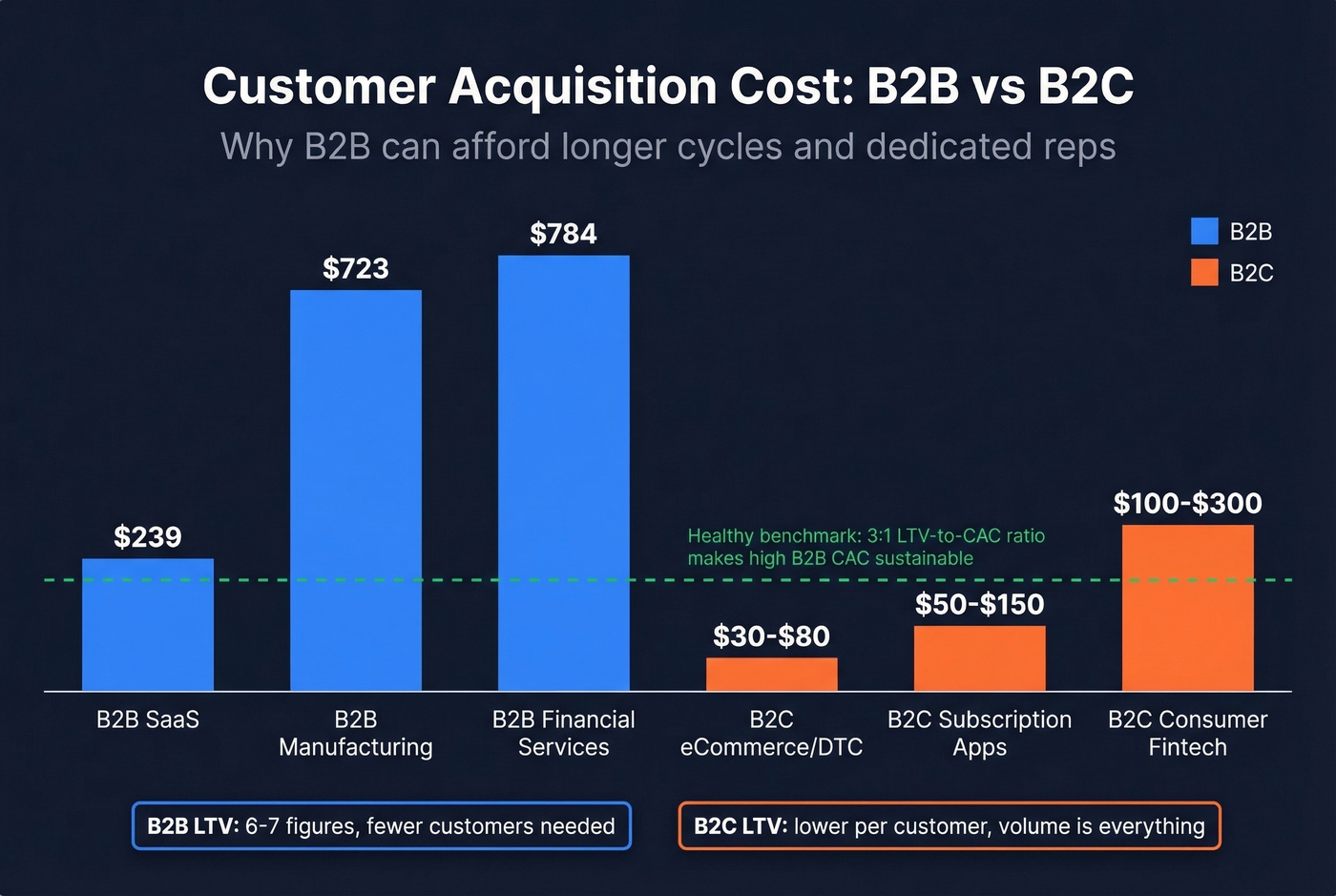
The cost to acquire a single customer reflects this gap:
| Category | CAC |
|---|---|
| B2B SaaS | $239 |
| B2B Manufacturing | $723 |
| B2B Financial Services | $784 |
| B2C eCommerce/DTC | $30-$80 |
| B2C Subscription Apps | $50-$150 |
| B2C Consumer Fintech | $100-$300 |
The healthy benchmark is a 3:1 LTV-to-CAC ratio. In B2B, that math works because lifetime values run into six or seven figures. In B2C, you need massive volume to offset thin margins.
4. Buying Motivation
The myth: B2B buyers are rational. B2C buyers are emotional.
The reality: Forrester's 2024 research puts buyer dissatisfaction at 81% with the provider they chose. If B2B buying were purely rational, that number would be a lot lower.
B2B purchases are driven by career anxiety, vendor fatigue, fear of making the wrong call in front of the committee, and pressure to show ROI within a quarter. Those are deeply emotional drivers wrapped in a rational-sounding business case. B2C buyers are just more honest about it.
Let's be real: if your annual contract value sits below $10K, the B2B/B2C line barely exists. Self-serve SaaS with a credit card checkout is functionally a B2C motion wearing a B2B costume. The real distinctions kick in when deals require multiple approvals and custom contracts.
5. Prospecting and Outreach
B2B reps spend only 28-30% of their time actually selling. The rest goes to admin, CRM updates, and finding the right people to talk to. When your buying committee has 8-13 members, you need accurate contact data for every single one of them.

B2C outreach is broadcast marketing - ads, social, email blasts to massive lists. B2B layers GDPR and stricter DNC/TCPA constraints on top of CAN-SPAM, and the data quality problem is uniquely punishing because contact data decays within weeks as people change jobs or get promoted. Prospeo runs a 7-day data refresh cycle across its 300M+ professional profiles - the industry average is six weeks. When you're trying to reach a dozen stakeholders at a target account, 98% email accuracy is the difference between a sequence that converts and one that tanks your domain reputation.
6. Sales Frameworks
B2B is complex enough that entire methodologies exist just to navigate it. SPIN Selling came from analysis of 35,000+ sales calls across 20+ countries. The Challenger Sale was built on research covering 6,000 reps at 90 companies. MEDDIC emerged at PTC in the 1990s and remains the gold standard for enterprise qualification.
B2C doesn't have equivalents. You don't need a qualification methodology to sell sneakers. The closest B2C gets is conversion rate optimization and A/B testing - a fundamentally different discipline.
7. Post-Sale Relationships
B2B relationships deepen after the signature. Account management, QBRs, expansion revenue, multi-year renewals - the post-sale motion often generates more revenue than the initial deal. Customer lifetime values regularly hit six and seven figures.
B2C relationships are transactional by comparison. Retention comes from brand loyalty, rewards programs, and convenience - not a dedicated CSM who knows your business.

Deals closed within 50 days hit a 47% win rate. Deals that drag past that crater to 20%. The difference is reaching all 8-13 stakeholders fast - with contact data that doesn't bounce. Prospeo gives you 300M+ profiles refreshed every 7 days, 98% email accuracy, and 125M+ verified mobile numbers so you multi-thread the entire buying committee from day one.
Stop losing deals to stale data and missing stakeholders.
How B2B Buying Is Changing in 2026
B2B buying isn't standing still. 6sense's data shows the average sales cycle dropped from 11.3 to 10.1 months year-over-year. Nearly half of buyers say economic conditions shortened their cycles, and 62% are engaging sellers earlier than they used to.
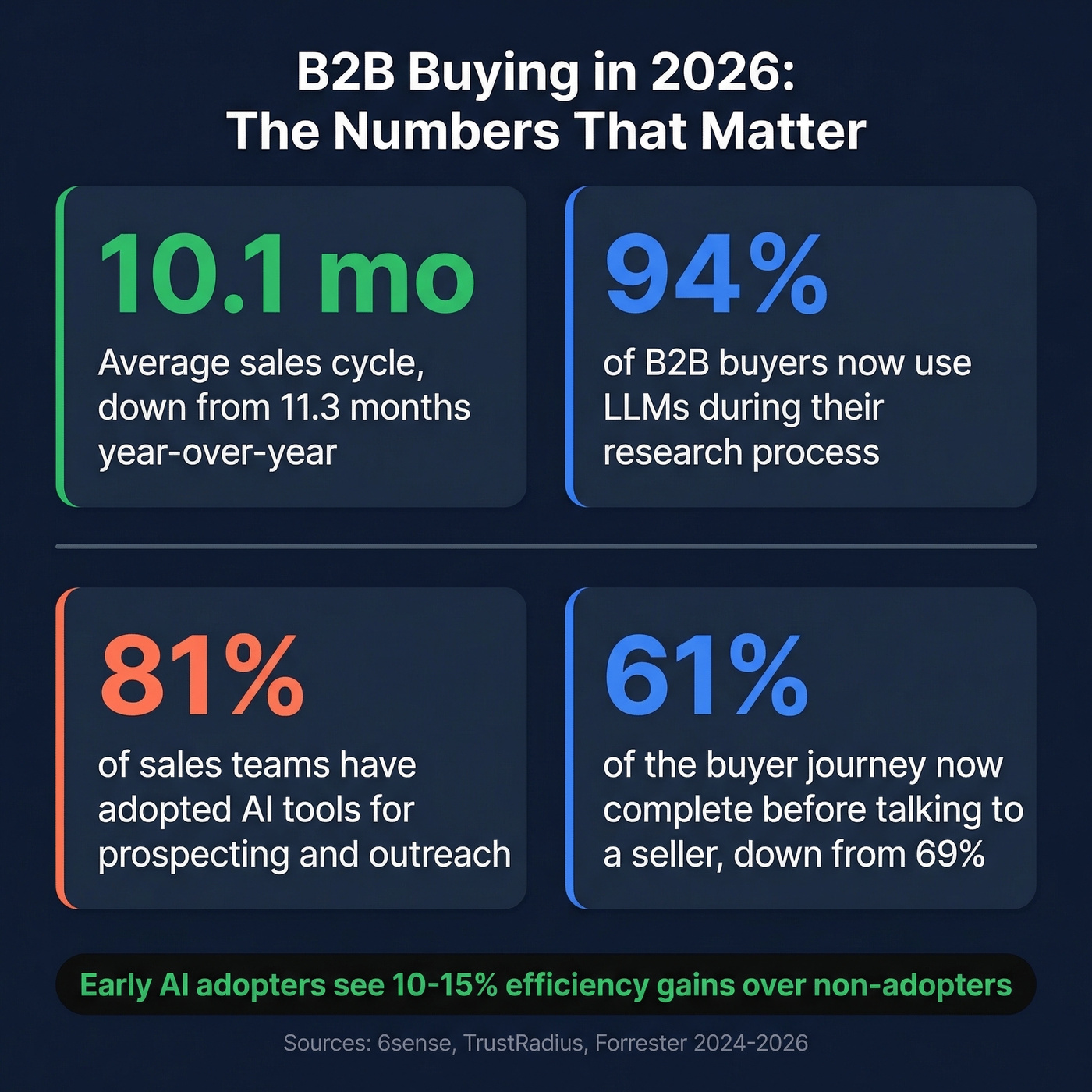
AI is accelerating everything. TrustRadius reports that 94% of B2B buyers now use LLMs during research. On the seller side, 81% of sales teams have adopted AI tools, with early adopters seeing 10-15% efficiency gains. We've watched teams cut prospecting time in half by layering intent data with AI-powered sequencing - the reps who resist this shift are falling behind fast.
Buyers used to complete 69% of their journey before talking to a seller. That's pulled forward to 61%, which means sellers who show up with relevant insights early have a real advantage.
Common Mistakes When Crossing Models
The biggest trap when switching between B2B and B2C is assuming your instincts transfer. They don't.
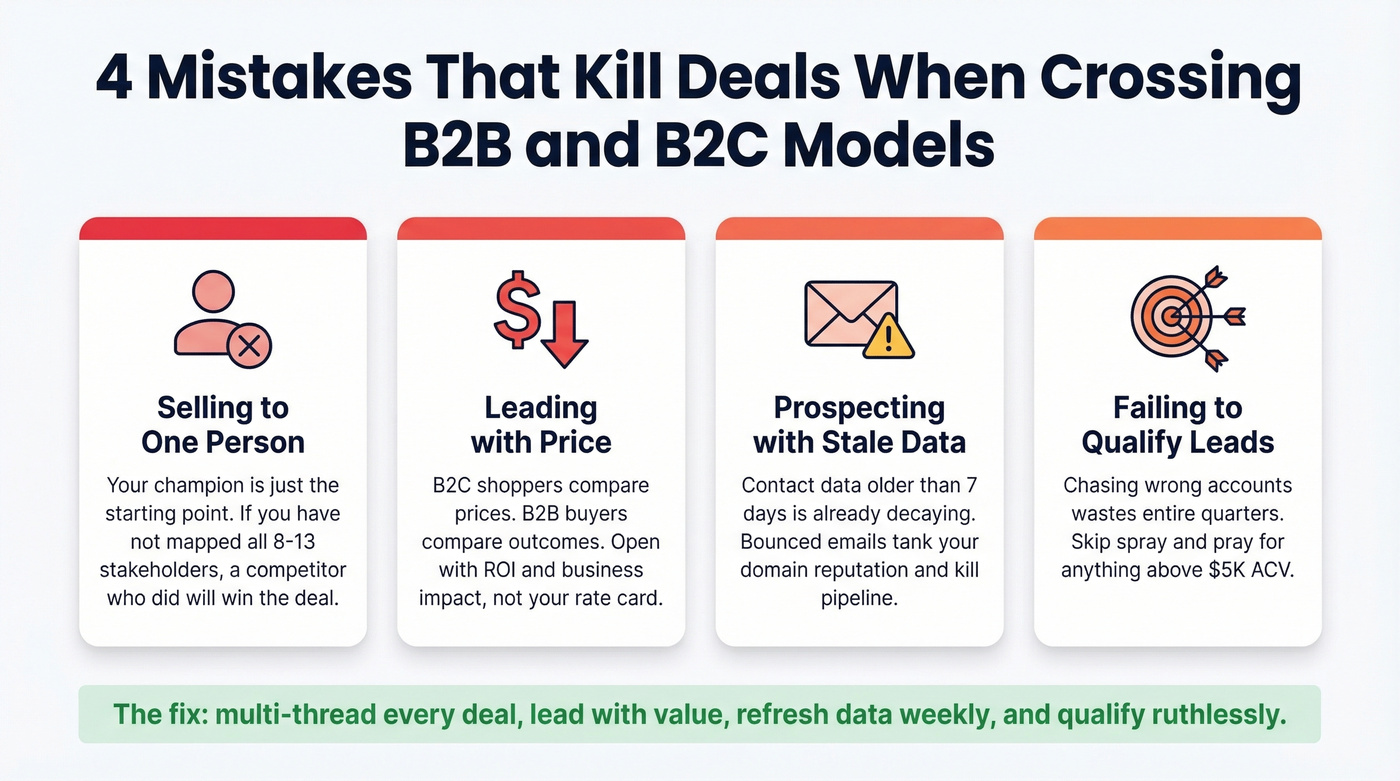
Selling to one person instead of the committee is the classic B2C-to-B2B mistake. Your champion is just the starting point - if you haven't mapped the full buying group, you'll lose to a competitor who did. Equally dangerous: leading with price instead of value. B2C shoppers compare prices; B2B buyers compare outcomes. Open with ROI, not your rate card.
On the tactical side, prospecting with stale data will kill your pipeline faster than bad messaging. If your contact data is more than a week old, it's already decaying. And failing to qualify leads wastes entire quarters - chasing the wrong accounts is the most expensive habit in B2B. Skip the "spray and pray" approach entirely if you're selling anything above $5K ACV.
Which Model Fits You?
B2B means higher commissions, deeper relationships, and the intellectual challenge of navigating complex organizations. It also means longer cycles, more rejection, and quarters where nothing closes. B2C offers faster wins, higher volume, and the dopamine hit of closing multiple deals per day - but a lower ceiling on individual deal value.
Many companies operate in both worlds. Manufacturers run DTC channels alongside enterprise distribution. SaaS companies offer self-serve plans that feel like B2C alongside six-figure enterprise contracts. The line is blurrier than most guides admit.
Pick based on your temperament. The best B2C reps we've seen struggle in B2B because they can't slow down. The best B2B reps struggle in B2C because they over-engineer every interaction. Whichever side you land on, the differences between B2B and B2C sales shape every tool, tactic, and metric you'll use - so understand them before you build your playbook.
B2B reps spend 70% of their time not selling - hunting for contacts, updating CRMs, fixing bounced emails. With 30+ search filters, buyer intent signals across 15,000 topics, and emails at $0.01 each, Prospeo eliminates the data bottleneck that kills B2B pipelines. Your SDRs send sequences that land, not sequences that tank your domain.
Give your reps the 28% of selling time back - with data that actually connects.
FAQ
Is B2B sales harder than B2C?
By most measurable metrics, yes. Only 16% of B2B reps hit quota in 2023, average win rates sit at 20-21%, and 86% of deals stall before closing. B2C has its own challenges - thin margins, massive volume requirements - but B2B's complexity with multi-stakeholder committees and longer cycles is quantifiably higher.
How long is a typical B2B sales cycle?
Under $1K, expect roughly 25 days. $50K-$100K averages 120 days. Over $500K stretches to 270 days. The overall average is approximately 6.5 months, though 6sense data shows this compressing as buyers engage sellers earlier in 2026.
What tools do B2B sales teams need?
B2B teams need a contact data platform for verified emails and direct dials, a CRM with pipeline management and multi-stakeholder tracking, sales engagement tools for sequencing, and intent data to identify in-market buyers. B2C teams rely on marketing automation, eCommerce platforms, and ad tech - fundamentally different stacks.
Can a company run both B2B and B2C sales?
Yes - many do. SaaS companies offer self-serve plans alongside enterprise contracts with dedicated AEs. Manufacturers sell DTC while running enterprise distribution. The key is separating the motions: different teams, different metrics, and different tech stacks for each model.