

6 Diggernaut Alternatives That Actually Work in 2026
Every "Diggernaut alternatives" page is an auto-generated directory listing 50 tools with zero guidance. Here are 6 that actually matter.
Diggernaut's G2 profile hasn't been active in over a year. The tool has exactly one review - from August 2023 - and while that reviewer praised Diggernaut's API, they flagged pricing as a barrier. On G2, pricing includes Medium ($59.99/mo) and Large ($199.99/mo). Diggernaut's own pricing page lists plans from $0 (PAYG) up through $499.99/mo, $999.99/mo, and Custom. When a product's public footprint goes that quiet, you don't build workflows on top of it. If you're here, you already know it's time to move.
Our Picks (TL;DR)
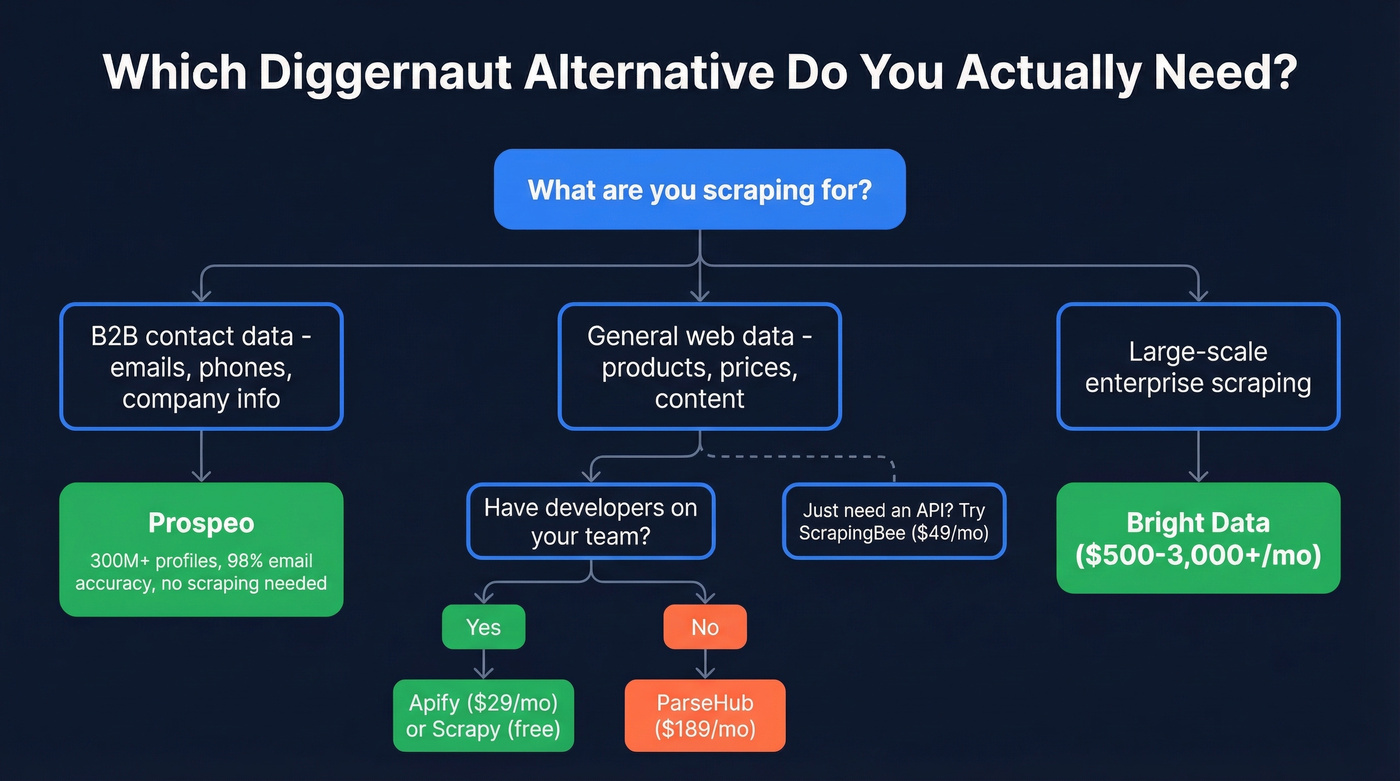
- Prospeo - Best if you're scraping for B2B contact data. Skip the scraper entirely; search 300M+ profiles and export verified emails.
- Apify - Best general-purpose scraping platform for developers. 10,000+ pre-built Actors, free tier included.
- ParseHub - Best no-code visual scraper. Point-and-click interface, IP rotation included.
Do You Actually Need a Scraper?
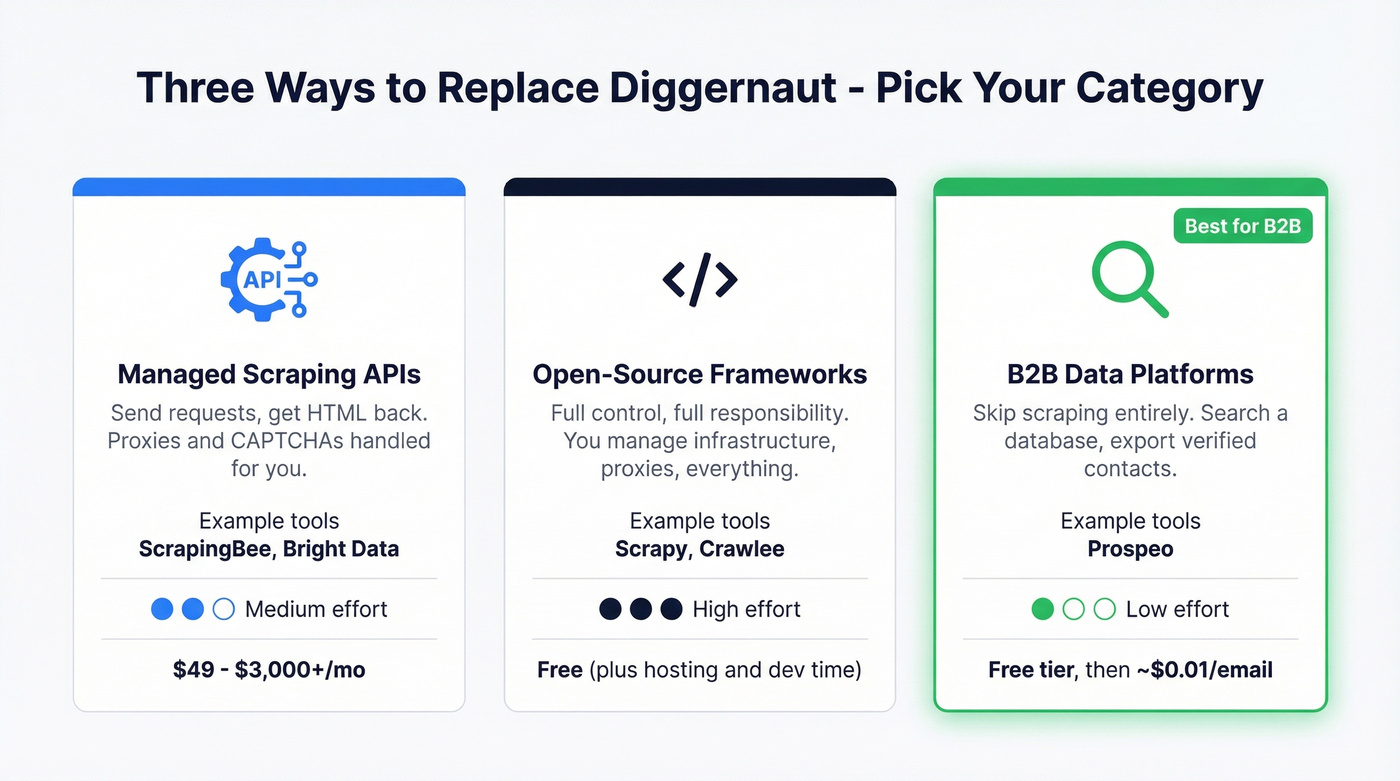
Before picking a replacement, figure out which category you actually need. Managed scraping APIs like ScrapingBee handle proxies and CAPTCHAs for you. Open-source frameworks like Scrapy give you full control but require infrastructure. And B2B data platforms skip scraping entirely.
Here's the thing: if you're using Diggernaut to collect business emails and phone numbers from company websites, building a scraper is solving the wrong problem in 2026. In our experience, most teams scraping for B2B data are better served by a dedicated sales prospecting database - no proxy management, no CAPTCHA solving, no HTML parsing.
If your average deal size sits below five figures, you almost certainly don't need a custom scraping pipeline for prospecting. The maintenance cost alone will eat your margin.

If your Diggernaut workflow was really about finding business emails and phone numbers, you never needed a scraper - you needed a data platform. Prospeo gives you 300M+ profiles, 98% email accuracy, and 125M+ verified mobiles with zero proxy management or HTML parsing.
Replace your entire scraping pipeline with a search bar.
The Best Diggernaut Alternatives for 2026
Prospeo - Skip the Scraper for B2B Data
If your Diggernaut workflow boils down to "find contact data for prospects," Prospeo replaces the entire pipeline. Instead of building a digger, managing proxies, and parsing HTML for email patterns, you search a database of 300M+ professional profiles with 30+ filters - job title, company size, technographics, buyer intent, funding stage - and export verified contacts directly.
The platform delivers 98% email accuracy through a proprietary 5-step verification process, with 143M+ verified emails and 125M+ verified mobile numbers. Data refreshes every 7 days, roughly six times faster than the industry average. One of our customers, Snyk, cut their bounce rate from 35-40% to under 5% and saw AE-sourced pipeline jump 180% after switching from manual prospecting workflows.
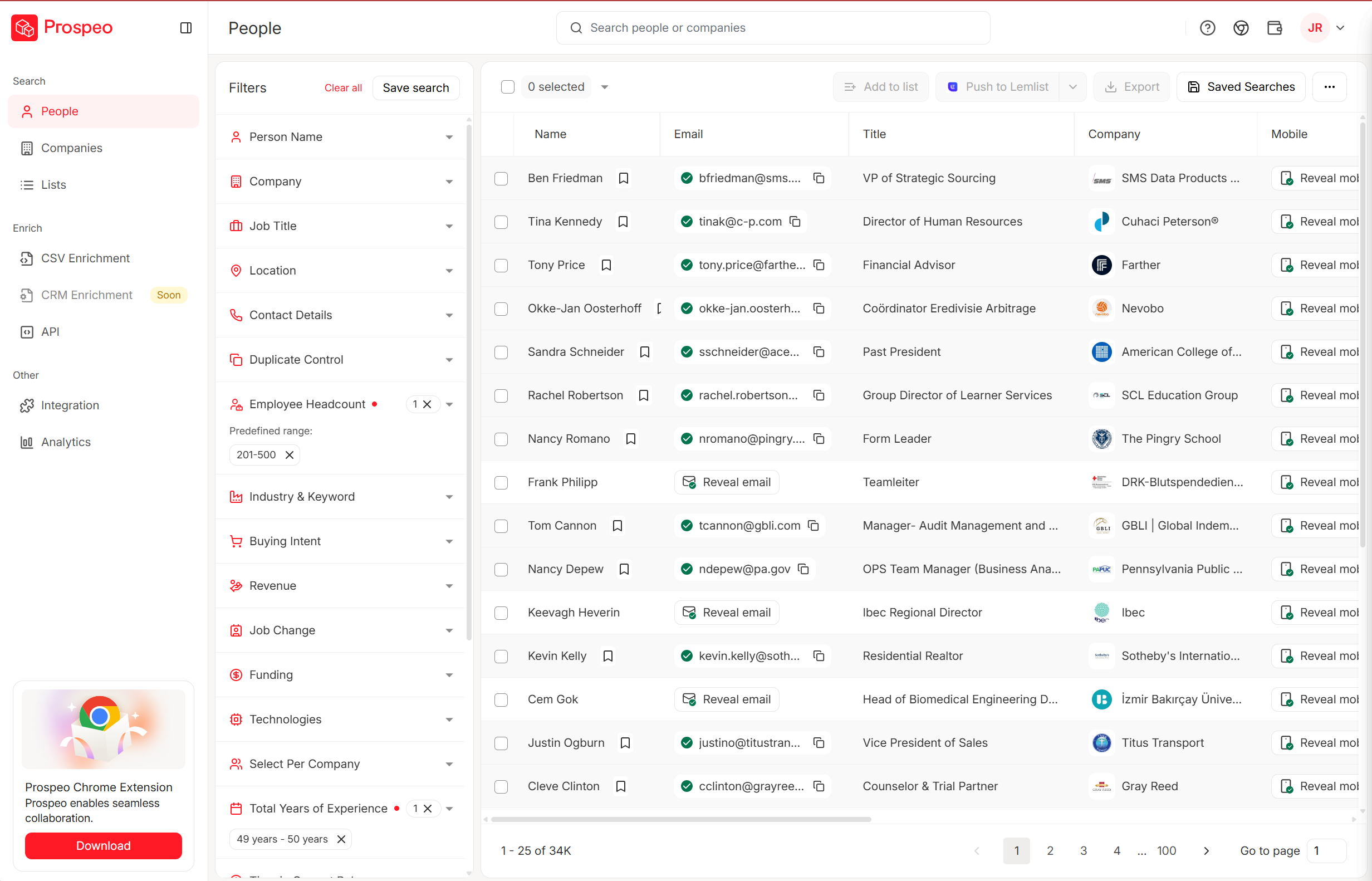
Pricing runs about $0.01 per email on paid plans, with a free tier that gives you 75 emails and 100 Chrome extension credits per month. Native integrations push contacts straight into Salesforce, HubSpot, Lemlist, Instantly, or Clay.
Use this if: You're prospecting for B2B contacts and don't want to maintain scraping infrastructure.
Skip this if: You need to scrape product data, pricing pages, or non-contact web content - that's a different problem entirely.
Apify - Developer Marketplace
Apify is the closest thing to a direct Diggernaut replacement for general-purpose scraping. The Apify Store has over 10,000 pre-built Actors - ready-made scrapers for everything from e-commerce sites to social platforms - so you're rarely building from scratch. The platform guarantees 99.95% uptime, which matters when you're running production workflows.
Billing runs on compute units (CUs), where 1 CU equals 1 GB of RAM for one hour. At the Starter tier, that's $0.30 per CU. In practice, a small lead gen scraping job runs about $5-15/mo. E-commerce price monitoring lands closer to $30-80/mo. We've found the free tier genuinely usable for testing and small projects - you get $5 in prepaid usage with no time limit on the credits.
Plans start free, then $29/mo for Starter and $199/mo for Scale.

Use this if: You're a developer who needs flexible, general-purpose scraping with minimal setup.
Skip this if: You just need business contact data - you'll spend more time configuring Actors than a data platform would take.
Scrapy - Open-Source Framework
Verdict first: If you have Python developers and want full control without vendor lock-in, Scrapy is the gold standard. If you don't have engineering resources to maintain scrapers long-term, skip it entirely.
Scrapy is free, open-source (BSD-3 license), and maintained by Zyte. It's a Python framework, not a managed service, which means you get total control over your scraping logic and total responsibility for infrastructure, proxy management, and error handling. Built-in middleware handles throttling, retries, and user-agent rotation, and the async architecture lets you run hundreds of concurrent requests without breaking a sweat.
The tool itself costs nothing. Your costs are hosting, proxies, and developer time. Scrapy and Apify are the two tools that consistently come up in Reddit threads and developer forums about production scraping - and for good reason. But for teams without dedicated Python talent, Scrapy is a time sink that never stops draining hours.
ParseHub vs. Apify - The No-Code Question
ParseHub offers a point-and-click interface that lets non-technical users build scrapers visually. IP rotation is included, and exports come in JSON, Excel, or CSV. It runs on Windows, macOS, and Linux.
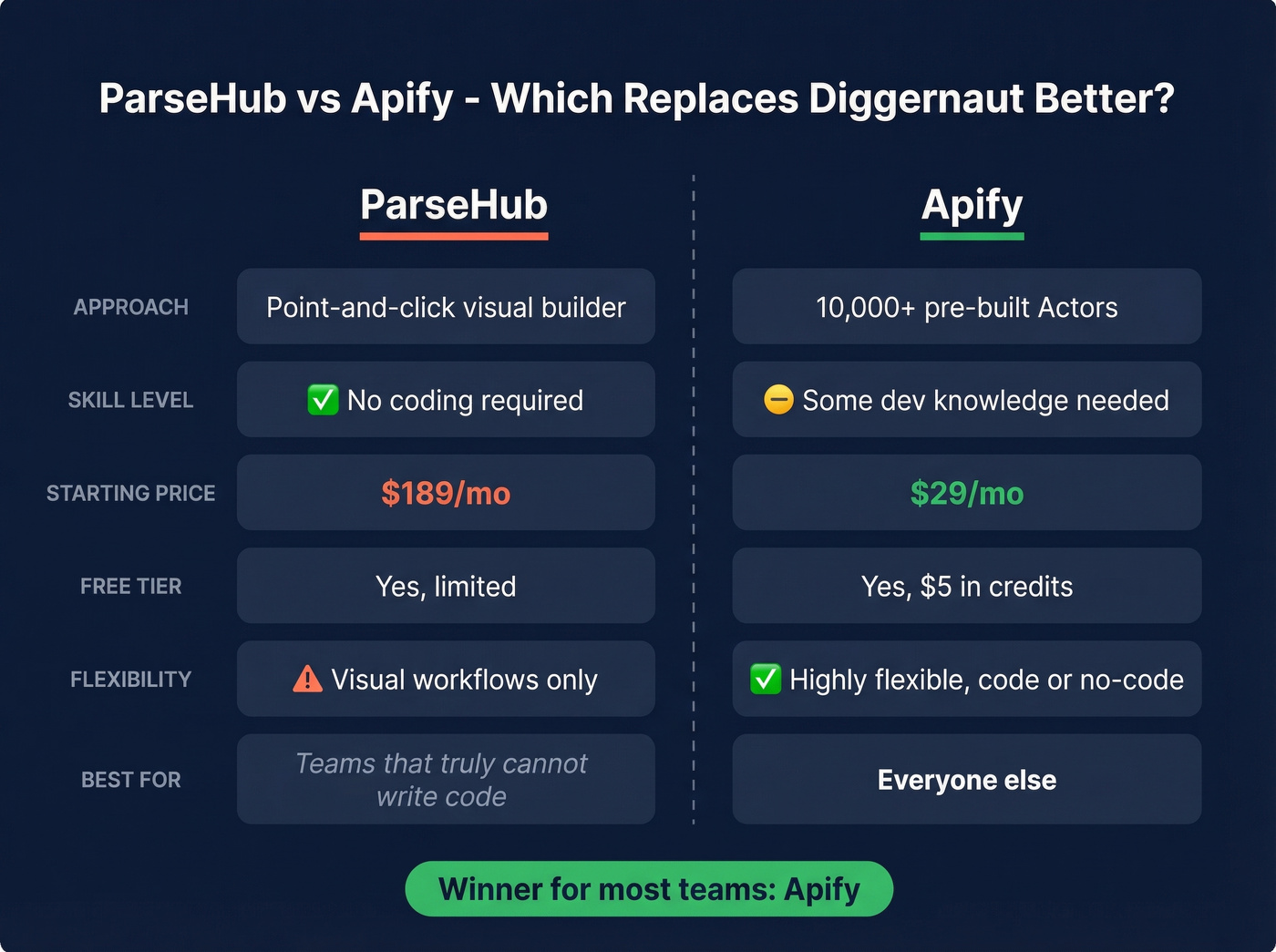
Let's break down the honest comparison:
| ParseHub | Apify | |
|---|---|---|
| Ease of use | Point-and-click, no code | Requires some dev knowledge |
| Starting price | $189/mo (Standard) | $29/mo (Starter) |
| Free tier | Yes (limited) | Yes ($5 in credits) |
| Flexibility | Visual workflows only | 10,000+ pre-built Actors |
The free plan is solid for testing, but the jump to $189/mo for Standard is steep - more than six times Apify's Starter tier for comparable work. Professional runs $599/mo. ParseHub makes sense only if your team genuinely can't write code and needs a visual builder. For everyone else, Apify wins on both price and flexibility.
ScrapingBee - Simple API
ScrapingBee starts at $49/mo and handles proxies and CAPTCHAs behind a clean REST API. It's the right pick for teams that want to send HTTP requests and get back HTML without managing any infrastructure. We'd recommend it over ParseHub for any team with even basic API experience - you'll pay less and get more control.
Bright Data - Enterprise Scale
Bright Data serves 20,000+ customers and offers proxy bandwidth from $0.066/GB. Typical scraping stacks run $500-3,000+/mo depending on volume and proxy type. This is the enterprise play - overkill for small teams, essential for large-scale data collection operations.
Other tools worth a look: Crawlee (modern TypeScript scraping framework by the Apify team), Oxylabs (enterprise proxies), and Browse AI (no-code web automation). We intentionally left out ETL tools like Fivetran and Skyvia - they solve a different problem than Diggernaut's core scraping use case.
Snyk's 50 AEs dropped their bounce rate from 35-40% to under 5% and grew AE-sourced pipeline 180% - no scrapers involved. Prospeo's 7-day data refresh and 5-step verification deliver contacts that actually connect, at roughly $0.01 per email.
Stop maintaining scrapers. Start booking meetings.
Pricing Comparison
Here's how every tool stacks up on price and model.
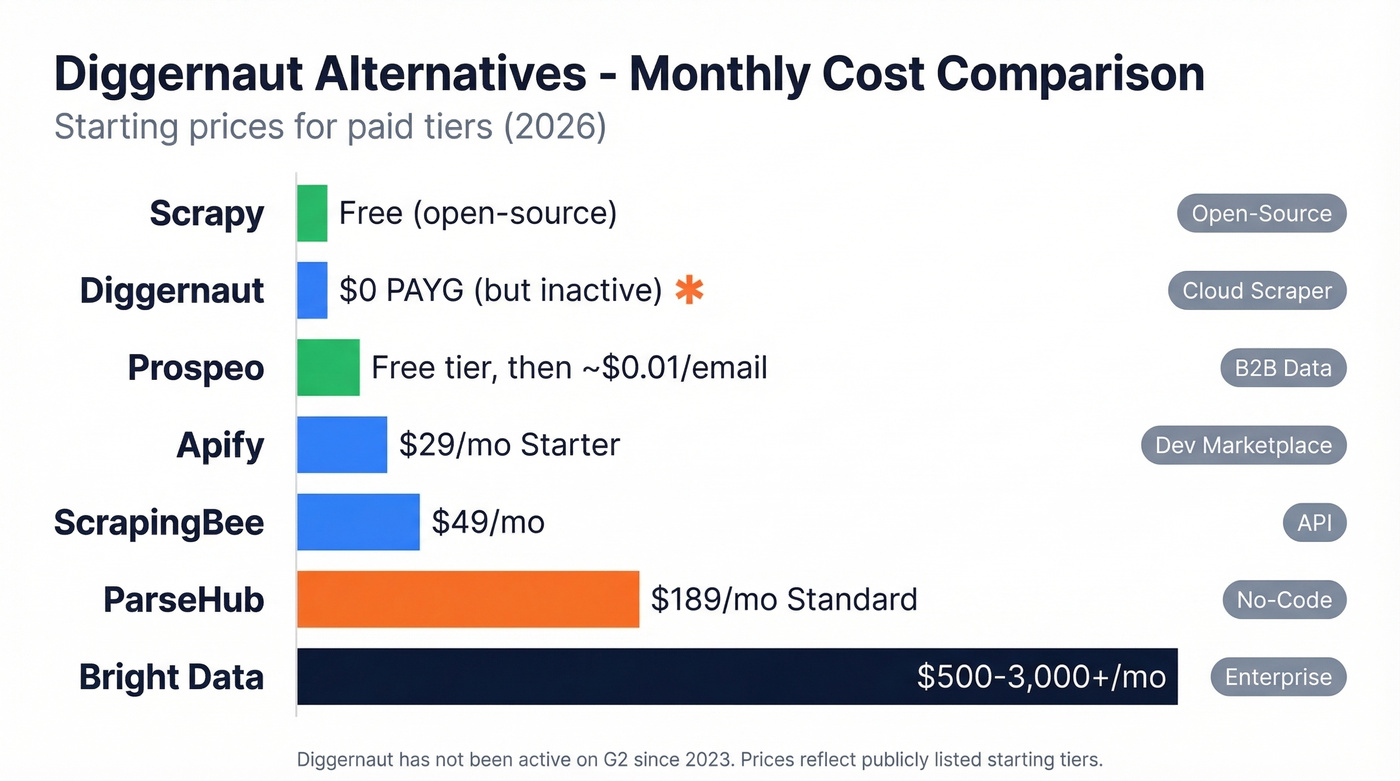
| Tool | Type | Starting Price | Free Tier | Best For |
|---|---|---|---|---|
| Diggernaut | Cloud Scraper | $0/mo (PAYG) | Yes (5K req/mo) | Compiled scrapers, API |
| Prospeo | B2B Data Platform | ~$0.01/email | Yes (75 emails/mo) | B2B contacts, no scraping |
| Apify | Dev Marketplace | $29/mo (Starter) | Yes ($5 usage) | General scraping, Actors |
| Scrapy | Open-Source | Free | N/A (open-source) | Python devs, full control |
| ParseHub | Visual Scraper | $189/mo | Yes (limited) | Non-technical, no-code |
| ScrapingBee | Scraping API | $49/mo | No | REST API, no infra |
| Bright Data | Enterprise | ~$500-3,000+/mo | No | Large-scale scraping |
FAQ
Is Diggernaut still active?
Diggernaut's G2 profile hasn't been active in over a year, and the product has just one review, dated August 2023. That's a red flag for production workflows. We'd recommend moving to an actively maintained alternative.
What's the cheapest Diggernaut alternative?
Scrapy is completely free as an open-source framework - you only pay for hosting and proxies. For managed options, Apify gives you $5 in compute credits monthly, and Prospeo's free tier includes 75 verified emails per month - enough to test a B2B workflow before committing.
Do I need a web scraper to find B2B emails?
No. Building and maintaining a scraper to collect business emails is unnecessary in 2026. Dedicated B2B databases offer 143M+ verified emails searchable by 30+ filters - job title, company size, intent signals, technographics - with 98% accuracy. You search, filter, and export. No proxies, no CAPTCHA solving, no HTML parsing.
Which Diggernaut alternative is best for developers?
Apify is the strongest pick for developers who need general-purpose scraping. Its 10,000+ pre-built Actors cover most common use cases, and the $29/mo Starter plan includes enough compute for small-to-mid production jobs. For full control with zero vendor lock-in, Scrapy is the open-source standard.