

Discovery Call Follow-Up Email: Template + Data (2026)
The Recap Email That Actually Gets Replies
You just hung up from a discovery call that went perfectly - real pain uncovered, budget confirmed, next steps agreed on. Now you're staring at a blank email draft. Here's the thing: your discovery call follow-up email matters more than the call itself. 80% of sales require five or more follow-ups, yet 44% of reps quit after the first. The call opens the door. The recap email keeps it from swinging shut.
What Your Recap Email Needs
Forget the ten-paragraph debrief. Your recap only needs to do two things: (1) confirm the next step with a date and an owner, and (2) remind them why they agreed to take that step. That's it.
We've seen reps overthink this into oblivion - three paragraphs of pleasantries, a wall of bullet points, a sign-off that reads like a legal disclaimer. Don't be that rep. Send it within two hours of hanging up, keep the whole thing to one phone screen, and close with "Anything I missed?" instead of the limp "Let me know if you have questions." The first invites a reply. The second invites silence.
When to Send Your Follow-Up
Leads contacted within five minutes are up to 100x more likely to qualify. You don't need to hit that bar for a discovery recap, but the principle holds - speed signals professionalism and keeps the conversation warm. Next-day follow-ups actively hurt reply rates.
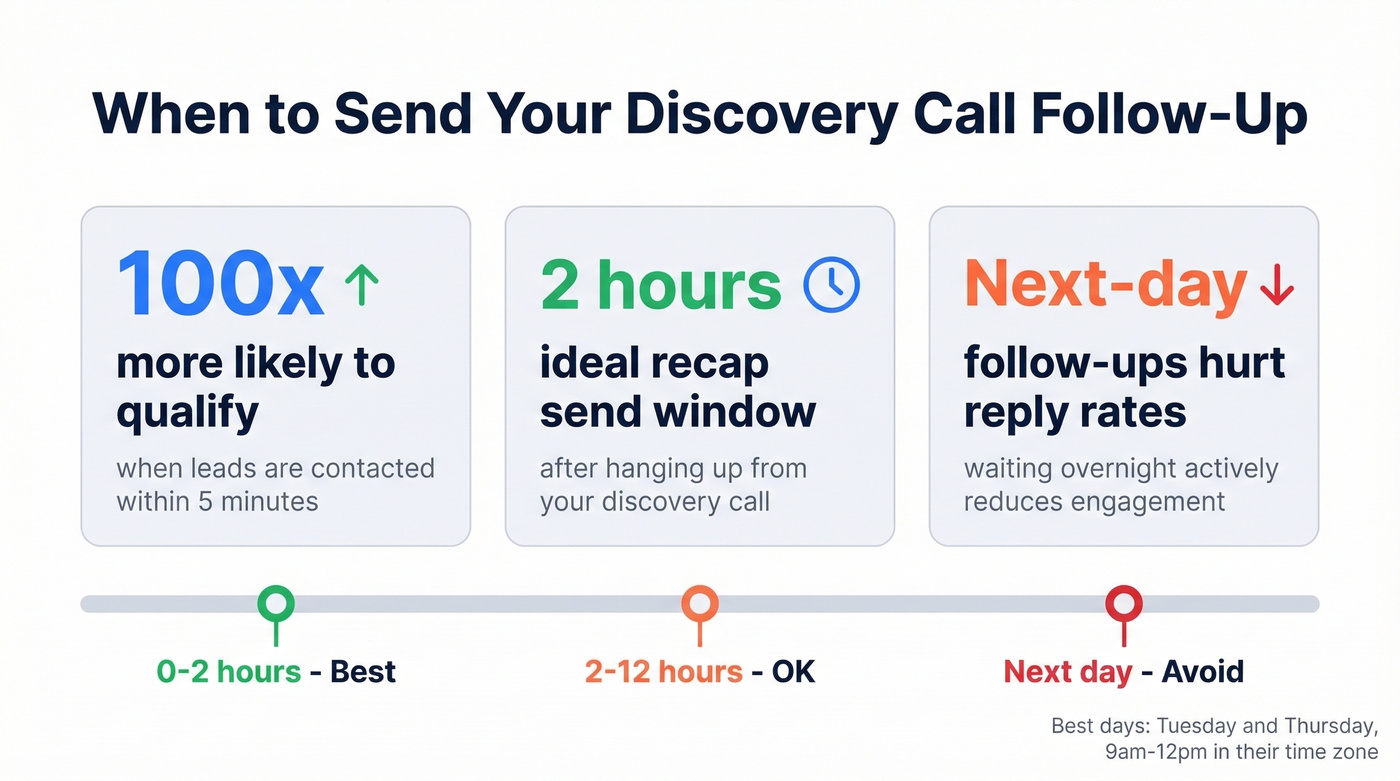
Send your recap within two hours. If you can pick a send window, 9am-12pm in their time zone on Tuesday or Thursday tends to perform best.
| Scenario | Send within |
|---|---|
| Discovery recap | 2 hours |
| No-response nudge | 3 days |
| Proposal follow-up | 2-3 days |

You nailed the discovery call. Don't let a bounced email kill the deal. B2B contact data decays 30% per year - that follow-up you just crafted might never land. Prospeo verifies emails at 98% accuracy with a 7-day refresh cycle, so your recap hits the right inbox every time.
Verify your prospect's email before you send that recap.
How to Structure It
Most recap emails bury next steps at the bottom. Flip the structure. Lead with the action - what's happening, when, and who owns it. Then add two or three bullets of context underneath.
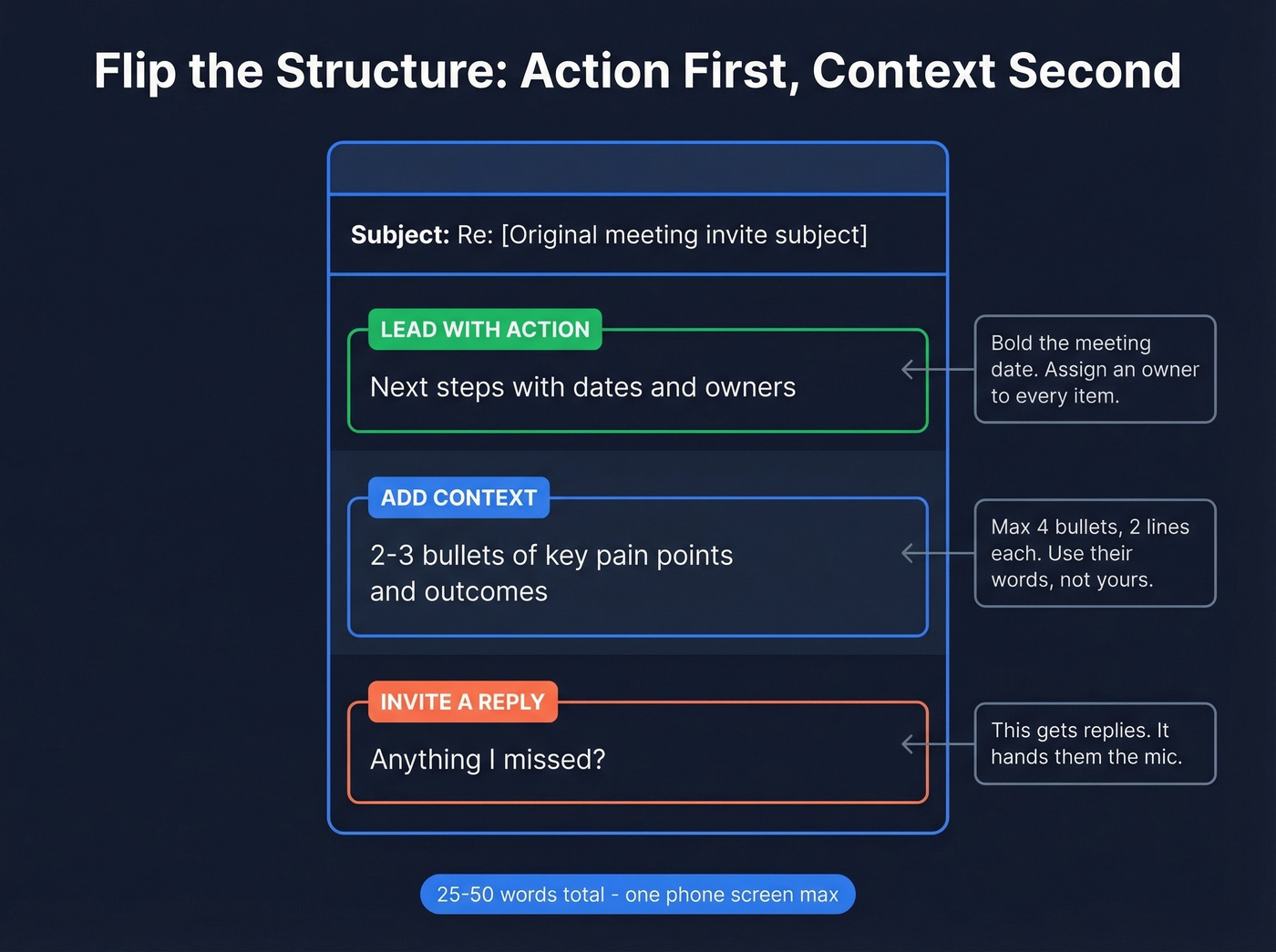
The entire email should be 25-50 words. No more than four bullets, max two lines each. Bold the meeting date. Assign owners to every action item. And close with "Anything I missed?" - it gets replies because it hands them the mic.
Copy-and-Paste Recap Template
Here's the template. Copy it, then change at least 20-30% to match your actual conversation - personalized emails pull 29% higher open rates and 41% higher click-through rates, so that customization isn't optional.
Subject: Re: [Original meeting invite subject]
Hi [First Name],
Great talking today. Here's where we landed:
Next steps:
- [Next meeting/demo] - [Date, Time] ([You/They] to send invite)
- [Prospect action] - [They] to share [document/access/intro] by [Date]
- [Your action] - [You] to send [pricing/case study/proposal] by [Date]
Quick recap:
- [Key pain point discussed]
- [Desired outcome they mentioned]
- [Timeline or urgency driver]
Anything I missed?
[Your name]
Reply in the existing thread. It keeps context in one place and feels less "cold" than a brand-new email.
Adapting for Your Framework
If you ran a BANT-style call, your recap bullets map to Budget, Authority, Need, and Timeline. For MEDDIC, you're covering Metrics, Economic Buyer, Decision Criteria, Decision Process, Identified Pain, and Champion. Don't list all six - pick the two or three that matter most for the next conversation.
For context, an analysis of 326K sales calls found that won deals average 57% rep talk time and 15-16 questions. If your call hit those marks, the recap locks in that momentum. If you talked too much, the recap is your chance to rebalance by centering their words, not yours.
Three Mistakes That Kill Your Follow-Up
1. "Just bumping this." Every follow-up must add new value. A case study, a relevant stat, a competitor insight - something that earns the open. "Checking in" earns the archive button.
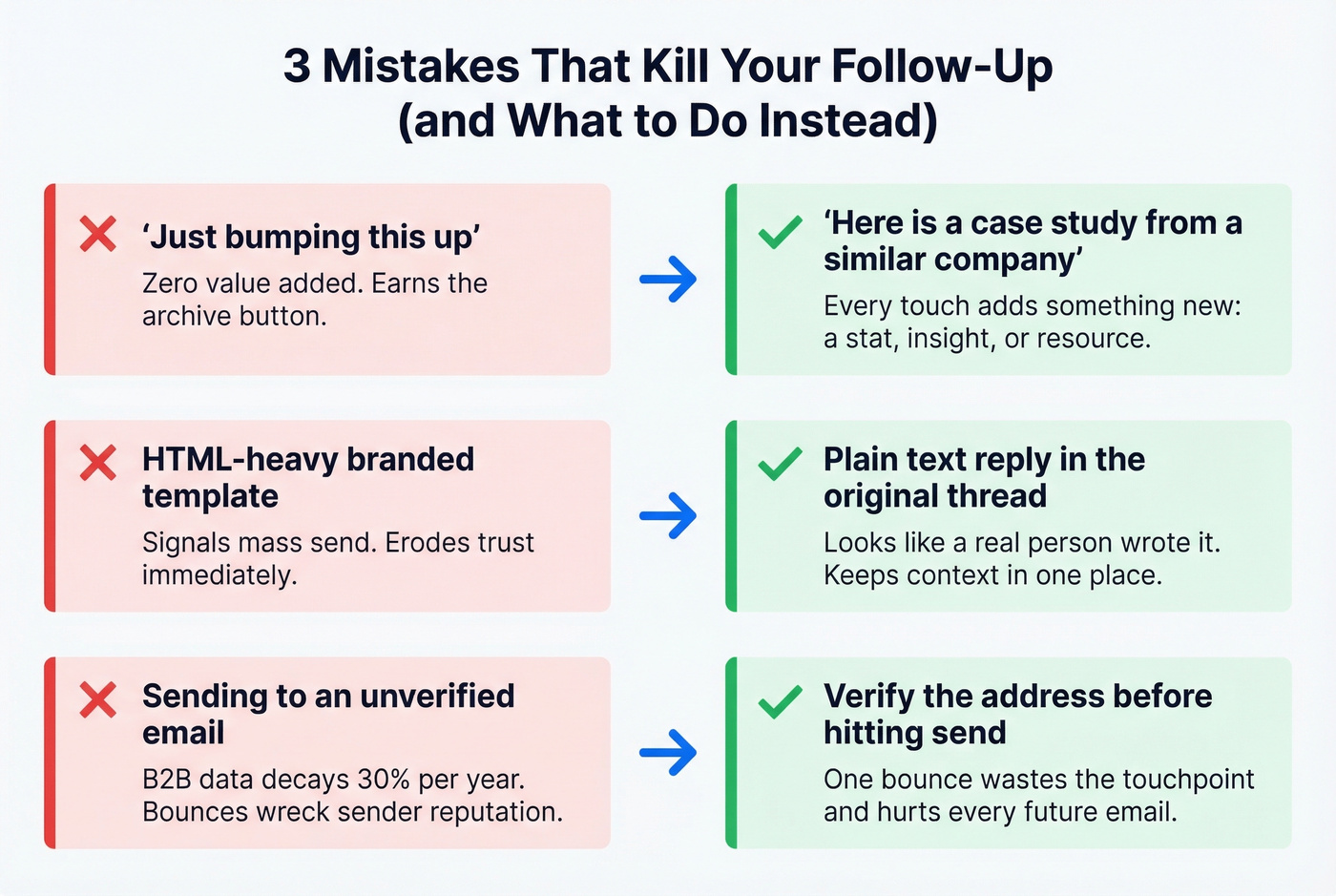
2. HTML-heavy formatting. Strip the fancy templates. Plain-text emails sent as a reply to the original thread win because they look like a real person wrote them. Formatted marketing-style emails signal "mass send" and erode trust fast.
3. Sending to a stale email address. B2B contact data decays roughly 30% per year. If you're following up with someone who changed roles since your CRM last synced, that email bounces - and repeated bounces drag down your sender reputation across every outbound message you send after it. Run the address through a verification tool before hitting send. Prospeo handles this with 98% accuracy, and the free tier covers 75 verifications a month.
When They Don't Reply
Don't panic. And don't send "just following up" the next morning.
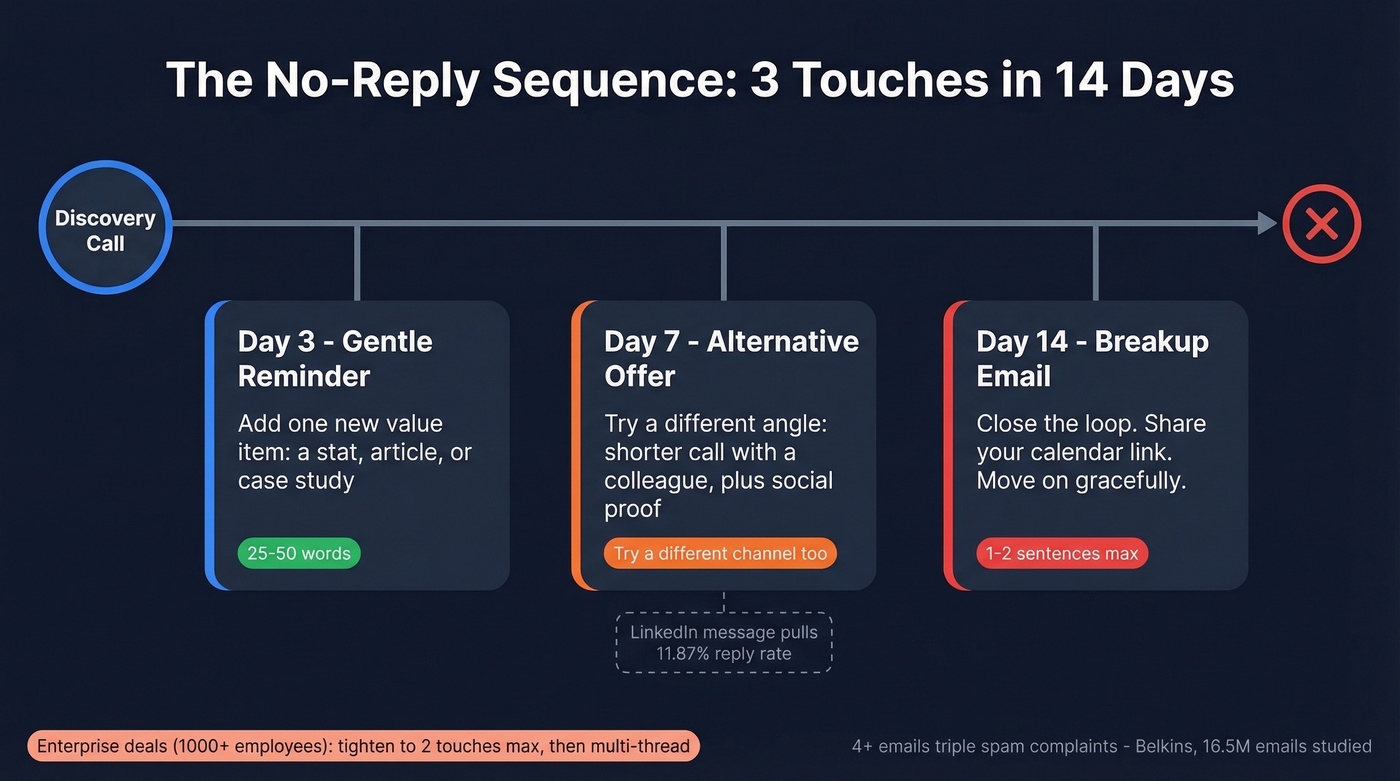
In our experience, reps who stick to a structured sequence outperform the ones who wing it every time. Here's a three-touch cadence that respects their inbox while keeping the deal alive:
| Day | Move | Length |
|---|---|---|
| Day 3 | Gentle reminder + one new value add (stat, article, case study) | 25-50 words |
| Day 7 | Alternative offer: "Would a shorter call with [colleague] work better?" + social proof | 25-50 words |
| Day 14 | Breakup: "Closing the loop. If timing changes, here's my calendar link." | 1-2 sentences |
A Belkins study of 16.5M emails found the highest reply rate (8.4%) comes from the first email. Reply rates decline with each follow-up, and sending four or more emails in a sequence more than triples spam complaints. Two to three follow-ups is the ceiling, not the floor.
If email isn't working by Day 7, try a different channel before the breakup. A profile visit plus a direct message on a professional network pulls an 11.87% reply rate according to the same data - worth trying before you close the loop.
Let's be honest about enterprise deals: prospects at companies with 1,000+ employees ghost faster and tolerate fewer follow-ups than SMB buyers. If your deal size is north of $50k and you're selling into a large org, tighten the sequence to two touches max and multi-thread to a different stakeholder instead. The third email to the same person isn't persistence. It's noise.
Multi-threading into a new stakeholder on Day 7? You need their verified email and direct dial first. Prospeo gives you 300M+ profiles with 30+ filters - find the right champion in seconds, not hours, and keep your deal alive.
Find the second stakeholder before your sequence runs out.
FAQ
How long should a discovery call follow-up email be?
Keep it to 25-50 words with four bullets max, two lines each. Next steps go at the top. If they have to scroll past the fold on a phone screen, it's too long - trim the pleasantries first.
Should I use the same subject line?
Reply in the original email thread for your first follow-up - it keeps context intact and avoids spam filters. For a second or third nudge days later, a fresh subject line with new value (a case study, a relevant metric) can re-engage a cold inbox.
What if the prospect's email bounces?
B2B contact data decays roughly 30% per year. Run the address through a verification tool before sending - a single bounce wastes the touchpoint, and repeated bounces drag down your sender reputation across every email you send after it.
How many follow-ups after a discovery call?
Two to three is the ceiling. Research across 16.5M emails shows that four or more follow-ups more than triple spam complaints. If you haven't heard back after three touches over 14 days, send a breakup email and move on - or multi-thread to another stakeholder.