

ABM Email Templates for Every Stakeholder in the Deal
Stop collecting ABM email templates. Start writing account narratives.
You've downloaded a dozen template PDFs that all look the same: "Hi {first_name}, I noticed {company_name} is {doing_something}..." That's not personalization - it's Mad Libs marketing. The reader knows it. Their delete finger knows it.
92% of ABM practitioners cite email as a leading channel, yet cold reply rates have slid to 5.8% as of 2026. The templates below will help, but only if you build them on two foundations most guides skip: an account narrative and verified contact data for every stakeholder in the deal.
Why Most Account-Based Emails Fail
Most ABM emails fail because they're personalized in exactly the wrong way. Swapping in a first name and company name isn't personalization - it's a mail merge with better branding.
85% of marketers who measure ROI say ABM outperforms every other marketing investment, according to ITSMA research. But the gap between "ABM strategy" and "ABM execution" is where pipeline goes to die. One ABM pilot that rebuilt around unified data and role-specific outreach hit a 63% meeting-to-opportunity conversion rate. The difference wasn't templates. It was the process behind them.
The Account Narrative Method
Before you open a template, build a narrative for each target account. This is the step that separates "spray and pray" from real 1:1 ABM.
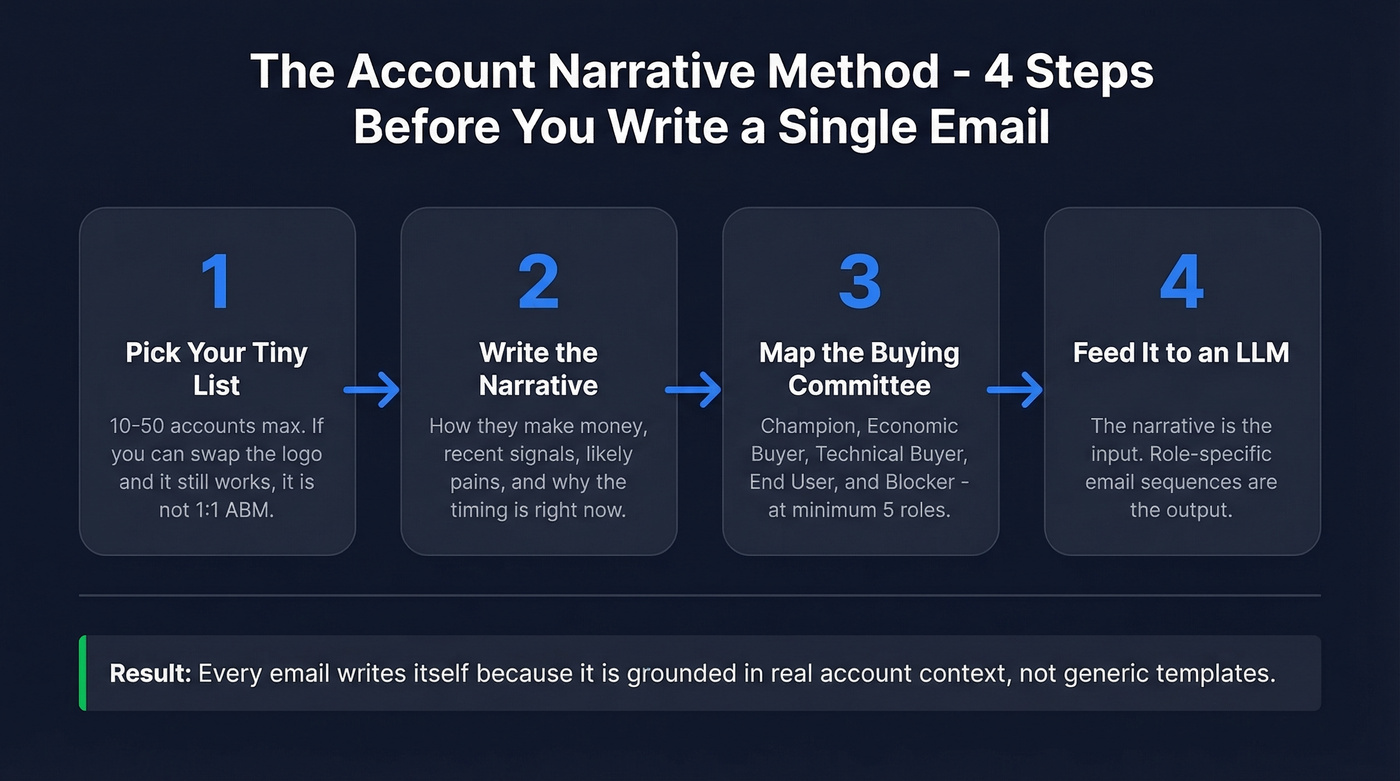
- Pick your tiny, scary list. 10-50 accounts max. As one practitioner on r/b2bmarketing put it: if you can swap the logo on your outreach and it still makes sense, you're not doing 1:1 ABM.
- Write the account narrative. Cover four things: how they make money, recent signals, likely pains tied to your solution, and why the timing is right now.
- Map the buying committee. Gartner's average B2B buying group includes 11 stakeholders. You need at least the champion, economic buyer, technical buyer, end user, and potential blocker.
- Hand your narrative to an LLM. Prompt example: "Given this account narrative, write a 3-email sequence for the VP of Engineering focused on security compliance and integration architecture." The narrative is the input. The templates are the output.
Here's what an account narrative actually looks like:
Acme Corp (Series C, 500 employees) sells project management SaaS to mid-market companies. They announced EMEA expansion in Q1 2026 and posted 3 data engineering roles last month. Pain: their current integration stack is manual and won't pass GDPR data residency requirements. Timing: EMEA launch is Q3 - they need to solve this in the next 90 days.
That paragraph is the foundation for every template below. Without it, you're guessing. With it, every email writes itself.
Role-Specific ABM Email Templates
We'll use the Acme narrative above: you're selling a data integration platform to a mid-market SaaS company expanding into EMEA.
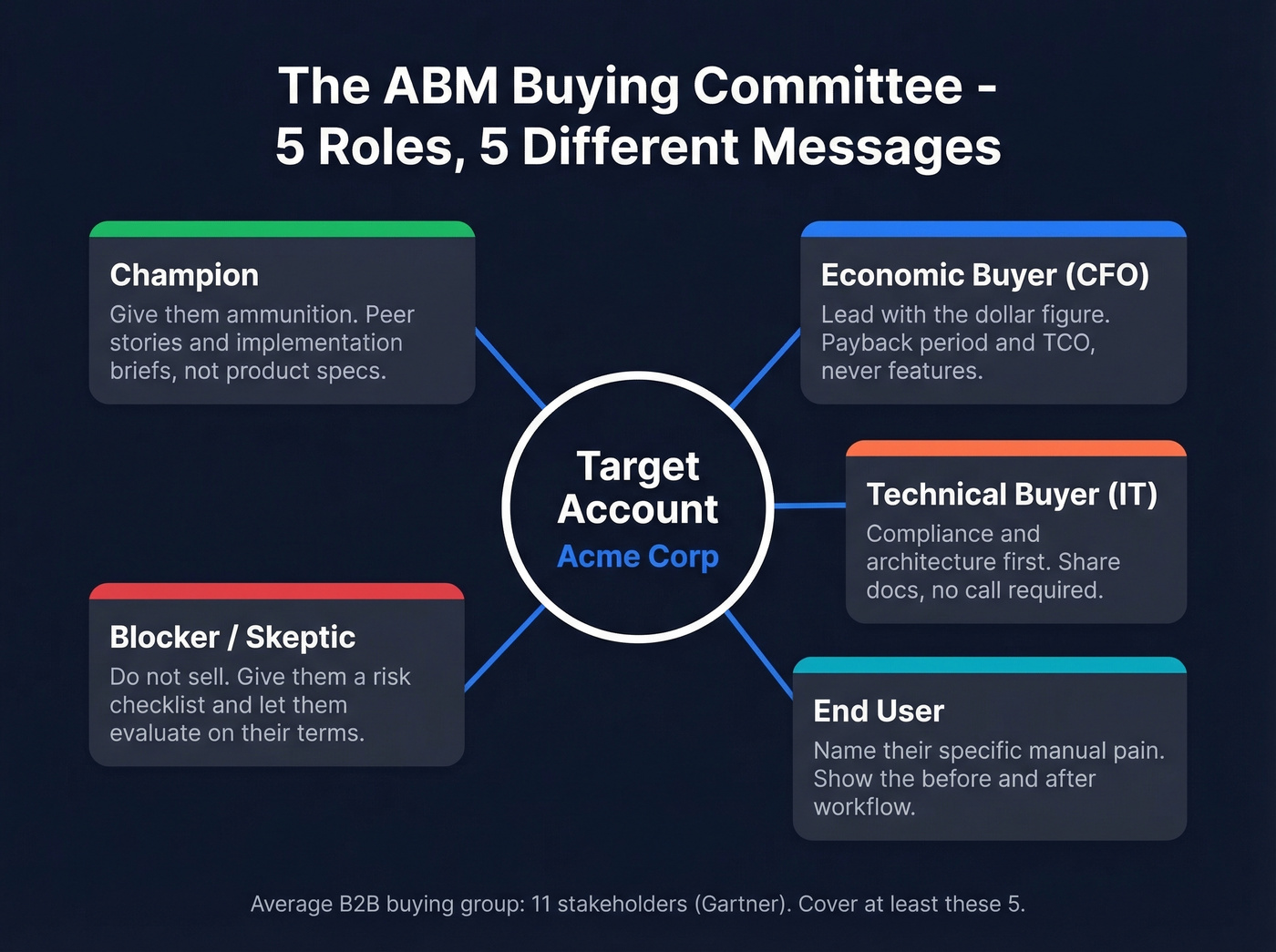
Champion
Your champion is the person who'll fight for you internally. Give them ammunition - peer stories, not product specs.
Subject: How Acme's EMEA push changes your data stack
Sarah - three of your peers at similar-stage SaaS companies rebuilt their integration layer before expanding into EMEA. The compliance requirements alone broke their legacy setup. I put together a 2-page implementation brief showing what they changed and what it cost. Worth 10 minutes this week?
Economic Buyer (CFO/Finance)
CFOs don't care about features. They care about payback period and total cost of ownership. Lead with the number, not the narrative.
Subject: $340K/yr in manual integration costs
James - companies at Acme's stage typically spend $280-400K annually on manual data integration across CRM, billing, and support systems. Our platform cuts that by 60% in year one, with a 4-month payback. I can walk through the TCO model in 15 minutes - no pitch deck, just the math.
Why this works: The subject line is a dollar figure, not a question. CFOs open emails that quantify a problem they suspect they have. The CTA promises math, not a demo - which matches how finance leaders actually evaluate vendors.
Technical Buyer (IT/Security)
Lead with compliance and architecture, not business outcomes.
Subject: SOC 2 + GDPR data routing for EMEA expansion
David - Acme's EMEA launch likely means new data residency requirements. Our platform supports SOC 2 Type II and GDPR-aligned data routing, and it fits into modern warehouse + CRM stacks. Happy to share our architecture docs and security whitepaper - no call needed unless you want one.
End User
Your end users spend hours on manual workarounds nobody in leadership sees. Name the specific pain before you pitch the fix.
Right now, Acme's ops team probably spends 3-5 hours per week manually exporting CSVs between HubSpot and Snowflake. That's the workflow you're replacing - and the email should say so directly.
Subject: No more CSV exports between HubSpot and Snowflake
Maria - after implementation, that manual sync is automatic and real-time. I recorded a 90-second walkthrough showing the before/after. Want me to send it?
Blocker/Skeptic
Here's the thing: skeptics don't want your pitch. The biggest mistake is trying to sell them. Don't. Give them the tools to evaluate you on their own terms, and they'll often come around faster than the champion did.
Subject: A risk checklist for your integration vendor review
Chris - I know adding another vendor to the stack isn't anyone's first choice. I can share a short security/risk assessment template our team uses, plus the exact questions we expect procurement and security to ask. Want me to send it so your team can evaluate on your terms?
Follow-Up Framework
Those are your first touches. For follow-ups across all five roles:
- Follow-up #2 (day 3-5): Reference a specific insight from your account narrative they haven't seen. New signal, new angle - never "just checking in." (If you need examples, borrow from these sales follow-up templates.)
- Follow-up #3 (day 7-10): Share a resource matched to their role. Case study for the champion, ROI calculator for the CFO, architecture doc for the technical buyer.
Finding verified emails for all five roles is the prerequisite. We've found that Prospeo's 30+ search filters make it straightforward to identify every stakeholder by company, title, and department, then export verified contacts in one step. With a 7-day data refresh cycle, you're not emailing someone who changed roles six weeks ago.

Your ABM templates are only as good as the contacts behind them. Prospeo's 30+ search filters let you map entire buying committees by title, department, and company - then export verified emails for every stakeholder in one step. 98% email accuracy. 7-day data refresh. No emailing someone who changed roles last month.
Stop writing perfect emails to the wrong people.
Sequence Timing That Works
Stagger outreach across the buying committee over 2-3 weeks. Don't blast all five contacts on the same Monday morning - that's how you get flagged internally. Pair email touches with a second channel so buying committee members see you in more than one place. (For a deeper system, see sequence management.)
| Sequence Type | Touches | Timing | CTA Style |
|---|---|---|---|
| Cold outreach | 4 | Day 1 → 3-5 → 7 → 10-14 | Meeting ask |
| Event-based | 3 | Day 1-2 → 7-10 → 12-15 | Resource share |
| Warm lead | 3 | Day 1 → 5-7 → 12-14 | Direct demo |
Some teams run a weekly ABM ops rhythm to keep this disciplined: review performance Monday, launch campaigns Tuesday-Wednesday, research new signals Thursday, build new sequences Friday. (This pairs well with a consistent lead generation workflow.)
Subject Lines That Get Opens
47% of recipients decide whether to open based on the subject line alone. Personalized subject lines lift open rates by 26%. In our experience, subject lines under five words often outperform longer ones in account-based contexts. If you want more options, pull from these email subject line examples and these cold email subject line examples.
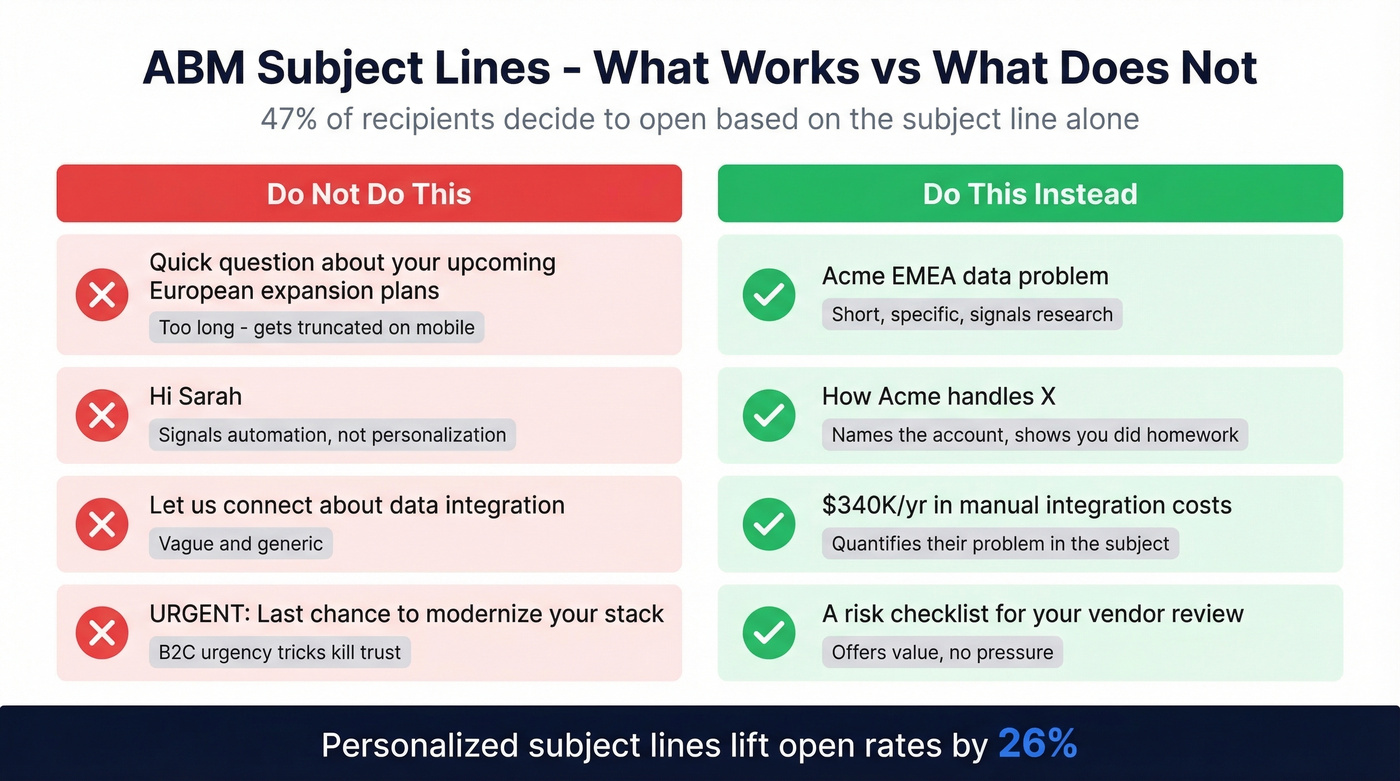
Keep them to 4-7 words. Mobile screens truncate longer subject lines, so "Acme's EMEA data problem" beats "Quick question about your upcoming European expansion plans."
Name the account, not the person. "How Acme handles X" outperforms "Hi Sarah" because it signals research, not automation.
Lead with their problem. "$340K/yr in manual integration costs" is more compelling than "Let's connect about data integration." And skip the urgency tricks entirely - "URGENT" and "Last chance" belong in B2C flash sales, not account-based outreach. Your buying committee will see right through it.
The Data Quality Foundation
None of these templates matter if your emails bounce. If you're troubleshooting, start with email bounce rate benchmarks and fixes, then work through an email deliverability guide to protect your domain.
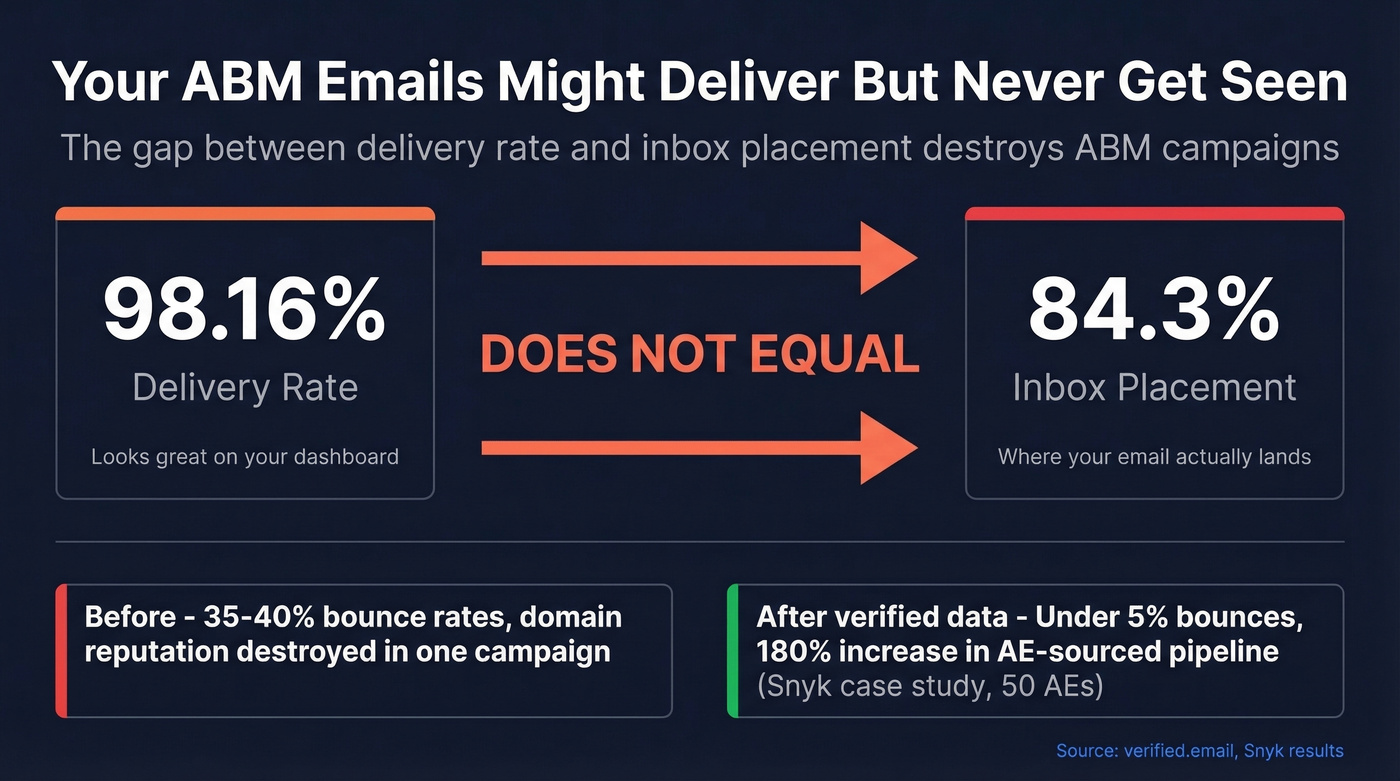
We've seen teams launch beautifully crafted sequences only to hit 35-40% bounce rates, torching their domain reputation in a single campaign. There's also a critical distinction most teams miss: 98.16% delivery rate doesn't mean 84.3% inbox placement. Your emails can "deliver" straight to spam.
Skip this if your deal sizes are under $10K: you probably don't need a $32,000 ABM platform contract. A lean stack - good data, a sequencer, and the account narrative method - will outperform an enterprise suite that your team barely uses. (If you're building the stack, compare SDR tools and outbound lead generation tools.)
Snyk's sales team faced the bounce rate problem head-on. They were running 35-40% bounces before switching data sources. After moving to Prospeo, bounces dropped under 5%, and AE-sourced pipeline jumped 180% - that's with 50 AEs prospecting simultaneously. Prospeo's 5-step verification process handles catch-all domains, spam traps, and honeypot filtering, which means your carefully written account-based emails actually land in inboxes instead of spam folders.
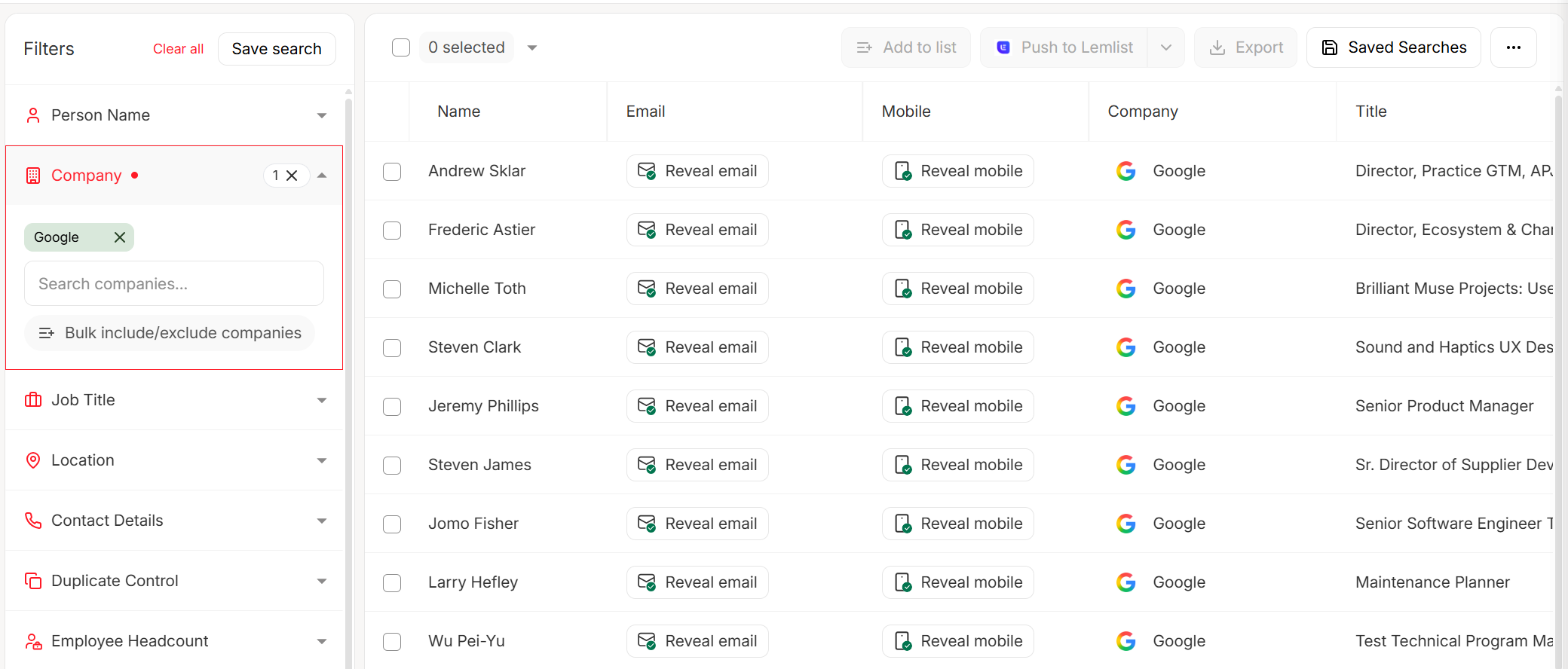
ABM requires reaching 11 stakeholders per account with role-specific messaging. That means verified contact data for champions, CFOs, IT buyers, end users, and blockers - all at the same company. Prospeo gives you 300M+ profiles with 98% email accuracy at $0.01 per email, so covering a full buying committee costs less than a cup of coffee.
Cover an entire buying committee for under a dollar.
FAQ
How many emails should an ABM sequence include?
3-5 touches per stakeholder over 2-4 weeks. Cold sequences typically run: intro on day 1, follow-up at day 3-5, value resource at day 7, and breakup at day 10-14. Shorten for warm leads, extend for enterprise deals with 6+ decision-makers.
What's a good reply rate for ABM emails?
Cold ABM reply rates average 5-8%. Well-researched 1:1 sequences targeting the right buying committee roles can hit 15%+ when paired with verified contact data and genuine account-level personalization. Measure meetings booked, not just replies.
Should I use the same template for every stakeholder?
No. Each buying committee role needs different framing, proof points, and CTAs. A CFO wants payback period math; a technical buyer wants architecture docs. Sending the same email to both is how deals stall in committee.
How do I find emails for an entire buying committee?
Use a B2B data platform like Prospeo to search by company, job title, and department. You can map and verify contacts for all key stakeholders in minutes, then export directly to your sequencer.