

Dolibarr vs SugarCRM: Which CRM Is Worth Your Money in 2026?
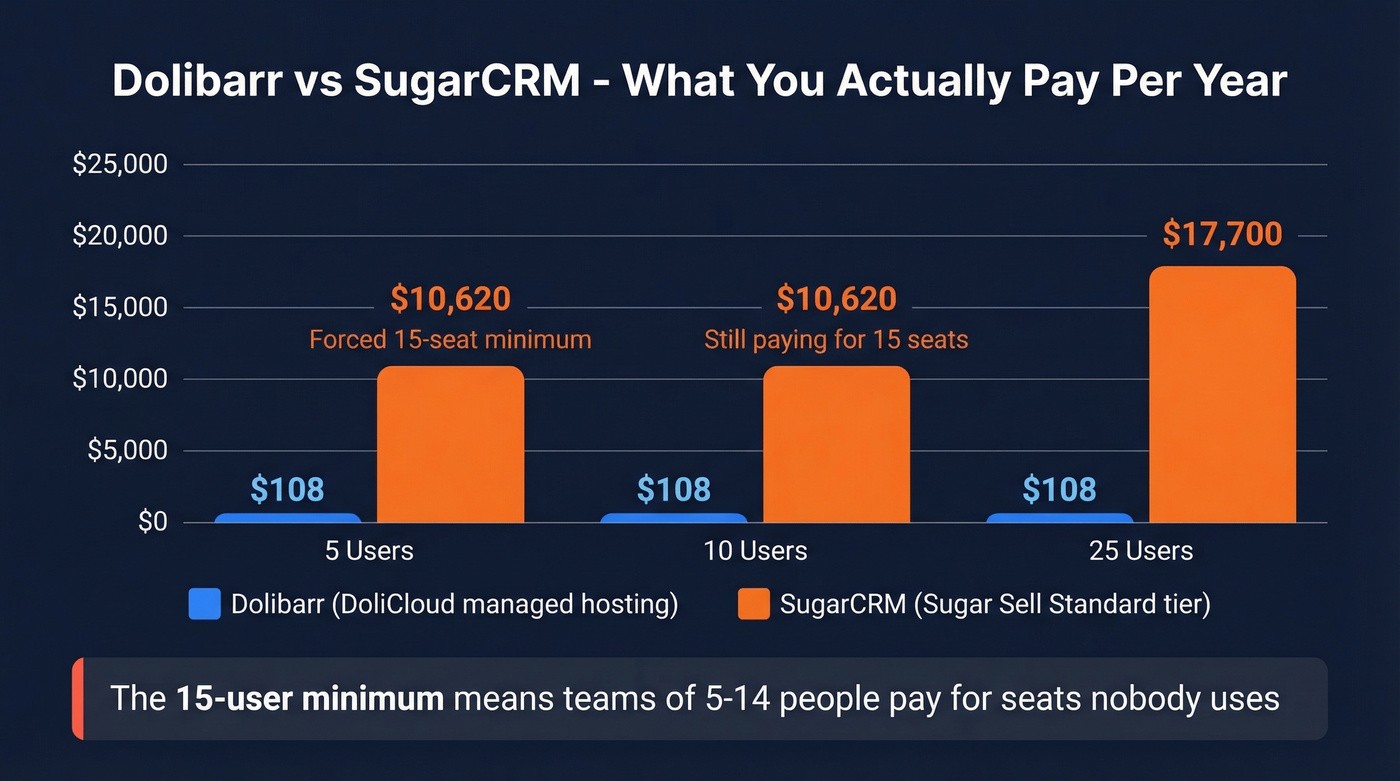
A 5-person team evaluating SugarCRM's Standard plan doesn't realize they'll be paying for 15 seats whether they use them or not. That's $10,620/year for a tool where two-thirds of the licenses sit empty. Dolibarr costs those same five people somewhere between zero and EUR108/year. The gap isn't a rounding error - it's an order of magnitude.
But price alone doesn't settle this. The Dolibarr vs SugarCRM decision comes down to who you are: a lean team that needs a free CRM/ERP combo, or a mid-market sales org that needs AI forecasting and serious workflow automation. Let's break it down.
Pricing Breakdown
Here's what you'll actually pay.
| Dolibarr | Sugar Sell Essentials | Sugar Sell Standard | Sugar Sell Advanced | Sugar Sell Premier | |
|---|---|---|---|---|---|
| $/user/mo | $0 / EUR9 cloud | $19 | $59 | $85 | $135 |
| Min users | 1 | 3 | 15 | 15 | 15 |
| Max users | Unlimited | 9 | Unlimited | Unlimited | Unlimited |
| Annual min | $0-EUR108 | $684 | $10,620 | $15,300 | $24,300 |
| AI features | No | No | Basic | Yes | Full suite |
The 15-user minimum on Sugar Sell Standard and above is the single most important pricing fact here. If you're a 5-person sales team that wants workflows and decent reporting, you're still buying 15 seats. That's $10,620/year before implementation costs, which typically run $5k-$50k+ depending on customization depth. We've seen teams burn through that budget before a single deal closes.
Dolibarr's open-source version is genuinely free under GPL. Self-host it on a VPS for roughly $10-$50/month, or use DoliCloud managed hosting from EUR9/month. For a 5-person team, you're looking at $0-EUR108/year total.
Sugar Sell Essentials at $19/user/month with a 3-user minimum and 9-user cap exists as an entry point, but it's stripped down compared to the core tiers and doesn't include AI features.
Feature Comparison
| Feature | Dolibarr | SugarCRM |
|---|---|---|
| CRM core | Yes | Yes |
| ERP: invoicing, inventory, HR | Yes | No |
| AI forecasting & lead scoring | No | Yes (Advanced+) |
| Workflow automation | Basic | SugarBPM (visual) |
| Reporting | Standard | Sankey diagrams, custom |
| Customer portal / knowledge base | Limited | Yes |
| Mobile app | Web-based | Native, offline capable |
| Marketplace | Dolistore | Sugar Marketplace |
| Self-hosted option | Yes (primary model) | Yes (on-prem available) |
| Open source | Yes (GPL) | No |
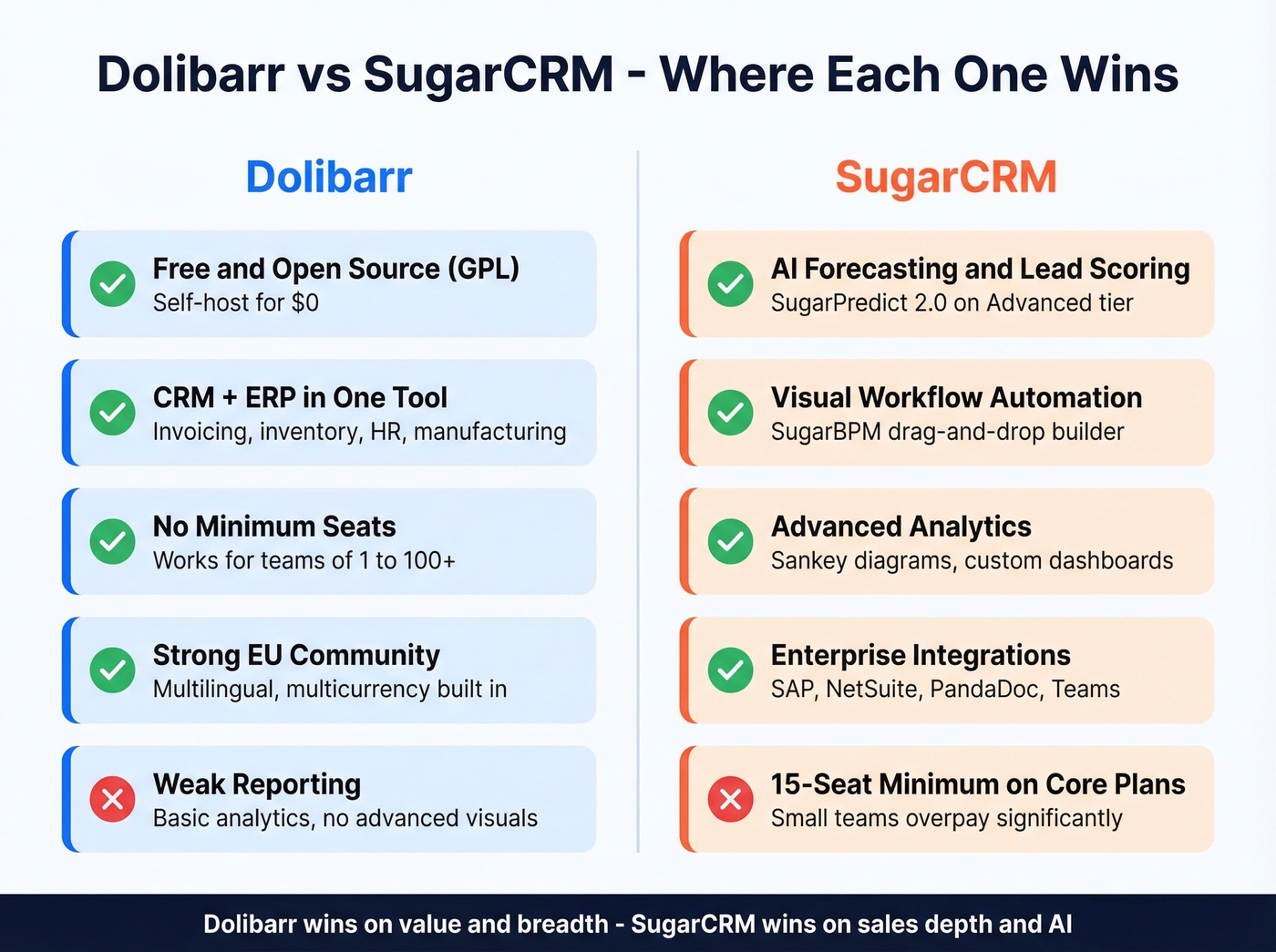
Dolibarr's strength is breadth at the SMB level. It's a combined CRM and ERP handling invoicing, inventory, HR, and even manufacturing through modular add-ons - all in a single system where you activate only what you need. SugarCRM's strength is depth on the sales side. SugarBPM's visual workflow designer is genuinely powerful for automating complex deal processes, and SugarPredict 2.0 adds AI features like sentiment analysis and autonomous contact enrichment using public and social data, starting at the Advanced tier.
Here's the thing: Dolibarr's reporting is the weakest link for growing teams. SugarCRM offers Sankey diagrams that visualize where deals drop off and which channels convert best - the kind of analytics a VP of Sales actually wants in a QBR. On integrations, Sugar Marketplace includes connectors for SAP, NetSuite, PandaDoc, and Microsoft Teams, while Dolibarr relies on its community-driven Dolistore. The ecosystem gap is real, though Dolibarr's community is active and particularly strong across Europe.

A CRM without fresh prospect data is just a filing cabinet. Whether you pick Dolibarr's free tier or SugarCRM's $10,620/year plan, neither gives you verified emails or direct dials. Prospeo pushes 98%-accurate contacts into either CRM via API, CSV, Zapier, or Make - refreshed every 7 days, not every 6 weeks.
Stop paying for empty CRM seats. Start filling them with real buyers.
User Ratings
| Platform | Dolibarr | SugarCRM |
|---|---|---|
| G2 | 4.6/5 (30 reviews) | 4.0/5 (1,183 reviews) |
| Capterra Overall | 4.5/5 (105) | 3.8/5 (410) |
| Capterra Ease of Use | 4.3 | 3.7 |
| Capterra Value for Money | 4.7 | 3.8 |
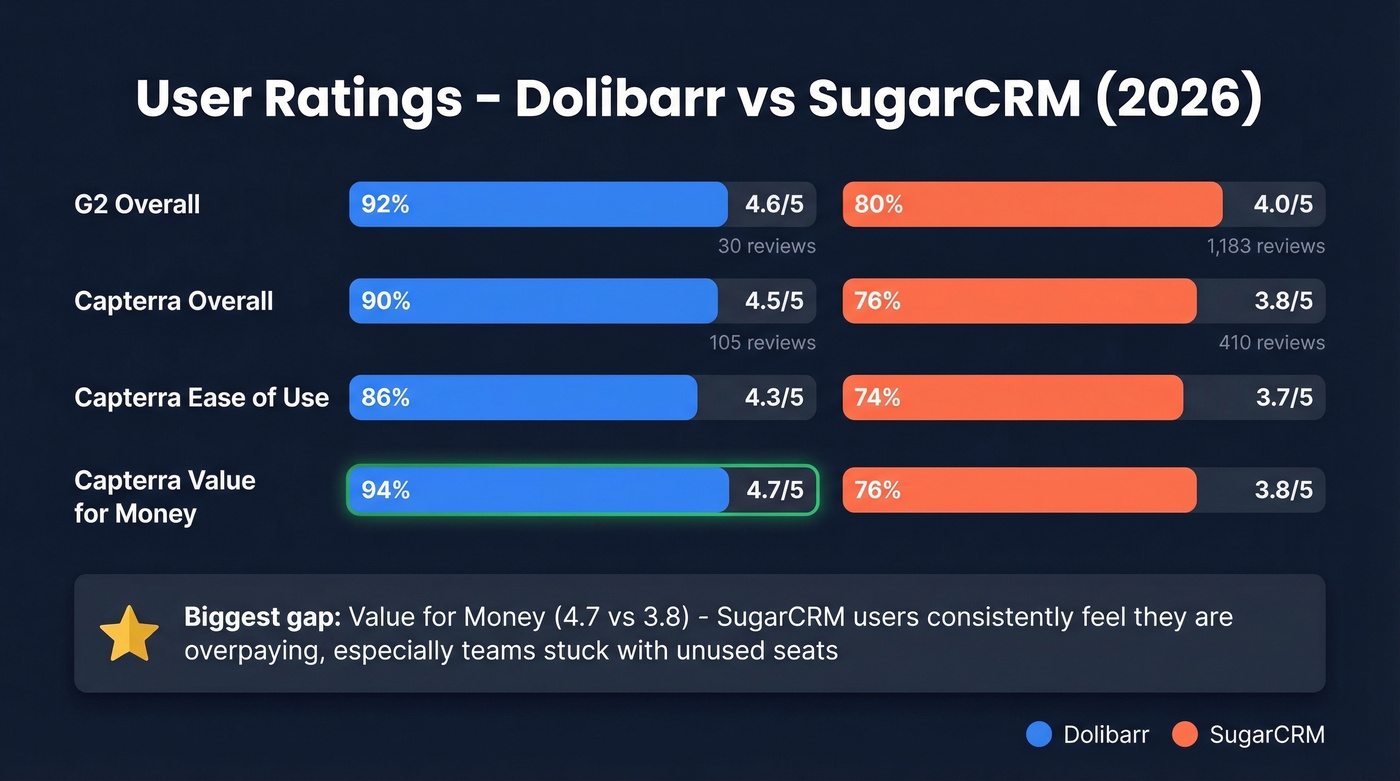
Dolibarr wins every category, but context matters. SugarCRM's 1,183 G2 reviews represent a much larger and more diverse user base - enterprise teams with complex implementations who grade harder. Dolibarr's 30 G2 reviews skew toward small teams who chose it specifically because it's free and simple.
The value-for-money gap of 4.7 vs 3.8 tells the real story. G2 reviewers praise SugarBPM's workflow builder but consistently flag slow analytics queries and the steep price jump to Premier. Capterra users call out storage limitations that force additional purchases and a mobile experience that frustrates field reps. SugarCRM users feel they're overpaying, especially teams stuck with unused seats from that 15-user minimum. The consensus on Reddit threads echoes this - smaller teams that wandered into SugarCRM often wish they'd started with something lighter.
Who Should Pick Which
Pick Dolibarr if you have fewer than 15 users, you're budget-conscious, you want self-hosting for data ownership, or you need combined CRM + ERP in one tool. EU-focused businesses particularly benefit from Dolibarr's multilingual, multicurrency design and its active community with strong adoption across France, Spain, and Italy. Dolibarr is commonly evaluated alongside Odoo and ERPNext by teams watching every dollar. If you're under 15 people, this isn't close.
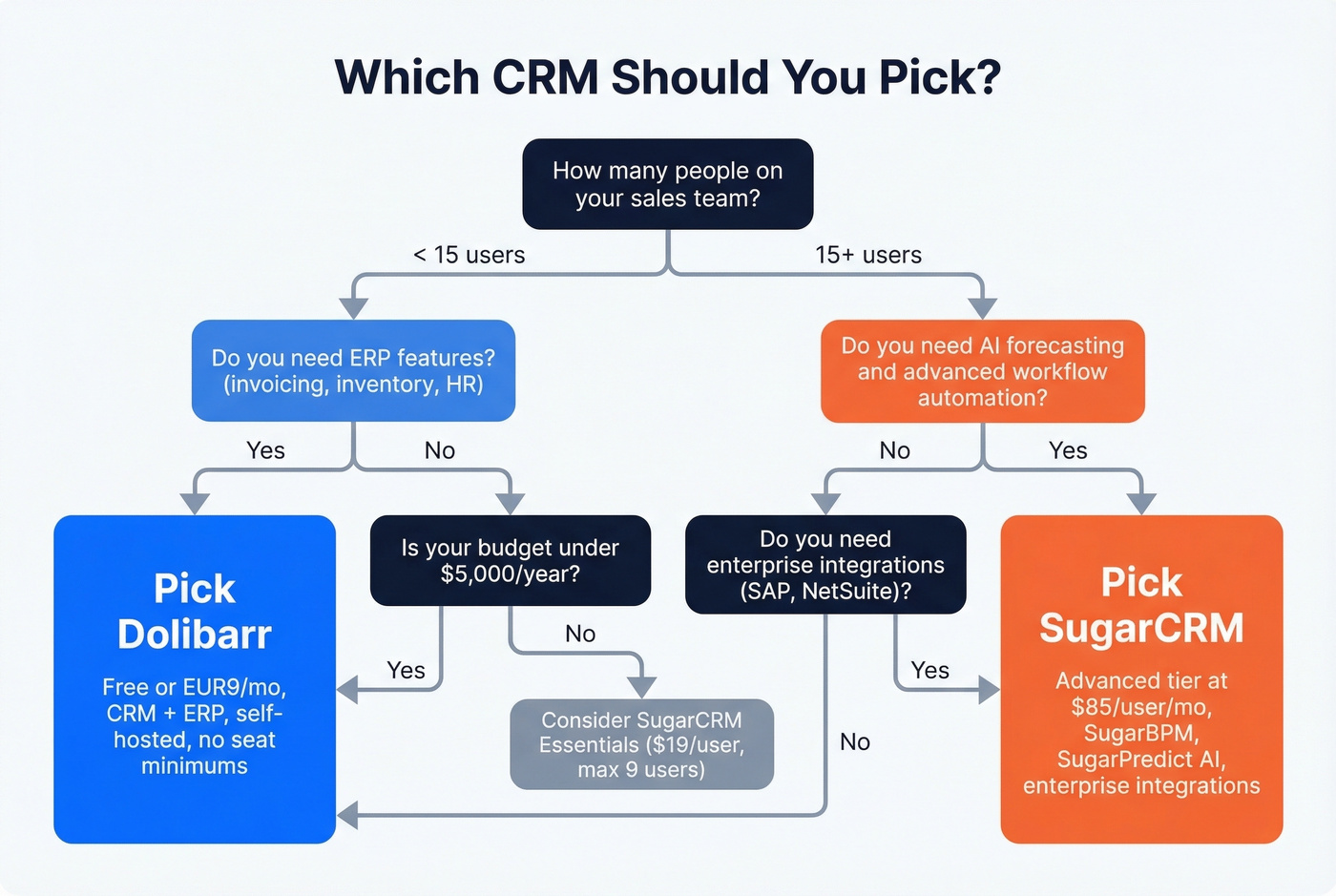
Pick SugarCRM if you have 15+ users, need AI forecasting and SugarBPM automation, require enterprise integrations with SAP or NetSuite, and have a dedicated admin to manage the platform. SugarCRM also offers on-premise deployment for data sovereignty, though at a significantly higher cost than Dolibarr's self-hosting. Budget for onboarding time - the learning curve is steep, and we've watched teams take 2-3 months to get fully productive.
Skip SugarCRM if your team is under 10 people. You'll pay for seats you don't use, wrestle with complexity you don't need, and spend implementation budget that could've gone toward actually selling. The teams that genuinely need SugarCRM aren't Googling this comparison - they're already deep in enterprise sales cycles with procurement teams and RFPs.
What Neither Tool Does
Neither Dolibarr nor SugarCRM is a prospecting database. They're built to manage relationships - contacts already in your pipeline, deals already in motion. A CRM with no fresh data flowing in is just an expensive address book.
Prospeo fills that gap with 300M+ professional profiles, 98% email accuracy, and 125M+ verified mobile numbers refreshed on a 7-day cycle. Push verified contacts into Dolibarr or SugarCRM via API/CSV, or through automation tools like Zapier or Make. At roughly $0.01 per email, it costs less than a single unused SugarCRM seat.
If you're comparing options, start with the bigger landscape of contact management software and then narrow down based on your outbound motion and data needs.

You're debating saving $10,000/year on CRM seats. Meanwhile, Prospeo finds verified emails at ~$0.01 each - less than a single unused SugarCRM license. 125M+ verified mobiles with a 30% pickup rate, no contracts, no 15-seat minimums.
Fill your pipeline for less than one wasted SugarCRM seat costs.
FAQ
Is Dolibarr really free?
Yes. The open-source version costs $0 under GPL. Self-host on a VPS for $10-$50/month, or use DoliCloud managed hosting from EUR9/month. Either way, it's a fraction of any commercial CRM - even SugarCRM's cheapest tier starts at $684/year.
Does SugarCRM offer a free trial?
Yes, with no credit card required. You can test core CRM features, though AI capabilities like SugarPredict are only available on Advanced ($85/user/mo) and Premier ($135/user/mo) tiers.
Can I migrate between Dolibarr and SugarCRM?
There's no direct migration tool. Both support CSV import/export, so you'd export contacts and deals from one and import into the other. Budget a few hours for field mapping and data cleanup. If your contact records have gaps or stale info, running them through an enrichment tool during the switch saves you from importing garbage into a clean system.