

The Best Email Verifier Tools in 2026: Real Accuracy Data, Not Marketing Claims
Every email verifier on the market claims 98-99% accuracy. Every single one. Then you run a real campaign and watch 15% of your list bounce. Hunter benchmarked 15 verification tools using roughly 3,000 emails - the top performer hit 70%. Not 99%. Not even 90%. Seventy percent.
That gap between marketing claims and observed performance is the whole story of this market. Roughly one in six emails never reaches the inbox according to Validity's deliverability benchmark. That's not purely a verification problem - sender reputation, content, and ISP filtering all play a role - but it starts with bad data. Send to dead addresses and your bounce rate tanks your domain reputation, which tanks deliverability for every email you send after that.
The accuracy figures below come from Warmup Inbox's 10,000-contact test unless otherwise noted. Catch-all resolution rates come from LeadMagic's separate 10,000-email benchmark. Pricing reflects commonly published entry pay-as-you-go rates as of early 2026.
Our Picks (TL;DR)
| Pick | Tool | Why |
|---|---|---|
| Best for B2B prospecting | Prospeo | Finds and verifies in one step - 98% accuracy, 5-step verification with catch-all handling, 7-day data refresh |
| Best standalone verifier | ZeroBounce | 98.8% observed accuracy, deliverability suite, 100 free monthly verifications |
| Best budget option | EmailListVerify | $4/1,000 emails, 98.5% observed accuracy - hard to beat on value |
How Email Verification Actually Works
Most people treat verification as a black box - upload a CSV, get green and red results. Understanding the pipeline helps you evaluate why tools disagree on the same address.
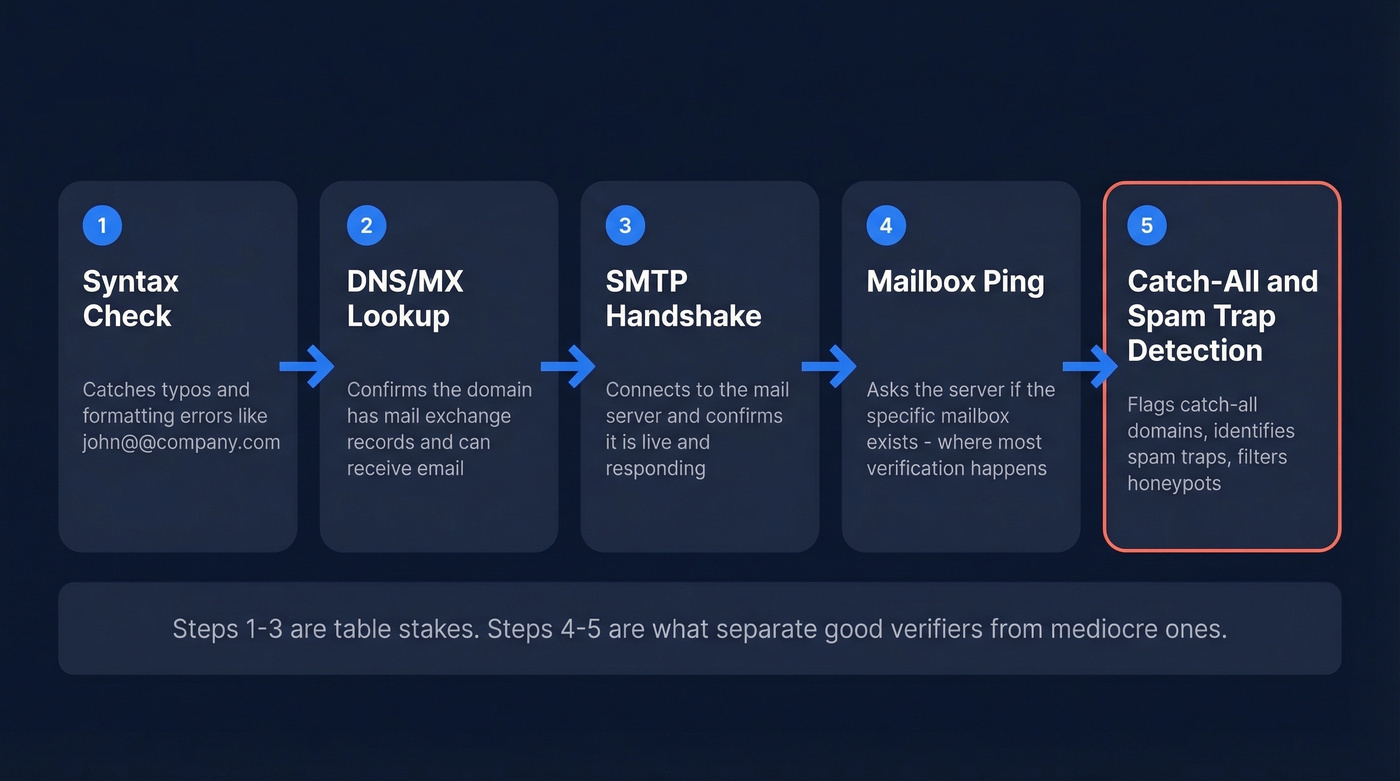
Serious verifiers run a five-step process:
- Syntax check - Does the email follow valid formatting rules? Catches typos like
john@@company.comor missing TLDs. - DNS/MX lookup - Does the domain have mail exchange records? No MX record means nobody's receiving email there.
- SMTP handshake - Connect to the mail server and initiate a conversation without sending an actual email. Confirms the server is live.
- Mailbox ping - Ask the server whether the specific mailbox exists. This is where most verification happens, and where catch-all domains break the process entirely.
- Catch-all and spam-trap detection - Flag domains that accept everything, identify known spam traps, and filter honeypots. This step separates good tools from mediocre ones.
One distinction most teams miss: delivery and deliverability aren't the same thing. Litmus defines delivery as the email being accepted by the recipient's mail server (no bounce). Deliverability is whether it lands in the inbox versus spam. A verification tool handles delivery. Your sender reputation handles deliverability.
The ISP-level data makes this concrete. Gmail inbox placement sits around 87%, but Microsoft drops to 75.6%. If your target accounts are enterprise companies running Outlook, a quarter of your emails may land in spam even after perfect verification. Gmail will start throttling you if spam complaints exceed 0.3% - and bounces from bad data accelerate that threshold fast.
Master Comparison Table
| Tool | Accuracy | Cost/1,000 | Catch-All Resolution | Free Tier |
|---|---|---|---|---|
| Prospeo | 98% | ~$10 | Advanced (5-step) | 75/mo |
| ZeroBounce | 98.8% | ~$8 | 12% | 100/mo |
| Bouncer | 98.9% | $4-7 | 15% | 100 credits |
| NeverBounce | 98.6% | $8 | 8% | 10 credits |
| EmailListVerify | 98.5% | $4 | Basic | 100 credits |
| Kickbox | 98.4% | $10 | Basic | Not public |
| Clearout | 98.1% | ~$7 | Basic | 100 credits |
| Hunter | 96.4% | ~$6 | Basic | 100/mo |
| MillionVerifier | 95.8% | ~$0.60 | 5% | Not public |
| Email Hippo | Not benchmarked | ~$5-15 | Greylisting | 100/day |
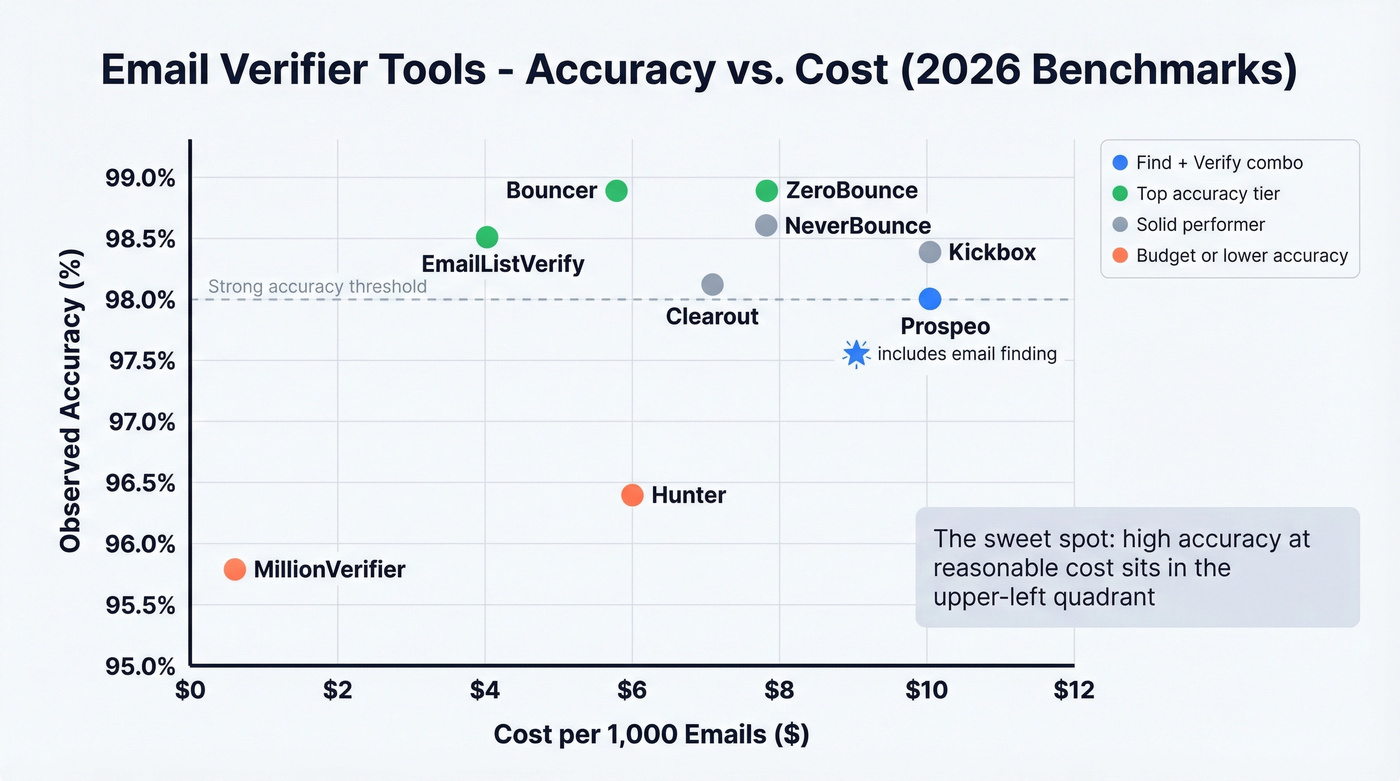
Bouncer and ZeroBounce lead on observed accuracy. MillionVerifier and EmailListVerify win on price. NeverBounce is the speed king. Prospeo is the only tool here that combines email finding with verification in a single platform - no CSV shuffle between tools.
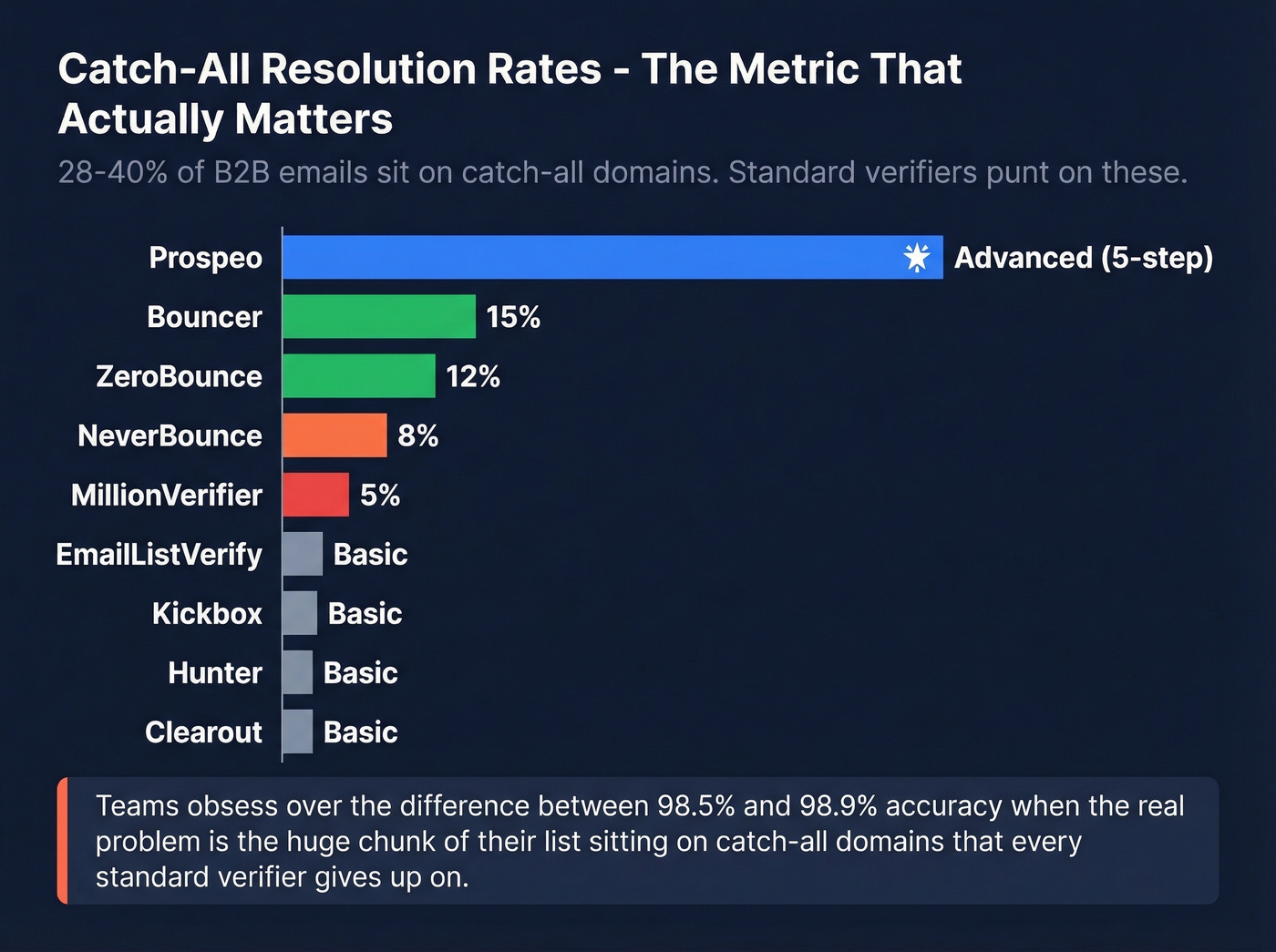
Let's be honest about what matters most here: teams obsess over the difference between 98.5% and 98.9% accuracy when the real problem is the 28-40% of their B2B list sitting on catch-all domains that every standard verifier punts on. Catch-all handling matters more than the second decimal place.

Most teams juggle one tool to find emails and another to verify them. Prospeo's 5-step verification - catch-all handling, spam-trap removal, honeypot filtering - runs on every email before it ever reaches your list. 98% accuracy. 7-day data refresh. Stack Optimize kept bounce rates under 3% across every client.
Stop paying twice to find and then verify the same email.
Top Email Verifier Tools Reviewed
Prospeo - Best for B2B Prospecting
Use this if: You're running outbound and need to find and verify emails without stitching together multiple tools.
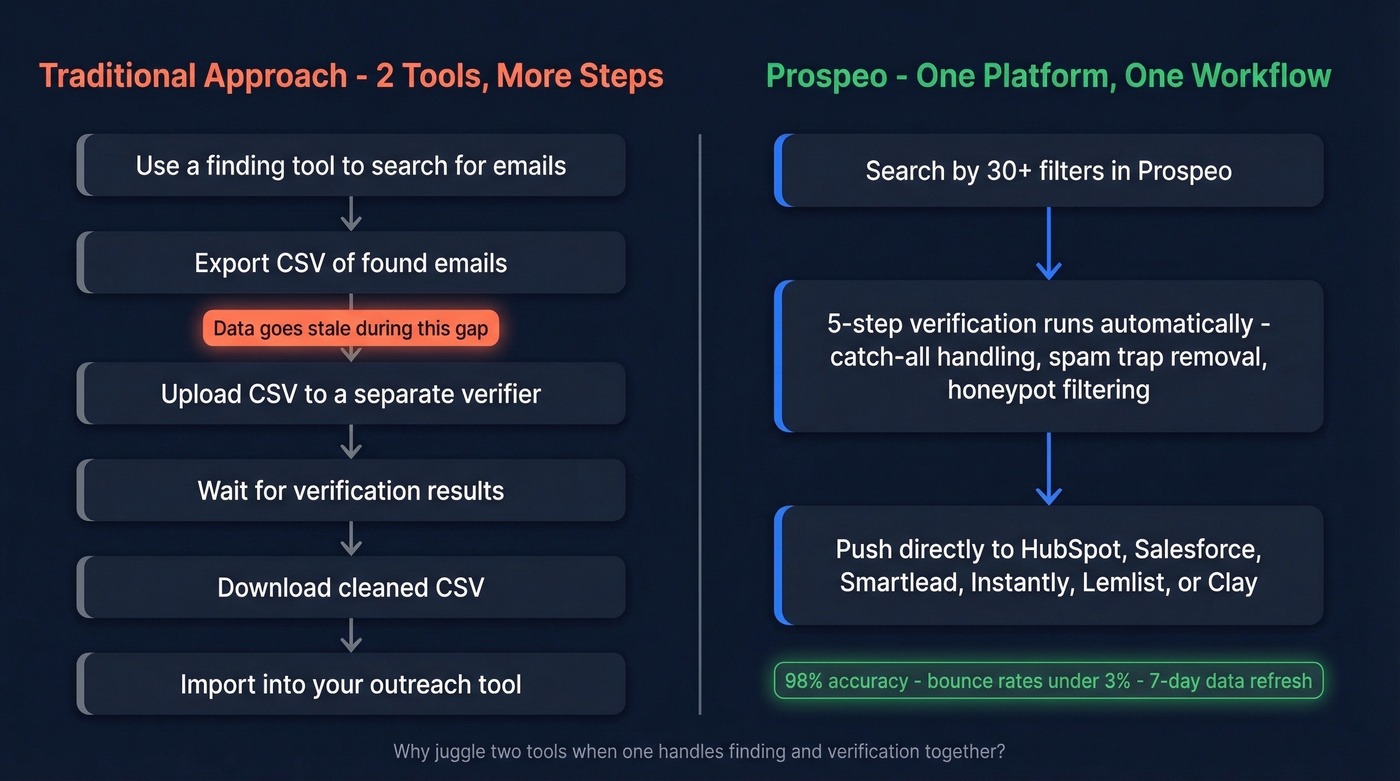
Prospeo runs a 5-step verification that includes catch-all handling, spam-trap removal, and honeypot filtering - all on proprietary infrastructure rather than third-party providers. The 143M+ verified emails in its database refresh every 7 days, compared to the 6-week industry average. You can search by 30+ filters, find verified contacts, and push them directly to HubSpot, Salesforce, Smartlead, Instantly, Lemlist, or Clay. The Chrome extension (40,000+ users) lets you verify addresses from any website in one click.
We've seen the results firsthand: Stack Optimize built from $0 to $1M ARR using Prospeo and kept client deliverability at 94%+ with bounce rates under 3% - zero domain flags across all clients. Pricing runs about $0.01 per email. Free tier gives you 75 emails per month, no credit card required.
Skip this if: You only need to verify an existing list and don't care about email finding. A standalone verifier will be cheaper per email for pure list-cleaning.
ZeroBounce - Best Standalone Option
ZeroBounce hit 98.8% observed accuracy in Warmup Inbox's test, but the real draw is everything around verification. Inbox placement testing, blacklist monitoring, and email scoring make this one of the deepest deliverability toolkits in the category. G2 reviews sit at 4.7 across 515 reviews, with Capterra matching at 4.7 on 458 reviews.
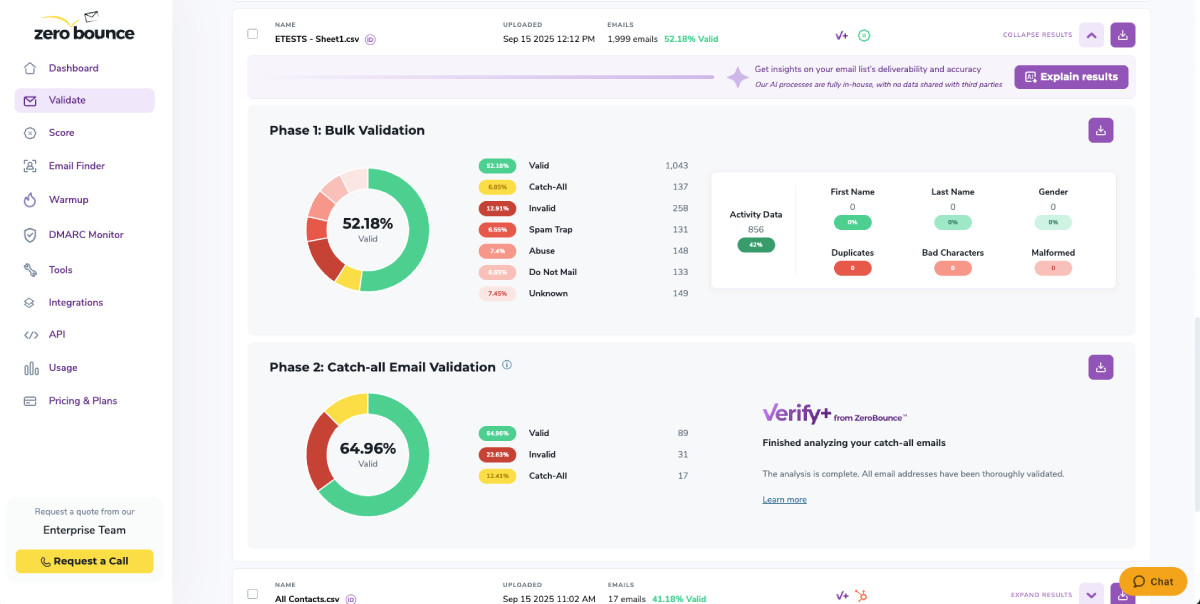
The catch-all resolution rate of 12% is the main gap. If catch-all domains make up a big chunk of your list, you'll still have a lot of unknowns after processing. Entry pricing is $16 for 2,000 emails on PAYG. The ZeroBounce ONE bundle at $99/mo packages verification with the deliverability suite. You get 100 free verifications monthly to test.
NeverBounce - Speed Over Everything
Three minutes. That's how long NeverBounce takes to chew through 10,000 emails - the fastest result in Warmup Inbox's benchmark. If you're processing large lists on a tight timeline, nothing else comes close.
Observed accuracy of 98.6% is strong, and the typo correction feature (catching gmai to gmail) saves you from obvious data-entry errors that other tools just flag as invalid. The Growth plan at $49/month for up to 10,000 emails includes auto-sync and deduplication - duplicates don't count against your credits. PAYG runs $8 per 1,000 with a 12-month expiry.
The weakness: only 8% catch-all resolution. For enterprise-heavy B2B lists, that's a real problem. NeverBounce is better suited for mixed lists or high-volume marketing sends where speed matters more than resolving every edge case.
Bouncer - The Accuracy Benchmark
When BulkEmailVerifier.com switched its entire verification backend to Bouncer, it confirmed what the accuracy data already suggested: Bouncer's engine is trusted enough for other tools to build on. Highest observed accuracy in the Warmup Inbox test at 98.9%, with 15% catch-all resolution - better than both ZeroBounce and NeverBounce on that metric.
G2 ratings are the highest in this roundup at 4.8 (232 reviews), with Capterra at an impressive 4.9 (233 reviews). Woodpecker uses Bouncer as its native verification partner, so if you're already in that ecosystem, it's a natural fit. Pricing is $20 for 5,000 emails. You get 100 free credits to test.
Skip this if: You need finding + verification in one tool, or you need catch-all resolution above 15%.
Clearout - Best for Real-Time Forms
Use this when you need to check addresses at the point of capture - signup forms, lead magnets, webinar registrations. Clearout's real-time widget catches bad emails before they enter your database. Observed accuracy of 98.1%.
Starter plan runs $21 for 3,000 credits monthly, with 100 free credits to test. G2 sits at 4.7 across 307 reviews. For bulk list cleaning, other tools are cheaper per email.
Kickbox - Best for Developer Teams
Your engineering team is building verification into a product or workflow via API? Kickbox's documentation is among the best in the space, and the Sendex reputation scoring adds a layer beyond simple valid/invalid results. Observed accuracy of 98.4%.
In Hunter's 3,000-email benchmark, Kickbox placed third at 67.53% - which tells you more about how hard real-world verification is than about Kickbox specifically. Entry pricing is $10 per 1,000 emails.
EmailListVerify - Best Budget Option
At $4 per 1,000 emails, EmailListVerify is the cheapest mainstream option that still delivers 98.5% observed accuracy. Processing 10,000 emails takes about 12 minutes - not the fastest, but acceptable. You get 100 free verifications when you create an account.
For bootstrapped teams running cold outreach on a tight budget, this is the obvious starting point. You'll need to pair it with another tool for catch-all resolution or deliverability monitoring, but for pure list-cleaning on a shoestring, nothing beats the value.
Hunter - Best for Small Lists
Hunter is interesting because they're both a tool vendor and a benchmarker. Their own 3,000-email benchmark showed their checker hitting 70% accuracy - the top score in that test, but still far from the 99% everyone markets. Observed accuracy in Warmup Inbox's larger test was 96.4%. The free plan gives you 100 verifications monthly, but credits are shared across Hunter's products, so a $34/mo plan can get eaten up fast if you're using multiple features.
MillionVerifier - Ultra-Budget Pick
At roughly $0.60 per 1,000 emails at 10k scale, MillionVerifier is the cheapest option by a wide margin. The tradeoff: 95.8% accuracy and only 5% catch-all resolution, with the slowest processing time at 35 minutes for 10,000 emails. Fine for cleaning massive marketing lists where a few extra bounces won't kill your domain. Don't expect miracles on catch-all domains.
Email Hippo - Free Daily Checks
Email Hippo offers 100 free verifications per day with greylisting handling - useful for spot-checking individual addresses rather than bulk cleaning. Rates fall in the $5-15 per 1,000 range for paid plans.
The Catch-All Problem
Here's the thing most comparison articles skip entirely: catch-all domains are where verification breaks down, and they make up a huge chunk of B2B email lists.
A catch-all domain accepts emails sent to any address - ceo@company.com, asdfgh@company.com, doesnotexist@company.com - they all get accepted. When a verifier runs its SMTP handshake and asks "does this mailbox exist?", the server says "yes" regardless. Standard verification can't tell the difference between a real person and a nonexistent address.
How common is this? LeadMagic measured 28% catch-all in their 10,000-email test dataset. Other estimates put it at 30-40% for B2B lists. That's potentially a third of your list sitting in limbo.
The resolution rates across tools tell the real story:
| Tool | Catch-All Resolution |
|---|---|
| MillionVerifier | 5% |
| NeverBounce | 8% |
| ZeroBounce | 12% |
| Bouncer | 15% |
| LeadMagic | 94.2% |
Most verifiers flag catch-all addresses as "unknown" or "risky" and move on. LeadMagic's 94.2% resolution rate shows what's technically possible, but it's a specialized tool, not a general-purpose verifier. For B2B teams where a third of their target accounts sit on catch-all domains, this is the difference between a clean send and a 15% bounce rate.
Enterprise security layers make it worse. Companies running Proofpoint, Mimecast, or Microsoft Defender often block verification probes entirely, producing false unknowns even on non-catch-all domains. The more enterprise your target market, the harder verification gets.
Catch-all domains break every standalone verifier on this list. Prospeo's proprietary infrastructure handles catch-all detection as part of its 5-step pipeline - no CSV exports, no second tool, no guessing. 143M+ emails verified and refreshed every 7 days, not every 6 weeks.
Get emails that actually land in inboxes for $0.01 each.
Why Verifiers Disagree on the Same List
This question comes up constantly on r/coldemail: run the same list through two tools and get wildly different results. One user reported roughly 40% conflicting results across tools on about 100 leads. That's not a bug.
Different tools use different SMTP connection methods, different IP addresses (some of which are blocked by certain mail servers), different catch-all scoring thresholds, and different risk tolerance settings. A tool that's aggressive about marking borderline addresses as "valid" will show higher accuracy on paper but more bounces in practice. A conservative tool flags more unknowns but protects your sender reputation.
Timing matters too. An email verified on Monday can bounce on Thursday because the person left the company, the domain changed MX records, or the server was temporarily down during the original check. Data decays at roughly 2-3% per month.
The consensus on Reddit's cold email community: run two tools on high-stakes lists. Verify with your primary tool, then run unknowns and catch-alls through a second verifier. It costs more, but it's cheaper than burning a domain.
How to Choose the Right Tool
Five questions. Your answers map directly to a tool.
What percentage of your list is B2B with catch-all domains? Heavy corporate - tech companies, enterprises, financial services - means catch-all handling is non-negotiable. Bouncer's 15% resolution is the best among general-purpose verifiers. Mostly consumer or SMB emails? Standard verification from any top tool works fine.
How many emails are you verifying per month? Under 1,000: use free tiers. Between 1,000 and 10,000: PAYG from EmailListVerify at $4/1,000 or NeverBounce at $8/1,000. Over 50,000: negotiate enterprise pricing or use MillionVerifier for the volume discount.
What's your budget per 1,000 emails? Under $5: EmailListVerify or MillionVerifier. $5-10: NeverBounce, Bouncer, or Kickbox. Over $10: ZeroBounce with the deliverability suite, or Prospeo with email finding included.
Do you need verification only, or finding + verification? If you're already sourcing emails from another tool and just need to clean them, a standalone verifier is the right call. Building prospect lists from scratch? A combined platform eliminates the two-tool workflow entirely.
What integrations matter? Most tools connect to HubSpot or Salesforce. For teams running Smartlead, Instantly, or Lemlist for outbound sequences, check native integrations before committing - swapping tools mid-campaign is painful.
FAQ
Is email verification legal?
Yes. Verification checks whether a mailbox exists without sending actual emails - it's a technical lookup, not a message. In GDPR contexts, look for a Data Processing Agreement and an opt-out workflow.
How often should I re-verify my list?
Every 30-90 days at minimum. Email addresses decay at roughly 2-3% per month from job changes, domain shutdowns, and mailbox deactivations. Tools with automatic refresh cycles keep contacts current between sends, but in our experience, quarterly re-verification is the floor for any active outbound program.
What's a catch-all domain?
A mail server configured to accept emails sent to any address at that domain, including nonexistent ones. Standard SMTP verification can't confirm whether a specific mailbox actually exists because the server always says "yes." Resolving catch-alls requires techniques beyond basic verification - and it's the single biggest source of post-verification bounces.
Why did I still get bounces after verification?
Three common causes: catch-all domains that returned "valid" but aren't real mailboxes, data decay between verification and sending, and temporary server issues during the original check that produced false positives. Using a tool with dedicated catch-all handling and fresh underlying data reduces this significantly, but no verifier eliminates bounces entirely.
Free email verifier vs. paid - what's the real difference?
Free tiers typically use the same verification engine as paid plans - the difference is volume. Most tools offer 50-100 free verifications monthly. For bulk lists, paid plans cost $4-10 per 1,000 emails depending on the provider.