


Easy Email Verification vs GetProspect: Which Tool Do You Actually Need?
These two tools get lumped together, but they solve fundamentally different problems. Easy Email Verification is a verification-first platform - you bring the list, it cleans it and monitors your deliverability. GetProspect is a finder-first platform - it builds prospect lists from a database and verifies along the way. Comparing them is like comparing a car wash to a dealership. Both involve cars, different jobs entirely.
30-Second Verdict
- Pick Easy Email Verification if you already have a list and need to clean it plus monitor deliverability with DMARC monitoring, blacklist alerts, and inbox placement testing.
- Pick GetProspect if you need to find emails from scratch and verify them in one workflow, especially at high volume where add-on packs get absurdly cheap.
What Each Tool Actually Does
Easy Email Verification
This is a deliverability toolkit built around verification. You upload a list or hit the API, and it validates addresses in real time or bulk. Beyond that, it offers DMARC monitoring, blacklist alerts, IP warmup, inbox placement testing, and email scoring - a surprisingly deep suite for sender reputation management. There's a JavaScript widget for real-time form verification too, and the platform advertises a no-data-storage policy, meaning uploaded lists aren't retained after processing. The free tier gives you 50 emails per day, enough for testing.
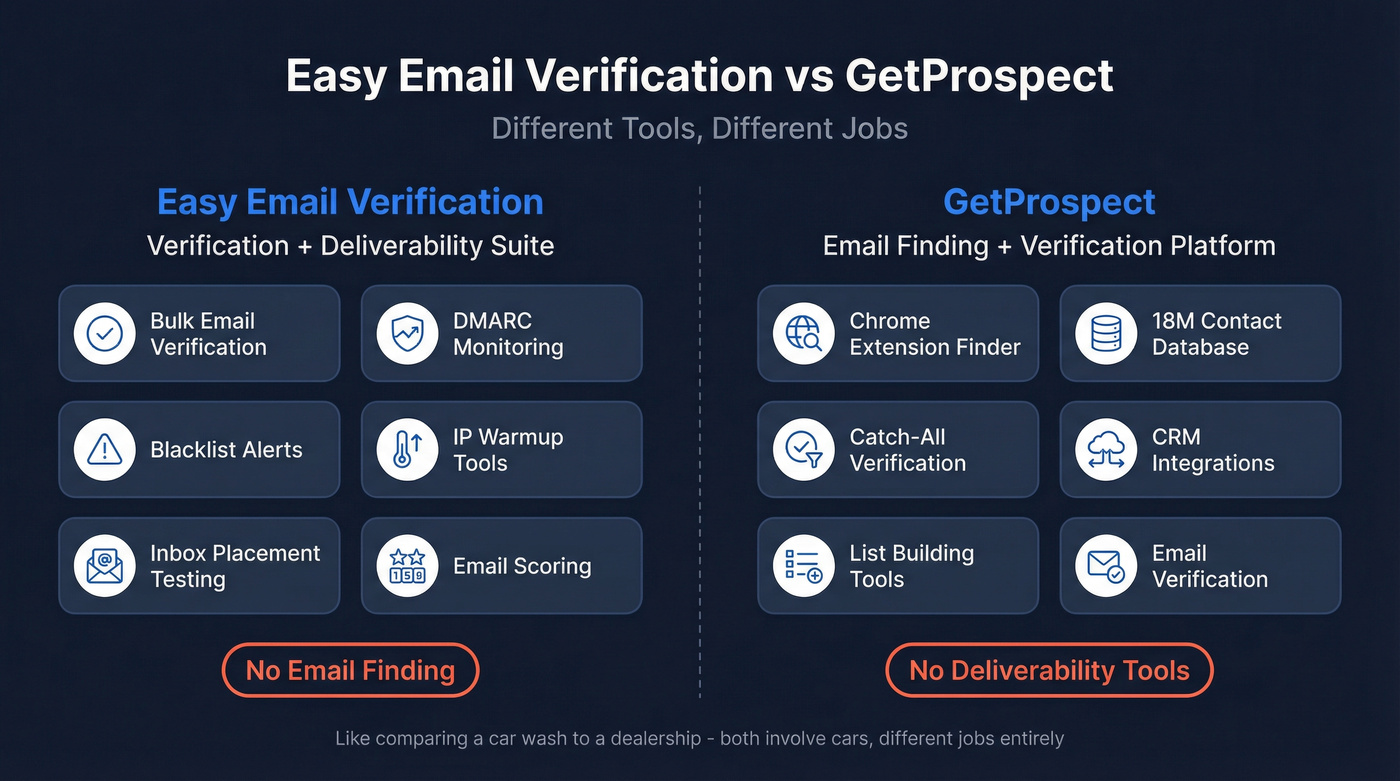
Use this if you're a marketing ops team cleaning a 10k CRM export before a campaign launch and you want ongoing email deliverability monitoring in one place. Skip this if you need to find emails - it doesn't do prospecting at all.
One thing that stood out in our research: Easy Email Verification has no major G2 or Capterra profile. That's not automatically a red flag for a niche verifier, but it means you're trusting vendor claims without third-party validation.
GetProspect
GetProspect is a lead generation platform first, verifier second. Its Chrome extension pulls contact info while you browse professional profiles, and the platform positions its database at 18M contacts with business emails. GetProspect also offers proprietary catch-all email verification - it validates emails on catch-all domains where other tools just shrug and mark them "unknown."

Use this if you're building prospect lists from scratch and want finding plus verification without juggling two tools. Skip this if you need deliverability monitoring - GetProspect doesn't offer DMARC, blacklist, or inbox placement tools.
Here's something worth knowing: GetProspect's 65% verified match rate (per PhantomBuster's Aug 2025 test) measures how often it returns a verified email from a profile - a different metric from its 95.9% verification accuracy on emails it already found. The Trustpilot 4.2/5 profile sits at 4.2/5 with just 9 reviews. Positive reviews praise the Chrome extension and easy list exports. Negative reviews flag account refusals with limited explanation, confusing quota limits, and frustrating support interactions.
Feature Comparison
Here's the thing: these tools barely overlap.
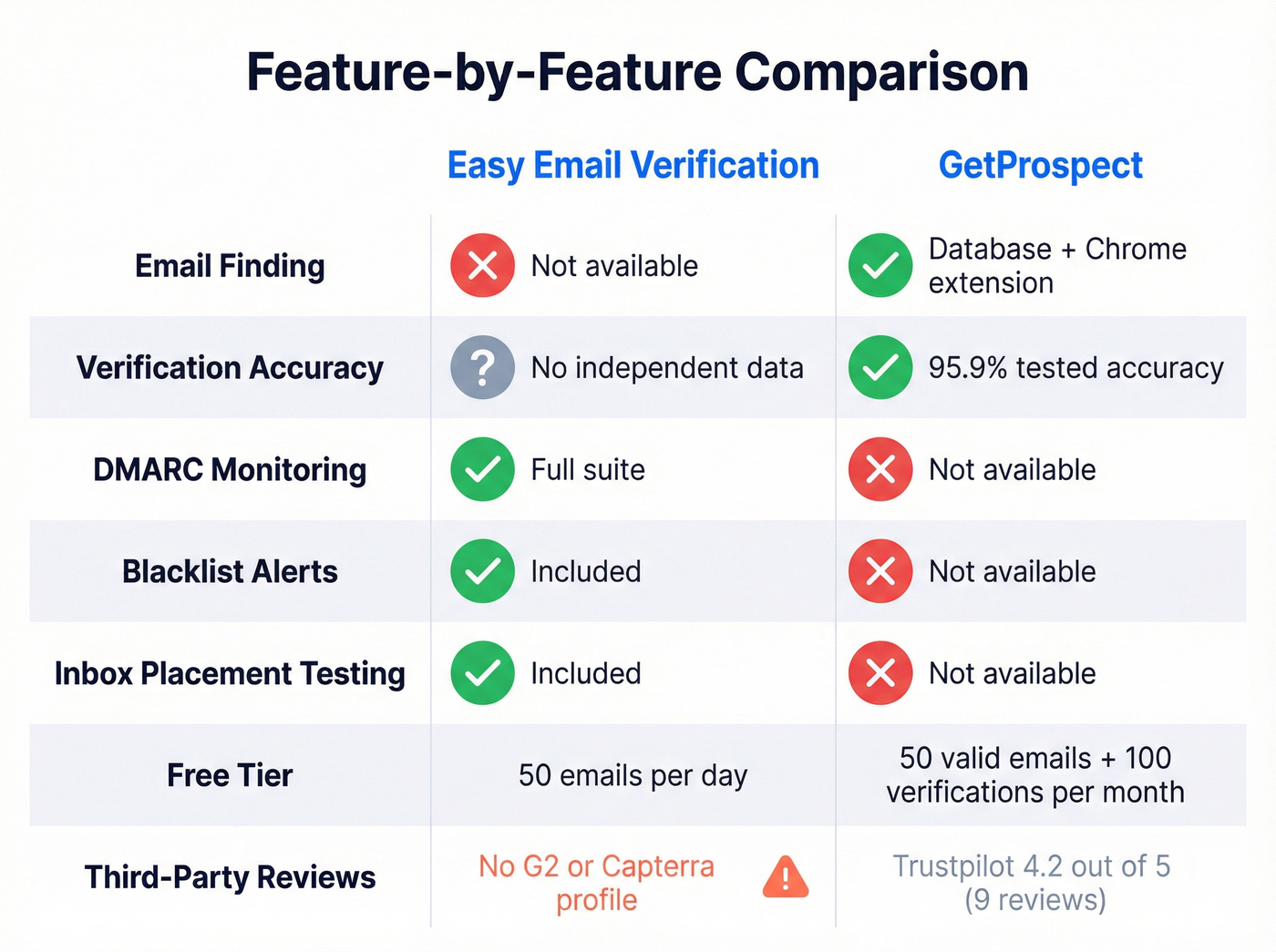
| Feature | Easy Email Verification | GetProspect |
|---|---|---|
| Primary function | Verification + deliverability | Email finding + verification |
| Email finding | No | Yes (database + extension) |
| Verification accuracy | Not independently tested | 95.9% observed |
| Deliverability tools | DMARC, blacklist, warmup, inbox placement | None |
| Free tier | 50 emails/day | 50 valid emails + 100 verifications/mo |
| Integrations | API, JS widget | API, CRM, Chrome extension |
| Review presence | None (G2/Capterra) | Trustpilot 4.2/5 (9 reviews) |
Easy Email Verification wins on deliverability infrastructure - it's not even close. GetProspect wins on prospecting capability because the other tool simply doesn't do it.
For context, independent benchmarks show wide variance across verifiers. ZeroBounce hits 97.8% in LeadMagic's 10,000-email test, while Hunter's own 3,000-email benchmark tops out at 70% when counting accept-all domains as unknowns. The methodology matters as much as the number. Easy Email Verification has no independent benchmark data at all, which makes its accuracy claims impossible to evaluate.

Why juggle Easy Email Verification for cleaning and GetProspect for finding when one platform does both better? Prospeo covers 300M+ profiles with 98% verified email accuracy, a 7-day data refresh cycle, and 30+ search filters - no two-tool tax required.
Find, verify, and enrich in one workflow - starting free.
Pricing Breakdown
| Plan | GetProspect | Easy Email Verification |
|---|---|---|
| Free | $0 (50 valid emails + 100 verifications) | $0 (50/day) |
| Entry paid | $49/mo (1,000 valid emails + 2,000 verifications) | $49/mo (Basic) |
| Mid-tier | $99/mo (5,000 valid emails + 10,000 verifications) | $99/mo (Advanced) |
| Higher tiers | - | $249/mo (Premium), $499/mo (Enterprise) |
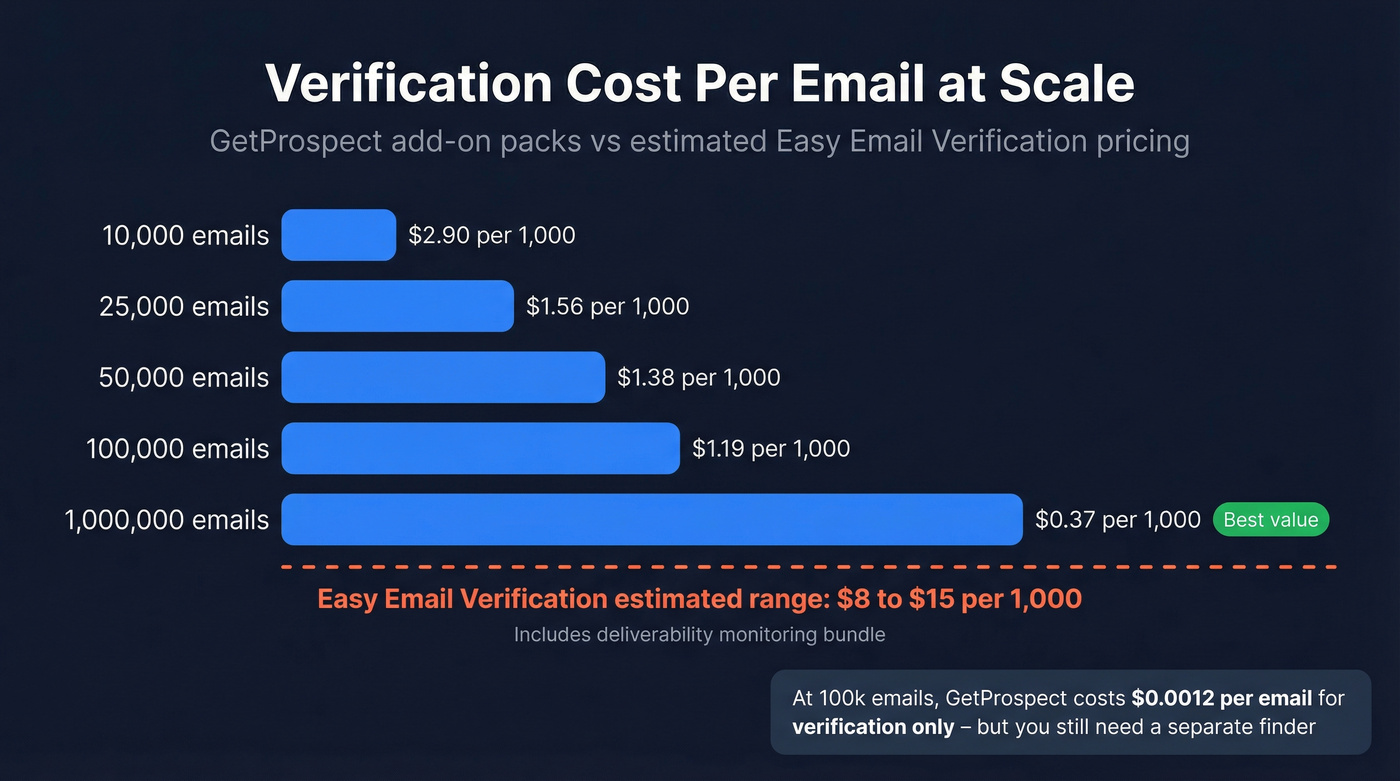
Where GetProspect gets interesting is the add-on verification packs - credits that never expire:
| Volume | Cost | Per 1,000 |
|---|---|---|
| 10,000 | $29 | $2.90 |
| 25,000 | $39 | $1.56 |
| 50,000 | $69 | $1.38 |
| 100,000 | $119 | $1.19 |
| 1,000,000 | $369 | $0.37 |
At the 100k tier, GetProspect's verification-only pricing is hard to beat - $0.0012 per email. But verification-only pricing is a trap if you're still paying separately for a finder. Based on industry norms for similar verifiers, Easy Email Verification runs roughly $8-15 per 1,000 verifications - 5-10x more expensive for pure verification, though it bundles deliverability monitoring that GetProspect doesn't touch.
Which Tool Fits Your Workflow?
Let's be honest: the category mismatch between these tools is the single biggest thing people miss. You aren't choosing between two verifiers. You're choosing between a deliverability suite and a prospecting platform.
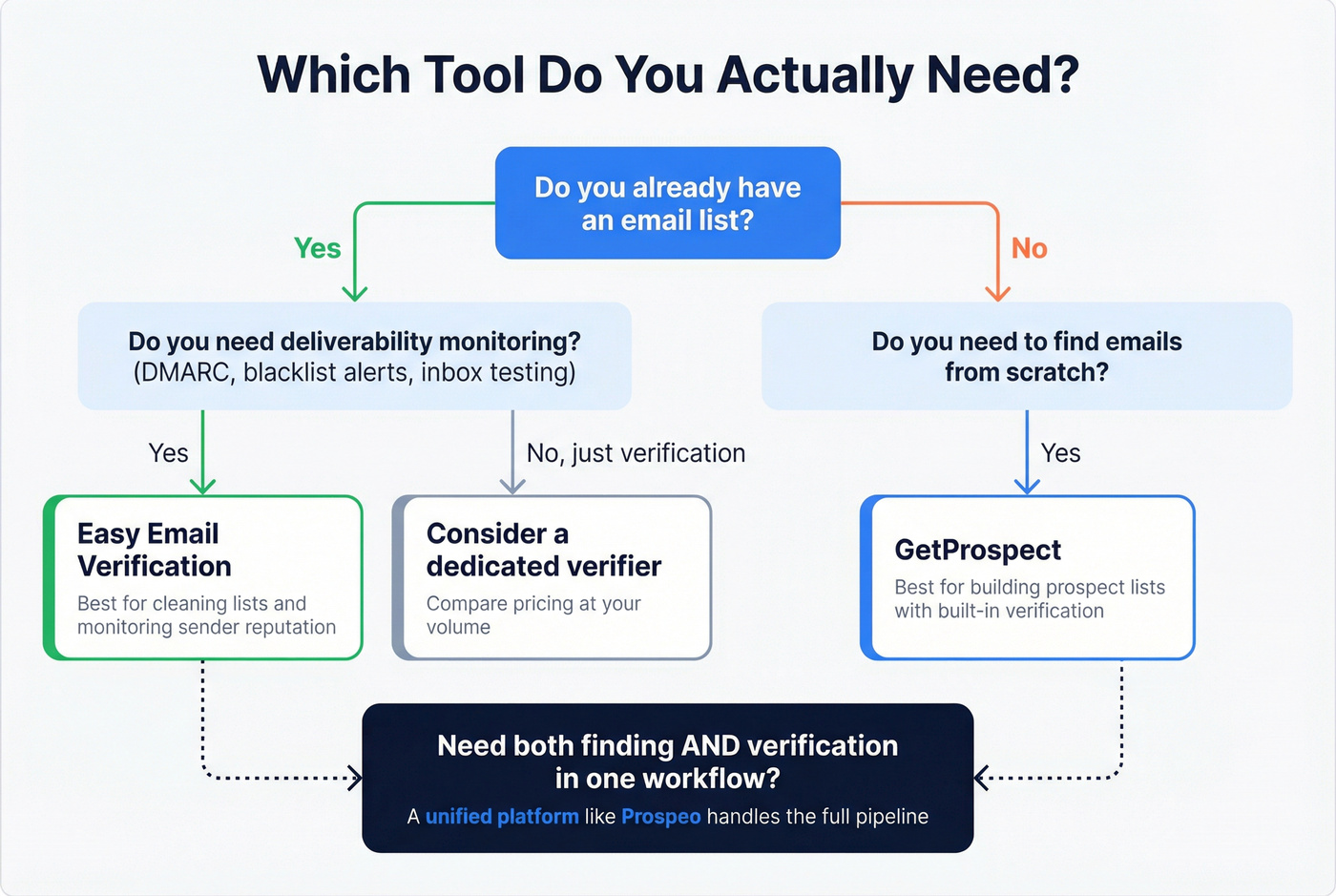
Pick Easy Email Verification if you already have lists and need cleaning plus ongoing deliverability monitoring. DMARC, blacklist alerts, and inbox placement testing are its real value - the verification is table stakes.
Pick GetProspect if you need to build prospect lists and verify as you go. The add-on packs drop below $0.003/verification at scale, and the Chrome extension is genuinely useful for grabbing contacts while browsing.
For teams that need both capabilities with the highest accuracy and freshest data, neither tool covers the full picture. Most teams we talk to actually need finding and verification - and stitching two tools together creates more problems than it solves.
A Simpler Alternative
Prospeo eliminates the two-tool tax. It covers 300M+ professional profiles with 98% email accuracy and a 7-day data refresh cycle - the industry average is six weeks. We've seen the difference firsthand: teams like Meritt tripled pipeline from $100K to $300K/week and cut bounce rates from 35% to under 4% after switching to a unified find-and-verify workflow. The free tier gives you 75 emails/month with no contract, and paid plans start at roughly $0.01 per email. With 30+ search filters - including buyer intent powered by Bombora, technographics, and job-change signals - it handles lead enrichment and verification in a single pass.
GetProspect's $0.0012/verification looks cheap until you factor in its 65% match rate and 18M contact database. Prospeo delivers 300M+ profiles at ~$0.01/email with 98% accuracy and catches what others miss - including catch-all domains, spam traps, and honeypots.
Better data at scale means fewer bounces and more replies.
FAQ
Is Easy Email Verification the same as EmailListVerify?
No. EmailListVerify has an established G2 profile (4.5/5, 59 reviews) and a different feature set. Easy Email Verification has no major G2 or Capterra presence - they're separate companies with distinct products.
How accurate is GetProspect's email verification?
In Warmup Inbox's 10,000-contact benchmark, GetProspect scored 95.9% accuracy and processed the list in about 18 minutes. Solid, though not best-in-class - Prospeo hits 98% with a proprietary 5-step verification process.
What if I need both email finding and verification?
That's the most common scenario, and it's exactly where both tools fall short individually. A unified platform handles finding, verification, and export in one workflow - no CSV juggling between tools, no double billing, and higher match rates on enrichment.