

The Best Email Campaign Tools for 2026
There are dozens of email campaign tools fighting for your money right now. Most "best of" guides rank them by feature count - who has the prettiest drag-and-drop editor, who bolted on AI subject line generation this quarter. That's backwards.
The average deliverability rate across 15 independently tested ESPs is just 83.1%. One in six marketing emails never reaches the inbox. Your tool choice matters far less than whether your list is clean and your sending reputation is intact.
Here's the uncomfortable truth: you don't need 15 tools. You need two - one for sending and one for making sure your data is clean before it hits the send queue. Everything else is optimization.
Our Picks
The short version. These four tools cover different problems - pick based on what's actually broken in your stack.
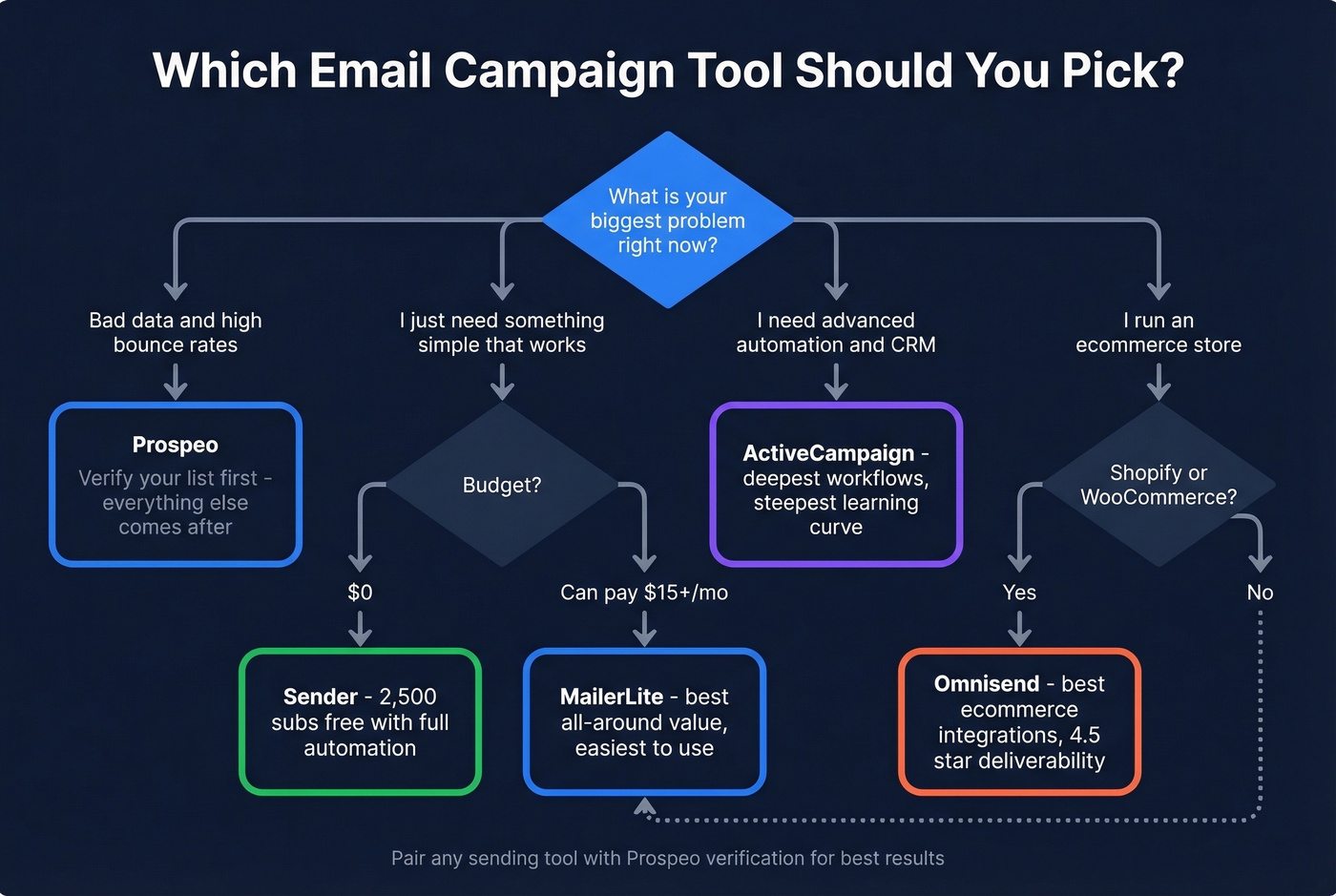
| Use Case | Pick | Why |
|---|---|---|
| List verification & data quality | Prospeo | 98% accuracy, pre-send verification |
| Best all-around for most teams | MailerLite | Simple UI, best value at scale |
| Best for advanced automation | ActiveCampaign | Deepest automation + CRM |
| Best free plan | Sender | 2,500 subs, 15K emails at $0 |
Prospeo isn't an ESP. It doesn't send emails. It's the tool that makes every other platform on this list work better - verifying your contacts before they enter your campaign so you're not torching your domain reputation on bad data. Think of it as the pre-send layer.
The other three are your actual sending platforms, and which one fits depends on your list size, automation needs, and budget.
What Actually Determines Campaign Success
Most marketers evaluate email tools by their template library or A/B testing features. That's like choosing a car by its paint color. The three things that actually determine whether your campaigns generate revenue are deliverability, automation depth, and list quality - roughly in that order.
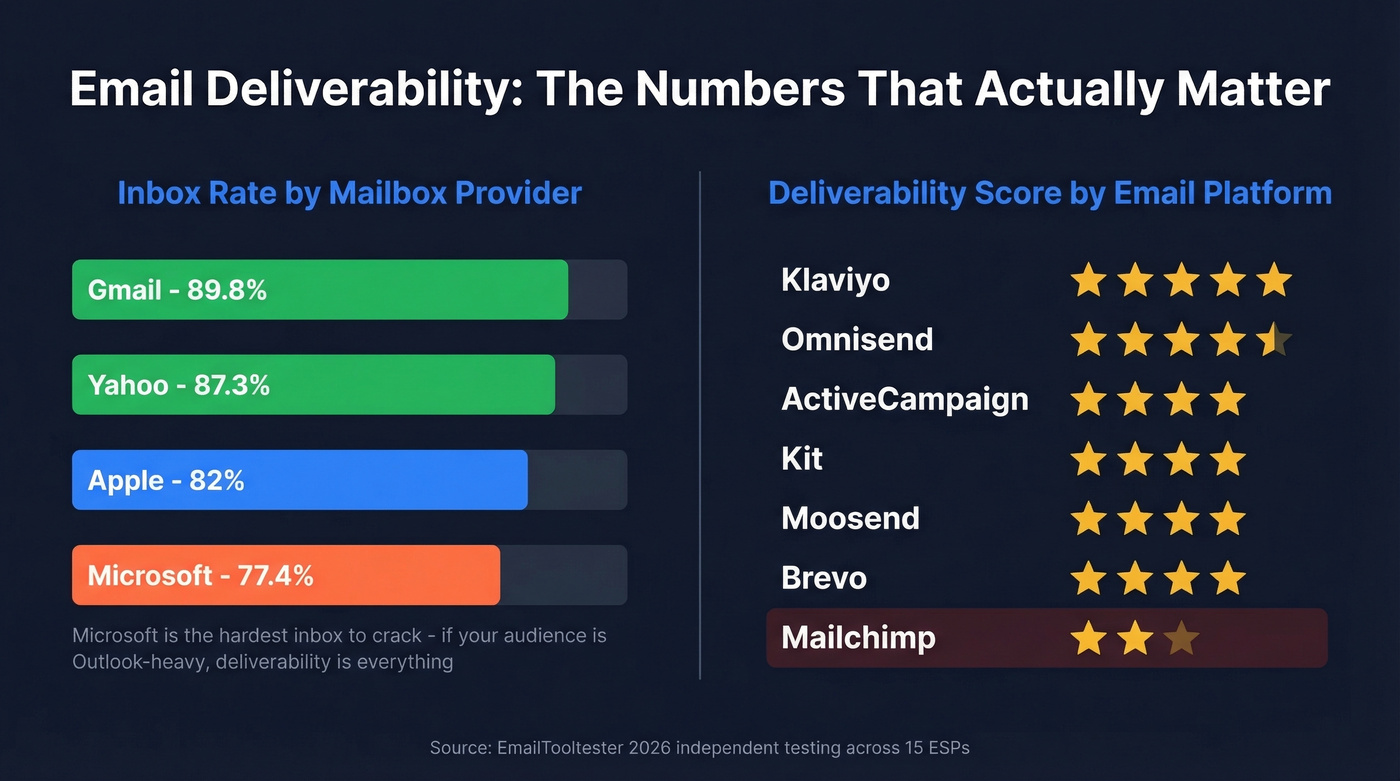
The four major mailbox providers handle about 77% of all email traffic, and they don't all treat your messages the same way.
| ISP | Inbox Rate |
|---|---|
| Gmail | 89.8% |
| Yahoo | 87.3% |
| Apple | 82% |
| Microsoft | 77.4% |
Microsoft is the hardest inbox to crack. If your audience skews corporate and Outlook-heavy, deliverability matters even more than these averages suggest.
Not all ESPs are equal here either. EmailTooltester scores platforms on a 5-star deliverability scale:
| Tool | Deliverability Score |
|---|---|
| Klaviyo | ★★★★★ |
| Omnisend | ★★★★½ |
| ActiveCampaign | ★★★★ |
| Kit (ConvertKit) | ★★★★ |
| Moosend | ★★★★ |
| Brevo | ★★★★ |
| Mailchimp | ★★★ |
Klaviyo scores highest on deliverability, but it's overpriced for anyone not running a Shopify or WooCommerce store. Omnisend gets you 90% of the way there for significantly less.
Then there's automation. Data from 183,000+ Klaviyo customers shows automated flows generate roughly 41% of total email revenue from just 5.3% of sends. Revenue per recipient for flows runs about 18x higher than one-off campaigns. Slazenger recovered 40% of lost revenue using automated flows alone. If your tool can't build sophisticated triggered sequences, you're leaving the majority of your email revenue on the table.

Let's be honest: if your deal sizes are under $5K and your list is under 5,000 contacts, you probably don't need to agonize over which ESP to pick. They're all fine. What will actually make or break your campaigns is whether those 5,000 addresses are real. Verify first, optimize later.
AI Features Worth Knowing About
Every ESP is bolting on AI right now, but most of it is window dressing. The features that actually matter: ActiveCampaign's AI send-time optimization (picks the best delivery window per contact), HubSpot's AI email writer (decent first drafts for teams without a copywriter), and Mailchimp's AI-generated subject lines (hit-or-miss, but free). Don't pick a tool because of its AI features - pick it despite them, and treat anything useful as a bonus.
Best Email Campaign Software, Ranked
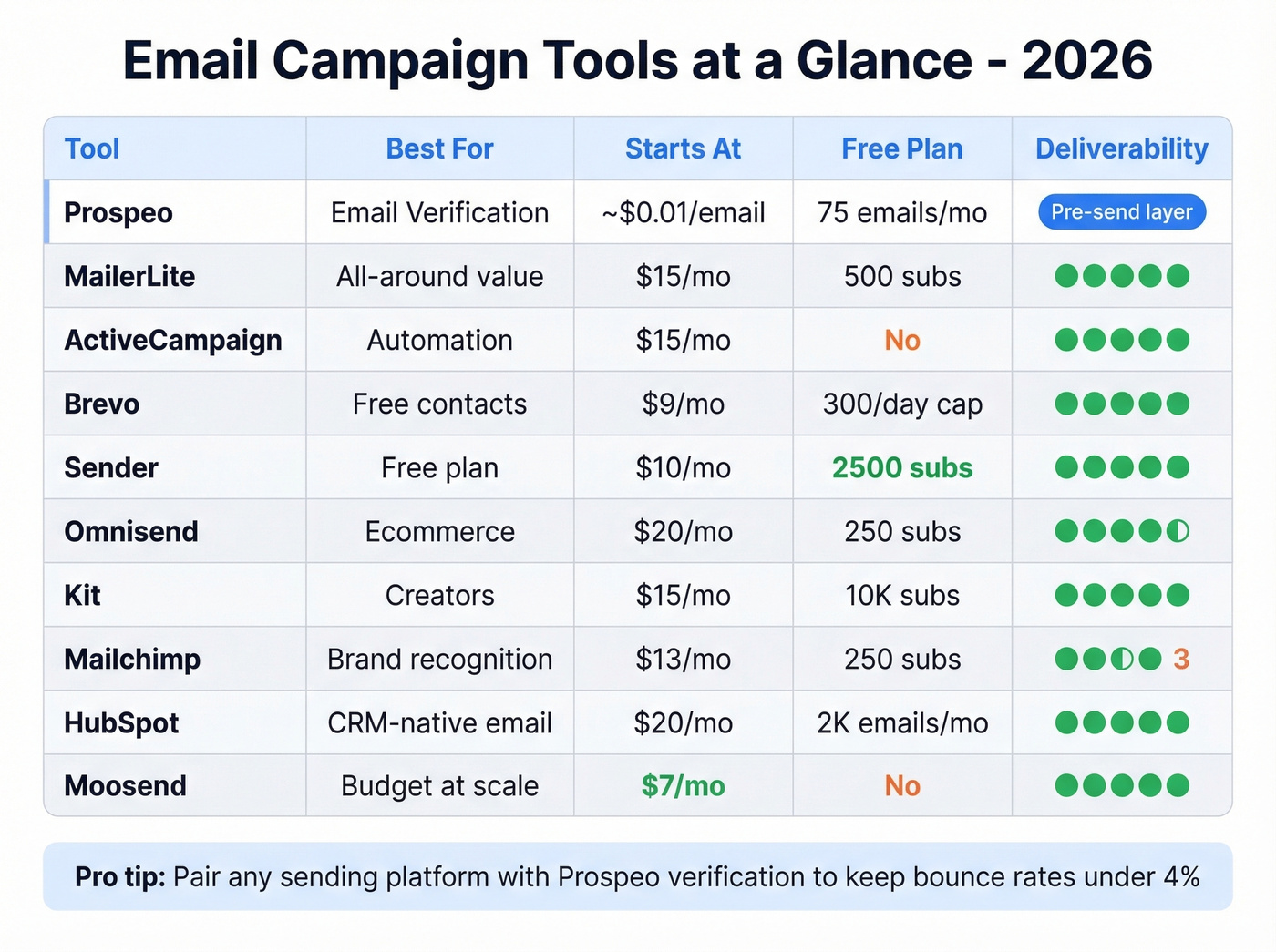
Here's the full breakdown, organized by what each tool does best.
| Tool | Best For | Starting Price | Free Plan | Deliverability |
|---|---|---|---|---|
| Prospeo | Email verification | ~$0.01/email | 75 emails/mo | N/A (pre-send) |
| MailerLite | All-around value | $15/mo (1K) | 500 subs | ★★★★ |
| ActiveCampaign | Automation | $15/mo (1K) | No | ★★★★ |
| Brevo | Free contacts | $9/mo (5K emails) | 300/day cap | ★★★★ |
| Sender | Free plan | $10/mo (1K) | 2,500 subs | ★★★★ |
| Omnisend | Ecommerce | $20/mo (1K) | 250 subs | ★★★★½ |
| Kit | Creators | $15/mo (<300) | 10K subs | ★★★★ |
| Mailchimp | Brand recognition | $13/mo (500) | 250 subs | ★★★ |
| HubSpot | CRM-native email | $20/mo (Starter) | 2K emails/mo | ★★★★ |
| Moosend | Budget at scale | $7/mo (500) | No | ★★★★ |
Prospeo - Best for Email Verification
Use this if you're running any sending platform on this list and want to make sure your sends actually land. Prospeo sits upstream of your ESP - it's the verification layer that catches invalid addresses, spam traps, and honeypots (fake addresses ISPs use to catch senders with dirty lists) before they destroy your sender reputation. The 5-step verification process with catch-all handling delivers 98% email accuracy, and data refreshes every 7 days versus the 6-week industry average.
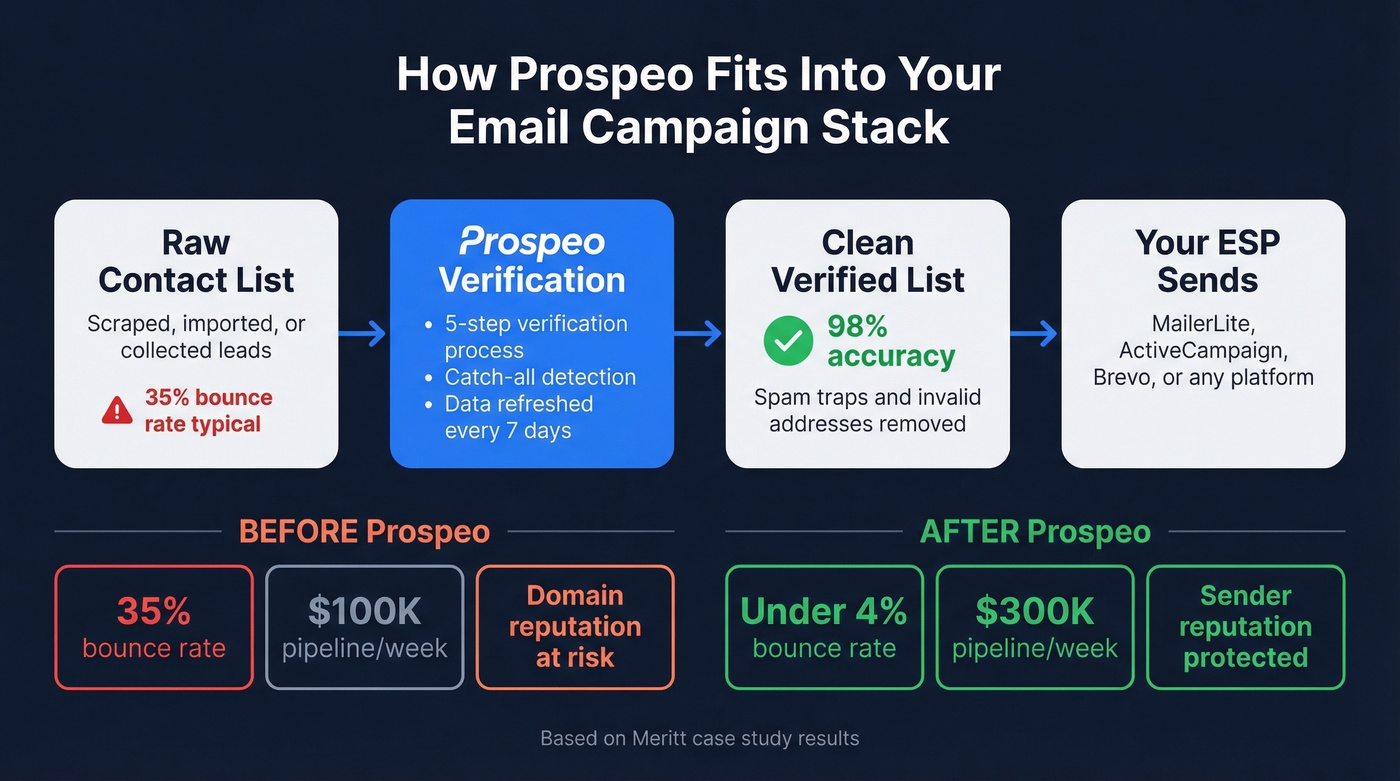
The proof is in the numbers. Meritt switched to Prospeo-verified lists and saw bounce rates drop from 35% to under 4%, with pipeline tripling from $100K to $300K per week. That's not a marginal improvement - that's the difference between a campaign that works and one that's actively damaging your domain.
Skip this if you only need a sending platform and your list is already verified through another service.
Pricing is credit-based at roughly $0.01 per email. The free tier gives you 75 emails plus 100 Chrome extension credits per month. No contracts, no sales calls required.
MailerLite - Best All-Around Value
Use this if you want the simplest path from "I have a list" to "I'm running automated campaigns." MailerLite carries a 4.6/5 on G2 across 1,094 reviews, and the top praise is consistently about ease of use. The drag-and-drop editor is genuinely good - not "good for the price," just good. Automation is included even on the free plan, which gives you 500 subscribers and 12,000 emails per month.
On month-to-month pricing, paid plans run $15/mo for 1,000 subscribers and scale to $73/mo at 10,000. That's meaningfully cheaper than ActiveCampaign or Omnisend at the same list size. The Reddit consensus matches the G2 reviews: MailerLite is the tool people recommend when someone asks "what should I use?" without specifying complex requirements. For teams that want simplicity and solid automation in one package, it's the safest bet.
Skip this if you need deep behavioral targeting, a built-in CRM, or enterprise-grade automation branching. MailerLite keeps things simple, and that's both its strength and its ceiling.
ActiveCampaign - Best for Automation
Use this if you've outgrown basic automation and need conditional logic, behavioral targeting, lead scoring, and a built-in CRM that actually works. ActiveCampaign's 4.4/5 on G2 with 14,607 reviews tells you two things: a lot of people use it, and most of them are satisfied. The workflow builder is the deepest in this price range, and AI send-time optimization is a genuine differentiator for teams sending at volume.
Here's the thing: the learning curve is brutal. It's the #1 con on G2, and Reddit threads consistently flag that pricing ramps up fast as your contact list grows. Starter plans begin at $15/mo for 1,000 contacts. Deliverability scores a solid 4 stars.
Skip this if you're a small team that just needs to send newsletters and basic welcome sequences. You'll pay for complexity you won't use.
Brevo - 100K Free Contacts (With a Catch)
On paper, Brevo looks unbeatable: the free plan allows 100,000 contacts, includes SMS and a light CRM, and paid plans start at just $9/mo for 5,000 emails. It's one of the only tools that lets you store that many contacts at zero cost. But the free plan caps you at 300 emails per day and 9,000 per month - meaning it would take you 333 days to email your full list once, assuming you even hit the monthly ceiling first. Paid plans are genuinely affordable though: $29/mo gets you 20,000 emails to unlimited contacts, priced by email volume rather than subscriber count. Reddit users call the templates "basic" compared to MailerLite or Mailchimp, but if you have a big list with low send frequency, Brevo is the cheapest way to keep those contacts warm.
Sender - The Free Plan That's Actually Useful
Most free plans are glorified demos. Sender's isn't.
You get 2,500 subscribers, 15,000 emails per month, and full automation access at $0 - no other free plan matches that combination. Paid plans are equally competitive at $10/mo for 1,000 subscribers and $38/mo at 10,000. The tradeoff is design: some users describe the editor as clunky, and the template library isn't as polished as MailerLite's. But for bootstrapped teams who need real marketing automation without a credit card, Sender is the obvious starting point.
Omnisend - Best for Ecommerce
Use this if you're running a Shopify or WooCommerce store. Omnisend's native ecommerce integrations are best-in-class, and its 4.5-star deliverability score is second only to Klaviyo. SMS and push notifications are built in, so you can run multi-channel flows without bolting on extra tools. Free plan covers 250 subscribers and 500 emails per month.
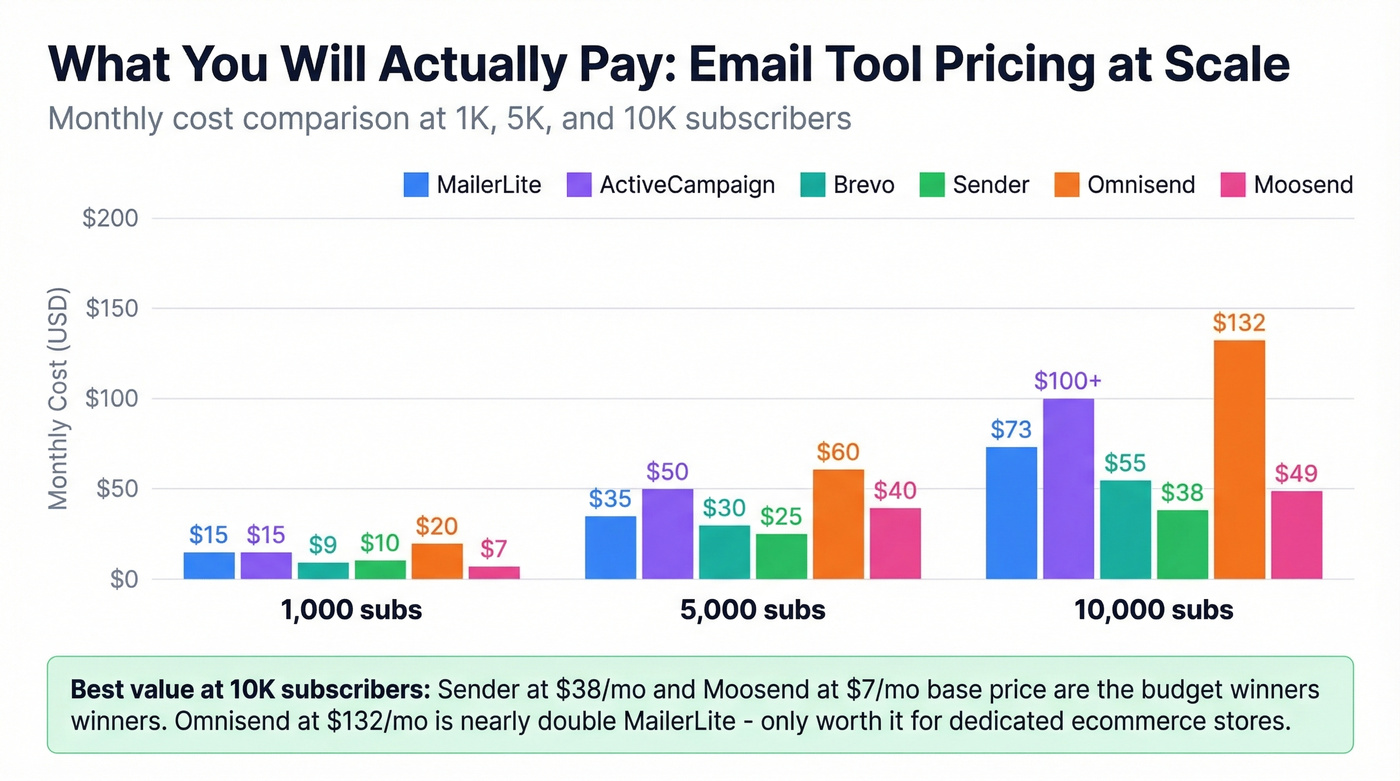
Skip this if your budget is tight at scale. Omnisend jumps to $132/mo at 10,000 subscribers - nearly double MailerLite's price at the same list size. Paid plans start at $20/mo for 1,000 contacts, which is reasonable, but the scaling curve is steep.
Kit (ConvertKit) - Best for Creators
Kit's free plan is generous on paper - 10,000 subscribers with unlimited emails. The platform is purpose-built for creator monetization with paid newsletters and tip jars, and deliverability scores 4 stars. But the free tier limits you to one visual automation and one email sequence, and you're required to promote other Kit creators' newsletters in your emails through their Creator Network. Paid plans start at $15/mo for under 300 subscribers and $39/mo at 1,000. It's a newsletter tool that happens to have automation, not the other way around.
Mailchimp - Overpriced for What You Get
Free plan: 250 subscribers, 500 emails. Three-star deliverability. Pricing climbs fast as your list grows, and it charges for inactive contacts. MailerLite and Sender offer more at every price point. We've tested both side by side, and there's no scenario where Mailchimp wins on value in 2026.
HubSpot - Only If You're Already In
Solid email tool - PCMag Editors' Choice - but only makes sense inside the HubSpot ecosystem. Free tier: 2,000 emails/mo. Starter: $20/mo. Marketing Hub Professional is typically $800+/mo, which prices out most small teams.
Moosend - Budget Pick at Scale
Starts at $7/mo for 500 contacts, stays competitive at $88/mo for 10,000 subscribers. Four-star deliverability, solid automation. Less well-known, but worth a trial if budget is your primary constraint.

One in six emails never reaches the inbox - and dirty data is the #1 reason. Prospeo's 5-step verification catches spam traps, honeypots, and invalid addresses before they torch your sender reputation. 98% email accuracy, refreshed every 7 days.
Clean your list at $0.01 per email before your next campaign send.
Pricing at Scale
Features matter, but pricing at scale is where most teams get burned. Here's what you'll actually pay at 1,000 and 10,000 subscribers on month-to-month plans:
| Tool | 1K Subs | 10K Subs |
|---|---|---|
| Moosend | $16/mo | $88/mo |
| Sender | $10/mo | $38/mo |
| MailerLite | $15/mo | $73/mo |
| Brevo | $9/mo* | $29/mo* |
| EmailOctopus | $13.50/mo | $44.50/mo |
| Zoho Campaigns | $7/mo | $49/mo |
| Omnisend | $20/mo | $132/mo |
| Mailchimp | $13/mo | ~$100/mo |
| ActiveCampaign | $15/mo | ~$150/mo |
Brevo prices by email volume, not contacts - $29/mo gets you 20,000 emails to unlimited contacts. Moosend's $7/mo starting price is for 500 contacts; the 1K column reflects the next tier up. EmailOctopus and Zoho Campaigns aren't reviewed above but are included as budget alternatives worth checking.
Sender and MailerLite are the clear value leaders at 10K subscribers. The Mailchimp tier-jump pain is real: crossing from 2,500 to 5,000 subscribers can add roughly $500/year to your bill. At 25,000+ subscribers, most tools get genuinely painful - that's where annual contracts and negotiation become essential.
Free Plan Comparison
Free plans are how most teams start, but the gotchas vary wildly:
| Tool | Subscribers | Emails/Mo | Automation | Gotcha |
|---|---|---|---|---|
| Sender | 2,500 | 15,000 | Full | Branding on emails |
| Kit | 10,000 | Unlimited | 1 flow only | Creator Network required |
| Brevo | 100,000 | 9,000 | Limited | 300/day send cap |
| MailerLite | 500 | 12,000 | Yes | Small sub limit |
| Beehiiv | 2,500 | Unlimited | N/A | 3 newsletters max |
| Mailchimp | 250 | 500 | None | That's a demo, not a plan |
Sender wins this comparison outright. Full automation at zero cost with a reasonable subscriber limit is unmatched. Kit's 10,000-subscriber free tier looks incredible until you realize you can only build one automation - and you're required to cross-promote other creators. Brevo's 100K contacts sound amazing until the 300/day cap and 9,000/month ceiling mean you'll barely scratch the surface of that list. Beehiiv is a solid newsletter platform but lacks marketing automation entirely - it's for publishers, not marketers.
Mistakes That Tank Results
Before you obsess over which platform to pick, make sure you're not sabotaging yourself with these common mistakes. Even the best sending software can't save you from fundamentally broken practices.
Image-only emails kill deliverability, break accessibility, and show a blank box to anyone with images disabled. Always include real text alongside your visuals.
Non-responsive templates are still shockingly common. Over 55% of emails are opened on mobile. If your template doesn't adapt, you're losing more than half your audience at the design level.
Same content to everyone. Look, we get it - segmentation takes work. But blasting identical messages to your entire list is the fastest way to train subscribers to ignore you. Even basic segmentation by engagement level or signup source dramatically improves results.
Ignoring list hygiene. Every bounced email chips away at your domain reputation. ISPs track this, and once your reputation drops, even your good emails start landing in spam. In our experience, verifying your list before every major campaign is the single highest-ROI habit you can build - catching invalid addresses before they bounce is cheaper than rebuilding a burned domain.
Skipping authentication. SPF, DKIM, and DMARC aren't optional anymore. Gmail and Microsoft are actively filtering unauthenticated senders. If you haven't set these up, do it before you send another email.
Meritt dropped bounce rates from 35% to under 4% and tripled pipeline to $300K/week - just by verifying contacts through Prospeo before they entered the send queue. No ESP switch. No workflow overhaul. Just cleaner data upstream.
Every email tool on this list performs better with verified data feeding it.
Before You Switch ESPs
Switching email platforms sounds simple until you're knee-deep in it. The top migration triggers on Reddit are predictable: unexpected price hikes, deliverability that tanks for no apparent reason, a UI that gets slower with every update, and support that takes days to respond.
But the hidden costs are what catch people off guard.
Rebuilding automations from scratch. Your welcome series, abandoned cart flows, re-engagement sequences - none of them transfer cleanly between platforms. Budget 2-4 weeks of rebuild time.
Re-warming your domain. Your sending reputation doesn't follow you. Start slow with a few hundred sends per day and ramp up over 2-4 weeks. Jumping straight to full volume on a new ESP is a fast path to the spam folder.
Losing engagement history. Open rates, click data, purchase attribution - most of this doesn't migrate. You'll lose segmentation based on historical behavior.
Export everything before you cancel. Warm your new domain for at least two weeks before going full volume. And whatever you do, don't switch mid-campaign or during peak season. We've seen teams try to migrate ESPs in November before Black Friday. It never ends well.
FAQ
What's the best free email campaign tool?
Sender gives you 2,500 subscribers, 15,000 emails per month, and full automation access at $0 - no other free plan matches that combination. Kit offers 10,000 subscribers free but limits you to one automation and one sequence, making it better for simple newsletters than real marketing workflows.
Which platform has the best deliverability?
Klaviyo scores highest at 5 stars in independent testing, followed by Omnisend at 4.5 stars and ActiveCampaign at 4 stars. Deliverability depends as much on your list quality as your sending platform - verify emails before sending and authenticate your domain with SPF, DKIM, and DMARC.
How do I improve campaign deliverability?
Verify your email list before sending to catch invalid addresses, spam traps, and honeypots before they bounce. Authenticate your domain with SPF, DKIM, and DMARC records, keep spam complaint rates below 0.3%, and remove unengaged subscribers regularly. Pairing your sending platform with a verification tool gives you the best shot at consistent inbox placement.
Is Mailchimp still worth it in 2026?
For most teams, no. Its free plan is the smallest in the market at 250 subscribers, it charges for inactive contacts, and deliverability scores below average at 3 stars. MailerLite and Sender offer more features, better value, and comparable or better deliverability at every price point.
What's the difference between campaigns and automated flows?
Campaigns are one-time broadcasts sent to a segment on a specific date; flows are triggered sequences - welcome series, abandoned carts, post-purchase follow-ups - that fire automatically based on behavior. Flows generate 41% of email revenue from just 5.3% of sends, making them the real revenue engine for any email program.