

Email Compliance: Laws, Authentication & Best Practices (2026)
A GDPR fine takes months of investigation, legal back-and-forth, and regulatory process. Gmail rejecting your emails? That happens overnight, with no appeal.
Email compliance in 2026 isn't just about staying on the right side of the law - it's about staying in the inbox. And the inbox has its own rules now, enforced by algorithms that don't negotiate.
The Short Version
The discipline sits on three layers. Legal: know which commercial email laws govern your recipients (CAN-SPAM, GDPR, CASL) and follow their consent and opt-out rules. Mailbox providers: authenticate your domain with SPF, DKIM, and DMARC, then keep spam complaint rates below 0.10%. Operational hygiene: verify your contact data before every send, because bounces and spam traps destroy deliverability faster than any regulator can fine you.
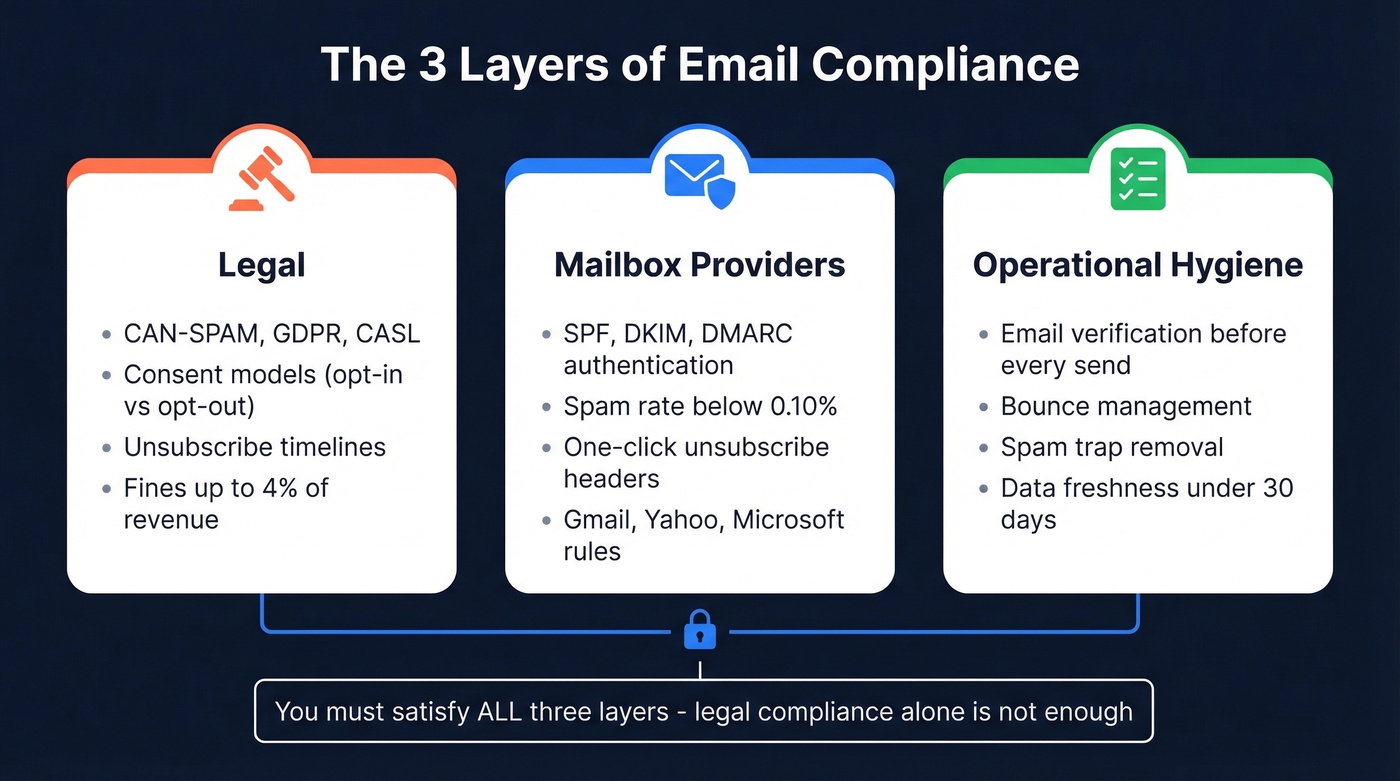
The rest of this guide breaks down every layer with specific laws, thresholds, checklists, and the mistakes that actually get companies fined.
What Is Email Compliance?
It's the set of rules governing who you can email, what you must include, and how your infrastructure needs to behave. Most people think of it as "follow CAN-SPAM" or "get GDPR consent." That's one-third of the picture.
Legal regulations - CAN-SPAM, GDPR, CASL, and their regional equivalents - dictate consent models, unsubscribe timelines, and penalties. Mailbox provider policies from Google, Yahoo, and Microsoft enforce their own authentication and spam-rate requirements, and they'll reject your mail outright if you don't comply. Operational hygiene - list quality, bounce management, and data freshness - determines whether your emails actually land.
Here's the thing: a company can be perfectly legal under US law and still have every email bounced by Gmail because their DMARC record is misconfigured or their spam complaint rate crept past 0.30%. The inbox is governed by three authorities now. You need to satisfy all of them.
Why It Matters in 2026
The penalties are real and getting bigger. Each individual email violating CAN-SPAM carries a penalty of up to $53,088. GDPR fines can reach 4% of global annual turnover or EUR 20 million, whichever is higher. The SEC has collected over $2 billion in electronic messaging fines from 100+ firms - mostly for recordkeeping failures, not marketing.
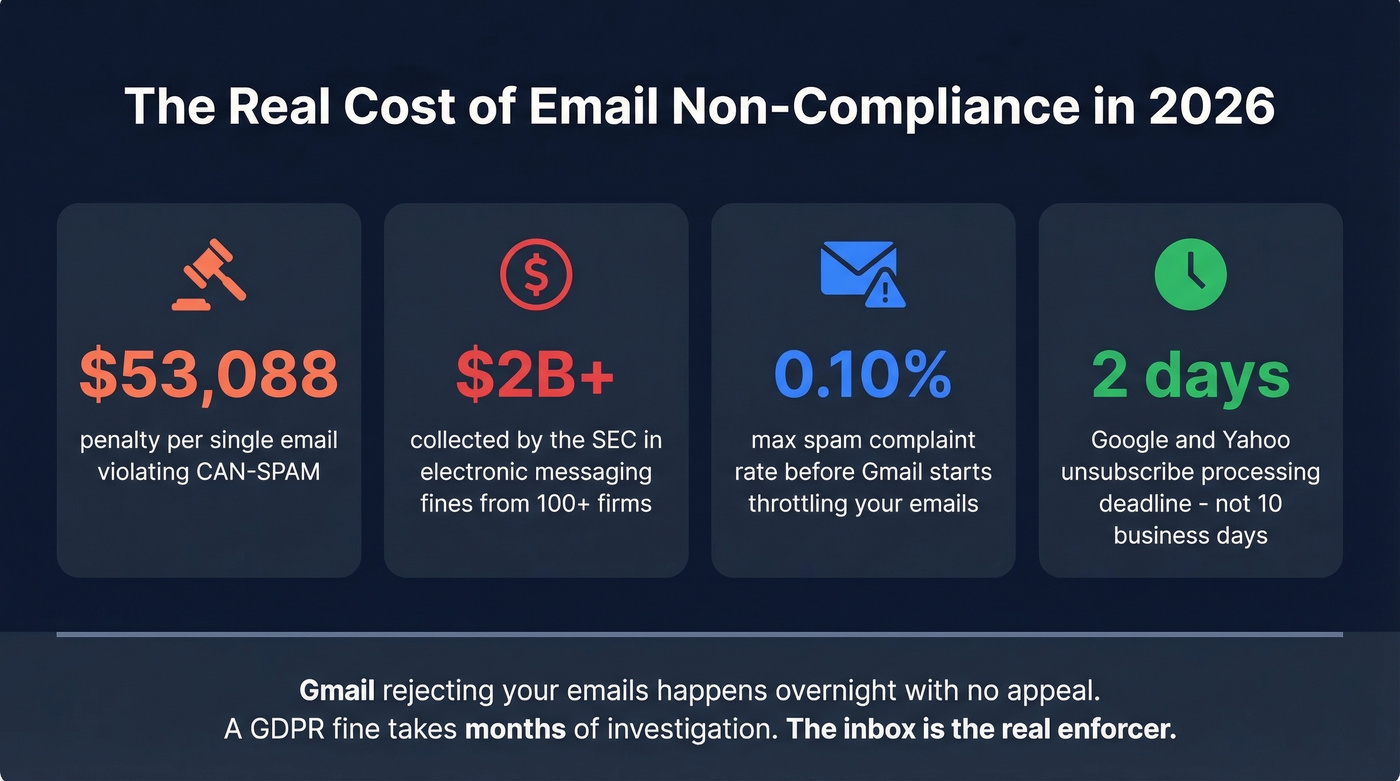
Gmail is a bigger threat than the FTC. The FTC investigates complaints, builds cases, and negotiates settlements over months or years. Google started rejecting non-compliant bulk email in April 2024. No warning letter. No negotiation. Your emails just stop arriving.
Since February 2024, Google and Yahoo enforce authentication requirements for anyone sending more than 5,000 messages per day to Gmail addresses. Microsoft followed with its own enforcement starting May 5, 2025. If your spam complaint rate hits 0.30% in Google Postmaster Tools, messages get throttled, then rejected. Satisfying all three layers - legal, provider, and operational - is the only way to protect your sending reputation.
The financial cost of non-compliance is obvious. The hidden cost is worse. We've seen companies lose an entire quarter of pipeline because a single purchased list torched their sender reputation overnight. Domain reputation damage takes months to rebuild, and no amount of money accelerates that timeline.
Major Laws by Region
You need to comply with the regulations that apply in the recipient's jurisdiction, not just your own. This recipient-location nuance catches more companies than any other detail.
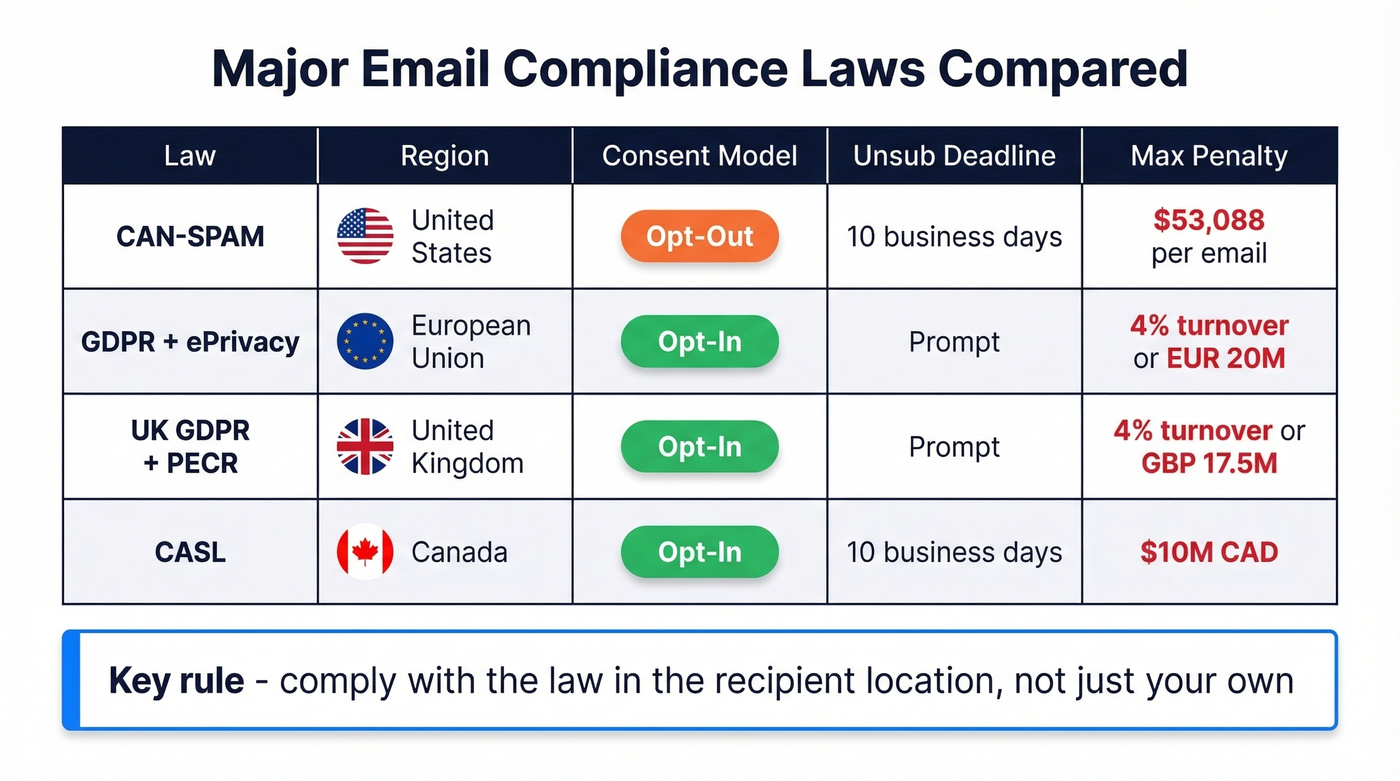
| Region | Law | Consent Model | Unsub Deadline | Max Penalty |
|---|---|---|---|---|
| US | CAN-SPAM | Opt-out | 10 biz days | $53,088/email |
| EU | GDPR + ePrivacy | Opt-in | Prompt | 4% turnover / EUR 20M |
| UK | PECR + UK GDPR | Opt-in | Prompt | 4% turnover / GBP 17.5M |
| Canada | CASL | Opt-in | 10 biz days | $10M CAD |
GDPR and UK GDPR require data subject access requests to be fulfilled within one month. Brazil's LGPD is tighter at 15 days. CAN-SPAM and CASL have no equivalent DSAR obligation.
CAN-SPAM Act
CAN-SPAM is the most permissive major email law. It's opt-out, meaning you can email someone without prior consent as long as you follow the rules. And yes, this applies to B2B email - there's no business-to-business exception.
The requirements:
- Accurate header information - "From," "To," "Reply-To," and routing info must be truthful
- Non-deceptive subject lines - must reflect the actual content
- Identify the message as an ad - clearly and conspicuously
- Valid physical postal address - street address, PO box, or registered private mailbox
- Clear opt-out mechanism - must work for at least 30 days after sending
- Honor opt-outs within 10 business days - no fees, no extra info required
- Never sell or transfer opted-out addresses - except to a compliance vendor
Purely transactional messages like order confirmations and account updates are exempt from most CAN-SPAM provisions, but they still can't contain misleading routing information.
GDPR & ePrivacy
GDPR flips the model. You need a lawful basis before sending - typically consent or legitimate interest. For cold B2B outreach, legitimate interest can work, but it requires a documented balancing test showing the recipient's privacy rights don't override your business interest. That balancing test isn't optional. It's the document a regulator will ask for.
Double opt-in isn't required by GDPR itself, but it's strongly recommended because it provides bulletproof consent documentation and dramatically reduces spam complaints. The "soft opt-in" exists in many EU member states and the UK: if someone is an existing customer, you can email them about similar products without fresh consent, provided you offered an opt-out at the point of data capture and include one in every message.
A common mistake: gating a lead magnet behind a mandatory marketing checkbox. GDPR requires consent to be freely given, meaning the marketing opt-in must be separate from the download. Enforcement interpretations evolve year over year, so staying current matters.
Cross-border transfers to the US typically use DPF or Standard Contractual Clauses. For UK transfers, the UK-US Data Bridge applies where applicable; otherwise the IDTA or the UK addendum to SCCs is used.
CASL and Others
Canada's CASL is among the strictest. It distinguishes between implied consent (existing business relationship, valid for two years) and express consent (explicit opt-in, no expiry). Penalties reach $10 million CAD for businesses, with potential private lawsuits on top.
For companies operating across borders, the practical approach is to build your baseline around the strictest law your recipients fall under, then relax requirements only where a specific jurisdiction explicitly allows it.

One bad list can torch your domain reputation overnight. Prospeo's 5-step email verification - with catch-all handling, spam-trap removal, and honeypot filtering - delivers 98% accuracy so your bounce rate stays under every provider threshold.
Stop risking your domain on unverified data. Start with emails that actually land.
Mailbox Provider Rules (2024-2026)
Google and Yahoo started enforcing bulk sender requirements on February 1, 2024. Microsoft followed on May 5, 2025. These aren't suggestions - non-compliant email gets rejected.
Initial enforcement in February 2024 meant temporary errors on a small percentage of non-compliant traffic. By April 2024, Google began outright rejecting messages. Microsoft's enforcement ramped through mid-2025. The requirements boil down to three things:
- Authentication: SPF, DKIM, and DMARC are mandatory for bulk senders (5,000+ messages/day to Gmail)
- Spam rate: Keep your Google Postmaster Tools spam rate below 0.10% - and never hit 0.30%
- One-click unsubscribe: Marketing messages must support one-click unsubscribe via List-Unsubscribe headers, processed within two days
That two-day unsubscribe processing window deserves emphasis. CAN-SPAM gives you 10 business days. Google and Yahoo give you two calendar days. The provider policy is stricter than the law, and it's the one that actually determines whether your emails arrive.
Technical Authentication Checklist
Authentication is the foundation. Without it, nothing else matters.
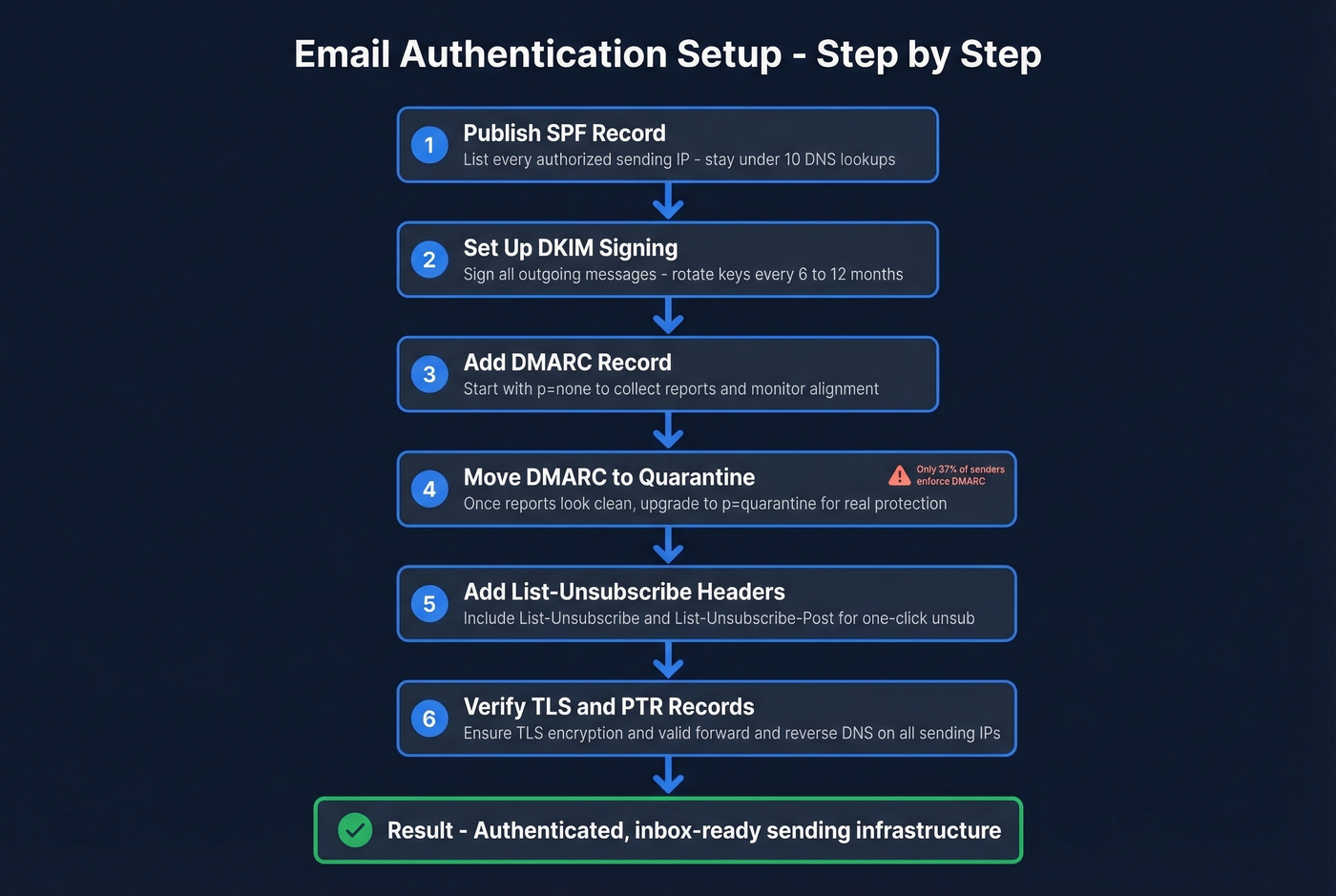
- SPF: Publish an SPF record listing every IP authorized to send on your domain's behalf. Keep it under the 10-lookup limit.
- DKIM: Sign outgoing messages with a DKIM key. Rotate keys every 6-12 months - 47.7% of senders only rotate after a security breach, which is too late.
- DMARC: Publish a DMARC record. The minimum is
p=none, butp=noneis like having a security camera that doesn't record. Only 37% of DMARC users enforce withrejectorquarantine. Move top=quarantineas soon as your reporting shows clean alignment. - ARC headers: Implement Authenticated Received Chain for forwarded messages to preserve SPF/DKIM results through mailing lists and forwarding services.
- Valid PTR records: Ensure sending IPs have valid forward and reverse DNS records.
- List-Unsubscribe headers: Include both
List-UnsubscribeandList-Unsubscribe-Postheaders in every marketing message. This enables one-click unsubscribe in Gmail and Yahoo. - TLS encryption: Send over TLS. Non-negotiable.
The adoption stats tell a sobering story. 66% of senders know they use both SPF and DKIM - meaning a third either don't or aren't sure. DMARC adoption is growing (up 11% year-over-year), but most deployments sit at p=none, which provides reporting but zero protection.
Most companies think they're DMARC-compliant because they have a record. A p=none policy tells mailbox providers "I'm watching but not enforcing." Move to quarantine, then reject. This single change does more for your deliverability than any compliance software subscription.
Let's be honest about list hygiene too: it belongs on this checklist even though it's not technically "authentication." Run your contacts through a verification tool before every campaign, especially if your data is older than 30 days. Invalid addresses inflate bounce rates, and bounces feed directly into the reputation signals that trigger Gmail's spam-rate thresholds.
Email Retention Requirements
Compliance doesn't end when you hit send. Regulated industries face specific retention obligations for email communications.
| Regulation | Retention Period | Applies To |
|---|---|---|
| SOX | 7 years | Public companies |
| HIPAA | 7 years | Healthcare orgs |
| IRS | 7 years | All US businesses |
| FDIC | 5 years | Financial institutions |
| FOIA | 3 years | Federal/state agencies |
| CMMC/DoD | 3 years | DoD contractors |
| PCI DSS | 1 year | Payment processors |
GDPR doesn't set a fixed retention period. Instead, it limits retention to what's necessary for the stated purpose - a vaguely defined standard that makes legal teams nervous for good reason.
The practical challenge is encryption interoperability. Email is unencrypted by default, and end-to-end encryption requires sender and receiver alignment across potentially dozens of providers. Legal hold and e-discovery obligations add another layer: you need to be able to produce emails on demand during litigation, which conflicts with "delete everything" privacy instincts.
Mistakes That Get Companies Fined
1. Sending without consent proof. Having a contact's email isn't consent. Business cards, purchased lists, and event badge scans don't count under GDPR or CASL. If you can't produce a timestamped consent record, you don't have consent.
2. Hidden or broken unsubscribe links. Burying the unsubscribe link in tiny gray text, requiring a login to unsubscribe, or letting the mechanism break after 30 days. All violations. All common.
3. Missing physical address. CAN-SPAM requires a valid physical postal address in every commercial email. Startups operating out of coworking spaces often skip this. Don't.
4. Ignoring retention obligations. Deleting emails that SOX or HIPAA requires you to keep, or keeping emails that GDPR says you should have purged. Both are violations, in opposite directions.
5. Buying or using unverified lists. This is the single dumbest decision a company can make. Purchased lists are loaded with spam traps, honeypots, and dead addresses. They spike your bounce rate, push complaint rates past Google's 0.30% threshold, and can permanently damage your domain reputation. The fix is straightforward: verify every email before it enters your sending workflow. Prospeo's 5-step verification catches spam traps, honeypots, and catch-all domains - the hidden triggers that spike bounce rates past provider thresholds.

6. Ignoring recipient jurisdiction. Applying only your local laws while emailing recipients in stricter jurisdictions is a recipe for fines. A US company emailing EU prospects needs to follow GDPR, full stop.
7. No audit trail for consent. If a regulator asks how you obtained consent for a specific contact, you need a timestamped record showing when, where, and how they opted in. "They filled out a form" isn't enough without the log to prove it.
Skip the compliance software if you're a small team. You don't need a $500/month platform to stay compliant. You need clean data, proper authentication, and a checklist you actually follow.
Real Enforcement Cases
If you think enforcement is theoretical, the SEC would like a word.
By early 2025, the SEC had charged over 100 firms and collected more than $2 billion in penalties - primarily for electronic messaging recordkeeping violations. In January 2025 alone, the SEC charged 12 firms totaling $63 million: Blackstone paid $12 million, KKR paid $11 million, and Charles Schwab paid $10 million. In August 2024, Ameriprise, Edward Jones, Raymond James, and LPL Financial each paid $50 million. In February 2024, a sixteen-firm sweep netted $81 million in combined penalties, with Piper Sandler getting hit with $14 million from the SEC plus $2 million from the CFTC.
These weren't marketing email violations. They were recordkeeping failures - employees using WhatsApp, personal email, and text messages for business communications without proper archiving. The lesson extends beyond marketing: every business communication channel carries compliance obligations, and regulators are actively enforcing them.
On the GDPR side, Italy's Garante fined Enel Energia EUR 26.5 million in 2021 for aggressive telemarketing and email campaigns without valid consent - still the largest marketing-related GDPR fine on record.
Look, if the SEC is fining Blackstone $12 million for messaging violations, your company's "we'll deal with compliance later" approach isn't a strategy. It's a liability.
Email compliance starts with data hygiene, and data hygiene starts with freshness. Prospeo refreshes all 300M+ records every 7 days - not the 6-week industry average - so you're never sending to stale addresses that trigger bounces and spam traps.
Clean data isn't optional when Gmail enforces harder than the FTC.
FAQ
Does CAN-SPAM apply to B2B email?
Yes. CAN-SPAM applies to all commercial messages, including B2B. There's no business-to-business exception. Every commercial email must include sender identification, a physical address, and a working opt-out mechanism regardless of whether the recipient is a consumer or a business contact.
Is cold email legal?
In the US, yes - CAN-SPAM allows unsolicited commercial email with proper identification, a physical address, and an opt-out. Under GDPR, cold email to EU recipients requires a lawful basis, typically legitimate interest with a documented balancing test. The recipient's jurisdiction determines which law applies.
What spam complaint rate is too high?
Google's target is below 0.10%, with 0.30% as the danger zone. Exceeding 0.30% triggers throttling or outright rejection. Keeping rates low starts with sending only to verified, opted-in addresses and making unsubscribe effortless.
How does email verification help with compliance?
Sending to invalid addresses inflates bounce rates, triggers spam traps, and pushes complaint rates above provider thresholds. Verifying addresses before sending removes dead contacts, spam traps, and honeypots. Our team runs verification before every campaign - it's the single highest-ROI compliance habit we've found.
Do I need double opt-in for GDPR?
Double opt-in isn't legally required by GDPR, but it's the strongest consent proof available. It creates a timestamped, verifiable record that a regulator can't dispute, and it cuts spam complaints by filtering out mistyped or fraudulent signups.