

Best Email Enrichment Tools in 2026: Real Accuracy Data, Real Prices
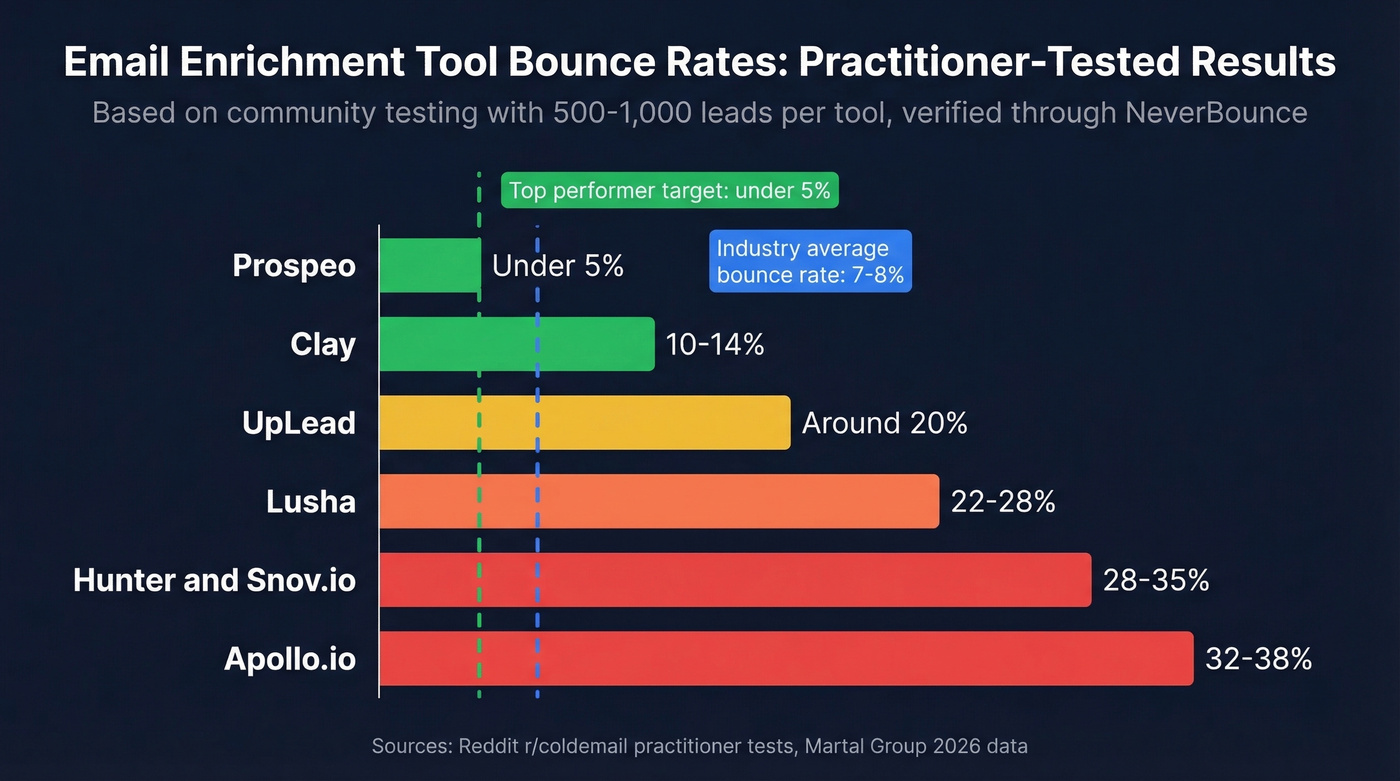
A practitioner on r/coldemail ran the test everyone talks about but nobody does. Same filters, same ICP, roughly 500-1,000 leads per tool, every list verified through NeverBounce. Apollo bounced 32-38%. Hunter and Snov hit 28-35%. Even the "better" tools like Seamless and UpLead landed around 20%. Meanwhile, 17% of cold emails never reach the inbox due to bounces and spam filtering, and the average cold email bounce rate sits at 7-8%. Most providers can't even get you there.
Here's the thing: most "enrichment tool" roundups are actually data enrichment lists solving the wrong problem. You don't need 50 firmographic fields. You need one thing - a verified, deliverable email address that won't torch your domain. Top-performing outbound teams target 95%+ deliverability. If your provider is handing you 30% bounces, that's not enrichment. It's a liability.
Our Top Picks
- Prospeo - Best for email accuracy and data freshness. 98% email accuracy, 7-day refresh cycle, proprietary verification infrastructure. Free tier (75 emails/month + 100 Chrome extension credits), paid plans at ~$0.01/email. If deliverability is the thing keeping you up at night, start here.
FullEnrich - Best budget waterfall enrichment. Cascades through 25+ vendors at $29/mo for 500 credits. Community-reported valid email rates around 90% vs. 60-70% from single-source tools. The catch-all billing is annoying, but the coverage is real.
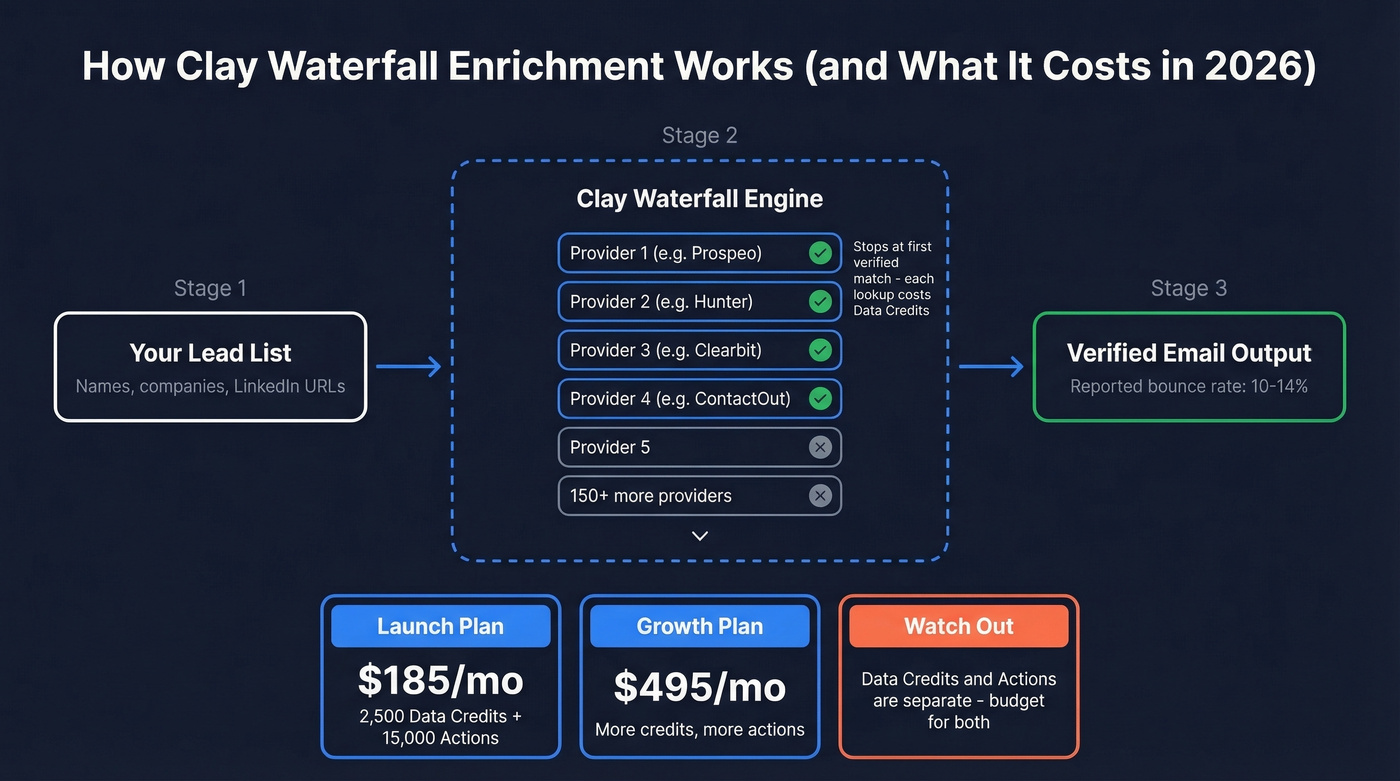
Clay - Best for custom enrichment stacks. 150+ data providers, full workflow builder, and the lowest practitioner-reported bounce rates (~10-14%) when configured properly. It's a power tool - you'll need a GTM engineer to get the most out of it.
Tool Comparison Table
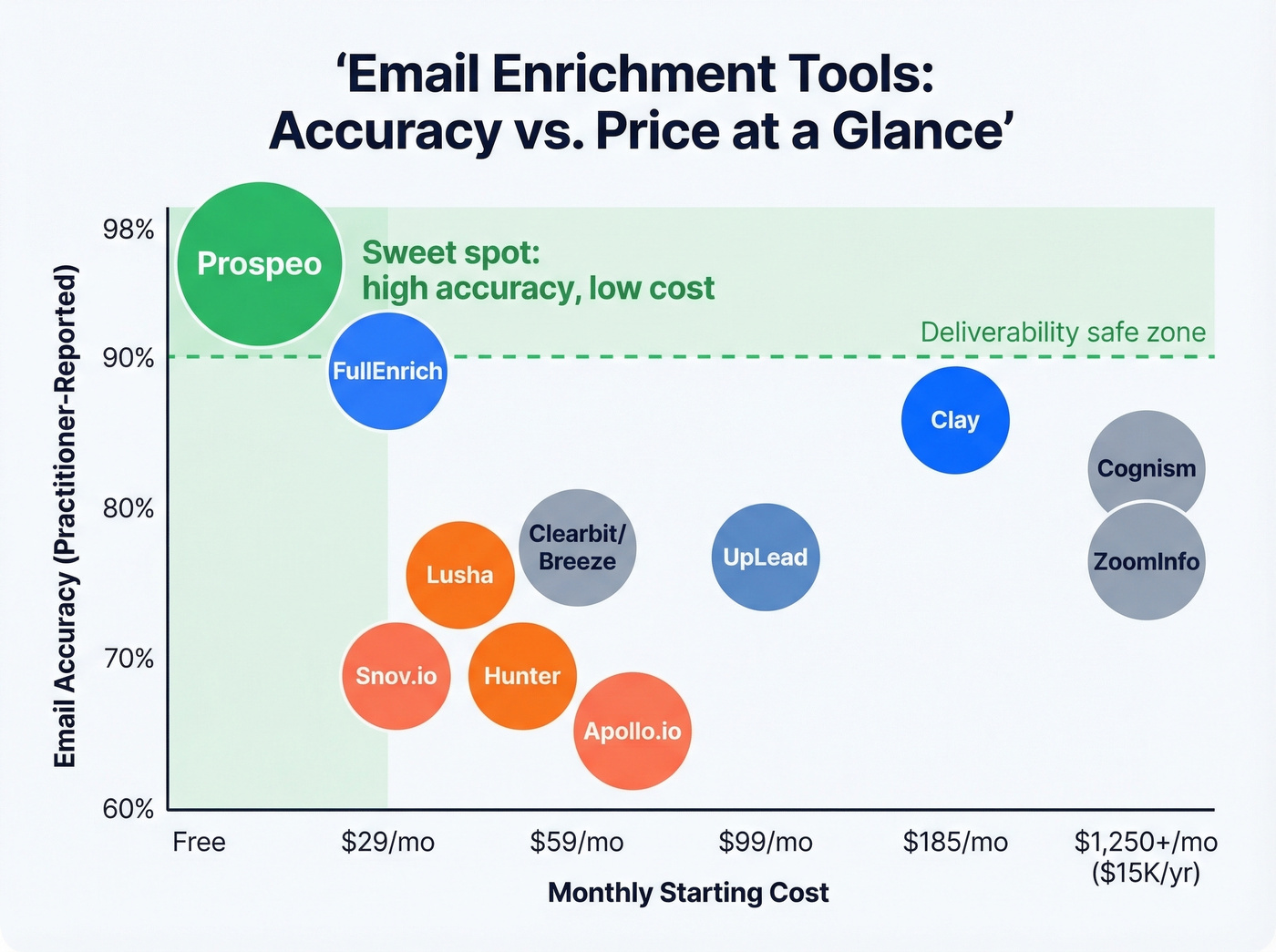
Accuracy figures below are directional, based on practitioner testing and community reports rather than vendor marketing. We've bolded the category winner in each row.
| Tool | Email Accuracy | Starting Price | Data Refresh | Best For |
|---|---|---|---|---|
| Prospeo | 98% verified | Free; ~$0.01/email | 7 days | Email accuracy |
| Clay | ~86-90% (waterfall) | $185/mo (Launch) | Varies by source | Max coverage |
| FullEnrich | ~90% valid rate | $29/mo (500 credits) | Varies by source | Budget waterfall |
| Apollo.io | ~62-68% valid | Free; $59/user/mo | Not public | All-in-one prospecting |
| ZoomInfo | ~75-80% valid | ~$15K/yr | Not public | Enterprise sales intel |
| Cognism | ~80-85% (est.) | ~$15K+/yr (custom) | Not public | EMEA compliance |
| Clearbit/Breeze | ~70-80% (est.) | $45/mo (100 credits) | Not public | HubSpot-native |
| Lusha | ~72-78% valid | Free; $36/user/mo | Not public | Quick individual lookups |
| Snov.io | ~65-72% valid | Free; $30/mo | Not public | Budget prospecting |
| Hunter | ~65-72% valid | Free; ~$49/mo | Not public | Domain-based search |
| UpLead | ~75-80% valid | ~$99/mo | Not public | Mid-budget accuracy |
Practitioner-tested bounce rates, lowest to highest: Prospeo (<5%) → Clay waterfall (10-14%) → UpLead (~20%) → Lusha (22-28%) → Hunter/Snov (28-35%) → Apollo (32-38%).

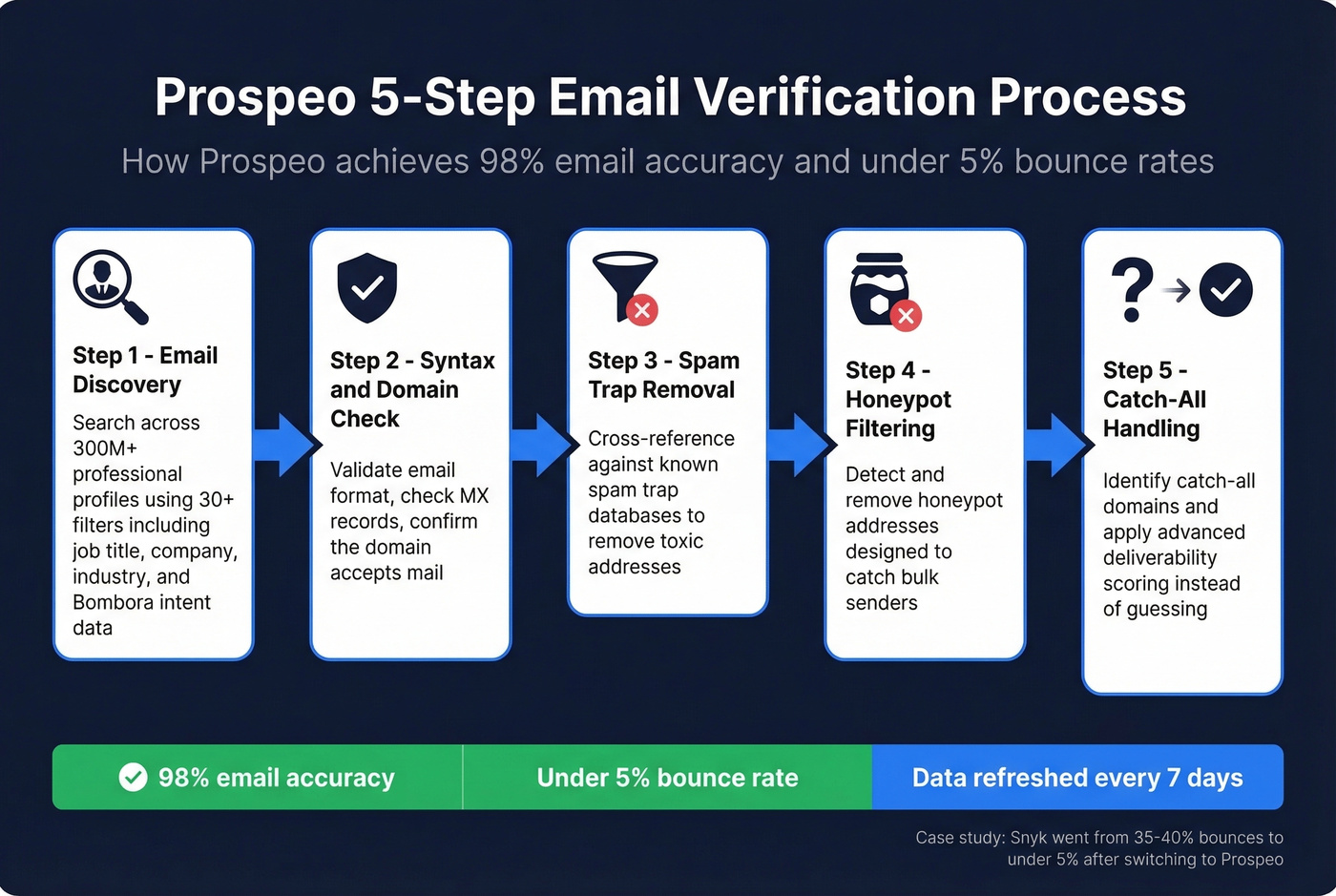
You just saw the bounce rates: Apollo at 32-38%, Hunter and Snov at 28-35%. Prospeo's 5-step verification - with catch-all handling, spam-trap removal, and honeypot filtering - keeps bounce rates under 5%. That's 143M+ verified emails refreshed every 7 days, not every 6 weeks.
Stop paying for emails that bounce. Start at $0.01 per verified address.
In-Depth Reviews
Prospeo
Use it if you're running outbound at scale and can't afford bounces above 5%. Prospeo's database covers 300M+ professional profiles with 143M+ verified emails, all running through a proprietary 5-step verification process that includes catch-all handling, spam-trap removal, and honeypot filtering. The 98% email accuracy isn't a marketing number - Snyk went from 35-40% bounce rates to under 5% after switching, and Stack Optimize maintains 94%+ deliverability across all clients while building from $0 to $1M ARR on the platform.

The 7-day data refresh cycle is the real differentiator. Most competitors refresh around 4-6 weeks, which means you're emailing people who changed jobs a month ago. The 92% API match rate, 30+ search filters - including buyer intent powered by Bombora - and a Chrome extension with 40,000+ users make it work as both a standalone enrichment tool and an anchor in waterfall setups. Native integrations cover Clay, Salesforce, HubSpot, Smartlead, Instantly, Lemlist, Zapier, Make, and n8n.
Pricing is transparent: free tier gives you 75 emails/month plus 100 Chrome extension credits, paid plans run ~$0.01/email, 10 credits per mobile number. No contracts, no sales calls required.
Skip it if you need a full sequencing platform built in - pair with Instantly or Lemlist for that.
Clay
Use it if you have a GTM engineer or the patience to become one and want the absolute lowest bounce rates possible. Clay's waterfall architecture pulls from 150+ data providers, and practitioners report bounce rates of ~10-14% when the stack is configured well. That's the best single-tool result in community testing.
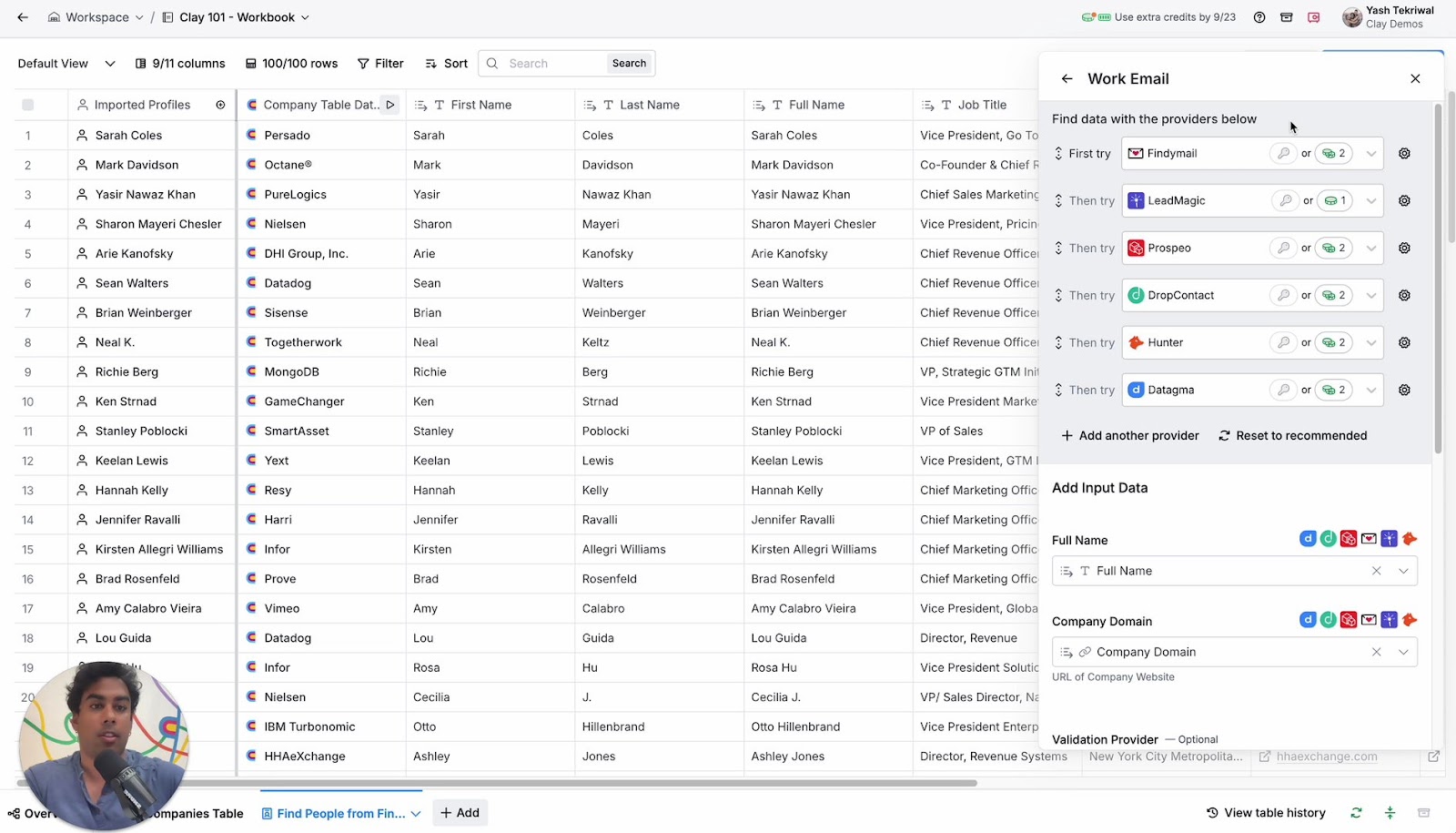
Clay overhauled its pricing in March 2026, and this matters if you're evaluating it now. The new plans split credits into Data Credits for provider lookups and Actions for workflow operations like AI calls, CRM pushes, and exports. Launch runs $185/mo with 2,500 Data Credits and 15,000 Actions. Growth is $495/mo. Legacy customers are grandfathered, but new users face a steeper learning curve on credit economics. We've seen teams spend weeks configuring Clay before getting reliable results - budget for that ramp time.
Skip it if you want plug-and-play. Clay is a workflow builder, not something you can hand to an SDR on day one. G2 rates it 4.8/5 from 174 reviews.
FullEnrich
FullEnrich is the easiest path to waterfall enrichment. It cascades through 25+ vendors - including sources like Hunter, Datagma, Clearbit, and ContactOut - then verifies the results. Community testing shows it pushing valid email rates from ~60-70% (single-source tools like Apollo or Lusha) to around 90%.
The catch: FullEnrich charges credits for catch-all emails with no option to exclude them. One G2 reviewer reported ending up with 347 valid emails out of 2,000 leads after external verification, and 71% of results came via a single sub-provider (Wiza). If your ICP skews toward catch-all domains, budget for an external verification step.
Pricing is genuinely affordable: free trial with 50 credits, Starter at $29/mo for 500 credits, Pro at $55/mo for 1,000. G2 rates it 4.8/5 across 171 reviews. Skip it if you need phone numbers or if your target accounts sit on heavily catch-all domains.
Apollo.io
Apollo is the Swiss Army knife of sales tools - prospecting, sequencing, enrichment, and a massive free tier all in one platform. The enrichment side has degraded. Practitioners report 32-38% bounce rates on Apollo-sourced email lists, and the "guessed emails" problem is well-documented on Reddit.
Use it if you need an all-in-one prospecting and sequencing platform and you're willing to verify emails externally before sending. Apollo's free tier is generous, Basic runs $59/user/mo, and Professional is $99/user/mo. With 9,407+ G2 reviews and a 4.7/5 rating, the platform itself is solid. Just don't trust the emails without a verification layer.
Skip it if email accuracy is your primary buying criterion. Apollo's workflow is excellent - its email data is not.
ZoomInfo
ZoomInfo has the deepest US B2B database, strong intent data, and a sales intelligence suite with workflow tools, chat, and org charts. It's the enterprise default for a reason - 4.5/5 on G2 with 8,996+ reviews.
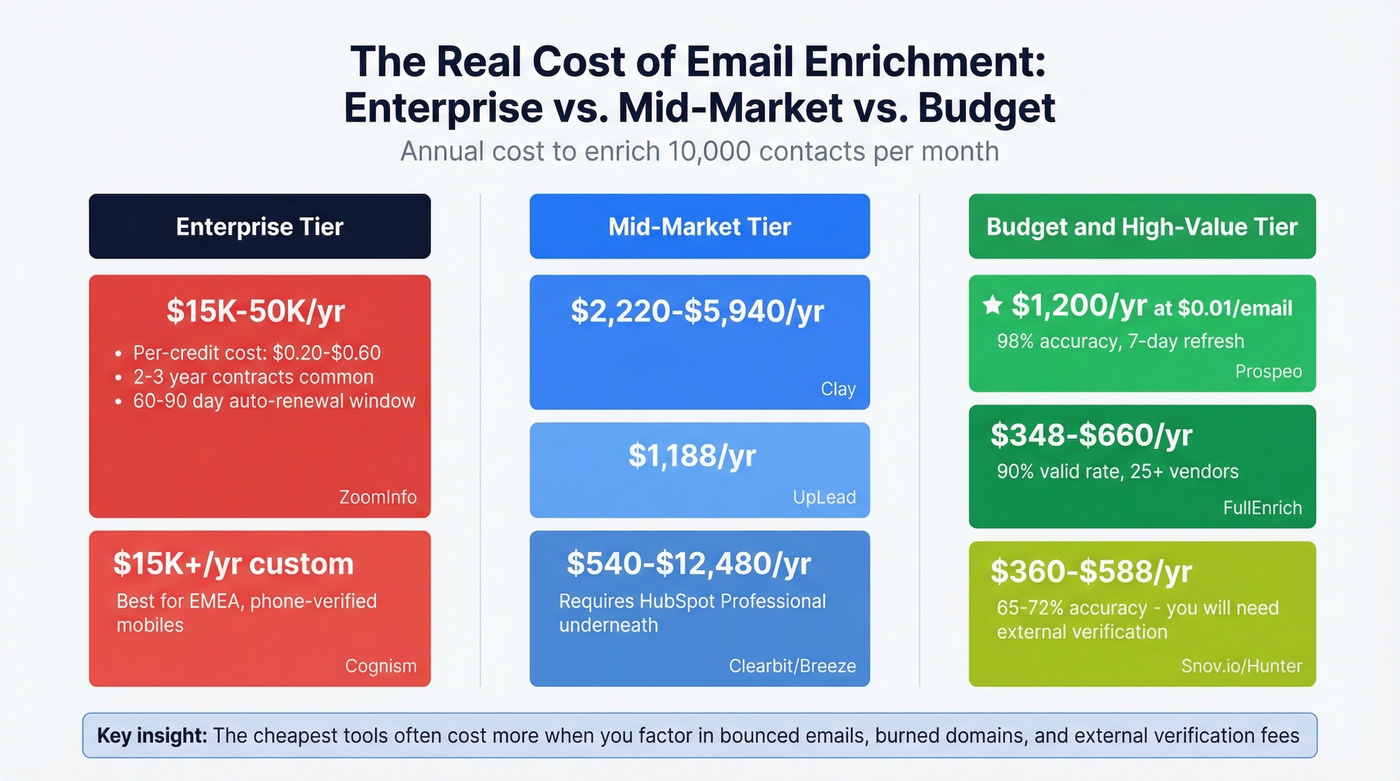
But you're paying for a full sales intelligence suite when you might just need verified emails. Professional starts at ~$15K/year, but teams commonly land above $25K/year once add-ons are included, and some hit $50K. Per-credit costs range from ~$0.60 down to ~$0.20 at high volume. ZoomInfo pushes 2-3 year contracts with 60-90 day auto-renewal windows - miss that window and you're locked in. Discounts of 30-65% are common if you negotiate hard, which tells you something about the list price.
Look, ZoomInfo is still the best all-in-one enterprise sales platform. But if your deal sizes sit below $20K, you almost certainly don't need ZoomInfo-level data, and you definitely don't need ZoomInfo-level pricing. For contact enrichment specifically, it's overkill.
Cognism
Cognism is a strong option for teams selling into Europe. Diamond Data provides phone-verified mobile numbers, and GDPR/CCPA compliance is baked into the product rather than bolted on. G2 gives it 4.5/5 with ~1,200 reviews. If your ICP is EMEA-heavy, Cognism's data quality in that region beats ZoomInfo.
The US database is thinner than ZoomInfo's, and the platform doesn't try to be an all-in-one GTM suite. Custom pricing typically runs $15K+/year - expensive if you only need email addresses. Best for teams with a clear European focus who also need compliant mobile numbers.
Clearbit / Breeze Intelligence
Clearbit as a standalone product has been sunset. It's now a HubSpot add-on called Breeze Intelligence, and the pricing reflects that dependency. Deep firmographic and technographic enrichment, real-time website visitor identification, and tight HubSpot integration - if you're already on HubSpot Professional+, the data flows natively into your CRM without middleware.
The entry point is $45/mo for 100 credits, but realistic mid-market costs run $950-$1,040/mo when you factor in HubSpot Professional + 1,000 credits. Credits expire monthly with no rollover. Cost-per-credit drops from $0.45 at 100 credits to $0.15 at 1,000, but you're still paying for HubSpot underneath. Only makes sense if you're already committed to the HubSpot ecosystem.
Lusha
Lusha's Chrome extension is solid for individual prospecting - free tier includes 50 emails and 5 phone numbers, Pro runs $36/user/mo, Premium $59/user/mo. Reasonable for small teams doing manual lookups. But practitioner-reported bounce rates of ~22-28% and fast-draining credits make it a poor fit for any kind of volume. G2 gives it 4.3/5 across 1,566 reviews - the lowest rating in this list. If you're enriching more than a few hundred contacts per month, you'll outgrow Lusha quickly.
Snov.io and Hunter
Both sit in the budget tier. Snov.io starts at $30/mo, Hunter at ~$49/mo. Practitioner bounce rates for both land around 28-35%, with community feedback flagging lots of guessed emails from Snov. Hunter's domain search is genuinely useful for account-based prospecting - plug in a company domain and get associated email patterns - but you'll need a verification layer either way. These are starter tools, not long-term solutions for teams doing serious volume.
UpLead
UpLead runs around ~$99/mo with practitioner bounce rates sitting around 20%, which is better than Apollo or Snov but still not great. Community reports flag inconsistent results depending on the vertical, so test with your specific ICP before committing.
Waterfall vs. Single-Source Enrichment
The single biggest accuracy improvement you can make isn't switching tools - it's switching architecture. In our experience, the jump from single-source to waterfall enrichment is the highest-ROI change a team can make.
Let's break down why the numbers favor waterfall:
| Metric | Single-Source | Waterfall |
|---|---|---|
| Coverage | 50-70% | 85-95% |
| Cost per record | ~$0.10 | ~$0.15 |
| Cost per usable record | ~$0.17 | ~$0.17 |
| Usable contacts from same list | Baseline | ~50% more |
The cost per usable record is roughly the same - but you get 50% more usable contacts from the same input list. CRM data decays roughly 30% per year, so the coverage gap compounds fast.
A typical waterfall sequence starts with your primary provider, then cascades unfound contacts through secondary sources like Datagma, ContactOut, Hunter, and RocketReach. Single-provider match rates run 35-52%; a well-configured waterfall hits 85-90%. The pay-for-success model means you only pay the provider that actually returns valid data.
How to Choose the Right Tool
Forget abstract criteria. Here are the scenarios that actually matter.
Small team, tight budget, accuracy matters most: Start with a free tier, verify everything, and scale from there. At ~$0.01/email with 98% accuracy, the unit economics are hard to beat.
Need prospecting + sequencing in one platform: Apollo.io, but verify emails externally before sending. The 32-38% bounce rate is a domain reputation risk you don't want to take.
Selling into EMEA and need compliance: Cognism. The premium is worth it for compliant European data and phone-verified mobiles.
Already deep in HubSpot Professional+: Breeze Intelligence makes sense as an add-on, but run the total cost math first. $950+/mo for enrichment credits on top of your HubSpot subscription adds up fast.
Have a GTM engineer and want maximum coverage: Clay with a waterfall stack. The setup investment pays off in the lowest bounce rates available, but don't underestimate the configuration time.
Want waterfall without the complexity: FullEnrich at $29/mo. Easiest path to multi-provider coverage.
Two underrated buying criteria most teams overlook: data freshness and catch-all handling. A 7-day refresh cycle vs. a 6-week cycle means the difference between emailing someone at their current job and emailing a dead address. Catch-all domains - where any address returns "valid" - are the silent killer of enrichment accuracy. Make sure your tool handles them explicitly.
Enrichment cadence matters too. Re-enrich active prospects every 30-90 days and cold lists every 90-180 days. People change jobs, companies rebrand, domains expire. If you're not re-enriching on a schedule, your database is rotting.
If you’re also evaluating where the records come from, compare B2B databases and B2B list providers before you commit.
Stack Optimize built a $1M agency on Prospeo data with 94%+ deliverability and zero domain flags. Snyk cut bounce rates from 35-40% to under 5% across 50 AEs. The difference isn't luck - it's a proprietary email-finding infrastructure that doesn't rely on the same third-party providers everyone else recycles.
See why 15,000+ companies switched their enrichment source.
FAQ
What's the Difference Between Email Enrichment and Verification?
Enrichment finds the email address - it takes a name and company and returns a contact. Verification confirms that address is deliverable and won't bounce. The best email enrichment tools do both in a single step. If yours only does enrichment, add a separate verification layer before sending.
What's a Good Bounce Rate for Enriched Lists?
Under 5% is strong. Under 2% is excellent. If you're consistently above 8%, your enrichment provider is the problem - not your copy, not your targeting. The industry average for cold email sits at 7-8%, but top performers stay well below that. Gmail's spam complaint threshold is just 0.1%, so even moderate bounce rates cascade into deliverability disasters.
What Is Waterfall Enrichment?
Waterfall enrichment cascades a contact through multiple data providers until one returns a valid result. It pushes coverage from 50-70% to 85-95%, and the cost per usable record stays roughly the same - you just get significantly more usable contacts. If you're seeing 20%+ bounces from a single source, waterfall architecture is the fix.
How Do Email Appending Services Differ from Enrichment Tools?
Email appending services specialize in matching existing contact records - typically a name and company - against large databases to fill in missing addresses. Traditional appending companies often work in batch mode, while modern enrichment tools operate in real time with API-driven lookups and built-in verification. Prioritize providers that verify deliverability as part of the append process rather than handing you unverified matches.
How Often Should You Re-Enrich Contact Data?
Re-enrich active prospects every 30-90 days and cold lists every 90-180 days. CRM data decays about 30% per year - people change jobs, companies rebrand, domains expire. Fresher data means fewer bounces and less domain reputation damage, which is why data refresh frequency should be near the top of your evaluation checklist.