

Email List Validation: What Every Tool Gets Wrong (and How to Fix It)
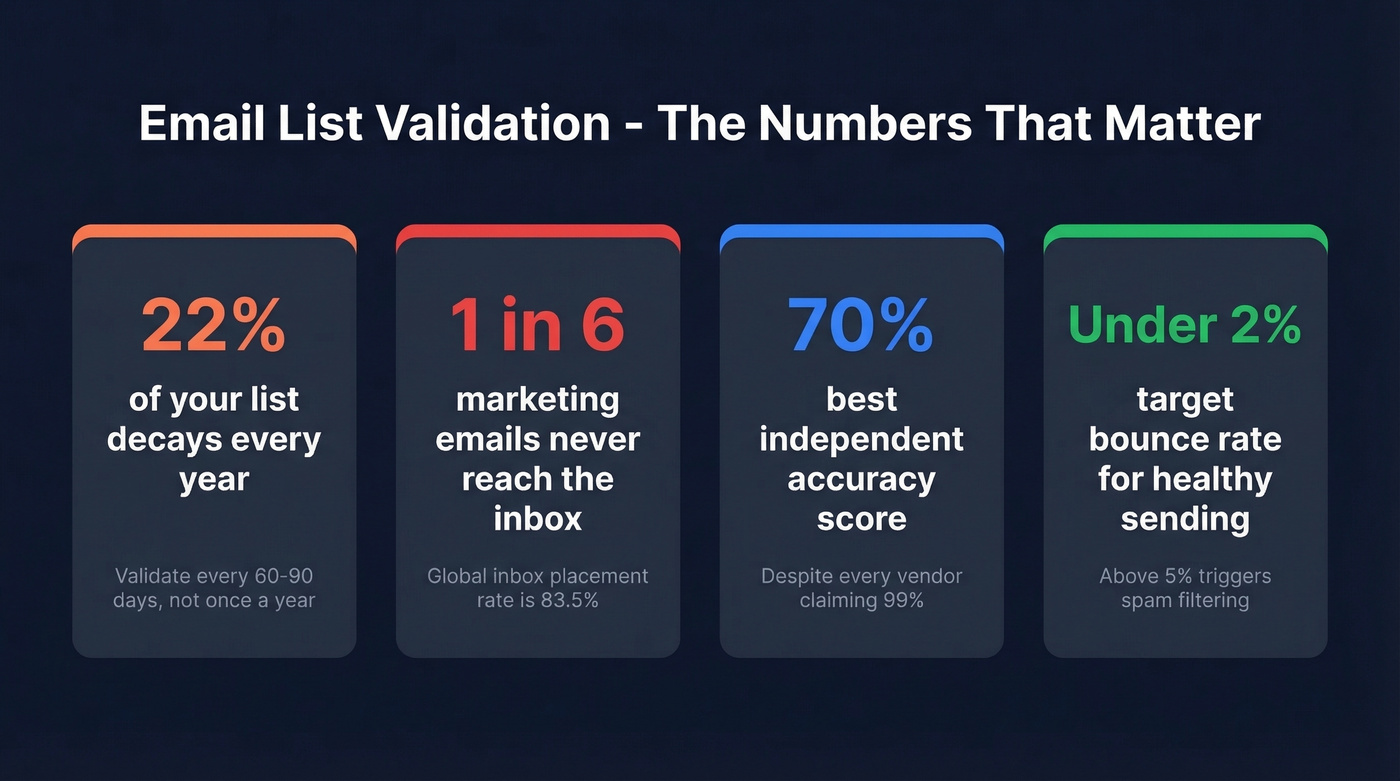
Nearly 1 in 6 marketing emails never reach the inbox. The global inbox placement rate sits at roughly 83.5%, and that's not a rounding error - it's a pipeline leak that proper email list validation prevents.
Rejoiner analyzed a sample of 1,163,174 email addresses validated by their clients over 60 days. Twelve percent were too risky to send to. If your list looks anything like that, you're burning budget, tanking your sender reputation, and wondering why reply rates keep dropping.
The Short Version
Your list decays roughly 22% every year. Validate every 60-90 days, not once a year. Most tools market 99% accuracy - independent testing puts the best at 70%. Expect "unknown" results and plan for them.
The smartest move is sourcing pre-verified emails so you skip the cleanup step entirely. Prospeo runs a 5-step verification process with a 7-day data refresh cycle, so your data doesn't rot between validations.
How Email Verification Actually Works
Email list validation sounds simple, but the mechanics matter. Most providers use a three-step process, and understanding it helps you interpret results instead of blindly trusting a green checkmark.
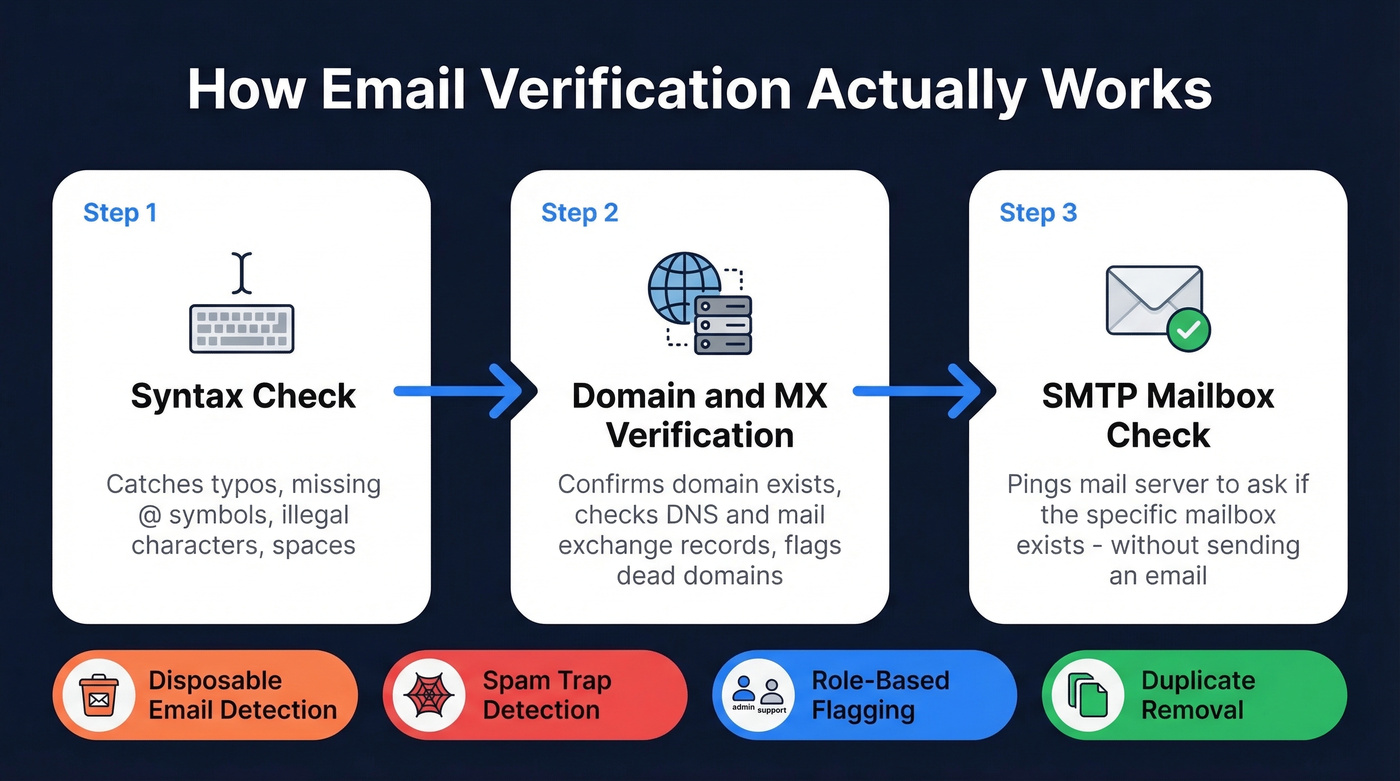
Step 1: Syntax check. The tool confirms the email follows a valid format - no missing @ symbols, no illegal characters, no spaces. This catches typos and garbage entries. Every tool nails this.
Step 2: Domain and MX verification. The tool queries DNS records to confirm the domain exists and has mail exchange records configured. If someone typed john@gooogle.com, this step catches it. Dead domains and parked pages get flagged here.
Step 3: SMTP mailbox check. The tool pings the mail server to ask whether the specific mailbox exists - without actually sending an email. This is where things get tricky, because some servers lie.
Good validators also detect disposable addresses from services like Mailinator and Guerrilla Mail, plus spam traps planted by ISPs. They'll flag role-based addresses like info@ or sales@ and remove duplicates. The two delivery modes are bulk CSV upload for cleaning an existing list and real-time API validation for verifying at the point of capture. Most teams need both.
The Accuracy Problem Nobody Talks About
Here's the thing: every email verification vendor's homepage says "99% accuracy." It's the most meaningless number in the space.
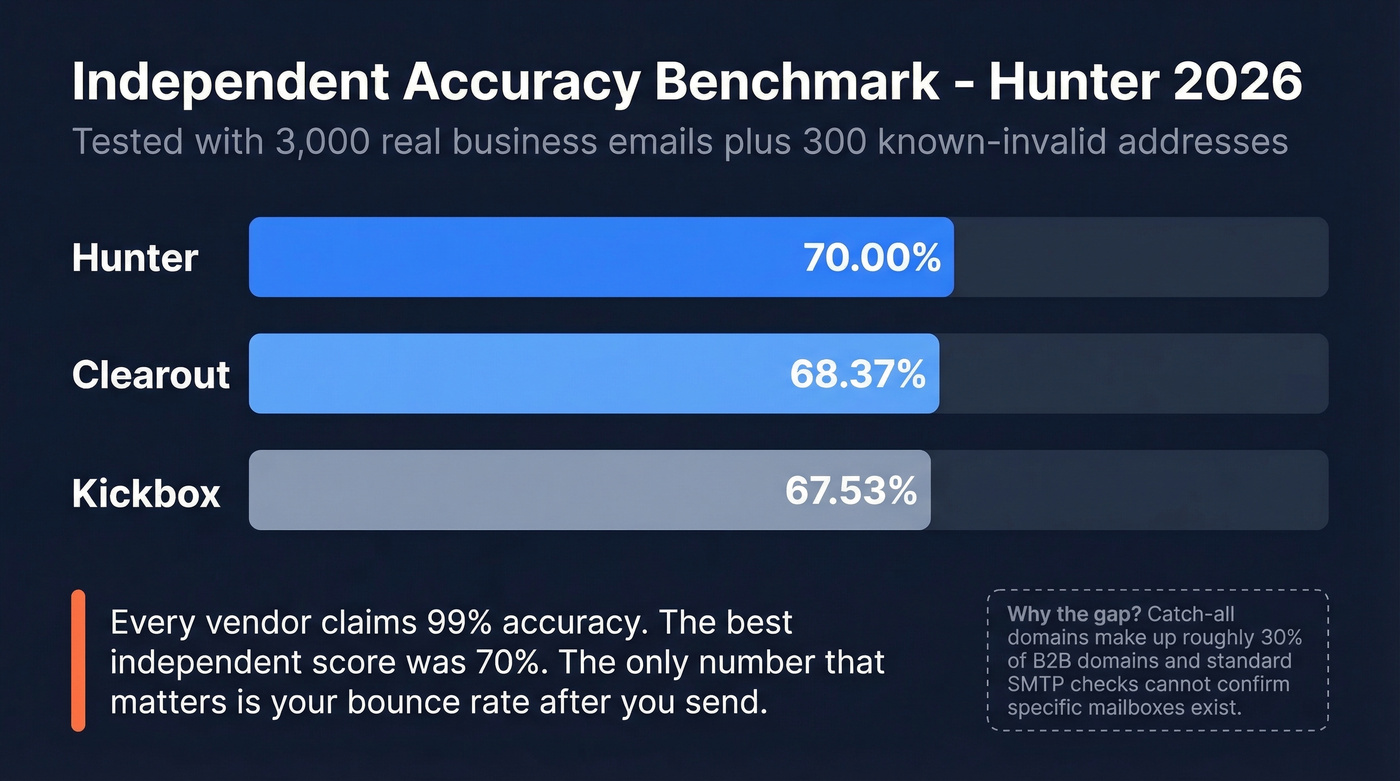
Hunter ran an independent benchmark of 15 email verifiers using 3,000 real business emails segmented by company size, plus 300 known-invalid addresses. They executed every test through Clay under identical conditions. The top overall accuracy? Hunter at 70%. Second place was Clearout at 68.37%. Kickbox came in at 67.53%. Hunter disclosed that the dataset was sourced from their own activity, which gives them a slight edge - but the methodology and raw data are publicly available.
Now compare that to LaGrowthMachine's 2026 benchmark of 127,000 verification checks across 7 tools over 30 days, which reported accuracy above 98% for most providers. Two serious, independent tests - and a 28-point gap in results. The difference comes down to methodology: what emails you test, how you define "accurate," and whether unknown results count against you. This is exactly why vendor accuracy claims are worthless. The only number that matters is your bounce rate after you send.
A major culprit behind "inaccurate" results is catch-all domains. Roughly 30% of B2B domains use catch-all configurations, meaning the server accepts mail for any address at the domain. Standard SMTP checks can't confirm a specific mailbox exists. Accuracy also drops on mid-market and enterprise domains with stricter server configurations - so the contacts you care about most are exactly the ones hardest to verify.
If your average deal size is under $5k, you probably don't need to obsess over verification accuracy. A basic tool plus good list hygiene will get you under 2% bounce rates. Save the multi-tool cross-referencing for high-value outbound where every contact matters.
Bounce Rate Benchmarks
Before you evaluate tools, you need to know what "good" looks like. ActiveCampaign's benchmark data gives us clean thresholds:
| Metric | Target |
|---|---|
| Excellent bounce rate | Under 1% |
| Good bounce rate | Under 2% |
| Danger zone | Above 5% |
Industry-specific benchmarks vary - business and finance averages 0.55%, construction runs higher at 1.28%, consulting lands around 0.79%. Once you cross 5%, spam filtering kicks in and your deliverability takes a real hit. The goal isn't perfection. It's staying well under 2% consistently.

Why scrub lists every 90 days when you can source pre-verified emails? Prospeo's 5-step verification and 7-day data refresh keep bounce rates under 4% - without a separate validation tool.
Start with clean data instead of paying to fix dirty lists.
Validation Costs in 2026
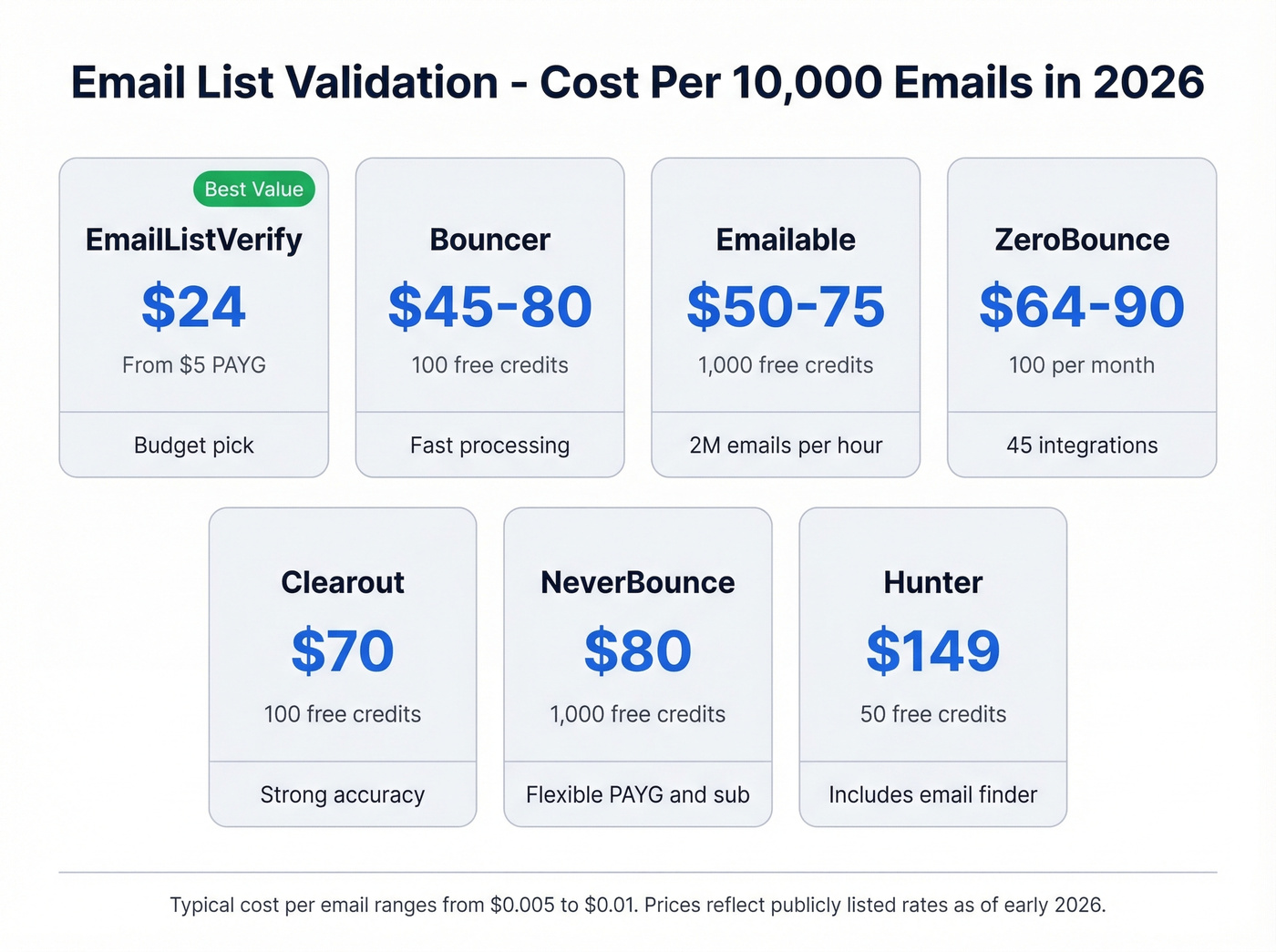
Pricing varies depending on whether you're buying pay-as-you-go credits or a monthly subscription. Some tools bundle features that others charge separately for, so the per-email cost doesn't tell the full story.
| Tool | Price / 10k | Free Tier | PAYG / Sub | Notes |
|---|---|---|---|---|
| EmailListVerify | ~$24 | From $5 PAYG | PAYG | Budget pick |
| Bouncer | $45-80 | 100 credits | PAYG | Fast processing |
| NeverBounce | $80 | 1,000 credits | Both | $8/1k PAYG or $49/mo |
| Emailable | $50-75 | 1,000 credits | PAYG | 2M emails/hour |
| ZeroBounce | $64-90 | 100/mo | Both | 45 direct integrations |
| Clearout | ~$70 | 100 credits | PAYG | Strong accuracy scores |
| Hunter | $149 | 50 credits | Sub | Includes email finder |
The typical cost-per-email lands between $0.005 and $0.01. NeverBounce's PAYG rate is $8 per 1,000 credits, with credits expiring after 12 months. Their Growth plan runs $49/month for up to 10,000 verifications - better value if you're validating consistently. Hunter's $149 price point includes their email finder tool, so it's not apples-to-apples with pure validators.
Best Validation Tools Compared
Prospeo (Start With Verified Data)
Most validators are built for cleanup: you upload a list, wait for results, then try to guess what to do with "unknown" and catch-all domains.
Prospeo flips the workflow. It gives you access to 143M+ verified emails inside a 300M+ professional profile database, backed by a 5-step verification system, real-time email verification, and a 7-day data refresh cycle. With 98% verified email accuracy and catch-all handling built in, it's the best option when you'd rather start with clean data than pay to scrub dirty lists every quarter. Stack Optimize built to $1M ARR using Prospeo with client deliverability above 94%, bounce rates under 3%, and zero domain flags across all clients.
If you still need a traditional validator for form capture or periodic hygiene, pair Prospeo's pre-verified sourcing with one of the tools below.
ZeroBounce
ZeroBounce is the most reviewed standalone validator on G2 - 4.7/5 across 1,361 reviews. The 45 direct integrations are a genuine differentiator; most competitors rely on Zapier or Make for connections, while ZeroBounce plugs directly into major ESPs and CRMs.
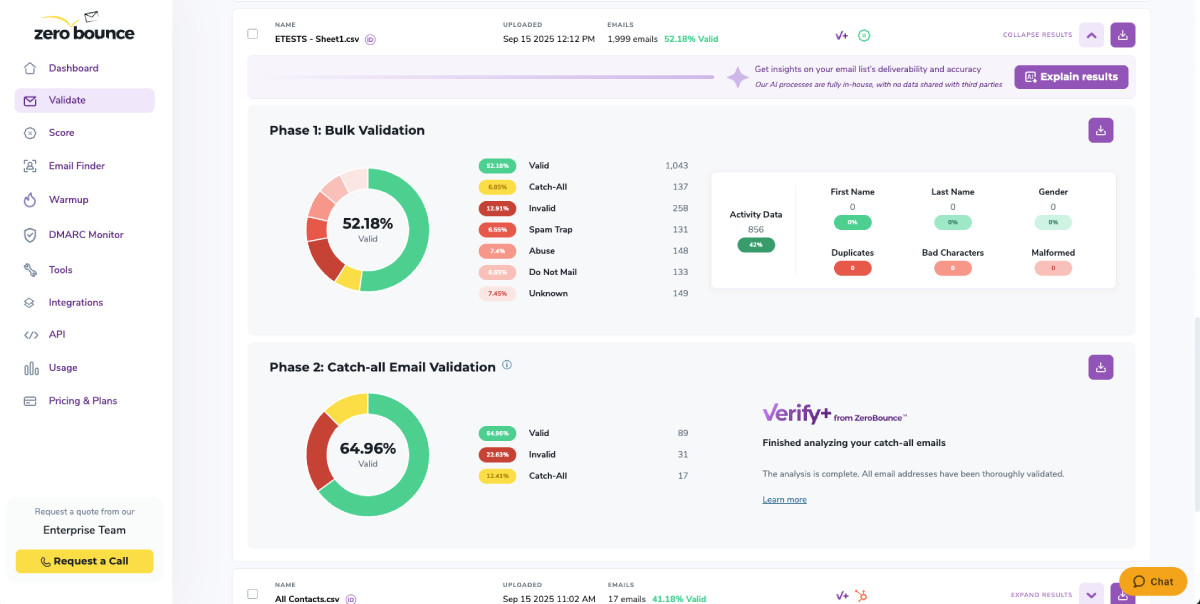
G2 reviewers consistently cite pricing as a drawback, and "Inaccuracy" appears as a con tag - which suggests the tool works well for most use cases but isn't infallible on harder-to-verify domains. For teams deeply embedded in a specific ESP ecosystem, ZeroBounce's integration depth is hard to beat. For pure accuracy at scale, cross-reference with a second tool.
NeverBounce
NeverBounce wins on flexibility. The PAYG model at $8 per 1,000 credits is the lowest barrier to entry for teams that validate sporadically, while the $49/month Growth plan makes sense for consistent volume. Deduplication comes included on subscription plans, which saves a step most teams forget about. The 80+ integrations cover the major platforms.
One thing to watch: credits expire after 12 months on PAYG. We've seen teams buy large credit packs for a "discount" and lose half to expiration. Buy what you'll actually use.
Bouncer
Skip this one if you need deep integrations or an all-in-one platform. Bouncer is the no-frills accuracy play.
Capterra 4.9/5 with 233 reviews, G2 4.8/5 with 232 reviews - quietly some of the strongest scores in the space. Pricing ranges from $45 to $80 per 10,000 with 100 free credits. Processing speed hits 180,000 emails per hour. If you care about accuracy and don't need 45 direct integrations, Bouncer consistently outperforms its price point.
Emailable
Need to validate 500,000 contacts before tomorrow's campaign? Emailable processes 2 million emails per hour. Pricing lands at $50-75 per 10,000 with 1,000 free credits and 22 integrations. The speed advantage is real, but integration depth is thinner than ZeroBounce or NeverBounce. Pure speed play.
EmailListVerify
The budget option at roughly $24 per 10,000 verifications. G2 rates it 4.5/5 across 59 reviews, with 11 integrations. Reviewers flag room for improvement as a common theme. You get what you pay for - functional validation without the bells.
Clearout
Clearout scored 68.37% in Hunter's independent accuracy benchmark - second-highest out of 15 providers tested. At ~$70 per 10,000 with 100 free credits, it's worth testing against your specific list. Independent benchmark performance is a more reliable signal than any vendor's self-reported accuracy number.
How to Handle Catch-All Domains
Catch-all domains are the single biggest headache in email verification. A catch-all server accepts mail sent to any address at the domain - realname@company.com and gibberish123@company.com both get accepted. Standard SMTP verification can't tell you whether a specific mailbox actually exists.
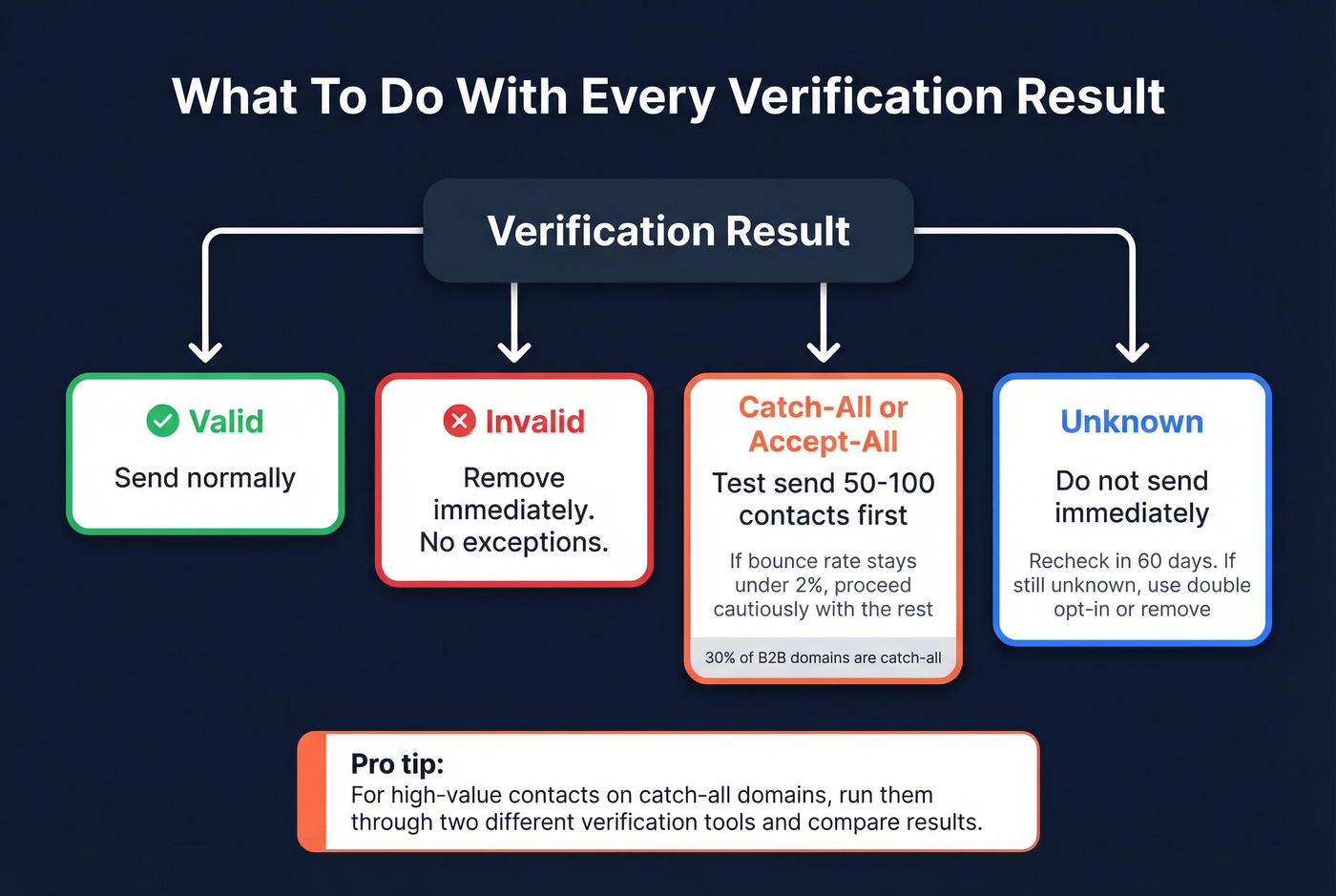
You can't just ignore these results when 30% of B2B domains use catch-all configurations. Here's the framework we use:
- Valid results: Send normally.
- Invalid results: Remove immediately. No exceptions.
- Catch-all / accept-all results: Run a low-volume test send of 50-100 contacts and monitor bounces. If rates stay under 2%, proceed cautiously with the rest.
- Unknown results: Don't send immediately. Recheck in 60 days - server configurations change. If still unknown, consider double opt-in or remove.
For high-value contacts on catch-all domains, run them through two different verification tools and compare results. This cross-referencing approach catches invalid addresses that a single tool misses. The worst move is treating all catch-all results as valid and blasting your full list. The second worst is treating them all as invalid and throwing away 30% of your pipeline.
Five Mistakes That Kill Deliverability
1. Never removing inactive subscribers. Contacts who haven't opened in 6+ months drag down engagement metrics. ISPs notice. Prune quarterly.
2. Ignoring hard bounces. A single hard bounce should trigger immediate removal. Soft bounces get three strikes. Most ESPs handle this automatically, but check your settings - we've found default configurations that let hard bounces pile up for weeks before triggering removal.
3. Relying on single opt-in. Double opt-in adds friction but eliminates typos, bots, and fake signups. The tradeoff is worth it for list quality.
4. Purchasing or renting lists. A purchased list can easily hit 25% bounce rates with 2% spam complaint rates. That's a domain reputation death sentence. Just don't.
5. Ignoring GDPR and CAN-SPAM. Validation intersects with compliance. GDPR requires lawful basis for processing personal data, including email addresses. CAN-SPAM mandates honoring opt-outs within 10 business days. Running validation on a list you shouldn't have in the first place doesn't make it legal to email - it just makes it deliverable. Make sure your data collection practices are compliant before you worry about bounce rates.
When and How Often to Validate
The 60-90 day recheck cadence isn't arbitrary - it's math. At 22% annual decay, a 100,000-contact list loses roughly 1,833 valid emails per month. Wait six months and you're sitting on about 11,000 dead addresses.
Validate immediately before any major campaign launch. Validate after importing any new list, regardless of source. Validate after 90+ days of inactivity on a segment. And if you're running cold outbound, validate before every sequence - your domain reputation depends on it.
Let's be honest: the teams with the best deliverability don't treat email list validation as a periodic cleanup task. They build verification into their workflow so dirty data never enters the system in the first place - either through real-time API validation at the point of capture or by sourcing pre-verified contacts that handle verification upstream.
Stack Optimize built to $1M ARR with 94%+ deliverability and zero domain flags - because Prospeo's 143M+ verified emails and catch-all handling eliminate the validation step entirely. At ~$0.01/email, it costs less than most standalone validators.
Skip the cleanup. Source 98%-accurate emails from day one.
FAQ
Is free email validation accurate enough?
Free tiers - typically 50 to 1,000 credits - work fine for testing a tool against your specific list before committing. For ongoing validation of 10,000+ contacts, you'll need a paid plan. Expect to pay $0.005-$0.01 per email, with volume discounts kicking in above 50,000.
What's a catch-all domain and why does it matter?
A catch-all domain accepts email sent to any address at that domain, even fabricated ones, so verification tools can't confirm whether a specific mailbox exists. Roughly 30% of B2B domains use this configuration. Treat catch-all results as "test carefully" - send a small batch, monitor bounces, and proceed only if rates stay under 2%.
How is email address cleansing different from verification?
Cleansing corrects formatting errors, removes duplicates, and standardizes entries before they reach the verification step. Validation then confirms whether each cleaned address actually exists and can receive mail. Running a cleansing pass first saves credits you'd otherwise burn on addresses that fail the syntax check.
How long does bulk verification take?
Processing speed ranges from 100,000 to 2 million emails per hour depending on the tool. A 50,000-email list typically finishes in 5-30 minutes. Emailable and Bouncer are among the fastest options if speed is your priority.