

Email Wording to Schedule a Meeting: Templates, Subject Lines, and Data That Actually Work
You sent 50 meeting requests last month and got two replies. One was an out-of-office. The problem isn't your product or your target list - it's the wording. Your subject line's too long, the body reads like a brochure, and your CTA asks the prospect to do homework instead of just say yes.
What You Need (Quick Version)
Three rules matter more than any template:
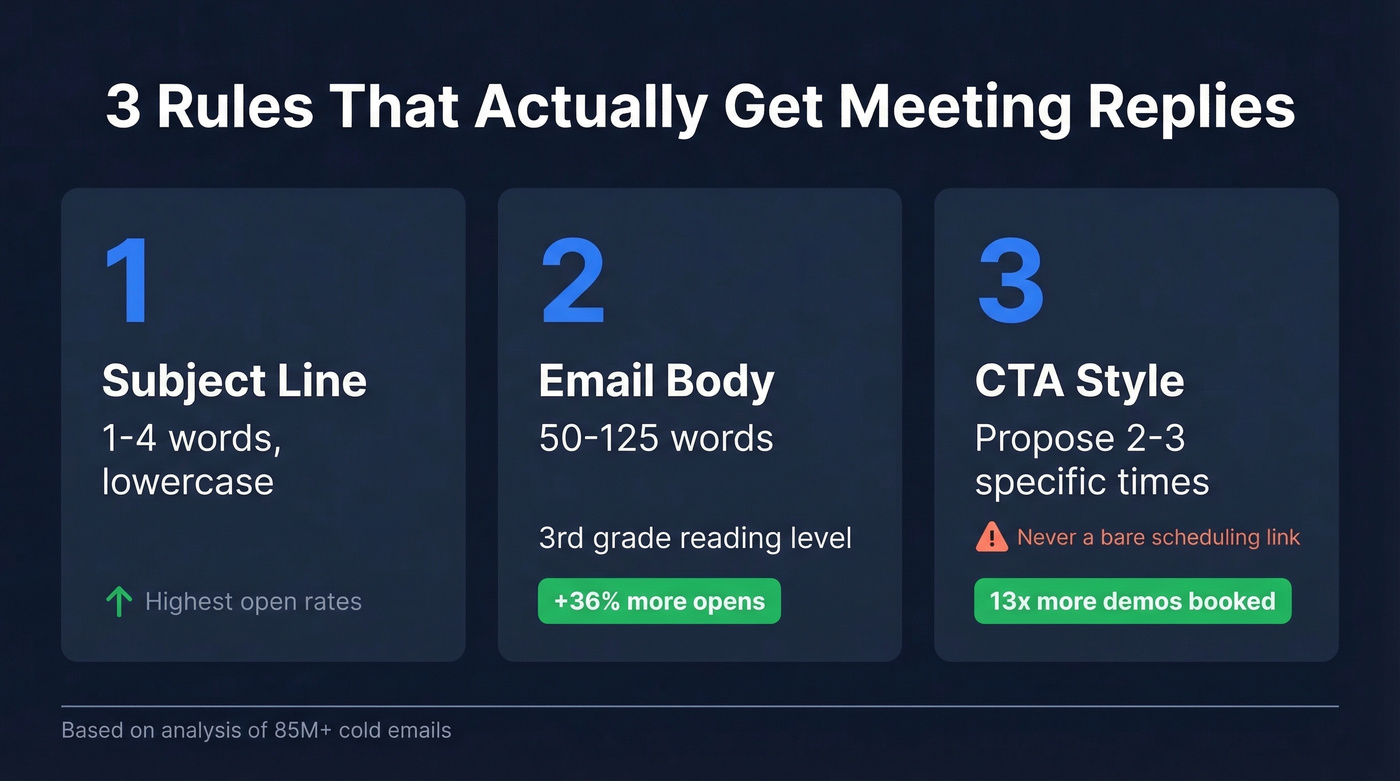
- Subject line: 1-4 words, lowercase. An analysis of 85M+ cold emails found this length gets the highest open rates.
- Body: 50-125 words, third-grade reading level. Third-grade writing beat college-level writing by 36% on opens.
- CTA: Propose 2-3 specific times - never a bare scheduling link. A Chili Piper A/B test showed suggested times produced ~13x more demos booked than a link alone.
Here's the data behind each rule, plus 12 templates you can copy right now.
Subject Lines That Get Opened
The 30MPC/Gong dataset across 85M+ cold emails is the best benchmark we've found. The takeaways: keep it to 1-4 words, go all-lowercase except proper nouns, and drop anything that smells salesy - promotional language tanks open rates by up to 17.9%.
Empty subject lines boost opens by 30% but kill reply rates by 12%. It's a gimmick. Don't do it.
One caveat: privacy protections now inflate open-rate numbers, so treat opens as directional and track replies and clicks as your real signal. Here are subject lines that work, organized by tone:
| Tone | Example |
|---|---|
| Casual | quick question |
| Casual | 15 min this week? |
| Direct | meeting request |
| Direct | time for a call? |
| Mutual connection | [Name] suggested we chat |
| Value-forward | saving {{Company}} 20 hrs/mo |
| Curiosity | idea for {{Company}} |
| Curiosity | noticed something |
| Referral | {{YourCompany}} x {{Company}} |
| Simple | next steps |
The Email Format That Gets Replies
Write at a third-grade reading level. That sounds insulting, but emails at that level outperform college-level writing by 36% on opens. Short sentences. Common words. Zero jargon. In our experience, the 80-90 word sweet spot works best for cold outreach - the same practitioner benchmark pegs 50-125 words as the optimal range, with 50%+ response rates tied to that length. Go longer and you're writing a brochure nobody asked for.
The structure:
- Open with "Hi [FirstName]" - skip "Dear" and definitely skip "To Whom It May Concern"
- Delete "My name is..." - your name's in the signature
- Include 1-3 questions - emails with 1-3 questions get 50% more responses than those without
- Close with a soft ask - "Would any of these times work?" beats "Please confirm your availability at your earliest convenience"
Before and After
Same meeting request, two versions. The difference is stark.
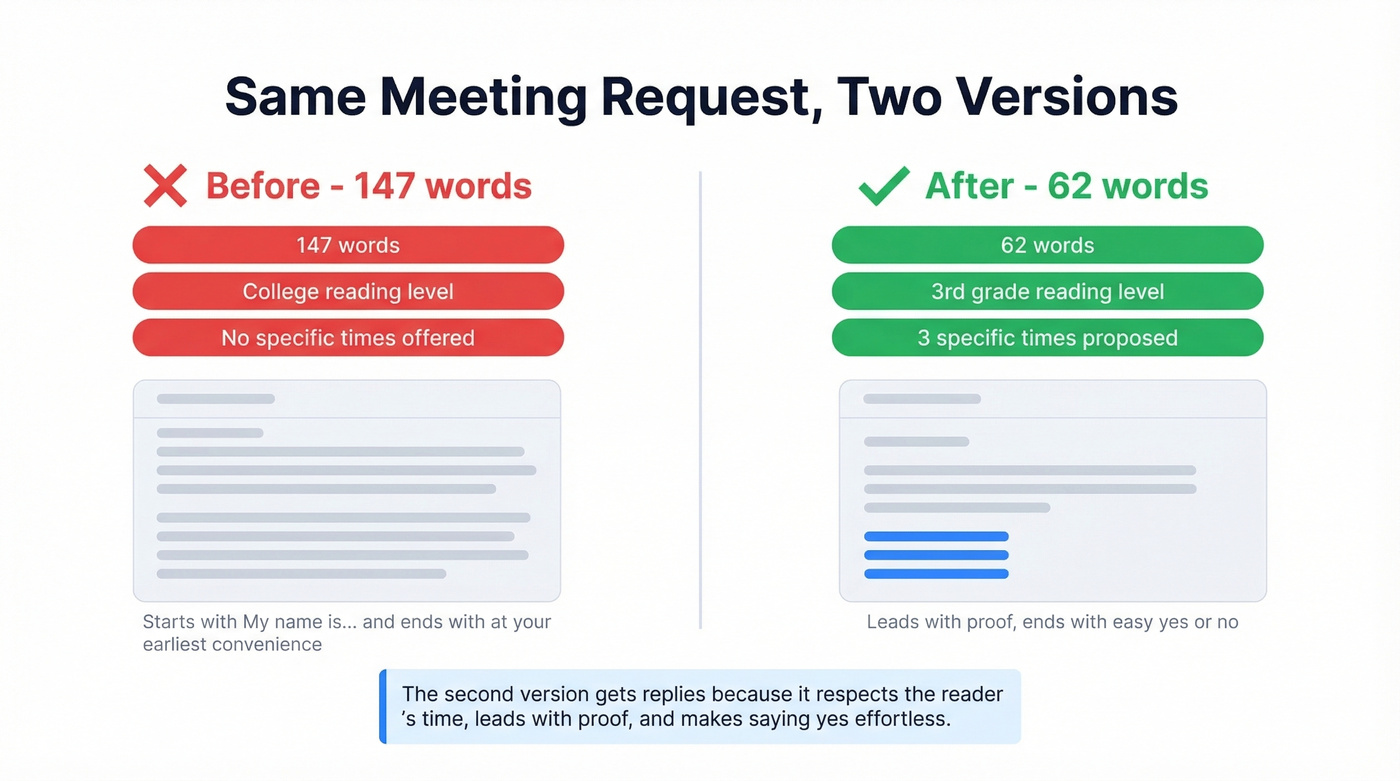
❌ Before (147 words, college reading level):
Dear Mr. Thompson, My name is Sarah Chen and I'm the VP of Partnerships at Acme Solutions. We are a leading provider of enterprise workflow automation tools that help companies like yours streamline operational efficiency. I noticed your company recently expanded into the APAC market and I believe there are significant synergies between our organizations that could be mutually beneficial. I would love to schedule a meeting at your earliest convenience to discuss how we might collaborate. Please let me know if you have any availability in the coming weeks. I look forward to hearing from you.
✅ After (62 words, third-grade reading level):
Hi David, Saw that {{Company}} just expanded into APAC - congrats. We helped Rivian's ops team cut onboarding time by 40% during their EMEA launch. Might be relevant. Worth 15 minutes? - Tuesday 2pm ET - Thursday 10am ET - Friday 9am ET If none work, happy to adjust.
Same person, same ask. The second one gets replies because it respects the reader's time, leads with proof, and makes saying yes effortless.

You just spent time crafting the perfect meeting request - don't waste it on a dead email address. Prospeo gives you 98% verified emails with a 7-day refresh cycle, so your carefully worded ask actually lands in the right inbox. At $0.01 per email, one booked meeting pays for thousands of lookups.
Find the verified email, then send the perfect meeting request.
12 Copy-Paste Templates
The brackets aren't optional - generic emails get generic results. Spend 60 seconds on each prospect's company page to fill them in. Every template below follows the same anatomy: short opener, one value line, proposed times.
Cold Outreach - Direct
Use this when you have a clear, quantifiable value prop.
Hi [FirstName],
I help [role/industry] teams [specific outcome]. [Company] caught my eye because [one specific reason].
Would a 15-minute call make sense to see if there's a fit? Here are a few times:
- [Day], [Time] [TZ]
- [Day], [Time] [TZ]
- [Day], [Time] [TZ]
If none work, happy to adjust.
Cold Outreach - Curiosity
Use this when you have a trigger event but haven't mapped the pain yet.
Hi [FirstName],
Noticed [Company] just [trigger event - new hire, funding, expansion]. That usually means [related challenge].
Had a quick idea on how to tackle it. Worth 15 minutes?
- [Day], [Time]
- [Day], [Time]
Both templates stay under 70 words. The "Direct" version leads with a result; the "Curiosity" version leads with relevance. Pick based on how much you know about the prospect's situation.
After an Intro
Hi [FirstName],
[Mutual contact] suggested we connect - they mentioned you're working on [initiative]. We helped [similar company] with [result].
Would love to hear what you're seeing. Do any of these work?
- [Day], [Time]
- [Day], [Time]
After Content Engagement
Hi [FirstName],
Saw you downloaded [resource/attended webinar]. Curious - is [topic] a priority for your team right now?
Happy to share what's working for teams like yours. Quick call this week?
- [Day], [Time]
- [Day], [Time]
You're referencing a real action they took, which signals relevance without being pushy. The question format invites a reply even if they aren't ready to meet.
Internal / Cross-Team
Hi [FirstName],
Want to align on [project/initiative] before [deadline/milestone]. Should take 20 minutes.
Does [Day] at [Time] work? If not, here's my calendar: [link]
Client or Partner
Hi [FirstName],
Wanted to check in on [project/account status]. A few things to cover - shouldn't take more than 30 minutes.
Would [Day] at [Time] work for you? Happy to shift if needed.
Reschedule
Hi [FirstName],
Something came up and I need to move our [Day] call. Apologies for the shuffle.
Would any of these work instead?
- [Day], [Time]
- [Day], [Time]
Let me know what's easiest.
Cross-Timezone
Nearly a third of meetings now span multiple time zones - a 35% increase since 2021. Always include the timezone abbreviation.
Hi [FirstName],
Would love to connect on [topic]. Since we're in different time zones, here are a few options:
- [Day], 9:00 AM ET / 2:00 PM GMT
- [Day], 10:00 AM ET / 3:00 PM GMT
If neither works, let me know your preferred window and I'll adjust.
C-Suite Executive
Skip the small talk. Executives scan faster and delete faster than anyone else on your list - keep it under 50 words and lead with the number, not the narrative.
Hi [FirstName],
[Company] is spending [estimated time/money] on [problem]. We cut that by [X%] for [similar company].
15 minutes to see if it's relevant?
- [Day], [Time]
- [Day], [Time]
Post-Conference
Hi [FirstName],
Good meeting you at [event]. Your point about [specific thing they said] stuck with me - we're seeing the same pattern with [related insight].
Worth a follow-up call? I'm free [Day] at [Time] or [Day] at [Time].
Follow-Up (2-Day)
Hi [FirstName],
Bumping this up - I know inboxes get buried. Still think [value prop] could help with [challenge].
Would [Day] at [Time] work for a quick 15 minutes?
Follow-Up (5-Day)
Hi [FirstName],
Tried you a few days ago about [topic]. Totally understand if the timing's off.
If [challenge] is still on your radar, I'm around [Day] or [Day]. If not, no worries - just let me know and I'll stop bugging you.
That "permission to say no" line actually increases reply rates. People are more likely to engage when they don't feel trapped.
Scheduling Link vs. Proposed Times
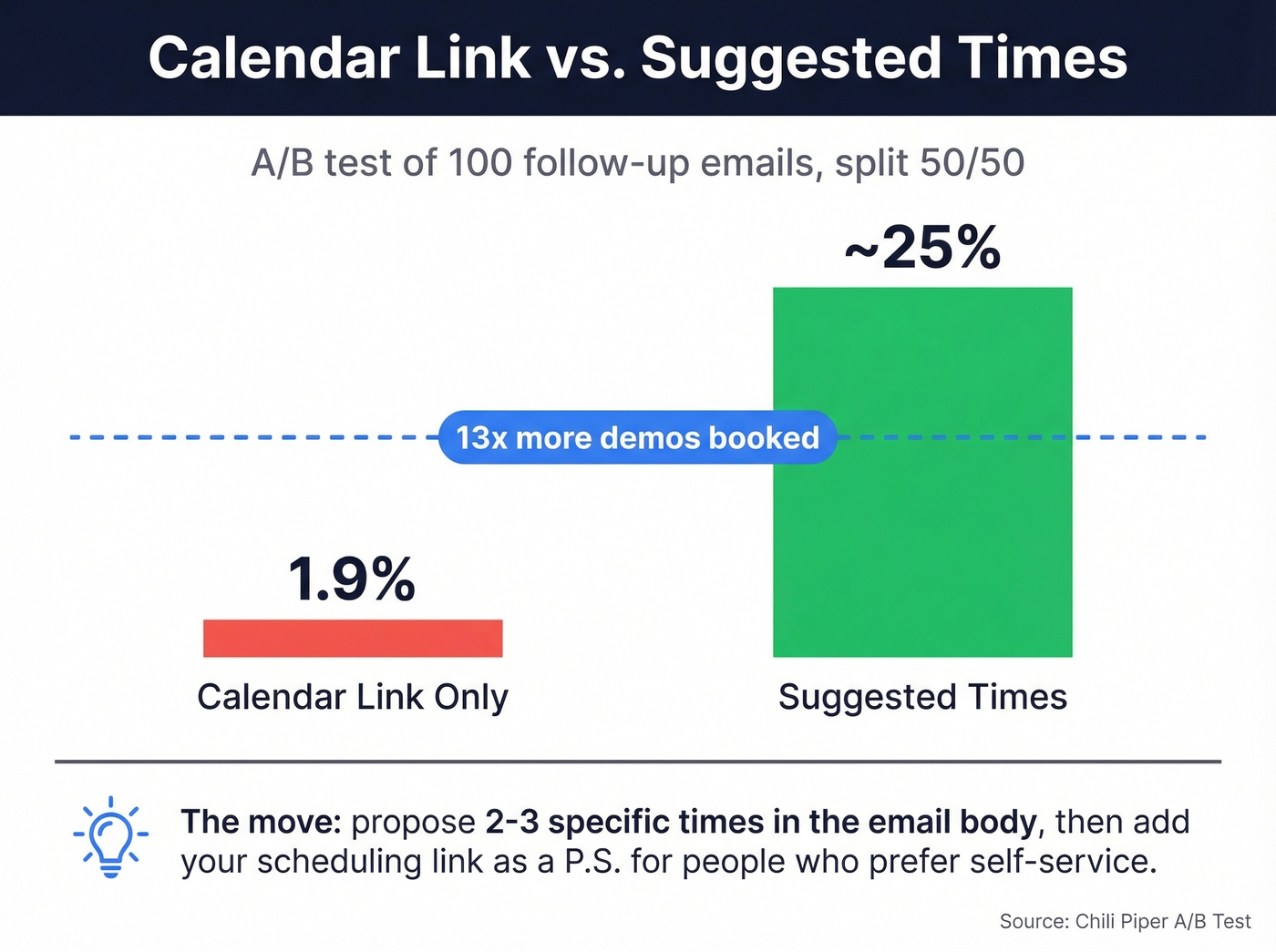
Let's be honest - scheduling links feel efficient for you but create friction for the prospect. A Chili Piper A/B test split 100 follow-up emails evenly: 50 with only a calendar link, 50 with suggested times. The link-only group converted at 1.9%. The suggested-times group booked ~13x more demos.
The r/sales consensus backs this up with the bluntest phrasing possible: sharing a scheduling link means "the conversation tends to die down." Prospects feel like you're making them do the work.
The move: propose 2-3 specific times in the body, then drop your scheduling link as a P.S. for people who prefer self-service. Best of both worlds.
When to Hit Send
A MailerLite analysis of 2.1M+ campaigns found Friday has the highest average open rate (49.7%), with Monday close behind (49.4%). Peak opens land between 8-11 AM local time. Peak clicks happen later, around 8-9 PM.
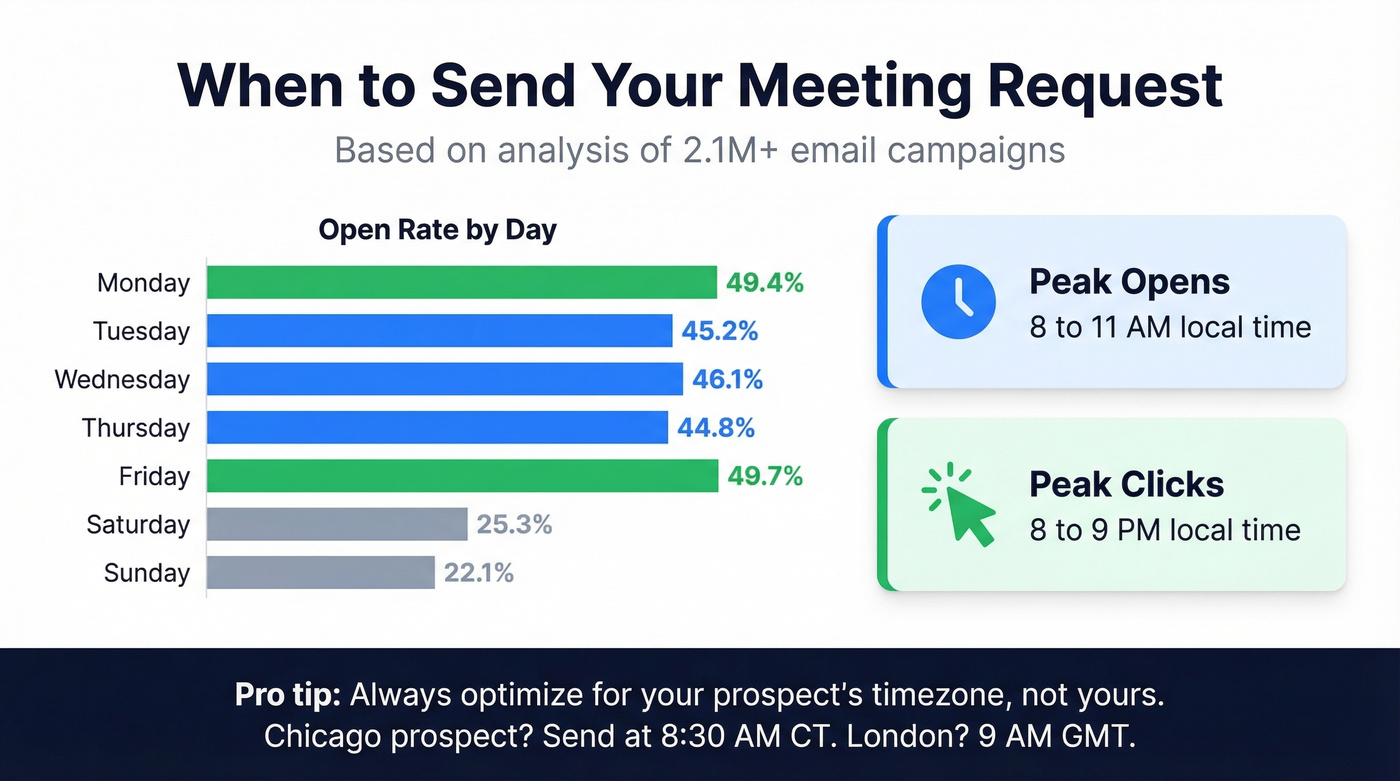
For cold meeting requests, target the local-morning window. If your prospect's in Chicago, schedule for 8:30 AM CT. London? 9 AM GMT. Don't optimize for your timezone - optimize for theirs.
Mistakes That Kill Your Reply Rate
Here's the thing: most of these aren't wording problems. They're process problems disguised as wording problems.
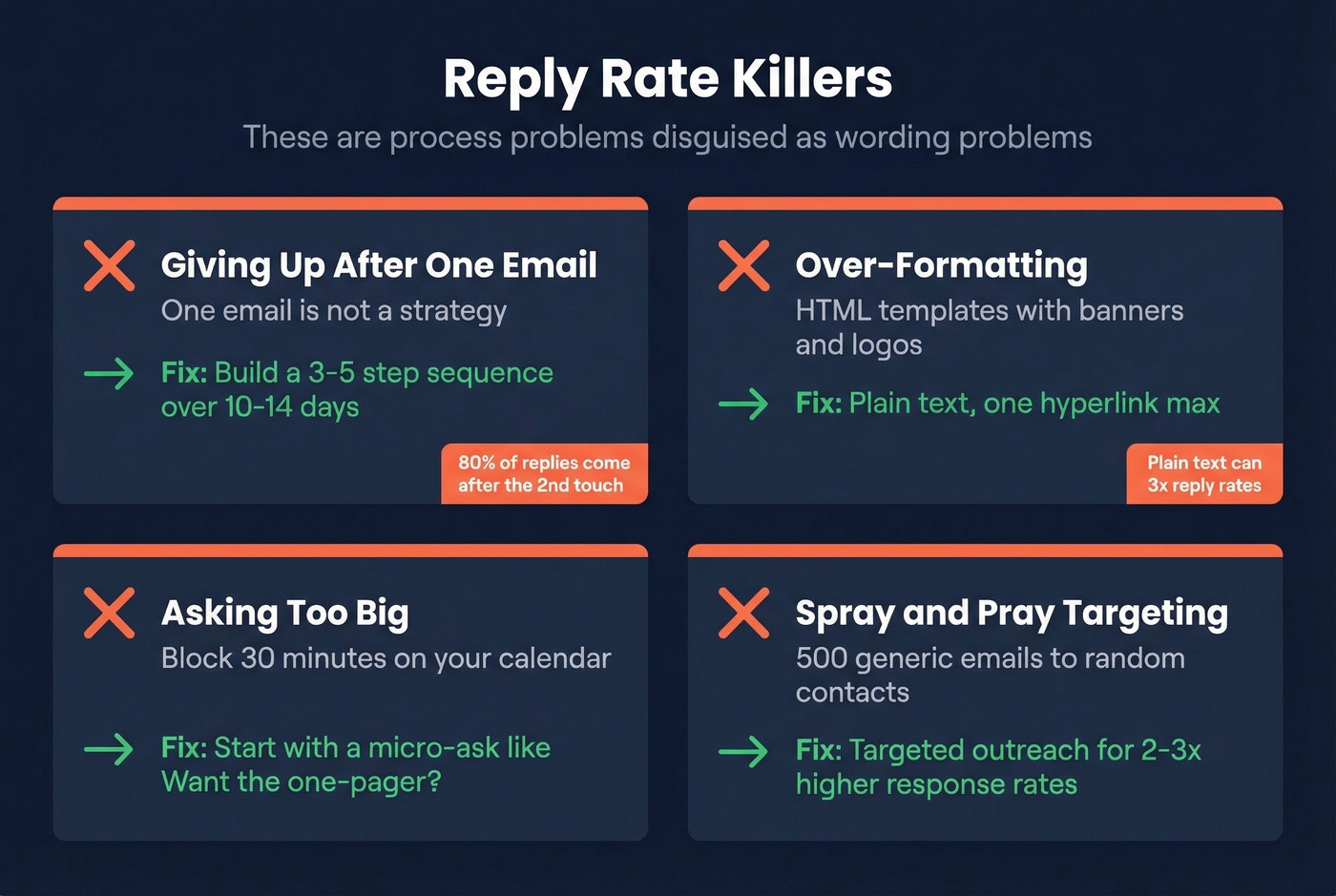
- Giving up after one email. 80% of cold email replies come after the second touch. One email isn't a strategy - build a 3-5 step sequence over 10-14 days.
- Over-formatting. Plain text outperforms branded HTML templates with banners, logos, and multiple links. We've seen teams triple their reply rates just by switching to plain text. One hyperlink max.
- Asking too big. "Micro-asks" like "Want the one-pager?" convert better than "Block 30 minutes on your calendar." Lower the bar first.
- Spray-and-pray targeting. Targeted outreach delivers 2-3x higher response rates. Sending 500 generic emails doesn't just fail - it damages your sender reputation.
- Letting emails bounce. The best wording in the world doesn't matter if the email never arrives. Prospeo checks addresses against 143M+ verified emails with 98% accuracy, and the free tier gives you 75 verifications per month to start.
If your deal size is under $10k, you don't need a 12-touch, multi-channel sequence. You need 50 verified emails, 5 tight templates, and the discipline to follow up twice. Complexity is where small teams go to die.

Templates and subject lines only convert when they reach real decision-makers. Prospeo's 300M+ database with 30+ filters - including job title, intent data, and company growth signals - lets you build a list of prospects who actually need what you're offering. No more meeting requests sent into the void.
Stop perfecting emails to the wrong people. Start with the right list.
FAQ
How long should a meeting request email be?
Aim for 50-125 words, with 80-90 as the sweet spot. That's short enough to scan in under 30 seconds while still including a value statement, a specific ask, and 2-3 proposed times. Go over 125 words and reply rates drop sharply.
What's the best subject line for scheduling a meeting?
Keep it to 1-4 words, all lowercase. Data from 85M+ cold emails shows short, non-salesy subject lines get the highest open rates. Examples: "quick question," "15 min this week?," or just the prospect's company name.
Should I send a follow-up if I don't hear back?
Yes - 80% of cold email replies come after the second touch. Wait 2-3 business days, then send a brief follow-up referencing your original message. A 3-5 step sequence over 10-14 days is standard practice for outbound teams.
How do I make sure my meeting request emails get delivered?
Verify every address before sending. Bounced emails damage your sender reputation and tank deliverability for future campaigns. Even a small batch of bad addresses can snowball into inbox placement issues that take weeks to fix.