

EmailListVerify vs Hunter: The Only Comparison You Need
Your SDR just exported 10,000 leads and needs them verified before loading into Instantly. Do you burn half your Hunter credits - credits that also fuel your email finding - or use a dedicated tool that costs $40 for the whole list? That tension is the entire EmailListVerify vs Hunter debate in a nutshell.
We've run both tools across large verification batches, and the answer depends entirely on what you're actually using them for. Let's break it down.
30-Second Verdict
EmailListVerify wins if you only need verification, want pay-as-you-go pricing, and hate credit expiration.
Hunter wins if you need email finding + verification + campaigns in one platform and will actually use all three.
Side-by-Side Feature Comparison
Here's how the two stack up on the metrics that actually matter for verification-heavy workflows.
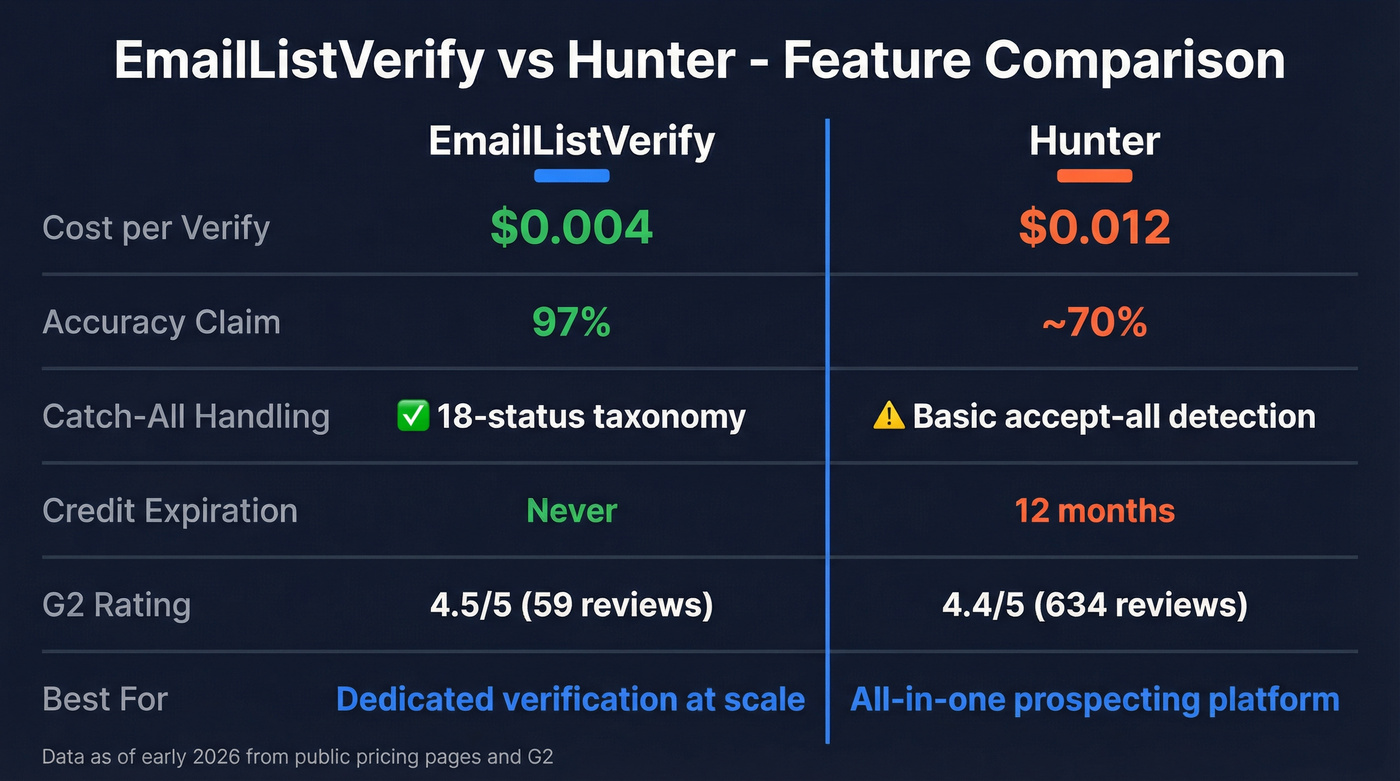
| Feature | EmailListVerify | Hunter |
|---|---|---|
| Starting price | $4 / 1,000 emails (pay-as-you-go) | $49/mo (2,000 credits) |
| Cost per verify | ~$0.004 | ~$0.012 |
| Accuracy claim | 97% | ~70% (own benchmark) |
| G2 rating | 4.5/5 (59 reviews) | 4.4/5 (634 reviews) |
| Catch-all handling | 18-status taxonomy | Detects accept-all; proprietary resolution for some providers |
| Credit expiration | Never (pay-as-you-go) | 12 months (bulk credits) |
| Free tier | 100 verifications | 50 credits/month (~100 verifications) |
| Speed | 100K+/hr | Not disclosed |
Pricing Breakdown
Hunter isn't expensive for what it does. It's expensive if you're only using it to verify.
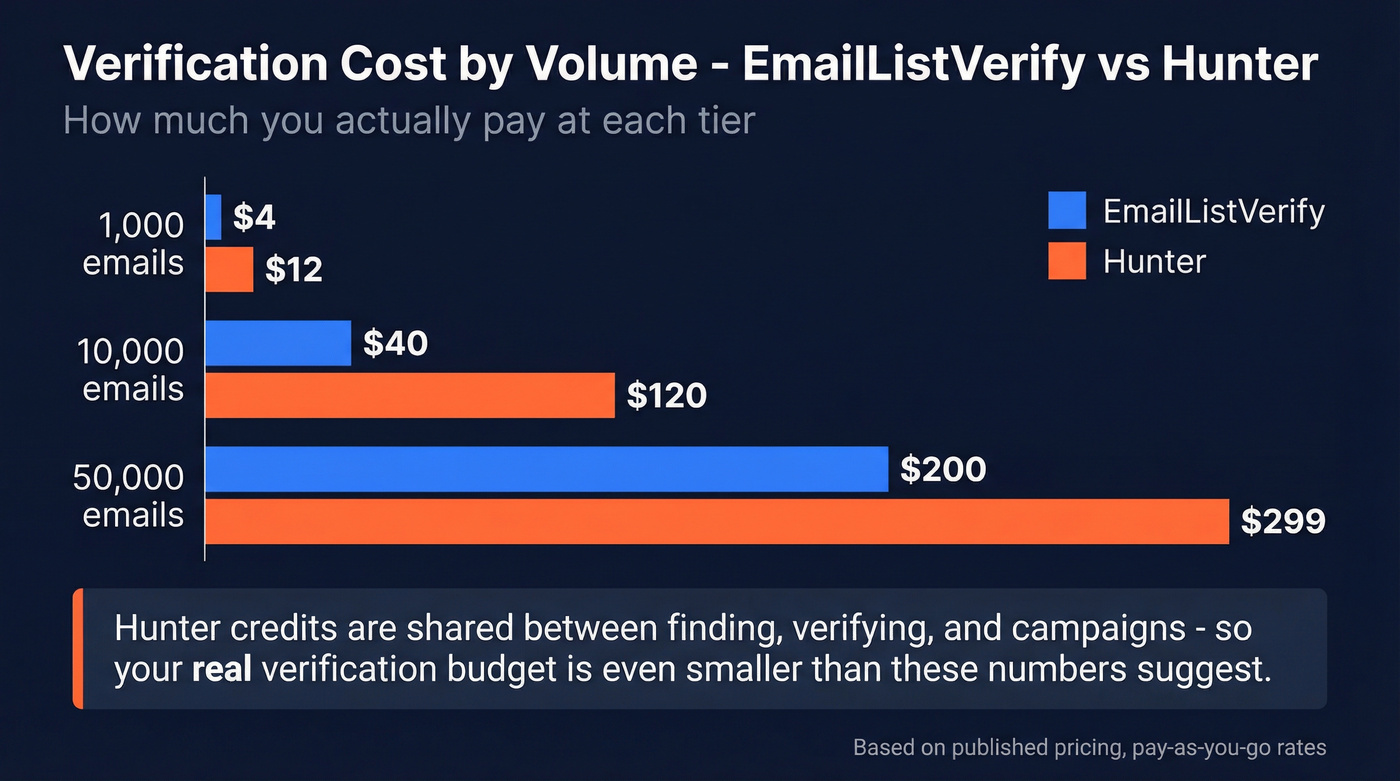
Each verification costs 0.5 credits, so a Starter plan ($49/mo, or $34/mo billed annually) gives you up to 4,000 verifications - about $0.012 per email. But those same credits fuel email finding, domain searches, and campaigns. Your verification budget competes with your prospecting budget every single month. That shared credit pool is the hidden cost nobody talks about, and G2 reviewers consistently flag credit limits as a pain point at scale.
EmailListVerify doesn't have this problem. Pay-as-you-go starts at $4 for 1,000 verifications - $0.004 per email - and those credits never expire.
| Volume | EmailListVerify | Hunter |
|---|---|---|
| 1,000 emails | ~$4 | ~$12 |
| 10,000 emails | ~$40 | ~$120 |
| 50,000 emails | ~$200 | ~$299 (Scale plan) |
At 50K verifications, you're paying roughly 1.5x more on Hunter. And that math gets worse if you're also burning credits on finding.

Tired of choosing between verification budget and prospecting budget? Prospeo finds and verifies emails in a single step - 98% accuracy, $0.01 per email, no shared credit pool. No 12-month expiration. No surprise costs at scale.
Stop paying twice for what should be one workflow.
Accuracy and Catch-All Handling
Most comparison articles pretend these two tools are direct competitors. They're not. Hunter is a Swiss Army knife; EmailListVerify is a scalpel.
On accuracy, EmailListVerify claims 97%. Hunter ran its own benchmark of 15 verifiers and scored itself at 70.00% - with EmailListVerify at 63.87%. That benchmark used 3,000 real business emails (2,700 collected from recent outreach responses plus 300 known invalids) and ran the tools in bulk mode using Clay's default settings. An independent benchmark by Icypeas testing 17 verifiers found the average accuracy across tools sits around 85%.
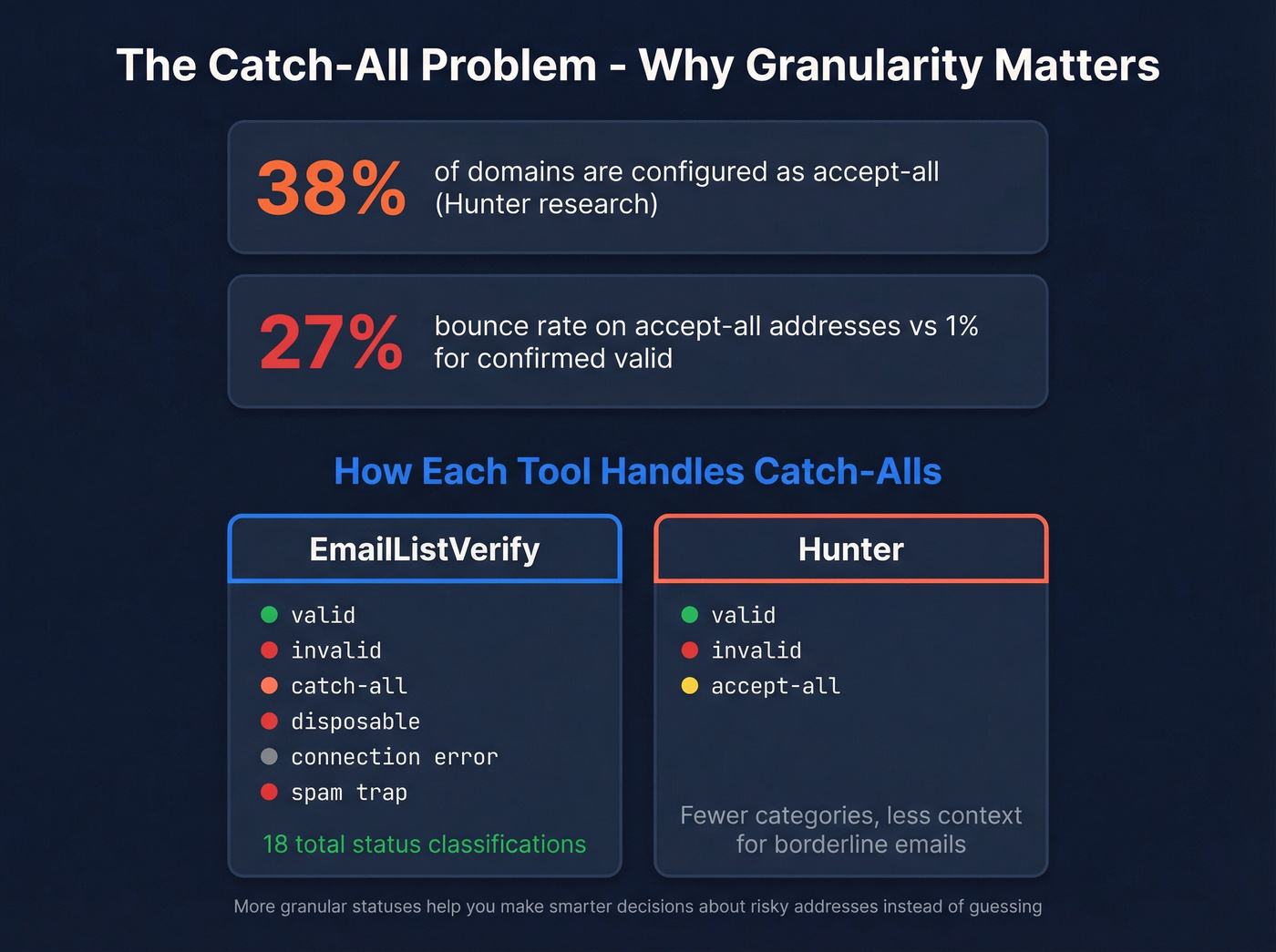
Here's the thing: a single accuracy number doesn't tell you much. Where EmailListVerify genuinely pulls ahead is granularity. Its verification pipeline runs syntax validation, domain/MX checks, mailbox-level status probes, and disposable/risk detection - then returns 18 different status classifications, including connection-related issues that other tools lump into "unknown." Practitioners on r/coldemail confirm this level of detail lets you make smarter decisions about borderline addresses instead of just guessing.
Catch-all domains remain the industry's unsolved problem. Hunter's research found 38% of domains were configured as accept-all, and emails sent to those addresses bounced at 27% versus 1% for confirmed valid ones. Neither tool fully solves this, but EmailListVerify's taxonomy at least tells you why an address is risky.
When to Choose Each Tool
Choose EmailListVerify
You already have your lead sources sorted - Sales Nav, Clay, a purchased list, whatever - and you just need clean verification before loading into your sequencer. ELV users on G2 praise its speed and affordability, and the pay-as-you-go model with non-expiring credits is perfect for teams with variable volumes. One month you verify 500 emails, the next month 50,000. You never lose credits and you never pay for features you don't use.
Skip it if you need email finding at scale. EmailListVerify does offer an email finder, but it burns 5 credits per email found at medium confidence or higher, which adds up fast.
Choose Hunter
You genuinely use the full stack: finding emails by domain, verifying them, and running campaigns inside one platform. Hunter's value is workflow consolidation, not verification economics. For a solo founder who wants one login for prospecting, it's hard to beat.
Skip it if verification is your primary use case. You'd be paying for email finding, campaigns, and domain search features you'll never touch. The 12-month credit expiration adds use-it-or-lose-it pressure that gets annoying fast when your verification volume is spiky.
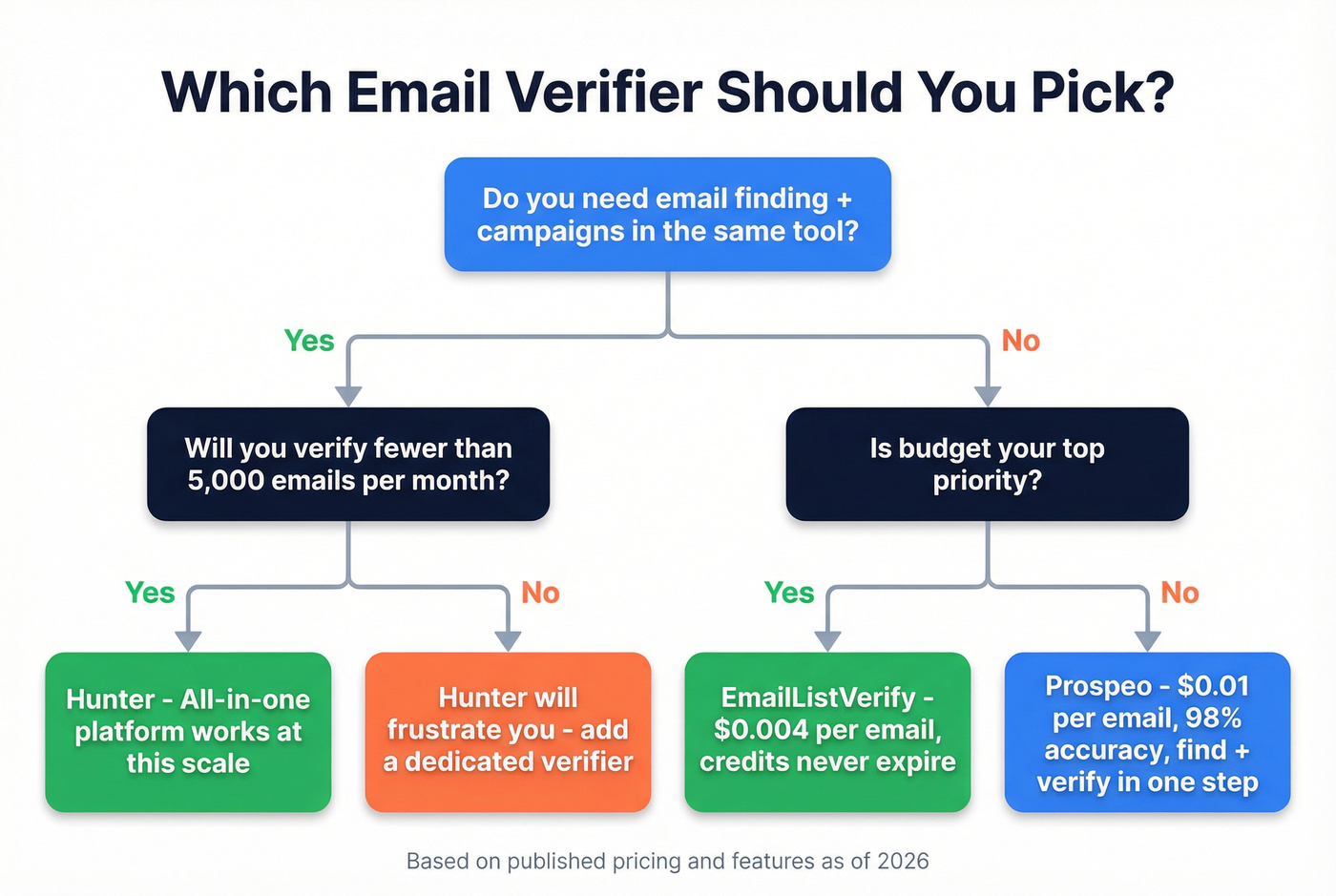
Our honest take: If your monthly verification volume regularly exceeds 10,000 emails, Hunter's credit model will frustrate you within three months. We've seen it happen repeatedly - teams sign up for the convenience, then quietly add a dedicated verifier within a quarter.
If Neither Fits
At roughly $0.01 per email with a free tier of 75 emails/month, it sits between EmailListVerify's rock-bottom pricing and Hunter's bundled approach, with better accuracy than either and no shared credit pool forcing you to choose between finding and verifying.

Catch-all domains tank deliverability - Hunter admits a 27% bounce rate on accept-all addresses. Prospeo's 5-step verification includes catch-all handling, spam-trap removal, and honeypot filtering, refreshed every 7 days. Teams using Prospeo see bounce rates under 4%.
Get the verification accuracy neither tool can match.
FAQ
Is EmailListVerify more accurate than Hunter?
Independent benchmarks put the average verifier around 85% accuracy. Hunter scored itself at 70% in its own test. EmailListVerify's 18-status taxonomy gives you more actionable data per result, which matters more than a single accuracy number when you're deciding which borderline addresses to keep.
Can I use EmailListVerify and Hunter together?
Yes. A waterfall approach - verify with one tool, re-verify questionable results with the other - catches edge cases either verifier alone would miss. Reddit threads on r/coldemail consistently confirm that verification tools disagree on borderline addresses, so layering improves deliverability.
Do either tool handle catch-all domains well?
No verifier fully solves catch-all domains. Hunter's own research shows 38% of domains are accept-all, with a 27% bounce rate on those addresses. EmailListVerify flags catch-alls with more granular status codes, which helps you make informed decisions. Prospeo's 5-step process includes dedicated catch-all handling and spam-trap removal, reducing risk further than either standalone option.