

What Is Enablement? Definition, Types, Frameworks, and Tools
76% of organizations now have a dedicated enablement function - up from 32% just five years ago. Yet only 25% of those organizations actually track whether it's working. That gap between adoption and accountability is the central tension of this discipline in 2026.
The Short Version
Enablement is the strategic function of equipping employees with the skills, knowledge, tools, content, and processes they need to perform effectively - and measuring whether that investment changes behavior.
It's an organizational change function, not just sales training. It spans skills, technology, content, and process across seven distinct types. Sales enablement is the most common, but revenue, partner, customer, product, business, and IT variants all follow the same logic. If you can't measure behavior change, you don't have a real program - you have a content library nobody uses.
And here's the foundation layer most teams skip: verified contact data. Bad emails and wrong phone numbers kill every playbook, no matter how polished.
What Is Enablement, Really?
The dictionary definition of "enable" is straightforward: to make something possible. In business, that idea becomes a discipline - the strategic function of equipping your workforce with the skills, knowledge, strategies, technology, and resources they need to increase organizational effectiveness. If you've ever asked "what does this term actually mean?" and gotten a vague answer about training or content, you're not alone. The word has been stretched thin by overuse.
Let's simplify. It means giving people what they need to do their jobs well, then proving it worked. Not a department that makes slide decks. An organizational change function that touches hiring, onboarding, coaching, content, tooling, and measurement.
Two quick disambiguations: in psychology, "enabling" refers to reinforcing harmful behavior - the opposite of what we're talking about. In patent law, it's a legal requirement that a specification must teach someone to reproduce the invention. Neither applies here.
The business definition draws a clear boundary. This isn't just training (that's event-based). It isn't just operations (that's systems and logistics). It's the ongoing performance system that connects strategy to execution. When a new rep can run a discovery call that sounds like your best AE within 60 days instead of 180, that's the function working. When a CS team can articulate expansion value because they have the right content at the right deal stage, that's it working too.
The scope has expanded dramatically. Five years ago, the term almost always meant "sales enablement." Today it covers every team that touches revenue - and increasingly, every team that touches productivity.
Defining It for Your Organization
Before getting into the seven types, here's a question most teams skip: how do you define this function in a way that actually sticks inside your company? The generic definition - equipping people with what they need - is true but useless if it doesn't translate into clear ownership, measurable outcomes, and executive buy-in.
The best charters we've seen answer three questions: who are we enabling, what behavior are we changing, and how will we prove it worked? Nail those three, and the rest of the framework falls into place.
Why It Matters
Organizations with formal programs achieve a 49% win rate on forecasted deals versus 42.5% without. That 6.5 percentage-point gap compounds across hundreds of deals per quarter.
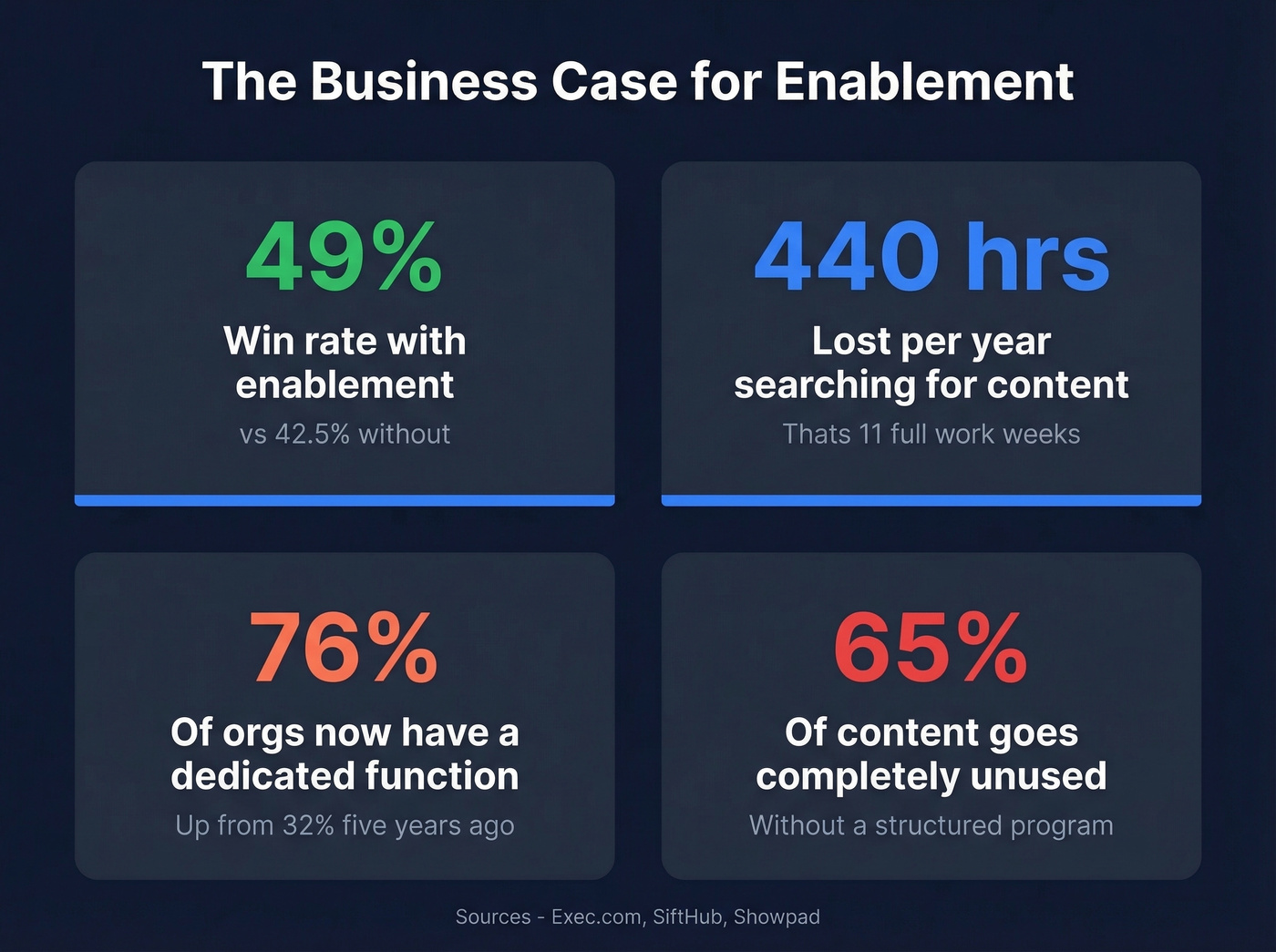
The productivity argument is equally stark. Reps spend roughly 28-30% of their time actually selling. The rest disappears into content searches, CRM updates, internal meetings, and tool-switching. Revenue teams burn 440 hours per year searching for or creating content - that's 11 full work weeks. A structured program exists to claw that time back.
Hiring patterns confirm the shift. 76% of organizations now have a dedicated function, and formal roles have grown from 58% adoption in 2017 to over 80% today. The question isn't whether you need this capability. It's whether yours is actually working.
| Metric | With Program | Without |
|---|---|---|
| Win rate (forecasted) | 49% | 42.5% |
| Onboarding ramp time | 40-50% shorter | 3-6 months SMB, 6-9 months enterprise |
| Rep selling time | +20% improvement | ~28-30% of week |
| Content utilization | Managed, measured | 65% goes unused |
Organizations that treat this function as an ROI engine - not a cost center - see a 15% lift in win rates and 12% higher quota attainment.
The 7 Types
Most people hear the term and think "sales." That's like hearing "marketing" and thinking "email blasts." Sales is the most common type, but it's one of seven distinct disciplines. Each follows the same logic - equip people, measure behavior change - but applies it to different teams and outcomes.
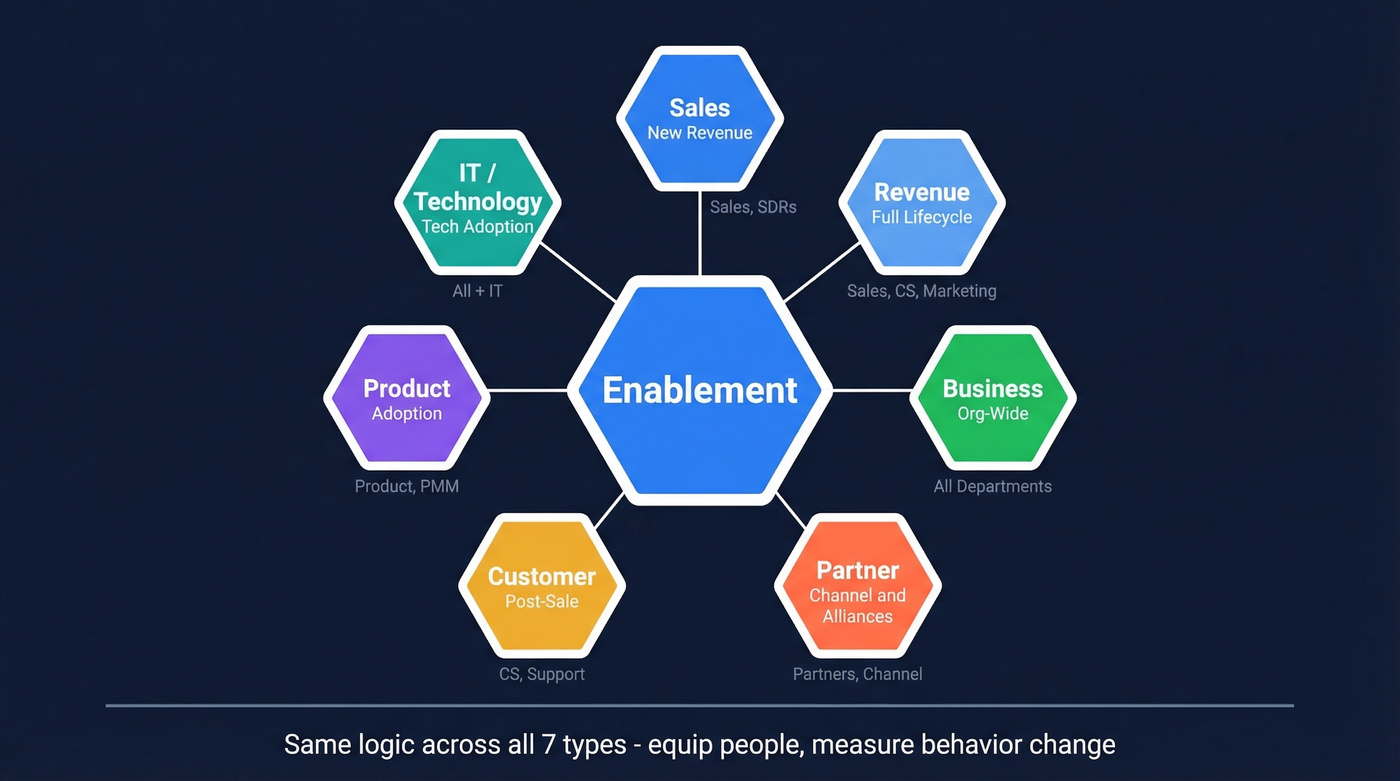
| Type | Scope | Primary Teams | Example Use Case |
|---|---|---|---|
| Sales | New revenue | Sales, SDRs | Onboarding, call coaching |
| Revenue | Full lifecycle | Sales, CS, Marketing | Cross-sell playbooks |
| Business | Org-wide | All departments | Change management |
| Partner | Channel/alliances | Partners, channel | Controlled asset access |
| Customer | Post-sale | CS, Support | Onboarding portals |
| Product | Adoption | Product, PMM | Feature launch readiness |
| IT/Technology | Tech adoption | All + IT | New tool rollouts |
Sales Enablement
The original and still the most mature type. Sales enablement equips reps with content, coaching, tools, and insights to engage buyers and close deals. The focus is new revenue and new logos. A well-run function owns onboarding, ongoing coaching cadences, competitive battle cards, and content governance. It doesn't own the CRM (that's ops) or the annual SKO (that's training). It owns the system that makes reps effective every day.
Revenue Enablement
Sales enablement focuses on the sales team. Revenue enablement extends the same discipline to marketing, customer success, partnerships, pre-sales, and solution engineering - covering the full buyer lifecycle from first touch through renewal and expansion. Where sales enablement builds buyer-tailored deal rooms, revenue enablement builds scalable customer portals with unified lifecycle analytics. The content library serves all revenue teams with personalization and governance autonomy by group.
Business Enablement
The broadest type. Business enablement equips employees across the entire organization with the strategies, processes, and technology to be effective. Gartner found that 47% of digital workers struggle to find the information they need to do their jobs, and McKinsey puts it more bluntly: more than half of employees are "relatively unproductive." This variant addresses that at the system level - change management during M&A, digital transformation rollouts, automation, workflow optimization, and organizational design.
Partner Enablement
If you sell through channels, partners need the same content, training, and tools your internal teams get - but with controlled access and analytics. Partner enablement grants permissioned access to internal assets and tracks how partners interact with that content. The measurement layer matters here: you need to know which partners actually use your materials and which ones are winging it.
Customer Enablement
Post-sale work focused on helping customers succeed with your product. This includes onboarding programs, training portals, certification paths, and self-service knowledge bases. Companies that run structured customer programs see the payoff: faster time-to-value drives higher NPS, and customers who complete onboarding and training are far more likely to expand.
Product Enablement
This is the type that gets skipped most often - and it shows. Product enablement bridges the gap between what product builds and what the field can actually sell. Without it, launches happen and nobody on the front line knows what changed or why it matters. The best programs run "launch readiness" certifications: reps can't pitch a new feature until they've passed a competency check. Teams that skip this step watch adoption stall.
IT / Technology Enablement
Every new tool rollout is a readiness problem. The average revenue tech stack includes 10+ tools with 43% underutilized at less than 50% adoption. IT enablement ensures employees can actually use the technology the company invests in. Given those utilization numbers, this type has a massive ROI case - it's just rarely formalized.

Reps lose 440 hours a year on busywork - and bad data makes it worse. Prospeo gives your enabled reps 300M+ verified profiles, 125M+ direct dials, and 98% email accuracy so every playbook actually connects to real buyers.
Stop enabling reps with broken contact data. Start with Prospeo.
Enablement vs. Ops vs. Training
These three functions get confused constantly. They're related but distinct, and mixing them up creates org-chart chaos.
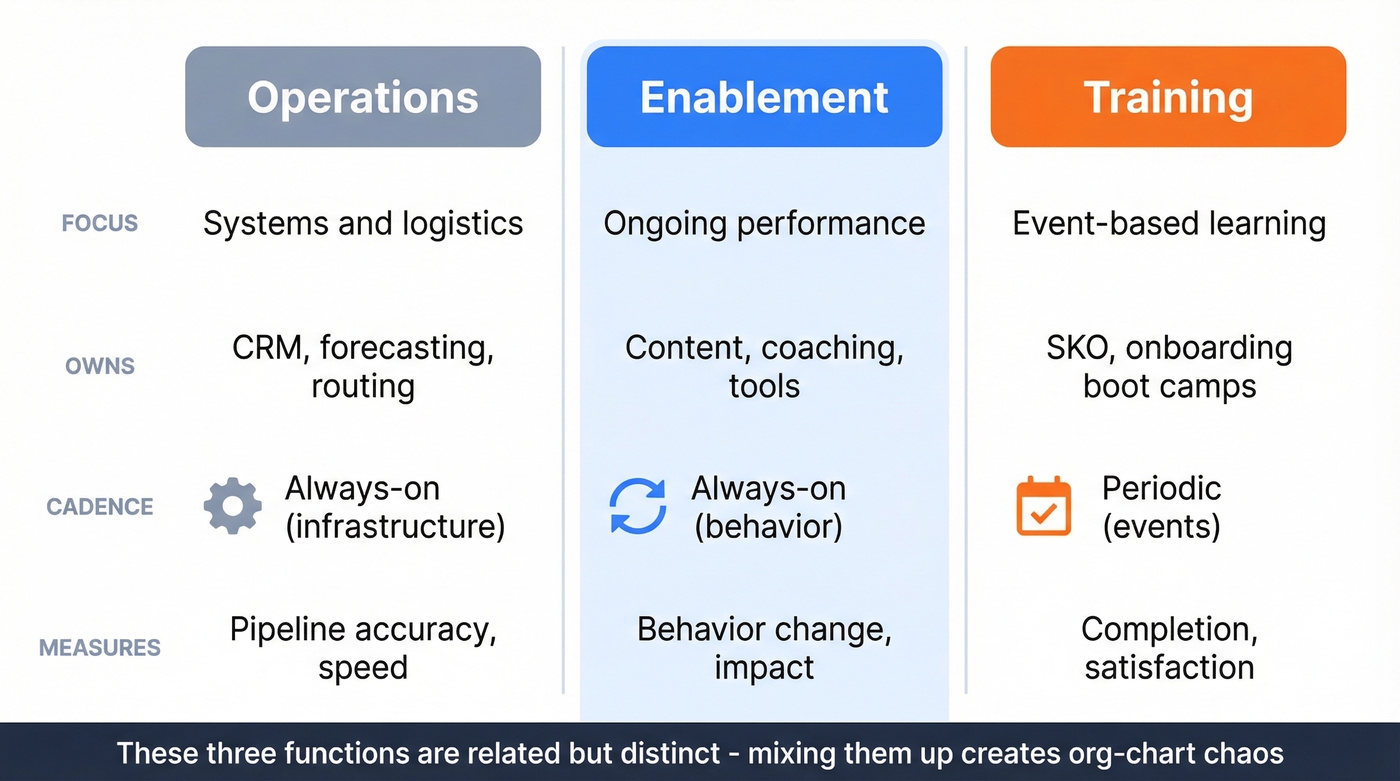
| Dimension | Operations | Training | Enablement |
|---|---|---|---|
| Focus | Systems, logistics | Event-based learning | Ongoing performance |
| Owns | CRM, forecasting, routing | SKO, onboarding boot camps | Content, coaching, tools |
| Cadence | Always-on (infrastructure) | Periodic (events) | Always-on (behavior) |
| Measures | Pipeline accuracy, speed | Completion, satisfaction | Behavior change, impact |
Ops builds the plumbing - CRM configuration, territory design, lead routing, forecasting models. Training delivers event-based skill development - onboarding boot camps, annual kickoffs, product certification sessions.
The ongoing performance system connects content, coaching, and tools to daily execution. Sellers spend up to 15 hours per week digging through disconnected content and tools. That's not an ops problem and not a training problem. Ops can't fix it by adding another Salesforce field. Training can't fix it with another webinar. A structured program fixes it by putting the right content in front of the right rep at the right moment.
How to Implement a Program
Most teams overcomplicate this. A four-step framework works: Define, Assess, Invest, Implement.
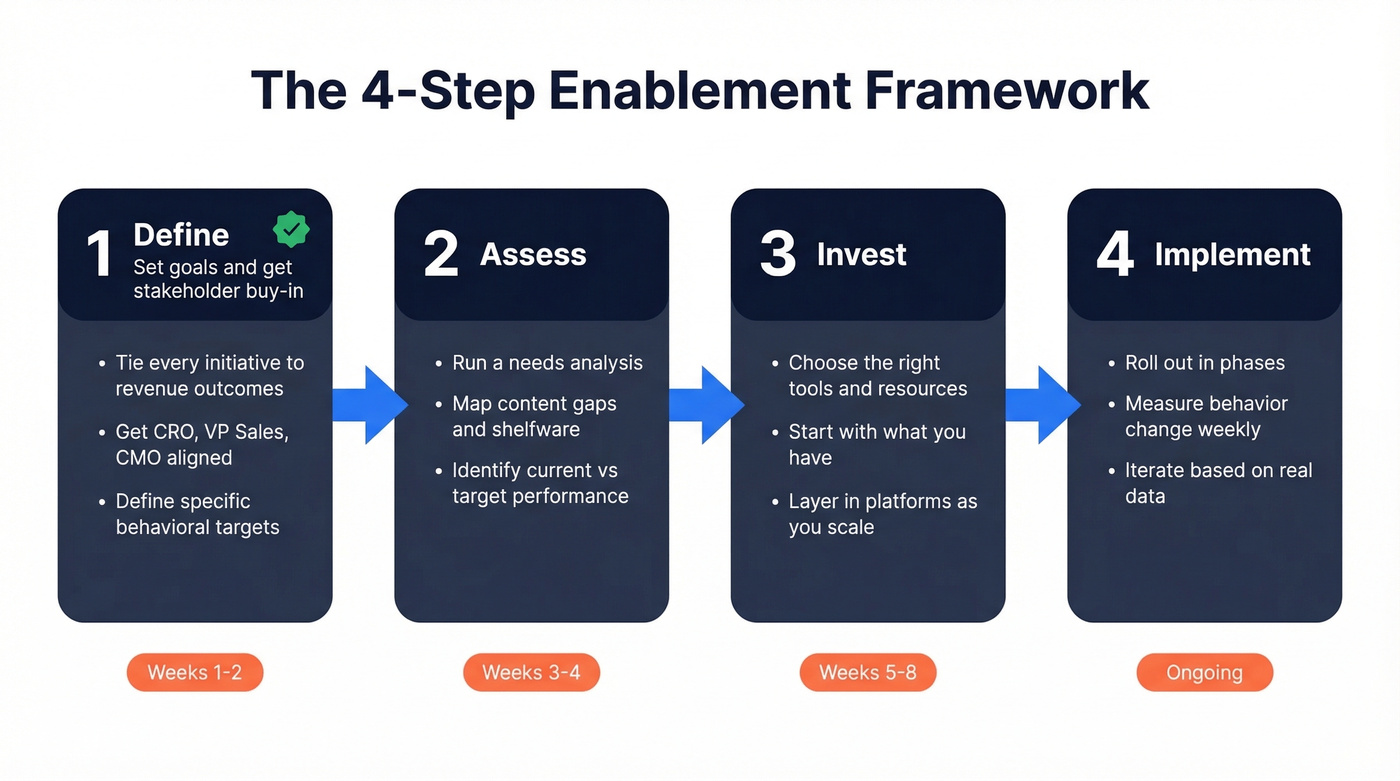
Step 1: Define goals and get stakeholder buy-in. Programs without executive sponsorship die within two quarters. Define the behavioral outcomes you want - not "better selling" but "reps execute the new discovery framework on 80% of calls within 90 days." Tie every initiative to a revenue outcome. Get your CRO, VP Sales, and CMO aligned before you build anything.
Step 2: Assess your current state. Run a needs analysis. Where are reps struggling? What content exists but isn't used? Which tools are adopted and which are shelfware? Map the gap between current performance and target performance.
Step 3: Invest in the right tools and resources. This doesn't mean buying a $100k platform on day one. Choose technology that integrates with your existing stack, supports analytics, and scales with your team. The investment also includes people - program managers, content creators, and coaches. Target benchmarks: 60-80% active monthly content adoption and 80-90% certification completion rates within the first year.
Step 4: Implement with change management. This is where most programs stall. Implementation requires five parallel workstreams: needs analysis and impact assessment, stakeholder management, learning and development, communications, and program management. Assign clear ownership using a RACI model - the enablement team owns program design, Sales Managers own coaching execution, Marketing owns content creation, and RevOps owns systems and data.
Here's the thing most teams miss: there's a difference between a strategy, a plan, and a program. Your strategy defines the behavioral outcomes you want. Your plan is the roadmap with timelines, budget, and ownership. Your program is the training cadences, coaching loops, content operations, and adoption tracking that make it real. You need all three.
How to Measure Impact
30.3% of practitioners say their metrics only minimally reflect the value delivered. If you can't prove impact, you can't defend budget - and teams that can't defend budget get cut.
The measurement framework that works has three levels.
Level 1 - Adoption. Did people engage with what you built? Track content usage rates, training completion, certification pass rates, and tool login frequency. These are table-stakes metrics. They tell you whether the program is reaching the field, but not whether it's working.
Level 2 - Behavior. Did people change how they work? Track call quality scores, coaching assessment results, competency evaluations, and manager feedback. Compare enabled cohorts against non-enabled cohorts. If reps who completed your new discovery training don't run better discovery calls, the training failed - regardless of completion rates.
Level 3 - Impact. Did behavior change move business outcomes? Win rate, average deal size, ramp time, quota attainment, pipeline velocity. This is where the function earns its seat at the revenue table.
A concrete example: say you're rolling out a cross-sell program after an acquisition. Your measurement stack includes opportunities identified by reps (adoption), collaboration calls between sales and CS (behavior), and deals closed within 120 days (impact). Correlate training participation with earlier opportunity creation to prove causation, not just correlation.
Organizations that run this kind of rigorous measurement see 15% higher win rates and 12% higher quota attainment. But only 25% of organizations track impact at all. The rest are flying blind.
Why Programs Fail
Three failure modes kill these initiatives. We've watched all three play out.
1. The proof gap. A practitioner on r/salestechniques put it perfectly: "enablement talks in vibes." Leadership wants revenue-linked metrics. The team delivers completion rates and satisfaction scores. When budget season arrives, the function that can't tie its work to pipeline gets cut. Every time. The numbers back this up: 55% of organizations say they can't effectively drive GTM initiatives, largely because they can't prove what's working.
2. Content rot and tool sprawl. 65% of sales content goes unused. The average revenue team runs 10+ tools with 43% underutilized. And 29% of organizations still rely on multiple disconnected GTM tools with no unified analytics. Teams that keep building content without auditing what exists create the exact problem they were hired to solve - more noise, not less.
3. One-off training syndrome. A two-day workshop isn't a program. It's an event. Sustained behavior change requires coaching, reinforcement, and measurement over time. Programs that train once and never follow up produce a temporary spike in enthusiasm and zero lasting impact.
Trends Shaping 2026
The Highspot State of Sales Enablement report - 350 GTM professionals across 21 countries - captures where the market is heading.
AI coaching is exploding. AI-powered training adoption is up 164% year-over-year. AI coaching users are 36% more likely to report higher win rates, and AI-powered training users are 35% more likely to report increased deal sizes. The use case gaining fastest: real-time call analysis with targeted coaching feedback, replacing the old model where managers spend 13 hours per week manually reviewing calls.
Tool consolidation is real. Companies use two fewer tools on average compared to last year. 27% more companies now run a few core, integrated tools rather than a sprawling stack. Organizations with well-integrated stacks are 42% more likely to increase sales productivity.
CRM-embedded delivery is becoming the standard. Just-in-time content and training prompts triggered by deal stage, buyer persona, or competitive context - delivered inside the CRM, not in a separate portal. Reps don't leave their workflow. Content finds them.
Personalized learning paths replace one-size-fits-all. Adaptive microlearning that diagnoses skill gaps and serves targeted content is replacing the annual certification grind. The best programs combine AI-driven skill assessment with peer coaching, surfacing best-practice calls for reps to learn from.
Tools and Platforms
The tool market breaks into four categories. Here's what 2026 looks like.
Look, most teams with smaller deal sizes don't need a six-figure platform. A solid CRM, a conversation intelligence tool, and clean contact data will outperform a bloated enterprise deployment that nobody actually uses. Buy the platform when you have the headcount to manage it.
| Category | Tool | Pricing | Best For |
|---|---|---|---|
| Enterprise | Highspot | $25k-$100k+/yr | Large GTM orgs |
| Enterprise | Seismic | $30k-$150k+/yr | Content governance + AI |
| Mid-Market | Showpad | $20k-$80k/yr | Content + coaching |
| Coaching | Mindtickle | $15k-$60k/yr | Readiness + certs |
| Coaching | Allego | $20k-$75k/yr | Video coaching |
| Conversation Intel | Gong | $15k-$50k+/yr | Call analysis + deals |
| Digital Sales Rooms | Dock | Free / $350/mo (5 users) / $750/mo (10 users) | Deal rooms + onboarding |
| Digital Sales Rooms | Aligned / DealHub | $30k-$100k+/yr | Complex enterprise deals |
| CRM + Enablement | HubSpot | $20-$150/user/mo | SMB-mid-market |
Content and coaching platforms - Highspot, Seismic, and Showpad - are the enterprise incumbents. They handle content management, coaching workflows, analytics, and increasingly AI-driven recommendations. Expect to spend $20k-$150k+ per year depending on seats and modules. For mid-market teams, Showpad's implementation guide is worth reading before you commit to any platform.
Digital sales rooms are the fastest-growing subcategory. Practitioners on r/salestechniques consistently highlight buyer engagement signals, mutual action plans, and setup speed as the criteria that matter most.
Conversation intelligence - Gong dominates here. Call analysis, deal intelligence, and coaching insights pulled from actual buyer conversations. Table stakes for any team running more than a handful of reps.
Data quality and prospecting is the foundation layer most teams skip. Every other tool in your stack assumes your reps have accurate contact data. Most don't. If your team's running bounce rates above 10%, skip the fancy platform purchase and fix the data first - it's the cheapest, highest-ROI move you'll make. (If you want benchmarks and fixes, start with bounce rates above 10%.)
You measured the win rate lift. You cut ramp time in half. But if your reps bounce 35% of emails, none of it compounds. Prospeo's 7-day data refresh and 5-step verification keep your enablement ROI from leaking out the bottom of the funnel.
Enablement without data quality is just expensive training.
FAQ
What is enablement in business?
It's the strategic function of equipping employees with the knowledge, tools, content, and processes they need to perform effectively - then measuring whether that investment changes behavior and drives results. It spans seven types: sales, revenue, partner, customer, product, IT, and business.
What's the difference between sales and revenue enablement?
Sales enablement focuses exclusively on the sales team closing new business. Revenue enablement expands that scope to every customer-facing team - marketing, CS, partnerships - covering the full lifecycle from first touch through renewal and expansion.
How do you measure success?
Track three levels: Adoption (content usage, training completion), Behavior (call quality scores, coaching assessments), and Impact (win rate, deal size, quota attainment). Only 25% of organizations measure at the impact level - those that do see 15% higher win rates.
What tools do teams need to get started?
At minimum: a CRM, a coaching or readiness tool, and a data quality layer for verified contacts. Platforms like Showpad or Mindtickle handle content and coaching starting around $15k-$20k/year, while a tool like Prospeo covers the data foundation at roughly $0.01/email with a free tier.
Why do most programs fail?
Three reasons dominate: no revenue-linked metrics (the "proof gap"), content rot where 65% of assets go unused, and one-off training with no reinforcement loop. Programs measuring only completion rates rarely survive their second budget cycle.