

The Enterprise Sales Process That Actually Closes Seven-Figure Deals in 2026
Your VP just asked why the $300K deal you forecasted for Q3 is slipping to Q1. You don't have a good answer - because the real answer is that your enterprise sales process has four stages when it needs seven. Sloppy selling at this level is dying. The teams still closing seven-figure deals in 2026 have process rigor that most orgs can't match.
Here's what that process actually looks like.
Why Enterprise Selling Is Harder Than Ever
The numbers are brutal. Only 43.5% of sales professionals hit quota according to RepVue's most recent Cloud Sales Index, and a separate Salesforce study found just 16% of reps hit quota in 2023. Win rates dropped 18% compared to 2022 and 27% compared to 2021. Sales cycles grew 16% in H1 2023 - and 38% compared to 2021 - before stabilizing, which just means they stopped getting worse.
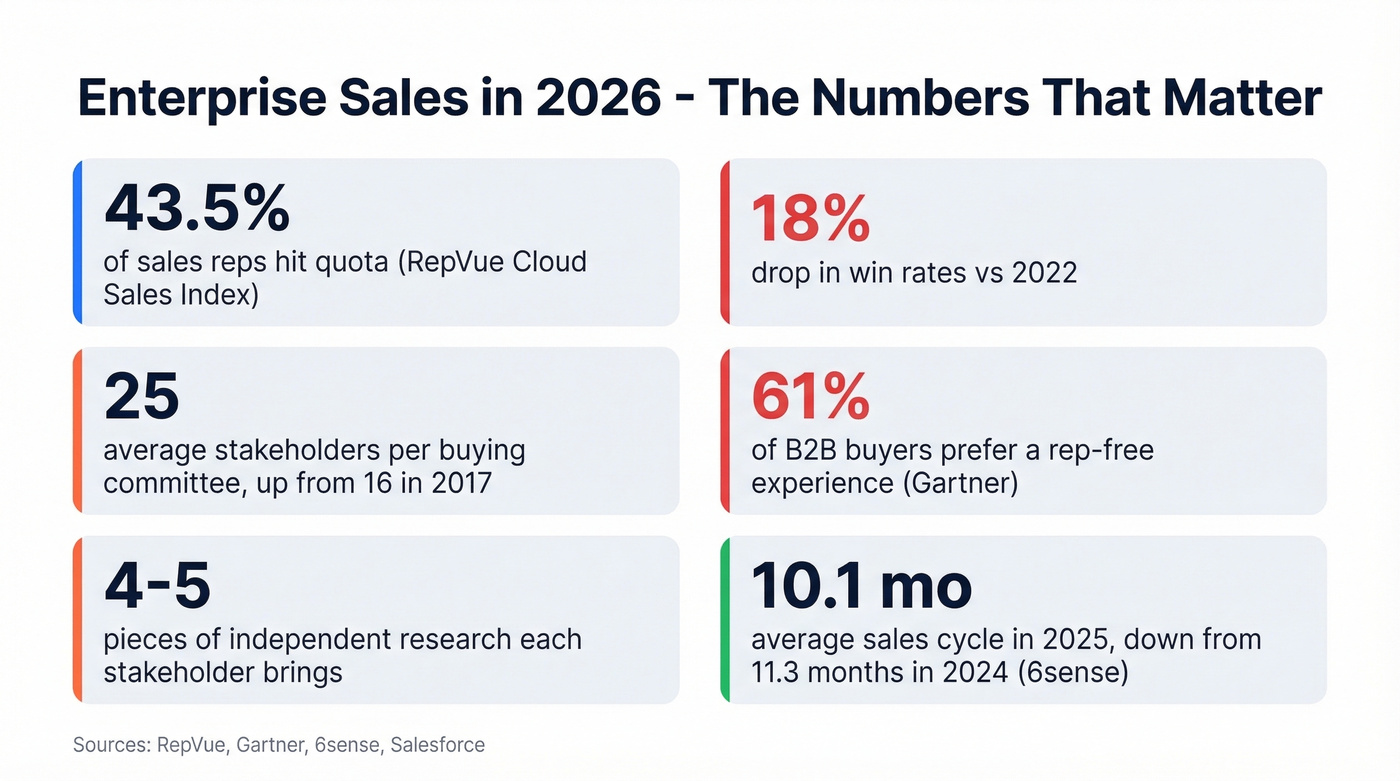
Buyers are pulling away from sellers entirely. A Gartner survey of 632 B2B buyers found that 61% prefer a rep-free buying experience, and 73% actively avoid suppliers who send irrelevant outreach. That's not a preference. It's a wall.
The average buying committee now sits around 25 stakeholders, up from 16 in 2017. Each of those stakeholders brings 4-5 pieces of independent research to the table. Your reps aren't just selling - they're competing against a committee's own homework. None of this means enterprise sales is dying. It means the teams that win are the ones with a process disciplined enough to navigate it. Everyone else is forecasting deals that slip quarter after quarter.
What Defines Enterprise Sales?
Enterprise sales is the practice of selling high-value solutions - typically six- to seven-figure annual contracts - to large organizations with complex buying structures. Cycles run 3-12+ months. Stakeholder counts start in the double digits. Every deal touches multiple departments: IT, procurement, finance, legal, and the C-suite.
The distinction from mid-market and SMB sales isn't about deal size alone. It's about structural complexity.
| Dimension | SMB | Mid-Market | Enterprise |
|---|---|---|---|
| Deal Size | Under $50K | $50K-$100K | $100K-$1M+ |
| Cycle Length | 14-60 days | 60-120 days | 120-270+ days |
| Stakeholders | 1-3 | 3-7 | 13+ |
| Procurement | Rare | Sometimes | Always |
| Process Complexity | Low | Moderate | High |
Forrester's 2024 State of Business Buying findings put the average B2B purchase at 13 stakeholders, with 89% of buying decisions crossing multiple departments. That's not a sales call - it's a political campaign.
Sales Cycle Benchmarks
Every enterprise sales guide says "months or even years." Here are the actual numbers.
By Annual Contract Value
| ACV Range | Avg Cycle (Days) |
|---|---|
| $50K-$100K | 120 |
| $100K-$250K | 170 |
| $250K-$500K | 220 |
| $500K+ | 270 |
By Prospect Company Size
| Employee Count | Avg Cycle (Days) |
|---|---|
| 201-500 | 95 |
| 1,001-5,000 | 135 |
| 10,001+ | 185 |
By Industry
| Industry | Avg Cycle (Days) |
|---|---|
| Software | 90 |
| Financial Services | 98 |
| Healthcare | 125 |
| Manufacturing | 130 |
| Energy | 155 |
| Non-profit | 162 |
Source for all three tables: Focus Digital's cycle length analysis.
One encouraging trend: 6sense data shows the average sales cycle dropped from 11.3 months in 2024 to 10.1 months in 2025, and the point of first contact moved earlier - from 69% to 61% of the buyer's journey. Buyers are engaging sooner, which means sellers who show up prepared have a real window. Sellers who show up cold are getting filtered out faster than ever.
The 7-Stage Enterprise Sales Process
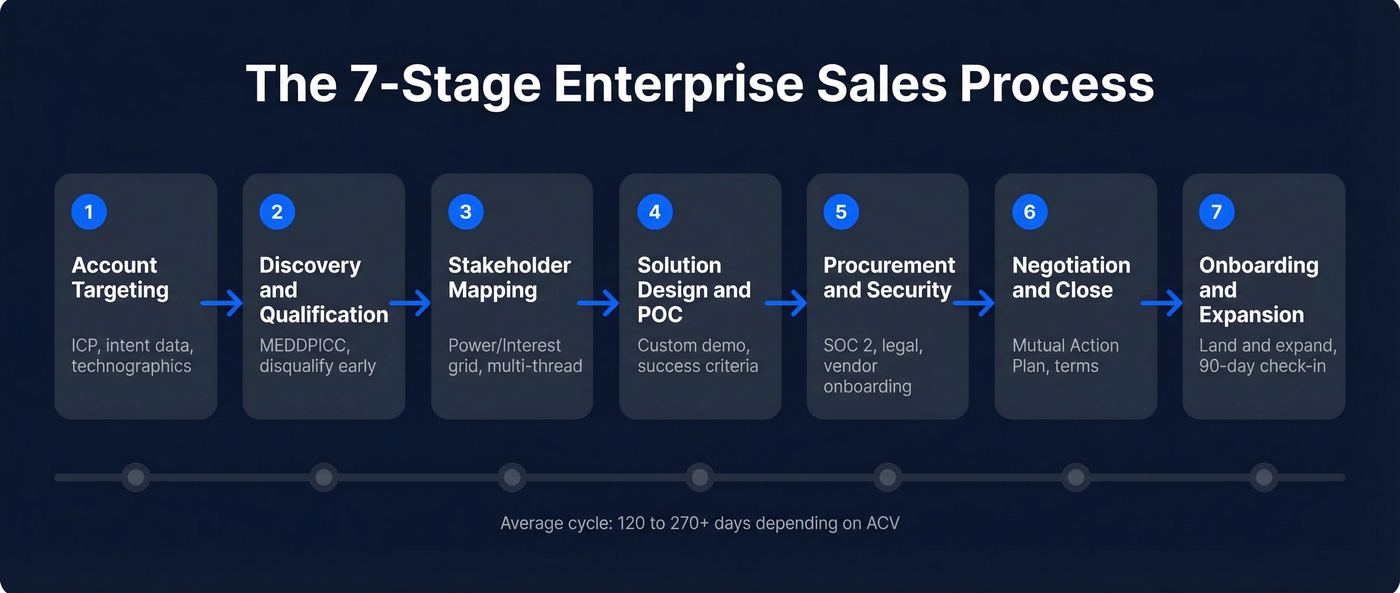
Most frameworks describe enterprise sales using the 4D model - Discovery, Diagnosis, Design, Delivery. That model collapses procurement, stakeholder mapping, and expansion into invisible sub-steps, which is exactly where deals die. The deals that close on time follow seven distinct stages. Skip one and you'll feel it three months later when procurement sends back a 47-page security questionnaire you weren't expecting.
Stage 1 - Account Targeting
Everything starts with picking the right accounts. Eighty-six percent of B2B purchases stall, and targeting the wrong accounts is the root cause more often than anyone admits.
Your ICP definition needs to go beyond firmographics. Layer in technographic signals - what tools do they already use? - intent data showing active category research, and growth indicators like headcount changes, funding rounds, and job postings. The goal isn't a longer target list. It's a shorter, higher-conviction one. We've seen teams cut their target account list by 60% and increase pipeline velocity because reps stopped wasting cycles on accounts that were never going to buy.
Stage 2 - Discovery and Qualification
The first real conversation isn't about pitching. It's about disqualifying. The best enterprise sellers use discovery to find reasons to walk away early, not reasons to stay optimistic.
This is where MEDDPICC enters the picture. Your first meeting should answer three questions: Is there a real problem with measurable impact? Is there budget or a path to budget? Can you identify the economic buyer? If you can't answer all three after two meetings, the deal probably isn't real. Strong enterprise sales development practices mean SDRs surface these signals before an AE ever takes the call, so qualification starts at the top of the funnel rather than halfway through it.
Stage 3 - Stakeholder Mapping
Enterprise deals involve 6-20 decision-makers. Engaging multiple contacts across departments yields a 37% higher likelihood of closing. Deals touching one department close at 28%. Two departments: 39%. Three or more: 44%.
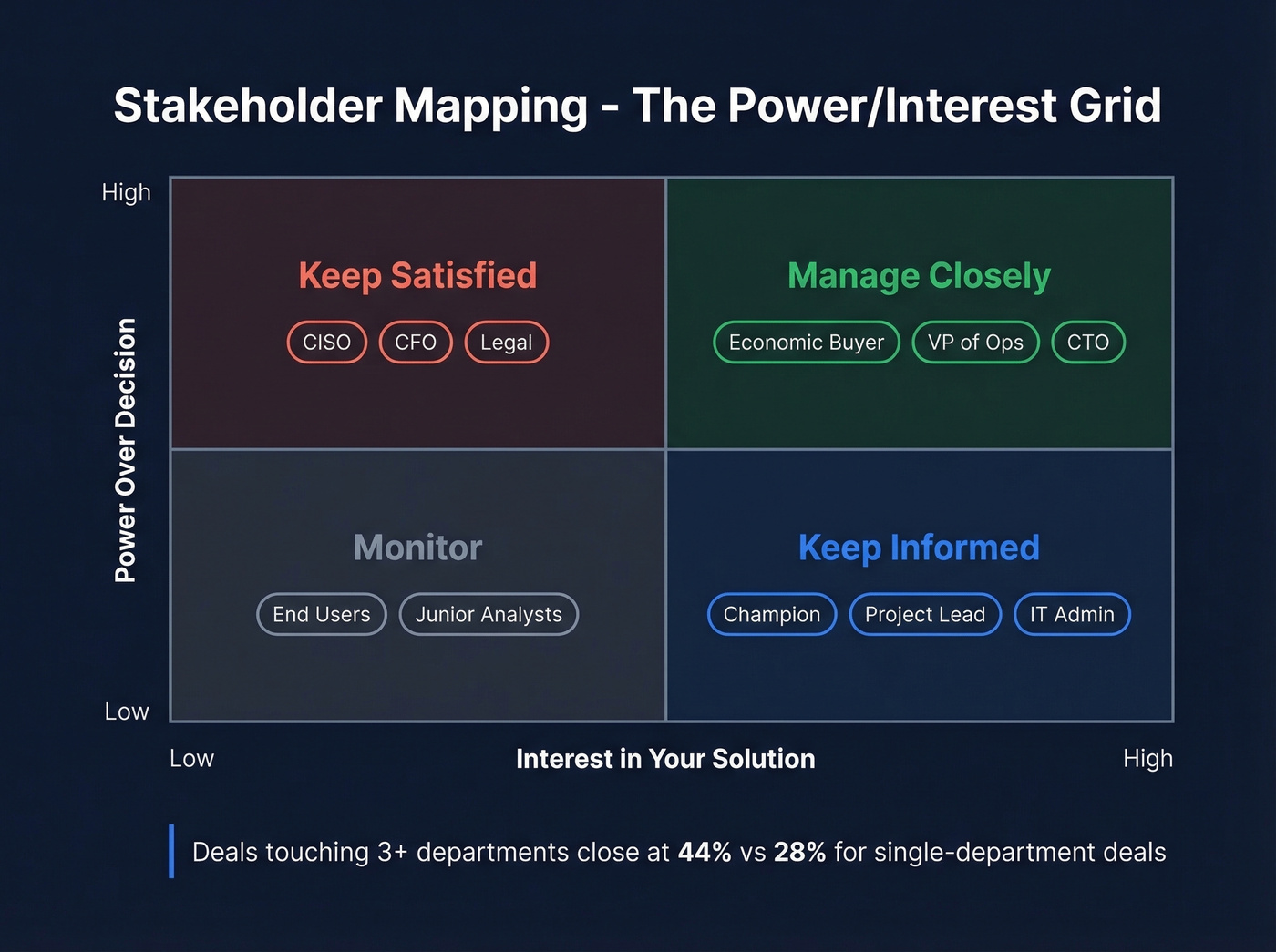
Single-threading - relying on one champion to sell internally - is the single most common reason enterprise deals die. Build relationships across the buying committee from the start. Map every stakeholder using a Power/Interest grid and identify who can block, who can champion, and who controls the budget.
Stage 4 - Solution Design and POC
Generic demos don't work at this level. You need to show the buyer's data, the buyer's workflow, and the buyer's ROI model. Treat any proof of concept as a mini-project with defined success criteria, a timeline, and an executive sponsor. The biggest risk is scope creep - a POC that drags on for months without a clear decision point.
Here's the thing: 69% of buyers report inconsistencies between what's on your website and what sellers say in meetings. Alignment between marketing, pre-sales, and AEs isn't optional - it's the difference between a POC that converts and one that quietly dies.
Stage 5 - Procurement and Security
This is the stage that kills deals - and the stage almost no sales guide covers well. Twenty-eight percent of deals fail when buyers can't secure internal approval. That's not a pipeline problem. That's a process problem.
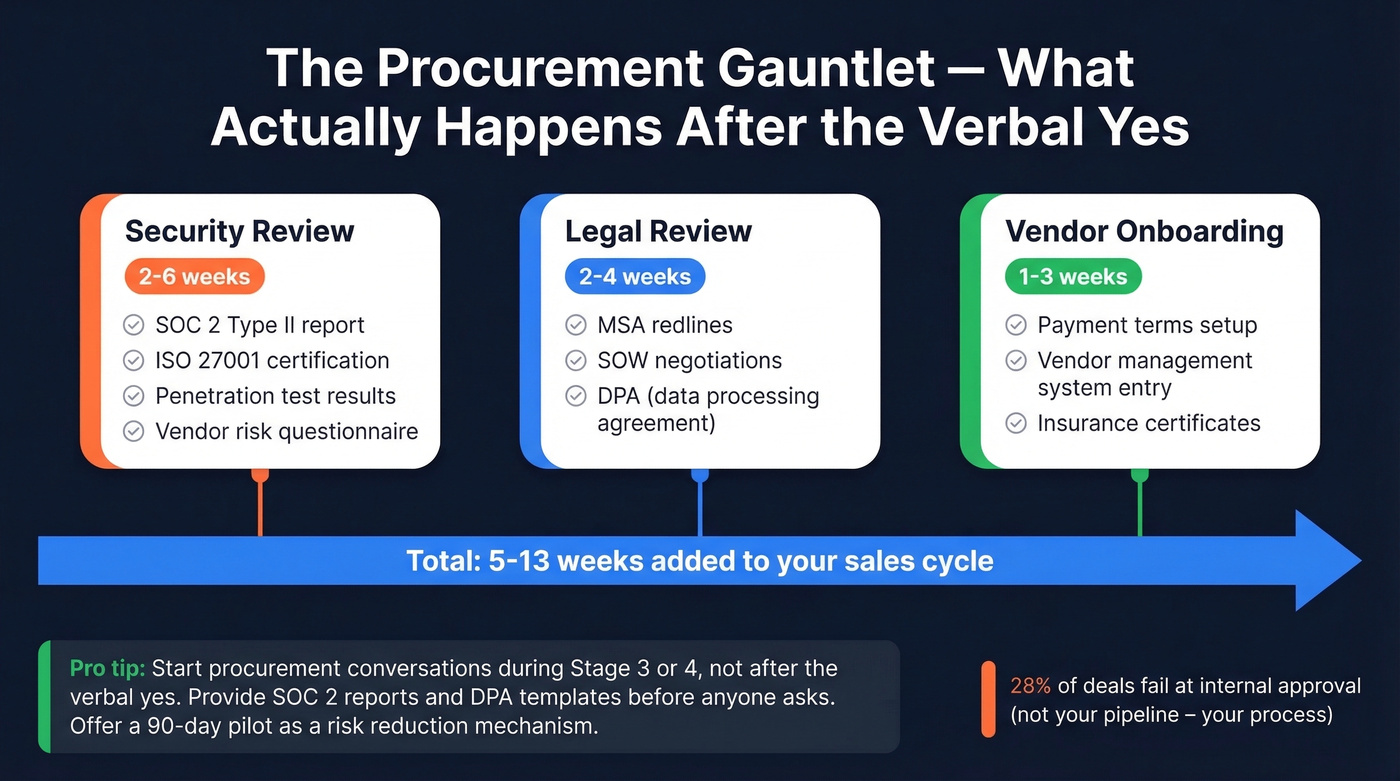
Here's what procurement actually involves:
| Review Type | What They Need | Timeline |
|---|---|---|
| Security | SOC 2 Type II, ISO 27001, pen test results, vendor risk questionnaire | 2-6 weeks |
| Legal | MSA, SOW, and DPA redlines | 2-4 weeks |
| Vendor Onboarding | Payment terms, vendor management system entry, insurance certificates | 1-3 weeks |
Half of organizations experienced at least one compliance issue in the past three years. Procurement teams aren't being difficult - they're managing real risk.
The tactical play: Engage procurement during Stage 3 or 4, not after you have a verbal "yes." Provide SOC 2 reports, DPA templates, and insurance certificates before anyone asks. Offer a 90-day pilot as a risk-reduction mechanism - it's easier for procurement to approve than a $500K annual commitment.
Stage 6 - Negotiation and Close
By this stage, the deal should be 80% done. If you're still negotiating value, something went wrong in Stages 2-4. Negotiation in enterprise sales is primarily about terms - payment schedules, SLAs, implementation timelines, and contract length.
The Mutual Action Plan is your close vehicle. It turns the final stretch from ad-hoc emails into a structured, co-owned project plan. Deals with MAPs close at a 26% higher rate. And Forrester found that 81% of buyers end up dissatisfied with the provider they chose. Differentiation matters all the way through the finish line.
Stage 7 - Onboarding and Expansion
Onboarding is a sales function, not just a customer success handoff. The land-and-expand model that drives enterprise revenue growth depends on a smooth transition from closed deal to active usage. If the first 90 days go poorly, the renewal becomes a fight.
Introduce the CS team during Stage 6, co-create an onboarding plan with the buyer's project sponsor, and set a 90-day check-in with the executive sponsor. We've watched expansion deals die because the AE disappeared after signature - don't be that team.

You can't close a 25-stakeholder deal if you're missing half the buying committee's contact data. Prospeo gives you 30+ filters - buyer intent, technographics, headcount growth, funding - to build high-conviction target account lists, then delivers 98% accurate emails and verified direct dials for every stakeholder on the map.
Stop single-threading. Reach every decision-maker in the buying committee.
Qualification Frameworks for Complex Deals
If you're using BANT for $200K+ deals, you're bringing a checklist to a chess match.
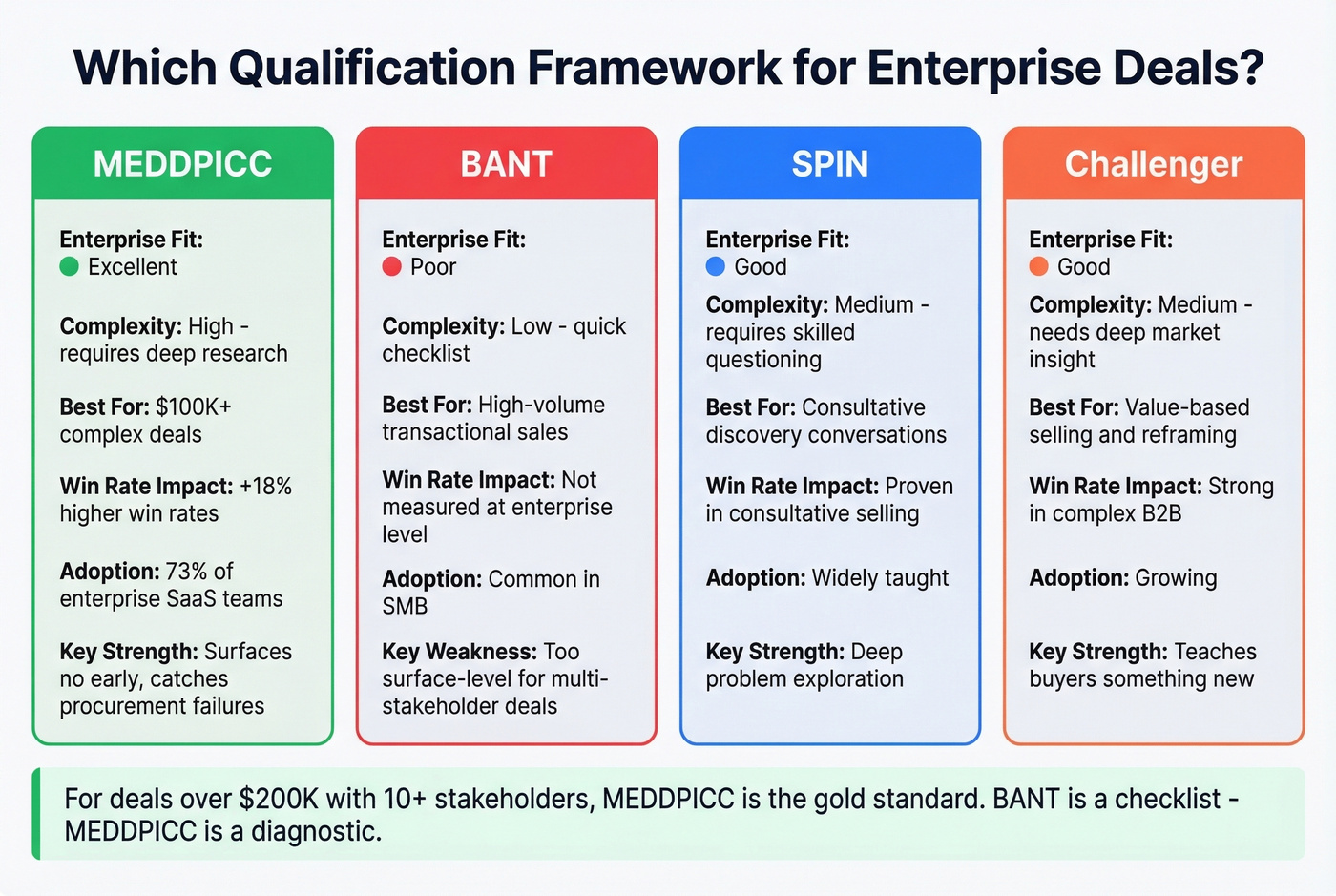
| Framework | Best For | Key Challenge | Enterprise Fit |
|---|---|---|---|
| MEDDPICC | Complex enterprise | Time-intensive research | Excellent |
| BANT | High-volume, transactional | Surface-level qualification | Poor |
| SPIN | Consultative discovery | Requires skilled questioning | Good |
| Challenger | Value-based selling | Needs deep market insight | Good |
MEDDPICC dominates enterprise sales for a reason. The framework - Metrics, Economic Buyer, Decision Criteria, Decision Process, Paper Process, Implicate the Pain, Champion, Competition - was created at PTC in 1996 and helped drive PTC's growth from $300M to $1B in four years. Today, 73% of SaaS companies selling above $100K ARR use some version of it. Organizations that fully adopt it report 18% higher win rates and 24% larger deal sizes.
The key insight: MEDDPICC is a disqualification framework. Its job isn't to help you sell - it's to surface "no" early so you stop investing months in dead deals. The "Paper Process" addition specifically catches the procurement-stage failures covered in Stage 5.
The common failure mode is reps filling in MEDDPICC fields after calls based on guesses and optimism. The CRM becomes fiction. Managers get post-mortems instead of real-time visibility. MEDDPICC only works as a living diagnostic, not a compliance checkbox.
Stakeholder Mapping Deep Dive
Single-threading is malpractice in enterprise sales. The data is unambiguous.
Forrester puts the average B2B purchase at 13 stakeholders. Gartner research says complex buying groups include 6-10 decision-makers, each bringing 4-5 pieces of independent research. Outreach found that 74% of buyer teams show unhealthy conflict during the decision process. You're not just selling to a committee - you're selling to a committee that can't agree with itself.
Here's the 10-role taxonomy you should map for every enterprise deal:
- Project Sponsor - owns the initiative internally
- Champion - actively sells on your behalf
- Executive Sponsor - provides air cover and budget authority
- Financial Approver - signs off on spend
- Technical Buyer - evaluates architecture and integration
- Ops/Process Owner - cares about workflow impact
- Business User - the end user who lives with the product daily
- Legal Reviewer - redlines contracts and assesses risk
- Influencer - shapes opinions without formal authority
- Final Authority - the last signature
Not every deal has all ten. But every deal has more than the three you've identified. Use a Power/Interest grid to plot each stakeholder's influence against their engagement level. The quadrant that matters most: high power, low interest. Those are the people who can kill your deal without ever attending a meeting.
Mutual Action Plans
A Mutual Action Plan is a co-created roadmap between seller and buyer that defines every step from "we agree this is worth pursuing" to "we're live." It includes milestones, owners, deliverables, and due dates.
Deals where AEs use MAPs have a 26% higher win rate than those without. Yet only 45% of sellers consistently use them. We've seen MAPs cut late-stage slippage by weeks - they turn a vague "we're working through internal approvals" into a project with deadlines and accountability.
Introduce the MAP after Stage 3 and before Stage 5. Here's the template:
| Objective | Milestone | Owner | Deliverables | Due Date |
|---|---|---|---|---|
| Technical validation | POC kickoff | Buyer IT + Seller SE | Test environment, data set | Week 2 |
| Security approval | Vendor risk review | Buyer InfoSec | SOC 2, pen test, DPA | Week 4 |
| Legal sign-off | MSA redlines | Buyer Legal + Seller Legal | Final MSA | Week 6 |
| Go-live | Onboarding | Joint team | Training, config | Week 8 |
Define success metrics for each milestone separately. POC passes if latency stays under 2 seconds. Security passes when the vendor risk assessment clears. Go-live succeeds at 80% user adoption within 30 days.
Five Mistakes That Kill Enterprise Deals
Fake Urgency with Committees
Fake scarcity doesn't work when 13 people need to agree. "This pricing expires Friday" erodes trust with buying committees that have seen every trick. One sales leader reported increasing win rates by 20% over two quarters simply by replacing urgency-based CTAs with data-backed proposals and tailored value maps. Let the business case create urgency - don't manufacture it.
Single-Threading
Twenty-eight percent close rate with one department. If your champion leaves, your deal dies. The fix isn't complicated - it's just uncomfortable. Ask your champion to introduce you to their peers in other departments. Most reps avoid this because it feels pushy. It's not. It's professional.
Ignoring Procurement
Twenty-eight percent of deals fail when buyers can't secure internal approval. The mistake isn't that procurement is hard - it's that sellers treat it as a surprise instead of a stage. Ask in your second or third meeting: "What does your vendor approval process look like?" Then build those timelines into your MAP.
Prospecting with Bad Data
Enterprise deals involve 13+ stakeholders. If your data provider hasn't refreshed records in six weeks, you're emailing people who've changed roles and calling numbers that ring out. When your sales cycle stretches past six months, the first touchpoint can't be a bounce - tools like Prospeo's Email Finder run on a 7-day refresh cycle with 98% email accuracy across 300M+ profiles, which is the kind of freshness enterprise multi-threading demands.
The proof is in the numbers. Snyk's team of 50 AEs saw bounce rates drop from 35-40% to under 5% after switching their data source, with AE-sourced pipeline up 180% and 200+ new opportunities per month. Bad data doesn't just waste time - it poisons your domain reputation and makes every subsequent email less likely to land.
Treating Enterprise Like a Volume Game
Reps spend 70% of their time on non-selling tasks. In enterprise sales, that ratio gets worse without a process. The temptation is to compensate with more emails, more calls, more demos.
Look - this isn't a volume game. It's a depth game. Every hour spent on a poorly qualified deal is an hour stolen from the deal that could actually close. If your average contract value sits below $50K, you probably don't need a seven-stage process. Run a tighter three-stage cycle and save the complexity for deals that justify it. But if you're selling six figures and above, skipping stages isn't efficiency - it's negligence.
Configuring Your CRM for Enterprise Workflows
The three tools that matter most are a CRM, a sales engagement platform, and a verified data source. Everything else is optional until you've nailed those three. For teams under 10 reps, start with just CRM and data - add engagement tooling when sequencing volume justifies the cost.
Map each of the seven stages to a distinct pipeline phase with mandatory fields that enforce MEDDPICC completion. Without this, reps skip stages and managers lose visibility - which is how deals slip without warning. The enterprise account executive workflow should mirror the stages above, with each phase triggering specific tasks, required stakeholder documentation, and exit criteria before a deal can advance.
| Category | Tool | Starting Price | Why It Matters |
|---|---|---|---|
| CRM | HubSpot / Salesforce | HubSpot: $0+; Salesforce: ~$25-$330/user/mo | Deal tracking, forecasting |
| Sales Engagement | Outreach | ~$100-$150/user/mo | Sequence execution, MAPs |
| Conversation Intel | Gong | ~$100-$150/user/mo | Call coaching, deal risk |
| CPQ / Proposals | PandaDoc | Free-~$35/user/mo | Proposal speed, e-sign |
| B2B Data | Prospeo | Free-~$39/mo+ | Verified contacts, intent |
HubSpot's free CRM tier is genuinely useful for early-stage teams - don't pay for Salesforce until your deal volume and reporting needs demand it. Skip Gong entirely if your team is under five reps; the ROI doesn't justify the spend at that scale.

Enterprise cycles already run 120-270 days. Bad data makes them longer. Prospeo's 7-day refresh cycle means you're never emailing someone who changed roles six weeks ago - and 125M+ verified mobiles with a 30% pickup rate give your reps a direct line past gatekeepers to economic buyers.
Shorten your sales cycle with data that's never more than 7 days old.
FAQ
What are the stages of the enterprise sales process?
A complete enterprise sales process has seven stages: account targeting, discovery and qualification, stakeholder mapping, solution design and POC, procurement and security review, negotiation and close, and onboarding and expansion. Most guides compress this into four stages, which is why deals stall in procurement - it was never treated as its own phase.
How long is a typical enterprise sales cycle?
Enterprise sales cycles run 120-270 days depending on annual contract value. Deals in the $100K-$250K range average 170 days; deals above $500K average 270 days. Company size and industry add further variation - selling to a 10,000+ employee organization in energy or manufacturing pushes toward the longer end.
What is MEDDPICC and why does it matter?
MEDDPICC stands for Metrics, Economic Buyer, Decision Criteria, Decision Process, Paper Process, Implicate the Pain, Champion, Competition. Used by 73% of SaaS companies selling above $100K ARR, it's primarily a disqualification framework - surfacing "no" early so reps stop investing months in dead deals. Organizations that fully adopt it report 18% higher win rates.
Why do enterprise deals stall in procurement?
Procurement requires security reviews (SOC 2, ISO 27001), legal redlines on MSAs and DPAs, vendor risk assessments, and multi-team approvals. Twenty-eight percent of deals fail at this stage. Sellers who engage procurement early - during discovery, not after verbal agreement - and provide clean documentation proactively avoid the late-stage stalls that push deals into the next quarter.
How do you build an enterprise prospect list with clean data?
Start with a tight ICP definition layering firmographics, technographics, and intent signals. Then use a B2B data platform with verified emails and direct dials refreshed frequently - stale data is the fastest way to burn your domain reputation when you're multi-threading across a 13-person buying committee over a months-long cycle. Filtering by buyer intent, headcount growth, and job changes helps you prioritize accounts that are actually in-market rather than spraying outreach at everyone who fits a firmographic profile.