

How to Find New Business Listings Before Your Competitors Do
Nearly half a million new business applications were filed in the US last month - 496,443 in February 2026, according to the Census Bureau. A huge chunk of those are potential customers actively setting things up and making buying decisions early. The teams that find new business listings first win the deal. The teams that arrive second get ignored.
The problem isn't that new business data doesn't exist. It's scattered across 50 state registries, Google Maps, and list brokers - and none of those sources give you a verified email you can actually send to. We've spent months testing every method below, and here's what actually works.
What You Need (Quick Version)
Three methods, ranked by cost:
- Free + best raw data: Secretary of State databases. Every state has one. You'll get entity names, formation dates, and registered agents.
- Free + fastest for local leads: Google Maps monitoring with tools like Outscraper or Botster. Phone numbers, websites, and addresses without manual searching.
Five Ways to Find Newly Registered Businesses
Search State Government Registries (Free)
Every state requires businesses to register with the Secretary of State's office or an equivalent agency, per the SBA's own guidance. That means new LLCs, corporations, and partnerships show up in a searchable public database.
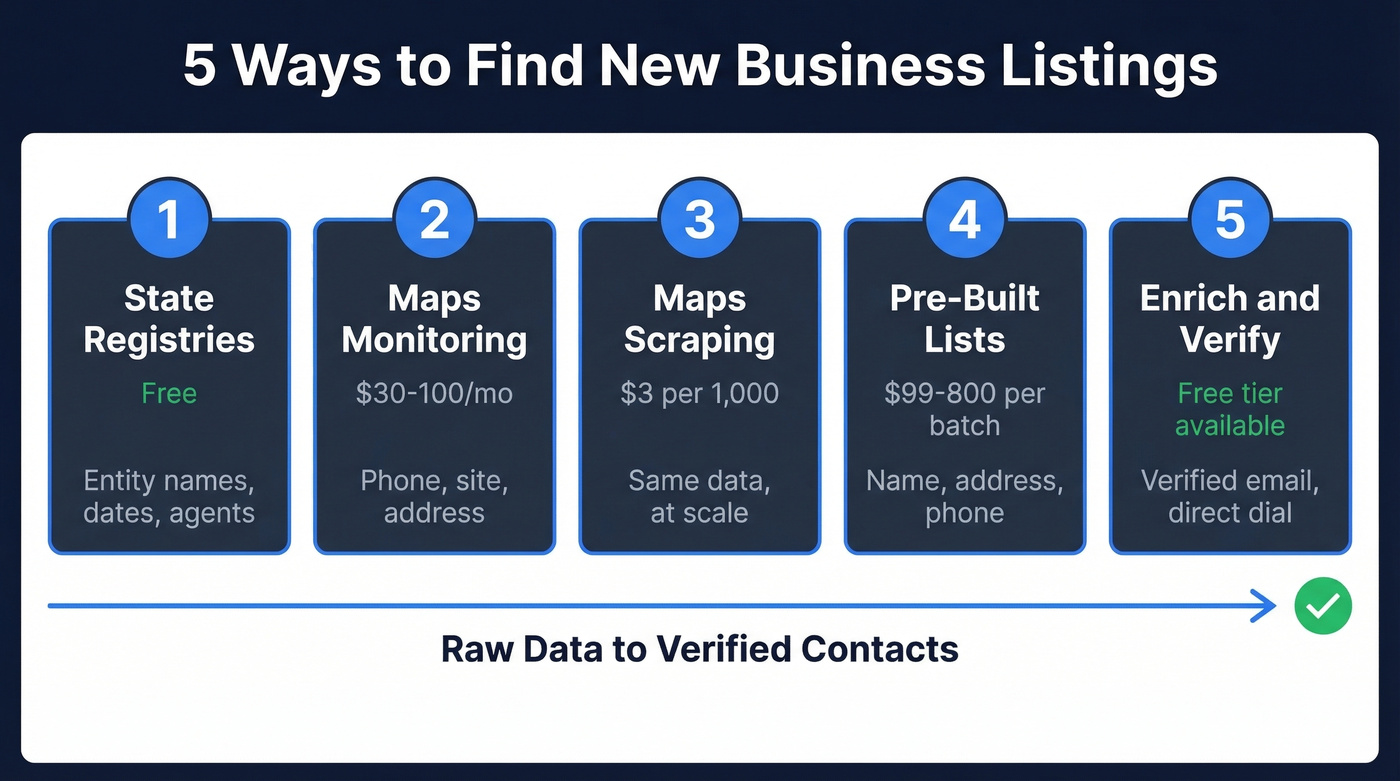
Go to your target state's business entity search portal. LLC University maintains a directory covering all 50 states plus DC and Puerto Rico. Use formation/filing date filters where available to isolate recent filings. You'll typically get entity names, registered agents, and filing dates - but not much else.
Take New York: the NY Department of State lets you search its Corporation and Business Entity Database directly. As of January 2026, NY also requires Beneficial Owner Disclosure for non-exempt LLCs formed under foreign country law that are authorized to do business in New York, a sign that state filing requirements keep evolving and the data available is getting richer over time.
Beyond SOS databases, some industries maintain their own registries. State contractor licensing boards, healthcare provider directories, and bar associations all publish new registrations - and most teams never think to check them.
The catch: bulk CSV downloads vary wildly by state. Some offer them, many require manual extraction. And if you're searching New Hampshire, skip Chrome - their portal works better in Firefox or Edge.
Monitor Google Maps for New Listings
Google Maps holds data on over 200 million businesses and places worldwide. When a new business creates its profile, it shows up here - often before it appears anywhere else.
Botster offers a scheduling feature called "Deliver new items only" that runs your saved search on a recurring basis and returns only listings that weren't there last time. Set it to run weekly for your target geography and industry, and you've got a passive lead pipeline. Botster pricing varies by usage, but expect $30-$100/month for regular scheduled runs.
One useful tactic: sort results by vote count. Fewer votes typically means newer or less-known businesses. Google Maps often shows around 40 results per search query, so run multiple variations - "plumber Austin" and "plumbing contractor Austin TX" - to avoid missing listings.
Scrape Google Maps at Scale
Manual monitoring eats time. That's exactly why the scraping approach exists.
Outscraper is the most straightforward option - free for your first 500 businesses, then $3 per 1,000 records. No monthly fees, pure pay-as-you-go. Outscraper also offers email scraping at $3/1K domains and phone lookup at $5/1K numbers, but those are separate add-ons, not bundled.
For the DIY crowd, one Reddit poster built an automation stack using n8n plus a scraping browser that pulls 500+ leads per week at roughly $10-15/month in operating costs. The key constraint is that Google Maps often shows about 40 results per search, so the system generates dozens of query variations automatically to maximize coverage. If you're comfortable with no-code automation tools, this approach is surprisingly cheap - though it takes a weekend to set up properly.
Buy a Pre-Built List
If you need leads today and don't want to build anything, pre-built lists are the fastest path. LeadsPlease sells business mailing lists starting at $99.75 for 500 records, scaling down to $800 for 10,000 records (8 cents each at volume).
Use this if: you need a one-time batch of leads for a direct mail campaign or cold call blitz and don't want to touch a scraping tool.
Skip this if: you're building an ongoing pipeline. LeadsPlease advertises 90%+ accuracy when used within 30 days of placing the order, and like any purchased list, the data degrades fast. Plan to verify and clean it before outreach.
Enrich and Verify Contacts
Here's the thing: every method above gives you a business name and maybe a phone number. None of them reliably give you the owner's verified email address. This enrichment step is where most teams drop the ball - and where the real competitive advantage lives.
Take the company name or domain you pulled from a state registry or Google Maps, search it in Prospeo, and you'll get the owner's verified email and direct dial. The platform runs a 5-step verification process that delivers 98% email accuracy, with data refreshed every 7 days so you're not emailing addresses that went stale last quarter. The free tier covers 75 email lookups and 100 Chrome extension credits per month - enough to validate your workflow before you spend a dollar.

State registries and Google Maps give you business names. Prospeo gives you the owner's verified email and direct dial. Paste any company name or domain and get 98%-accurate contact data refreshed every 7 days - not last quarter's stale records.
Start with 75 free email lookups. No credit card required.
Methods Compared
| Method | Cost | Data You Get | Freshness | Effort |
|---|---|---|---|---|
| State registries | Free | Name, date, agent | Varies by state | Moderate |
| Maps monitoring | $30-100/mo | Phone, site, address | Near real-time | Low |
| Maps scraping | Pay-as-you-go ($3/1,000 after first 500 free) | Same, at scale | Near real-time | Low |
| Pre-built list | $99.75-$800 per order (500-10,000 records) | Name, address, phone | Degrades over time | Very low |
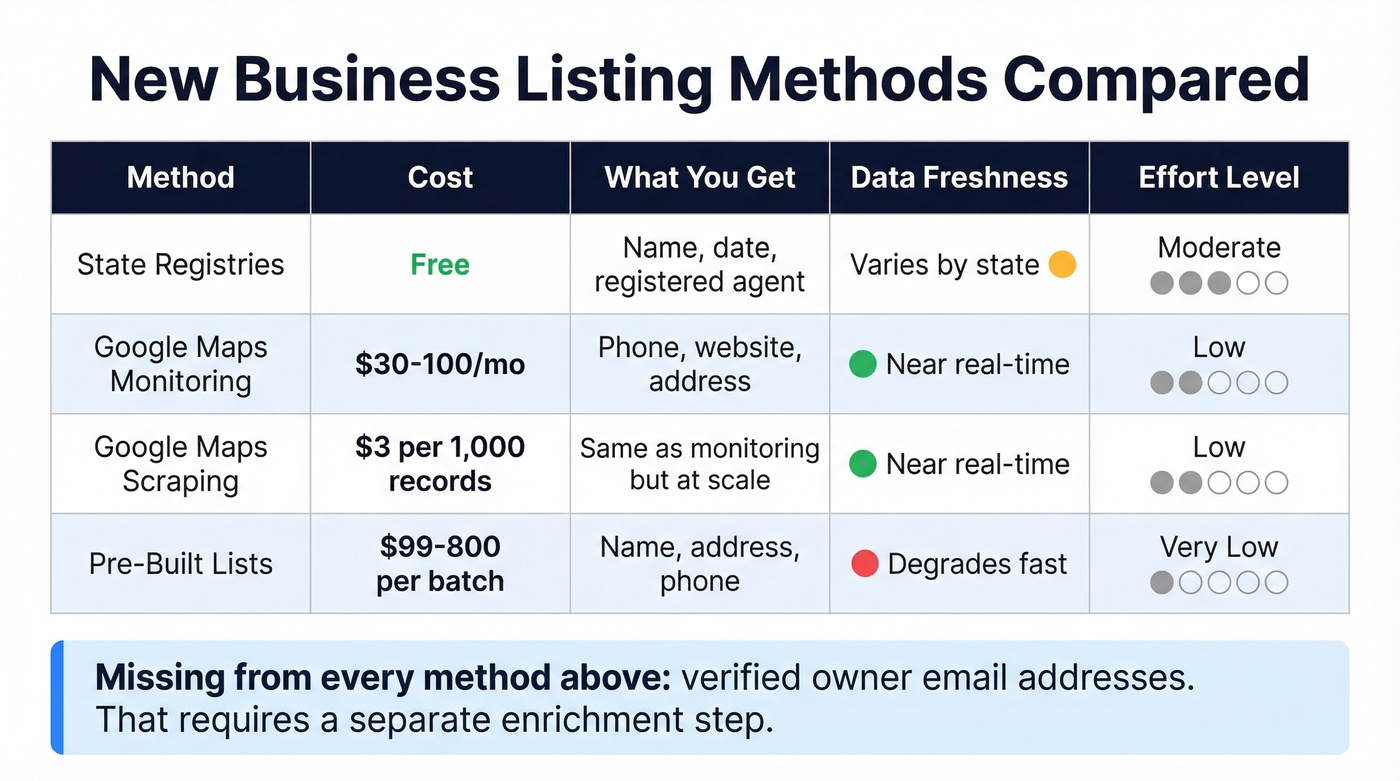
For most teams, the winning stack is state registries for raw filings, Google Maps scraping for local leads, and Prospeo for verified contact data.
The Step Most People Skip
Let's be honest about what happens when you skip verification. You've scraped 2,000 new listings from Google Maps. You load them into your sequencer and hit send. Half the emails bounce. Your sender reputation tanks. Now your emails to real prospects land in spam too.
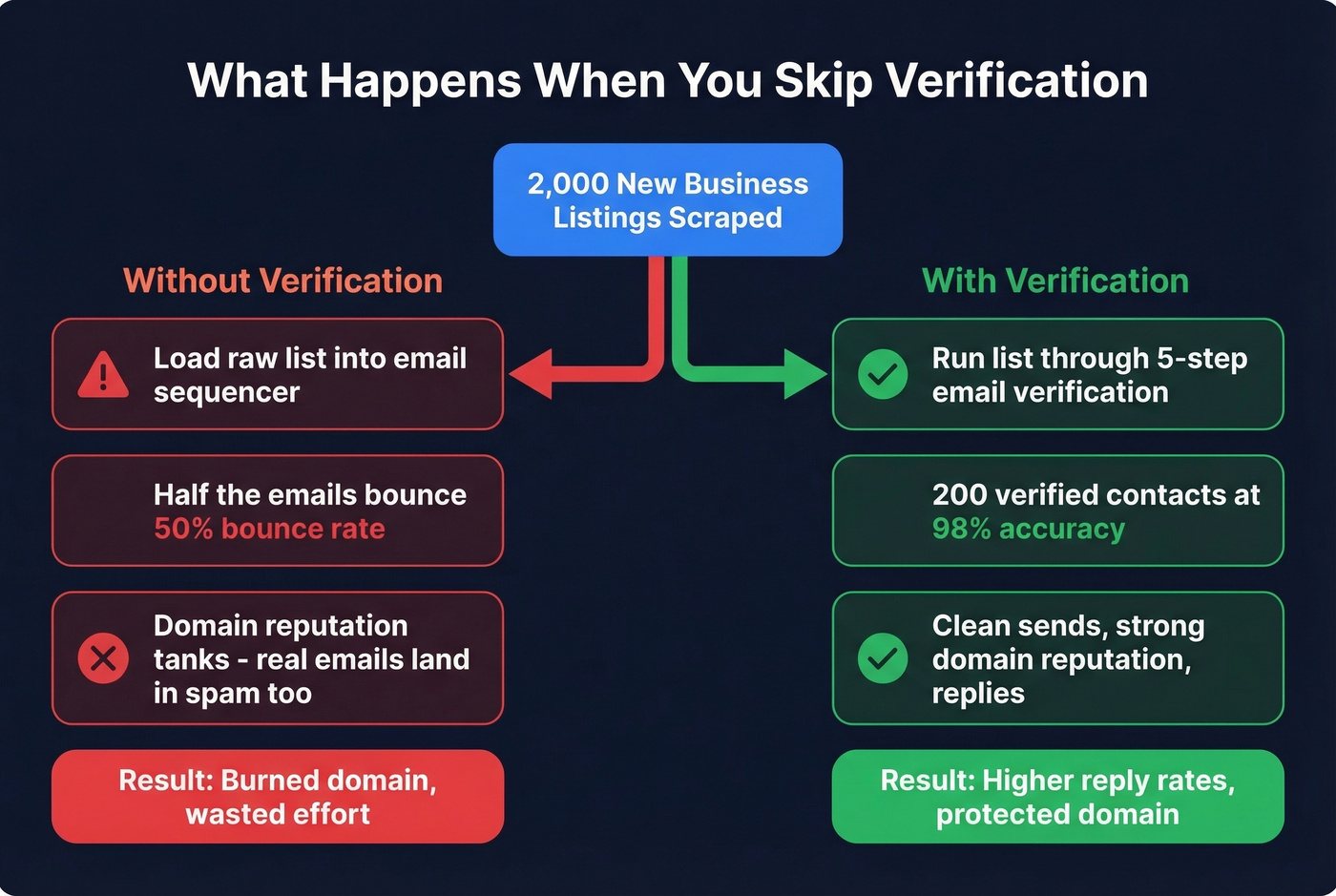
We've seen this play out dozens of times. Raw listings from any source - state registries, Google Maps, purchased lists - aren't outreach-ready. They're starting points. Run your list through a verification tool before you send a single email. At 98% accuracy, Prospeo's 5-step verification catches invalid addresses, spam traps, and honeypots that would otherwise torch your deliverability. You're protecting the asset that matters most: your sending domain.
A list of 200 verified contacts will outperform a list of 2,000 unverified ones every single time. Stop optimizing for volume and start optimizing for accuracy.
Sending cold outreach to unverified new business listings is how domains end up in spam. Prospeo's 5-step verification catches bad addresses, spam traps, and catch-all domains before they torch your sender reputation - at roughly $0.01 per email.
Stop guessing. Verify every new listing before you hit send.
FAQ
What information do state business registries include?
Secretary of State databases publish entity names, formation dates, registered agents, and entity types. Some states include officer names and business addresses. You won't get email addresses or phone numbers from these filings - that requires a separate enrichment step using a B2B data platform.
How many new businesses register in the US each month?
The Census Bureau reported 496,443 business applications in February 2026. About 28,994 of those are projected to become active businesses within four quarters - but even the ones that don't fully launch still need vendors during their formation phase.
How do I get email addresses for new business owners?
Government registries and Google Maps rarely include owner emails. Use a B2B data platform to search the company name or domain and pull verified contact info. Prospeo's free tier covers 75 lookups per month at 98% accuracy - enough to test the workflow before committing a dollar.