

The Data-Backed Follow-Up Cadence Guide (With Copy-Paste Templates)
An SDR launches a 12-touch sequence on Monday morning. By Wednesday, 8% of emails have bounced, Gmail starts throttling sends, and the remaining touches land in promotions - or worse, spam. The follow-up cadence was fine. The data underneath it wasn't.
Deals closed within 50 days carry a 47% win rate. Past that window, win rates drop below 20%. Your sales follow-up cadence is the mechanism that keeps deals inside that window - or lets them drift past it.
The Short Version
Most replies come from the first 1-3 touches. After 4+ emails, unsubscribe and spam complaint rates more than triple. Keep sequences tight.
Inbound and outbound need completely different cadences. Inbound: respond in minutes. Outbound: 8-12 touches across 2-3 weeks. And your cadence is only as good as your data - if 30% of your emails bounce, your sender reputation collapses and every touch lands in spam.
What Is a Follow-Up Cadence?
A follow-up cadence is a pre-planned sequence of multi-channel touches - email, phone, social, video - spaced at specific intervals with branching rules that adapt based on prospect behavior. It's not the same as an "email sequence," which is single-channel and linear.
A real sales cadence includes timing logic, channel switching, and stop rules that prevent you from burning contacts. Think of it as the operating system for your outreach, not just a drip campaign with a fancier name.
How Many Touches Do You Need?
Here's where the data gets contradictory, and most guides just cherry-pick the stat that supports their argument.
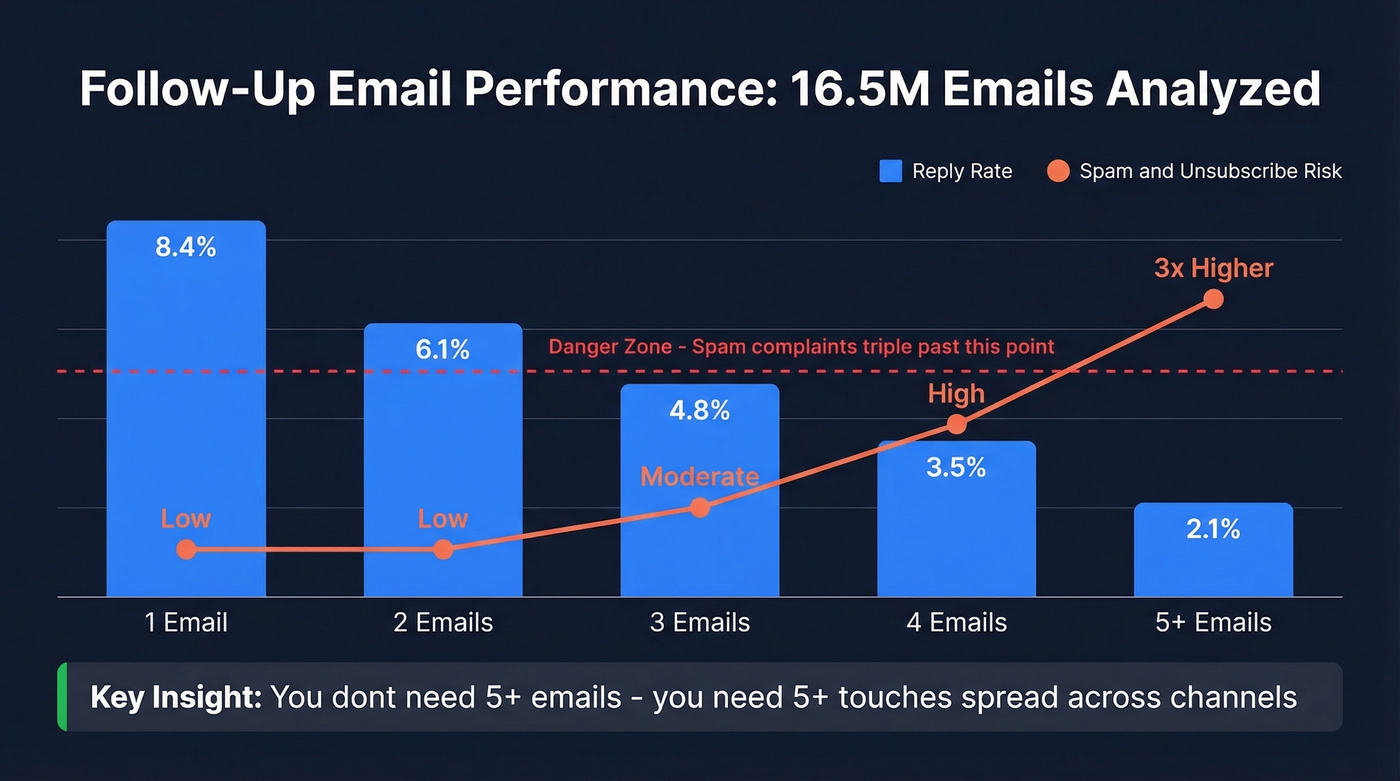
A Belkins study of 16.5M cold emails across 93 business domains found the highest reply rate comes from a single email: 8.4%, with a 45.37% open rate. Performance declines with each follow-up - going from 1 to 5+ emails cuts reply rate by more than half, and 4+ emails more than triples unsubscribe and spam complaint rates.
Other benchmarks push the opposite direction: 57% of conversions happen after the third email, and 80% of successful sales require 5+ follow-ups.
The resolution is channel mix. You don't need 5+ emails - you need 5+ touches spread across channels. The number of outreach attempts matters less than how you distribute them. Company size matters too: SMBs tolerate more follow-ups, while enterprise prospects ghost quickly and punish persistence.

You just read it: 8% bounce rates collapse sender reputation and kill every touch that follows. Prospeo's 5-step email verification delivers 98% accuracy - so your cadence actually reaches the inbox. At $0.01 per email, bad data isn't a budget problem. It's a choice.
Stop building cadences on data that bounces.
Inbound vs. Outbound Cadences
Inbound: Speed Wins Everything
77% of customers expect to interact with someone immediately when they contact a company. In a test of 433 companies, only 7% responded within 5 minutes - and over 50% didn't respond within 5 business days. That's staggering.
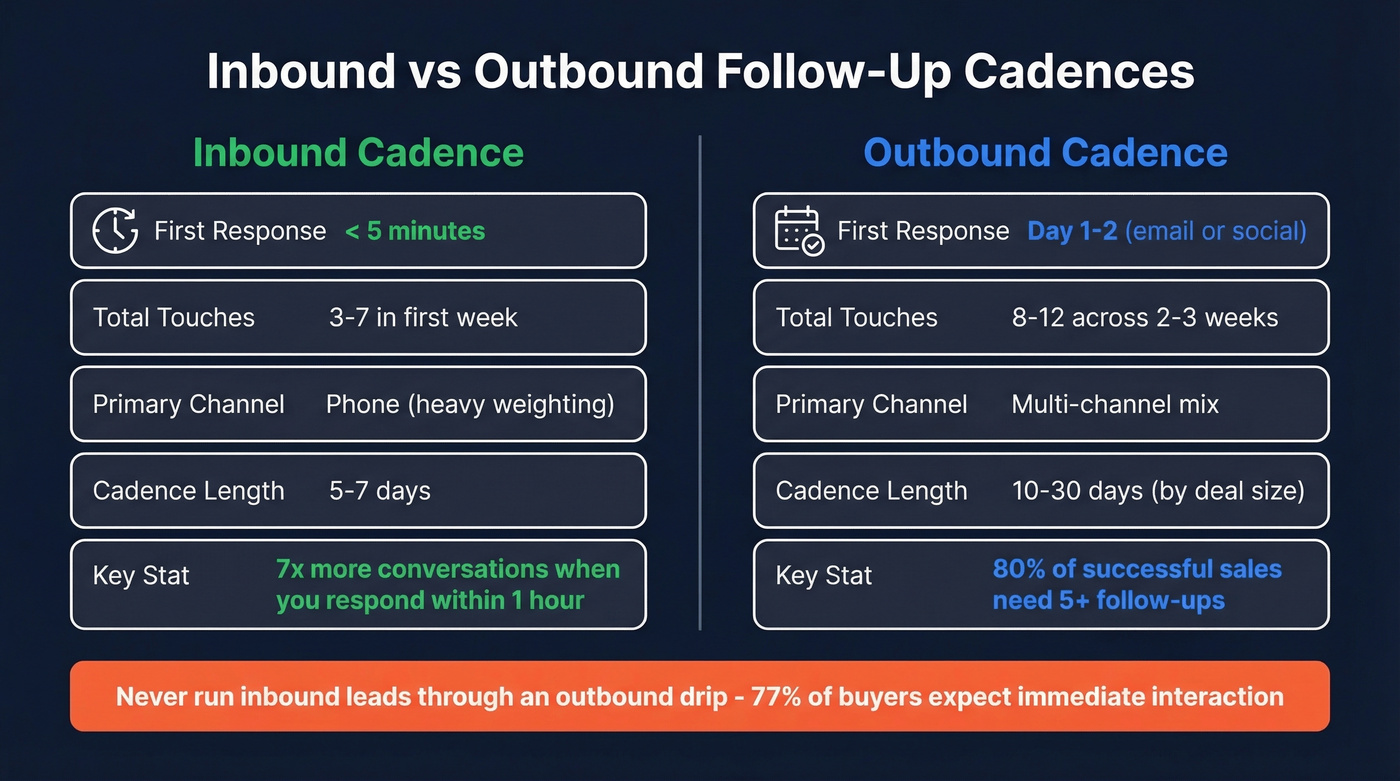
Build your inbound cadence around a first response within 5 minutes, 3-7 touches in the first week, and heavy phone weighting. Contacting inbound leads within 1 hour makes you 7x more likely to have meaningful conversations with decision makers.
Outbound: Patience With Structure
Outbound cadences build trust from a cold start, which means the touches required are higher. Plan 8-12 touches over 2-3 weeks, mixing email, phone, social, and video. Enterprise deals stretch to 12-18 touches across 21-30 days. Every touch needs to earn the next one - these prospects didn't ask to hear from you.
Copy-Paste Cadence Templates
We've tested variations of these across our own outreach and refined them based on what we've seen work for teams using Prospeo data. They're starting points, not gospel.
10-Day Sprint (SMB / Transactional)
Best for deals under $50K with a single decision-maker.
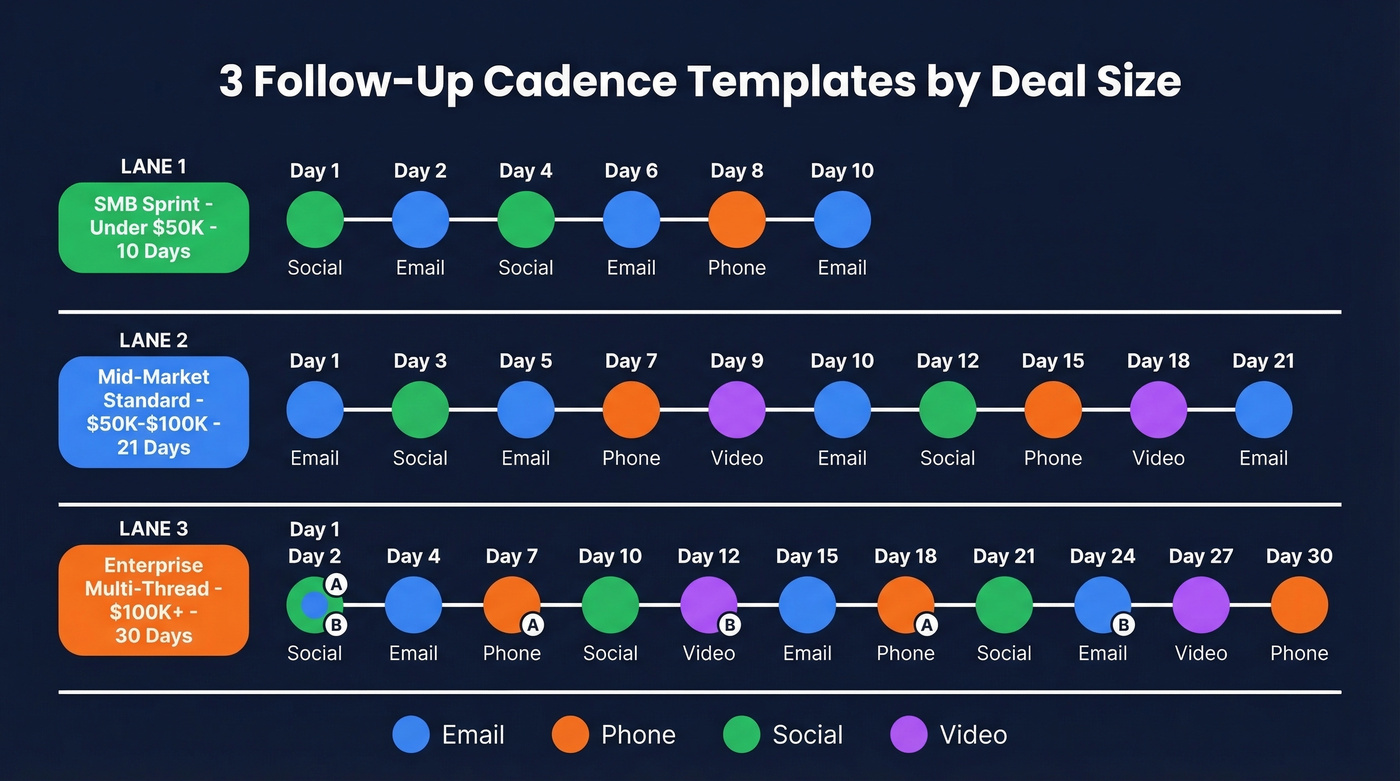
| Day | Channel | Action |
|---|---|---|
| 1 | Social | Connect request + note |
| 2 | Personalized intro email | |
| 4 | Social | DM with value add |
| 6 | Follow-up with case study | |
| 8 | Phone | Call + voicemail |
| 10 | Breakup email |
If you're already doing social touches, try swapping one DM for a 60-second personalized video. It breaks the pattern and signals real effort.
21-Day Standard (Mid-Market)
Best for $50K-$100K deals with 2-3 stakeholders.
| Day | Channel | Action |
|---|---|---|
| 1 | Personalized intro | |
| 3 | Social | Connect + engage content |
| 5 | Phone | Call attempt #1 |
| 7 | Follow-up (new angle) | |
| 9 | Video | Personalized video message |
| 10 | Phone | Call attempt #2 + VM |
| 12 | Case study / social proof | |
| 15 | Phone | Call attempt #3 |
| 18 | Re-engage with insight | |
| 21 | Breakup email |
What makes this work: the channel switch on Day 9. By that point, email-only fatigue has set in. A short video breaks the pattern and signals effort that a templated email never will.
30-Day Enterprise
Best for $100K+ deals with 6.3 stakeholders on average. Multi-thread across 2+ contacts per account.
| Day | Channel | Action |
|---|---|---|
| 1 | Exec-level intro (Contact A) | |
| 2 | Social | Connect Contact A + B |
| 4 | Phone | Call Contact A |
| 7 | Intro to Contact B | |
| 10 | Phone | Call Contact B |
| 12 | Industry insight (both) | |
| 15 | Phone | Call Contact A |
| 18 | Case study (Contact A) | |
| 21 | Video | Personalized video (Contact B) |
| 24 | Phone | Call both contacts |
| 27 | ROI data (both) | |
| 30 | Breakup (both contacts) |
Multi-threading is the whole game at enterprise. If Contact A goes dark, Contact B keeps the deal alive. The consensus on r/sales backs this up - single-threaded enterprise deals die quietly.
Branching rules for all templates: Pause on any reply. "Not now" means snooze 60-90 days. Opt-out means suppress immediately. Never continue a cadence after a hard no.
On post-sale cadences: These templates cover pre-sale outreach. Post-sale sequences for onboarding, renewal, and expansion follow different rules - shorter intervals, warmer tone, and success-metric triggers instead of engagement triggers. That's a different article entirely.
Timeline and Channel Mix
Email should make up 40-50% of touches. Best windows: Monday afternoons and Thursday mornings.
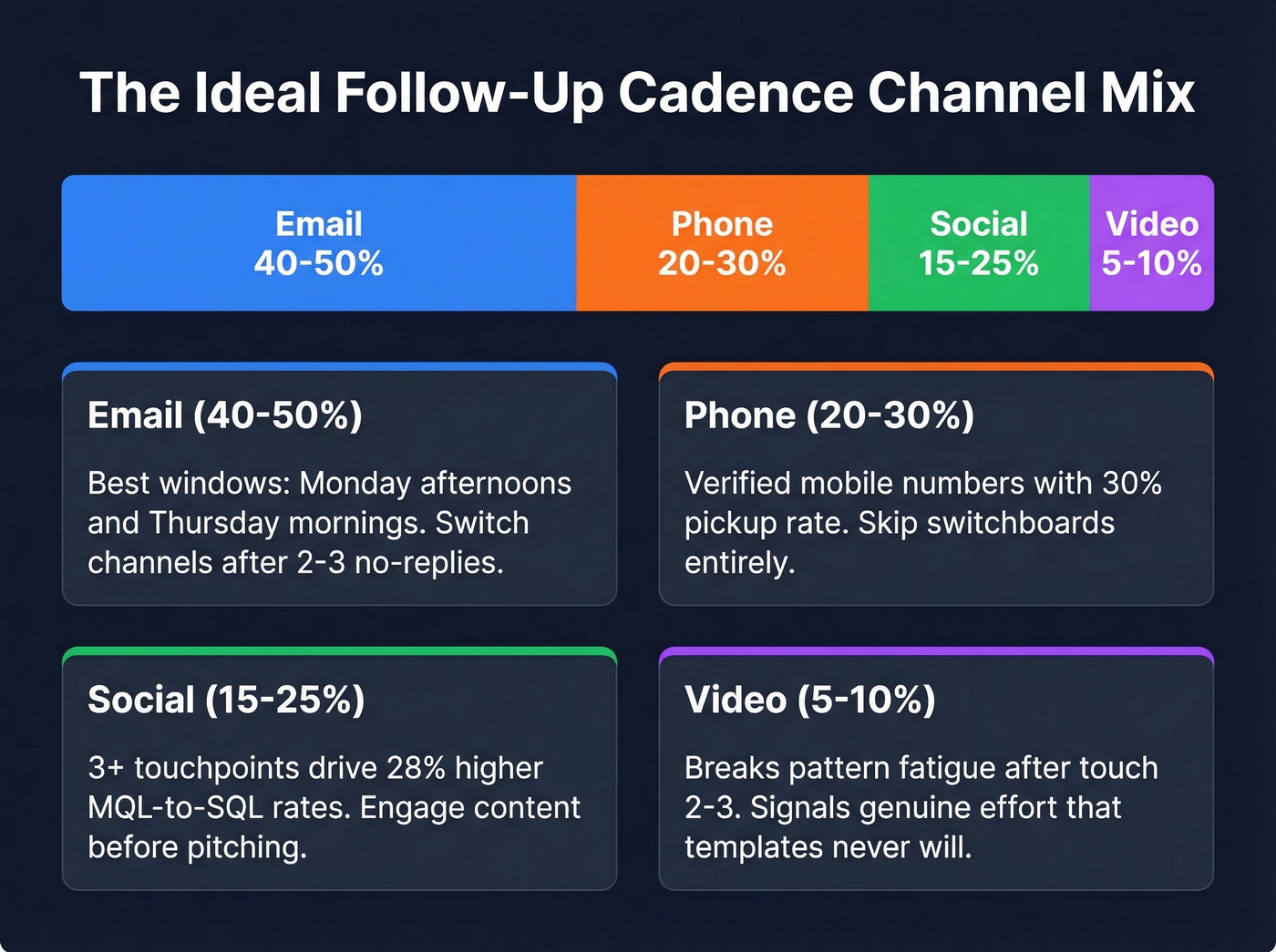
Phone accounts for 20-30% of touches. Timing matters less than reaching the right number - verified mobile numbers with a 30% pickup rate are critical when phone touches make or break your cadence. Skip this if your team doesn't have direct dials; calling switchboards in 2026 is a waste of everyone's time.
Social fills 15-25% of touches. SDRs using 3+ touchpoints see 28% higher MQL-to-SQL rates.
Video rounds out the remaining 5-10%. Personalized video messages break pattern fatigue and signal genuine effort. If you get no response after touch 2-3 on one channel, switch.
For execution tools: Outreach (~$50-150/user/mo) and Salesloft (~$75-200/user/mo) handle enterprise cadences well. HubSpot works for teams that want sequences inside their CRM. Mailshake is a solid lightweight option for SMBs.
Let's be honest: if your average deal size is under $25K, you probably don't need Outreach or Salesloft. HubSpot plus clean data will outperform a $150/seat platform running on a garbage contact list every single time.
Mistakes That Tank Your Pipeline
Too Many Emails, No Channel Switch
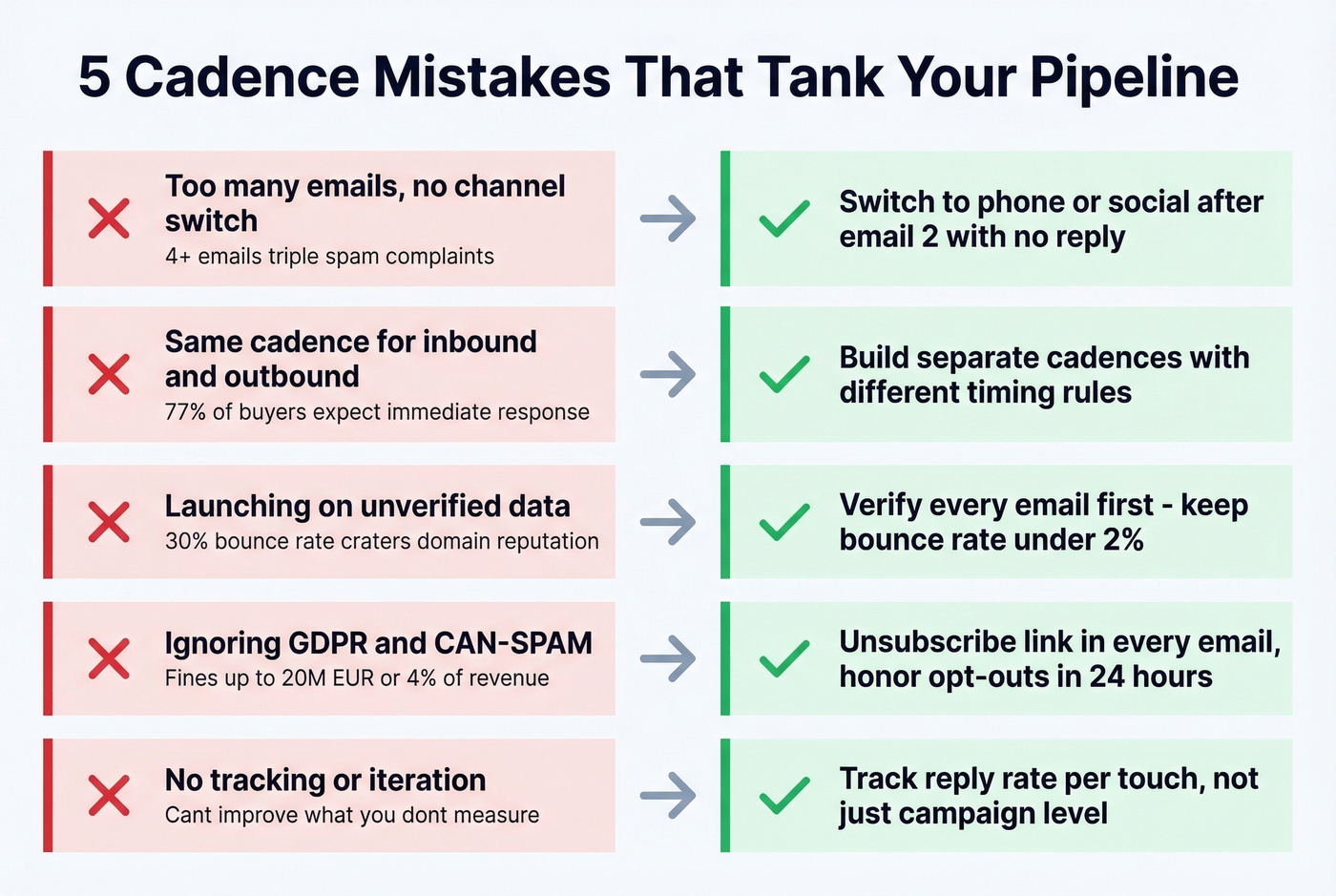
The Belkins data is unambiguous: 4+ emails more than triple unsubscribe and spam complaint rates. After email #2 with no response, move to phone, video, or social. Stacking emails is the fastest way to get flagged.
Same Cadence for Inbound and Outbound
That 77% immediacy expectation isn't a suggestion. Running an inbound lead through a slow outbound drip sequence is costing you qualified meetings right now. Build separate cadences - or at minimum, separate timing rules.
Launching on Unverified Data
Here's the thing: none of the templates above matter if 30% of your emails bounce. Your domain reputation craters, ISPs throttle your sends, and every subsequent touch lands in spam. We've seen teams with beautiful 12-touch sequences generate zero pipeline because their list was garbage from day one.
Keep bounce rate under 2% and spam complaints under 0.01%. Verify your list before you hit send. Prospeo's real-time verification catches invalid emails, spam traps, and catch-all domains - 98% accuracy on 143M+ verified emails, with a 7-day refresh cycle. At roughly $0.01 per email, it's the cheapest insurance your cadence can have.

Ignoring GDPR and CAN-SPAM
Fines run up to EUR 20M or 4% of global annual revenue. Include unsubscribe links in every email. Honor opt-outs within 24 hours. This isn't optional.
No Tracking or Iteration
If you're not measuring reply rate per touch, you can't improve. Track per-step metrics, not just campaign-level. When reply rates drop below 2% after touch 3, shorten the sequence or switch channels. Our team found that most cadences need at least one full iteration before they start performing - the first version is always a draft, even if it doesn't feel like one.
Phone touches make up 20-30% of a winning cadence, but only if you're dialing real numbers. Prospeo gives you 125M+ verified mobile numbers with a 30% pickup rate - no switchboards, no gatekeepers. Multi-thread enterprise deals with direct dials to every stakeholder.
Turn your phone touches from wasted dials into live conversations.
FAQ
How many follow-up emails should I send before stopping?
Data from 16.5M cold emails shows diminishing returns after 3 emails - reply rates drop by half while spam complaints triple. Keep email-only sequences to 3-4 messages, then switch to phone or social. Total cadence touches across all channels should be 8-12.
What's the ideal spacing between follow-ups?
Space your first follow-up 2-3 days after the initial email, then extend intervals to 3-5 days between subsequent touches. This prevents inbox fatigue while keeping you top of mind. When you're running a multi-channel sequence, weave phone and social touches between emails so prospects aren't seeing the same channel back to back.
What's the best day and time to send follow-up emails?
Monday afternoons and Thursday mornings consistently show the highest open and reply rates for B2B outreach. Avoid Friday afternoons and weekends - open rates drop 30-40% compared to midweek sends.
How do I know if my cadence is working?
Track reply rate per touch, not just overall campaign metrics. Healthy benchmarks: 8%+ reply rate on touch 1, 4-6% on touches 2-3. If replies drop below 2% after touch 3, shorten the sequence or switch channels. Keep bounce rate under 2% - anything higher signals a data quality problem, not a messaging problem.