

How to Build a Sales Email Sequence That Actually Gets Replies
A team we worked with last year sent 1,000 cold emails. They got 8 replies, a 9% bounce rate, and a warning from Google. The emails were well-written. The problem wasn't copy - it was infrastructure. Bad data, no domain authentication, zero warm-up. Their sales email sequence failed before a single prospect read a word.
This guide covers cold outbound and re-engagement sequences - the two types where deliverability and data quality determine success or failure.
What You Need Before Writing a Single Email
Your sequence needs three things before you draft anything: verified contact data with a bounce rate under 2%, authenticated sending domains with SPF/DKIM/DMARC, and a warmed-up inbox.
Then: 4-7 emails, under 80 words each, spaced 3-7 days apart, sent Tuesday through Thursday between 9-11 AM in the recipient's timezone. That's the formula. The rest of this article is the proof and the templates.
2026 Benchmarks
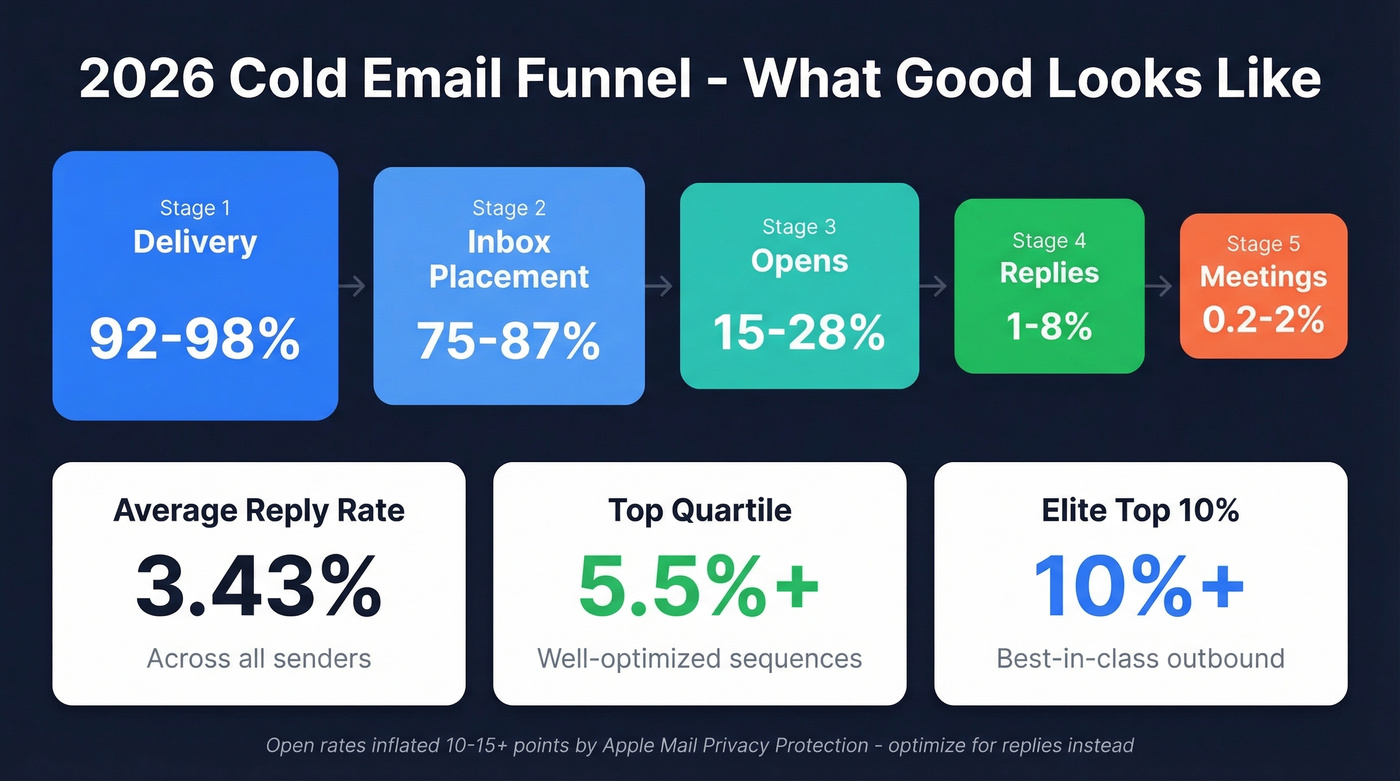
Here's what "good" actually looks like right now. Instantly's benchmark report analyzed billions of cold email interactions across thousands of active workspaces:
| Metric | Average | Top Quartile | Elite (Top 10%) |
|---|---|---|---|
| Reply rate | 3.43% | 5.5%+ | 10%+ |
| Open rate | 27.2% | - | - |
Outreach's customer base averages a 2.9% reply rate and 27.2% opens with a 2.8% bounce rate - roughly in line with broader benchmarks. MarketBetter's 2026 deliverability guide maps the full funnel: delivery 92-98%, inbox placement 75-87%, opens 15-28%, replies 1-8%, meetings 0.2-2%.
One caveat on open rates: Apple Mail Privacy Protection inflates them by 10-15+ points, so reply rate is the only metric worth optimizing around.
If you're below a 2% reply rate, don't rewrite your emails. Fix your deliverability and data quality first. (If you want a deeper benchmark breakdown, start with email bounce rate and standard email open rate.)
Before You Send
This is where most sequences die.
Configure SPF, DKIM, and DMARC on every sending domain. Add one-click unsubscribe headers as defined by RFC 8058 - required by bulk sender rules. Keep spam complaints below 0.3% and bounces below 2%. None of this is optional.
57.3% of B2B emailers now authenticate their domains, up from roughly 30% two years ago. If you're not in that group, you're already behind.
Domain warm-up schedule:
- Week 1: 5-10 emails/day
- Week 2-3: 20-40/day
- Week 4-6: 40-50/day when healthy
One Reddit practitioner scaled from 3 to 7 sending domains with a 26/day cap per domain. That's the right approach - spread volume to protect reputation. (If you need a tighter framework, see email velocity and how to improve sender reputation.)
Inbox placement varies by provider. Outlook lands just 75.6% of emails in the inbox, Google hits 87.2%, and Yahoo sits at 86%. If your prospects are heavy Outlook users, your deliverability bar is even higher. Industry matters too - healthcare inbox placement runs 94.7% while SaaS sits at just 80.9%.
Here's the thing: your sequence is only as good as your contact data. That same Reddit practitioner dropped their bounce rate from 11% to under 2% after switching to verified contacts. Prospeo's 5-step email verification with catch-all handling and spam-trap removal delivers 98% accuracy on 143M+ verified emails, refreshed every 7 days. Bad data doesn't just kill reply rates - it burns your sending domains. (Related: email deliverability guide and spam trap removal.)

Steps and Cadence
The data is clear: sequences with 4-7 steps generate roughly 3x the replies of 1-3 step sequences. But where those replies land depends on your audience. Superhuman's analysis of 2.5M touches found 70% of responses from emails 2-4, while Instantly's data shows 58% from Step 1. The difference likely reflects audience and sequence design, but the takeaway is the same: follow-ups matter.
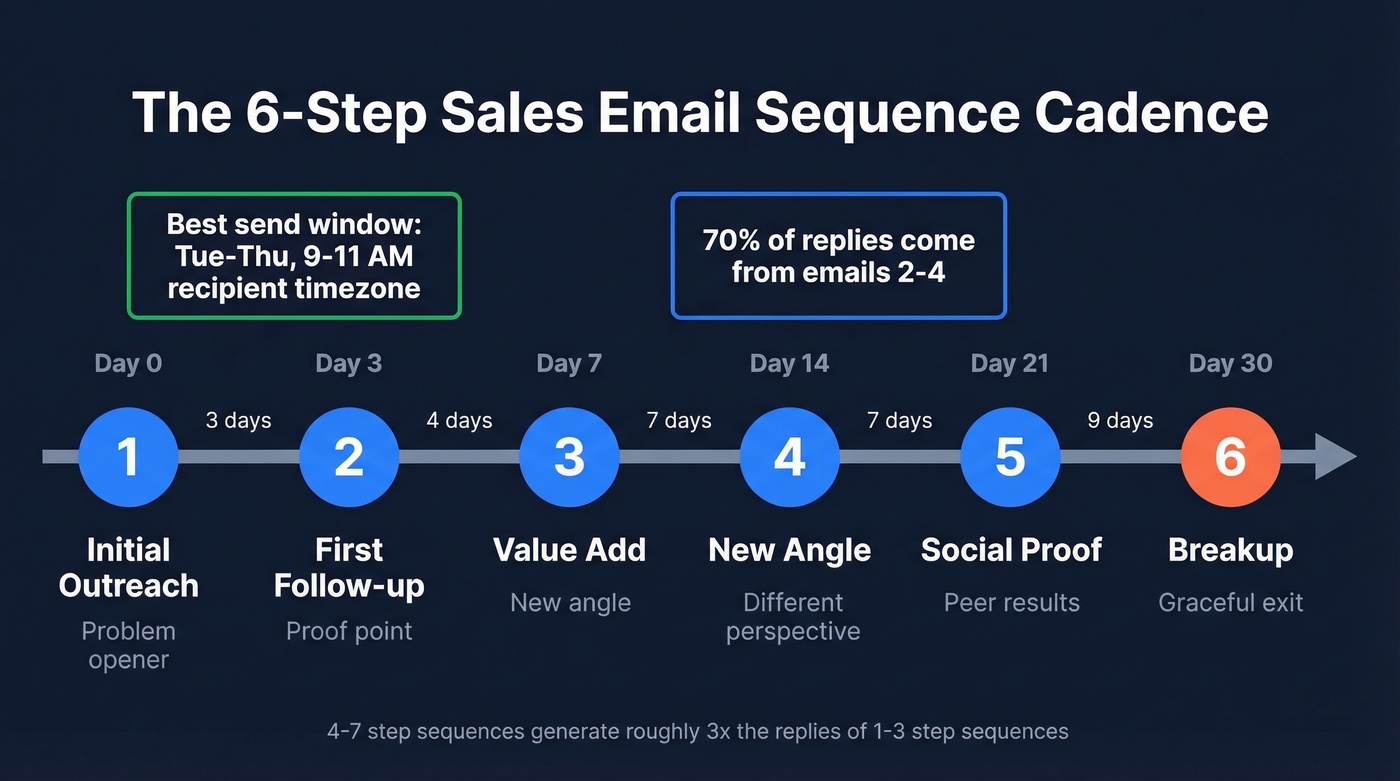
Here's the framework we've seen work across dozens of outbound campaigns:
- Day 0 - Initial outreach
- Day 3 - First follow-up
- Day 7 - Value add
- Day 14 - New angle
- Day 21 - Social proof
- Day 30 - Breakup
The 3-business-day spacing rule is a solid baseline for cold B2B prospecting. Send Tuesday through Thursday, 9-11 AM in the recipient's timezone. That Reddit case study saw a 16% lift in opens just from fixing send timing. Each touchpoint should build on the last - never repeat the same angle twice. (More timing data: best time to send cold emails.)

That 9% bounce rate from the intro? Prospeo users keep it under 2%. Our 5-step verification with catch-all handling and spam-trap removal delivers 98% email accuracy across 143M+ verified contacts - refreshed every 7 days, not every 6 weeks.
Stop burning sending domains with bad data. Start at $0.01 per verified email.
Writing Emails That Get Replies
Sub-80-word emails with a single CTA consistently outperform longer messages. One practitioner cut their emails from 141 words to under 56 and doubled their reply rate. (If you want more examples, see emails that get responses and email call to action.)
Lead with the prospect's problem, not your product. Subject lines matter more than most people think: "Quick question" pulled ~39% opens versus "Partnership opportunity" at under 19%. Real personalization means referencing a specific company initiative or role challenge - something like "Noticed you just opened a Berlin office" or "Saw you're hiring 3 AEs this quarter." Dropping a {first_name} token into a template isn't personalization. It's mail merge. The best cold email sequences tie every sentence back to a pain point the recipient actually cares about.
Two Sequences You Can Steal
Build your list with a verified database - Prospeo offers 300M+ profiles with 30+ filters including buyer intent - then load contacts into your sequencer via native integrations with Instantly, Smartlead, Lemlist, or Outreach. (For more outbound fundamentals, see sales prospecting techniques.)

Cold Outbound (5 Steps)
Day 0 - Problem opener
Subject: Quick question
[Name], noticed [Company] is [specific observation]. Most teams in [industry] are dealing with [problem]. Worth a 10-min call to see if we can help?
For example: "Noticed Acme just opened a Berlin office" - not "Hi {first_name}, hope you're well."
Day 3 - Follow-up with proof
Subject: Re: Quick question
Wanted to share - [similar company] cut [metric] by [X%] using [approach]. Happy to walk through how.
Day 7 - New angle
Subject: [Company] + [your value prop]
Different angle: [specific insight about their business]. This usually means [implication]. Open to exploring it?
Day 14 - Social proof
Subject: What [peer company] did
[Peer company] faced the same challenge and [result]. Figured it was worth flagging.
Day 21 - Breakup
Subject: Should I close your file?
Haven't heard back - totally fine. If timing's off, I'll step back. If something changes, I'm here.
These five emails follow a deliberate arc: problem, proof, new angle, social validation, and a graceful exit. Each step earns the right to send the next one.
Re-Engagement (3 Steps)
For leads who went dark after initial conversations.
Day 0 - New value hook
Subject: Something changed
[Name], since we last spoke, we've [new capability/result]. Thought it might change the math for [Company].
Day 5 - Social proof
Subject: Quick update
[Similar company] just [achieved result]. Given your [specific situation], figured this was relevant.
Day 12 - Clean breakup
Subject: Last note
Closing the loop. If priorities shift, you know where to find me.
Going Multi-Channel
Email-only sequences hit about a 5.2% reply rate. Add social touches and that jumps to 11.7%. Layer in phone and you're at 18.3% with a 4.9% meeting booking rate - a 3.5x improvement over email alone.
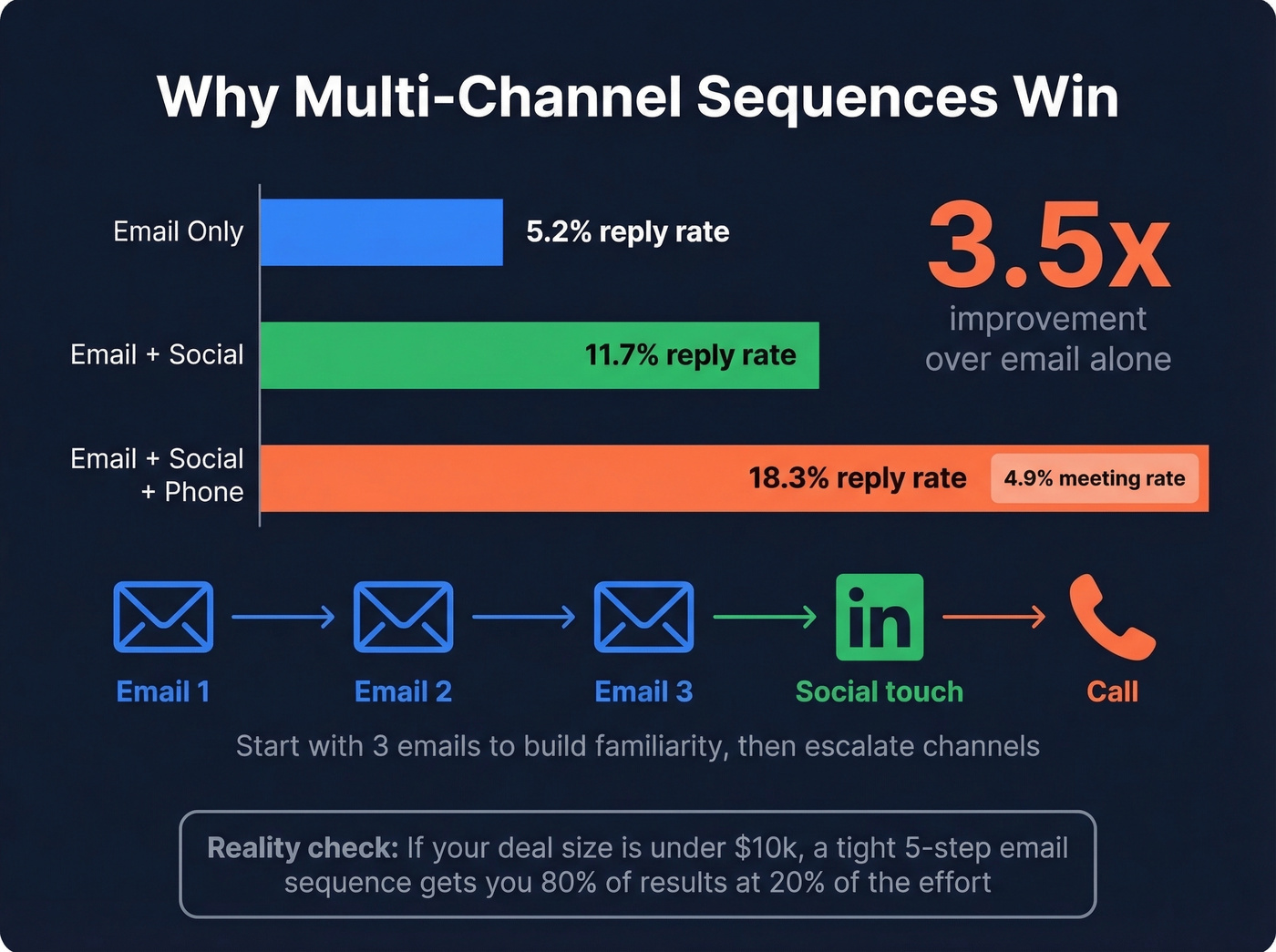
The pattern that works: start with 3 email-only touches to establish familiarity, then escalate to social engagement, then phone. Outreach recommends targeting a 12% prospect reply rate across channels for cold prospecting sequences. Hit 12%? Your sequence works. Miss it? Your channel mix is too narrow.
Let's be honest though: if your average deal size is under $10k, you probably don't need a multi-channel sequence at all. A tight 5-step cold email sequence with verified data and good targeting will get you 80% of the results at 20% of the effort. Save the phone-and-social orchestration for enterprise deals where the math justifies the time investment.
Diagnosing a Broken Sequence
We've seen teams waste months rewriting copy when the real problem was a 6% bounce rate. When replies dry up, diagnose in layers:
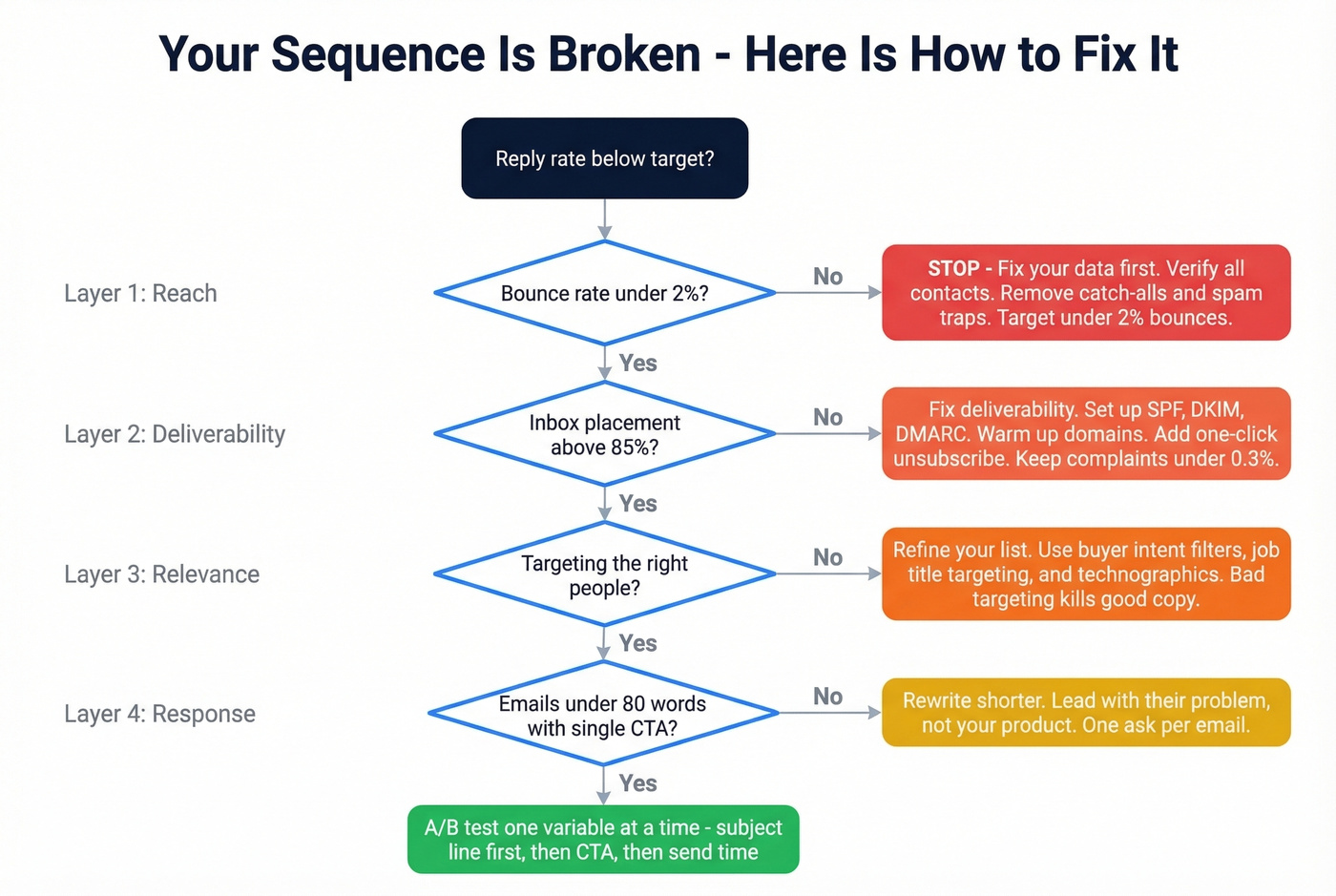
- Reach - Is your bounce rate under 2%? Check inbox placement, not just delivery rate.
- Relevance - Are you targeting the right people with the right message? Bad targeting kills good copy.
- Response - Are emails under 80 words with a clear, single CTA? Is the subject line earning the open?
- Results - If your last-step reply rate is still above 3%, your sequence is too short. Add a step.
A/B test one variable at a time - subject line first, then CTA, then send time. Most sequencing tools like Instantly, Outreach, and Mixmax support native A/B testing, so there's no excuse to skip this.
Look, more emails don't equal more replies. Google and Microsoft enforce hard spam thresholds. Fewer, better emails from warmed domains with verified data wins every time. A disciplined sales email sequence built on clean infrastructure will always outperform a bloated cadence running on bad data. Skip the volume game entirely if you can't guarantee your data is clean - you'll do more damage than good.
Build your sequence list with 300M+ profiles filtered by buyer intent, technographics, job changes, and headcount growth. Then push verified contacts directly into Instantly, Smartlead, Lemlist, or Outreach with native integrations.
Go from filtered prospect list to live sequence in under 5 minutes.
FAQ
How long should a sales email sequence be?
Four to seven emails over 14-30 days. Sequences with 4-7 steps generate roughly 3x the replies of 1-3 step sequences. Beyond 7, you'll hit diminishing returns unless each touch adds a genuinely new angle or piece of value.
What's a good reply rate for cold outbound in 2026?
The average is 3.43%. Top-quartile teams hit 5.5%+, and elite performers exceed 10%. If you're below 2%, fix deliverability and data quality before rewriting copy - the problem is almost certainly infrastructure, not messaging.
Should I use separate domains for cold outreach?
Yes. Use 3-7 dedicated sending domains to protect your primary domain's reputation, and cap each at 25-30 emails per day. Pairing dedicated domains with verified contacts keeps bounce rates under 2% and protects every domain in your rotation.