

Emails That Get Responses: A Data-Backed Guide for 2026
An operator on r/Entrepreneur rebuilt their cold email stack and watched reply rates jump from 3% to 6%. The fix wasn't better copy - it was infrastructure, list hygiene, and cutting emails to under 56 words.
Writing emails that get responses starts well before the first draft. The average cold email reply rate is 5.8% across 16.5M emails, down roughly 15% from the prior year. Most teams lose the game before the prospect ever sees the subject line.
The Order Matters
Here's the thing: almost everyone gets the priority wrong. They obsess over templates while their emails land in spam.
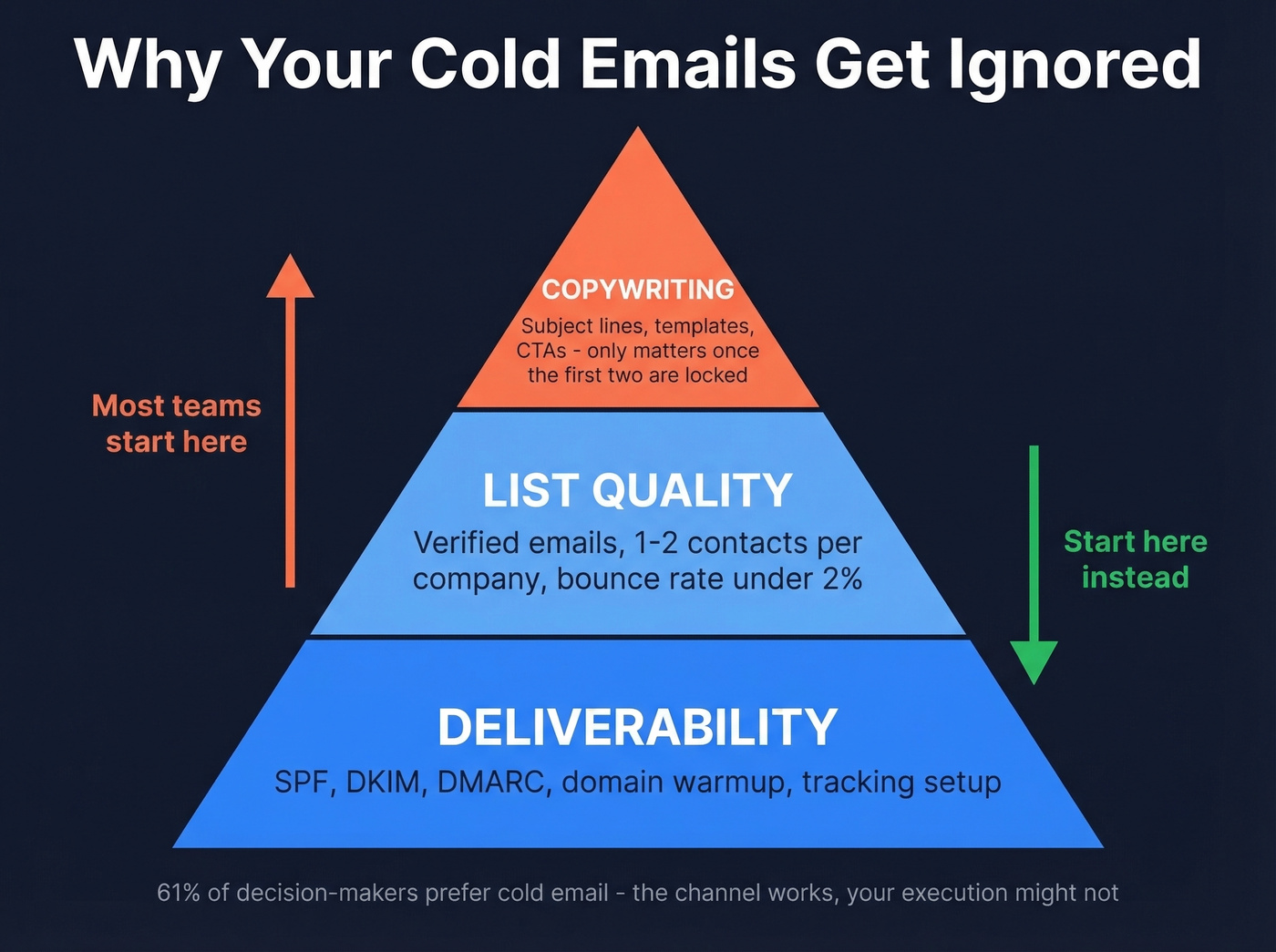
- Deliverability - emails must hit the inbox, not the promotions tab or spam folder
- List quality - every bad address erodes sender reputation
- Copywriting - only matters once the first two are locked
61% of decision-makers prefer cold email over calls or social touches. The channel works. Your execution might not.
Make Sure Emails Actually Arrive
SPF, DKIM, and DMARC records aren't optional. Skip them and you're in spam. Google, Yahoo, and Microsoft enforce bulk-sender thresholds: spam complaints under 0.3%, bounces under 2%.
Warm up new domains slowly - 5 to 10 emails per day, ramping over 4-6 weeks. That Reddit operator ran 7 domains, each capped at 25-30 sends daily. Set up a custom tracking domain via CNAME and turn off the open-tracking pixel. It injects HTML that spam filters flag, and the data it gives you is unreliable anyway. Measure replies instead.
The full stack - domains, warmup, sending tool, verification - runs $200-$800/month for most teams. We've seen teams spend more and get worse results because they skipped verification entirely.
If you want the deeper technical checklist, start with an email deliverability audit and keep an eye on email velocity as you ramp.
Fix Your List Before Writing a Word
Targeting precision has a bigger impact on reply rates than any copywriting trick. Emailing 1-2 contacts per company yields a 7.8% reply rate. Blast 10+ contacts at the same company and that drops to 3.8%.
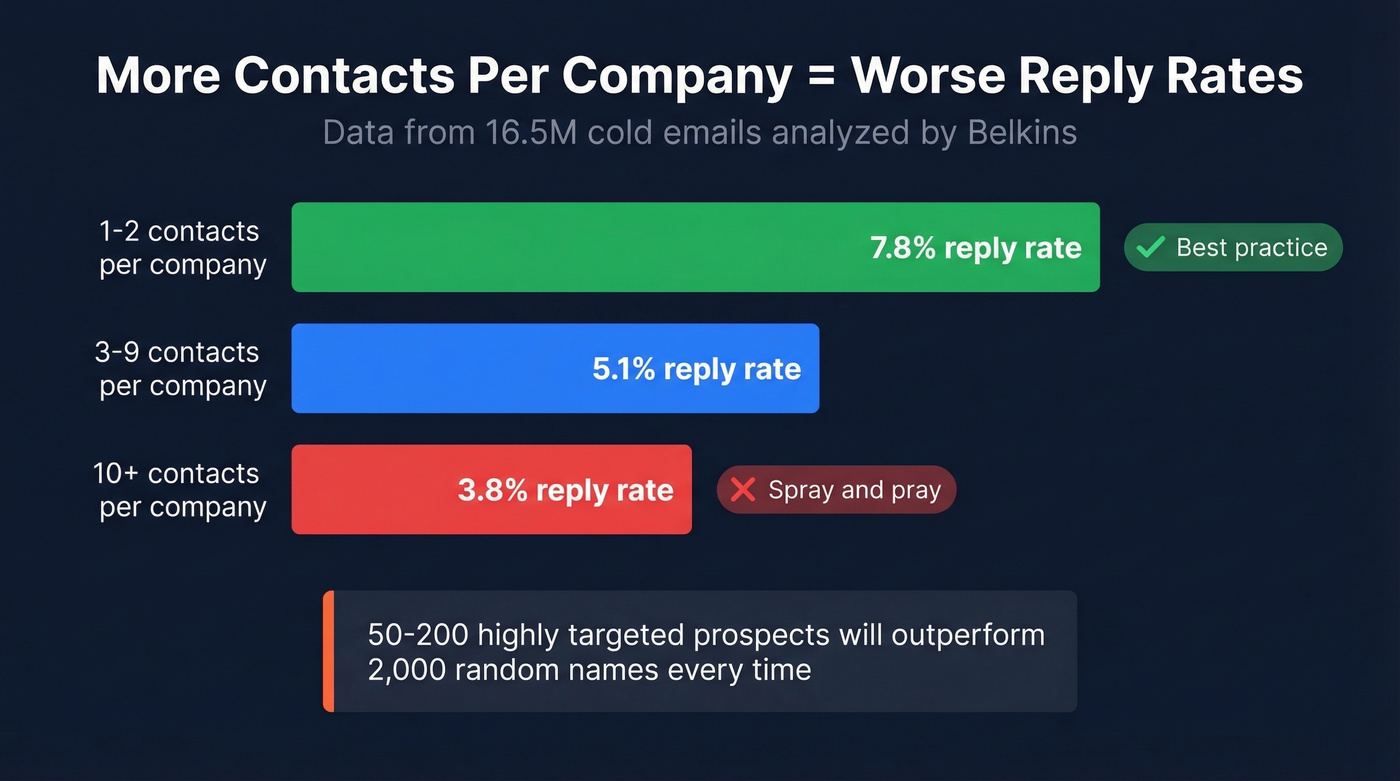
50-200 highly targeted prospects will outperform 2,000 random names every time.
That Reddit operator cut their bounce rate from 11% to under 2% by verifying every address before sending. Prospeo's 5-step verification catches invalid addresses, handles catch-all domains, and strips spam traps - delivering 98% email accuracy. The free tier gives you 75 verified emails per month, enough to test your targeting before scaling.
If you're building lists from scratch, use an ideal customer profile first, then layer in firmographic filters to keep the list tight.

That 11% bounce rate the Reddit operator started with? It was killing their sender reputation before prospects ever saw the email. Prospeo's 5-step verification - catch-all handling, spam-trap removal, honeypot filtering - delivers 98% email accuracy with a 7-day data refresh cycle. Layer in buyer intent signals and job-change filters to reach the right person at the right moment.
Fix your list first. Replies follow.
The data is clear: 1-2 contacts per company at 7.8% reply rates crushes 10+ contacts at 3.8%. Precision targeting wins. Prospeo gives you 30+ filters - intent data, technographics, funding, headcount growth - so every send goes to a prospect who actually fits. At ~$0.01/email, you spend less on 200 perfect contacts than most teams waste on 2,000 random ones.
Stop blasting. Start targeting the prospects who'll actually reply.
Subject Lines That Earn Opens
Keep them short. 2-4 word subject lines hit a 46% open rate across 5.5M emails. Performance drops steadily past 7 words. Personalized subject lines drive 7% reply rates versus 3% without - a 133% lift. Hype words like "ASAP" or fake urgency push opens below 36%.
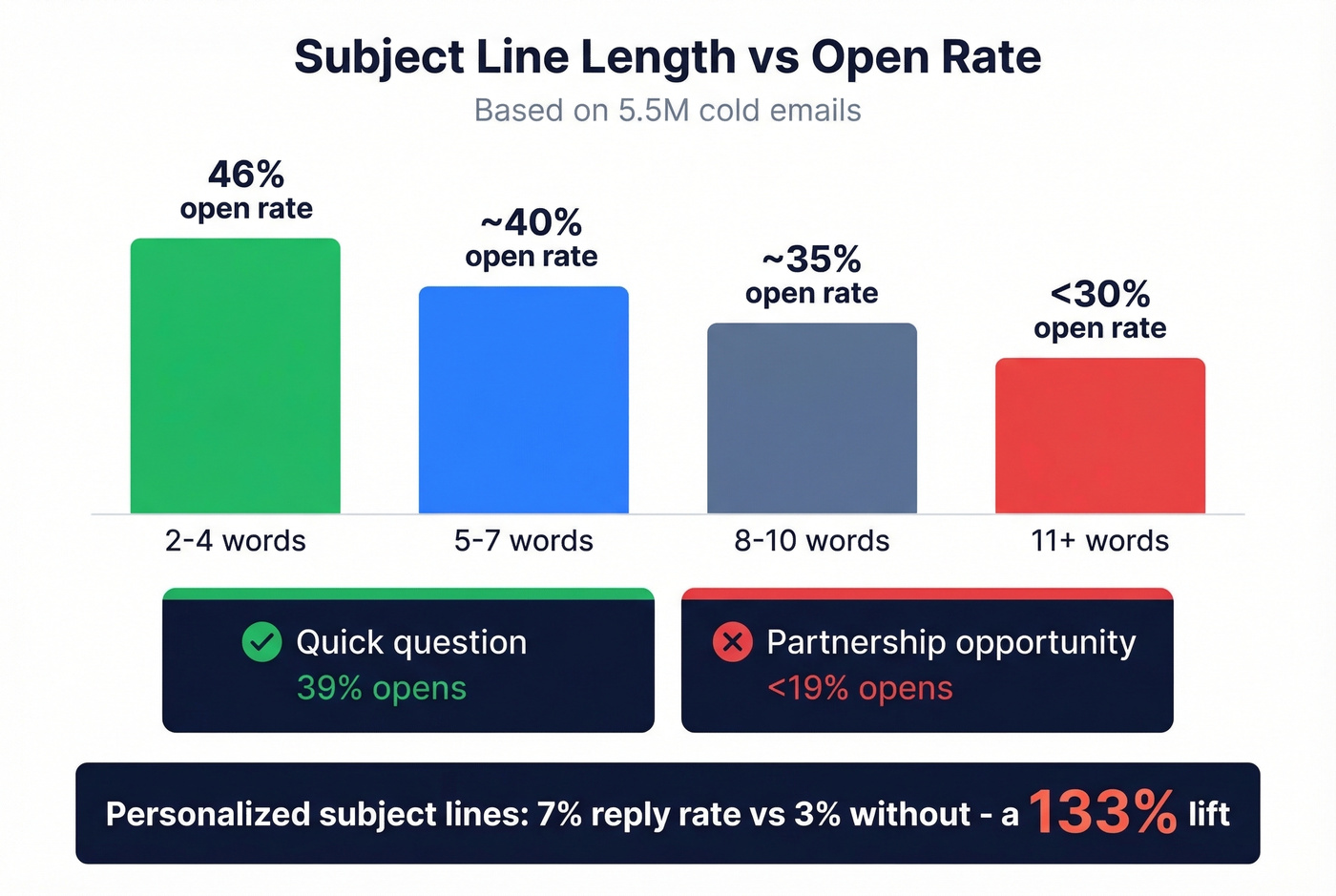
The Reddit operator's best performer was dead simple: "Quick question" at 39% opens. "Partnership opportunity" tanked below 19%.
If you need a swipe file, pull from these cold email subject line examples and sanity-check against subject lines that get opened.
Boring beats clever.
Templates That Actually Get Replies
Relevance beats personalization. Nobody cares that you noticed their marathon time. They care that you understand their problem. The best trigger events are role changes, executive hires, funding rounds, and event appearances. One operator sending 2M+ emails found that speed-to-lead on these triggers mattered more than clever copy.
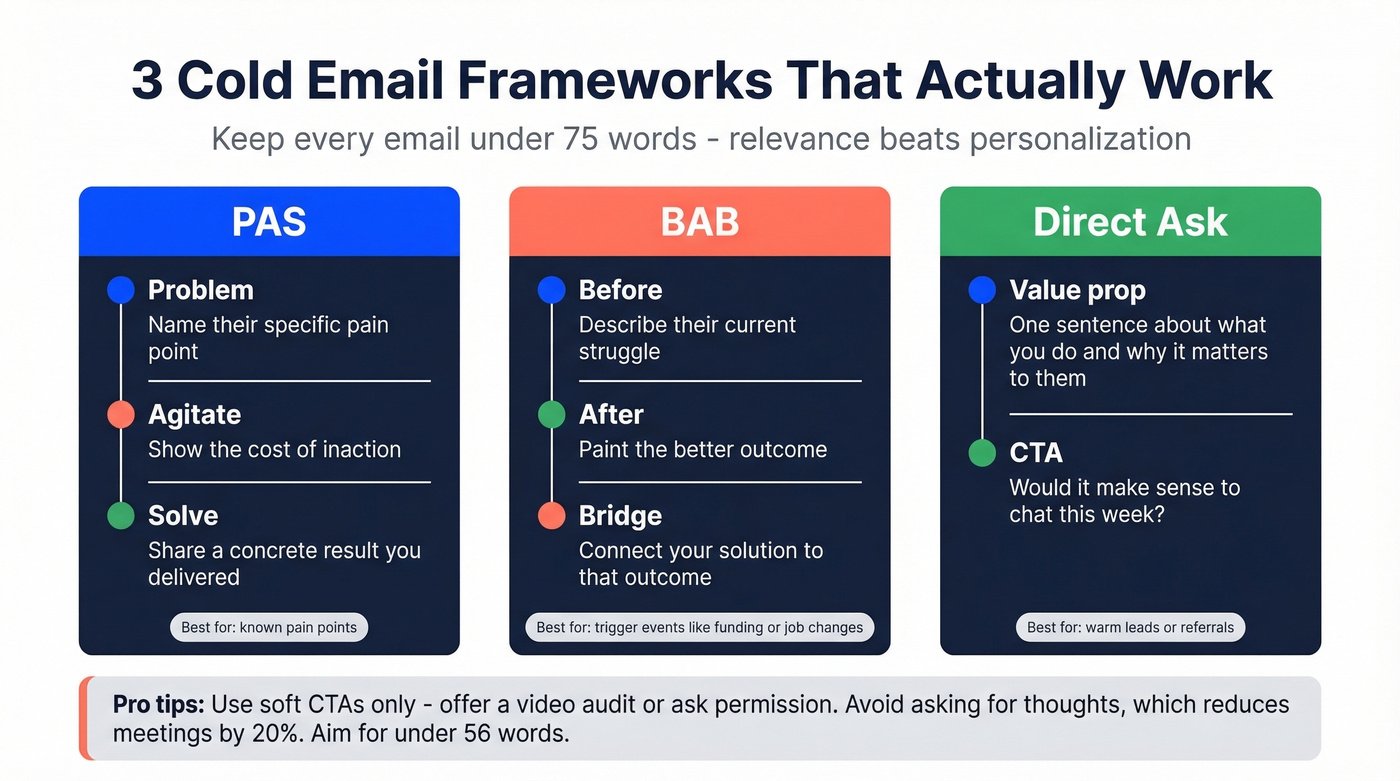
Aim to keep every email under 75 words. Soft CTAs only - offer a quick video audit or ask permission before sending links. Avoid asking for "thoughts," which reduces meeting-setting by roughly 20%. One practitioner books 6-7 meetings per week from just 100-500 prospects using this approach.
For more variations, borrow from cold email follow-up templates and these sales follow-up templates.
PAS (Problem - Agitate - Solve):
{{First name}}, most {{title}}s at {{company size}} companies tell us {{pain point}} costs them {{consequence}}. We helped {{similar company}} cut that by {{result}} in {{timeframe}}. Worth a quick conversation?
BAB (Before - After - Bridge):
{{First name}}, before {{trigger event}}, teams like yours at {{company}} typically struggle with {{problem}}. After switching to {{approach}}, {{customer}} saw {{specific result}}. Happy to show you how - interested?
Direct Ask:
{{First name}}, {{one sentence about what you do and why it matters to them}}. Would it make sense to chat this week?
That last one is closer to a text message than an email. That's the point.
When to Send and When to Stop
| Metric | Data Point |
|---|---|
| Best day | Thursday (6.87% reply) |
| Best time | 8-11 PM recipient time zone (6.52%) |
| 1st follow-up lift | +49% replies |
| 4th follow-up drop | -55% replies |
| Spam complaints | 0.5% to 1.6% (emails 1-4) |
| Recommended cap | 3 follow-ups (4 total) |
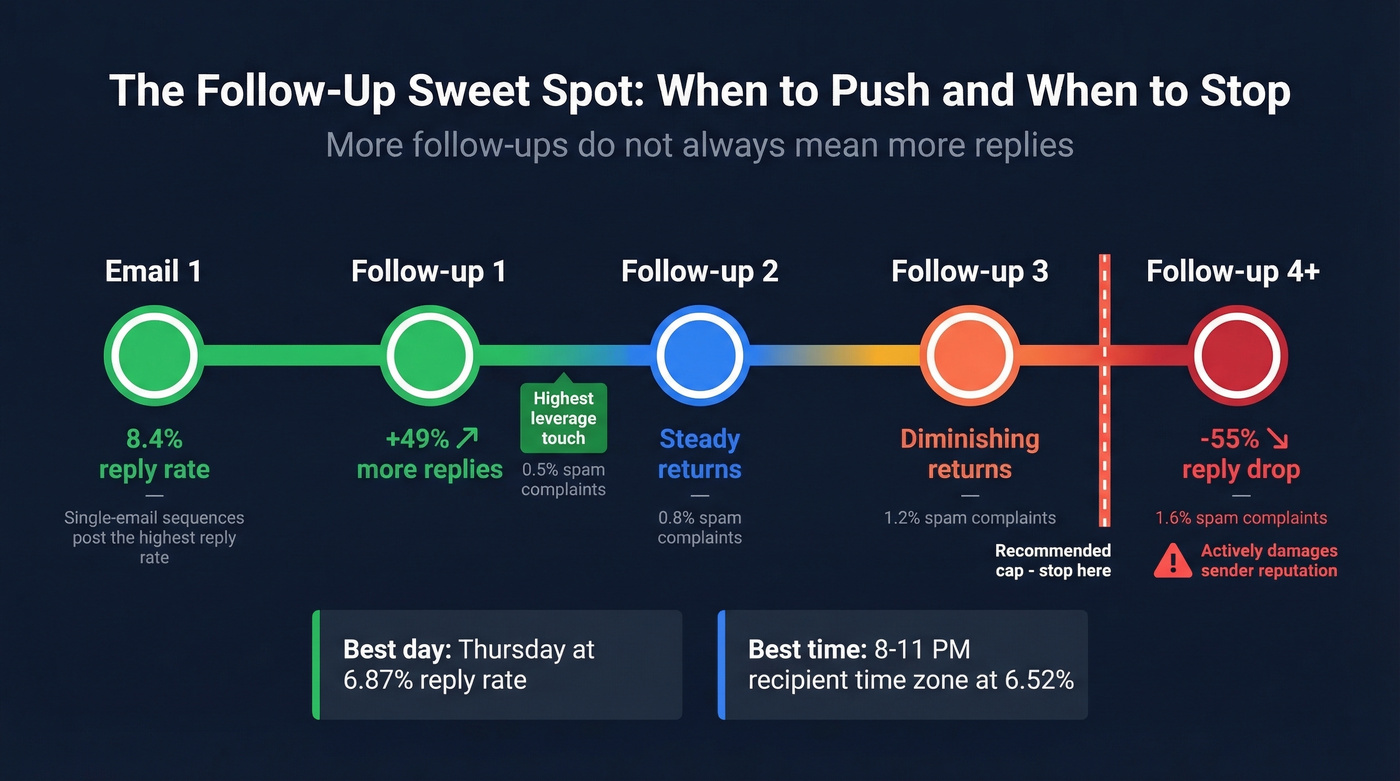
Your first follow-up is the highest-leverage touch you can add. By the fourth, you're actively damaging sender reputation - spam complaints triple. Cap sequences at 3 follow-ups, then recycle prospects into a future campaign with a fresh angle. The dataset favors evenings, while the Reddit operator saw gains sending 8-11 AM. Test both windows.
If you want a deeper breakdown by timezone and industry, see the best time to send cold emails data.
Let's be honest about something the industry doesn't talk about enough: 1-email sequences posted the highest reply rate at 8.4%. If your targeting and copy are sharp enough, you don't need a sequence at all. In our experience, the teams obsessing over 7-step drip campaigns would get better results spending that energy on list quality.
FAQ
What's a good cold email reply rate in 2026?
The benchmark across 16.5M emails is 5.8%. Top performers exceed 25%, and anything around 8% is strong. If you're below 3%, fix deliverability and list quality before rewriting copy.
How short should a cold email be?
Under 75 words is a solid rule. The best case study we've tracked used emails under 56 words - two-sentence paragraphs, one question, no attachments. Shorter messages signal respect for the reader's time and consistently outperform longer pitches.
How do I keep my bounce rate under 2%?
Verify every email before sending. Never send to a list older than 7 days without re-verifying - contacts change jobs, addresses get deactivated, and what was valid last Tuesday can bounce today. Prospeo's catch-all handling and spam-trap removal are built for exactly this problem.
What tools help build lists for cold emails that get responses?
You need a data provider with strong verification built in, not bolted on. Look for buyer intent signals, job-change filters, and technographic data so you're reaching prospects at the exact moment they're likely to reply. A 7-day data refresh cycle keeps contacts current - the industry average is 6 weeks, which is an eternity in B2B.