

Funny Sales Emails That Actually Get Replies (With Templates)
It's the fourth follow-up. Your prospect has opened every email - you can see the timestamps - but hasn't replied once. Their inbox is packed with templated outreach that all reads the same with a different logo. The pattern interrupt that actually works right now? Funny sales emails that sound like a real person wrote them.
The Quick Version
- Save humor for follow-ups 2-4 and breakup emails. In one well-known test, a humorous breakup email drove nearly 2X the reply rate versus a plain-text goodbye.
- Keep funny emails under 60 words with a soft CTA. Humor is the seasoning, not the meal.
- Verify your contact data before you send. A joke addressed to the wrong name is worse than no joke at all.
Does Humor in Sales Emails Actually Work?
GoCo, an HR/benefits software company targeting CXOs at 10-500 employee orgs, A/B tested a humorous "cute baby duck goodbye" breakup email against a plain-text control. The humorous version pulled nearly double the reply rate. And the ratio of positive-to-negative responses stayed consistent across both variants, which is the part most people miss - humor didn't just get more replies; it got the same quality of replies, just more of them.
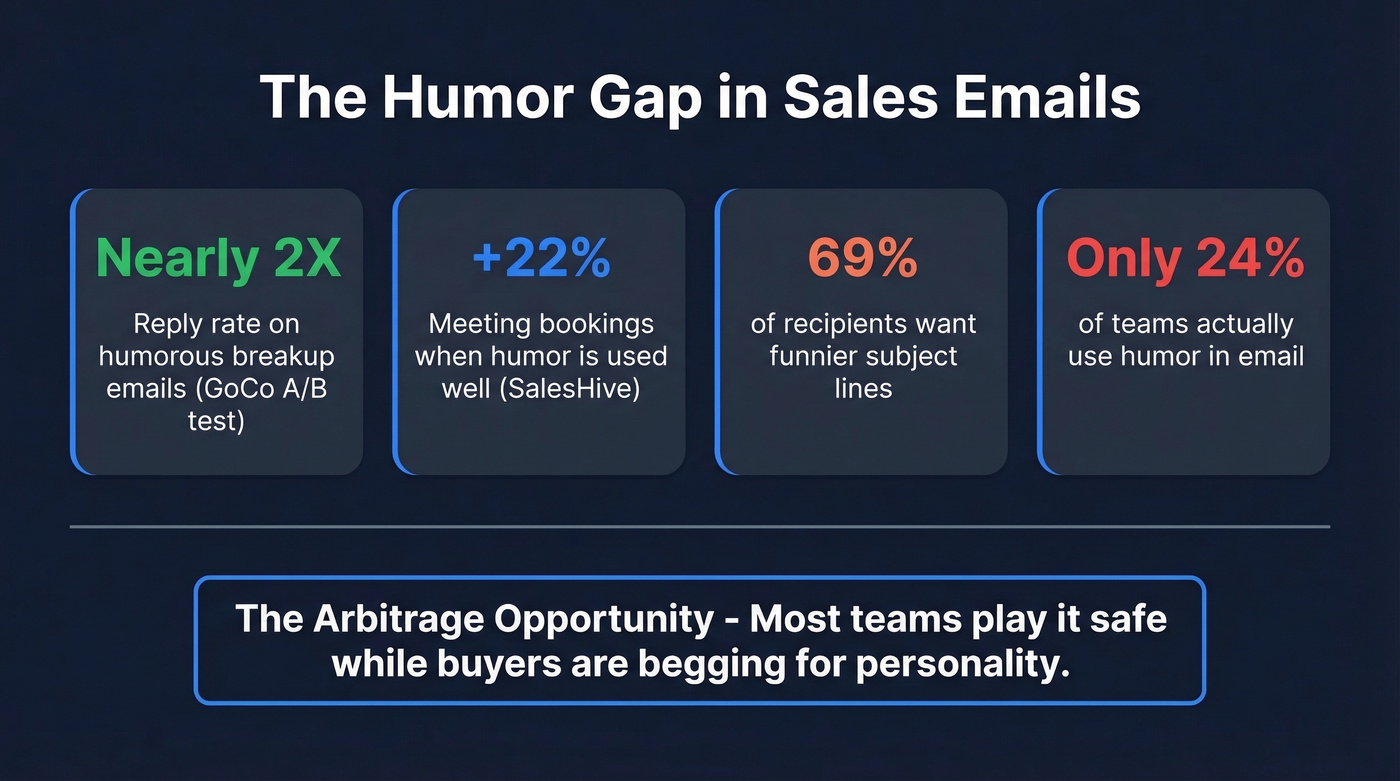
SalesHive found even broader lifts: +18-34% open rates, +22% meeting bookings, and +15% deal velocity when humor is deployed well. Here's the competitive gap that should get your attention: 69% of recipients say they'd open brand emails more often if subject lines were funnier, but only 24% of teams actually use humor in email marketing. That's a massive arbitrage opportunity sitting in plain sight.
The consensus on r/copywriting and r/coldemail echoes the same idea: short, unserious, maybe-funny emails beat polished, formal outreach. The best humorous cold emails share one trait - they sound like a real person talking, not a brand broadcasting.
The Psychology Behind It
Humor isn't decoration. Research summarized by Harvard's Program on Negotiation shows that humor can induce positive emotion, increase trust and social closeness, and boost creativity in the recipient. When someone laughs at your email, they're primed to like you.
A 2017 study by Bitterly, Brooks, and Schweitzer found that appropriate humor increases perceived confidence and competence - you literally come across as smarter when you're funny. Separate research by Kurtz, Algoe, and colleagues showed that shared laughter increases perceived similarity between strangers. That's exactly what cold email needs: a fast-track to "this person gets me."
Two failure modes to watch. Humor that falls flat is mostly harmless - you just sound like everyone else. Humor that's inappropriate actively damages trust.
Five Humor Techniques That Work
1. Self-deprecating self-awareness. Acknowledge the awkwardness of cold email itself. "I know this is a cold email. You know this is a cold email. Now that we've gotten that out of the way..." This works because it signals social intelligence. Marketing Examples frames this as "proving you're human before you pitch."
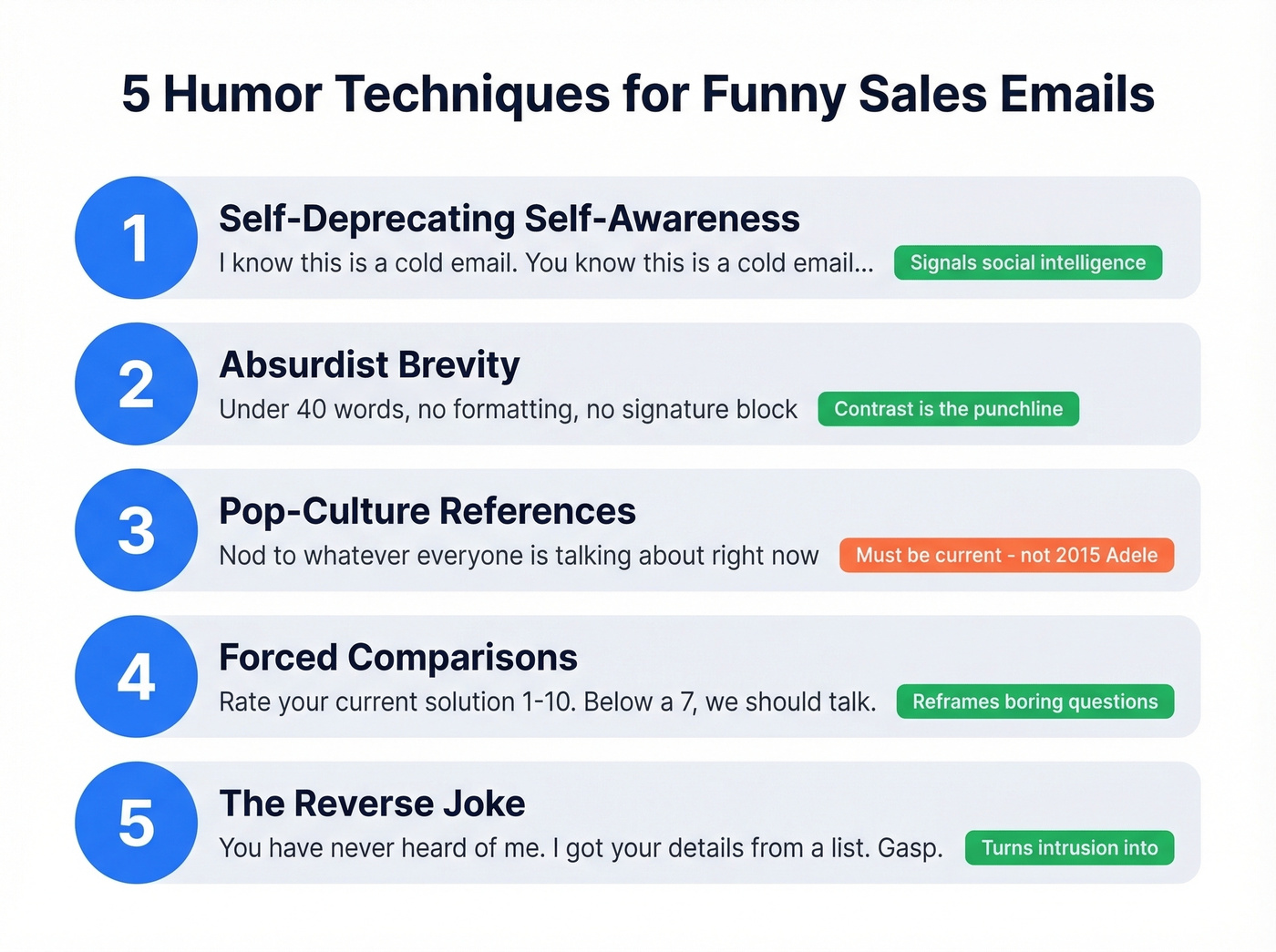
2. Absurdist brevity. Write something so short and deadpan it can't be ignored. Under 40 words, no formatting, no signature block. The humor comes from the contrast with every overwrought email in their inbox.
3. Pop-culture references. The key word is current. A nod to whatever show or cultural moment everyone's talking about right now lands. A reference to a 2015 Adele song doesn't. Keep references broad enough that your prospect doesn't need to be a superfan to get it.
4. Forced comparisons. Instead of "are you happy with your current provider?" - which everyone ignores - try "On a scale of 1 to 10, how would you rate your current solution? Below a 7, we should talk. If it's a 10, teach me your secrets."
5. The reverse joke. Call out the absurdity of the sales process itself. The Charm Offensive team uses lines like "You've never heard of me... I got your details from a list. Gasp... at least you're list-worthy." It reframes cold email from intrusion to shared joke. One r/coldemail poster put it bluntly: "The emails that work for me are the ones that admit what they are."
When to Deploy Humor in Your Sequence
Here's the thing most "funny email" articles get wrong: they tell you to lead with humor. Don't. Humor in cold emails enhances value-based selling - it doesn't replace it. Your first email should establish credibility. Humor works best once the prospect has context about who you are.
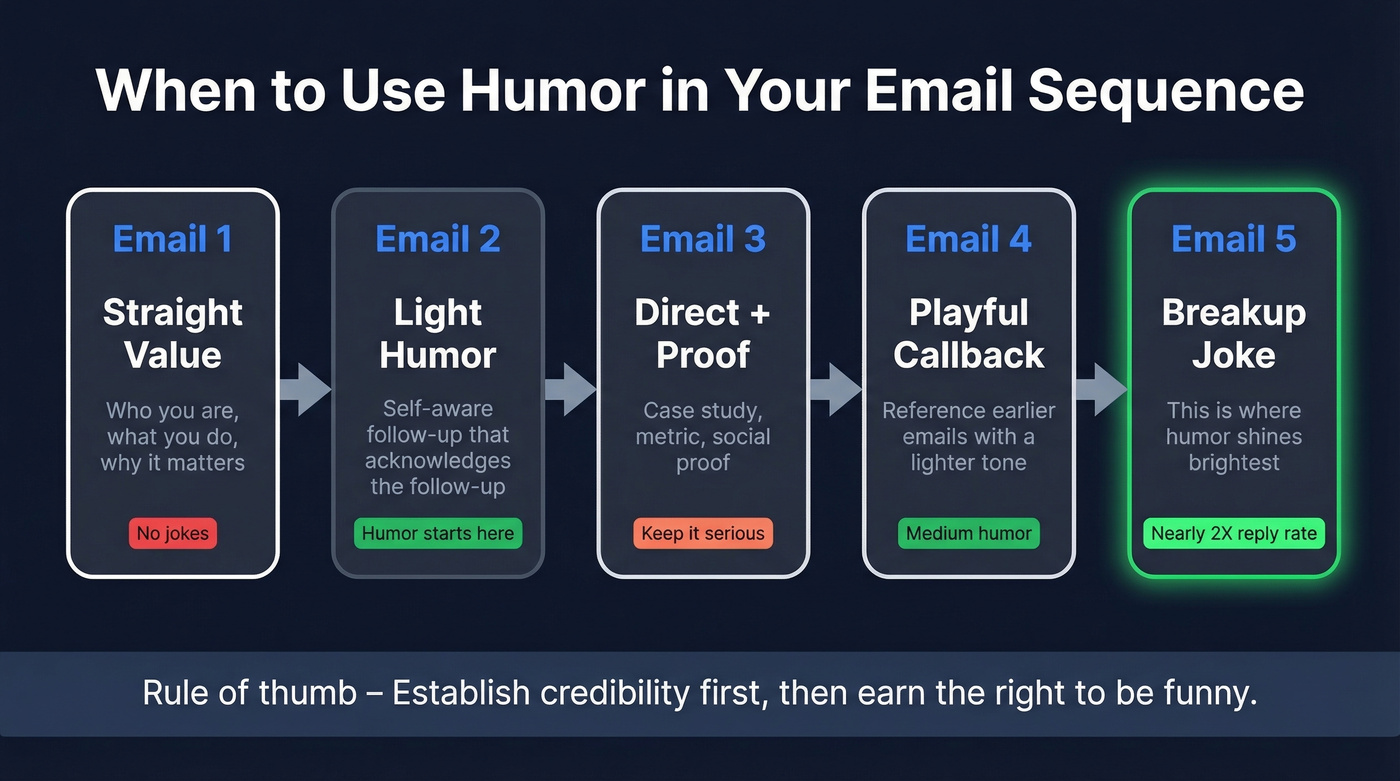
- Email 1: Straight value. Who you are, what you do, why it matters to them. No jokes.
- Email 2: Lightly humorous. A self-aware follow-up that acknowledges you're following up.
- Email 3: Direct with proof. Case study, metric, social proof.
- Email 4: Playful callback. Reference something from email 1 or 2 with a lighter tone.
- Email 5: Breakup joke. This is where humor shines brightest - and where we have the clearest "nearly 2X replies" data.
We've seen teams front-load humor and wonder why it doesn't convert. A stranger making jokes before establishing value reads as unserious, not charming. Test one variable at a time - subject line humor vs. body humor - and measure reply rate, not just opens.
If your average deal size is under $10k and your sales cycle wraps in under 30 days, creative emails with humor in follow-ups will outperform every "professional" nurture sequence you've ever built. Formal outreach is optimized for the sender's comfort, not the buyer's attention.

A joke addressed to the wrong person kills the bit. Prospeo's 98% email accuracy and 7-day data refresh mean your perfectly crafted funny follow-up actually lands in the right inbox - not a bounce folder.
Stop wasting great copy on bad data. Verify before you send.
Templates That Actually Get Replies
The Self-Aware Opener
Subject: This is a cold email
Hi {{first_name}},
I know this is a cold email. You know this is a cold email. Let's skip the part where I pretend we have a mutual connection.
I help [type of company] [achieve specific outcome]. Worth a quick conversation?
- {{your_name}}
Under 50 words. The humor is structural - you're breaking the fourth wall of sales outreach. Soft CTA. No links.
The Humorous Follow-Up
Pop-culture version:
Subject: Plot twist
{{first_name}}, I'm starting to think my emails are getting the same treatment as unread terms and conditions.
Fair enough. But unlike those, this one's actually short: [one-sentence value prop].
Interested?
Absurdist brevity version:
Subject: Quick question
{{first_name}}, this email is 22 words long. Can we talk about [specific problem] for 10 minutes? That's it. That's the email.
Forced comparison version:
Subject: Scale of 1-10
{{first_name}}, rate your current [solution category] from 1 to 10.
Below a 7? I've got something worth 5 minutes. A 10? I'll send you a trophy.
The "I'm a Real Human" Template
One Reddit poster shared a cold email that opened with "Hi (first name)... just kidding" followed by "I am a real human unless this is all just a simulation." The self-awareness works - it's a pattern interrupt that immediately separates you from bot-generated outreach. Here's a cleaner version:
Subject: Not a robot (probably)
{{first_name}}, I promise a human wrote this. No AI, no templates, no "I hope this finds you well."
I noticed [specific observation about their company]. [One-sentence value prop]. Got 5 minutes this week?
The Breakup Email
This is the template category with the hardest data behind it. GoCo's nearly 2X reply rate came from a breakup email, and in our experience, breakup emails are the single safest place to test humor because the prospect has already ignored you - the stakes are as low as they'll ever be.
The cute goodbye:
Subject: Goodbye, {{first_name}} 🐣
I've sent a few emails. You haven't replied. I get it - I'm not everyone's cup of coffee.
This is my last one. If timing's ever better, reply to this thread. I'll be here.
No hard feelings. Mostly.
The dramatic farewell:
Subject: My last email (for real this time)
{{first_name}}, I've officially exhausted my follow-up creativity. This is the part where dramatic music plays and I walk slowly into the sunset.
If [specific problem] ever keeps you up at night, you know where to find me.
Reengaging Ghosted Prospects
Subject: Remember me?
{{first_name}}, three months ago you said "not right now." I respected that. I waited. I've been very patient.
Has "right now" arrived yet? [One sentence on what's changed - new feature, case study, market shift.]
Worth a 5-minute catch-up?
Re-engagement is a natural fit for humor because you already have shared history with the prospect. A light, self-aware tone reminds them you're a real person - not another automated drip.
Subject Lines That Get Opens
Multiple practitioners on Reddit say that no subject line at all or a funny/nonsensical subject outperformed classic sales subject lines. Keep them to 5-8 words and avoid spammy punctuation.
| Subject Line | Why It Works |
|---|---|
| This is a cold email | Radical honesty; pattern interrupt |
| Did my email fall into a black hole? | Relatable; low-pressure |
| Plot twist | Curiosity gap in two words |
| Quick question (it's actually quick) | Subverts a cliche |
| I come in peace | Disarms; signals self-awareness |
| Goodbye, {{first_name}} | Breakup curiosity |
| Not a robot (probably) | AI-era humor; timely |
| My boss said to stop emailing you | Creates intrigue + sympathy |
| Re: that thing you never replied to | Meta-humor; bold |
| This email is 19 words long | Promises brevity; delivers |
| I wrote a haiku about your tech stack | Absurdist; industry-specific |
When NOT to Use Humor
| Factor | Humor-Friendly | Humor-Risky |
|---|---|---|
| Persona | Creative roles, founders, SDRs | Legal, compliance, CFOs |
| Industry | Tech, media, agencies, startups | Healthcare, finance, government |
| Seniority | Mid-level, directors | C-suite (before rapport) |
| Email # | Follow-ups 2-5, breakups | First touch to cold list |
| Joke type | Self-deprecating, absurdist | Edgy, political, sarcastic |
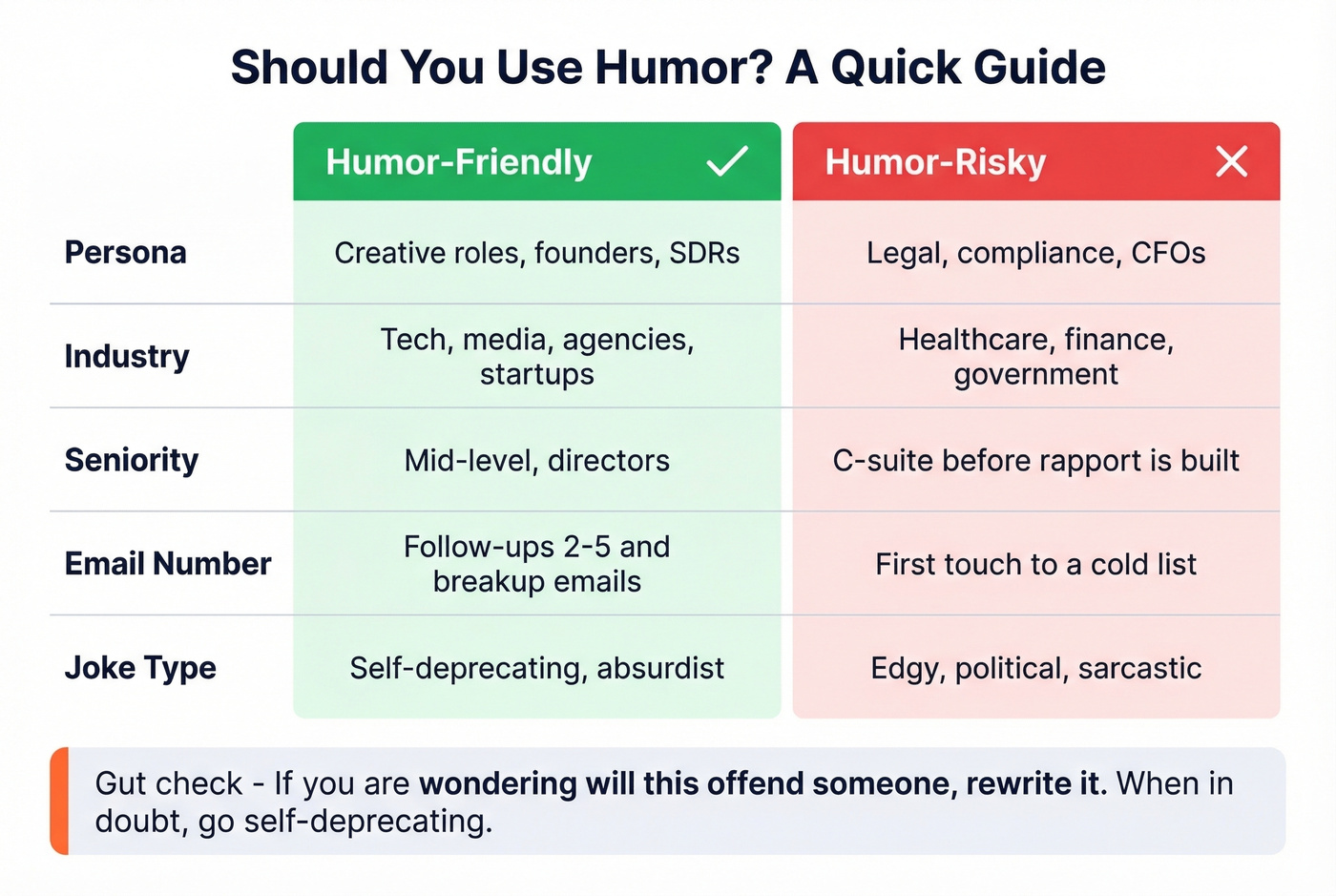
Skip humor entirely for regulated industries until you've built rapport. C-suite prospects can appreciate it, but only after you've earned the right.
The simplest gut check: if you're wondering "will this offend someone?" - rewrite. And here's a reframe worth remembering: humor acts as a qualifier. Self-important prospects who can't handle a light joke probably aren't great clients anyway. The prospects who laugh at your emails tend to become your best customers.
Let's be honest about the flip side, too. Forced humor is worse than no humor. A dated meme, an inside joke nobody gets, or a try-hard one-liner will make you look less professional than a straightforward email. When in doubt, default to self-deprecating. Browse cold email humor examples from communities like r/coldemail before writing your own - seeing what real reps have tested helps you calibrate tone.
Technical Rules for Delivery
Even the funniest email fails if it hits spam.
- Under 60 words per email body. A 200-word joke is a chore.
- Total email weight under 125KB. Heavy emails trigger spam filters.
- GIFs under 1MB. Better yet, use a still image with a play-button overlay.
- Host images on your branded domain with alt text.
- No links in your first email - including Calendly. Links in cold first-touches often hurt deliverability.
- No tracking pixels. You lose open-rate data. You gain inbox placement.
- No attachments. Ever.
- Soft CTA only. "Worth a conversation?" beats "Book 30 minutes on my calendar."
Start with clean data. Verify emails before you send so you're not burning your domain reputation on dead addresses.
The Prerequisite Nobody Talks About
Your funniest email is worthless if it bounces, lands in spam, or addresses the prospect by the wrong name. "Hi {{first_name}}" rendering as "Hi Jessica" when the prospect's name is James doesn't just kill the joke - it kills your credibility permanently.

This is where data quality becomes non-negotiable. We use Prospeo's email verification - 98% accuracy on a 7-day refresh cycle - to make sure every address in a sequence is live before the first send goes out. The free tier gives you 75 verifications per month, which is enough to test a humor sequence without risking your domain. The connection is straightforward: humor requires precision. The right joke to the right person at a verified address is a reply. The right joke to a dead inbox is a bounce that tanks your sender reputation.
You just spent 20 minutes writing the perfect breakup email. Don't send it to an outdated address. Prospeo verifies 143M+ emails through a 5-step process - catch-all handling, spam-trap removal, the works - starting at $0.01 per email.
Great humor deserves a real inbox. Start verifying for free.
FAQ
Do funny cold emails work for enterprise deals?
Yes, but calibrate the humor type. Self-deprecating humor works across seniority levels and deal sizes. Avoid absurdist or pop-culture jokes with C-suite contacts in regulated industries. Breakup emails are the safest place to test - GoCo's nearly 2X reply rate came from a company selling to CXOs.
How short should a humorous sales email be?
Under 60 words. Practitioners on r/copywriting consistently push "short, unserious, and maybe funny" emails paired with a soft CTA like "Worth a conversation?" A 200-word joke isn't funny - it's a chore nobody finishes reading.
How do I make sure funny sales emails actually get delivered?
Email verification ensures your messages reach real inboxes instead of bouncing. Prospeo's free tier includes 75 verifications per month at 98% accuracy - enough to test a humor sequence without risking your domain. Beyond verification, keep total email weight under 125KB, skip links in your first touch, and never attach files.
Where can I find more witty cold email examples?
Browse subreddits like r/coldemail and r/sales for real-world examples reps have tested. The key is adapting any template to your prospect's industry and seniority - a line that kills with a startup founder will fall flat with a VP of Finance.