


Gigasheet Pricing, Reviews, Pros and Cons: The Full 2026 Breakdown
Gigasheet shows several different prices depending on where you look: $25, $95, $165, $250, and $5,000. Capterra and GetApp highlight the $95/month Premium starting price, G2 shows a $5,000/year starting anchor for MRF Explorer, and Gigasheet's own Premium pricing page shows multiple price blocks that don't line up cleanly with the review aggregators. We dug through every source to reconcile the numbers. Here's what Gigasheet actually costs in 2026, what users think of it, and whether it's worth your money.
30-Second Verdict
Gigasheet carries a 4.9/5 on G2 from 23 reviews and a matching 4.9/5 on GetApp from 7 reviews - impressive, though the combined sample is still small. The product has pivoted hard toward healthcare price transparency analytics. If you're analyzing massive MRF files or payer-negotiated rates, it's one of the few purpose-built tools in the space. If you just need a big-data spreadsheet for CSVs, you're paying for healthcare features you'll never touch.
And if you're here because you need B2B contact data, you're in the wrong product category entirely.
What Gigasheet Actually Costs in 2026
The pricing confusion comes from multiple product tiers aimed at very different buyers, plus third-party aggregators mashing them together. We reconciled the main sources to build this breakdown:
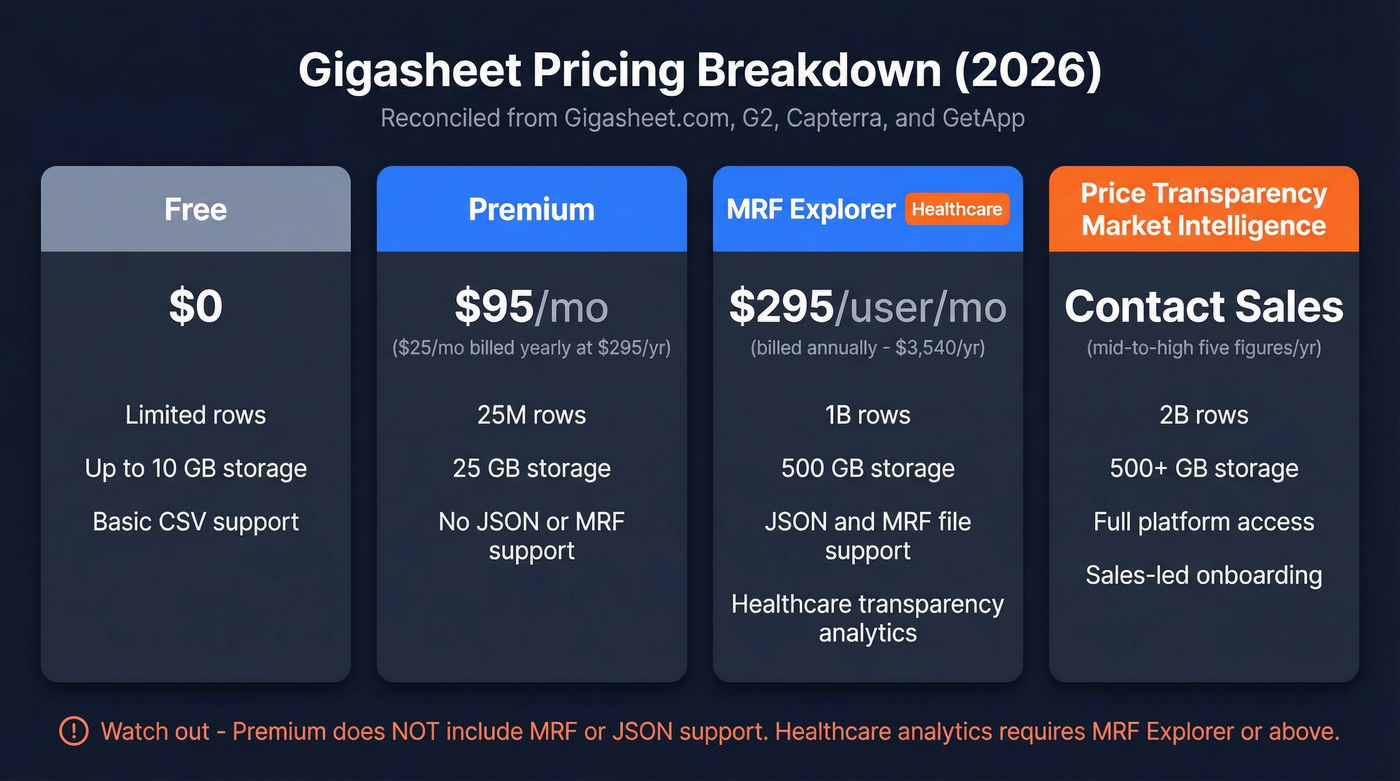
| Plan | Price | Max Rows | Storage |
|---|---|---|---|
| Free | $0 | Not specified | Limited (listed as 1 GB on some sources, up to 10 GB on others) |
| Premium | $95/month or $25/month billed yearly at $295/year | 25M | 25 GB |
| MRF Explorer | $295/user/month billed annually ($3,540/year) | 1B | 500 GB |
| Price Transparency Market Intelligence | Sales-led, mid-to-high five figures/year | 2B | 500 GB+ |
That clears up most of the mystery. Capterra's $95 flat-rate figure maps to the monthly Premium price. G2's $5,000 starting price refers to MRF Explorer, not Premium. Adding to the confusion, Gigasheet's own pages show inconsistent Premium annual pricing: the Premium pricing page lists $25/month billed yearly at $295/year, while another packaging page lists Premium (Individual) from $75 per user/month billed annually and $95/month billed monthly. Not ideal transparency for a transparency company.
Here's the detail most review sites miss: Premium doesn't support JSON or MRF files. If you need healthcare price transparency analysis - the thing Gigasheet is now built around - you need MRF Explorer at minimum ($3,540/year). Premium is self-serve with cart checkout. Price Transparency Market Intelligence is sales-led.
Pros and Cons From Real Users
Pros:
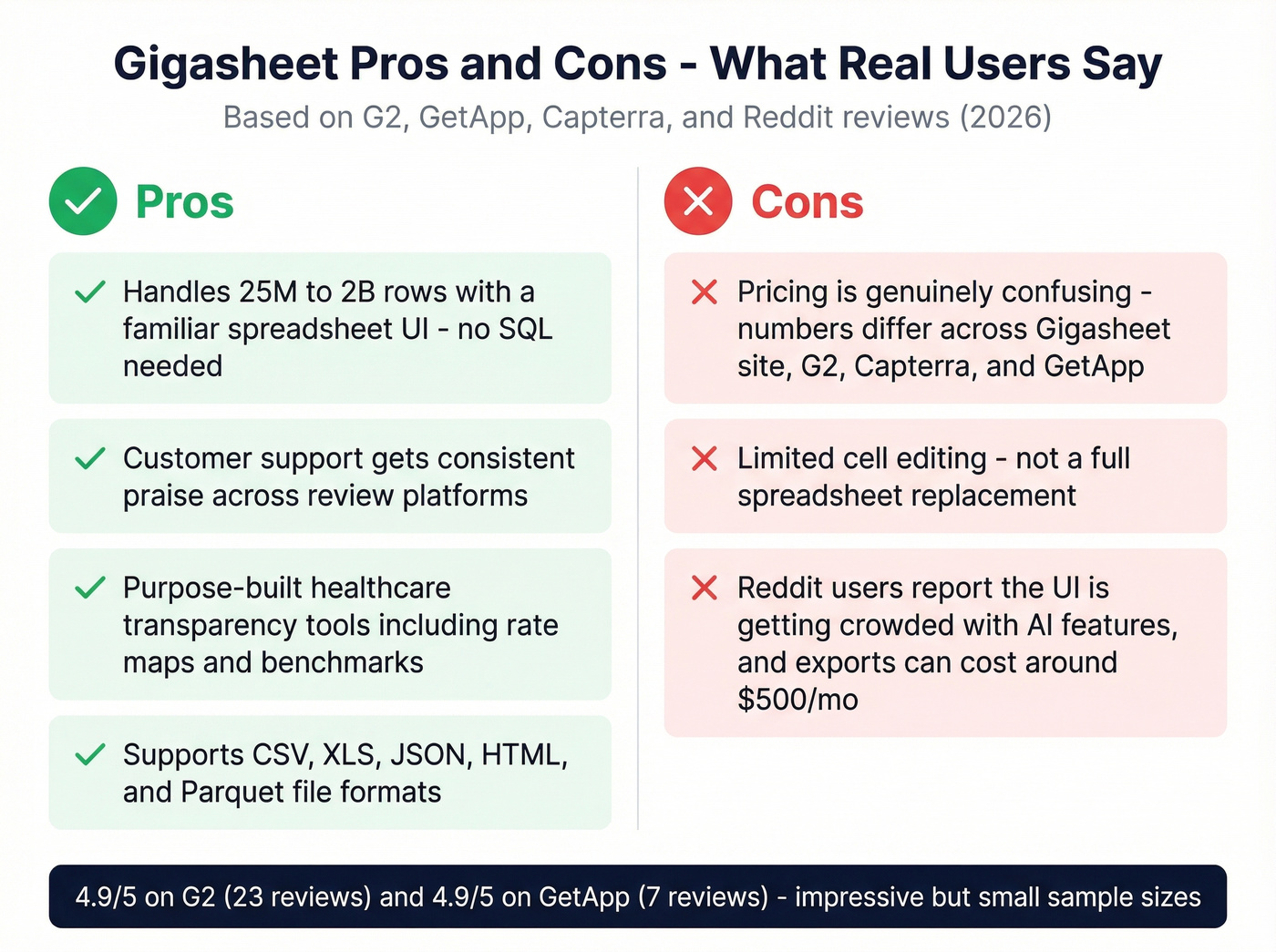
- Spreadsheet-like UI handling 25M to 2B rows without SQL or coding knowledge
- Consistently praised customer support across user reviews
- Purpose-built healthcare transparency features including interactive rate maps, visual plan comparisons, and automated benchmarks via the new Price Transparency Explorer launched in February 2026
- Warehouse backend architecture with broad format support - CSV, XLS, JSON, HTML, and Parquet
Cons:
- Genuine pricing confusion across sources, compounded by unclear tier labeling on Gigasheet's own page - and features that were once free now sit behind paid tiers
- Limited cell editing capabilities, which reviewers flag as a gap for anyone expecting full spreadsheet functionality
- One Reddit user reported the interface is "getting way too complicated and crowded with AI functionality" and that doing occasional large-file exports could run roughly $500/month, calling the pricing "out of hand"

Gigasheet's pricing confusion proves a point: you shouldn't need a spreadsheet to figure out what you're paying. Prospeo's pricing is transparent - $0.01/email, no contracts, no sales calls. 300M+ profiles, 98% email accuracy, and a free tier you can start in 30 seconds.
Stop analyzing pricing pages. Start building pipeline.
Who Should (and Shouldn't) Use Gigasheet
Use it if you're a healthcare organization analyzing Transparency in Coverage or MRF data at scale. The February 2, 2026 TiC enforcement requirements made this urgent for payers, providers, and benefits consultants. Gigasheet is one of the few platforms built specifically for this.
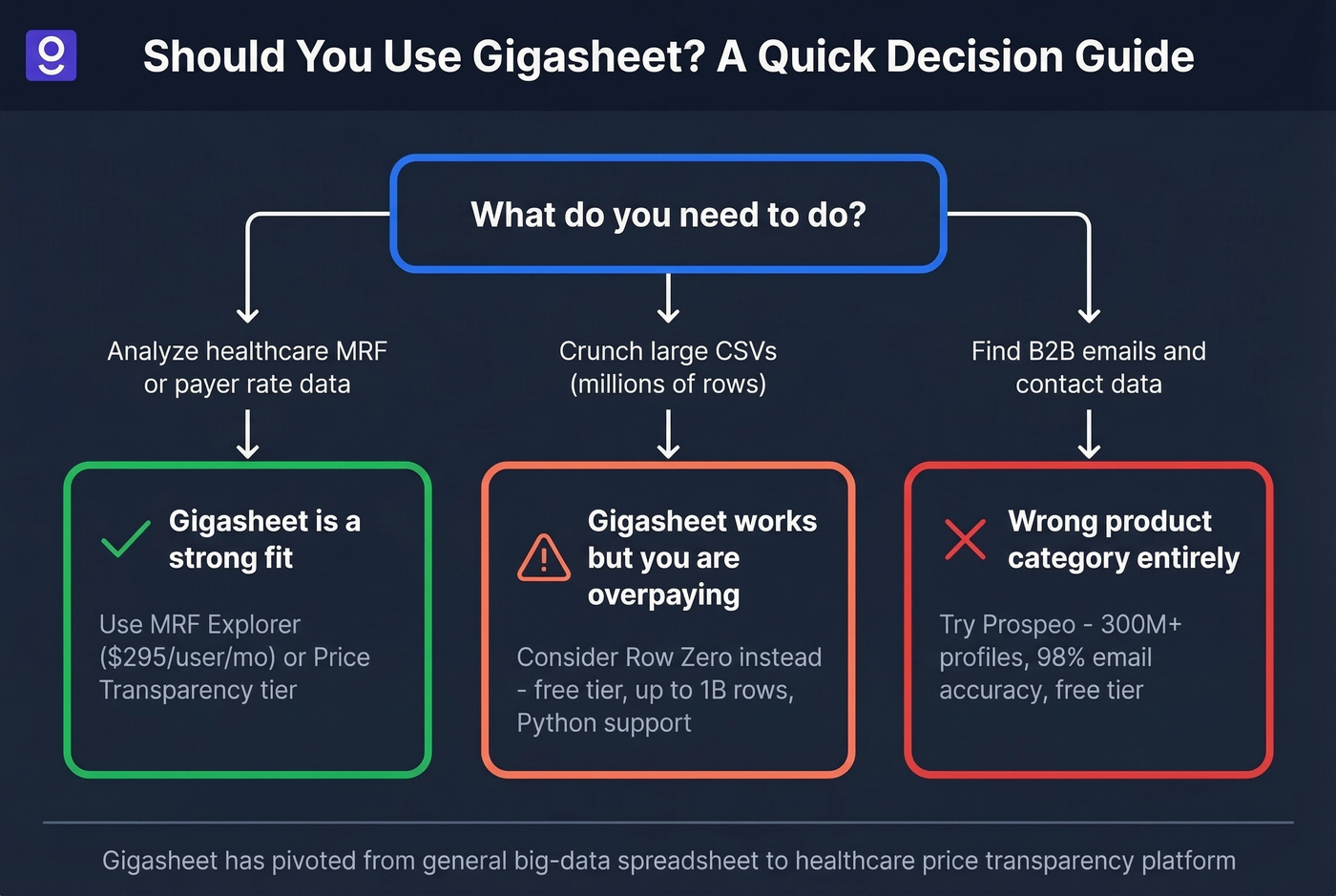
Power analysts working with multi-million-row CSVs might find value, but you're paying a premium for healthcare capabilities you won't touch. Row Zero is cheaper for pure spreadsheet-scale analysis.
Skip it if you need lead enrichment. Gigasheet doesn't do prospecting, email finding, or lead enrichment. For verified emails and direct dials, Prospeo is the right category - 300M+ professional profiles, 98% email accuracy, and a free tier with no demo required.
Alternatives Worth Considering
Row Zero takes an in-memory approach rather than Gigasheet's warehouse backend. It can open CSVs up to 1 billion rows, supports Python functions, and has a free tier. The tradeoff: Row Zero handles basic spreadsheet-style formats like well-formed CSV, while Gigasheet supports JSON, Parquet, and HTML. For general analytics without healthcare needs, Row Zero is the better pick.
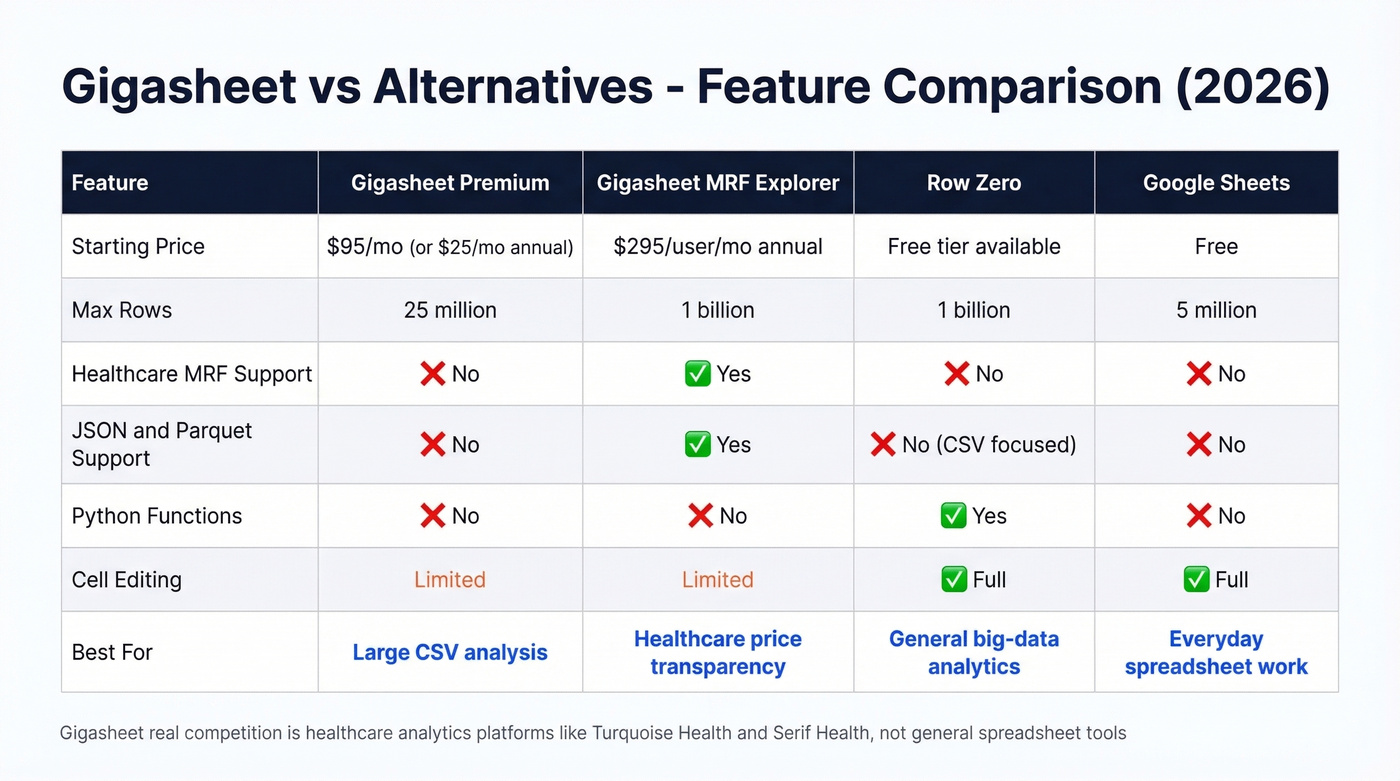
Excel and Google Sheets still work fine for plenty of day-to-day analysis - but they hit hard limits. One G2 reviewer notes Google Sheets caps out at 5 million rows and 10 million cells per sheet. If your files regularly blow past that, you need something else.
Let's be honest about the competitive picture, though. Gigasheet's real competition isn't other spreadsheet tools - it's healthcare analytics platforms like Turquoise Health and Serif Health. The moment they pivoted to price transparency, they stopped competing on general-purpose big data and started competing on domain expertise. If you're not in healthcare, you're browsing the wrong aisle.
The Bottom Line
Gigasheet isn't a general-purpose big-data spreadsheet anymore - it's a healthcare price transparency platform with spreadsheet DNA. The 4.9 ratings hold up but the sample sizes are too small to be definitive, and the pricing page needs serious cleanup. If you're analyzing payer rates and MRF files post-enforcement, it's worth a demo at the MRF Explorer tier or above. If you just need to crunch large CSVs, you're overpaying for a healthcare tool. Know which problem you're solving before you commit.
If you landed here looking for B2B contact data, Gigasheet isn't it. Prospeo gives you 30+ search filters, 143M+ verified emails, and 125M+ direct dials - with a 7-day data refresh cycle that's 6x faster than the industry average. No healthcare pivot required.
Get verified emails and direct dials, not spreadsheet rows.