

The Go to Market Approach That Actually Works (With Real Numbers)
Only 40% of products launched actually make it to market. The other 60% don't fail because the product was bad - they fail because the commercial system around the product was broken. Wrong audience, wrong channel, wrong pricing, wrong motion.
There's a reason a post titled "k wtf is go to market" exists on r/FPandA. The term gets thrown around constantly, and half the time it means "marketing plan" and the other half it means "sales plan." Neither is right.
A go to market approach is the whole commercial engine: who you're selling to, how you reach them, what you charge, how you close, and what you measure to prove it's working. Let's break it down with a framework you can actually use this quarter, plus the numbers that keep you honest.
Quick version: If your ACV is under $5K, go product-led. Between $5K and $25K, run a hybrid play - PLG acquisition plus sales-assisted expansion. Above $25K, go sales-led. Three metrics matter: LTV:CAC >= 3:1, CAC payback under 12 months, and pipeline velocity.
What a GTM Approach Actually Is
A go to market approach is the system a company uses to bring a product to buyers and generate revenue. It covers ICP definition, positioning, pricing, channel selection, sales motion, onboarding, retention, and the metrics that tell you whether the machine is healthy. Marketing strategy sits inside that system. It isn't the system.
You need a GTM approach in three moments: launching a new product, entering a new market, or fixing something that's stalled. Same product, different decisions.
A Bain study of 2,300 global companies found that only 9% achieved sustained revenue and profit growth over a decade. The separator wasn't prettier decks. It was an adaptive commercial system that kept execution aligned with the market as the market changed.
| GTM Approach | Marketing Strategy | Business Strategy | |
|---|---|---|---|
| Scope | Full commercial system | Demand generation | Company direction |
| Timeframe | Launch to traction | Ongoing campaigns | 3-5 year horizon |
| Owner | Cross-functional (CEO/CRO) | CMO / marketing team | CEO / board |
| Output | Revenue from new market | Leads and awareness | Portfolio allocation |
| Example | Sell Barista Edition to US cafes | Content calendar for Q3 | Expand into APAC by 2028 |
Nine GTM Motions (and How to Pick)
Most GTM posts give you two options: product-led or sales-led. That's like saying there are two ways to get from New York to LA - fly or drive. In reality, there are nine distinct GTM motions, and picking the right one (or combining two) is the highest-impact decision you'll make.
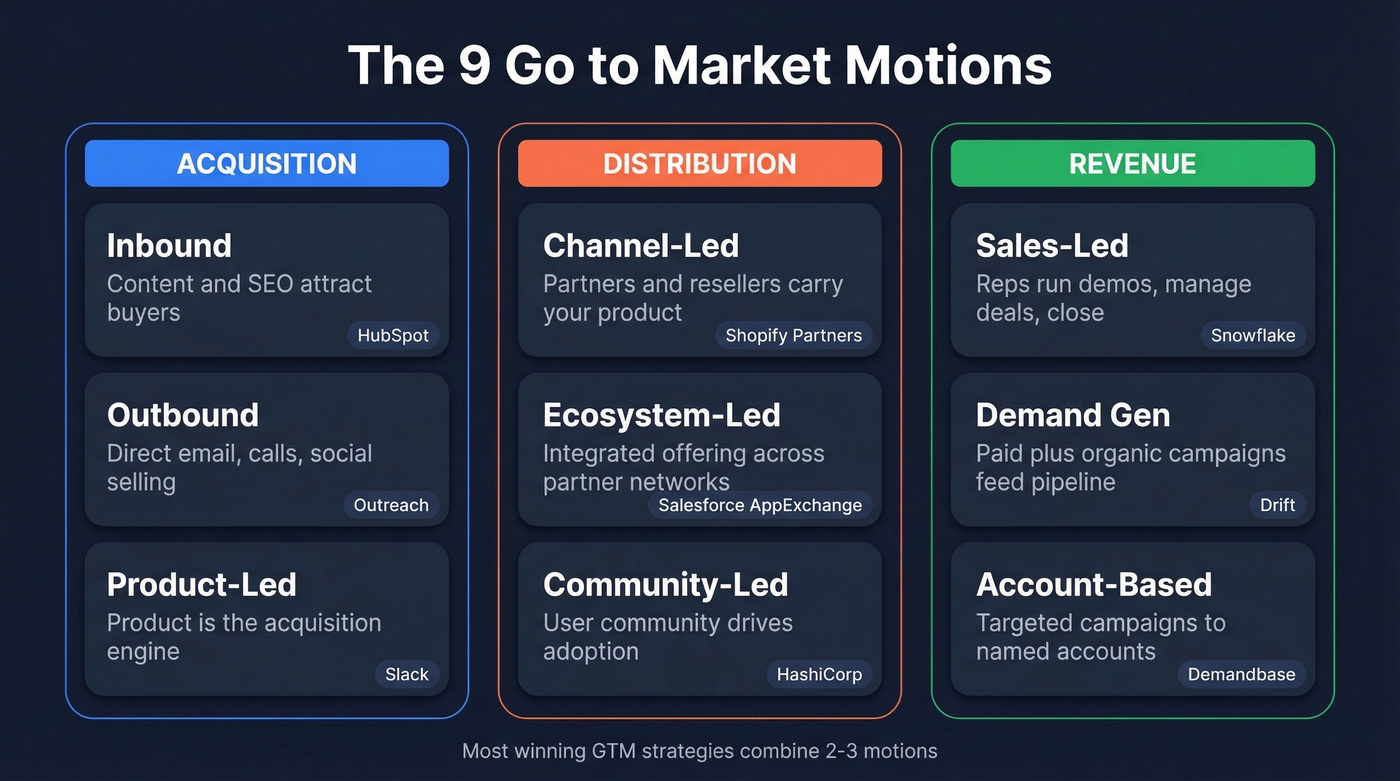
The motion taxonomy
| Tier | Motion | What it is | Example brand | When it works |
|---|---|---|---|---|
| Acquisition | Inbound | Content/SEO attracts buyers | HubSpot | Long cycles, education-heavy markets |
| Outbound | Direct email, calls, social selling | Outreach | Clear ICP, higher ACV, revenue pressure | |
| Product-led | Product is the acquisition engine | Slack | Simple product, low ACV, viral loops | |
| Distribution | Channel-led | Partners and resellers carry your product | Shopify Partners | Geographic expansion, regulated industries |
| Ecosystem-led | Integrated offering across partner networks | Salesforce AppExchange | Platform plays, API-first products | |
| Community-led | User community drives adoption | HashiCorp | Developer tools, niche verticals | |
| Revenue | Sales-led | Reps run demos, manage deals, close | Snowflake | Complex products, multi-stakeholder buying |
| Demand gen | Paid + organic campaigns feed pipeline | Drift | Established category, proven funnel | |
| Account-based | Targeted campaigns to named accounts | Demandbase | Enterprise, high ACV, small TAM |
Outbound deserves a blunt callout. It's one of the fastest ways to create pipeline, and it's also one of the easiest ways to torch your deliverability if your data's sloppy. We've seen teams "test outbound" with a list full of old contacts, rack up bounces, and then spend the next month wondering why even their legit emails land in spam. It's a self-inflicted wound, and it's maddening because it's avoidable.
Prospeo is built for that exact problem: 300M+ professional profiles, 143M+ verified emails, 125M+ verified mobile numbers, and 98% email accuracy on a 7-day refresh cycle. That freshness matters more than most people admit, because a list decays while you're still writing the sequence.
Kyle Poyar summed up PLG well: "Product-led growth is about prioritizing the user experience in everything you do." It's a great north star. It also breaks down fast when the product needs a security review, procurement, and three stakeholders to agree on budget.
ACV decision matrix
Companies spend $2 in sales and marketing for every $1 of new ARR, and that ratio climbed 14% since 2024. Pick the wrong motion and you're not "being aggressive." You're just lighting money on fire, faster.
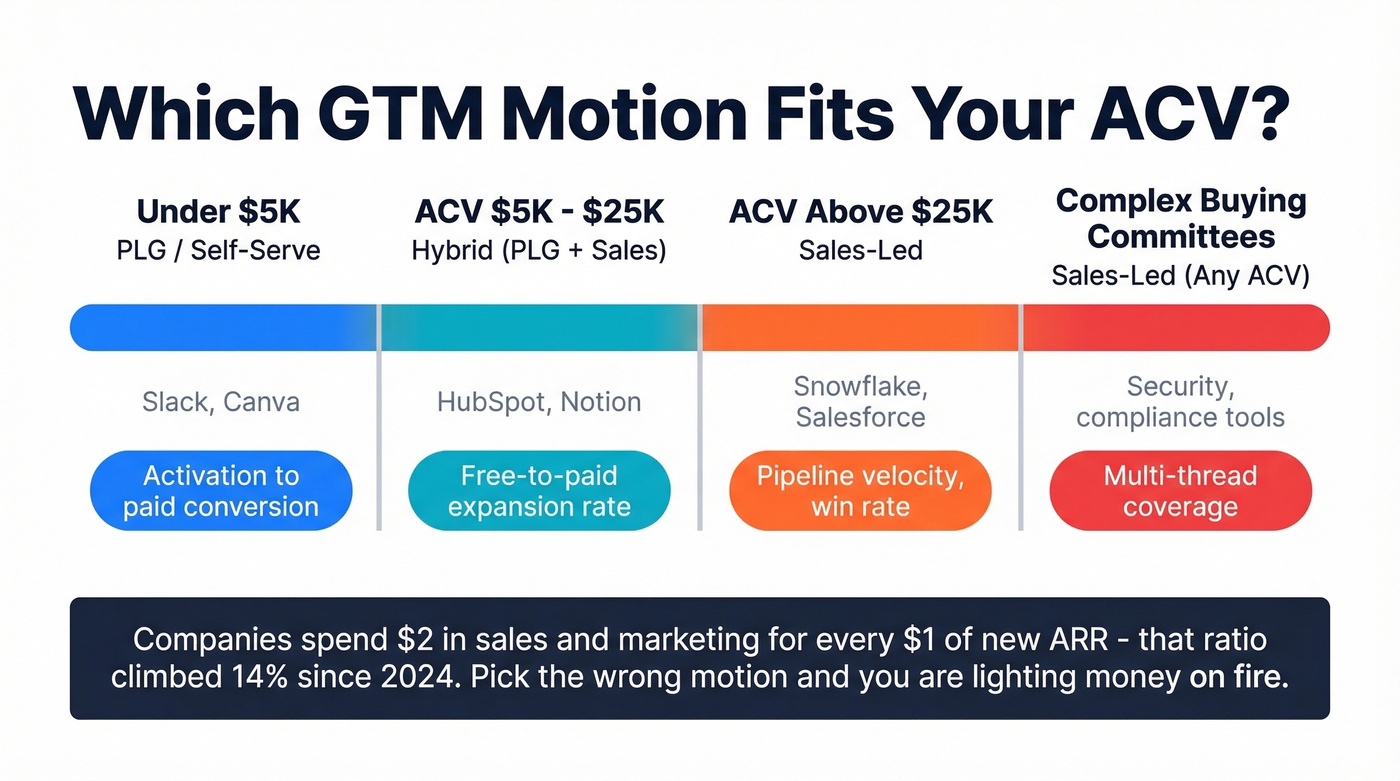
| ACV band | Recommended motion | Example | Key metric |
|---|---|---|---|
| Under $5K | PLG / self-serve | Slack, Canva | Activation -> paid conversion |
| $5K-$25K | Hybrid (PLG + sales) | HubSpot, Notion | Free-to-paid expansion rate |
| Above $25K | Sales-led | Snowflake, Salesforce | Pipeline velocity, win rate |
| Complex committees | Sales-led (any ACV) | Security, compliance tools | Multi-thread coverage |
Hot take: a lot of Series A teams default to sales-led because it feels like "real" selling. But if your average deal is under $10K and you're hiring a VP of Sales before you've personally closed 20 deals, you're building a mature-company GTM before you've earned it. That mistake is expensive, and it usually shows up as a bloated CAC and a pipeline that looks busy but doesn't close.
Build Your GTM in Seven Steps
1) Size your market
TAM, SAM, SOM isn't just investor theater. It tells you whether your unit economics can ever work.
TAM is the total addressable market at 100% share. SAM is what you can serve with your current product and constraints. SOM is what you can realistically win in the next 12-18 months. If your SOM can't support a 3:1 LTV:CAC ratio at your target price point, you don't have a sales problem yet. You've got a math problem.
2) Define your ICP
Firmographics like industry, headcount, and revenue are table stakes. The ICPs that convert layer in behavior: tech stack, hiring patterns, funding events, and intent signals.
Here's the thing: "everyone who could buy" is not a list. It's a fantasy. The tighter your ICP, the higher your conversion rate and the lower your CAC, because your messaging gets sharper and your channel choices get simpler.
3) Nail your positioning
Test your value prop in founder-led sales conversations before you put it on a landing page. That's the highest ROI move in this whole process.
Generic positioning like "We're an AI-powered platform for..." doesn't answer the two questions buyers care about: why you, and why now. Build a simple value map: buyer's top three problems, your solution, and the alternative (including doing nothing). If you don't clearly win on at least one row, your positioning isn't done.
4) Set your pricing
Pricing is positioning with teeth.
Pricing too low signals low quality, especially in B2B where buyers use price as a proxy for reliability, support, and whether you'll still exist in 18 months. Price based on value delivered, not your costs. And test pricing early, because it forces clarity: what are buyers actually paying for, and what do they ignore?
5) Choose your channels
Your channel strategy has to match your ACV and your team's current capacity. A two-person startup running ABM across six channels isn't "ambitious." It's scattered.
Pick one primary channel, validate it, then add a second once the unit economics are stable. We'll get into CAC benchmarks below, but the headline is simple: channel cost has to fit deal size, or the math never works.
6) Build your prospect list (if outbound's in the mix)
For outbound and hybrid motions, your prospect list is the engine. Bad data means bounces, burned domains, and SDR hours wasted on people who left the company six months ago.
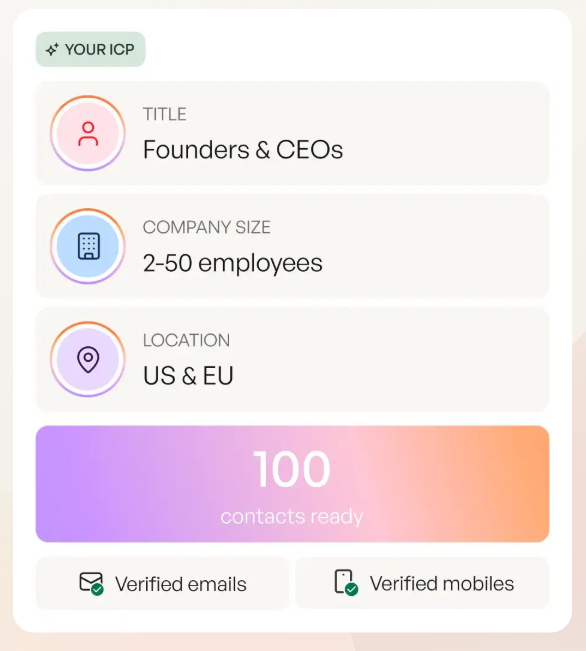
A practical setup we like: start with a narrow ICP, build a list, verify it, then run a small batch (100-300 contacts) to learn what messaging and offers get replies before you scale volume. Prospeo makes this workflow straightforward: 30+ search filters to build targeted lists, real-time email and mobile verification, CSV enrichment, and a Chrome extension that pulls contact data from web sources and inside your CRM. It's self-serve, starts free, and the pricing stays transparent as you scale.

Skip this step if you're pure PLG and your ACV is truly low. If you're selling anything that needs a human touch, though, list quality is one of those boring details that decides whether outbound works at all.
7) Set KPIs before launch
Three numbers matter more than everything else:
- LTV:CAC ratio: target 3:1 or better
- CAC payback period: under 12 months
- Pipeline velocity: deals x win rate x ACV / cycle length
Set targets before launch so you know what "working" looks like. Otherwise, every week turns into vibes-based decision making, and you'll keep changing channels and messaging before anything has time to compound.
A clean way to think about GTM scaling is three phases: initiation (founder-led), transition (first hires), and execution (repeatable motion). Most teams try to skip initiation. Don't. That's where you learn the language, triggers, and willingness-to-pay signals that make everything downstream work.

Outbound is the fastest GTM motion to generate pipeline - but only if your data doesn't tank your deliverability. Prospeo delivers 300M+ profiles with 98% email accuracy on a 7-day refresh cycle, so your sequences hit real inboxes.
Stop torching your domain reputation with stale data.
CAC Benchmarks for 2026
CAC has climbed 40-60% between 2023 and late 2025, and it hasn't snapped back. Knowing your channel-level CAC isn't optional anymore. It's survival math.
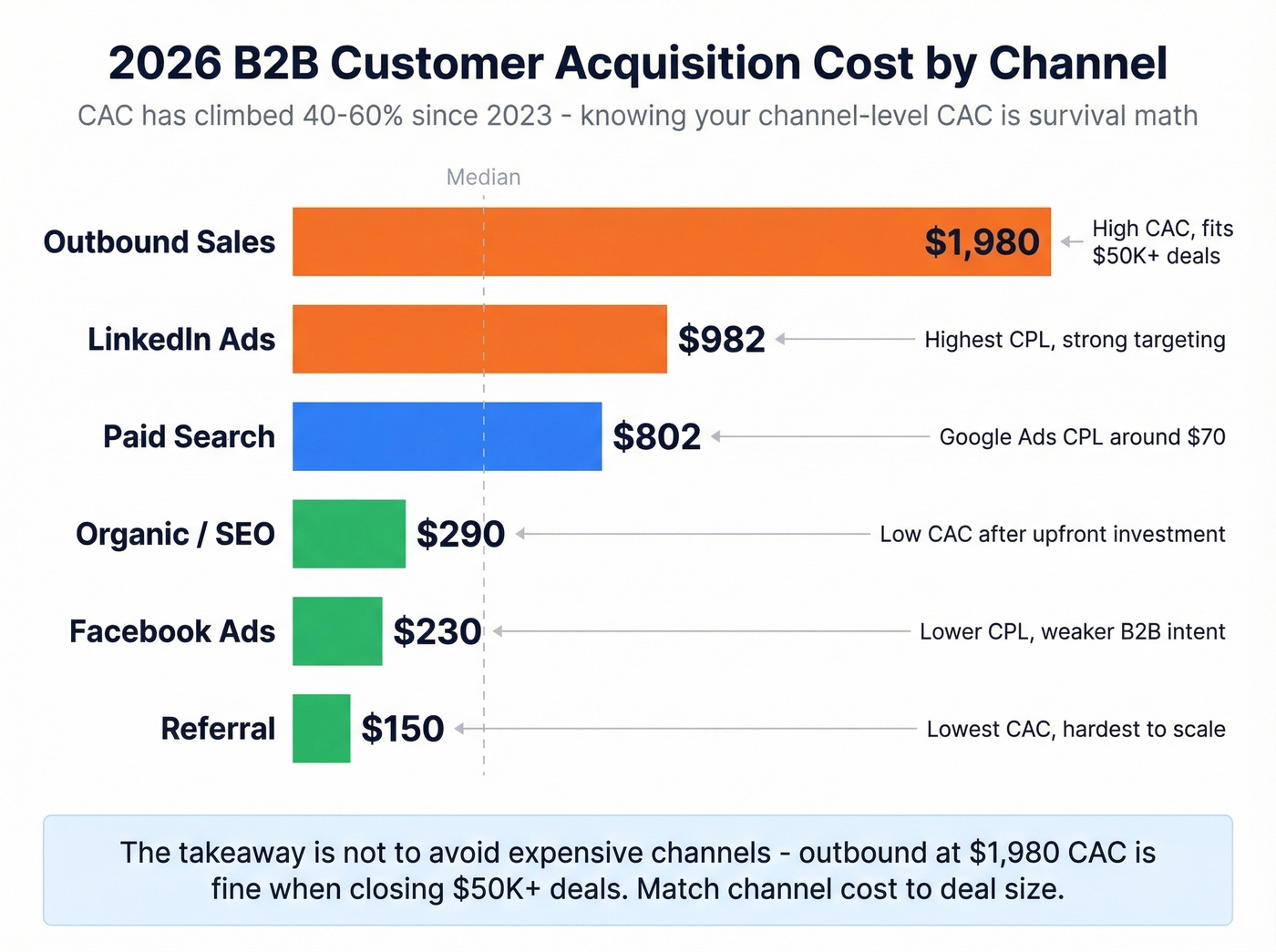
| Channel | Avg. B2B CAC | Notes |
|---|---|---|
| Paid Search | $802 | Google Ads CPL around $70 |
| LinkedIn Ads | $982 | Highest CPL, strong targeting |
| Facebook Ads | $230 | Lower CPL, weaker B2B intent |
| Outbound Sales | $1,980 | High CAC, fits higher ACV deals |
| Organic / SEO | $290 | Low CAC after upfront investment |
| Referral | $150 | Lowest CAC, hardest to scale |
The takeaway isn't "avoid outbound because it's expensive." Outbound at $1,980 CAC is fine when you're closing $50K+ deals with healthy gross margins. The mistake is running outbound for sub-$5K deals where the payback never pencils out, then blaming the SDR team for a math problem they can't fix.
How Oatly Went from $6M to $100M
Oatly didn't enter the US by buying shelf space at Walmart. They entered through specialty coffee shops - and the channel sequencing is a masterclass.
In 2016, Oatly launched Barista Edition in the US, targeting premium cafes like Blue Bottle and La Colombe in NYC. The product was formulated to froth and perform in espresso drinks, which mattered a lot to baristas and not at all to grocery shoppers. Barista Edition accounted for nearly 40% of cafe sales.
The move was deliberate: win tastemakers first, then expand. Word-of-mouth spread through vegan and fitness micro-influencers. By the time Oatly hit Whole Foods shelves in 2018, demand already existed, and shelves emptied for weeks. Resellers listed cartons for around $15 on secondary markets. The New Yorker wrote about the "oat milk shortage."
The tagline - "It's like milk, but made for humans" - was provocative on purpose. It made every other milk the weird choice, not Oatly.
US revenue grew from roughly $6M in 2018 to $100M by the end of 2020. By 2021, Oatly went public at about a $10B valuation, built on a GTM system that started with one product in a handful of New York cafes. That's not a "marketing win." That's sequencing, a tight use case, and expansion timed to pull-through demand.
Seven Mistakes That Kill Launches
1) Confusing GTM with marketing
GTM includes pricing, sales motion, channel sequencing, and success metrics, not just demand gen. I once watched a team ship a gorgeous content machine while their sales process was basically "book a demo and hope." They hit traffic goals every month and still missed revenue because nobody owned the messy middle between interest and signed contract.
Marketing's part of GTM. It isn't the whole thing.
2) Targeting too broadly
Multiple segments means multiple buying processes, multiple value props, and diluted execution everywhere. Oatly didn't try to win grocery shoppers and baristas at the same time. They picked a beachhead, owned it, then expanded.
3) Assuming a channel will scale
Your first 20 customers came from founder networks and warm intros. That's not a channel. That's a head start.
The real question is whether your next 200 customers come from a repeatable motion at a sustainable CAC.
4) Ignoring pricing signals
Pricing too low doesn't just leave money on the table. It signals your product isn't serious. In B2B, buyers use price as a proxy for support, reliability, and longevity.
Test pricing up before you test it down.
5) Picking the wrong sales model
Self-serve sounds efficient until your buyer needs procurement approval, a security review, and a DPA signed before they can swipe a card. Procurement and compliance break self-serve assumptions for a lot of enterprise deals, even when the product is easy to use.
6) Focusing only on acquisition
Retention and referrals get ignored while teams pour budget into top-of-funnel. That's a leaky bucket.
Bad prospect data is a silent killer here, too. Bounces wreck domain reputation and poison outbound before it has a chance to work, which is why we treat verification as non-negotiable in our own outbound programs.

7) Scaling before product-market fit
Spending on sales and ads while the product still has usability gaps is the most expensive mistake on this list. You're not buying growth. You're buying churn.
Founder-led sales is the antidote. Those early conversations produce the language, triggers, and willingness-to-pay signals that turn into a repeatable engine later, and you can't outsource that learning to a deck or a dashboard.
Your Go to Market Approach Is a System
That Bain stat is worth repeating: of 2,300 global companies studied, only 9% achieved sustained revenue and profit growth. The difference wasn't a better launch plan. It was an adaptive commercial system with fast feedback loops.
Bain contrasts Samsung and Nokia between 2006 and 2010. Samsung gained roughly 6 points of market share while Nokia lost 6. Both had great products. Samsung adapted its GTM system regularly. Nokia ran a plan that assumed the market would stay still.
In our experience, teams that nail their go to market approach don't have better slide decks. They have faster feedback loops, tighter ICPs, and the discipline to measure what matters even when the numbers are uncomfortable.
Build a one-page GTM canvas with six modules: ICP definition, positioning statement, pricing model, channel plan, KPI tracker, and launch checklist. Treat each module as a living document that gets rewritten every quarter based on what you're learning from real buyers, not internal opinions. That sounds simple, but it's hard in practice because it forces you to admit when a channel isn't working, when your pricing is off, or when your "ideal customer" isn't actually buying.
The companies that win aren't the ones with the best initial strategy. They're the ones that learn fastest and adjust before the market moves past them.
Your ICP definition is worthless without the contacts to back it up. Prospeo's 30+ filters - intent data, technographics, funding, headcount growth - turn your ideal customer profile into a targetable list with verified emails and direct dials.
Turn your ICP from a slide deck into a live pipeline.
FAQ
What's the difference between a go to market approach and a marketing strategy?
A go to market approach covers the full commercial system: positioning, pricing, sales motion, channel selection, and success metrics. Marketing strategy is one part of it, focused on generating awareness and demand. You can run great marketing and still fail at GTM if pricing, channel sequencing, or the sales motion is wrong.
How long does it take to build a GTM strategy?
One to two weeks for an initial canvas, plus 30-90 days of validation through founder-led sales. The real strategy comes from buyer conversations, not slides, so plan for iteration.
What's the best GTM motion for a startup with no sales team?
If your ACV is under $5K, go product-led. If it's above $5K, founder-led outbound is usually the fastest path to learning, as long as your list is clean and your ICP is tight. Hire reps after you've closed 10-20 deals and can explain the repeatable motion in plain English.
How do I know if my go to market approach is working?
Track three metrics: LTV:CAC ratio (target 3:1 or better), CAC payback period (under 12 months), and pipeline velocity. If CAC payback stretches past 12 months, your motion or channel has a structural problem, so revisit the ACV decision matrix and your channel mix.