

Go-to-Market Sales Strategy: The Monday-Morning Playbook for 2026
You launched. You got the press hit. The CEO posted on social. And the pipeline still isn't there. That's not a marketing problem - it's a go-to-market sales strategy problem. It's the gap between the deck your team presented to the board and what your SDRs actually do on Monday morning.
Bain surveyed 2,300 global companies and found only 9% sustained 5.5%+ annual revenue and profit growth over a decade. The other 91% had strategies. They had decks. What they didn't have was an operating system that connected positioning to pipeline math to daily execution.
What You Actually Need
Stop writing GTM decks. Write a GTM scorecard and a playbook. A sales-ready go-to-market plan that works has three non-negotiable pieces:
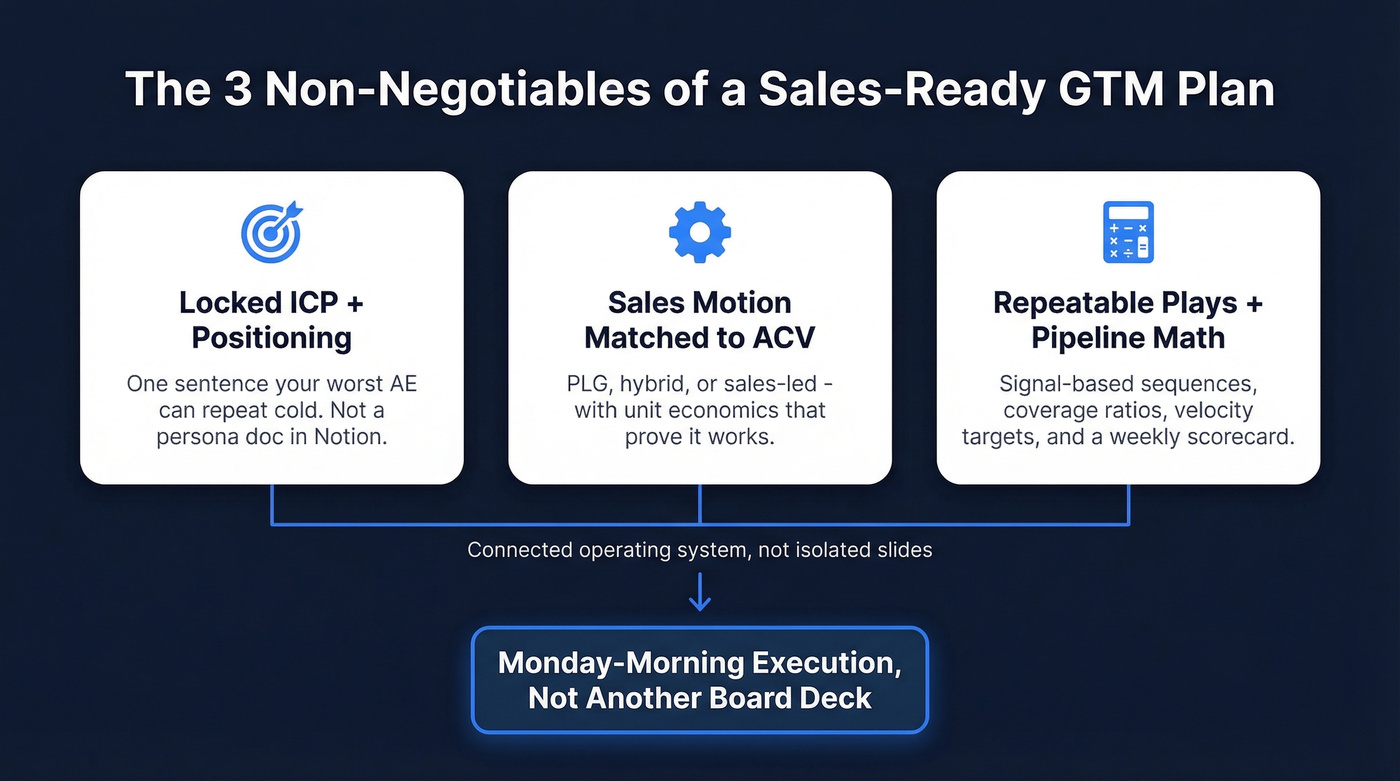
- Locked ICP + positioning - not a persona doc that lives in Notion. A one-sentence positioning statement your worst AE can repeat cold.
- A sales motion matched to ACV and buying complexity - PLG, hybrid, or sales-led, with the unit economics to prove it works.
- Repeatable plays with pipeline math behind them - signal-based sequences, coverage ratios, velocity targets, and a scorecard that tells you if you're winning or bleeding.
Too many GTM guides never mention pipeline coverage, win rates, or sales cycle math. That tells you they weren't written by people carrying a number.
Lock Your ICP and Positioning
April Dunford defines positioning as "how your product is a leader at delivering something that a well-defined set of customers cares a lot about." That's not a tagline - it's the context that tells buyers who you compete with, what features to expect, and whether your price makes sense. If you can't explain your positioning in one sentence, your reps will default to feature dumping. Every time.
Dunford's own work proves how much this matters. She helped a database company reposition from "desktop database - an Access killer" to "embeddable database for mobile devices." Same product, completely different market context. The repositioning unlocked a segment the sales team couldn't reach before. We've seen this pattern repeatedly: the product doesn't need to change, the framing does.
The 15-interview method validates your ICP before you build anything else. Run 15 conversations - five existing customers, five competitor customers, five target-market prospects. If 8+ of 15 repeat the same pain unprompted, you've got signal. Fewer than that, and your ICP is a guess.
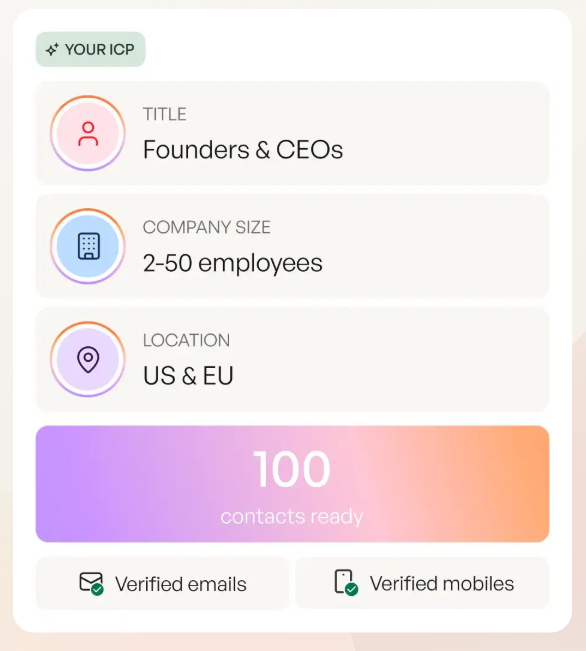
Build a one-page ICP card: company firmographics, buyer role, trigger event, pain, desired outcome, and proof you can deliver. Then lock your positioning:
For [target customer] who [problem], [product] is a [category] that [benefit]. Unlike [alternative], we [unique mechanism/proof].
That canvas drives everything downstream - messaging, sequences, battlecards, pricing. Get it wrong and every dollar you spend on outbound compounds the mistake.
Choose Your Sales Motion
Your ACV and buying complexity determine your motion. Not your preference, not your board's opinion - the math.
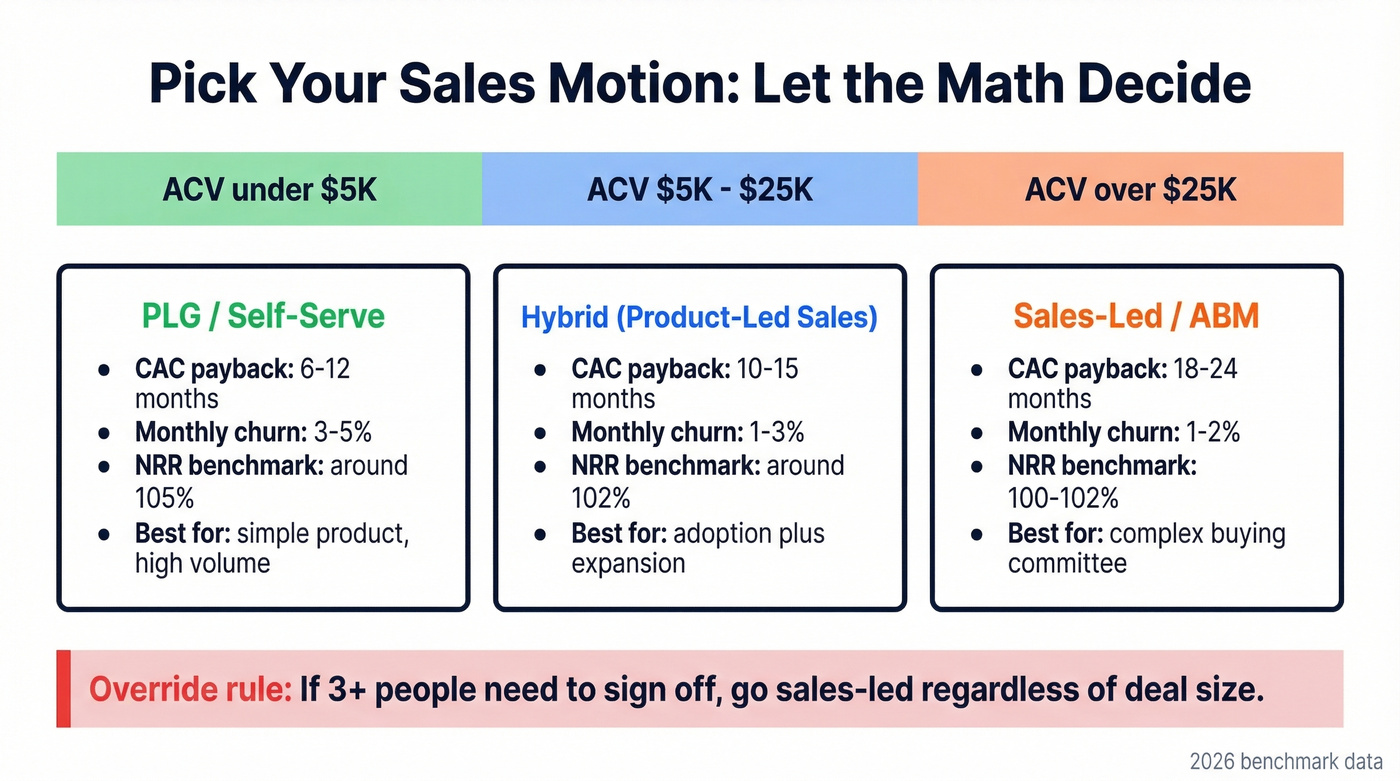
| Dimension | PLG / Self-Serve | Hybrid (PLS) | Sales-Led / ABM |
|---|---|---|---|
| ACV sweet spot | <$5K | $5K-$25K | >$25K |
| CAC payback | 6-12 mo | 10-15 mo | 18-24 mo |
| Monthly churn | 3-5% | 1-3% | 1-2% |
| NRR benchmark | ~105% | ~102% | ~100-102% |
| When to use | Simple product, high volume | Adoption + expansion | Complex buying committee |
Here's the thing: pure PLG rarely delivers outsize gains on its own. McKinsey analyzed 107 public B2B SaaS companies and found a small subset of outperformers drives the PLG average. The practical GTM sales motion for 2026 is product-led sales - bottom-up adoption feeding a sales team that uses product usage analytics to identify expansion-ready accounts. Hybrid inbound+outbound teams see up to 38% higher revenue growth than single-motion teams, which is why we push every company we work with toward a blended approach.
One override: complex buying committees mean sales-led regardless of deal size. If three people need to sign off on a $4K contract, self-serve won't close it. Match the motion to the buyer's process, not just the price tag.
ICONIQ's data shows AI-native companies convert trial-to-closed-won at 56% versus 32% for everyone else. That gap will only widen.
Pipeline Math That Matters
Pipeline velocity is the single metric that connects your sales motion to revenue:
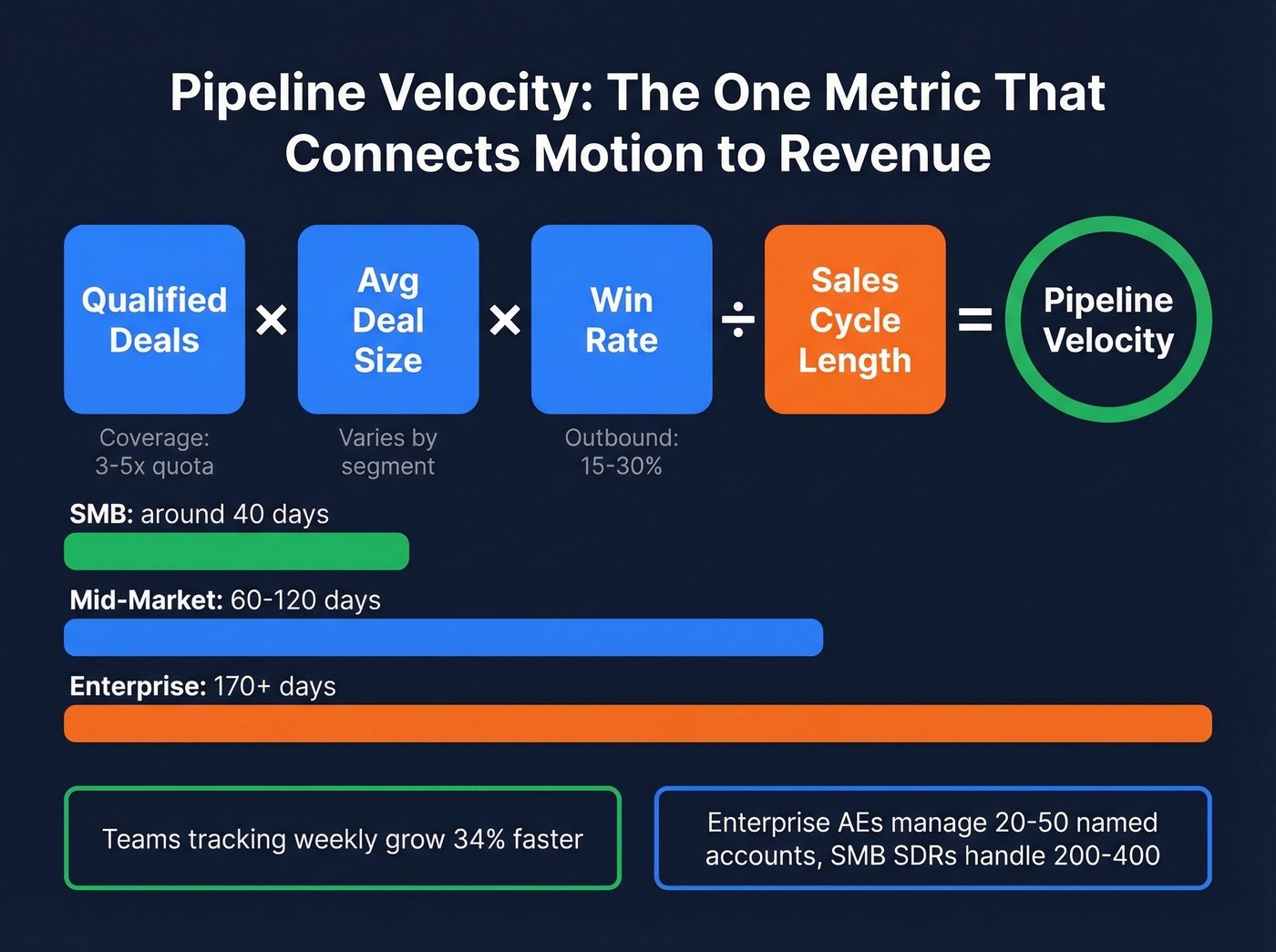
Pipeline Velocity = (Qualified Deals x Avg Deal Size x Win Rate) / Avg Sales Cycle Length
Track it weekly. Teams that do grow 34% faster than those running monthly or quarterly reviews. Your pipeline coverage target should sit at 3-5x quota - closer to 5x if your win rates are below 20%, closer to 3x if you're converting well on inbound.
Time-to-first-revenue varies dramatically by segment:
- SMB: ~40 days from first touch to closed revenue
- Mid-market: 60-120 days
- Enterprise: 170+ days
A capacity planning note most guides skip: enterprise AEs typically manage 20-50 named accounts, while SMB SDRs handle 200-400. If your reps are outside those ranges, your coverage model is broken before a single email goes out.
Win rates for outbound-sourced deals typically land between 15-30%. If your outbound win rate is below 15%, the problem is usually upstream - bad targeting, weak positioning, or stale data - not your closers.

Pipeline velocity depends on qualified deals - and qualified deals depend on reaching real buyers. Prospeo's 300M+ profiles with 30+ filters (intent, technographics, job change, headcount growth) let you operationalize your ICP card into a live target list. 98% email accuracy means your coverage ratio actually converts.
Stop running pipeline math on bad data. Start with contacts that connect.
GTM Plays That Create Pipeline
A sales play isn't a template. It's a signal-to-action recipe: when you see X, do Y, measure Z.
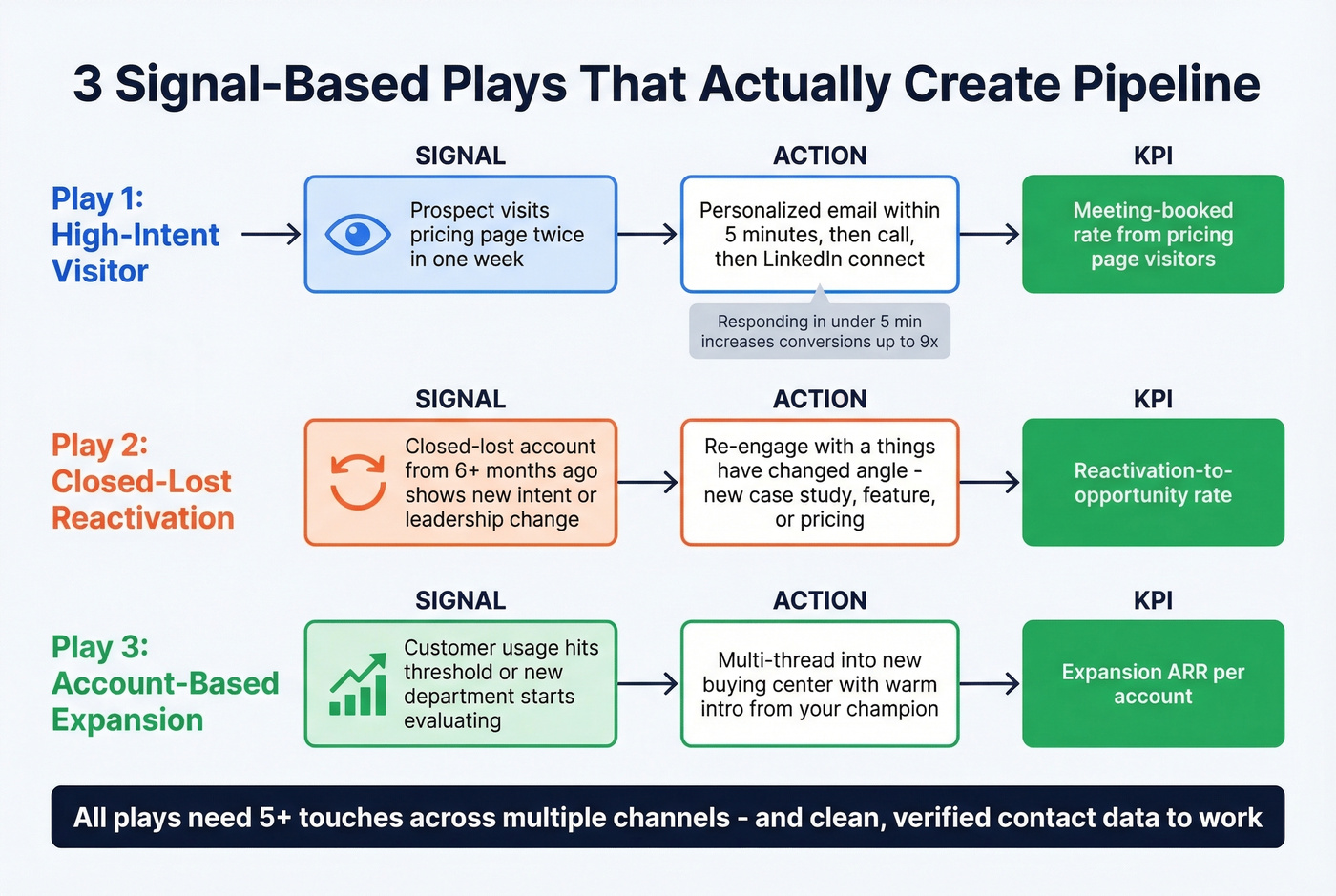
Play 1: High-intent website visitor. Signal: prospect visits pricing page twice in a week. Action: trigger a multichannel sequence - personalized email within 5 minutes (contacting inbound leads that fast increases conversions by up to 9x), followed by a call and a connection request. KPI: meeting-booked rate from pricing-page visitors.
Play 2: Closed-lost reactivation. Signal: a closed-lost account from 6+ months ago shows new intent signals or a leadership change. Action: re-engage with a "things have changed" angle - new case study, new feature, new pricing. KPI: reactivation-to-opportunity rate. This is the most underrated play in outbound, and the consensus on r/sales backs it up - reps who systematically work closed-lost accounts consistently outperform those chasing only net-new.
Play 3: Account-based expansion. Signal: existing customer's usage hits a threshold or a new department starts evaluating. Action: multi-thread into the new buying center with a warm intro from your champion. KPI: expansion ARR per account.
All three plays follow the same orchestration: define ICP segments, choose the trigger signal, layer intent conditions, build the sequence, monitor conversion. 80% of outbound deals need 5+ touches, and multichannel sequences drive 40%+ better engagement than single-channel.
Look, none of this works if your contact data is garbage. We've watched companies burn six figures on outbound with 25%+ bounce rates and single-digit connect rates. The play doesn't matter if the data is broken. Before you launch any sequence, run your list through a verification step - teams like Snyk cut their bounce rate from 35-40% to under 5% and saw AE-sourced pipeline climb 180% after switching to Prospeo's 7-day refresh cycle.
Enablement Before Day One
Reps can't run plays they don't understand. Before a single SDR touches a sequence, they need:
- Talk tracks aligned to your positioning canvas - pain-to-outcome narratives, not feature lists
- Objection handling docs built from real lost deals
- Battlecards for your top 3 competitors, updated quarterly
- Discovery scripts with open-ended questions that surface the trigger event and pain
- Case studies mapped to each ICP segment
- A call coaching feedback loop - recorded calls reviewed weekly
The definition of done for enablement isn't "we uploaded it to the wiki." It's "a new rep can run the closed-lost reactivation play on day 15 without asking their manager what to say."
I've sat in too many onboarding sessions where a new rep gets a Notion link and a "good luck." That's not enablement - it's abandonment. Inadequate enablement is one of the five most common GTM failure drivers, and it's the one most teams underinvest in because it doesn't feel like "strategy." Skip this if you want your ramp time to double and your best hires to churn out in six months.
Build Your GTM Scorecard
Numbers don't lie, but you have to track the right ones. Here's what 2026 benchmarks look like:
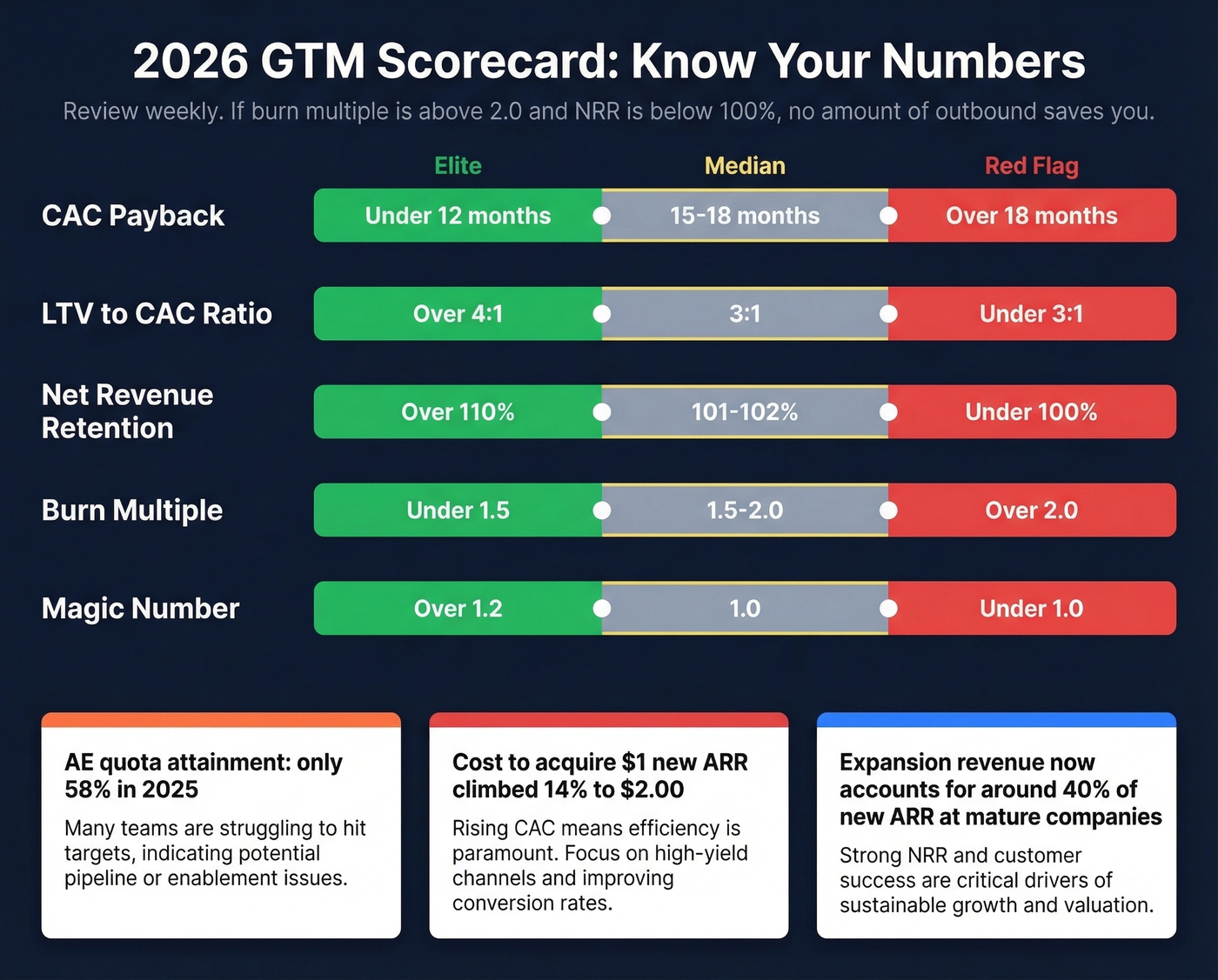
| Metric | Median | Elite | Red Flag |
|---|---|---|---|
| CAC payback | 15-18 mo | <12 mo | >18 mo |
| LTV:CAC | 3:1 | >4:1 | <3:1 |
| NRR | 101-102% | >110% | <100% |
| Burn multiple | 1.5-2.0 | <1.5 | >2.0 |
| Magic number | 1.0 | >1.2 | <1.0 |
Some context that makes these numbers sting: AE quota attainment sat at 58% in 2025 per ICONIQ's State of GTM report, barely moving from 59% the year before. Median SaaS annual revenue growth has dropped to 26%, down from 47% in 2024. The cost to acquire $1 of new ARR climbed 14% to $2.00. And expansion revenue now accounts for ~40% of new ARR at mature companies, meaning if your strategy is acquisition-only, you're leaving almost half the growth on the table.
Let's be honest: if your average deal is under $8K and you're running a full sales-led motion with enterprise-grade tooling costs, you're probably crushing your payback and burn multiple. Most teams in that range should run hybrid and invest the savings in product-led onboarding. The math doesn't lie.
Build this scorecard. Review it weekly. If your burn multiple is above 2.0 and your NRR is below 100%, no amount of outbound volume will save you.
Why GTM Strategies Fail
Five patterns show up repeatedly in failed execution. We've seen every one of them.
Misaligned market understanding. You skipped buyer validation. Fix: run the 15-interview method before you build the playbook.
Siloed execution. Product ships features marketing doesn't know about. Fix: weekly cross-functional standups with a shared pipeline dashboard.
Ineffective positioning. Messaging is feature-heavy instead of outcome-driven. Fix: rewrite every pitch around the positioning canvas.
Inadequate enablement. Reps got a Notion link and a "good luck." Fix: build the artifact list above and test reps on it.
Neglecting metrics. No KPIs, no optimization loop. Fix: implement the scorecard and review it before you review pipeline.
CB Insights analyzed 483 startup post-mortems: 42% failed due to no market need, 19% got outcompeted, 18% had pricing problems. Those aren't strategy failures - they're execution failures dressed up as bad luck.
If your go-to-market sales strategy doesn't change what SDRs do tomorrow morning, it's not a strategy. It's a deck.
FAQ
What's the difference between a GTM strategy and a sales strategy?
A GTM strategy covers the full path from product to market - audience, positioning, channels, pricing - while a sales strategy is the execution layer: motion, plays, pipeline math, and enablement. A go-to-market sales strategy combines both into a single revenue operating plan. Positioning without pipeline math is just branding; pipeline math without positioning is just spam.
How long does a GTM sales strategy take to show results?
SMB motions should generate first revenue within ~40 days. Mid-market takes 60-120 days. Enterprise: 170+ days. If you're not seeing pipeline signals within 30 days of outbound launch, something in your motion, data, or messaging is broken - diagnose before you scale.
What tools do I need to execute a GTM strategy?
At minimum: a CRM, a sales engagement platform for sequences, and a verified contact data source. Bad emails and stale phone numbers destroy deliverability and connect rates. Tools like Prospeo give you 98% email accuracy and mobile numbers refreshed every 7 days, with a free tier of 75 emails per month to start. Layer in intent data and conversation intelligence as you scale.
How do I build plays for a new market segment?
Start with the 15-interview method to validate the ICP, then map the buyer's journey for that segment. Identify trigger signals unique to those accounts - hiring patterns, tech stack changes, funding events - and build signal-to-action sequences around them. Test with 50-100 accounts before scaling, and track conversion at every stage.
Every GTM play in this article - intent-based sequences, closed-lost reactivation, account expansion - requires fresh, accurate contact data to execute. Prospeo refreshes every 7 days (not 6 weeks), so your signal-to-action plays hit real inboxes. At $0.01 per email, scaling from 200 to 2,000 accounts doesn't break your CAC model.
Run your plays on data that's 7 days fresh, not 6 weeks stale.