

How to Build a Go-to-Market Strategy for Europe (Without Burning Your Budget)
A RevOps lead we work with ran the same outbound playbook in Germany that crushed it in the US. Same sequences, same messaging, same cadence. Reply rates dropped 70%, bounce rates tripled, and the first German prospect who did reply asked why they'd received an unsolicited email in English. That's the go-to-market strategy for Europe learning curve compressed into one painful quarter.
Europe isn't a market. It's 52 countries, [27 in the EU](https://european-union.europa.eu/principles-countries-history/eu-countries_en), each with distinct languages, buying norms, compliance regimes, and trust signals. Only 29% of executives have implemented a GTM strategy effectively. Winning here means treating each country as its own GTM motion - not copy-pasting what worked stateside.
The Short Version
Pick one country, not a continent. Validate with at least 20 prospect conversations before committing infrastructure.
Invest in brand before outbound. European buyers lock in their shortlist on Day One 92.4% of the time. If you're not on that list, your SDRs are fighting uphill.
Build country-specific prospect lists with verified, GDPR-compliant data before hiring a single rep. Bad data in Europe doesn't just waste money - it creates legal exposure.
How European Buyers Actually Buy
The assumption most US teams carry into Europe is that their sales motion just needs translation. It doesn't. The buying process itself is structurally different.
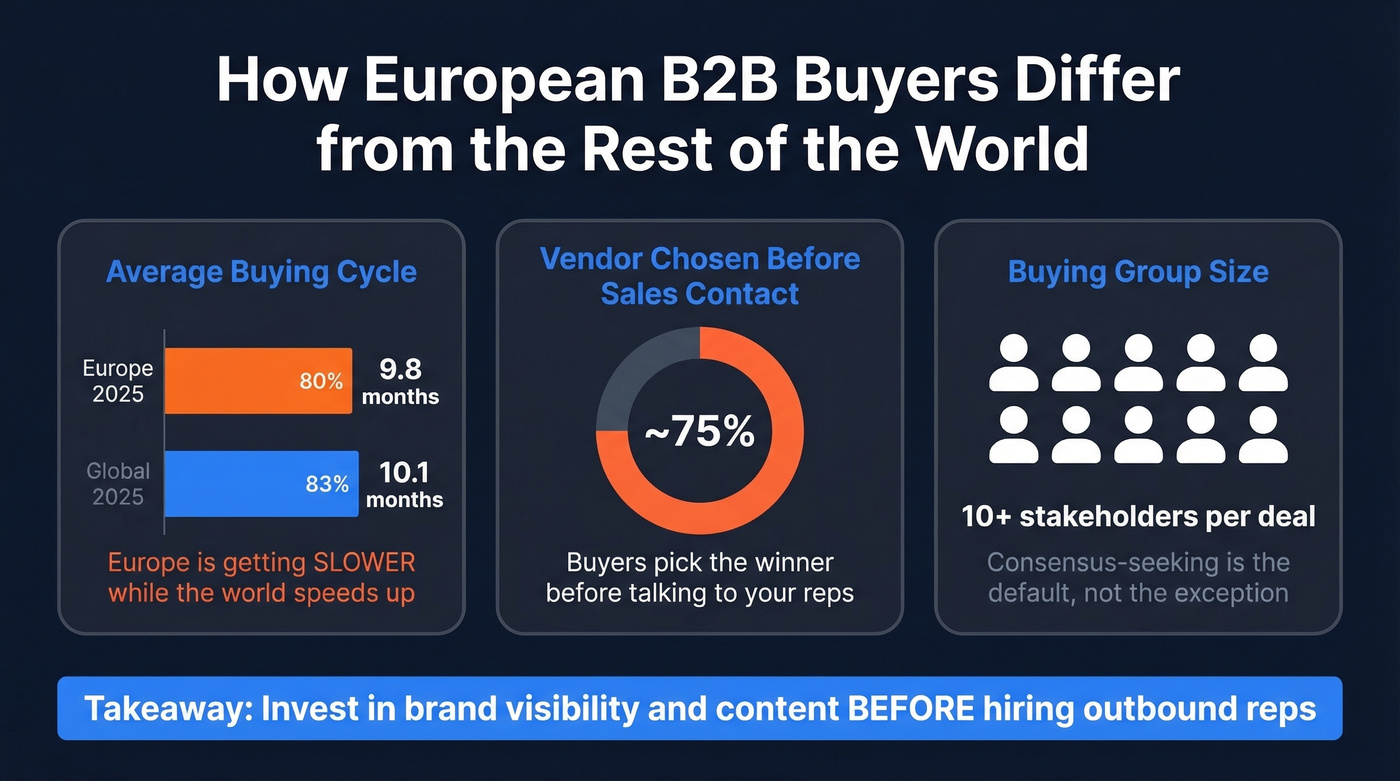
European B2B buying cycles rose to 9.8 months in 2025 data from 6sense, up from 9.0 months the year before - while global cycles actually contracted from 11.3 to 10.1 months. Let that sink in: European deals are getting slower while the rest of the world speeds up. Buying groups often include 10+ people across different seniority levels, and consensus-seeking is the default.
Here's the number that should reshape your entire approach: buyers choose the winning vendor before speaking with sales roughly 75% of the time. Nearly 78% of marketing leaders report that buyers seek answers from sources beyond vendors - peer reviews, webinars, their network. If your European presence is limited to a .com website and some cold emails, you're invisible during the window that matters most.
Allocate budget to content, community, and brand visibility in your target country before you hire outbound reps. The reps will be far more effective when prospects already recognize your name.
Country Prioritization
Most expansion playbooks say "start with the UK because they speak English." That's fine if you're selling into enterprise - London has deep tech budgets. But UK customer acquisition costs run 25-40% above EU benchmarks, and you're competing against entrenched local vendors plus every other US company that had the same idea.
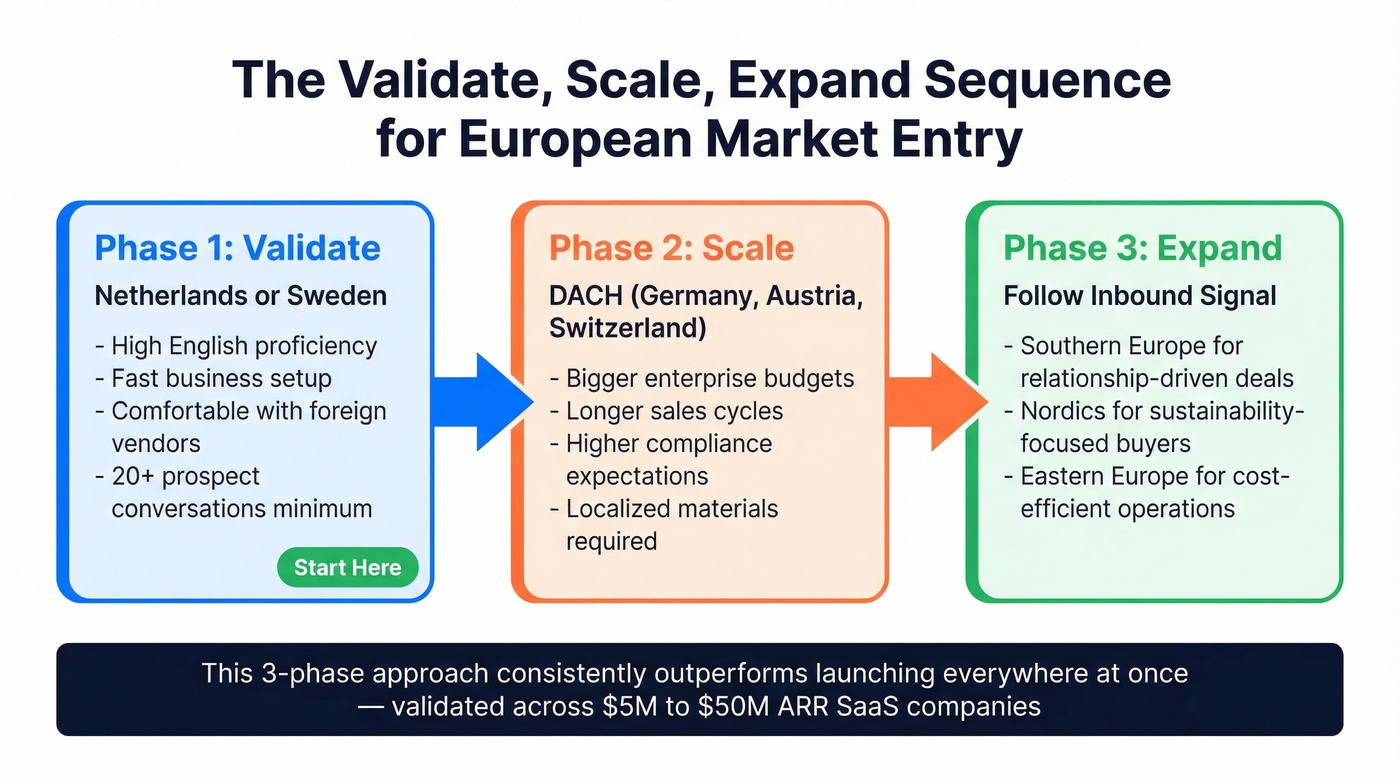
The smarter beachhead for most B2B SaaS companies is the Netherlands or Sweden. High English proficiency, fast business setup (especially in the Netherlands), and buyers comfortable evaluating foreign vendors. DACH (Germany, Austria, Switzerland) should be Phase 2 - the budgets are bigger, but the sales cycles are longer and compliance expectations are significantly higher. Ireland works best as an EU HQ for tax and legal structuring, not as a primary sales market.
| Country/Region | Corporate Tax | English Proficiency | Trust Driver | Setup Speed | Best For |
|---|---|---|---|---|---|
| Netherlands | 15% / 25.8% | Very high | Innovation, ROI | Fast (online) | SMB beachhead |
| Sweden | 20.6% | Very high | Sustainability | Moderate | PLG, mid-market |
| Germany | ~30% | Moderate | Compliance, rigor | Moderate | Enterprise |
| Ireland | 12.5% | Native | Tech ecosystem | Fast | EU HQ setup |
| Estonia | 20% (distributed) | High | Digital-first | 15 minutes | Legal entity |
| Bulgaria | 10% | Moderate | Cost efficiency | 1-2 weeks | Back office |
What this table doesn't capture: in the Nordics, sustainability is a buying criterion, not a nice-to-have. In DACH, your marketing materials need to reflect strict compliance standards. In Southern Europe, relationships and personal trust drive deals more than feature comparisons. European buyers tend to behave as "service buyers" - they expect to be served, not enrolled in a movement.
The Validate, Scale, Expand Sequence: Netherlands or Sweden first to validate product-market fit with English-speaking buyers, then DACH to scale into larger enterprise budgets, then expand opportunistically based on inbound signal. We've seen this three-phase approach work for SaaS companies from $5M to $50M ARR, and it consistently outperforms the "launch everywhere at once" strategy that burns through expansion budgets in a single quarter.

Before you hire a single European rep, you need verified, GDPR-compliant prospect lists for your beachhead country. Prospeo gives you 300M+ profiles with 30+ filters - including buyer intent, technographics, and headcount growth - so you can validate demand in the Netherlands, Sweden, or DACH without legal exposure. 98% email accuracy. 7-day data refresh. $0.01 per lead.
Validate European demand with real data before you commit real budget.
Choose Your Entry Mode
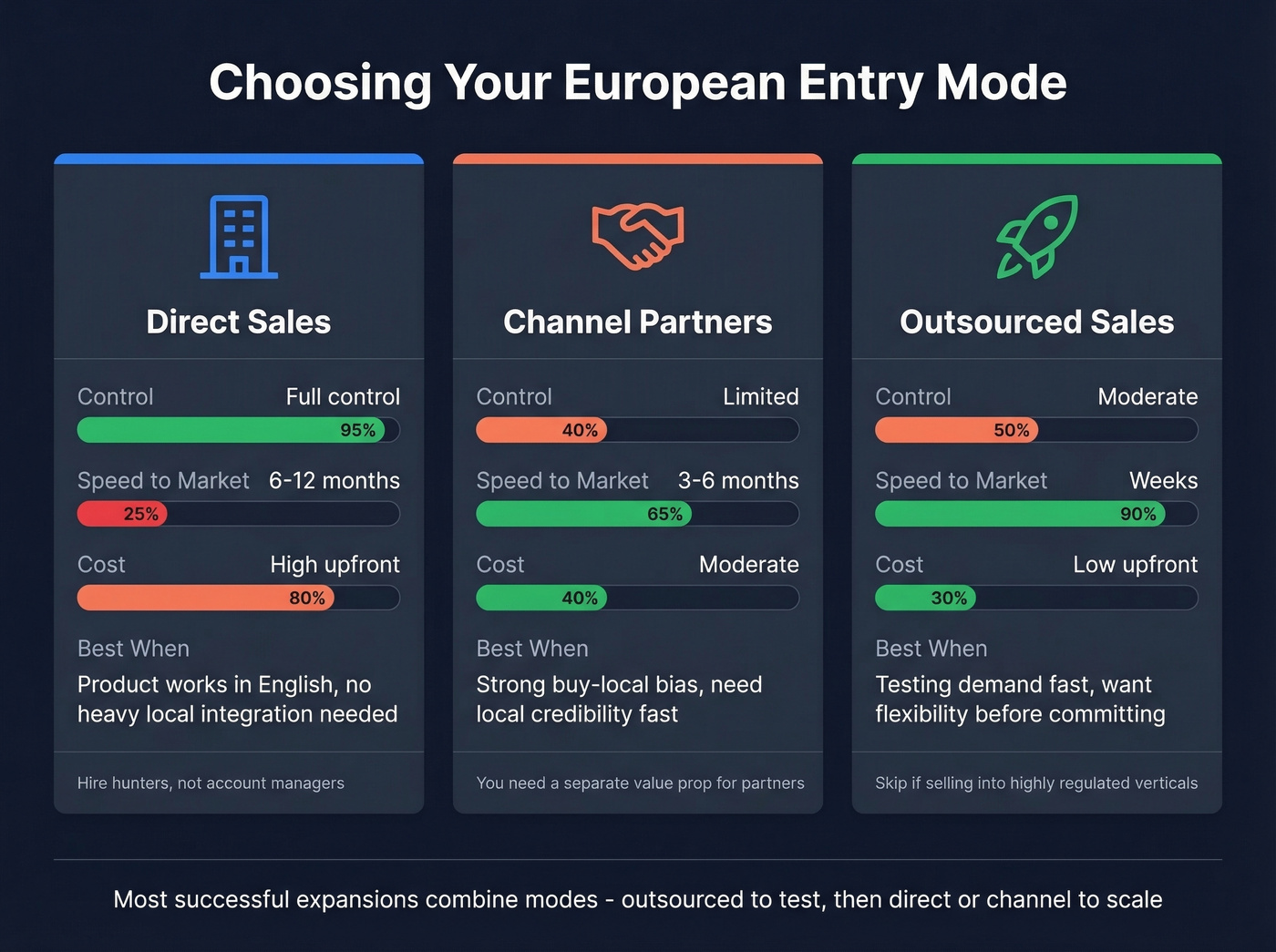
There's no single right way to enter Europe. But there's a wrong way: assuming one model works across every country. Pan-European distributors barely exist - even companies claiming regional coverage make decisions locally with local management. You also need two value propositions if going indirect: one for the end customer, one for the channel partner.
Direct Sales
Full control of pipeline, messaging, and customer relationships. This is the right call when your product doesn't require heavy local integration and you can support buyers in English. The downside is cost and the 6-12 months before reps are productive.
One critical hiring note: your first European reps should be experienced hunters, not account managers. Don't assume HQ staff can replicate their performance in an unfamiliar market. We've watched companies burn through two or three "safe" hires before finally bringing in someone who actually knows how to open doors in Frankfurt or Amsterdam.
Channel Partners
Local partners bring credibility and existing relationships - especially valuable where "buy local" bias is strong. The tradeoff is control: you're dependent on partners with their own priorities, and you need different partners in different countries. Making the channel program attractive goes well beyond offering 30% off list price.
Outsourced Sales
This is the fastest way to test demand without permanent infrastructure. Livefyre went from 10% to 40% of international profits in under three years using outsourced reps - Adobe later converted 10 of those professionals to permanent hires. Algonomy doubled ARR year-over-year with a hybrid model.
Use outsourced sales if you're testing demand and want to move fast. Skip it if you need deep product expertise in every conversation or you're selling into highly regulated verticals where credentialed reps are table stakes.
GDPR and Outbound Compliance
Let's be honest: the fear around GDPR and cold email is overblown. Cold email is legal in Europe. The rules are different, and getting them wrong creates real liability - but the framework isn't as scary as most US teams assume.
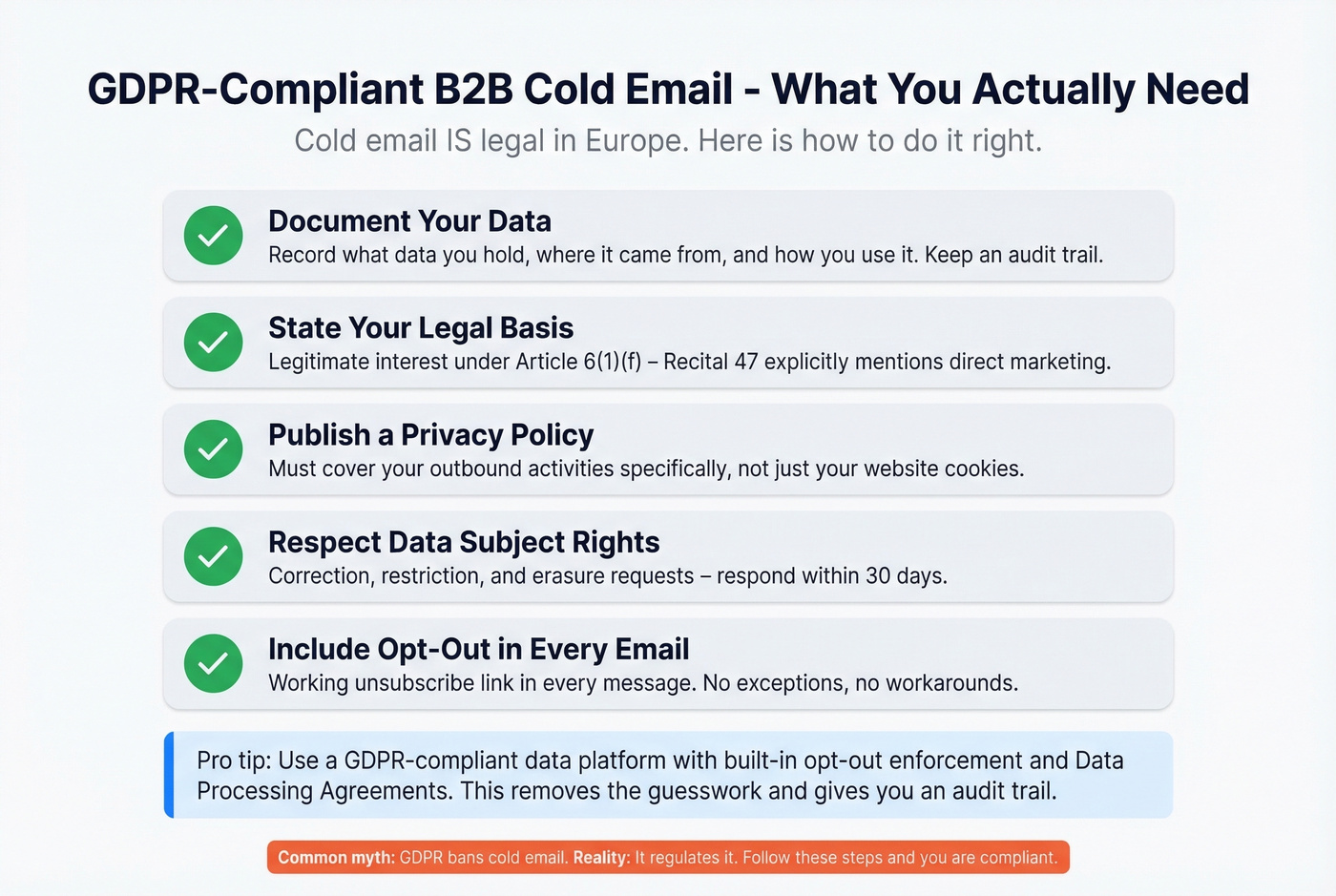
GDPR applies to B2B contacts whenever the data identifies a living person. The lawful basis most B2B outbound teams rely on is legitimate interest under Article 6(1)(f), supported by Recital 47, which explicitly mentions direct marketing as a potential legitimate interest.
In practice, here's what you need:
- Document what data you hold, where it came from, and how it's used
- State your legal basis for processing (legitimate interest for B2B prospecting)
- Publish a clear privacy policy covering outbound activities
- Respect data subject rights - correction, restriction, and erasure requests
- Include a working opt-out mechanism in every outreach
The easiest way to reduce compliance risk is to use a GDPR-compliant data platform that enforces opt-outs globally and provides Data Processing Agreements. That removes the compliance guesswork and gives you an audit trail if questions arise. Building compliance into your European expansion from day one also becomes a trust signal with buyers, not just a legal checkbox.
Build Your European Prospect List
This is where most US-to-Europe expansions quietly fail. Your existing data provider almost certainly has thin European coverage - stale records, missing mobile numbers, and email addresses that bounce far more than they should.
We've seen this pattern repeatedly: a team launches European outbound with their US provider's data, gets terrible deliverability, and concludes that "cold email doesn't work in Europe." It does. The data was the problem. One company's France campaign faltered because English-language emails didn't reach French decision-makers who preferred communications in their own language - a localization problem that starts with a data problem. If your provider can't filter by country, language, or local job titles, you're sending blind.
Prospeo's database covers 300M+ profiles and lets you filter by country, industry, job title, and buyer intent across 15,000 topics - the kind of granularity that US-centric providers simply don't offer for European markets. The 7-day data refresh cycle keeps European records current compared to the 6-week industry average, email accuracy runs at 98%, and the platform is fully GDPR compliant with opt-out enforcement and DPAs available. The free tier lets you test European coverage in your target country before scaling spend.

European buyers lock in their shortlist before talking to sales - which means your outbound reps need to reach the right people with verified contact data, not bounce off stale records. Prospeo's 125M+ verified mobile numbers (30% pickup rate) and proprietary email verification give your European team direct paths to decision-makers across every target market. GDPR compliant, no contracts, cancel anytime.
Stop burning your European expansion budget on bad data.
Timeline, Budget, and Benchmarks
European expansion is a 3-5 year investment. Positioning it as a one-off initiative is a recipe for failure.
For horizontal SaaS, expect 8-12 months to initial traction. For vertical or regulated solutions needing country-specific compliance validation, budget 18-24 months. UK-specific CAC will run 25-40% above EU benchmarks with a 12-18 month payback period. Earlier-stage companies should lean heavily on outsourced models, while later-stage orgs can afford the infrastructure investment of a local office.
Northern European SaaS companies average 31% ARR growth, which gives you a benchmark for what "good" looks like. Among those same companies, PLG adoption has dropped sharply - from 14% to 3.9% - confirming that European buyers still prefer a human touch in the sales process. Mid-market is the sweet spot for most entrants. Some teams are finding success with a flywheel model where strong onboarding and customer success drive referrals that reduce CAC over time, particularly in tight-knit European industry verticals.
Our take: If your average deal size is under EUR 15k, you probably don't need a local office or even a local rep in your first European market. An outsourced SDR team paired with strong data and localized content will outperform a premature hire who's ramping for six months while you figure out messaging. Save the headcount budget for Phase 2.
A few operational details that trip up US teams: bank transfers are preferred over credit cards in parts of Europe. Don't schedule anything in July or August in Southern Europe - entire companies go on holiday. Budget for localization beyond translation: your case studies, pricing pages, and demo flow all need country-specific versions. Treating localization as a core function separates companies that scale in EMEA from those that stall after one market.
FAQ
Is cold email legal in Europe?
Yes. B2B cold email is legal under GDPR using legitimate interest as your lawful basis, per Article 6(1)(f) and Recital 47. Include a clear opt-out, document your legal basis, and respect erasure requests. DACH tends to be stricter - consult local counsel for high-volume campaigns.
Which European country should I enter first?
The Netherlands or Sweden for most B2B SaaS companies. Both offer high English proficiency, fast setup, and buyer openness to foreign vendors. Save DACH for Phase 2 once you've validated messaging and product-market fit with lower-friction markets.
How long does European market entry take?
Plan for 3-5 years total. Horizontal SaaS sees initial traction in 8-12 months; vertical solutions needing compliance validation take 18-24 months. Northern European SaaS averages 31% ARR growth as a benchmark for mature entrants.
Do I need a local office to sell in Europe?
Not initially. Outsourced sales teams and Employer of Record arrangements let you test markets without permanent infrastructure. Invest in a local presence once you've proven demand and repeatable pipeline in your beachhead country.
How do I build a GDPR-compliant prospect list?
Use a data platform with strong European coverage, verified contacts, and built-in opt-out enforcement. Most US-centric providers have thin records outside North America. Look for 30+ search filters including country, industry, and job title, plus a short data refresh cycle so you're not emailing people who changed jobs three months ago.