


Google Maps Data Extractor: Pricing, Reviews & Pros/Cons (2026)
You scraped 5,000 businesses from Google Maps last week. Now you're staring at a spreadsheet full of info@ emails and front-desk phone numbers. That's not a lead list. That's a phone book.
A Google Maps data extractor is great at pulling business listings, but business listings aren't sales leads. At least three different products call themselves "Google Maps Data Extractor," and they vary wildly in pricing, architecture, and output quality. Let's sort them out.
30-Second Verdict
BotBulk's G-Extractor is the cheapest desktop option at $45/year. It extracts business listings - names, addresses, general phone numbers, generic emails - not verified decision-maker contacts. If raw local business data is all you need, it works. If you need outreach-ready contacts with real email addresses and direct dials, you're in a different tool category entirely.
What Is G-Extractor?
The primary product here is G-Extractor by BotBulk, a Windows desktop app that scrapes Google Maps results and exports them to Excel. It runs on Windows 10/11 with an Intel i3+ and 4GB RAM. Simple enough.
Confusingly, G Maps Extractor (gmapsextractor.com) is a separate cloud-based subscription tool with zero G2 reviews as of this writing. Outscraper is a pay-as-you-go API platform with substantial third-party review coverage on Capterra and AppSumo. BotBulk's G-Extractor, by contrast, has almost no independent review presence - which matters when you're evaluating a scraping tool that interacts with Google's infrastructure.
Pricing Breakdown
| Tool | Model | Starting Price | At Scale | Free Tier |
|---|---|---|---|---|
| G-Extractor (BotBulk) | Desktop license | $45/yr | $90 lifetime | No |
| G Maps Extractor | Cloud subscription | $39/mo | $99/mo (500K leads) | Yes (1K leads/mo) |
| Outscraper | Pay-as-you-go | $3/1K records | $1/1K (100K+) | Yes (500 records) |
| Apify | Platform + actor | $2.10/1K places | + $29/mo platform | Yes ($5 credit) |
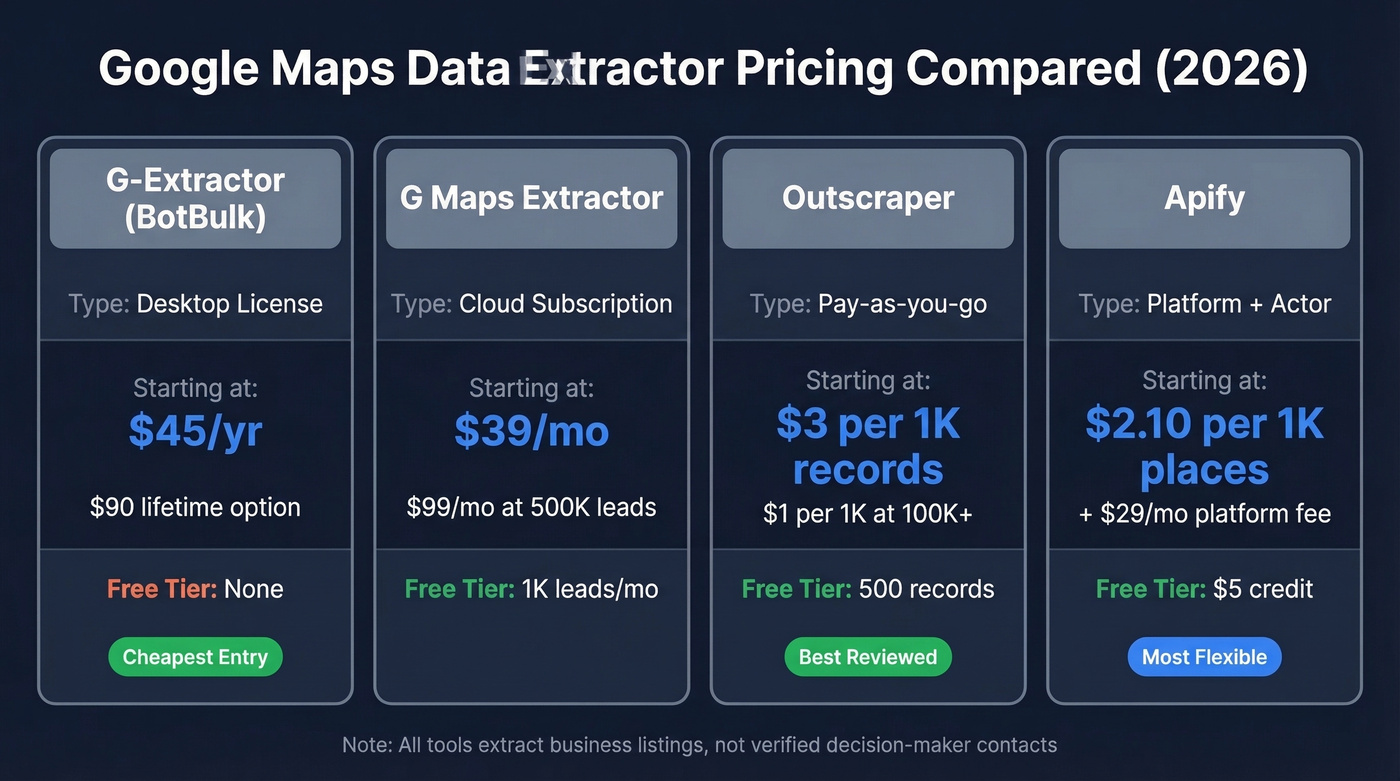
BotBulk's $45/year is the cheapest entry point here, and the $90 lifetime license is essentially two years of use then free forever. The catch: throughput depends on Google's own throttling and CAPTCHA challenges, not on BotBulk's licensing. Desktop scrapers on residential IPs hit Google's rate limits fast, and there's no proxy infrastructure built in to help.

Google Maps gives you the business. Prospeo gives you the person. Enrich company names from any Maps scraper with 98% accurate emails and 125M+ verified mobile numbers - starting at $0.01 per email.
Stop calling front desks. Start reaching decision-makers.
Pros and Cons
Pros:
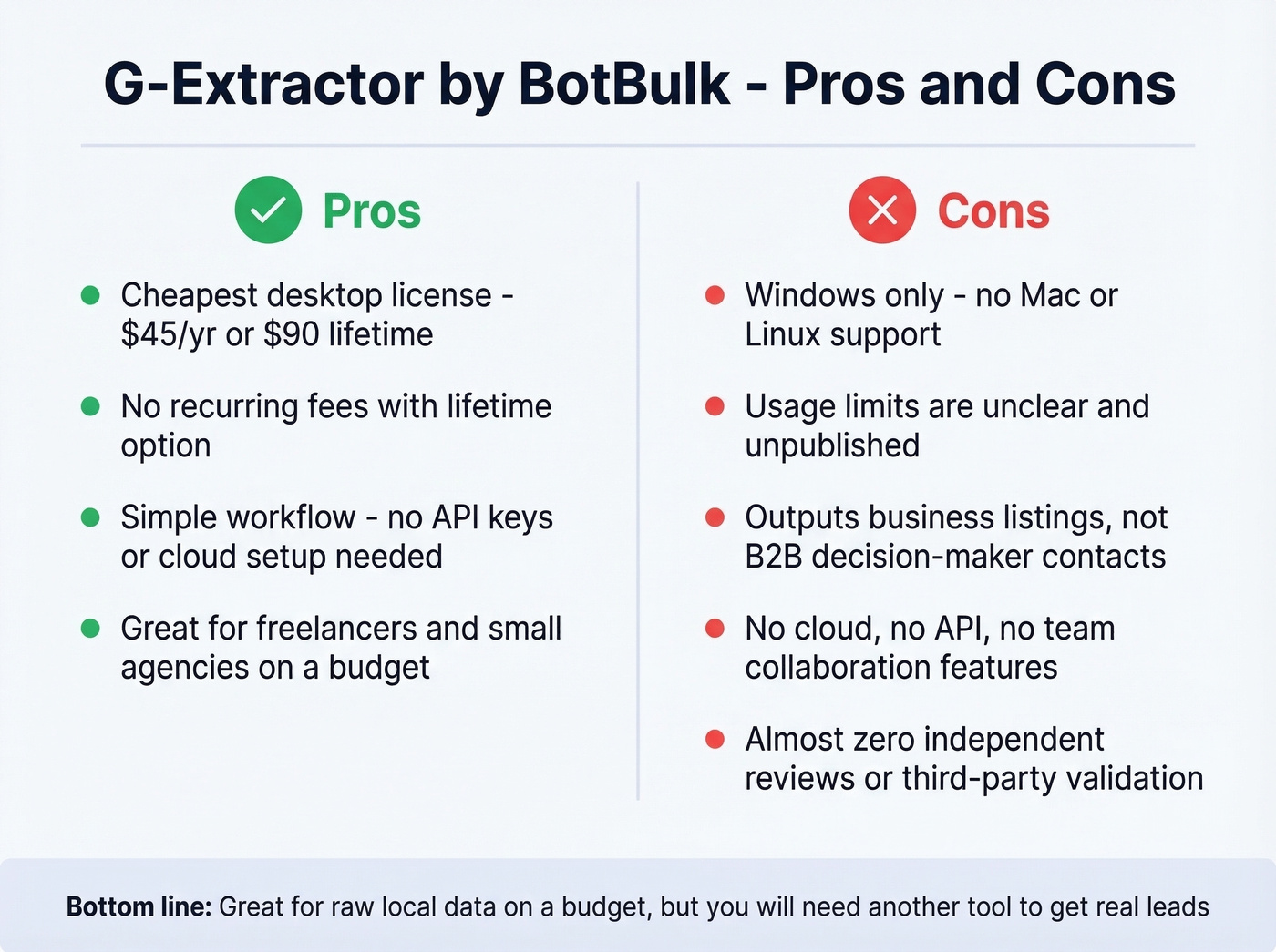
- Cheapest desktop license in this comparison. $45/year or $90 lifetime.
- No recurring fees with the lifetime license.
- Simple desktop workflow - no API keys, no cloud config.
- One-time purchase appeals to freelancers and small agencies who hate subscriptions.
Cons:
- Windows-only.
- Usage limits are a black box. BotBulk describes plans as differing by "usage limits" but doesn't publish clear extraction caps.
- Extracted data is business listings, not B2B contacts. You get front-desk numbers and info@ emails.
- No cloud, no team features, no API, no collaboration.
- Limited independent review coverage - you're trusting the vendor without much third-party validation.
What Users Actually Say
The review picture here is messy. The Capterra listing showing 4.5/5 across 21 reviews (last updated March 2026) appears to be for Outscraper, not BotBulk - the naming overlap between these tools makes it easy to confuse them.
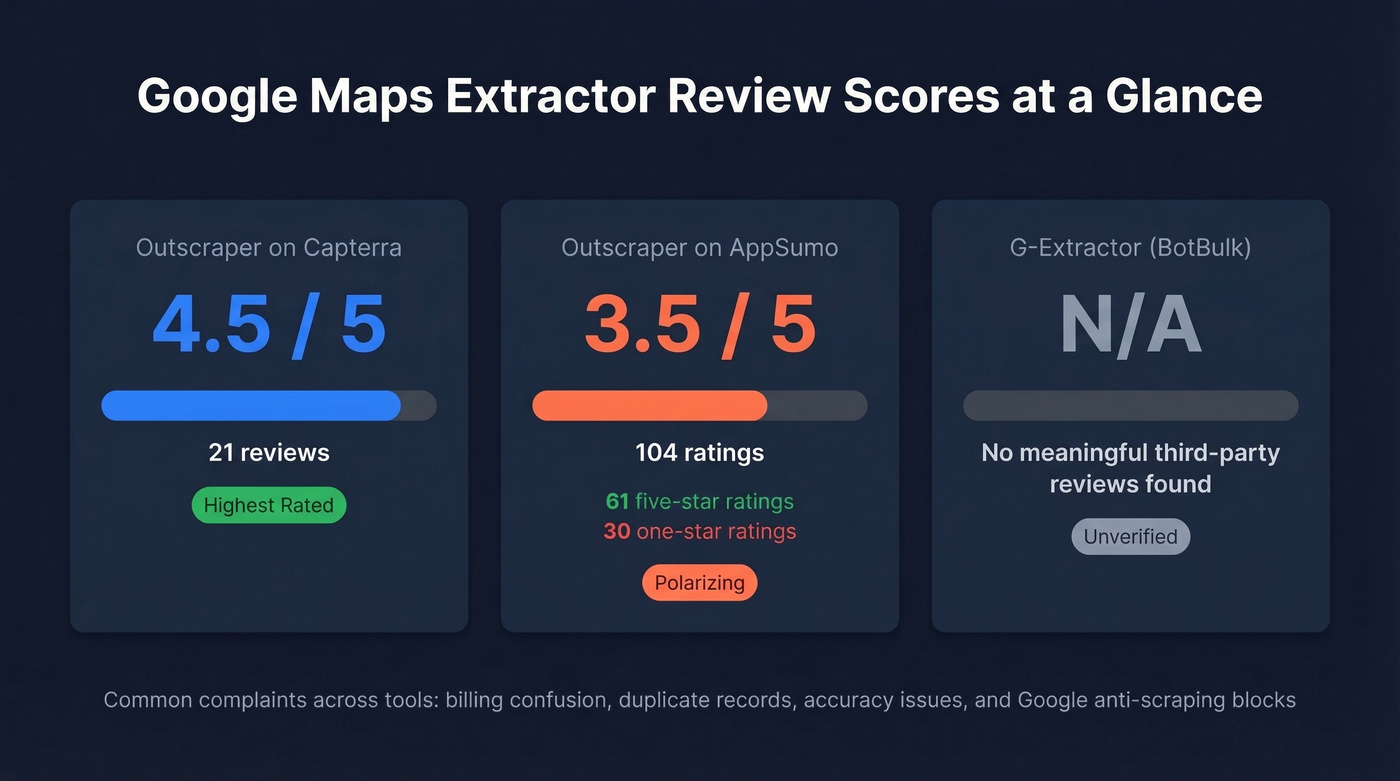
Outscraper's AppSumo reviews tell a more interesting story: 3.5/5 across 104 ratings, with 61 five-star ratings and 30 one-star ratings. The positives focus on time savings and fast exports. The negatives cluster around billing confusion with add-ons like Lead Gen Packs, accuracy issues, and duplicate records showing up in exports.
On r/webscraping, the consensus is that most Maps extractors hit the same wall: Google's anti-scraping measures keep getting tighter, and you end up juggling the Places API, proxy rotation, and polygon-based extraction to cover areas that don't fit a simple radius search. One user described bouncing between a Maps extraction tool, the Places API, and Octoparse just to handle district boundaries properly.
For BotBulk specifically, we didn't find meaningful third-party review coverage. At $45/year the financial risk is minimal, but skip this one if independent validation matters to your buying process.
The Real Data Quality Problem
Here's the thing: the scraper you pick barely matters. Most Google Maps extractors output listing-level data - business names, front-desk numbers, and generic emails. That's what Google Maps has. No scraper can extract data that isn't there.
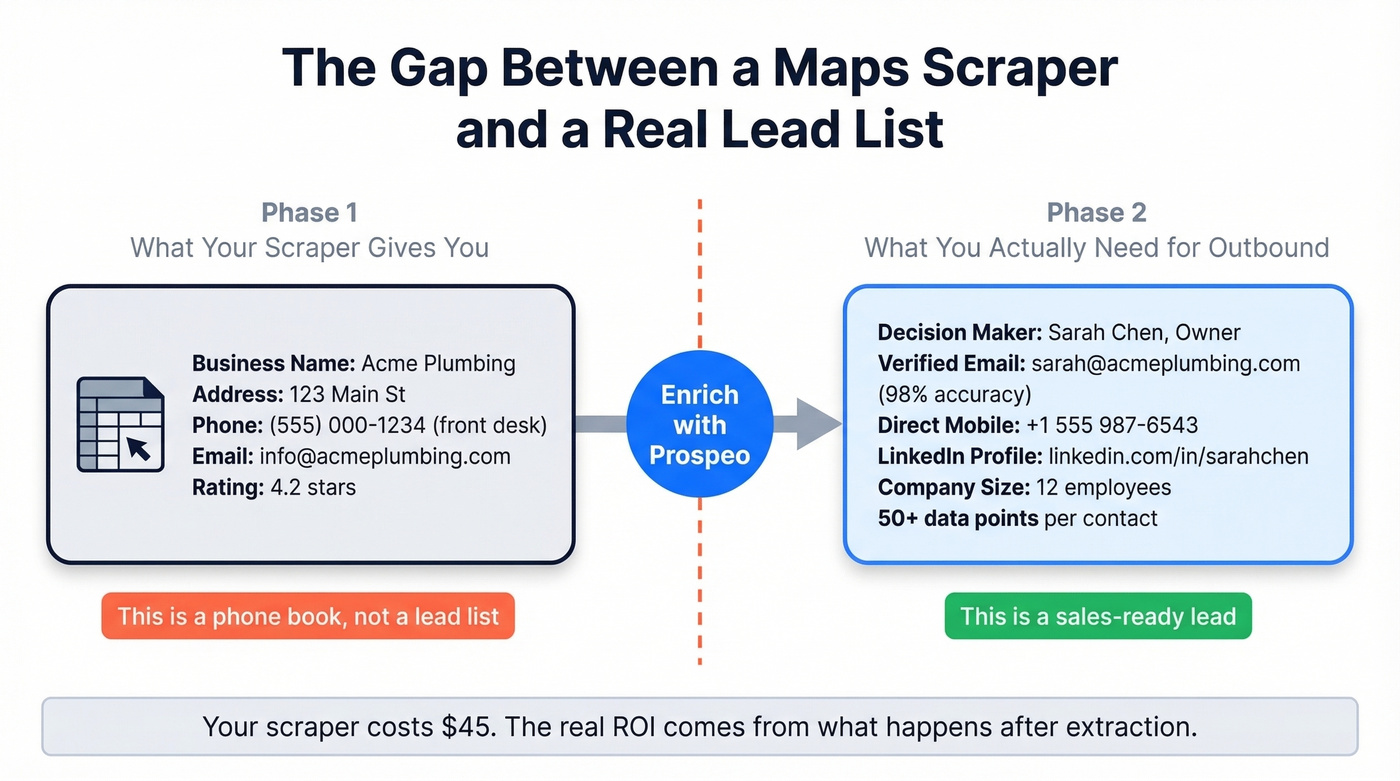
The real cost isn't the $45 license. We've seen teams burn 10+ hours a week chasing front-desk numbers pulled from Maps data, getting bounced between receptionists, leaving voicemails that never get returned, and watching their email deliverability tank because half those info@ addresses are dead or unmonitored. Google Maps gives you the business. A B2B data platform gives you the person.
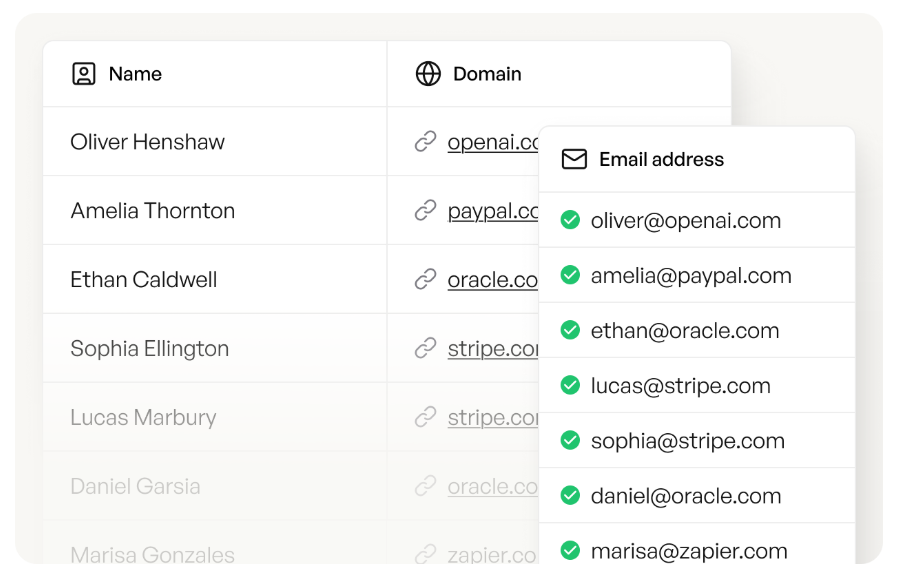
Once you've extracted target businesses, run those company names through Prospeo to find verified professional emails and mobile numbers - 98% email accuracy, 125M+ verified mobiles globally, with a free tier that includes 75 emails and 100 Chrome extension credits per month.
Final Verdict
For raw local business data on a tight budget, BotBulk's G-Extractor at $45/year is genuinely hard to beat. For cloud extraction at scale with better reliability, Outscraper or Apify are stronger picks. But the tool that actually determines whether your outbound campaign works or flops isn't the scraper - it's whatever you use to turn those business names into verified contacts with real email addresses and direct dials.
FAQ
Is Google Maps data extraction legal?
Scraping publicly visible Google Maps data is generally a gray area. Google's Terms of Service prohibit automated scraping, but enforcement varies widely. Using the official Places API is the safest route. Most businesses use extraction tools at their own risk - keep volumes reasonable and avoid storing personal data without a lawful basis under GDPR or equivalent regulations.
Which Google Maps scraper has the best reviews in 2026?
Outscraper leads with 4.5/5 on Capterra (21 reviews) and 3.5/5 on AppSumo (104 ratings). BotBulk's G-Extractor has minimal third-party coverage. Apify's Google Maps actor has strong developer community feedback but lives inside a broader platform, so reviews blend scraper quality with platform experience.
How do I turn Google Maps listings into real sales leads?
Maps scrapers export business names, addresses, and generic contact info - not decision-maker emails or direct dials. Feed extracted company names into a B2B data platform like Prospeo to enrich them with verified professional emails and mobile numbers. That's the step that makes outbound actually work.
Is G-Extractor worth $45/year?
At $45/year - or $90 for a lifetime license - G-Extractor is the cheapest desktop option available. It's worth it if you only need raw business listing data and you're comfortable with Windows-only software that has limited independent reviews. For higher-volume or team-based workflows, cloud tools like Outscraper offer more reliability and better scaling.
Your $45 scraper pulled 5,000 listings. Now what? Feed those company names into Prospeo and get verified professional emails, direct dials, and 50+ data points per contact - with a 92% match rate.
Turn a phone book into a pipeline in minutes.