

GTM Meaning: The No-BS Guide to Go-to-Market Strategy
There's a Reddit post from a senior agency person that sums up the problem perfectly: "Can someone please f***ing tell me what GTM means?" They knew the acronym - go-to-market - but couldn't figure out why their org used it for everything. "GTM presentation." "There was a GTM for this project." "GTM strategy." It's the most abused acronym in B2B, and the confusion isn't limited to one frustrated marketer. Over on r/FPandA, a finance professional put it bluntly: "Every time I try to read about it, it just sounds like marketing."
Fair enough. Let's fix that.
What Does GTM Stand For?
GTM has three common meanings in professional contexts:
- Go-to-market: The cross-functional plan for how you sell a product to a specific market. Not marketing. Not a launch checklist. A system covering who you sell to, what problem you solve, how buyers find you, and how you close them. Gartner defines it as "a plan that details how an organization can engage with customers to convince them to buy and gain a competitive advantage."
- Google Tag Manager: A free tag management system from Google that helps you deploy and manage tracking tags on your website without shipping a code release for every change.
- GTM Engineer / GTM team: An emerging role title blending RevOps, marketing automation, and go-to-market execution - still loosely defined at most companies.
This article is about the first one. If you're here for Google Tag Manager, wrong place. If you want to understand go-to-market strategy - what it actually means, how to pick a motion, the benchmarks that matter right now, and the mistakes that kill launches - keep reading.
What Go-to-Market Strategy Actually Means
Gartner's definition is accurate but sterile. Here's what go-to-market means in practice.
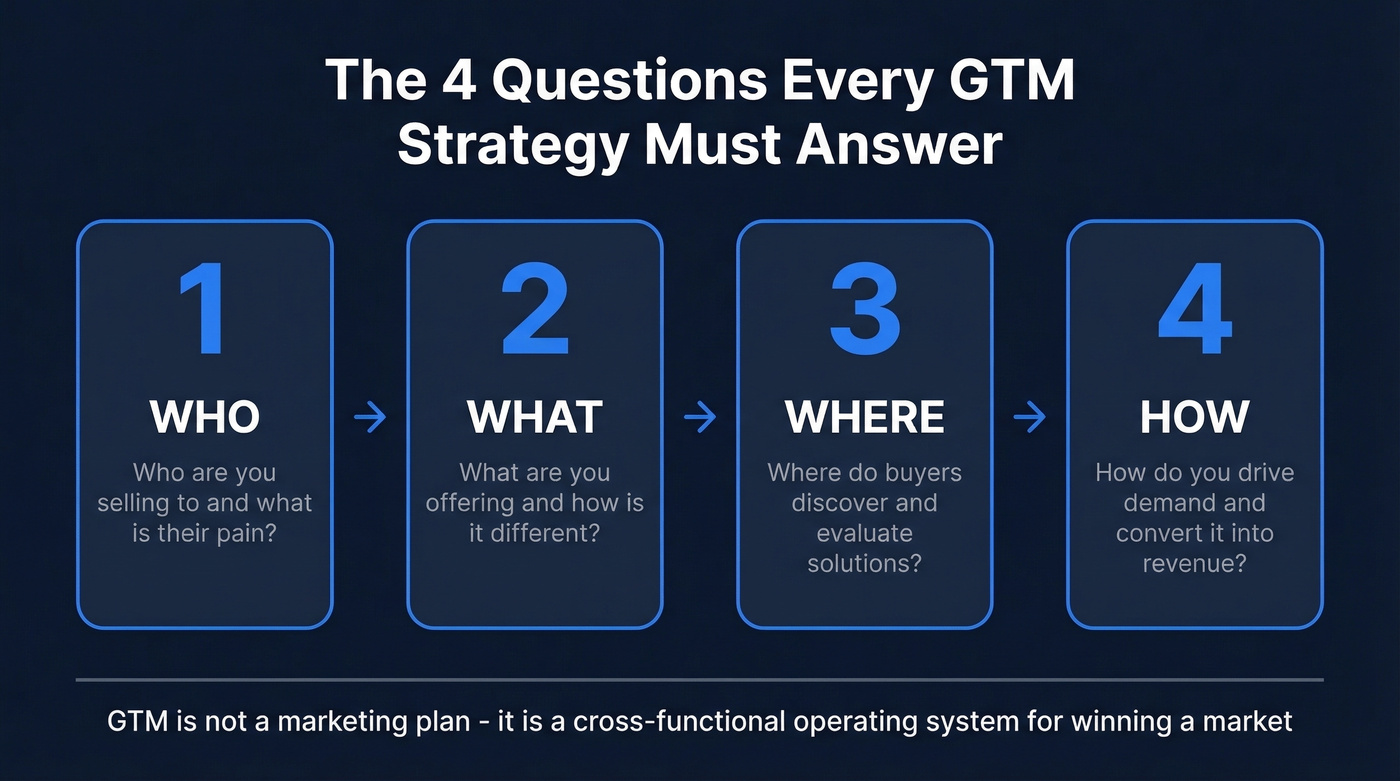
A go-to-market strategy answers four questions, as Warmly's framework lays out clearly:
- Who are you selling to - and what's their pain?
- What are you offering - and how is it different?
- Where do your buyers discover and evaluate solutions?
- How do you drive demand and convert it into revenue?
That's it. Every go-to-market strategy, whether it's a Series A startup or a Fortune 500 product line, boils down to those four questions. The deliverable isn't a slide deck. It's a cross-functional operating system that aligns product, marketing, sales, and customer success around a shared plan for winning a market.
The word "system" matters. Bain surveyed 2,300 global companies and found that only 9% achieved sustained revenue and profit growth over a decade. The winners didn't just have better products - they built adaptive go-to-market systems with fast feedback loops and cross-functional integration. Nokia vs. Samsung between 2006 and 2010 is the textbook example: Samsung gained roughly 6 points of market share while Nokia lost 6, largely because Samsung's approach adapted faster to smartphone distribution and carrier relationships.
When someone says "build a GTM," they're asking for this system - not a marketing plan, not a product brief, and definitely not a single launch event.
GTM Strategy vs. Marketing Strategy
This is where most confusion lives. If you're in finance, product, or engineering, go-to-market sounds like marketing with extra syllables. It's not.
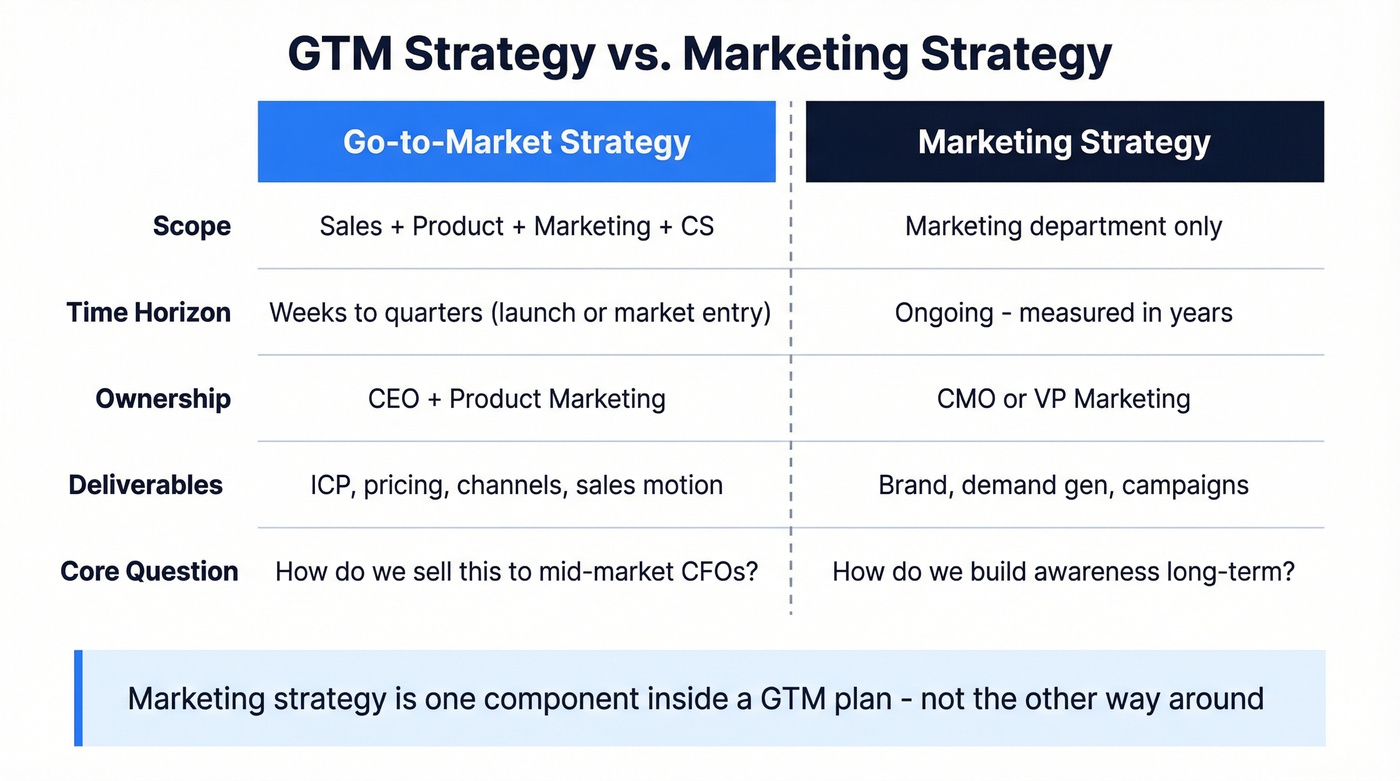
| GTM Strategy | Marketing Strategy | |
|---|---|---|
| Scope | Sales, product, marketing, CS | Marketing department |
| Time horizon | Launch/market entry (weeks to quarters) | Ongoing (years) |
| Ownership | CEO + product marketing | CMO / VP Marketing |
| Deliverables | ICP, pricing, channels, sales motion | Brand, demand gen, campaigns |
| Example | "How we sell this to mid-market CFOs" | "How we build awareness long-term" |
Marketing strategy is one component of a go-to-market plan. The broader strategy includes pricing, sales motion design, channel selection, competitive positioning, and enablement - none of which sit inside a typical marketing org. As Copy.ai's breakdown puts it: GTM is a tactical plan to launch or enter a market; marketing strategy is the longer-term engine for brand awareness, engagement, and loyalty.
70% of product marketers get this wrong, according to a practitioner analysis on Substack, by equating go-to-market with product launches or "just sales." The CEO owns these decisions. Product marketing drives execution and acts as the insight engine. Marketing runs one channel within the broader system.
The 6 Go-to-Market Motions
A go-to-market motion is the primary mechanism through which you acquire and convert customers. The strategy becomes concrete when you choose one. Most companies run multiple motions, but the best ones pick a primary motion and get great at it before layering on others.
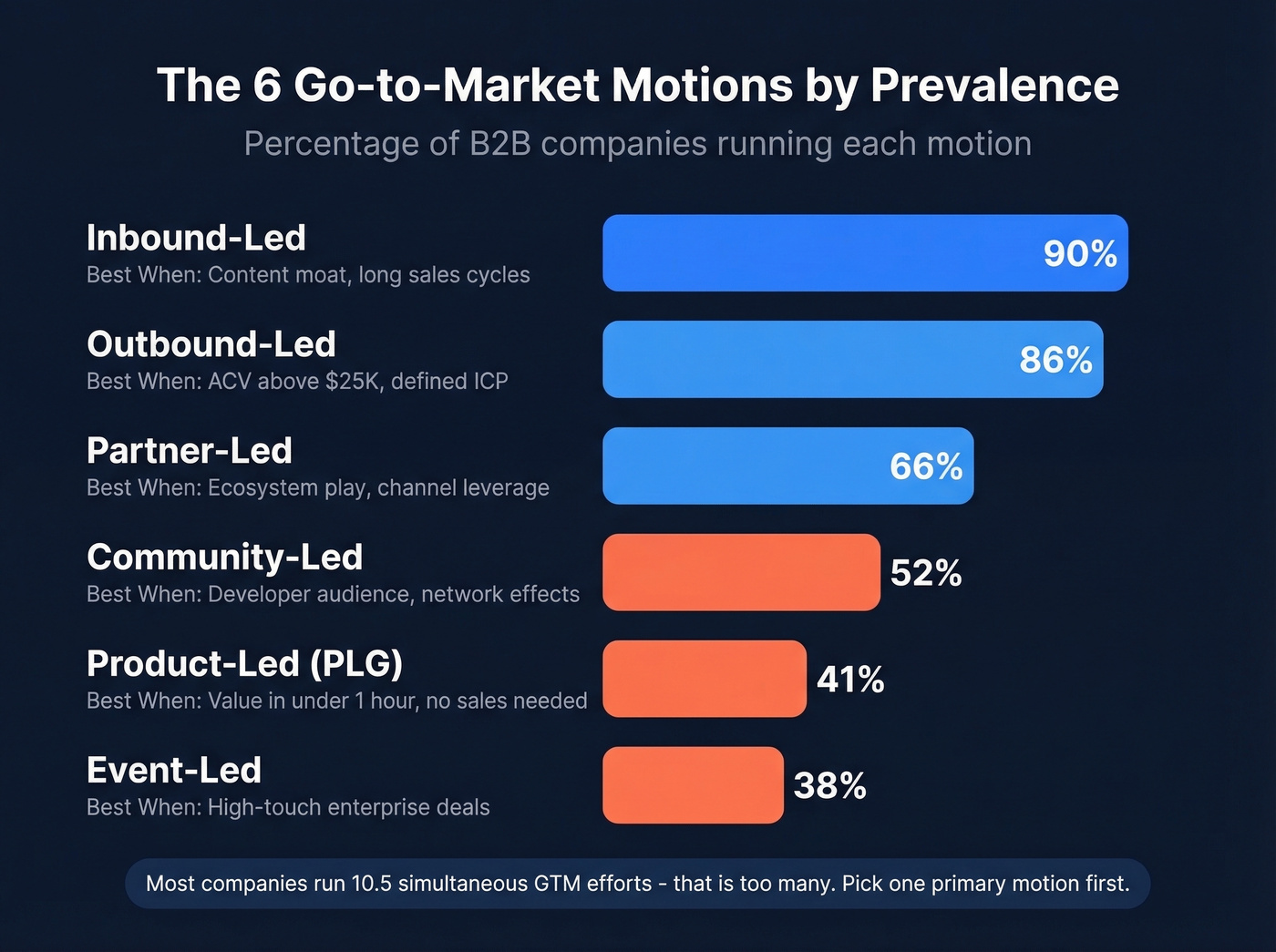
Here's how prevalent each motion is, per a GTM Partners survey:
| Motion | Prevalence | Best When |
|---|---|---|
| Inbound-led | 90% | Content moat, long cycles |
| Outbound-led | 86% | ACV >$25K, defined ICP |
| Partner-led | 66% | Ecosystem play, channel leverage |
| Community-led | 52% | Developer audience, network effects |
| Product-led (PLG) | 41% | Value in <1 hr, no sales needed |
| Event-led | 38% | High-touch enterprise |
The selection heuristics are simpler than most frameworks make them. If your average deal is above $25K and involves multiple stakeholders, you're sales-led - the buying process demands human guidance. If a user can sign up, get value, and hit an "aha" moment within an hour without talking to anyone, you're product-led. Everything else is a spectrum.
A note on ABM: Account-based marketing isn't a standalone motion. It's a targeting methodology that overlays outbound-led, event-led, or partner-led motions. You still need to pick a primary motion underneath it.
Here's the thing: the average company runs 10.5 simultaneous GTM efforts - 5 core channels plus 5.5 experimental initiatives. That's too many. An analysis of 73 B2B SaaS companies that crossed $10M to $50M ARR versus 41 that stalled shows a consistent pattern: the ones that scale systematize a primary motion early, while the ones that stall try multiple strategies without mastering any. Pick one primary motion, get it working, then layer.
The proof is in the partner-led numbers. PandaDoc unified its partner ecosystem and grew partner-sourced MRR 47% year-over-year. Close CRM went from less than 4% partner-sourced revenue to 10% in 12 months and later reached 18%. Unbounce drives 25% of new trial starts through 5,000+ partners. These results came from focus, not from running six motions at 17% effort each.
Notion is the PLG poster child - templates reduce time-to-value to minutes, the free tier is genuinely useful, and the product sells itself through shared workspaces. But Notion also has a sales team for enterprise. The motion isn't religion; it's a starting point.
If your average contract value sits below $10K, you probably don't need a sales-led motion at all. The math doesn't work - a six-touch enterprise sales process eating into an $8K deal leaves you underwater on CAC. Go product-led or inbound-led, and add sales only when deal sizes justify the headcount.

Every GTM motion - outbound, PLG, partner-led - depends on reaching the right buyers with accurate contact data. Prospeo gives you 300M+ profiles with 30+ filters including buyer intent, technographics, and headcount growth so your go-to-market strategy connects with real decision-makers, not dead inboxes.
Stop planning your GTM in a vacuum. Start with data that actually converts.
GTM Benchmarks for 2026
Numbers tell you whether your go-to-market approach is working or just existing. Here are the benchmarks that matter right now, synthesized from data covering 195 software companies.
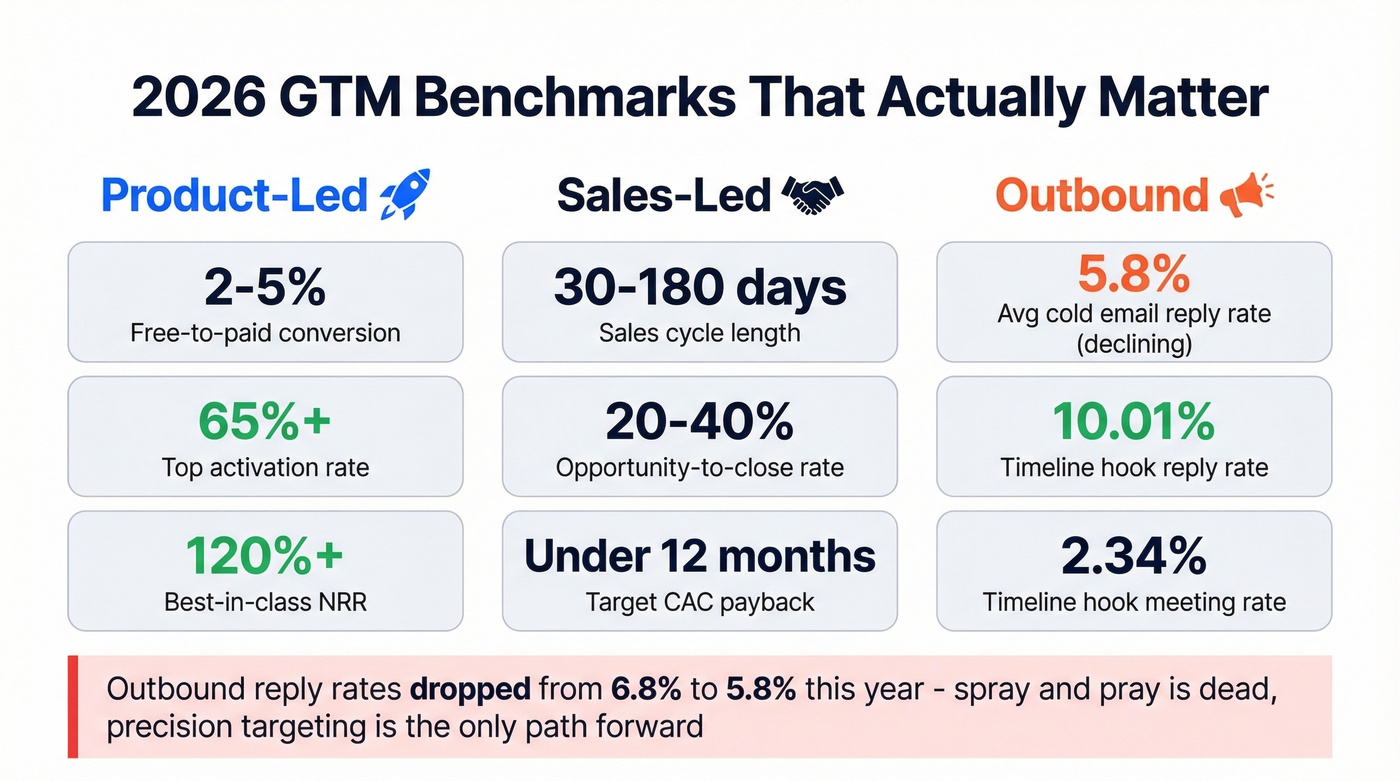
Product-led benchmarks:
- Free-to-paid conversion: 2-5% is typical
- Activation rate: top performers hit 65%+, average sits at 33%
- Net revenue retention: best-in-class exceeds 120%
Sales-led benchmarks:
- Sales cycle: 30-180 days depending on deal size
- Opportunity-to-close: 20-40%
- CAC payback: under 12 months is the target
- Quota attainment: >70% signals a healthy motion
Outbound benchmarks (the ones declining):
- Average cold email reply rates dropped from 6.8% to 5.8% over the past year, with no signs of reversal
- Timeline-based hooks pull a 10.01% reply rate vs. 4.39% for problem-focused hooks
- Meeting rates: 2.34% for timeline hooks vs. 0.69% for problem hooks
That outbound decline is the number that should worry you. Reply rates are compressing, which means the quality of your targeting and data matters more than ever. Spray-and-pray outbound is dead. Precision outbound - right person, right company, right timing - is the only version that still works. Signal-based prospecting, tracking job changes, funding events, and intent data to time outreach, is rapidly becoming table stakes.
And 36% of GTM leaders cite "scaling GTM motions and pipeline" as their top challenge. Not building pipeline - scaling it. The initial motion works; making it repeatable is where teams stall.
Real-World GTM Examples
Slack - Product-Led Freemium
Slack's ICP was tech-savvy SMB teams drowning in email threads. The value prop was simple: replace fragmented communication with one searchable, centralized platform. The channels were word-of-mouth, integrations that made Slack stickier, and a generous free tier that let entire teams use the product indefinitely.
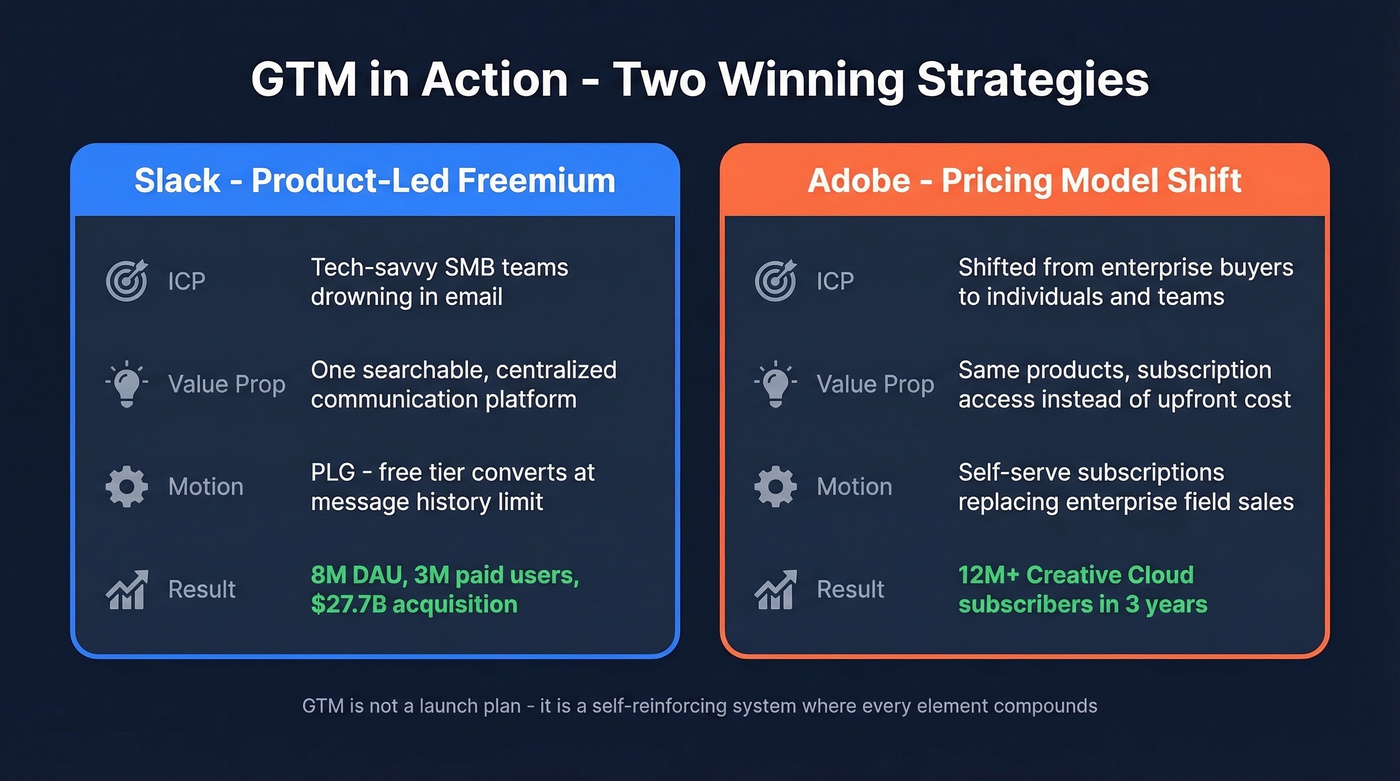
The pricing motion was pure PLG - free users converted to paid when they hit the message history limit or needed admin controls. By 2019, Slack had 8 million daily active users and 3 million paid users. Salesforce acquired them for $27.7 billion. The go-to-market approach wasn't a launch plan; it was a self-reinforcing system where product usage drove acquisition.
Adobe - Pricing Model Shift
Adobe's move from perpetual licenses to Creative Cloud subscriptions wasn't a product launch - it was a go-to-market pivot. Same products, fundamentally different strategy. The ICP shifted from enterprises making one-time purchases to individuals and teams paying monthly. The sales motion moved from enterprise field sales to self-serve subscriptions. The channel shifted from resellers to direct digital distribution.
Within three years of the 2013 shift, Creative Cloud subscribers surpassed 12 million, and recurring revenue became the dominant revenue stream. This is what a go-to-market strategy looks like at its most strategic: changing how you sell without changing what you sell.
Lick Paint - Education-First DTC
Go-to-market strategy isn't just for SaaS. Lick Paint, a UK direct-to-consumer paint brand, built their approach around education. Color specialists offer free video consultations. A quiz helps buyers find the right shade. UGC and community content build trust. Sustainability positioning differentiates from legacy brands. The motion is content-led and community-driven - proof that the framework applies whether you're selling software or paint.
7 Mistakes That Kill Launches
These come from startup post-mortems and cross-functional failure analysis. Every one of them is preventable.
1. Confusing GTM with marketing. Your go-to-market plan isn't a campaign calendar. It's a cross-functional system. If only the marketing team knows the plan, you don't have one. Make sure sales, product, and CS can each articulate the strategy in one sentence.
2. Targeting too broadly. "Our ICP is any company with 50+ employees" isn't an ICP - it's a census. Define a beachhead. One industry, one persona, one pain point. Expand after you win there.
3. Skipping channel validation. Assuming "we'll do content and outbound" without testing whether your buyers actually respond to those channels. A founder on r/startups put it well: they burned $40K on paid ads before discovering their buyers only responded to warm intros. Run small experiments across 2-3 channels before committing budget.
4. Neglecting pricing strategy. Pricing signals value. Price too low and buyers assume the product is lightweight. Too high and you've eliminated your beachhead. Run pricing experiments early - talk to 20 prospects about willingness to pay before you set a number.
5. Ignoring sales motion fit. Your sales motion has to match how your buyer actually buys. Selling a $5K/year tool with a 6-touch enterprise sales process is a mismatch that'll bleed you dry. Map the buyer's procurement reality: who signs off, what's the budget cycle, how do they evaluate.
6. Focusing only on acquisition. A strategy that ignores retention burns acquisition spend with no compounding return. Build retention loops and expansion triggers into the plan from day one. NRR above 120% is the benchmark for a reason.
7. Scaling before product-market fit. This is the most expensive mistake. We've watched teams pour money into outbound, hire reps, and run events before proving repeatable demand - and it ends the same way every time. Define your PMF criteria (repeat purchases, organic referrals, consistent win rates) and don't scale until you hit them.
Cross-functional misalignment and inadequate sales enablement are the silent killers underneath several of these mistakes. If your sales team doesn't have the playbooks, battle cards, and training to execute the plan, the strategy is just a document nobody reads.
Executing Your GTM: The Data Foundation
Strategy is the easy part. Execution is where go-to-market plans go to die.
Outbound is the second most prevalent motion at 86% adoption, and it's the most data-dependent. Your outbound execution is only as good as the contact data feeding it. With cold email reply rates compressing year over year, the margin for error has evaporated - every bounced email, every wrong number, every outdated title chips away at your domain reputation and your team's confidence in the channel.
Let's be honest about what actually happens. Your outbound team sends 500 emails a day. If 30% bounce because the data is stale, your domain reputation tanks within a week. The entire outbound channel dies before your strategy gets a fair test. You didn't have a strategy problem. You had a data problem.
Skip this section if you're running a purely product-led motion with no outbound component. But if outbound is part of your plan, data quality isn't a nice-to-have - it's the foundation everything else sits on.

Companies that scale past $10M ARR systematize their primary GTM motion early. The foundation? Clean data. Prospeo delivers 98% email accuracy on a 7-day refresh cycle - 6x faster than the industry average - so your outbound-led or ABM motion doesn't stall on bad contacts and burned domains.
Your GTM system deserves data refreshed weekly, not monthly.
FAQ
What does GTM mean in business?
GTM stands for go-to-market - the cross-functional plan covering how a company sells a product to a specific market. It spans ICP definition, pricing, sales motion design, channel selection, and enablement. If only your marketing team knows the plan, it's a marketing strategy, not a go-to-market strategy.
How is a go-to-market strategy different from a marketing strategy?
A go-to-market strategy includes pricing, sales motion, distribution, and competitive positioning - owned by the CEO and product marketing. Marketing strategy is one component focused on brand awareness and demand generation, owned by the CMO. Think of marketing as a channel within the broader go-to-market system.
How long does it take to build a go-to-market strategy?
Two to six weeks for the initial plan, depending on market complexity and existing customer research. But treat it as a living system - expect continuous iteration as you learn what channels, messaging, and motions actually convert.
What tools do you need for outbound GTM execution?
Three essentials: a verified prospect database like Prospeo for accurate contact data, a sequencing tool for multi-touch outreach (Instantly, Lemlist, or Outreach), and pipeline analytics (HubSpot or Gong) to measure reply rates and conversion.
Is GTM the same as Google Tag Manager?
No. They share the acronym, but Google Tag Manager is a free tool for deploying tracking tags on websites. In business strategy conversations, GTM almost always refers to go-to-market - the plan for bringing a product to buyers. Context makes the difference.