

Hard Bounce Rate in Email Marketing: 2026 Benchmarks, Codes, and Fixes
You just sent a 10,000-contact campaign and your ESP dashboard shows 4.8% hard bounces. That's 480 dead addresses, your sender reputation taking a hit, and a throttling warning sitting in your inbox. The real problem isn't the bounce itself - it's that those addresses were never verified before you hit send.
The formula is straightforward: hard bounces / emails sent x 100. A hard bounce means the receiving server permanently rejected your message - the address doesn't exist, the domain is gone, or authentication checks failed. Unlike soft bounces, these don't resolve on retry. They're permanent, and every single one chips away at your sender score.
The Quick Version
- Under 2% = healthy. Between 2-5%, investigate your list source and hygiene process. Above 5%, stop sending and clean your list before your ESP suspends you.
- Most hard bounces come from bad data, not bad deliverability settings. Verify before you send - not after.
- Read your SMTP codes. A 550 5.1.1 (user doesn't exist) needs a completely different fix than a 550 5.7.26 (DMARC failure). The bounce rate number alone doesn't tell you what's broken.
Hard Bounce vs. Soft Bounce
The distinction matters because each type demands a different response.
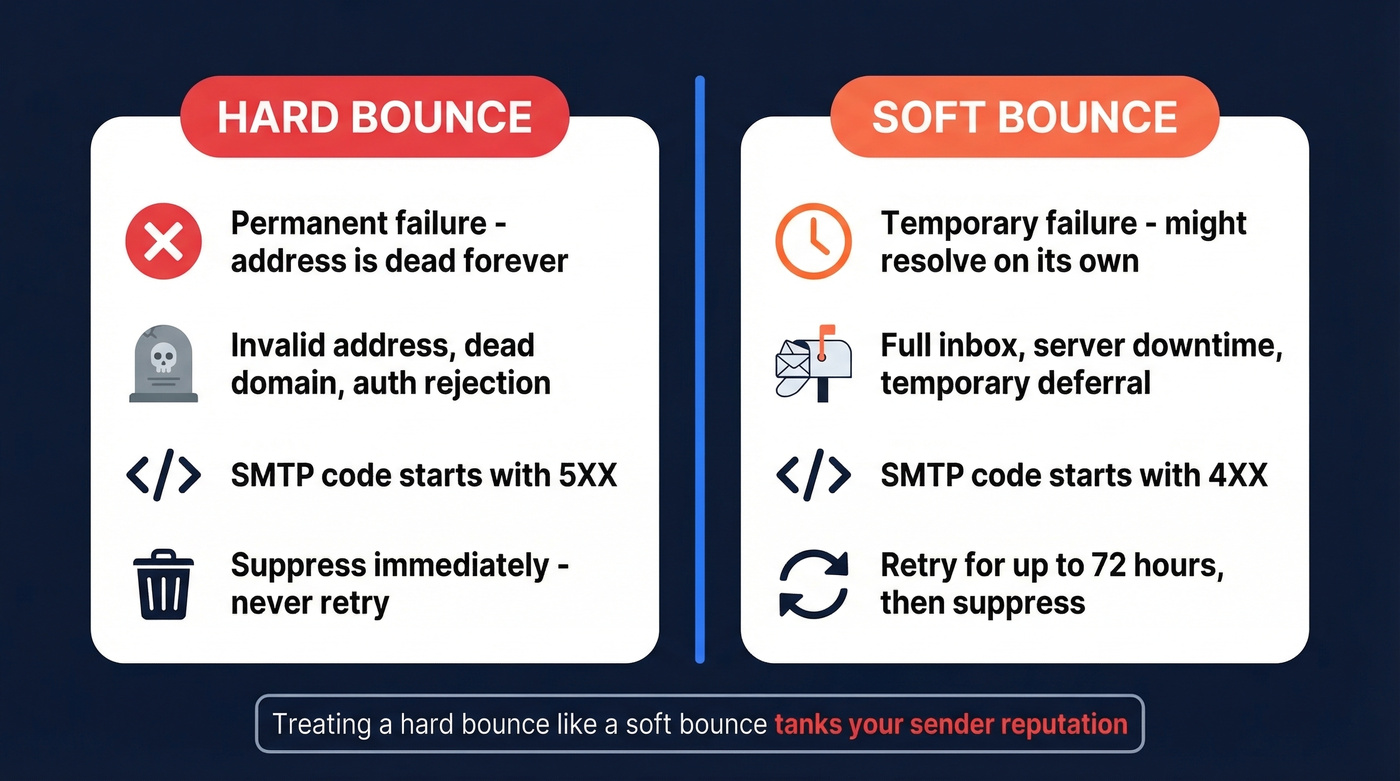
| Hard Bounce | Soft Bounce | |
|---|---|---|
| Definition | Permanent delivery failure | Temporary delivery failure |
| Typical cause | Invalid address, non-existent domain, policy/auth rejection | Full inbox, server downtime, temporary deferrals |
| SMTP prefix | 5XX (permanent) | 4XX (temporary) |
| Action | Suppress immediately | Retry for up to 72 hours, then suppress per ESP rules |
If your ESP lumps bounces together into one number, dig into the logs. Treating a soft bounce like a hard bounce wastes contacts. Treating a hard bounce like a soft bounce tanks your reputation.
2026 Benchmarks by Industry
Deliverability experts consistently land on the same thresholds:
| Threshold | Verdict | Action |
|---|---|---|
| Under 2% | Healthy | Keep current hygiene |
| 2-5% | Monitor | Audit list sources, verify |
| Above 5% | Act Now | Stop sending, clean list |
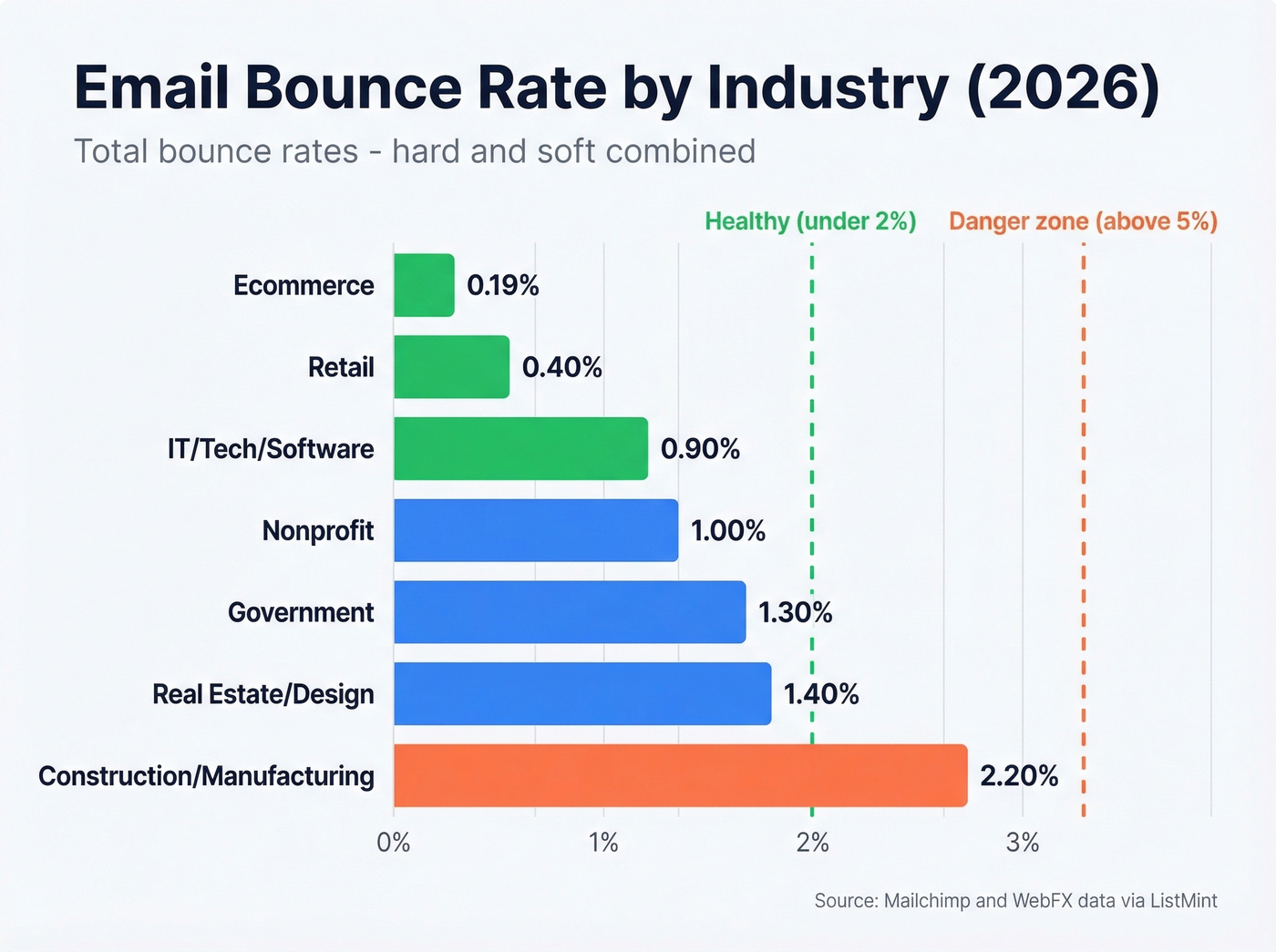
Industry benchmarks vary quite a bit. Mailchimp calculates metrics across billions of emails sent through its system, and a granular breakdown commonly cited comes from WebFX data reported by ListMint:
| Industry | Avg. Bounce Rate |
|---|---|
| Ecommerce | 0.19% |
| Retail | 0.40% |
| IT/Tech/Software | 0.90% |
| Nonprofit | 1.00% |
| Government | 1.30% |
| Real Estate/Design | 1.40% |
| Construction/Mfg | 2.20% |
These are total bounce rates - hard and soft combined. Your hard bounce metric alone should sit lower.
Here's the thing: if your rate is above 2%, you have a data quality problem, not a deliverability problem. No amount of SPF record tuning fixes a list full of dead addresses.

You read the benchmarks - above 2% means bad data, not bad deliverability. Prospeo's 5-step verification catches invalid addresses, spam traps, and catch-all domains before they hit your sender reputation. At $0.01 per verified email, cleaning your list costs less than a single bounced campaign.
Stop sending to dead addresses. Verify every email before you hit send.
Why Hard Bounces Happen
Six root causes cover the vast majority of permanent bounces. Let's break them down.
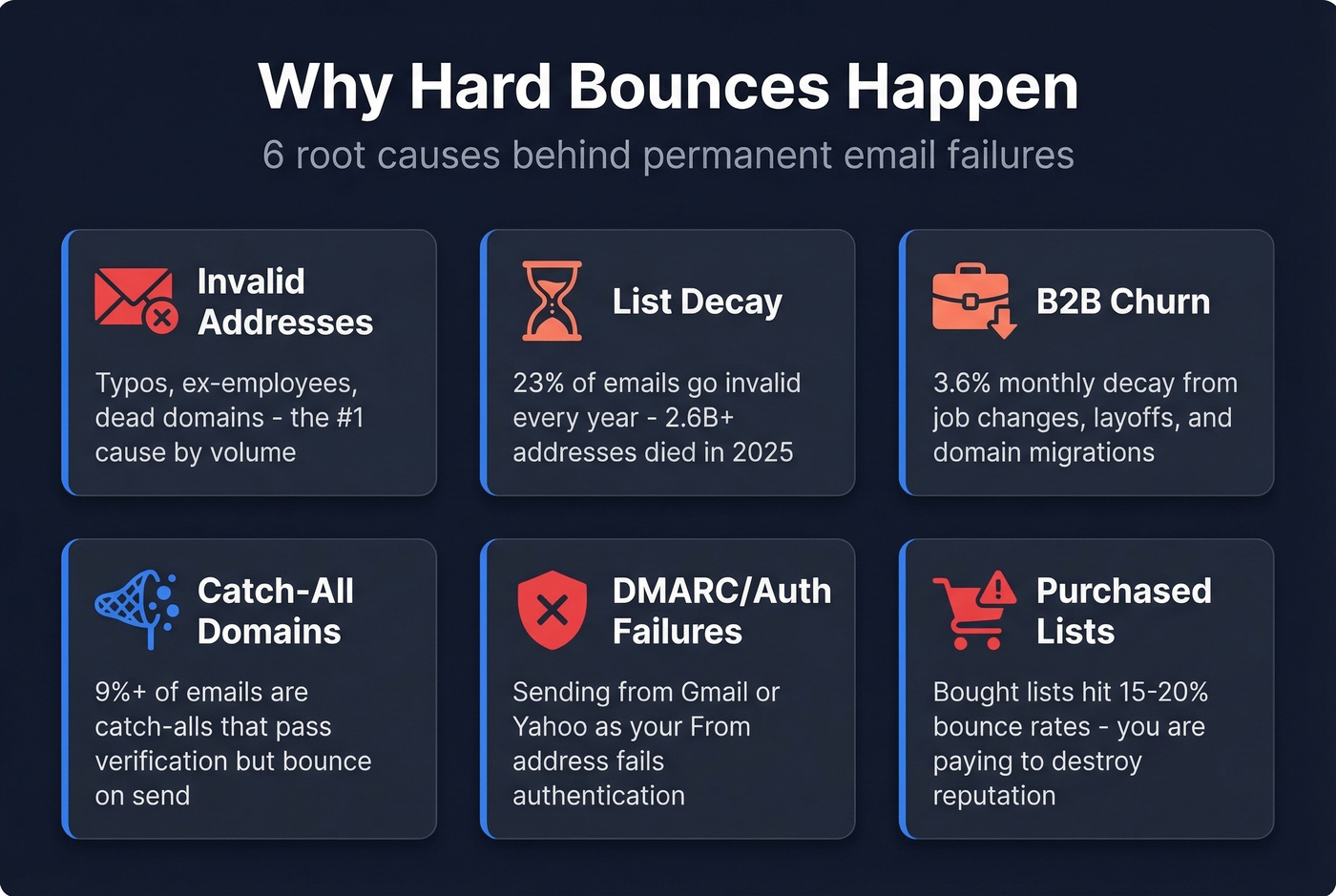
Invalid or non-existent addresses are the #1 cause by volume - typos during signup, employees who've left the company, domains that shut down. Simple as that.
List decay is relentless. ZeroBounce's 2026 report, based on 11B+ emails verified in 2025, found 2.6B+ were invalid - at least 23% annual list decay. That rate peaked at 28% in 2024 before settling back down.
B2B decay is worse than you think. RevenueBase tracked 3.6% decay in business emails in a single month (November 2024) - nearly double the traditional 1.5-2% monthly rate. Job changes, layoffs, and domain migrations all accelerate B2B churn, and we've seen this firsthand when helping teams audit their lists.
Catch-all domains fool basic verification. Over 9% of emails checked in 2025 were catch-alls - domains that accept mail for any address, including non-existent ones. They pass verification and bounce later. This is one of the sneakiest causes because everything looks clean until you actually send.
DMARC and authentication failures are entirely preventable. Using a free email address like Gmail or Yahoo as your From address will fail DMARC authentication and cause bounces with most receiving servers.
Purchased or scraped lists are bounce-rate disasters. We've seen teams hit 15-20% bounce rates on purchased lists. One practitioner on r/salestechniques reported 18-22% bounces before implementing a verification workflow - after cleaning up, their connect rate jumped from 12% to 19%.
If you're buying lists in 2026, you're not saving time. You're paying to destroy your sender reputation. The math never works out.
How to Read SMTP Bounce Codes
Most ESPs show you a bounce rate number but bury the SMTP codes that actually explain what went wrong. The same base code - 550 - can mean completely different things depending on the enhanced status code that follows it, and each requires a different fix.
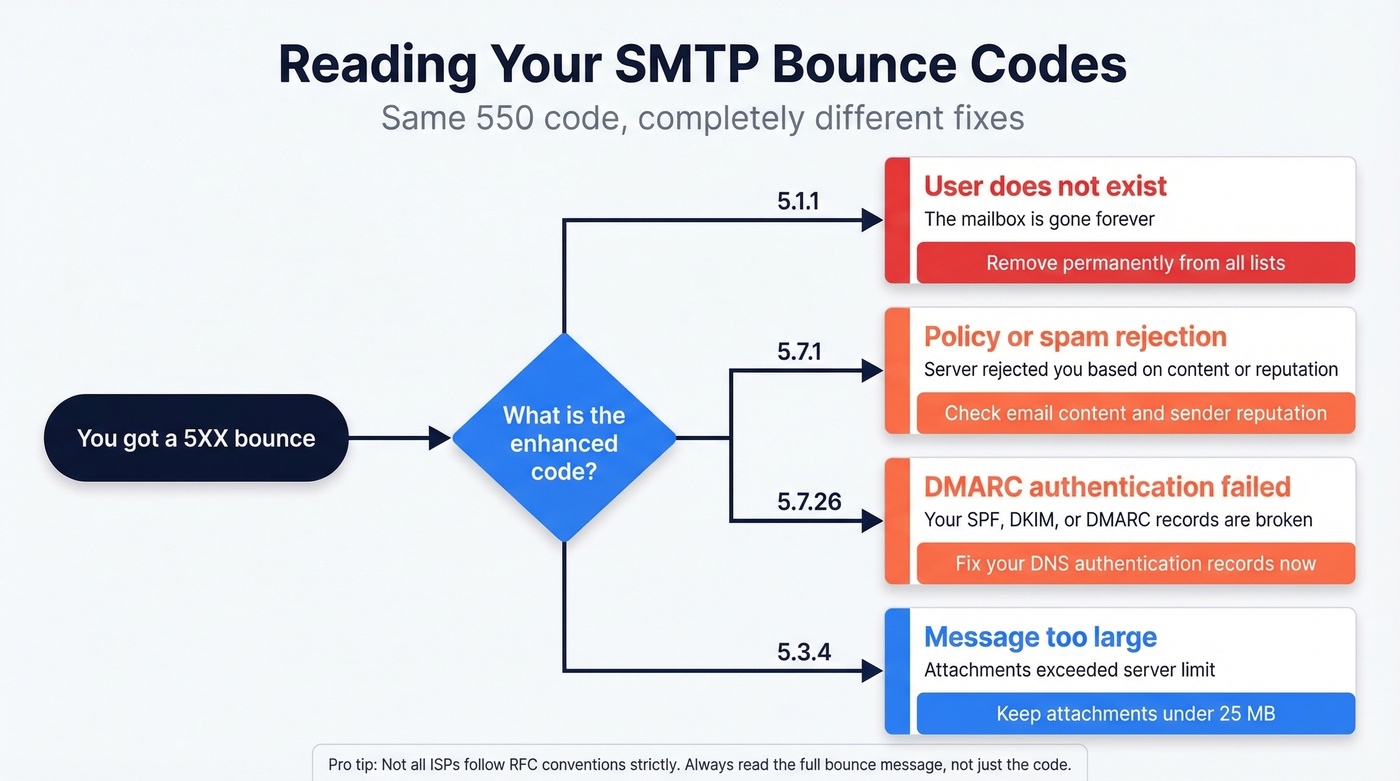
| Code | Meaning | Action |
|---|---|---|
| 550 5.1.1 | User/mailbox doesn't exist | Remove permanently |
| 550 5.7.1 | Policy/spam rejection | Check content + reputation |
| 550 5.7.26 | DMARC auth failed | Fix SPF/DKIM/DMARC |
| 552 5.3.4 | Message too large | Keep attachments under 25 MB |
Gmail uses standard enhanced codes like 550 5.7.26 for DMARC failures. Outlook and Microsoft 365 add proprietary codes - SC-001, SC-004, OU-001 - which typically indicate sender reputation blocks rather than list quality issues. Microsoft's documentation covers these in detail.
One caveat: not all ISPs follow RFC code conventions strictly. A 4XX from one server can be a permanent failure in practice. Always cross-reference the full bounce message, not just the code.
How to Reduce Bounces for Good
Five steps, in priority order.
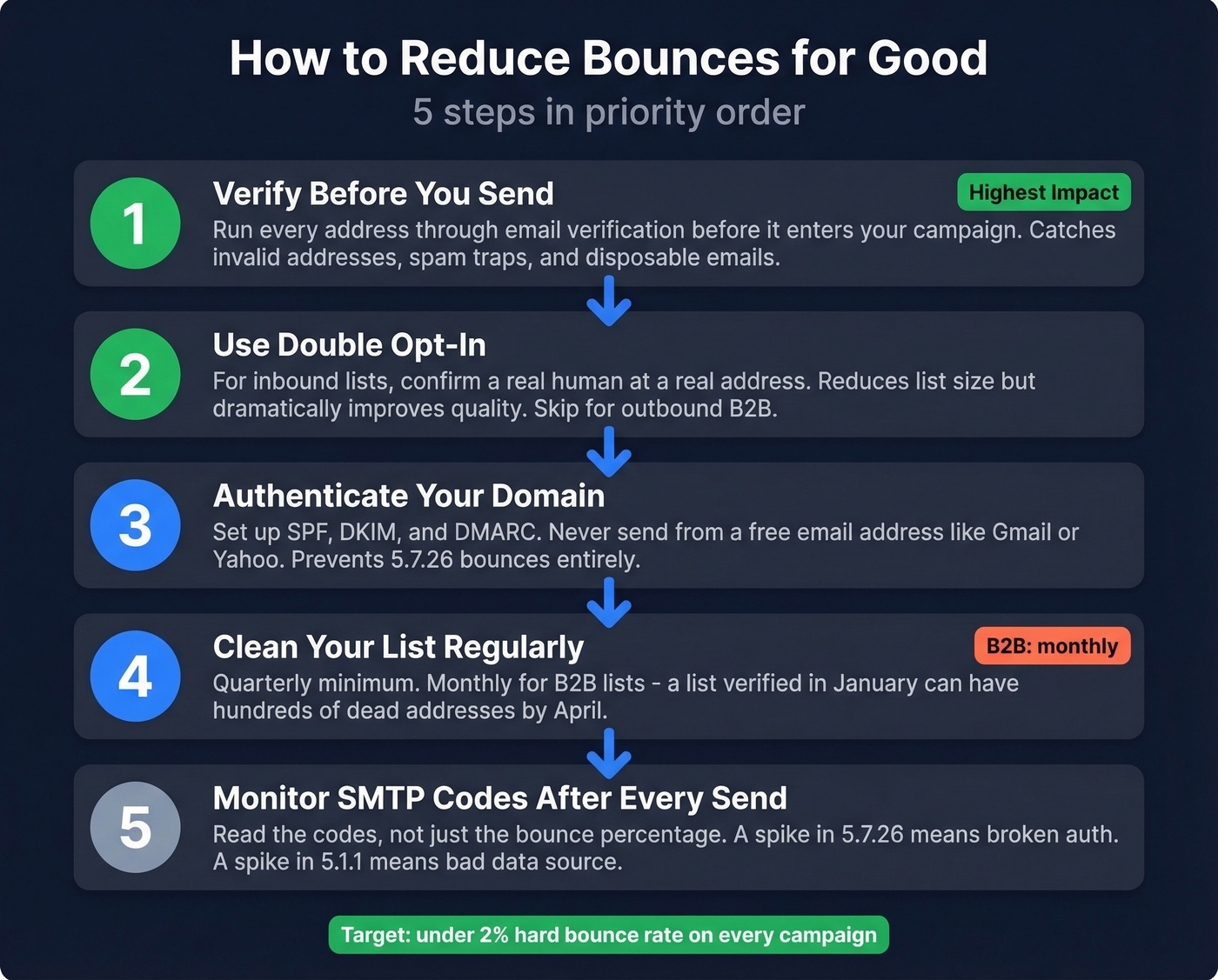
2. Use double opt-in. For inbound lists, double opt-in confirms a real human at a real address. It reduces list size but dramatically improves quality. Skip this if you're running purely outbound B2B campaigns - it doesn't apply there.
3. Authenticate your domain. Set up SPF, DKIM, and DMARC. Never send campaigns from a free email address. Google's sender guidelines spell out exactly what's required, and ignoring them is the fastest way to trigger 5.7.26 bounces.
4. Clean regularly. Quarterly at minimum. Monthly for B2B lists, given that 3.6% monthly decay rate we mentioned earlier. A list you verified in January can have hundreds of dead addresses by April.
5. Monitor SMTP codes after every send. Don't just glance at the bounce rate percentage - read the codes. A spike in 5.7.26 errors means your authentication is broken. A spike in 5.1.1 means your data source is bad. Different problems, different fixes.
If you need a broader baseline (hard + soft), see our full guide to email bounce rate.

B2B lists decay 3.6% per month. Prospeo refreshes all 300M+ profiles every 7 days - not the 6-week industry average - so the emails you pull today are still valid tomorrow. Catch-all handling, honeypot filtering, and spam-trap removal are built into every lookup.
Get emails that survive send day. 98% accuracy, verified in real time.
FAQ
What bounce rate will get my ESP account suspended?
Most ESPs don't publish exact thresholds, but rates above 5% consistently trigger warnings or throttling. HubSpot, Mailchimp, and SendGrid all monitor per-campaign bounce rates. Keep yours under 2% to stay safe.
Can I re-send to a hard-bounced address?
No. A hard bounce is permanent - the mailbox doesn't exist. Re-sending only damages your sender reputation further. Remove hard-bounced addresses immediately and add them to a suppression list so they're excluded from every future campaign.
How does a hard bounce differ from a block?
A hard bounce means the address itself is invalid or permanently unreachable. A block is a reputation-based rejection from the receiving server. Both return 5XX codes, but blocks can sometimes be resolved by improving your sender score and authentication. Hard bounces can't be fixed - the address is simply gone.
I verified my list and still got high bounces - why?
Catch-all domains are the most likely culprit. Over 9% of emails are catch-alls that accept mail for non-existent inboxes, fooling basic verification tools. Prospeo's 5-step process includes dedicated catch-all detection, and ZeroBounce flags them too. Whatever tool you use, make sure it explicitly handles this edge case before you send.