


Best Harmonix AI Alternatives in 2026
You've been demoing Harmonix AI, and the pitch is compelling - an intelligent omnichannel layer that works inside your CRM/ERP, no rip-and-replace. Then you hit the fine print: a 10-user minimum, custom pricing, and a product experience that's still Spanish-first. Time to explore alternatives that actually fit your team.
Important disambiguation: If you searched "Harmonix AI alternatives," most results cover Harmonic - a completely different company that does VC deal sourcing and startup discovery. This article covers the actual Harmonix AI, the omnichannel CRM overlay for sales and service teams.
Our Top Picks
| Pick | Best For | Starting Price |
|---|---|---|
| Prospeo | Teams whose real bottleneck is contact data, not the comms stack | Free (75 emails/mo) |
| Ringover | Sales teams wanting a lightweight calling-first overlay that connects to their CRM | $21/user/mo |
| Front | Messaging-heavy teams needing a shared inbox across channels | $25/seat/mo |
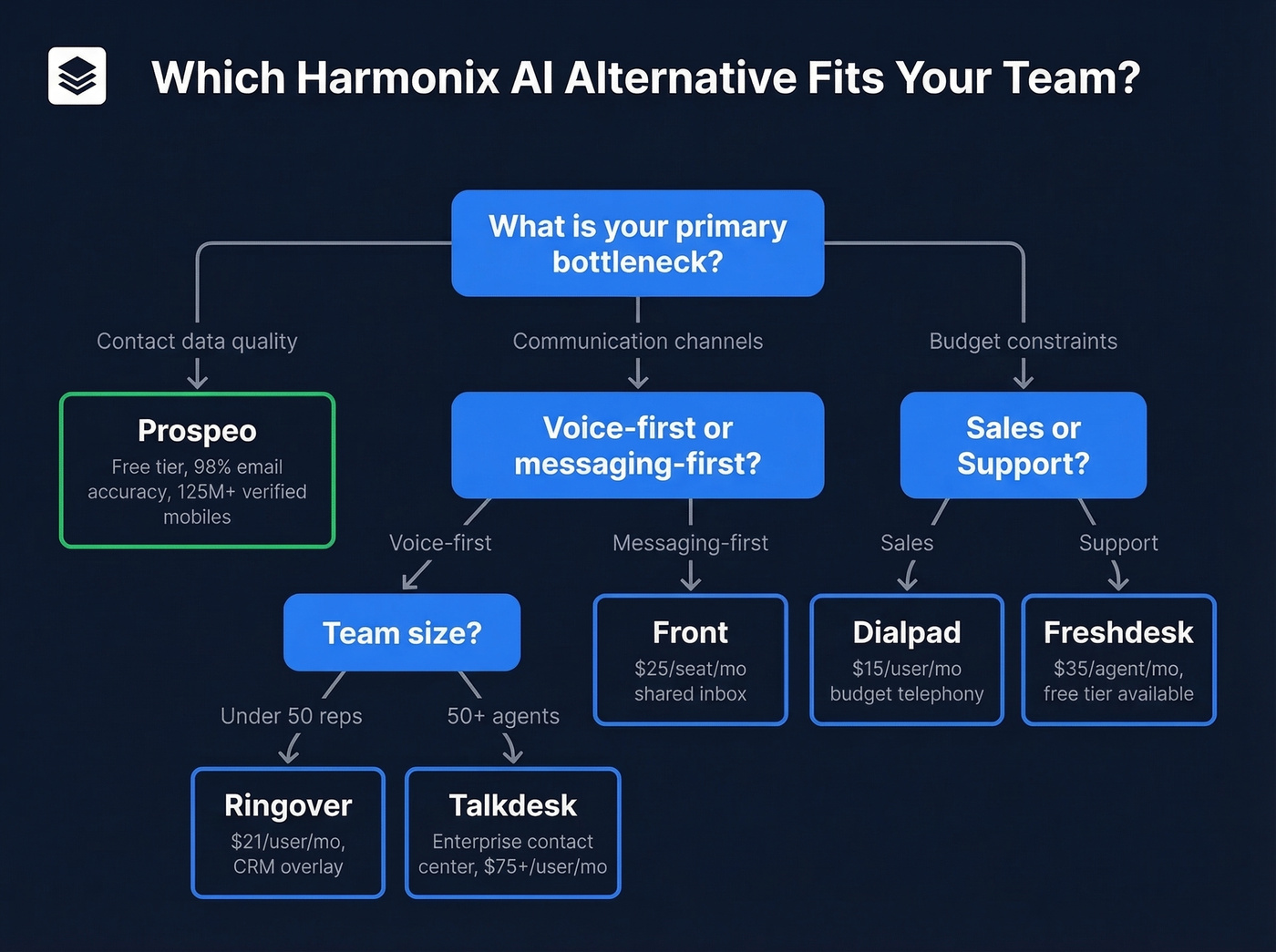
What Is Harmonix AI?
Harmonix AI is an intelligent omnichannel communications layer designed to sit inside your CRM/ERP. Instead of replacing your CRM, it adds a unified inbox for phone, WhatsApp, email, video, meetings, and documents - then uses AI to auto-log activity, generate summaries, and suggest next steps.
That's the key distinction between omnichannel and multichannel: omnichannel carries context across channels so a rep picking up a WhatsApp thread knows what happened on the last call. Multichannel just means you have multiple channels, usually siloed.
The headline claims from their site:
- +32% sales activity per rep
- 8 hours/week saved on manual logging
- +22% sales increase after three months
- +26% data capture improvement
- Service teams report 4.8/5 CSAT
- 5-minute install via browser extension
Those are vendor-reported numbers, but the overlay concept is genuinely smart. Your CRM stays the system of record, and migration risk drops to zero.

Harmonix AI overlays your CRM with omnichannel comms - but bad contact data still kills your results. Prospeo feeds 98% accurate emails and 125M+ verified mobiles into whatever stack you choose, on a 7-day refresh cycle.
Stop piping garbage data through your shiny new omnichannel tools.
Why Teams Switch
Opaque pricing with a 10-user minimum. No public pricing page, and you can't buy fewer than 10 seats. That kills it for smaller teams.
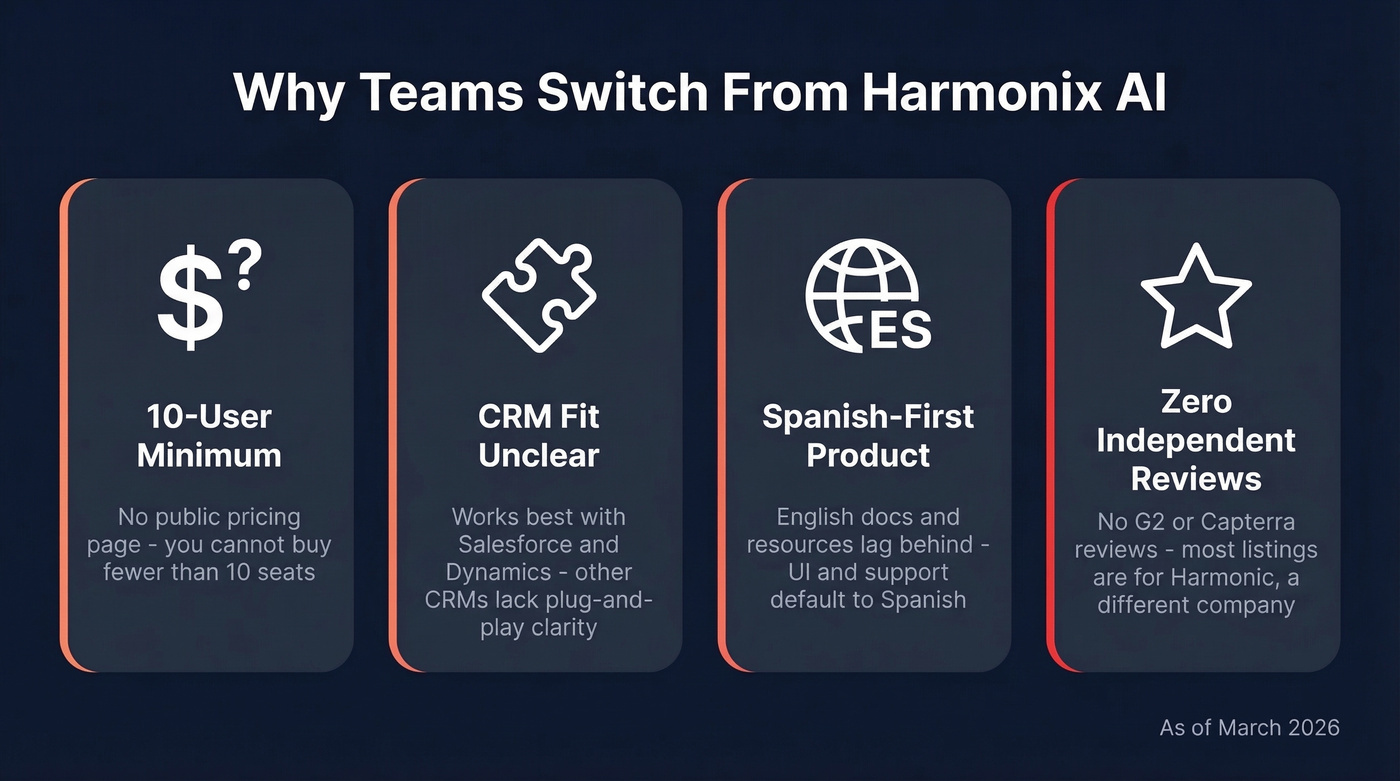
Custom-CRM fit isn't always obvious. Harmonix positions itself as working on top of CRMs and ERPs, including custom setups, but most buyers still evaluate it through the Salesforce/Dynamics lens. Teams on other CRMs often look for more plug-and-play options with clearer packaging (and a clearer sense of examples of a CRM that match their workflow).
Spanish-first product. The site and many resources are Spanish-first. English-language materials lag behind.
No independent reviews. Zero G2 or Capterra reviews for Harmonix AI specifically. The G2 page that shows up is actually for Harmonic, the VC tool. You're buying blind. Reddit threads are equally thin - most responses confuse it with Harmonic, so there's almost no English-language community discussion about the actual product.
7 Best Alternatives to Harmonix AI
1. Prospeo - Best for Contact Data Accuracy
Here's the thing most omnichannel articles won't tell you: if your average deal size is under $20k and your team is under 20 reps, your real bottleneck isn't the communication platform. It's the contact data feeding it. Wrong emails bounce. Wrong numbers waste call blocks. Your omnichannel stack is only as good as the data layer underneath it.
If you're evaluating tools in this category, it also helps to understand the broader landscape of data enrichment services and where verification fits in.
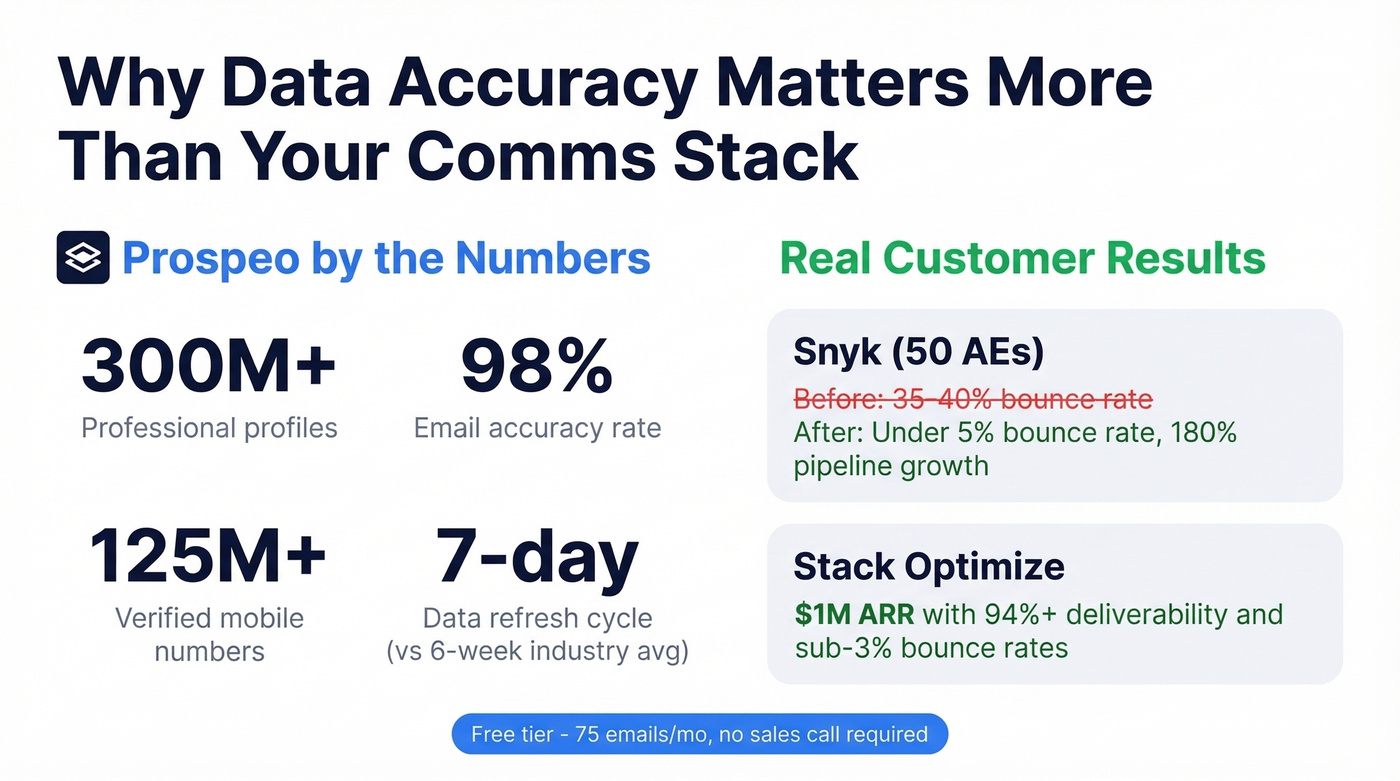
We've seen this play out dozens of times. Teams spend months evaluating dialers and shared inboxes, then pipe garbage data through them and wonder why results don't improve. Prospeo solves that specific problem with 300M+ professional profiles, 143M+ verified emails at 98% accuracy, and 125M+ verified mobile numbers with a 30% pickup rate - all on a 7-day refresh cycle compared to the 6-week industry average. Its proprietary email-finding infrastructure doesn't rely on third-party providers, and a 5-step verification process includes catch-all handling, spam-trap removal, and honeypot filtering.
Prospeo integrates natively with Salesforce, HubSpot, Smartlead, Instantly, Lemlist, Clay, and Zapier, so whatever CRM overlay or contact center you pick from this list, it plugs in alongside it. The free tier gives you 75 verified emails per month plus 100 Chrome extension credits to test with no contract and no sales call required.
Real results back this up: Snyk's 50-AE team cut bounce rates from 35-40% to under 5% and grew AE-sourced pipeline 180%. Stack Optimize built to $1M ARR while maintaining 94%+ deliverability and sub-3% bounce rates across all clients.
2. Ringover - Best CRM Overlay for Sales
Use this if you want the closest architectural match to Harmonix AI's overlay approach - a communication layer that connects to your existing CRM - but without the 10-user minimum friction. Ringover is primarily telephony-focused, with pricing starting around $21/user/mo (Smart plan) up to $44/user/mo (Business). If you want more options in this category, see our Ringover alternatives.
Skip this if you need deep WhatsApp-first workflows inside a single unified inbox. Ringover leans voice-first. Teams running high-volume WhatsApp outreach in LATAM or EMEA will usually want a more messaging-centric platform.

3. Front - Best Shared Omnichannel Inbox
Front flips the model. Instead of layering telephony onto your CRM, it builds a shared inbox where email is the core, and teams can add channels like SMS and chat - with WhatsApp available on higher tiers.
Pros:
- Transparent pricing: $25/seat/mo (Starter, max 10 seats), $65 (Professional), $105 (Enterprise)
- AI add-ons available, including Copilot at $20/seat/mo
- WhatsApp channel available on Professional+ with Meta-billed WhatsApp costs plus a 20% admin fee
Cons:
- Doesn't natively handle calls, so you'll still need a dialer for outbound
- Starter is single-channel only - omnichannel requires Professional at $65/seat/mo
- Run Professional + Copilot and you're at $85/seat/mo
Front is the pick for teams where the conversation happens in messaging channels, not on the phone.
4. Aircall - Best for Voice-First Teams
Aircall is a default cloud phone system for mid-market sales teams. Essentials starts at $30/user/mo, Professional at $50/user/mo. It integrates with most CRMs and gets reps dialing fast.
The catch: add-ons stack up quickly. AI costs $9/user/mo extra, Analytics+ another $15/user/mo. A fully featured seat hits $74/user/mo before you've made a single call. And there's a 3-license minimum.
Watch out for: Dropped calls and echo are common complaints from teams that switch away. AI transcription is limited to English, which matters if your team sells in multiple languages. Support quality tends to be better for larger accounts, with a noticeable drop-off below 50 licenses.
5. Talkdesk - Enterprise Contact Centers
Talkdesk is a full contact center platform with skills-based routing, IVR, workforce management, and enterprise-grade compliance options. Pricing is quote-based - expect roughly $75-$165/user/mo depending on the package. Implementation runs 3-6 weeks, not 5 minutes.
This is the right tool for 50+ agent service operations that need contact-center depth. It's overkill for a 15-person sales team that just wants to log calls in Salesforce. If you're comparing Talkdesk to Harmonix AI, you're solving a different problem entirely.
6. Dialpad - Budget Cloud Phone
Dialpad offers a cheap entry point: Standard at $15/user/mo, Pro at $25/user/mo. Good for basic cloud telephony and inbound-heavy teams on a budget.
Known issues include costs rising at scale, spam flagging and call reputation problems on outbound numbers, and weaker outbound tooling overall. Not great for high-volume outbound. If Dialpad is on your shortlist, compare it against other options in our Dialpad alternatives.
7. Freshdesk - Budget Support Platform
Freshdesk covers the support side of omnichannel, starting at $35/agent/mo. It carries a 4.5/5 on Capterra from 3,400+ reviews - real social proof. Best for customer service teams, not sales. If your Harmonix AI use case was service-only, Freshdesk is a proven budget option with a free tier for small teams.
Pricing Comparison
Front prices below reflect annual billing. Harmonix AI's range is estimated since they don't publish pricing.
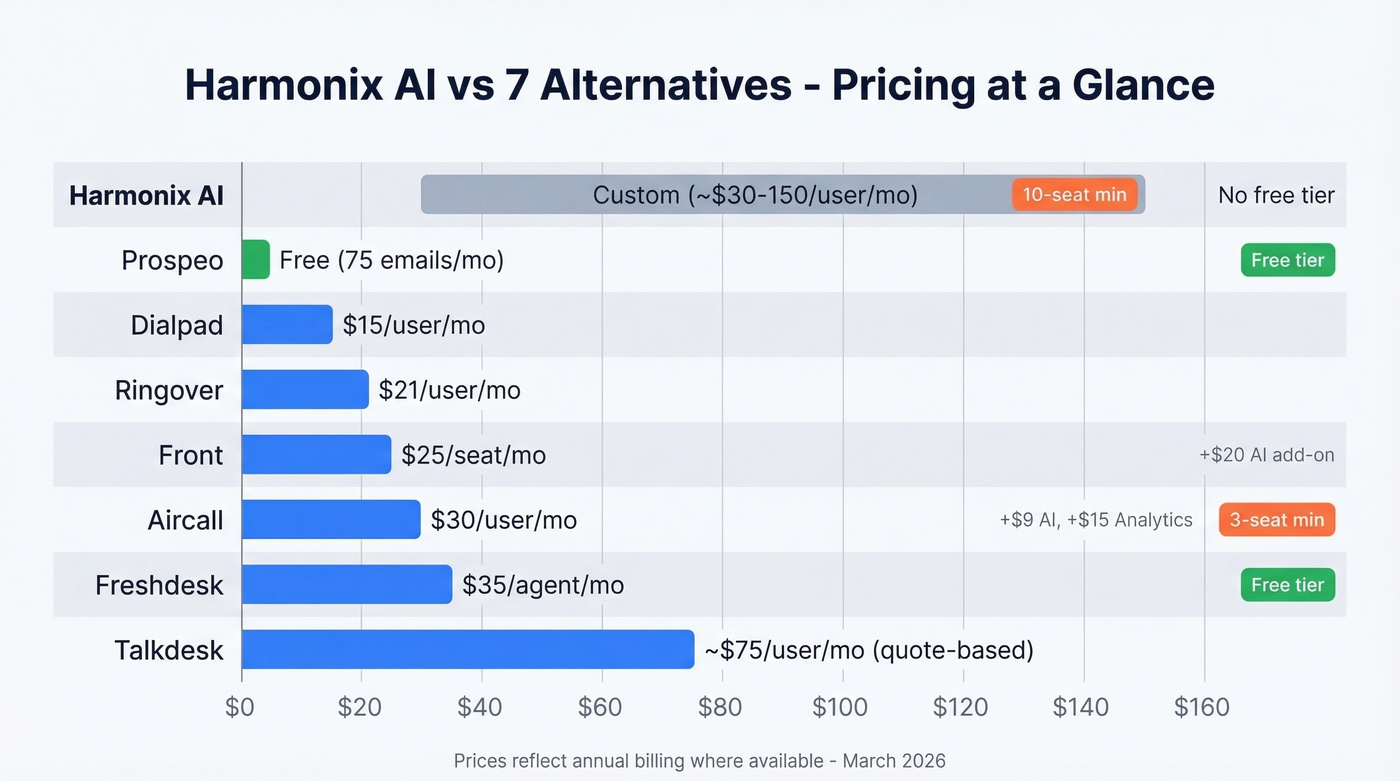
| Tool | Starting Price | AI Cost | Min Seats | Free Tier |
|---|---|---|---|---|
| Harmonix AI | Custom (~$30-150/user/mo) | Included | 10 | No |
| Prospeo | Free (75 emails/mo) | N/A | 1 | Yes |
| Ringover | $21/user/mo | Varies | 1 | No |
| Front | $25/seat/mo | $20/seat/mo add-on | 1 (max 10 on Starter) | No |
| Aircall | $30/user/mo | $9/user/mo add-on | 3 | No |
| Talkdesk | ~$75/user/mo (quote) | Varies by package | Custom | No |
| Dialpad | $15/user/mo | Varies by plan | 1 | No |
| Freshdesk | $35/agent/mo | Varies | 1 | Yes |
Snyk cut bounce rates from 35% to under 5% and grew AE-sourced pipeline 180% - not by switching dialers, but by fixing the data underneath. Prospeo starts free with 75 verified emails/month. No contracts, no sales calls.
Your real bottleneck isn't the comms platform. It's the data feeding it.
FAQ
What does Harmonix AI actually do?
Harmonix AI is an intelligent omnichannel layer inside your CRM/ERP that unifies phone, WhatsApp, email, video, meetings, and documents - then adds AI summaries, task suggestions, and automatic activity logging. Think of it as a communication overlay, not a CRM replacement.
Is Harmonix AI the same as Harmonic?
No. They're completely different products. Harmonix AI is an omnichannel CRM overlay for sales and service teams. Harmonic is a VC startup discovery database with 35M+ companies. Most search results confuse the two, so double-check which product you're actually evaluating.
What's a good free option for fixing contact data before choosing a platform?
Prospeo's free tier includes 75 verified emails and 100 Chrome extension credits per month - enough to test data quality before committing to any omnichannel stack. Most enrichment tools either gate free access behind a sales call or cap accuracy well below 98%.
How do I choose between a CRM overlay and a contact center?
For teams under 30 reps doing outbound sales, a CRM overlay like Ringover or Front is usually the right fit. Contact center platforms like Talkdesk make sense at 50+ agents handling inbound service queues with IVR, skills-based routing, and workforce management needs. Let's be honest - if you're reading this article, you're probably in the overlay camp.