

Highspot vs Spekit: Which Enablement Platform Deserves Your Budget in 2026?
You just got the Highspot renewal quote - around $91K for another year. Meanwhile, your CTO forwarded a GeekWire article about Highspot merging with Seismic, and the CFO wants to know why you're signing a six-figure contract right as the category consolidates. If you're weighing Highspot vs Spekit, that's a fair question, and the answer depends on more than feature checklists.
30-Second Verdict
Choose Highspot if you've got 200+ reps, complex content management needs, and you can negotiate a 1-year contract with merger protections baked in.
Choose Spekit if you're a mid-market team (50-200 reps), Salesforce-centric, and you need something live in weeks with high adoption.
Skip both if your real problem is stale CRM data - bounced emails, disconnected numbers, wrong contacts - feeding the enablement layer. Fix the data foundation first.
At-a-Glance Comparison
| Metric | Highspot | Spekit |
|---|---|---|
| G2 Rating | 4.7/5 (1,197 reviews) | 4.7/5 (286 reviews) |
| Ease of Admin | 8.7 | 9.1 |
| Quality of Support | 9.4 | 9.5 |
| Product Direction | 9.2 | 9.5 |
| Avg Annual Cost | ~$91,460 ACV | ~$15,145 median |
| Setup Cost/Time | $15K-$45K implementation | Live in weeks, lower services cost |
| Primary Segment | Mid-Market / Enterprise | Mid-Market |
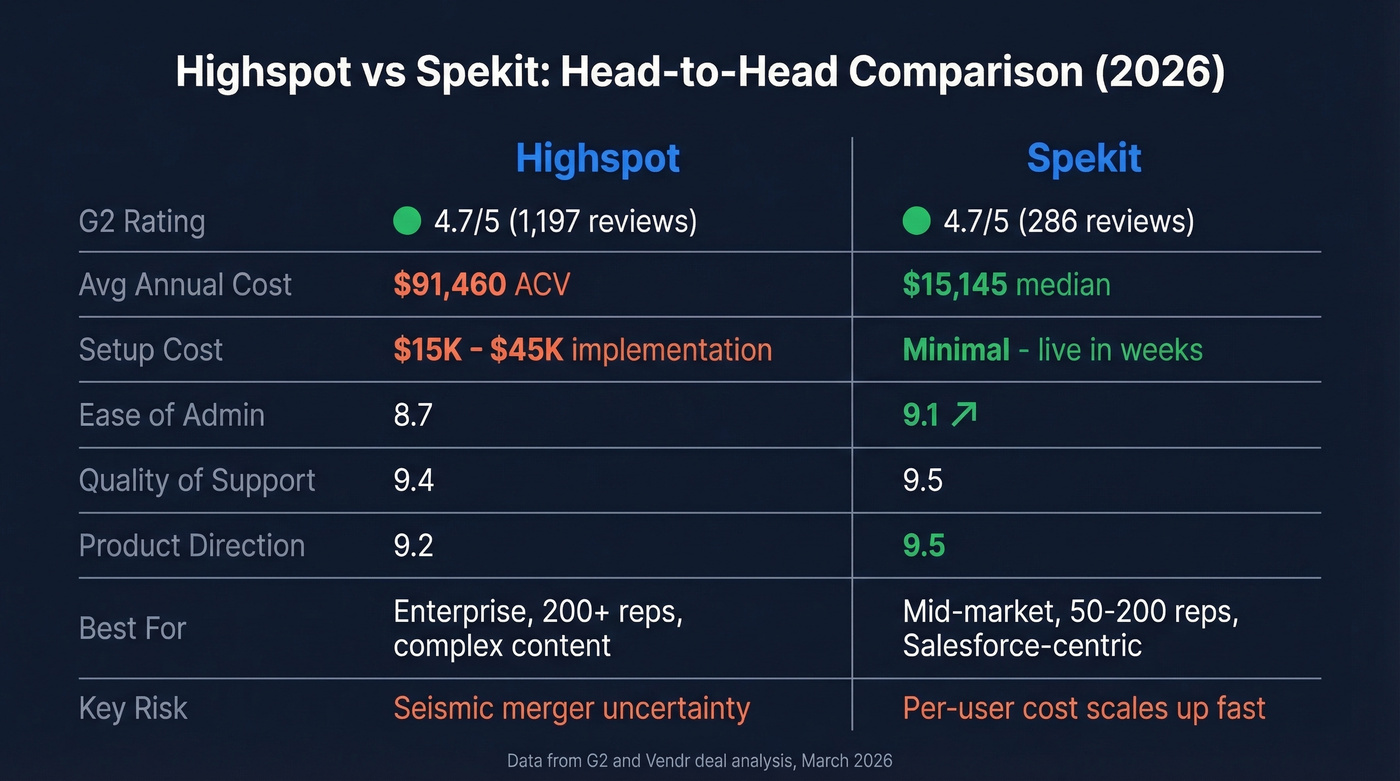
The G2 scores are nearly identical. The pricing gap isn't. That's the real story - and the merger makes it more complicated.
How the Seismic-Highspot Merger Changes Everything
On February 12, 2026, Highspot and Seismic signed a definitive agreement to merge. The combined entity will operate under the Seismic name, led by Seismic CEO Rob Tarkoff, with Highspot CEO Robert Wahbe joining the board. Highspot has raised $650M since 2011 at a peak $3.5B valuation; Seismic was valued at $3B in 2021 and serves roughly 2,000 customers worldwide.
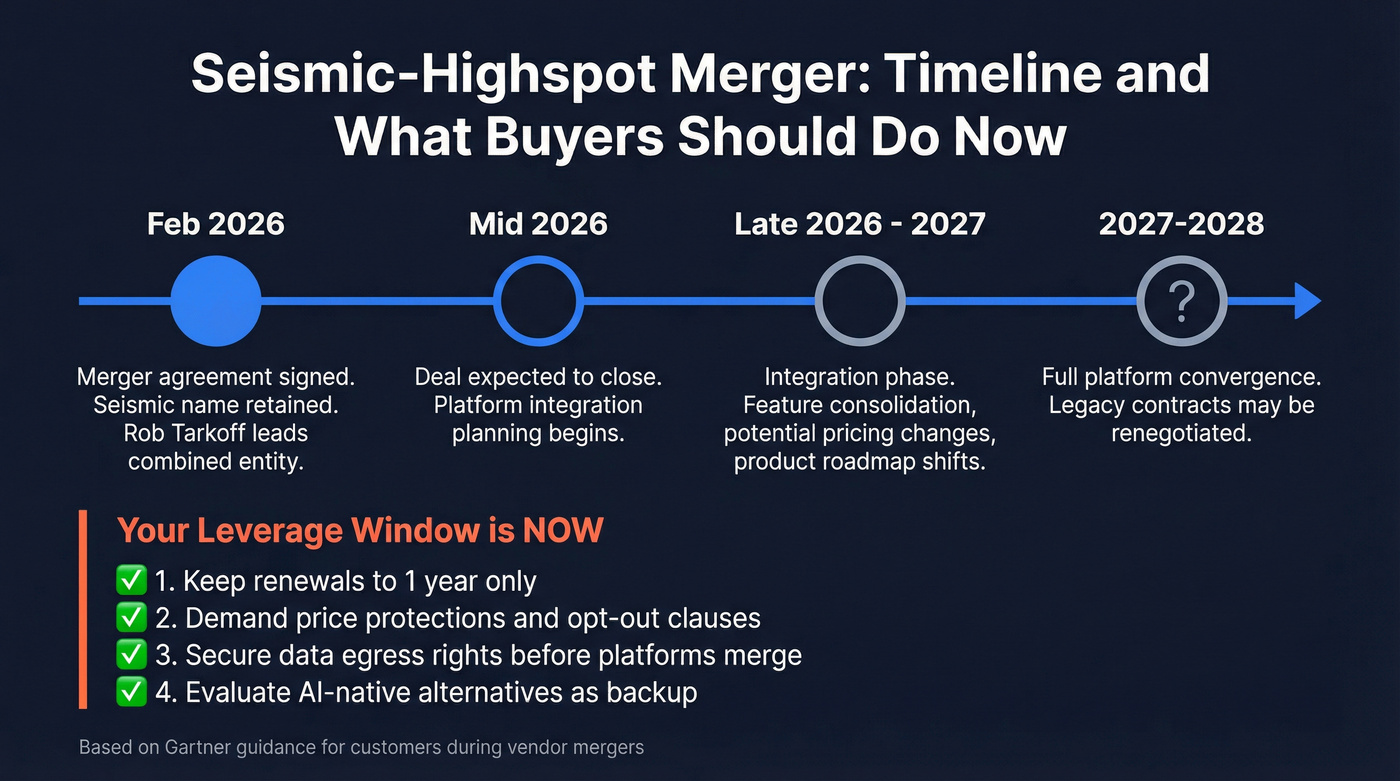
Integration risk is real, and it's now part of your buying decision.
Gartner's guidance for customers is blunt and worth following: keep renewals to 1 year, demand price and opt-out protections, secure data egress rights now before platforms merge, and start evaluating AI-native vendors as diversification. Spekit is already running with this narrative, hosting sessions about the 12-24 month integration timeline. In our experience, teams that negotiate during merger uncertainty save 20-30% on renewals. That window won't stay open forever.
Highspot: Strengths and Weaknesses
Highspot's core strength is content management at scale. With 40+ customers running 5,000+ reps and a largest deployment exceeding 50,000 users, it's proven for enterprise complexity. The Nexus AI engine powers content recommendations, and features like AI Role Play and coaching scorecards give enablement leaders real measurement tools.

Content organization and sharing get consistent praise in user reviews - reps can actually find what they need. Support is responsive, and Highspot doesn't charge extra for CRM integrations, which is rare at this price point.
But the tool that helps you organize content can also drown reps in it. As libraries grow, content overload becomes a real problem. Reporting terminology is unintuitive - reviewers flag the analytics as confusing - and keeping content fresh is an ongoing admin burden that never goes away. One buyer on r/ProductMarketing chose Paperflite over Highspot specifically because Highspot's UI felt cluttered and pricing was "rigid." Paid add-ons like Highspot Copilot, Advanced Analytics, and Premium Marketplace push costs higher still, and per SelectHub's analysis, the learning curve is steep enough that smaller teams risk underutilization.

Highspot and Spekit both organize content - but neither fixes the stale contacts feeding your CRM. If reps are bouncing 35% of emails, no enablement platform saves that pipeline. Prospeo delivers 98% email accuracy, 125M+ verified mobiles, and refreshes every 7 days - not every 6 weeks.
Fix the data layer before you spend six figures on enablement.
Spekit: Strengths and Weaknesses
Spekit takes a fundamentally different approach. Instead of building a content library reps have to visit, it embeds enablement directly into the tools they're already using - Salesforce and Gong chief among them. The platform runs on three pillars: a Knowledge Engine for governed GTM content, Unified Deal Context connecting Salesforce opportunity data with Gong call intelligence, and Agentic Coaching that delivers proactive recommendations in-workflow.

Deal Rooms let reps create tracked buyer experiences with engagement insights. Spekit touts 67%+ faster ramp times and up to 90% reduction in search time - vendor numbers worth pressure-testing during your eval, but directionally credible given the in-context delivery model.
Ease of use leads Spekit's G2 praise with 70 mentions. In-context learning (40 mentions) means reps don't leave their workflow, and integrations (33 mentions) round out the top three. The Salesforce + Gong combination is the killer differentiator for CRM-heavy orgs.
The downsides? Navigation slowdowns and performance issues show up in 12 user reviews - the in-app overlay isn't always snappy. Search can be inefficient (11 mentions), which is ironic for a tool built around reducing search time. Missing features get flagged too, and desktop app incompatibility is a real limitation if your org relies on non-web software. The per-user model also gets expensive for large teams, which narrows the pricing gap with Highspot faster than most buyers expect.
Real Pricing Compared
Neither Highspot nor Spekit publishes pricing. That's inexcusable for tools asking for five- and six-figure commitments. Here's what we know from Vendr's deal data:
| Highspot | Spekit | |
|---|---|---|
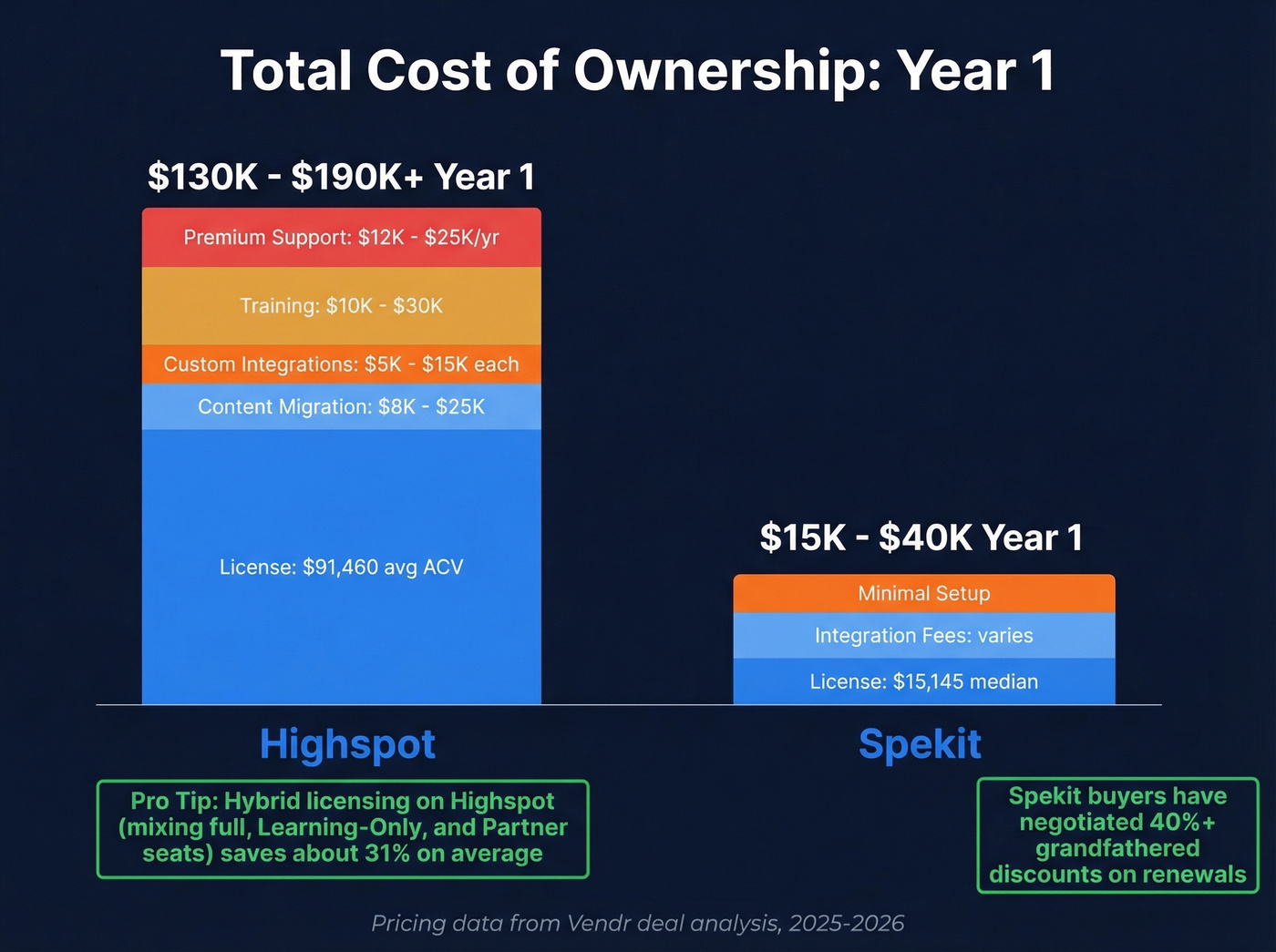
| Typical Annual Cost | ~$91,460 avg ACV | ~$15,145 median |
| Cost Range | Learning-Only ~$67/user/yr; Partner ~$183/user/yr | $8,749-$38,326/yr |
| Setup Cost | $15K-$45K | Minimal |
| Contract Model | Annual, negotiable | Annual, per-user |
Highspot's total cost of ownership goes well beyond the license. Budget for content migration ($8K-$25K), custom integrations ($5K-$15K each), and training ($10K-$30K). Premium support runs $12K-$25K/year, and professional services typically add 15-25% to first-year costs.
A hybrid licensing strategy - mixing full, Learning-Only, and Partner licenses - can save around 31% on average. We've seen this work particularly well for orgs with large partner ecosystems where not every user needs full access.
Spekit looks cheaper on paper, and it usually is. But watch for integration fees that used to be free and are now charged separately. On the bright side, Vendr buyers have negotiated 40%+ grandfathered discounts on renewals, so push hard if you're renewing. For teams exploring beyond these two, Mindtickle and GTMBuddy are worth a look if AI-native coaching matters more than content management.
Who Should Choose What
Go with Highspot if you have 200+ reps, need enterprise-grade content management, and can negotiate a 1-year contract with price protections and data egress clauses. Go in with eyes open about the merger timeline.
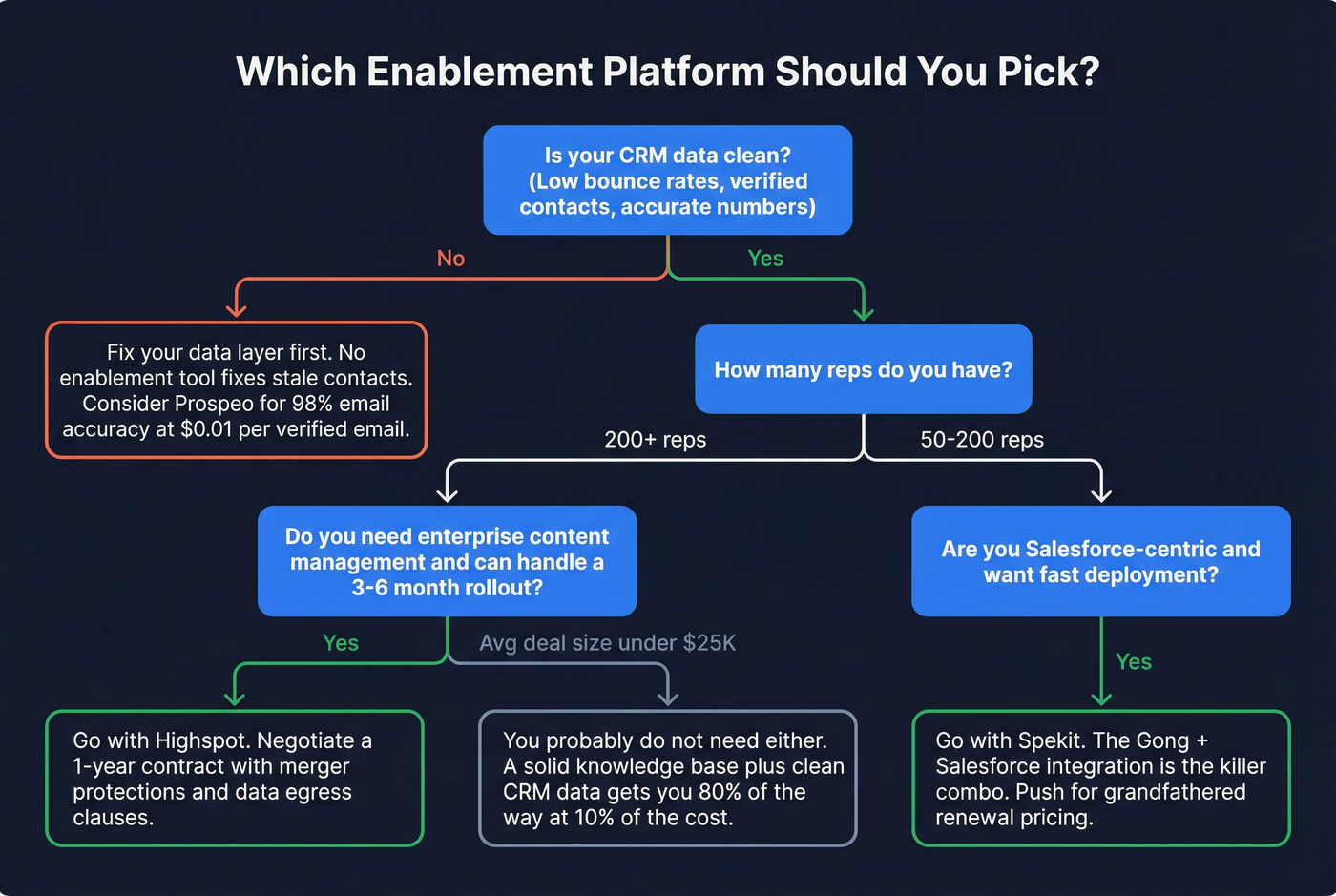
Go with Spekit if you're running 50-200 reps on Salesforce, want something live in weeks instead of months, and value adoption over feature depth. The Gong integration is a genuine differentiator.
Choose neither if your CRM is full of stale contacts, bounced emails, and disconnected numbers. Enablement tools deliver guidance based on CRM context - deal stage, persona, account data. If that foundation is rotten, you're delivering coaching to ghosts.
Here's the thing: if your average deal size is under $25K, you probably don't need either of these platforms. A solid knowledge base, a clean CRM, and a tool like Prospeo to keep contact data accurate will get you 80% of the way there at 10% of the cost. The Highspot vs Spekit debate is about to become less relevant as consolidation reshapes the category, and if you're making a decision today, factor in that merger-driven platform changes could hit within 12-24 months.
The Data Problem Neither Tool Solves
Let's be honest about something most enablement conversations skip entirely. These platforms surface content based on CRM context. If your CRM data is stale - wrong contacts, bounced emails, disconnected numbers - enablement delivers guidance to ghosts. We've seen teams invest $90K+ in enablement only to realize reps can't reach the people the platform is coaching them to engage.

Prospeo covers 300M+ professional profiles with 98% email accuracy and a 7-day data refresh cycle. It verifies emails and direct dials so your enablement investment actually connects reps with real humans. Starts free, paid plans from ~$39/mo - a rounding error compared to either enablement platform.
If you're actively cleaning lists, it's worth pairing this with an email deliverability check so your domain reputation doesn't get punished for bad data.
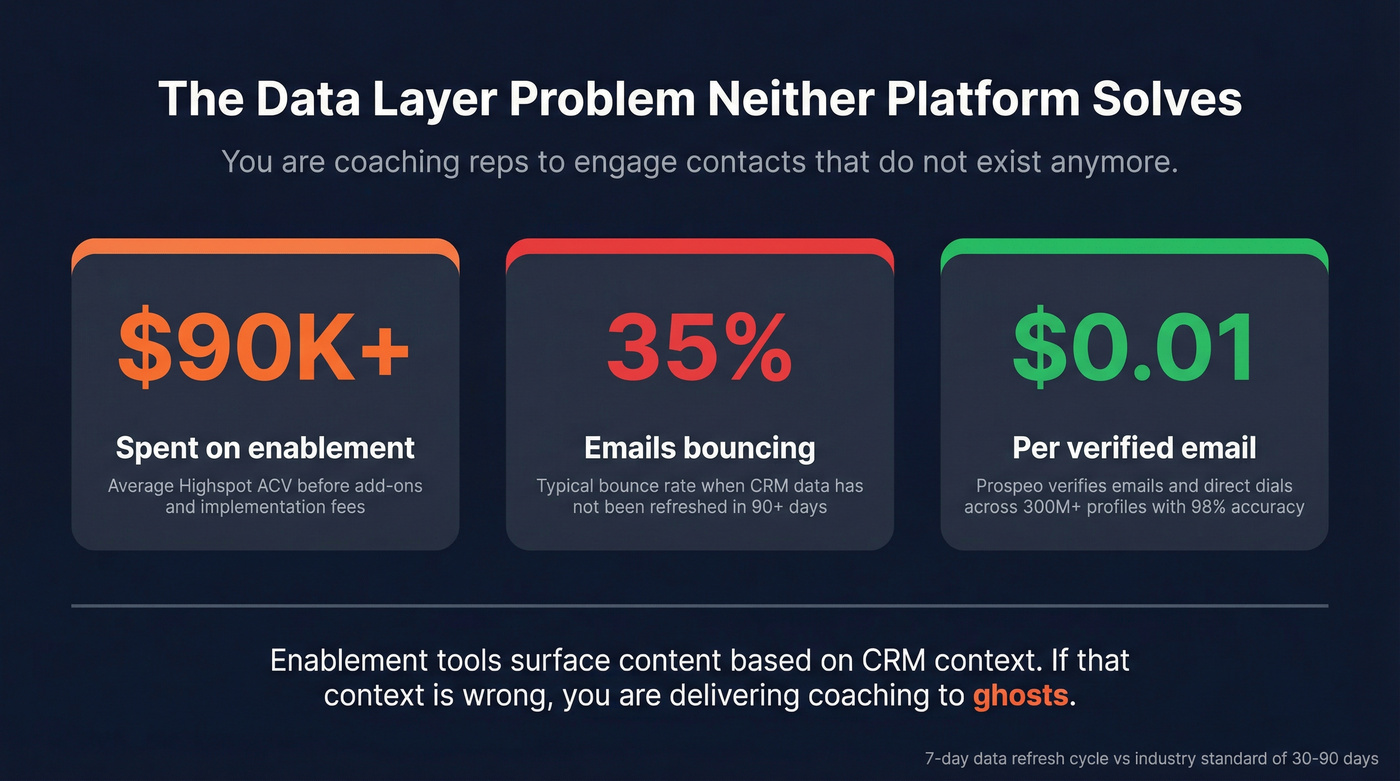
You're comparing $91K Highspot contracts against $15K Spekit licenses - but the real ROI leak is bad contact data underneath both platforms. At $0.01 per verified email, Prospeo costs less than a single Highspot implementation fee and actually connects your reps to real buyers.
Stop enabling reps to reach the wrong people faster.
FAQ
What happens to my Highspot contract after the Seismic merger?
Both companies said the platforms "will continue to be supported" after the deal closes. Gartner recommends keeping renewals to one year, demanding price and opt-out protections, and securing data egress clauses now. The 12-24 month integration window is your leverage period - use it.
Is Spekit cheaper than Highspot?
Significantly. The median Spekit contract runs ~$15,145/year versus Highspot's ~$91,460 average ACV. But Spekit's per-user model scales up for large teams, and integration fees are now charged separately. For 200+ reps, the gap narrows more than you'd expect.
Should I wait for the merger to finish before buying?
No - waiting 12-24 months leaves your team without enablement tooling. Buy now, but negotiate a 1-year contract with opt-out clauses and price protections. Merger uncertainty gives you leverage; use it to lock in better pricing on either platform.