

How Many Touchpoints Before a Sale? Every Benchmark That Matters
A rep on r/sales described chasing a single industrial equipment deal for nine months - cold call, voicemail, email, another voicemail, a connected call weeks later, resent attachments, another voicemail, and finally a meeting-booking email that landed. Seven deliberate touches spread across three quarters. He closed it. Most reps would've quit after touch three.
The real answer to how many touchpoints before a sale depends on what you're selling, who you're selling to, and how you define "touchpoint." Here's what the data shows, plus a cadence you can steal.
The quick version:
- SMB / transactional sales: 5-12 touches
- Mid-market B2B: ~76 touches over 211 days
- B2B SaaS / enterprise: 266 touchpoints
But the real question isn't how many - it's how many actually reach a human.
The "Rule of 7" Is a Myth
Every marketing textbook cites the "Rule of 7" - the idea that a prospect needs seven exposures before they buy. It sounds scientific. It isn't.
The rule was invented by a radio station in the 1930s to convince advertisers to buy more ad spots. There's no underlying research. No study. Just a sales pitch that became gospel.
Threshold effects in persuasion are real - people do need repeated exposure before they act. But the number is wildly variable depending on market size, product complexity, competitive density, and recency of need. Telling a rep selling janitorial supplies and a rep selling enterprise cybersecurity to both aim for "seven touches" is absurd. That nine-month industrial equipment pursuit on Reddit? It took seven deliberate touches, sure, but spread across months, not a two-week email sequence.
What the Data Actually Shows
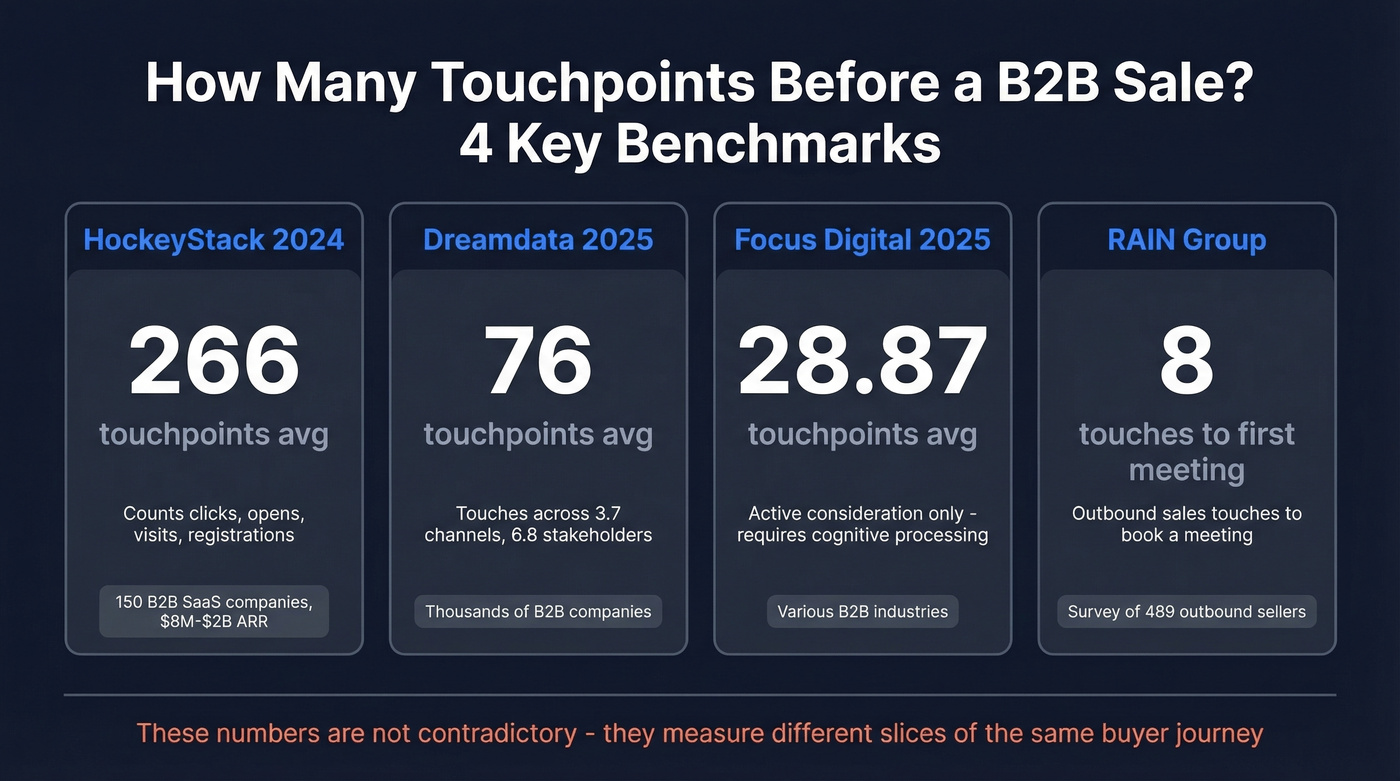
The reason touchpoint benchmarks vary so dramatically is definitional. One study counts every ad impression. Another counts only moments where a buyer actively engages. Here are the four most useful benchmarks and what each actually measures.
| Source | Touchpoints | What They Count | Sample |
|---|---|---|---|
| HockeyStack (2024) | 266 | Clicks, opens, visits, registrations | 150 B2B SaaS companies (ARR $8M-$2B), min $15k/mo ad spend |
| Dreamdata (2025) | 76 | Touches across 3.7 channels | Thousands of B2B companies using Dreamdata |
| Focus Digital (2025) | 28.87 | Active consideration only | Not disclosed |
| RAIN Group | 8 | Outbound to first meeting | Survey of 489 outbound sellers |
The HockeyStack dataset is the most granular: 150 B2B SaaS companies with ARR between $8M and $2B, all spending at least $15K/month on ads. Their 266-touchpoint average includes organic website visits, ad clicks, email opens, and webinar registrations. Alongside those 266 touchpoints, they measured 2,879 impressions - passive exposures like display ads that didn't require a click.
Dreamdata's 76-touch average uses a narrower definition: touches across 3.7 channels with 6.8 stakeholders involved. Focus Digital's 28.87 average is stricter still, requiring "active cognitive processing" - a Meta thruplay counts, but a cold call that gets cut off before you deliver your message doesn't.
None of these numbers are wrong. They're measuring different slices of the same elephant. The takeaway isn't a magic number - it's that complex B2B deals require dozens to hundreds of interactions across multiple channels and stakeholders. Top performers in the RAIN Group data don't just do more touches; they distribute them across the Interest, Consideration, and Commitment stages rather than front-loading everything into a single sprint.
By Deal Size and Industry
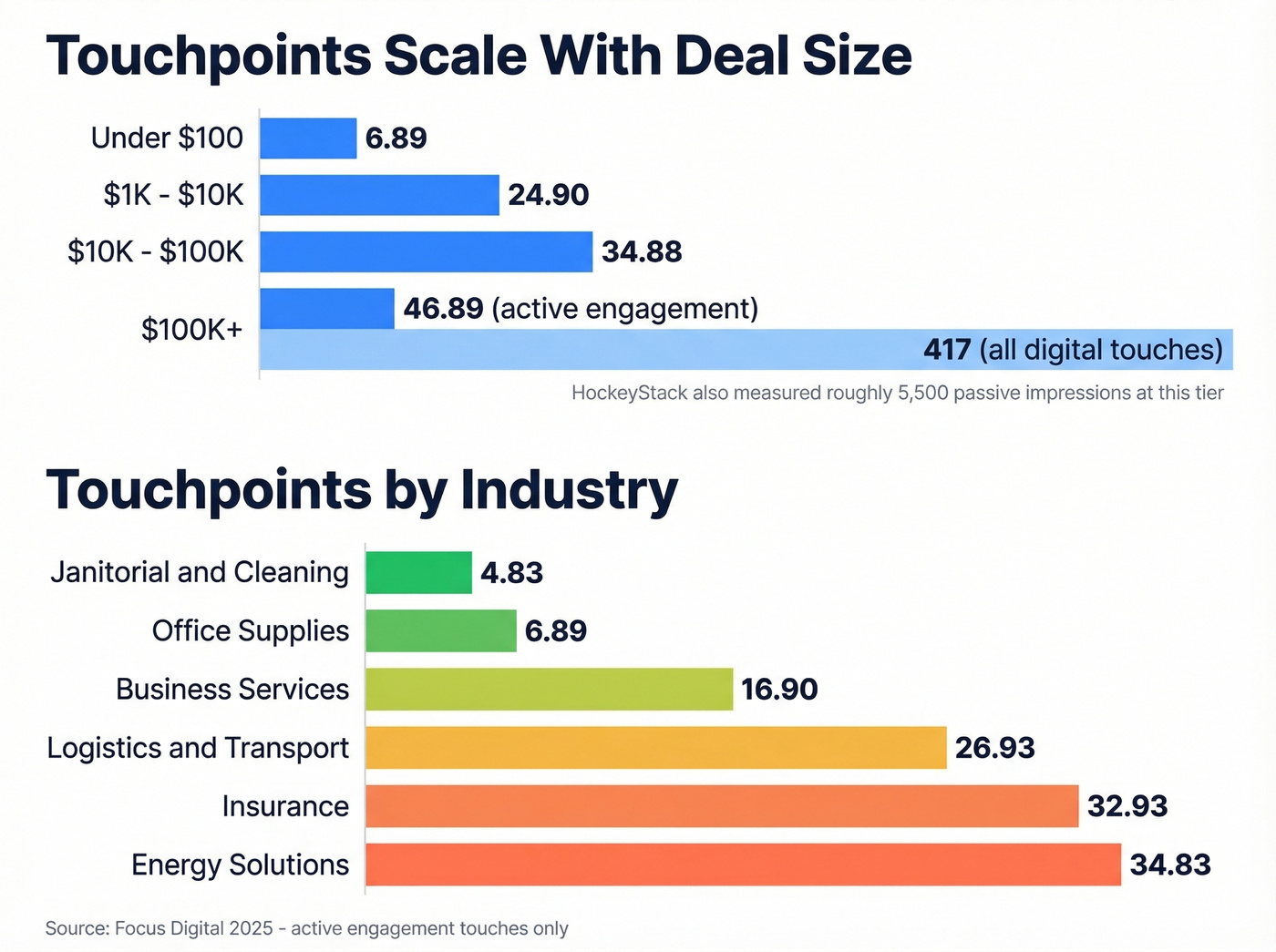
Deal size is the single strongest predictor of touchpoint volume. A $50 purchase doesn't need a buying committee. A $100K platform deal does.
| Deal Value | Focus Digital | HockeyStack |
|---|---|---|
| Under $100 | 6.89 | - |
| $1K-$10K | 24.90 | - |
| $10K-$100K | 34.88 | - |
| $100K+ | 46.89 | 417 (+ ~5,500 impressions) |
The gap between 46.89 and 417 for six-figure deals comes back to definitions. HockeyStack counts every click and open across a months-long SaaS evaluation - and those 417 touchpoints are accompanied by roughly 5,500 passive impressions. Focus Digital counts only moments of active engagement. Both are useful: one tells you how much marketing surface area you need, the other tells you how many deliberate sales actions to plan.
By Industry:
| Industry | Avg Touchpoints |
|---|---|
| Janitorial/Cleaning | 4.83 |
| Office Supplies | 6.89 |
| Business Services | 16.90 |
| Logistics/Transport | 26.93 |
| Insurance | 32.93 |
| Energy Solutions | 34.83 |
The pattern is clear: commodity purchases with low switching costs need fewer touches. Complex, high-stakes purchases with multiple decision-makers need more. If you're selling energy solutions, planning for 5 touches is delusional.
Here's the thing most teams miss, though: they don't have a touchpoint volume problem - they have a channel diversity problem. Personalized email averages 6.82 touches per deal while in-person meetings average just 3.03. The channel mix matters as much as the total count. LinkedIn accounts for 32% of B2B paid budgets and delivers the lowest cost per company influenced, which helps explain why it shows up so often in modern B2B journeys.

Channel diversity matters, but so does data quality. If 8 touches get you a first meeting, you can't afford a single bounce killing your sender reputation. Prospeo's 98% email accuracy and 125M+ verified mobile numbers mean every touchpoint in your cadence actually reaches a human.
Stop wasting touches on bad data. Make every one of them count.
Why Touchpoints Keep Rising
Touchpoint counts aren't static. They're climbing. HockeyStack measured a 19.8% year-over-year increase from 2023 to 2024, and nothing suggests the trend has reversed.
Buying committees are expanding fast. Forrester's 2026 State of Business Buying report found that 13 internal stakeholders and 9 external participants now influence a typical B2B purchase. If the purchase involves generative AI features, that buying group doubles. You're not convincing one person - you're convincing a small army.
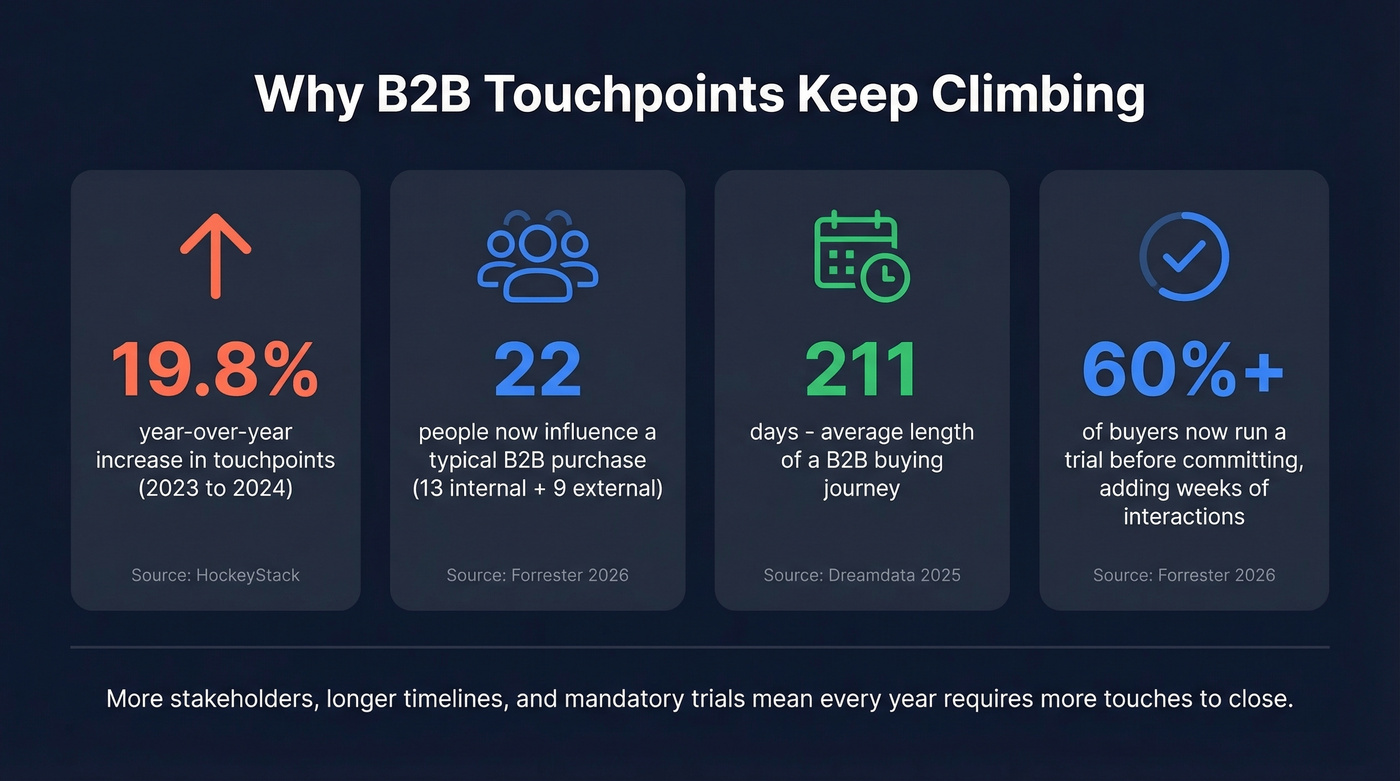
Trials are table stakes now, too. Over 60% of Forrester's respondents engaged in some form of trial before committing - an entire evaluation phase that didn't exist a decade ago, adding weeks of interactions to every deal.
The average B2B journey now spans 6.8 stakeholders across 3.7 channels over 211 days. That's not a funnel. It's a maze. Every stakeholder who enters the process resets the clock for their own evaluation, and mapping each stakeholder's individual journey - not just the account-level timeline - is the only way to plan realistic outreach.
When to Stop Following Up
More touches isn't always better. Belkins analyzed 16.5 million cold emails sent across 93 business domains in 2024 and found that the highest reply rate - 8.4% - came from the first email. Each subsequent follow-up performed worse. Four or more emails in a sequence tripled spam complaints and unsubscribe rates.
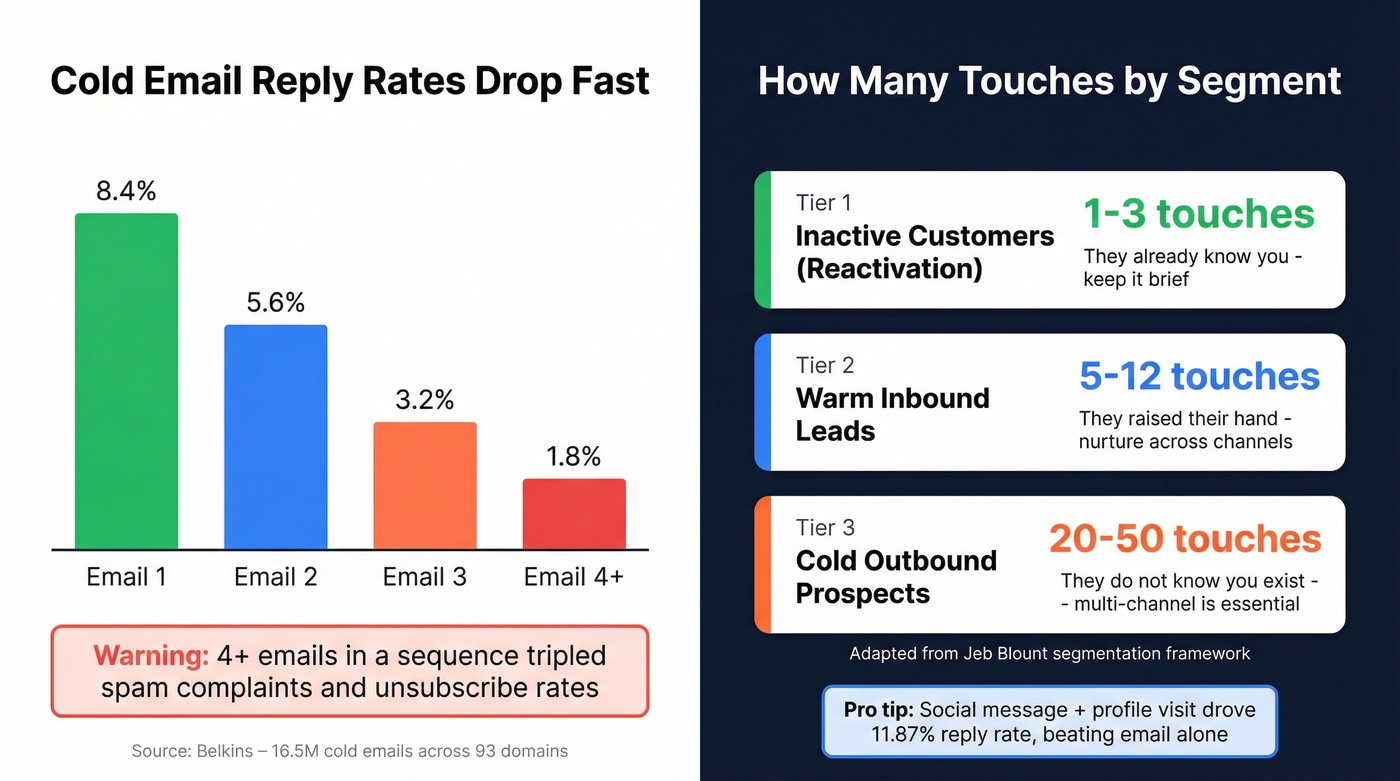
Reps on r/sales consistently say the 3rd or 4th follow-up is where most give up, and the Belkins data suggests that instinct isn't entirely wrong. Tolerance for persistence varies by segment: SMBs tolerate more follow-ups because their inboxes are less guarded, while enterprise prospects ghost quickly and punish persistence with spam reports.
A practical segmentation framework adapted from Jeb Blount:
- Inactive customers you're reactivating: 1-3 touches (they know you)
- Warm inbound leads: 5-12 touches (they raised their hand)
- Cold outbound prospects: 20-50 touches across channels (they don't know you exist)
Don't just stack more emails. Switch channels. A combined social message plus profile visit drove an 11.87% reply rate - significantly higher than email alone. When email stops working, pick up the phone or engage on social.
And touchpoints don't end at close. Post-sale check-ins, onboarding calls, and customer success touches directly affect retention and expansion revenue. The best teams plan their post-purchase cadence with the same rigor as their outbound sequences.
Sales Cadence Template: 21 Days
We've tested dozens of cadence structures with our team and across customer accounts. Here's a multi-channel cadence that maps to the 8-12 deliberate touches most high-performing B2B teams target:
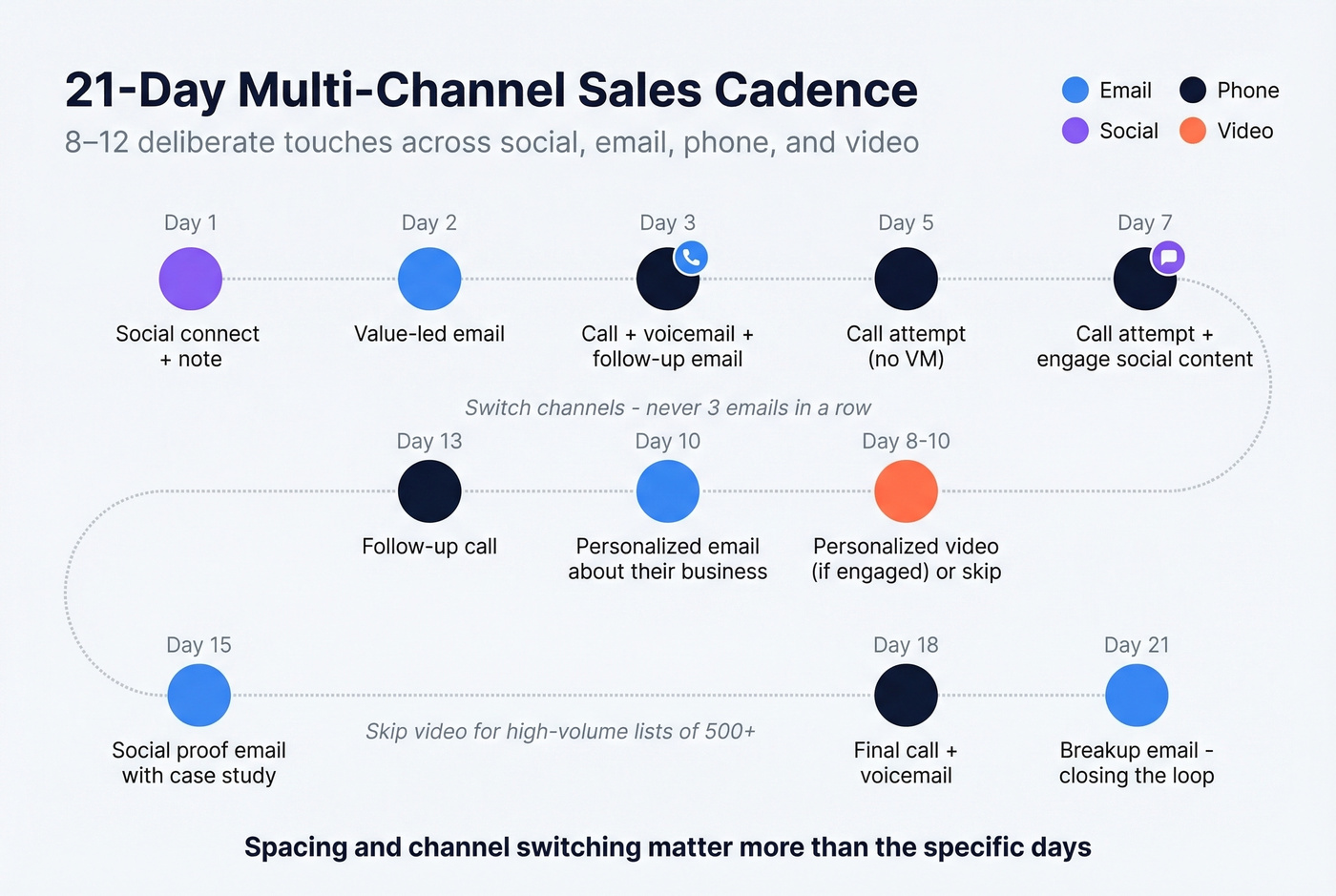
- Day 1 - Social connection request with a personalized note
- Day 2 - First email (value-led, not pitch-led)
- Day 3 - Call + voicemail + immediate follow-up email referencing the voicemail
- Day 5 - Call attempt (no voicemail)
- Day 7 - Call attempt (no voicemail); engage with their social content
- Day 8-10 - If the prospect has engaged with any touch so far, send a short personalized video via Loom or Vidyard. If no engagement, skip to Day 10.
- Day 10 - Personalized email referencing something specific to their business
- Day 13 - Follow-up call
- Day 15 - Social proof email (case study, relevant metric, peer reference)
- Day 18 - Final call + voicemail
- Day 21 - Breakup email ("closing the loop" framing)
Spacing and channel switching matter more than the specific days. Don't send three emails in three days - that's how you get flagged. And don't run an email-only sequence when the data shows multi-channel outreach dramatically outperforms single-channel. The cadence above hits social, email, phone, and video across 21 days. That's deliberate.
Skip the video step if you're running high-volume outbound to lists of 500+. It doesn't scale, and a generic Loom is worse than no Loom at all. Save video for your top 50 accounts.
Make Every Touch Count
Here's where most touchpoint discussions miss the point entirely. You can run a perfect 10-touch cadence, but if a third of your emails bounce, you've really only executed seven touches - and three of those went into the void.
The number of touches that land matters far more than the number you send.
We've seen this pattern repeatedly: teams obsess over sequence design while ignoring the data underneath. Meritt, an outbound agency, was running sequences with a 35% bounce rate before switching their data source. After cleaning up their contact data with Prospeo, bounce rates dropped under 4% and their connect rate tripled to 20-25%. They didn't change their cadence. They changed their data.
How to measure your own touchpoints. Tag every outbound activity in your CRM - calls, emails, social touches, meetings - and use multi-touch attribution to see which channels actually influence pipeline. Most CRMs support basic activity tracking out of the box. The teams that know their real touchpoint-to-meeting ratio outperform the ones guessing by a wide margin.
If 30-40% of your emails bounce, you don't have a touchpoint problem. You have a data problem. Fix the data first, then optimize the sequence.
With 6.8 stakeholders per deal across 211 days, you need accurate contact data for every decision-maker on the buying committee. Prospeo gives you 30+ filters - including buyer intent, department headcount, and job changes - to map entire committees and reach them with 98% verified emails at $0.01 each.
Find every stakeholder in the buying committee before your competitor does.
FAQ
How many touchpoints to make a sale on average?
SMB and transactional sales typically close in 5-12 touches, mid-market B2B averages 76 touches over 211 days, and enterprise SaaS deals average 266 touchpoints. The number depends on deal complexity, buying committee size, and whether you count passive impressions or only active engagement.
What counts as a touchpoint?
Any interaction where a prospect actively engages or is directly reached: email opens, ad clicks, calls, meetings, webinar attendance. Passive impressions like display ads are counted separately. HockeyStack's 266-touchpoint benchmark includes clicks and opens; Focus Digital's 28.87 requires "active cognitive processing."
Are touchpoints increasing year over year?
Yes. HockeyStack measured a 19.8% year-over-year increase from 2023 to 2024. Forrester's 2026 report shows buying groups now include 13 internal and 9 external stakeholders. More evaluators means more touches per deal, and this trend shows no signs of reversing.
How many follow-up emails are too many?
Belkins' 16.5-million-email study found reply rates peak on the first email and decline with each follow-up. Four or more emails tripled spam complaints. The sweet spot for cold outbound is 3-4 emails paired with calls and social touches - and those emails need to hit valid inboxes to count as real touches.
How do enterprise and SMB touchpoints compare?
SMB deals typically close with 5-12 deliberate touches, while enterprise deals above $100K average 46.89 active touchpoints to 417 total touchpoints depending on the measurement framework. Larger buying committees and longer evaluation cycles drive the gap - each new stakeholder adds their own sequence of interactions.