

How to Address Multiple People in an Email (2026 Guide)
You're drafting an email to your VP, two peers, and an external client. You type "Hi" and freeze. Figuring out how to address multiple people in an email shouldn't require a committee meeting - but here you are, wondering about name order, formality, and whether "Dear All" makes you look lazy.
An analysis of 300,000+ emails found that "Hi" (63% response rate) and "Hey" (64%) perform nearly identically, and both crush emails with no greeting by roughly 33%. Stop overthinking. Pick the right one for the situation and move on.
The Quick Decision Framework
Memorize this and you'll handle most multi-recipient emails without a second thought.
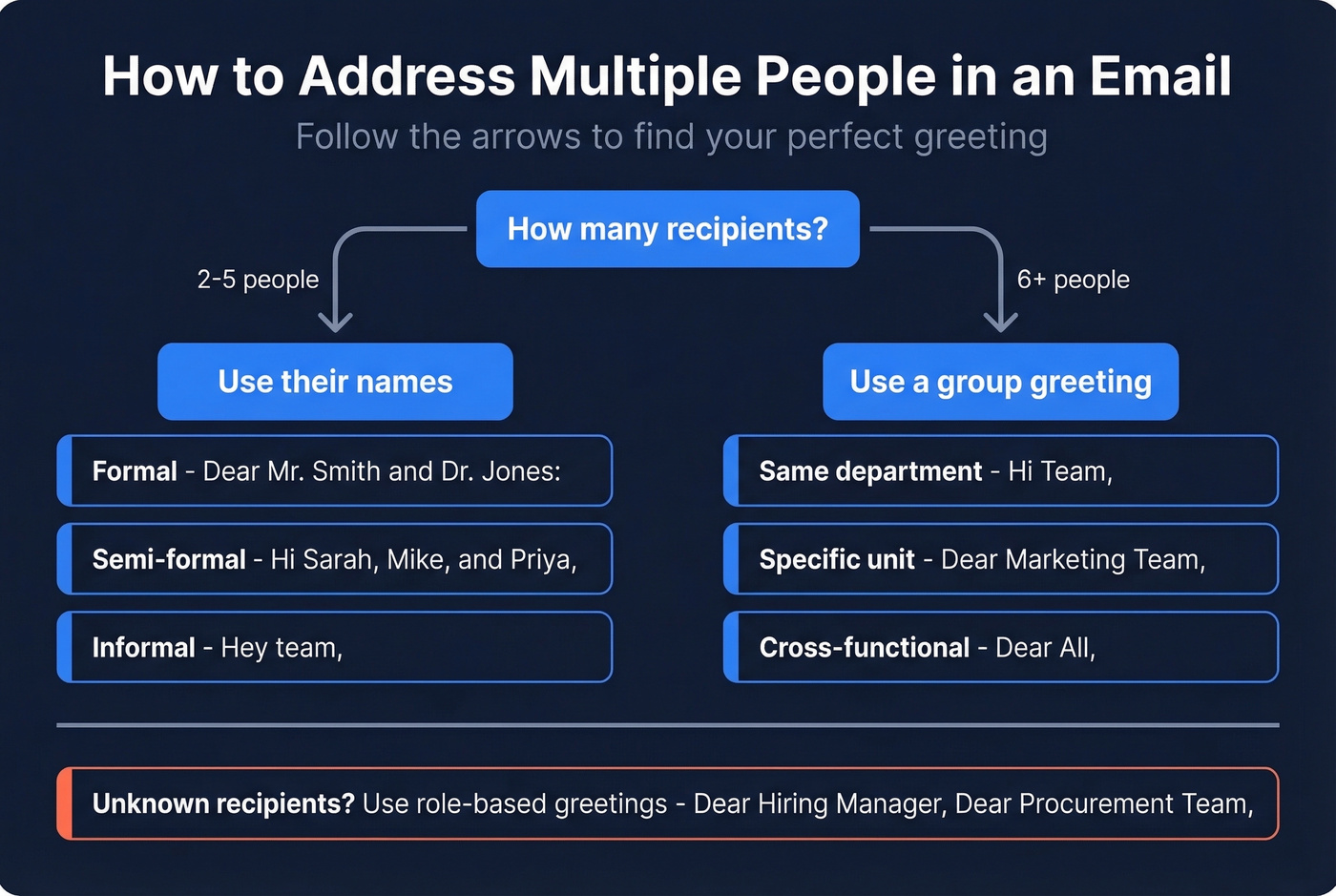
| Recipients | What to Do | Example |
|---|---|---|
| 2-5 people | Use their names | "Hi Sarah, Mike, and Priya," |
| 6+ people | Use a group greeting | "Hi Team," or "Dear Marketing Team," |
| Unknown recipients | Use a role-based greeting | "Dear Hiring Manager," |
The five-or-fewer rule is the dividing line. Below it, personalize. Above it, generalize.
Addressing Recipients by Name (2-5 People)
When you're emailing a small group, naming each person signals you actually know who's in the room. It takes five extra seconds and makes a real difference in tone.
Formal: "Dear Mr. Smith and Dr. Jones:" Semi-formal: "Hi Sarah, Mike, and Priya," Informal: "Hey team,"
The formal version works for first-contact emails with external stakeholders - board members, clients you haven't met, anyone whose title you'd use in a handshake. In our experience, semi-formal covers about 80% of daily work email. Informal is fine for teams that already communicate casually on Slack or in person.
Name Ordering
This trips people up more than it should. Three rules, in priority order:
- Seniority first. If your CEO is on the thread, their name leads.
- Client before internal. If you're emailing a client and your team, list the client first.
- Alphabetical as tiebreaker. When everyone's at the same level, alphabetize and move on.
Using "Dear" with Multiple Names
When the situation calls for a formal salutation, writing "Dear" followed by multiple names is perfectly acceptable - "Dear Sarah, Mike, and Priya," reads naturally and gives each recipient equal weight. For two people, "Dear Ms. Patel and Mr. Reyes," is clean and direct.
Punctuation
Use a comma after the greeting in semi-formal emails ("Hi Sarah, Mike, and Priya,") and a colon for formal ones ("Dear Mr. Smith and Dr. Jones:"). Match the tone of the email that follows.
One more option for highly formal contexts: the repeated salutation format - "Dear Mr. Smith, Dear Ms. Black," on the same line. It reads stiff for most workplaces, but it's perfectly correct for legal, academic, or diplomatic correspondence.
How to Address a Group in Email (6+ Recipients)
Once you're past five names, listing everyone becomes awkward. Nobody wants to read a greeting longer than the email body.
"Hi Team," is the Swiss Army knife. Use it when everyone's in the same department or project group, the email is internal, or you just need a fast neutral default. It covers most situations and rarely feels out of place.
"Dear [Department] Team," steps up the formality. Use it when the email goes to leadership or you're addressing a specific unit: "Dear Marketing Team," "Dear Board Members."
"Dear All," works well for internal, cross-functional groups and company-wide updates. For external recipients, "Dear Partners" or "Dear [Company] Team" is usually a stronger, more specific choice.
Per Emily Post's guidance, a common salutation like "Dear Team" is the right move for larger groups. And in reply chains, you only need a salutation in your first reply - after that, treat the thread like a conversation.
Inclusive and Gender-Neutral Greetings
Here's the thing: you just sent "Hey guys" to a thread that includes your company's new head of DEI. That's the kind of moment that makes you wish for an unsend button.
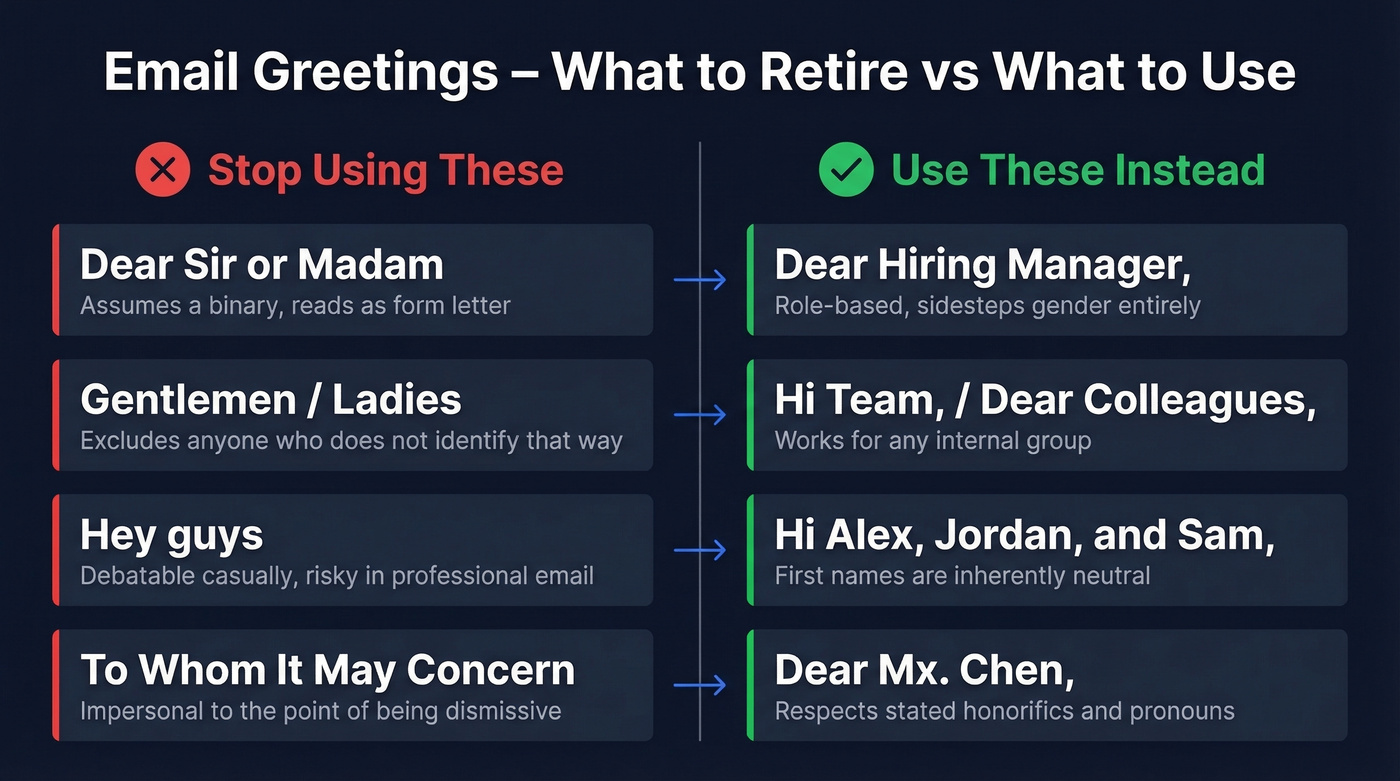
Gendered group greetings need to die. "Gentlemen," "Ladies," "Ladies and Gentlemen," "Hey guys" - all of these exclude someone in the room. One business writing instructor describes a recipient who physically cringed at "Dear Sales Dudes," and it became outright exclusionary the day a woman joined the team. Grammarly's style guidance is blunt: "Dear Sir or Madam" is outdated and excludes people outside the gender binary. Retire it.
Greetings That Need to Go
- "Dear Sir or Madam" - assumes a binary, reads as form letter
- "Gentlemen" / "Ladies" - excludes anyone who doesn't identify that way
- "Hey guys" - debatable casually, but risky in professional email
- "To Whom It May Concern" - impersonal to the point of being dismissive
What to Use Instead
Role-based greetings ("Dear Hiring Manager," "Dear Procurement Team,") sidestep gender entirely. Team-based greetings ("Hi Team," "Dear Colleagues,") work for internal groups. First-name greetings ("Hi Alex, Jordan, and Sam,") are inherently neutral.
When you know someone uses Mx. as an honorific or they/them pronouns, use them. "Dear Mx. Chen," is correct and respectful. If you're unsure, first-name greetings avoid the issue entirely - "Hi Taylor," never misgenders anyone.

You've got the perfect greeting for five recipients. But do you have their actual email addresses? Prospeo gives you 98% accurate, verified emails for 300M+ professionals - so your carefully crafted multi-recipient email actually reaches real inboxes.
Stop perfecting greetings for emails that bounce. Start with verified contacts.
Cross-Cultural Email Greetings
If you're emailing across borders, your default "Hi [First Name]" can land as disrespectful. Cultural norms around formality vary dramatically, and email is where these differences surface first.
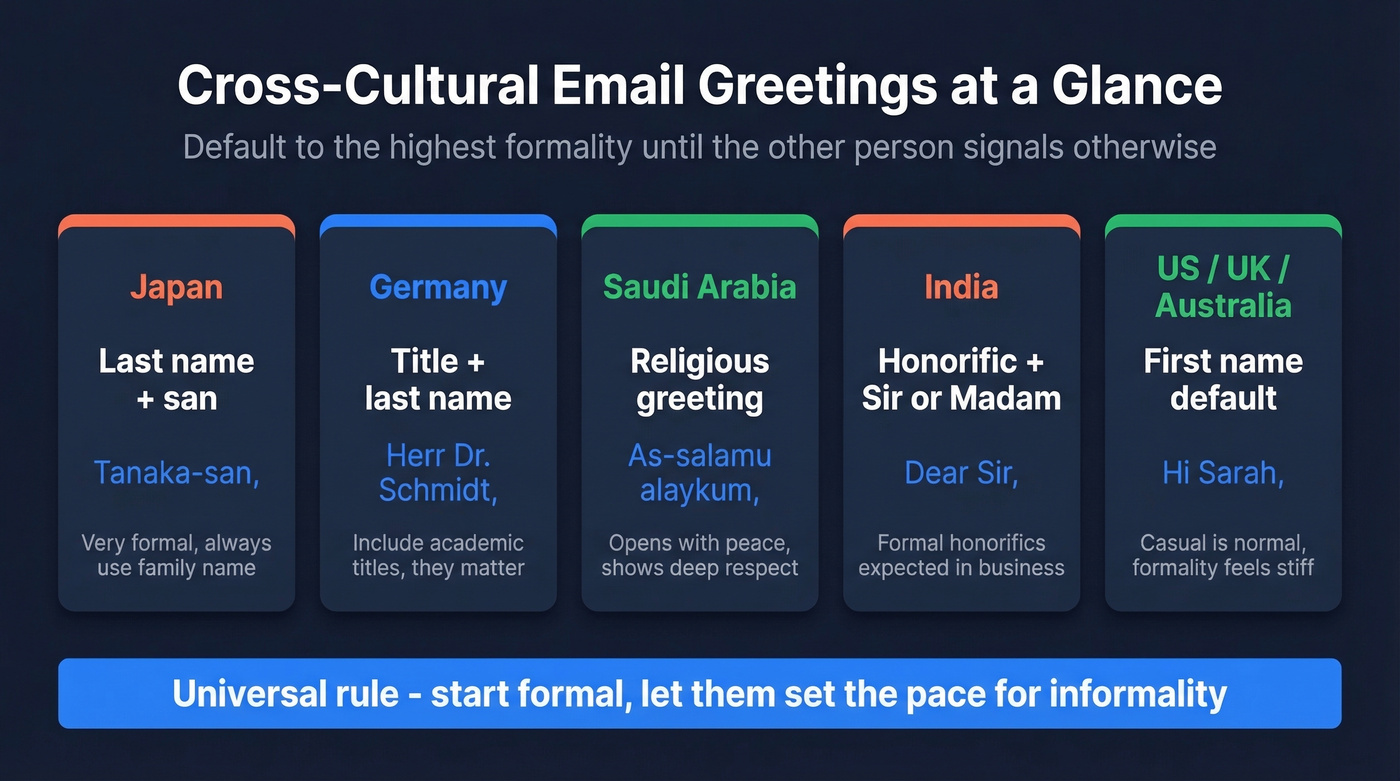
| Region | Greeting Norm | Example |
|---|---|---|
| Japan | Last name + "-san" | "Tanaka-san," |
| Germany | Title + last name | "Herr Schmidt," / "Frau Muller," |
| Saudi Arabia | Religious greeting | "As-salamu alaykum," |
| India | Honorific + Sir/Madam | "Dear Sir," / "Dear Madam," |
| US/UK/Australia | First name default | "Hi Sarah," |
The universal rule: default to the highest level of formality until the other person signals otherwise. If your German counterpart signs off as "Frau Dr. Muller," don't reply with "Hey!" Match their register, then let them set the pace for informality.
I'll say it plainly: most people default to too casual in international email, not too formal. You can always loosen up after the first exchange. You can't un-send a "Hey!" to a Japanese executive who expected "Tanaka-san." Skip the humor, leave out emoji, and don't use slang.
To vs. CC vs. BCC
Your greeting strategy is only half the equation. Where you put each recipient matters just as much.
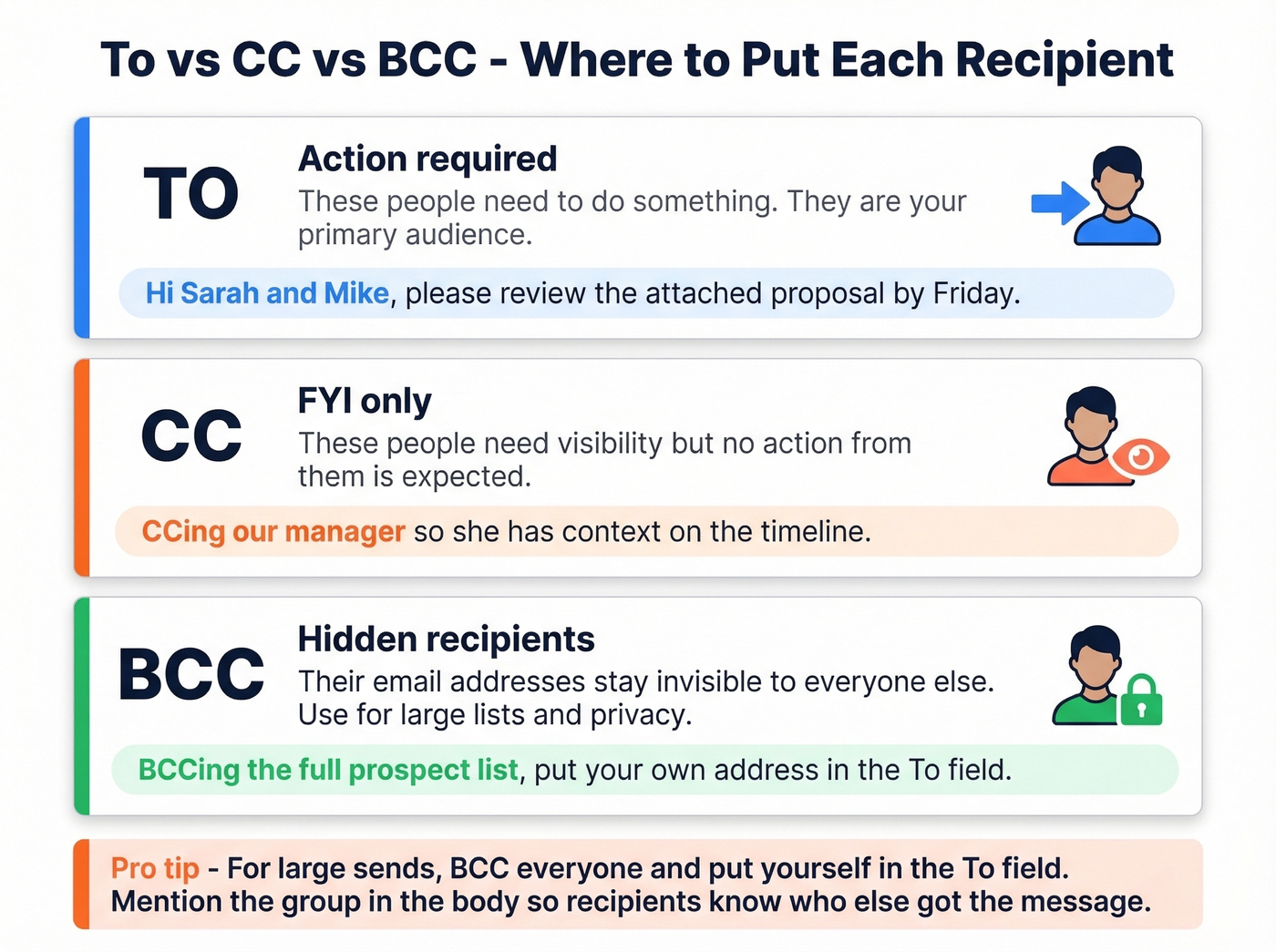
To: People who need to take action. They're the primary audience. CC: People who need visibility but no action - your "FYI" recipients. BCC: People whose email addresses shouldn't be visible to others.
For large recipient lists, BCC everyone to protect privacy. Emily Post's etiquette guidance recommends avoiding long address lists in the "To" and "CC" lines; instead, send individually or use BCC.
When BCC-ing a list, put your own address in the To field. Some email clients require a To recipient, and this keeps things clean. Then mention the group in the body - "Sending this to the full production team" - so recipients have context about who else received the message.
Copy-Paste Templates
2-3 Colleagues (Informal)
Hi Jake, Mia, and Carlos,
Quick update on the Q3 pipeline review - here's where we landed.
Formal Email to Three Recipients
Dear Ms. Nakamura, Mr. Torres, and Dr. Lin,
Thank you for making time for yesterday's call. Below is a summary of next steps, with owners noted for each item.
Large Department (Group Greeting)
Dear Engineering Team,
We're rolling out a new code review process starting Monday. Here's what changes and what stays the same.
Cold Email to Unknown Recipient
Dear Hiring Manager,
I'm writing regarding the Senior Product Manager role posted last week. I've attached my resume and a brief note on why I'm a strong fit.
Cross-Cultural First Contact
Dear Herr Dr. Schmidt,
It was a pleasure meeting you at the Munich conference. I'd like to follow up on our conversation about the partnership opportunity.
Group Email Mistakes to Avoid
Mixing formality levels. Don't open with "Dear Mr. Chen" and then address his colleague as "Hey Lisa" in the same greeting. Pick one register and stick with it.
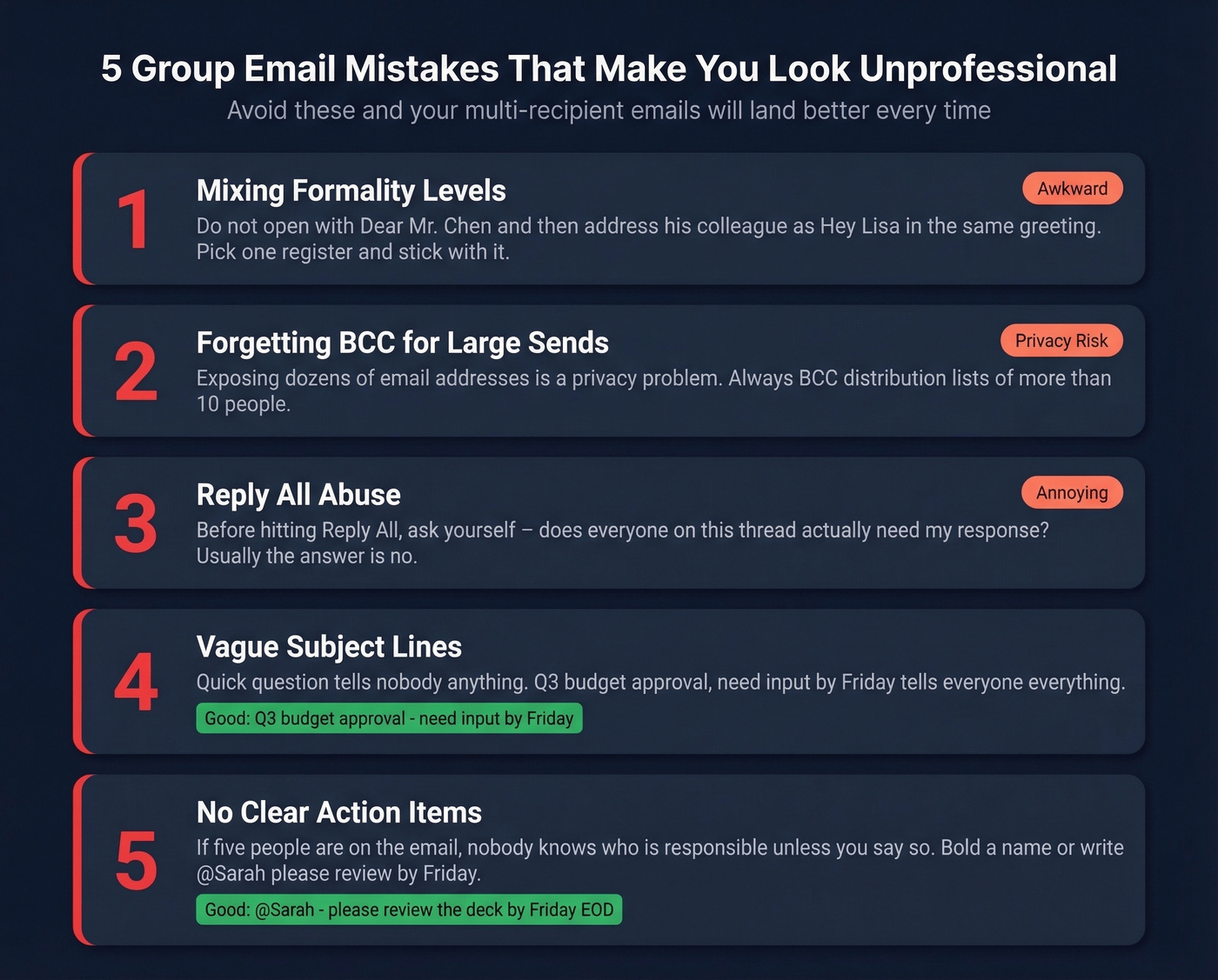
Forgetting BCC for large sends. Exposing dozens of email addresses is a privacy problem waiting to happen. Always BCC distribution lists. We've seen outbound campaigns tank sender reputation because someone pasted 200 addresses into the To field - don't be that person.
Reply All abuse. Before hitting Reply All, ask: does everyone on this thread need my response? Usually the answer is no.
Vague subject lines. "Quick question" tells nobody anything. "Q3 budget approval - need input by Friday" tells everyone everything.
No clear action items. If five people are on the email, nobody knows who's responsible unless you say so. Bolding a name or writing "@Sarah - please review by Friday" in the body creates a visual cue that cuts through the noise.
Before You Send - Verify the Address
The best greeting in the world doesn't matter if it bounces. If you're sending to a list of prospects or contacts you haven't emailed before, Prospeo can verify addresses in bulk before you hit send - 98% email accuracy on 143M+ verified addresses, with a 7-day data refresh cycle. Free to start, no contracts.
Addressing a cross-cultural group correctly only matters if your email lands. Prospeo's 5-step verification and 7-day data refresh mean every address you pull is current - no bounces, no spam traps, no wasted outreach.
Find the right emails first, then greet them perfectly. Starting at $0.01 per lead.
FAQ
Is "Dear All" professional?
Yes. "Dear All" works well for internal groups of six or more people. For external emails, prefer "Dear [Team Name]" or "Dear Partners" for a more polished impression. Internal all-hands updates are where "Dear All" shines.
Should I use "Dear" or "Hi"?
Use "Dear" for formal first contact with external stakeholders - clients, executives, or anyone you haven't emailed before. Use "Hi" for internal emails and ongoing threads. When in doubt, match the other person's tone from their last message.
How do you address a formal email to multiple recipients?
Use "Dear" followed by each person's honorific and last name, separated by commas: "Dear Dr. Patel, Mr. Reyes, and Ms. Tanaka." For groups larger than five, switch to a collective greeting like "Dear Board Members" or "Dear Selection Committee."
How do I greet people I've never met?
Use role-based greetings: "Dear Hiring Manager," "Dear [Company] Team," or "Dear Procurement Lead." These are specific enough to feel personal without requiring a name. Avoid "To Whom It May Concern" - it signals you didn't try to find out who you're writing to.
How do I verify email addresses before sending to a group?
Use a bulk verification tool that checks addresses against a live database and flags invalid contacts before you send. This prevents bounces that damage your sender reputation - especially critical when emailing large recipient lists for the first time.