

How to Ask Open-Ended Questions in Sales: Technique Beats Volume
Think about your last discovery call. Twelve questions in eight minutes. One-sentence answers. You pitched to fill the silence, the prospect said "sounds good, send me some info," and the deal went dark.
The problem wasn't your questions - it was how you asked them. Learning how to ask open-ended questions in sales isn't about memorizing a bigger list. It's about technique.
[Gong Labs analyzed 519,000+ B2B sales calls](https://www.gong.io/resources/guides/discovery-call-checklist) and found a clear pattern: top performers ask 11-14 targeted questions per discovery call, spread evenly throughout the conversation. Average reps front-load their questions like a checklist and wonder why prospects disengage after five minutes. Technique beats volume every time.
The 30-Second Framework
Before we get into the details, here's the short version:
- Ask 11-14 questions per discovery call, spread evenly - not crammed into the first five minutes.
- Master 3 follow-up techniques (mirroring, labeling, "Can you help me understand...") before memorizing another question list.
- Use the Sandler Pain Funnel as your default drill-down sequence when a prospect surfaces a problem.
That's it. Everything below expands on those three ideas.
Open-Ended vs. Closed-Ended
| Open-Ended | Closed-Ended | |
|---|---|---|
| Format | "How are you handling X today?" | "Are you using a CRM?" |
| Answer type | Narrative, detailed | Yes/no, one word |
| Best for | Discovery, deepening pain | Confirming facts, opening a conversation |
Don't treat closed-ended questions as the enemy. They're useful as conversation openers - confirm something simple, then pivot to open-ended follow-ups. "Are you running outbound today?" followed by "How's that working for you?" is a natural one-two punch that reduces friction early in the call.
What 519K+ Calls Tell Us
The Gong Labs research is one of the largest published benchmarks for discovery calls. Across those recordings, the sweet spot was 11-14 questions. Ask fewer and you're not digging deep enough. Ask more and you start sounding like a survey.
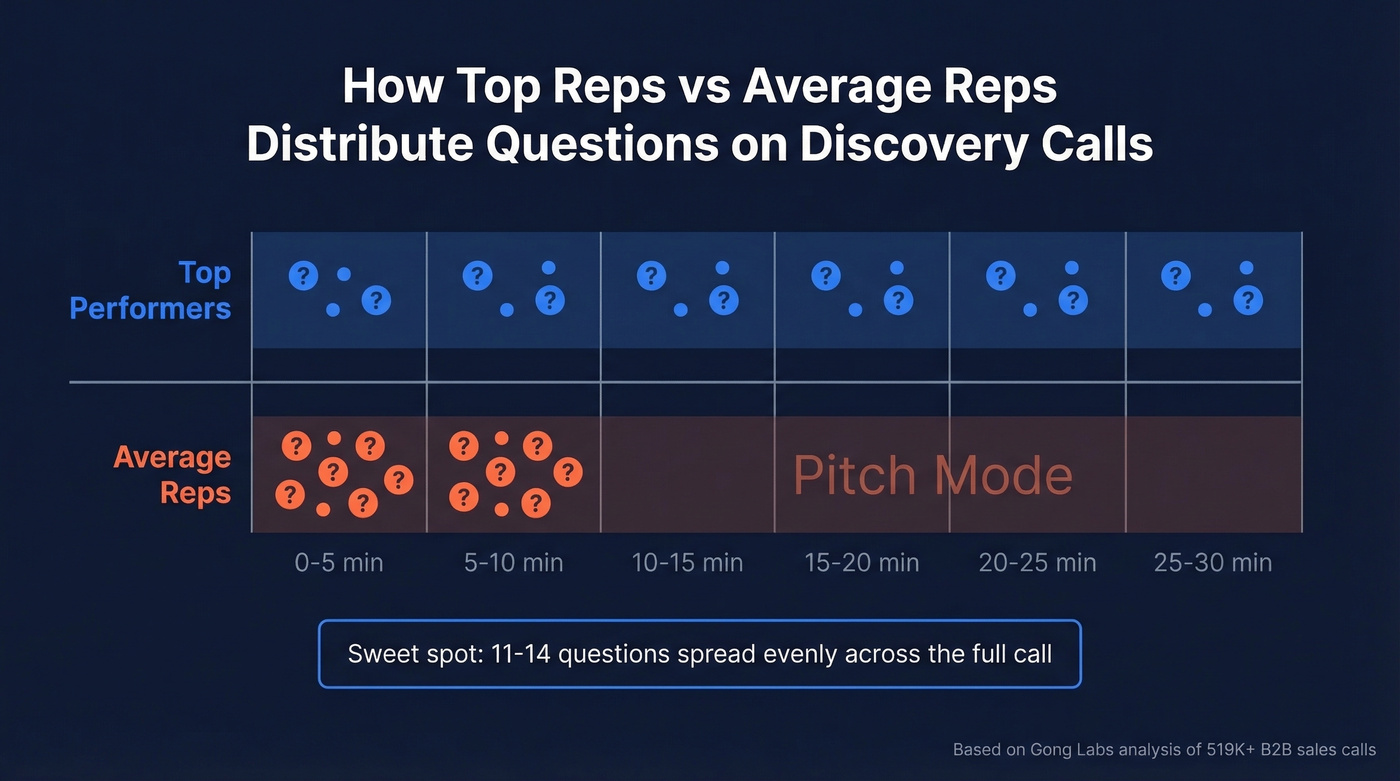
But the distribution matters more than the count. Top performers spread questions evenly across the full call. Average reps dump most of their questions in the first few minutes, then shift into pitch mode. That front-loading pattern is what makes discovery calls feel like interrogations - and it's the single most common mistake we see when reviewing call recordings with sales teams.
There's also a strong correlation between longer buyer answers and closed deals. If your prospect is giving you one-word responses, you're not asking the wrong questions. You're asking them the wrong way.

Your discovery questions are only as good as the prospects hearing them. Prospeo gives you 98% accurate emails and verified direct dials so every perfectly crafted open-ended question lands with the right decision-maker - not a dead inbox.
Stop perfecting questions for prospects you'll never reach.
Technique Over Question Lists
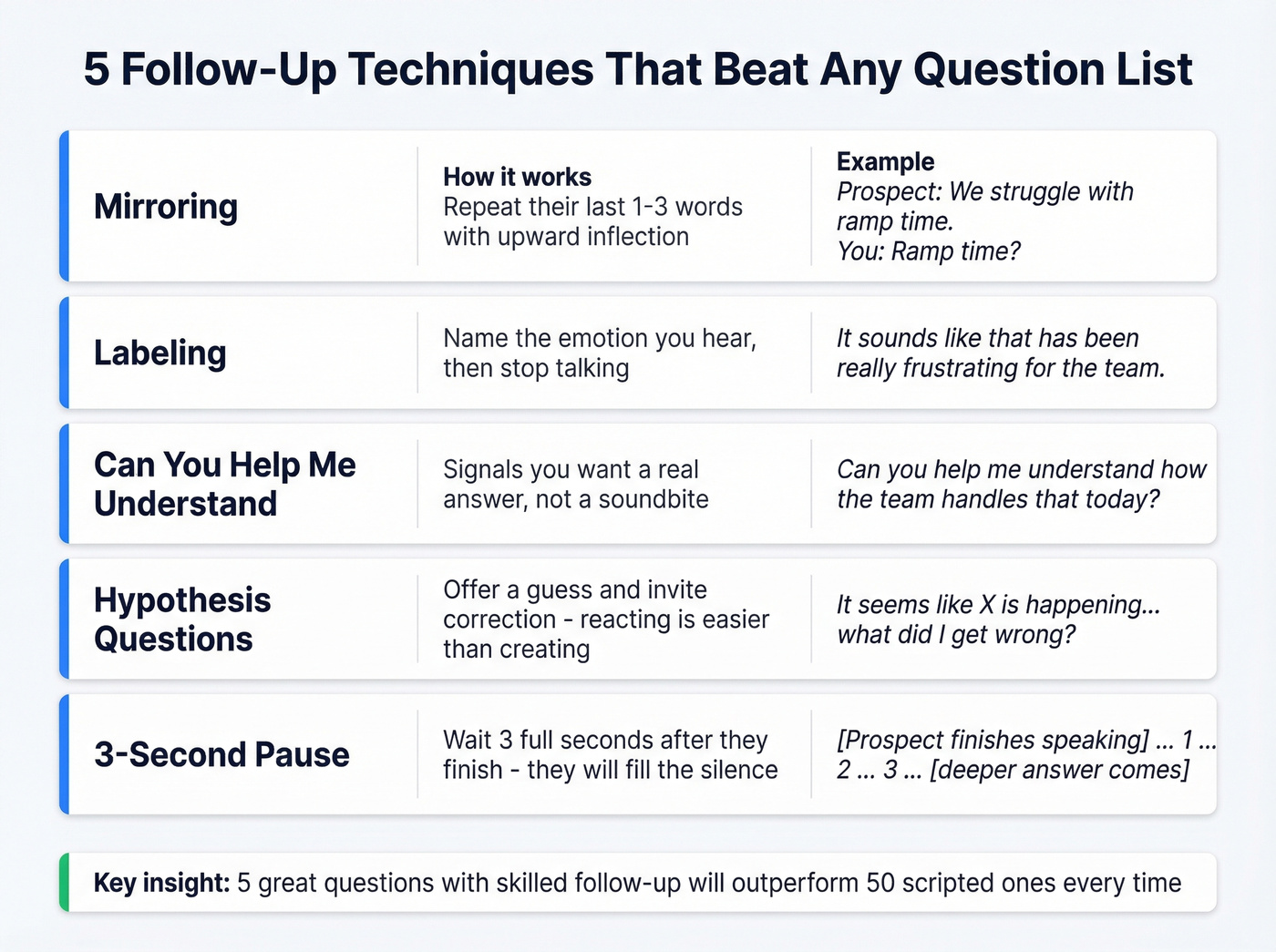
Most articles on this topic hand you a massive question bank. None of them teach you how to listen. Here's the thing: five great questions with skilled follow-up will outperform fifty scripted ones every time.
Mirroring
Repeat the last one to three words your prospect said, with an upward inflection. Prospect says "We've been struggling with rep ramp time." You say "Ramp time?" Then shut up. They'll elaborate almost every time. We've seen reps who master mirroring get noticeably longer prospect responses - it's one of the simplest techniques in sales and one of the most underused.
Labeling
Name the emotion you're hearing. "It sounds like that's been frustrating for the team." Then stop talking. Labeling validates the prospect's experience and invites them to go deeper without you asking another question. Research across those 519K+ calls confirms this pattern correlates with longer buyer responses - and longer responses correlate with closed deals.
"Can You Help Me Understand..."
This phrasing hack signals that you want a real answer, not a soundbite. "Can you help me understand how the team is handling that today?" lands differently than "How do you handle that?" Small shift. Consistently draws out more detail.
Hypothesis Questions
Instead of asking vague questions that shift all the cognitive work to the buyer ("What are your biggest priorities?"), offer a hypothesis and invite correction. The template from Close.com's framework: "I don't work within your four walls, but it seems like [hypothesis]... what did I get wrong?"
This gives the prospect something to react to, which is far easier than constructing an answer from scratch. In our experience, hypothesis questions are the single biggest unlock for reps who already ask decent questions but can't get prospects to open up. Reacting is easier than creating - use that to your advantage.
The 3-Second Pause
After your prospect finishes speaking, wait three full seconds before responding. It feels like an eternity. It works because most people will fill the silence with the deeper answer they were holding back. Zero preparation required, outsized results.
One caveat: not every discovery call should be pain-focused. Some buyers respond better to aspiration questions ("Where do you want to be in 12 months?"). Read the room. But when a prospect surfaces a real problem, these techniques will take you deeper than any question list ever could.
Best Open-Ended Sales Questions by Stage
You don't need 55 questions. You need a handful per stage and the skill to follow up on whatever the prospect says. These come from real reps on r/sales and frameworks like Gap Selling and Sandler.
Opening & Rapport
- "What's going on in your world that made you decide to talk to me?"
- "Why now? What changed?"
- "Can you walk me through how you're currently handling this today?"
Pain & Discovery
- "What happens if nothing changes?"
- "If you didn't solve this in the next 6-12 months, what's the impact?"
- "Why hasn't this been fixed before today?"
- "Can you give me an example of how this causes problems day to day?"
Qualification
- "Who else should be involved in this decision before we move forward?"
- "How are you navigating the process of choosing a solution?"
- "Have you tried to solve this before? What happened?"
- "What would success look like - what metrics would change?"
Closing & Commitment
- "Is it a problem worth solving now?"
- "What's it going to take to get this deal done?"
- "Are there any reasons not to move forward together?"
- "What's the main reason you'd hesitate?"
The Sandler Pain Funnel
If you learn one questioning framework, make it this one. It's a sequence of eight questions designed to move from surface symptoms to true pain:
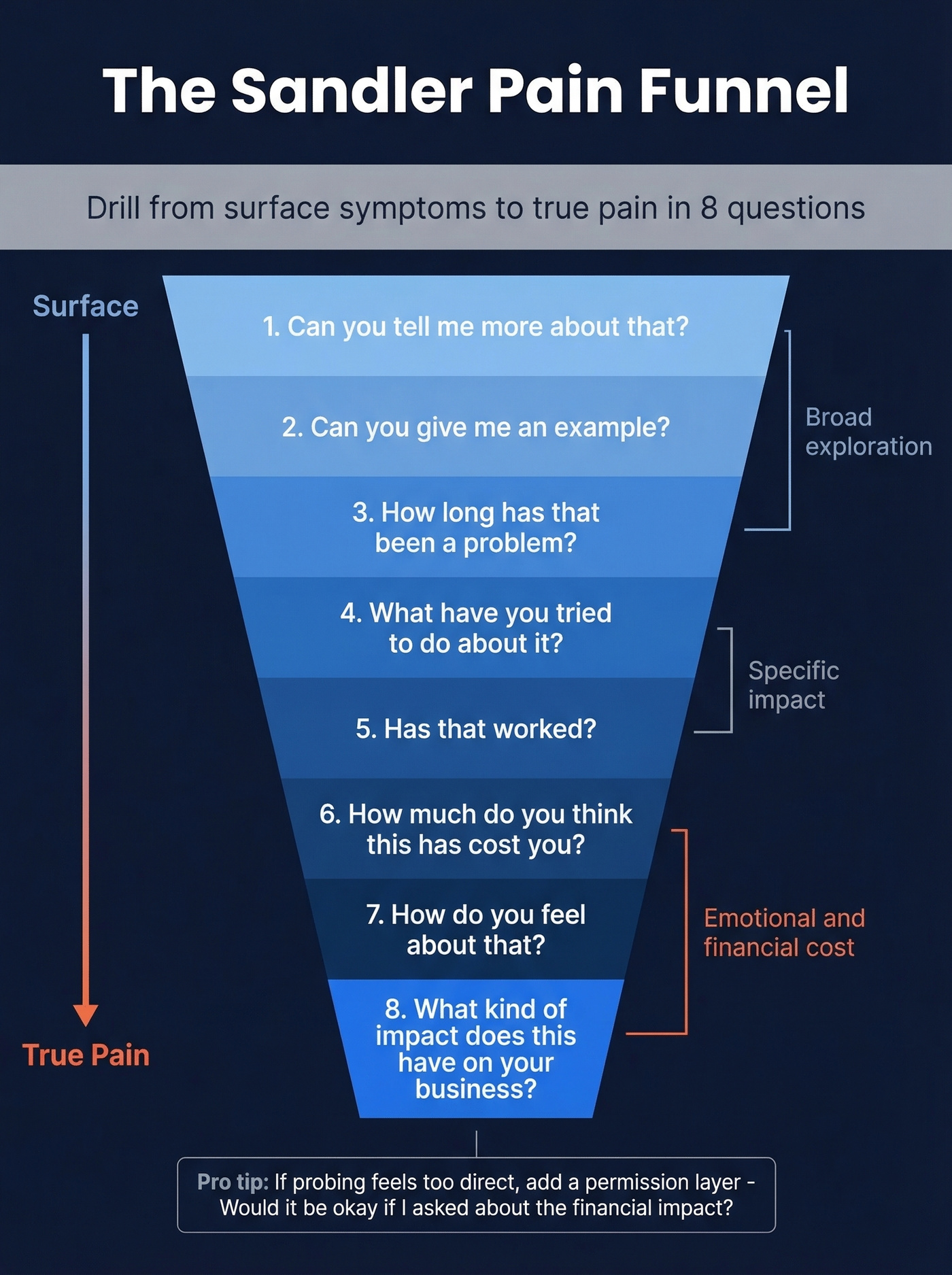
- "Can you tell me more about that?"
- "Can you give me an example?"
- "How long has that been a problem?"
- "What have you tried to do about it?"
- "Has that worked?"
- "How much do you think this has cost you?"
- "How do you feel about that?"
- "What kind of impact does this have on your business?"
The sequence works because each question drills deeper into the same problem rather than jumping to a new topic. One practical tip: if probing feels too direct, add a permission layer - "Would it be okay if I asked about the financial impact?" softens the approach without losing depth.
How it differs from SPIN: SPIN Selling maps four question types (Situation, Problem, Implication, Need-Payoff) across the full sales conversation - it's broader. The Sandler Pain Funnel goes deeper into a single problem through layers. The most common SPIN mistake is skipping Implication questions and jumping straight to Need-Payoff, which weakens your value story. Start with Sandler because it's immediately usable on your next call.
Five Mistakes That Kill Discovery
1. Front-loading questions like a checklist. Twelve questions in the first five minutes, then thirty minutes of pitching. The data is clear: spread questions evenly or you'll lose engagement.
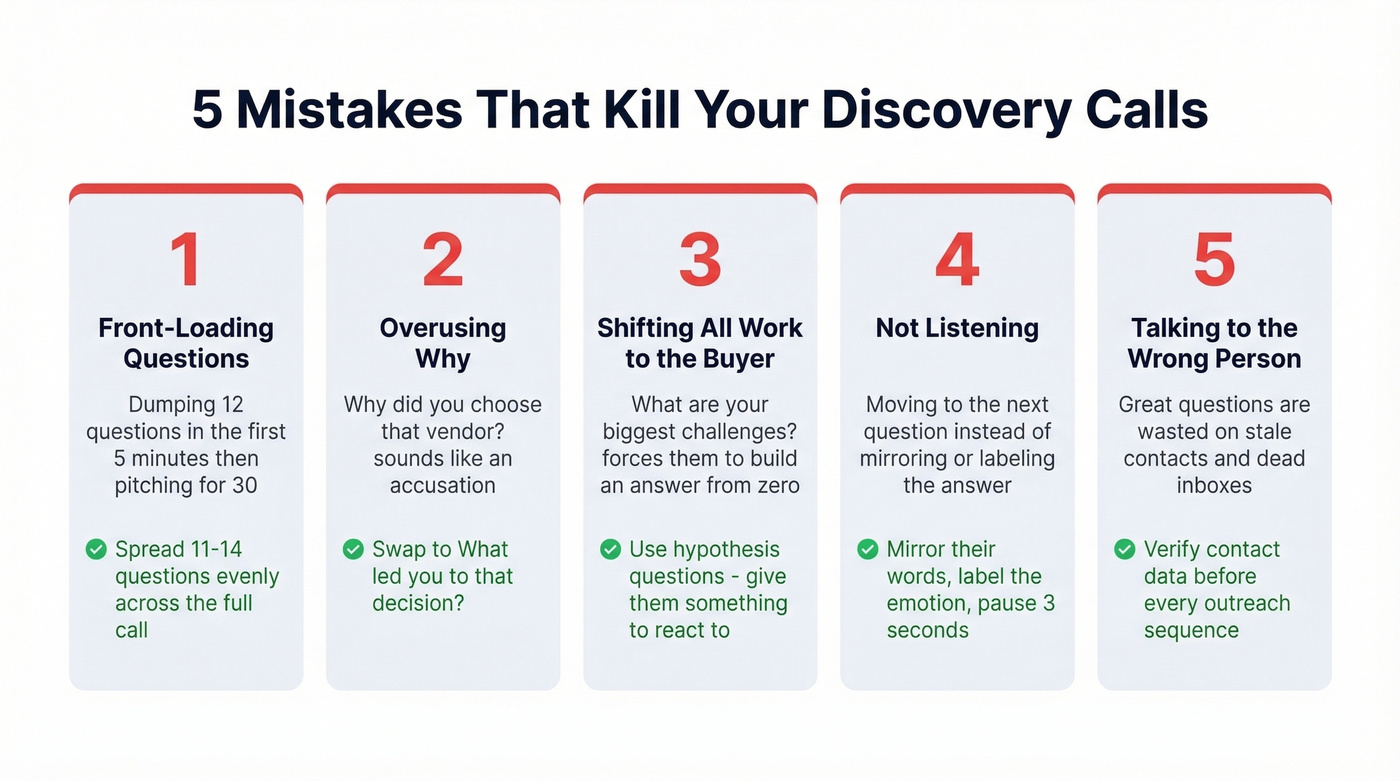
2. Overusing "why." "Why did you choose that vendor?" feels accusatory. Swap it for "What led you to that decision?" Same information, zero defensiveness.
3. Shifting all the work to the buyer. "What are your biggest challenges?" forces the prospect to construct an answer from scratch. Use hypothesis questions instead - give them something to react to.
4. Not listening. You asked a great question, got a one-word answer - "Hiring." - and panicked. You moved to the next question instead of mirroring ("Hiring?") or labeling ("Sounds like that's been a bottleneck"). We've watched reps transform their close rates by changing nothing except their follow-up habits. The follow-up is where deals are won.
5. Talking to the wrong person. Look, great questions are wasted on wrong prospects. If your contact data is stale or unverified, you never get to the discovery call in the first place. This is where tools like Prospeo matter - 98% email accuracy and a 7-day data refresh cycle mean you're reaching the actual decision-maker, not their predecessor who left six months ago.
Let's be honest: most sales teams don't have a questioning problem. They have a listening problem wrapped inside a contact data problem. Fix those two things and your discovery calls will improve more than any framework alone could deliver.
Top reps ask 11-14 targeted questions per call. But first, they need calls. Prospeo's 300M+ verified profiles with 30+ filters - including buyer intent and job changes - let you book more discovery calls with prospects already in-market.
Fill your calendar with prospects worth qualifying.
FAQ
How many questions should I ask on a discovery call?
Data from 519K+ B2B sales calls shows 11-14 targeted questions is the sweet spot. Beyond that, success rates drop toward average. Spread them evenly throughout the call instead of front-loading them in the first few minutes.
What's the difference between SPIN and Sandler questioning?
SPIN maps four question types (Situation, Problem, Implication, Need-Payoff) across the full conversation. The Sandler Pain Funnel drills deeper into a single problem through eight layered questions. SPIN is broader; Sandler goes deeper. Start with Sandler because it's immediately actionable.
How do I get longer answers from prospects?
Mirror their last few words with an upward inflection, label their emotion ("It sounds like..."), or preface with "Can you help me understand..." Then pause for three full seconds. Silence draws out depth that another question never will.
Should I skip open-ended questions with senior executives?
Not exactly - but adjust your approach. Senior buyers have less patience for broad questions like "Tell me about your challenges." Lead with a hypothesis question that shows you've done your homework, then use mirroring and labeling to go deeper. Executives respect reps who come prepared with a point of view.