

How to Build a Sales Process That Reps Actually Follow
Your CRM is full of deals stuck in "Proposal Sent" for 47 days. The CEO wants a forecast, and your best answer is a shrug. If you're figuring out how to build a sales process, stop copying a generic template and start building backward from what actually closes. With 69% of reps missing quota and spending most of their week on non-selling work, "winging it" is expensive. Teams with a formal sales process drive 28% higher revenue than teams without one.
Here's the thing: if your average contract value sits below five figures, you don't need a "perfect" enterprise-grade process. You need a simple one that forces next steps, kills dead deals fast, and keeps your data clean.
What You Need (Quick Version)
- Reverse-engineer your process from closed-won deals, not a textbook.
- Define 5-7 pipeline stages with exit criteria and SLAs.
- Pick a qualification framework that matches your deal size.
- Verify your contact data before reps touch it.
- Automate admin, not relationships.
- Review the process every six months with real conversion numbers.
Sales Process vs. Sales Methodology
A sales process is the set of stages a deal moves through from first touch to closed-won or closed-lost. It's not a methodology.
Process = the stages and the rules for moving between them. Methodology like MEDDIC, Challenger, or SPIN = how reps execute inside those stages. Blur the two and you end up with a philosophy nobody can run inside a CRM. Before creating a sales process, nail this distinction - it saves months of rework.
Reverse-Engineer From Closed-Won Deals
Most "step-by-step" sales process articles start at prospecting. That's backwards. You already have proof of what works: your closed-won deals.
Pull your last 20 closed-won deals and list the milestones they hit in order. Patterns show up fast: discovery within X days, a technical stakeholder by week two, a mutual action plan before pricing, procurement started before the proposal. Those patterns become your stages and exit criteria.
This is also where you'll hear the truth from the floor. A recurring complaint on r/sales is some version of: "Leadership built a process in a spreadsheet, then yelled at reps for not using it." We've seen this play out firsthand. Flip the script - build from wins, then pressure-test it with the reps who run deals every day.
Define Your Pipeline Stages
This is the backbone. Every stage needs entry criteria (what must be true to enter), exit criteria (what must be true to advance), an SLA (how fast the next action happens), and required CRM fields so your pipeline isn't fiction.
The 6-Stage Pipeline Table
| Stage | Entry Criteria | Exit Criteria | SLA | Win Prob. | Required CRM Fields |
|---|---|---|---|---|---|
| New | Lead created + owner assigned | Contact verified + routed | First touch in 24h | 5% | Source, ICP fit score |
| Qualified | First touch completed | Discovery booked | Book discovery in 48h | 20% | Pain, budget range |
| Discovery | Discovery held | Problem + stakeholders mapped | Proposal draft in 72h | 40% | Stakeholders, timeline |
| Proposal | Scope + pricing sent | Next step scheduled | Follow-up in 48h | 60% | Deal amount, close date |
| Commit | Stakeholders aligned | Verbal yes + timeline | Paperwork in 7 days | 80% | Decision process, champion |
| Closed | Contract sent or decision made | Won or lost reason logged | Log same day | 0/100% | Won/lost reason, revenue |
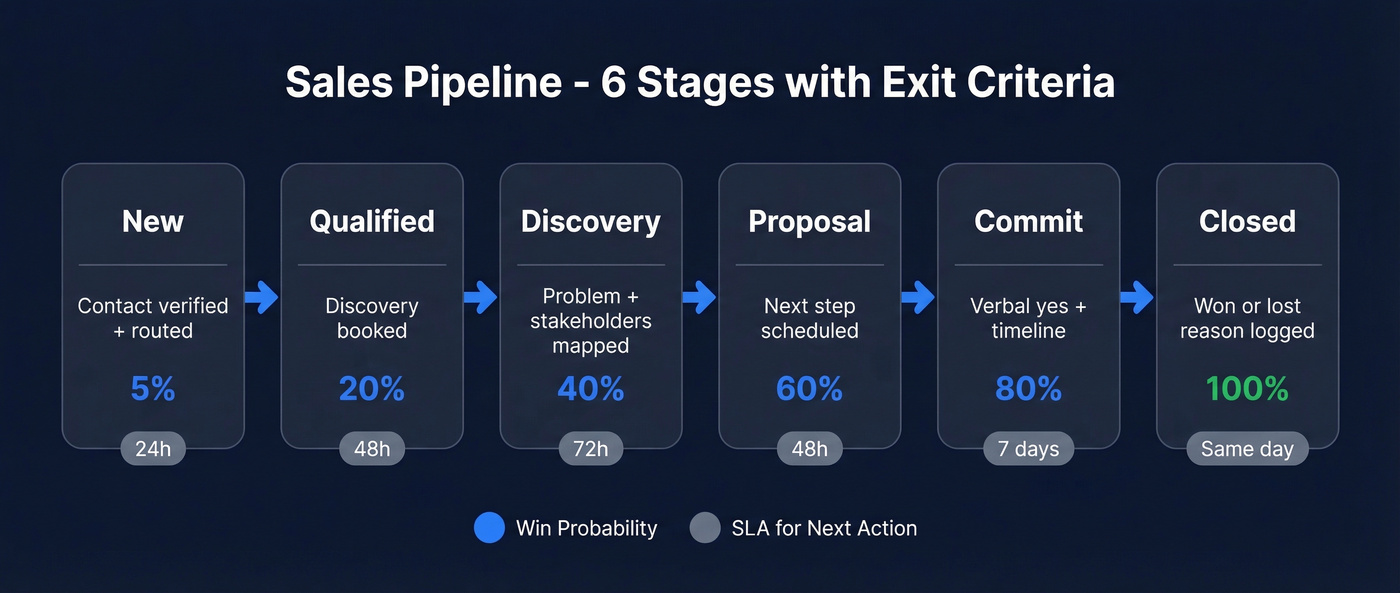
Four rules keep this real: stages are mutually exclusive, every deal has one owner, every deal has one dated next step, and you don't advance stages without meeting exit criteria. Break any of those and your forecast turns into vibes.
When to Disqualify
A healthy pipeline isn't a big pipeline - it's an honest one. Disqualify when:
- There's no path to budget (not "later," but no path at all)
- A competitor is already locked in under contract
- The prospect ghosts after three touches across two channels
- You're RFP filler and they already picked a winner
- You're talking to a non-ICP contact with no route to the buyer
We've watched teams inflate pipeline 2-3x by refusing to disqualify. It feels great until forecast week, when half the "committed" deals evaporate.
Enterprise Variant (Add Two Stages)
If procurement is a real obstacle, insert Security and Legal between Proposal and Commit. Track blockers as fields: security questionnaire status, DPA status, vendor onboarding status. Enterprise cycles routinely run 6-18 months, and deals stall in procurement if you don't operationalize it.
Build Your Prospecting Engine
Data Quality Is Step Zero
If your emails bounce, your process collapses before it starts. Bad data wrecks deliverability, wastes SDR hours, and trains reps to distrust the system.
This is where Prospeo fits naturally: 300M+ profiles, 143M+ verified emails, 125M+ verified mobile numbers, and 98% email accuracy on a 7-day refresh cycle. You can filter by 30+ criteria, export verified contacts, and keep sequences from turning into bounce-fests. One customer, Meritt, dropped their bounce rate from 35% to under 4% and tripled pipeline from $100K to $300K per week.
On capacity planning, a simple split works: if you have inbound, protect it with fast response times, then aim most outbound effort at accounts you can actually win. Follow-up matters more than most teams admit. Build sequences that assume persistence, not one-and-done hero emails.
Lead Scoring (Keep It Simple)
Use a three-factor score:
- Fit (0-50): ICP match
- Intent (0-40): site activity, content engagement, intent signals
- Urgency (0-10): triggers like funding, hiring, leadership change
Set thresholds: MQL at 45+, SQL at 65+. Anything above SQL gets a same-day call.

A sales process without clean data is just a flowchart. Prospeo gives your reps 300M+ profiles with 98% email accuracy on a 7-day refresh cycle - so every stage from prospecting to close runs on contacts that actually connect.
Stop building pipeline on bad data. Start with contacts that convert.
Choose a Qualification Framework
Match the framework to deal complexity.
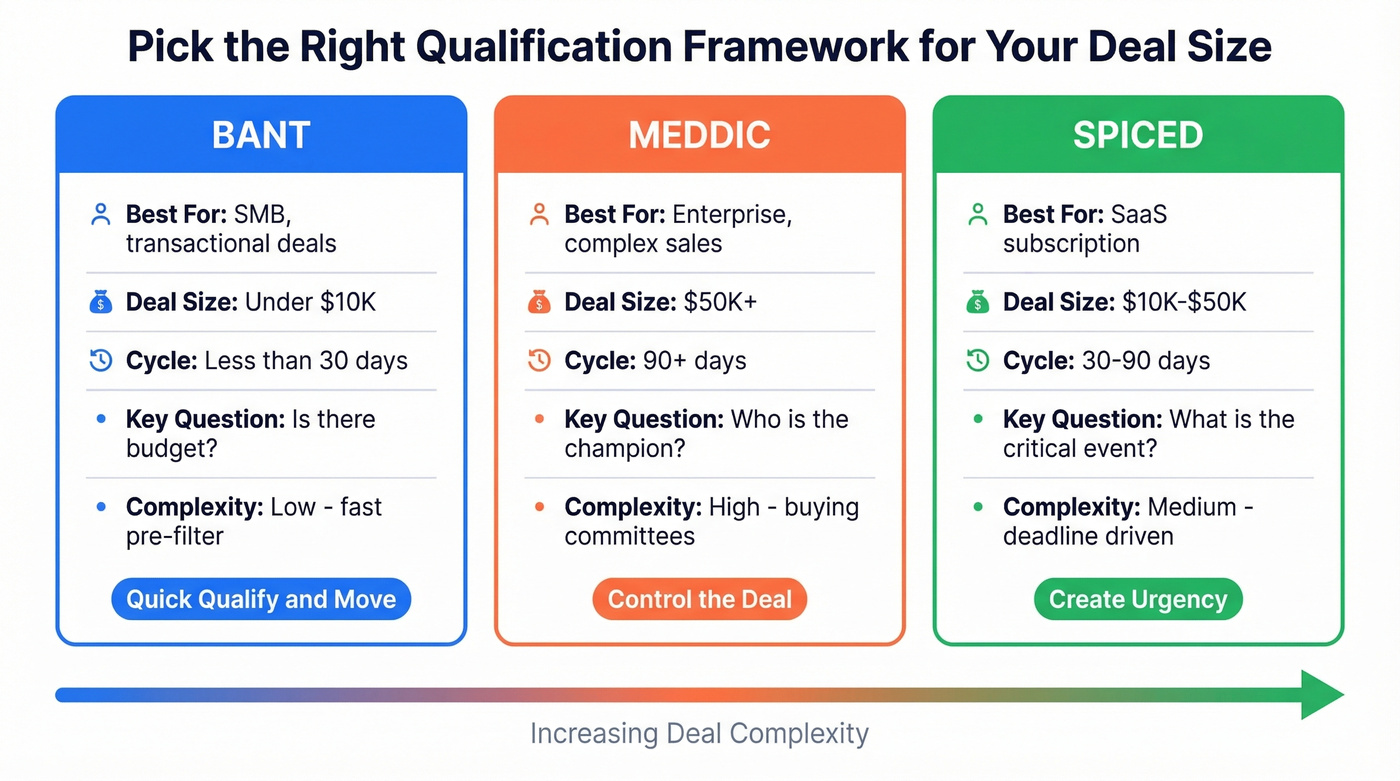
| Framework | Best For | Deal Size | Cycle | Key Question |
|---|---|---|---|---|
| BANT | SMB, transactional | Under $10K | < 30 days | "Is there budget?" |
| MEDDIC | Enterprise, complex | $50K+ | 90+ days | "Who's the champion?" |
| SPICED | SaaS subscription | $10-50K | 30-90 days | "What's the critical event?" |
BANT is a fast pre-filter. For small, fast deals, it's perfect: budget, authority, need, timeline. If you can't get clean answers quickly, it's not a real opportunity. Skip the complexity - just qualify and move.
MEDDIC is for $50K+ deals with buying committees, where it's the difference between "we're in the running" and "we're actually controlling the deal." Let's be honest about champions: a real champion shares internal politics, brings detractors into the conversation, and helps you navigate procurement. If your "champion" only says nice things in meetings, they're a fan - not a champion.
SPICED shines when the buyer needs a deadline. If you can't name the critical event, you're selling "nice to have," and those deals slip forever.
Outreach, Follow-Up, and Closing
Your SLAs matter more than your copy.
- Inbound: respond in 5 minutes.
- Outbound: first touch within 24 hours of list delivery.
- Follow-up: every 2-3 days in week one, then weekly.
Make Mutual Action Plans Mandatory
A mutual action plan is the simplest way to stop "verbal yes" from turning into a 6-week stall. It's a shared doc with 3-5 steps that answers: who does what, by when, and what could block signature.
Teams that switch from pressure-based closing to mutual action plans and data-backed proposals see real gains - HubSpot documented a 20% win rate increase over two quarters. Predictability beats pressure every time.
Automate Admin, Not Relationships
Where automation actually helps:
- Prospecting: list building, enrichment, verification
- Qualification: call notes + prompts for missing fields
- Proposal: first-draft generation, CPQ
- Pipeline hygiene: stale-deal alerts, risk flags, forecast modeling
Sales teams are investing heavily in AI right now, and the ones doing it well are pulling ahead. Use that momentum to remove busywork, not to replace judgment.
Tooling that stays sane:
- CRM: HubSpot (free tier for startups), Salesforce (~$25-$300/user/month depending on edition)
- Sequencing: Outreach or Salesloft (~$100-$200/user/month)
- Prospecting: Apollo (free tier; paid ~$49-$99/user/month) for speed; pair with Prospeo's verified data when accuracy matters
- Enrichment: Prospeo's enrichment API returns 50+ data points with a 92% match rate, plugging into Salesforce, HubSpot, Clay, Zapier, and more
Adoption tip that actually works: after rollout and training, schedule a follow-up session one month later to review usage, fix friction, and lock in the habits. Most "CRM failures" are just "nobody reinforced the new behavior."
Measure, Benchmark, and Iterate
Pipeline Velocity Formula
Pipeline velocity is revenue per day:
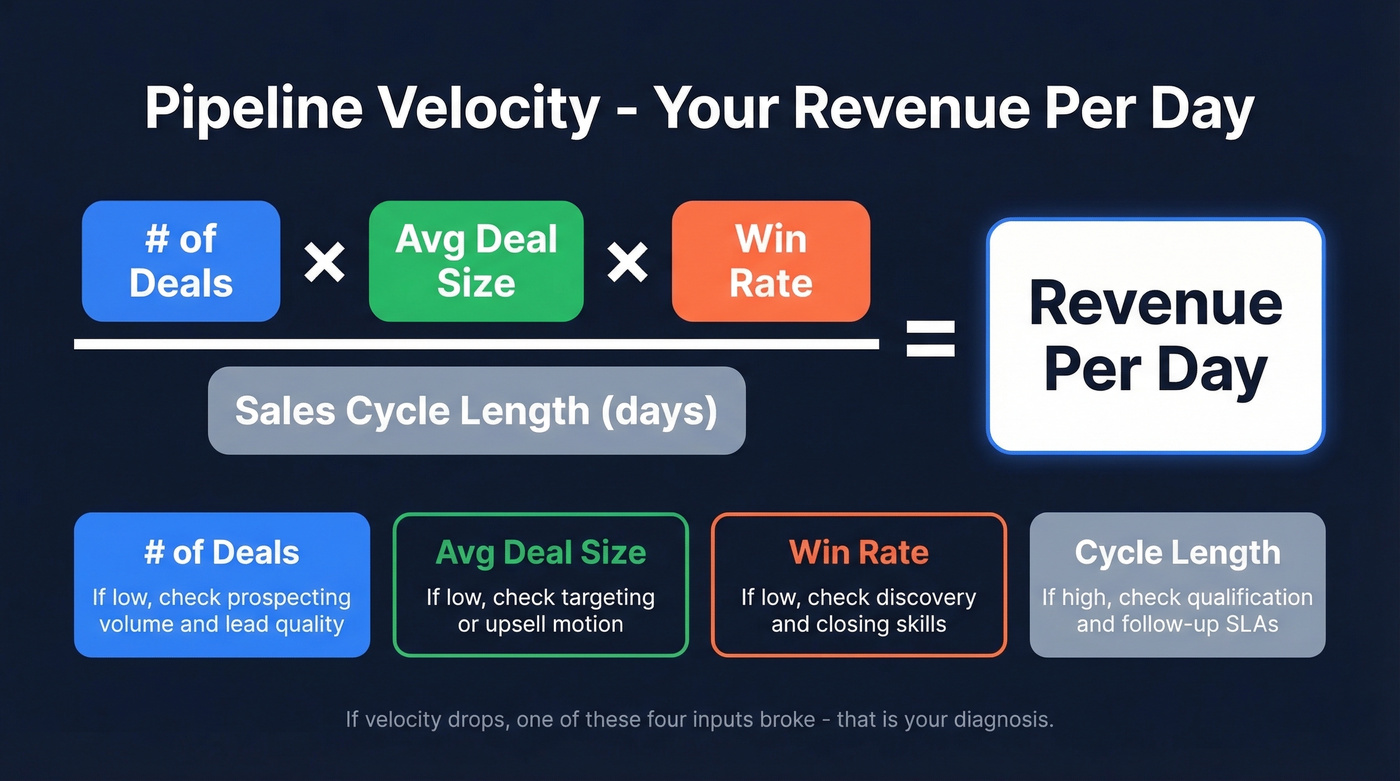
(# of deals x average deal size x win rate) / sales cycle length (days)
If velocity drops, one of those four inputs broke. That's your diagnosis.
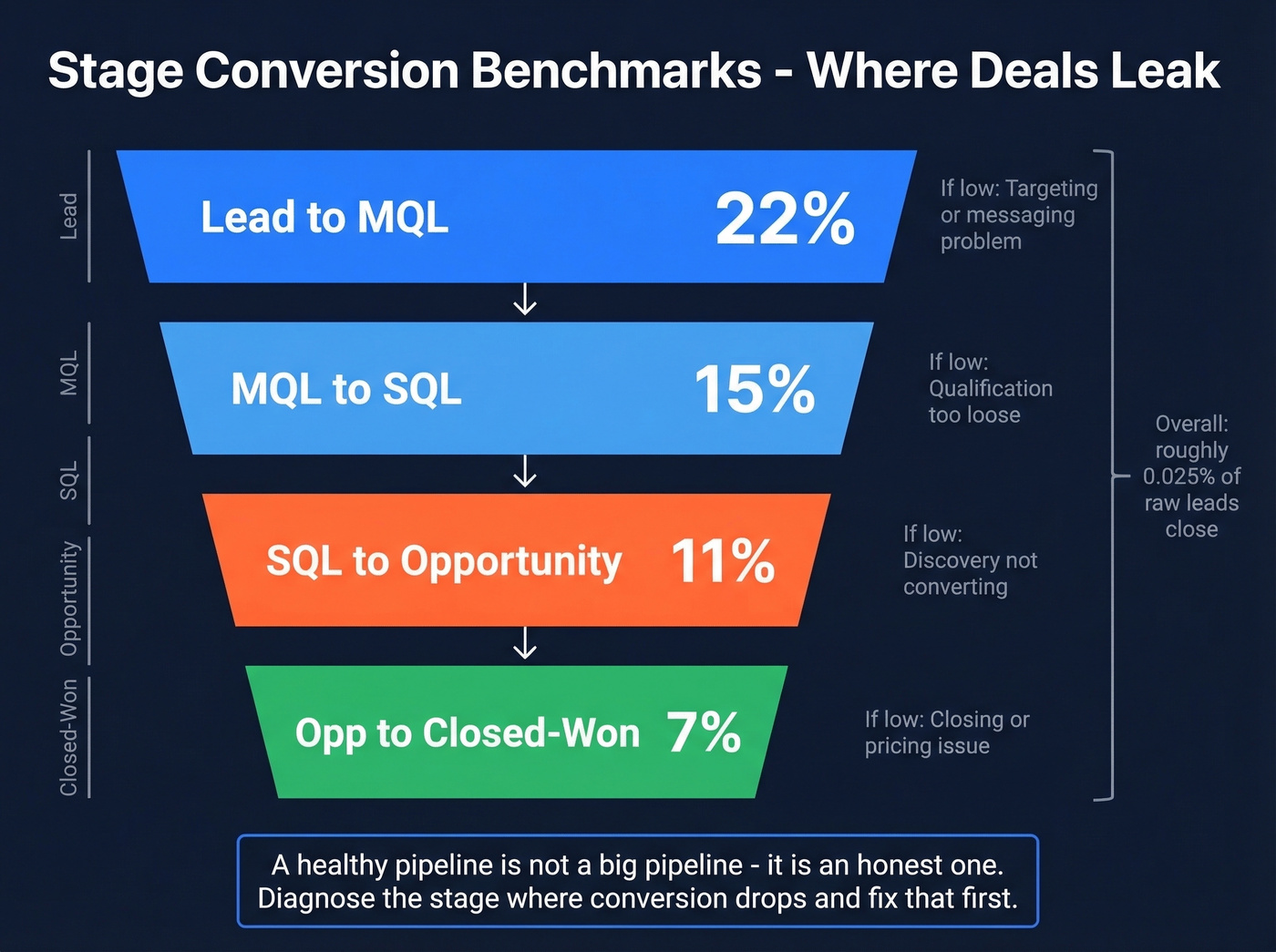
Stage Conversion Benchmarks
| Stage Transition | Benchmark | Low Numbers Mean |
|---|---|---|
| Lead to MQL | 22% | Targeting or messaging problem |
| MQL to SQL | 15% | Qualification too loose |
| SQL to Opportunity | 11% | Discovery not converting |
| Opp to Closed-Won | 7% | Closing or pricing issue |
Core Metrics Dashboard
| Metric | What It Tells You | Healthy Range |
|---|---|---|
| Pipeline coverage | Forecast safety vs quota | 3x-5x quota |
| Stage conversion rate | Where deals leak | Stable or improving MoM |
| Sales cycle length | How fast you get paid | Down or flat QoQ |
| Win rate | Offer + execution quality | Upward trend by segment |
| % stale deals | Pipeline hygiene | <10% with no next step |
| Activity-to-meeting rate | Prospecting effectiveness | Improving by ICP tier |
Review Cadence
Review the process every six months using conversion rates, cycle length, and win rate by segment. Sales cycles have stretched materially since 2020. A process you set 18 months ago can quietly bleed deals today if you don't revisit it with fresh numbers.
Scaling Across Company Stages
| Dimension | Startup | SMB | Enterprise |
|---|---|---|---|
| Stakeholders | 1-2 | 3-5 | 6-10+ |
| CEO access | Direct | Possible | Rare |
| Cycle length | 2-4 weeks | 2-6 months | 6-18 months |
| Qualification | BANT | BANT/SPICED | MEDDPICC |
| CRM stages | 4-5 | 5-6 | 7-9 |
| Collateral | One strong one-pager | Case studies | Function-specific decks |
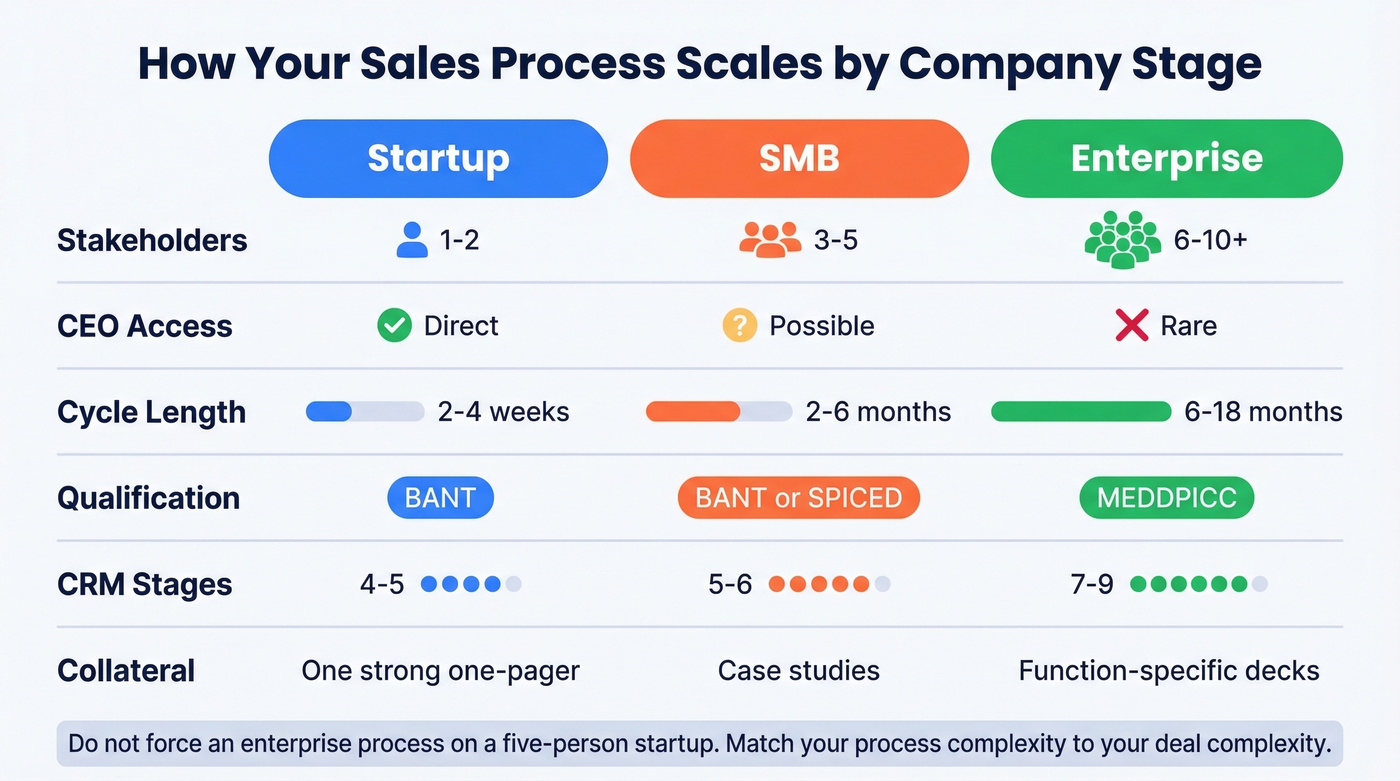
Don't force an enterprise process on a five-person startup. It'll die on arrival. Startups need speed and learning; enterprise needs governance and risk control.
Mistakes That Kill Your Process
- No exit criteria. "Proposal Sent" becomes a graveyard.
- Too many stages. Past seven, reps stop caring.
- No required fields. You can't forecast from missing data.
- Built without reps. If they didn't help build it, they won't run it.
- No reinforcement. Train once, then follow up a month later - or watch adoption fade.
Knowing how to build a sales process is only half the battle. The other half is enforcing it with clean data, honest disqualification, and regular reviews. Start from your wins, keep stages tight, and let the numbers tell you what to fix.
Meritt followed this exact playbook - clean data in, structured process out - and tripled pipeline from $100K to $300K/week while cutting bounce rates from 35% to under 4%. Prospeo's 30+ filters let you target by intent, technographics, and headcount growth so reps only work deals worth winning.
Feed your sales process the data it deserves at $0.01 per verified email.
FAQ
What's the first step when building a sales process?
Start with your last 20 closed-won deals. Map the milestones they all share - discovery timing, stakeholder involvement, pricing sequence - then turn those patterns into stages with measurable exit criteria. This grounds your process in reality, not theory.
How many pipeline stages should I use?
Five to seven stages work for most B2B teams. Fewer than five hides conversion problems; more than seven gets ignored by reps. Every stage needs a measurable exit criterion - if you can't define one, merge it with an adjacent stage.
How often should I update my sales process?
Every six months minimum. Use stage conversion rates, win rate by segment, and average cycle length as your inputs. Sales cycles have lengthened since 2020, so a process older than a year likely has silent leaks.
What tools do I need to operationalize a sales process?
A CRM (HubSpot or Salesforce), a sequencing tool (Outreach or Salesloft), and a verified data source. Prospeo covers prospecting and enrichment with 98% email accuracy and a 7-day refresh cycle - critical for keeping bounce rates low and rep trust high.
What's the difference between a sales process and a methodology?
A process defines the stages and rules deals follow in your CRM. A methodology (MEDDIC, SPIN, Challenger) dictates how reps execute conversations within those stages. You need both, but build the process first - methodology without structure is just philosophy.