

How to Calculate Sales Revenue: Formulas, Examples, and Mistakes to Avoid
A RevOps Manager lead we know closed 40 deals last quarter. When finance ran the numbers, recognized revenue only went up 8%. That gap between "deals closed" and "revenue on the books" is where most teams get tripped up - and it usually comes down to how you calculate sales revenue: timing, definitions, or both.
Let's fix that.
The Quick Version
Sales revenue = units sold x average selling price (product businesses), customers x average service price (service businesses), or MRR x 12 (subscription). Net sales subtracts returns, allowances, and discounts - never COGS. Running a SaaS company? Skip straight to the MRR/ARR section. If your number feels wrong, jump to the 7 common mistakes below.
What Is Sales Revenue?
Sales revenue is the income your business generates from its core operations - selling products or delivering services. Not interest income. Not asset sales. Just the money customers pay you for the thing you actually do.
Sales Revenue = Units Sold x Average Selling Price
You sell 500 units at $120 each. Sales revenue = 500 x $120 = $60,000. That's your top line before any deductions, and this basic formula applies to any product-based business regardless of size.
Sales Revenue vs. Total Revenue vs. Net Income
This trips up more people than it should. On r/Entrepreneur, a construction business owner asked the difference between "sales" and "revenue" and got a dozen conflicting answers. Here's the hierarchy that actually matters:
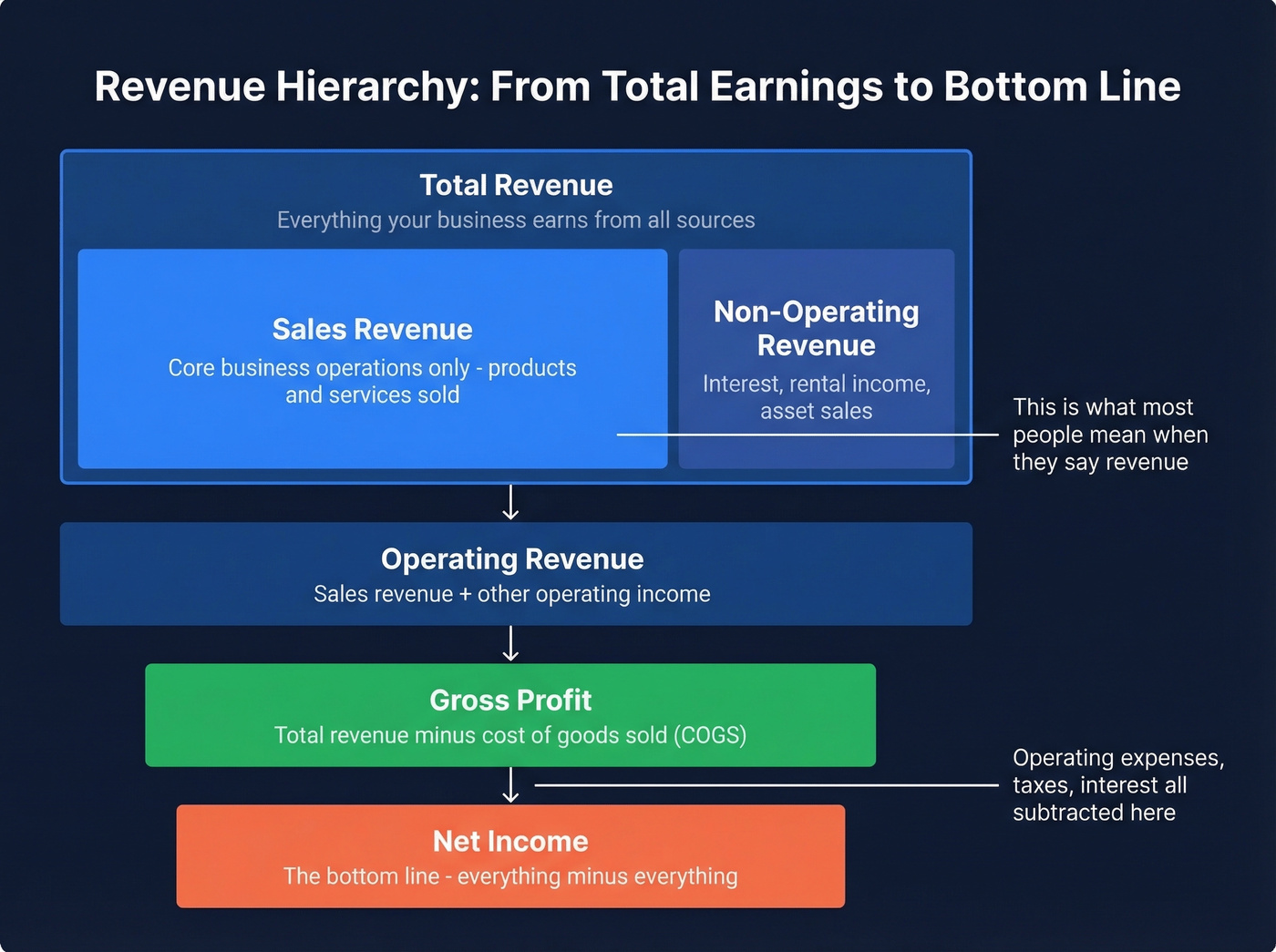
| Term | What It Includes |
|---|---|
| Sales Revenue | Core business operations only |
| Operating Revenue | Sales revenue + other operating income |
| Total Revenue | Operating + non-operating (interest, rentals, asset sales) |
| Gross Profit | Total revenue - COGS |
| Net Income | Everything minus everything (the bottom line) |
The key distinction is operating vs. non-operating. If you run a software company and earn $50,000 in interest on your cash reserves, that's revenue - but it isn't sales revenue. Sales revenue only counts income from your core product or service. Total revenue wraps in everything else.
Revenue Formulas by Business Model
Product-Based Revenue
Revenue = Units Sold x Average Selling Price
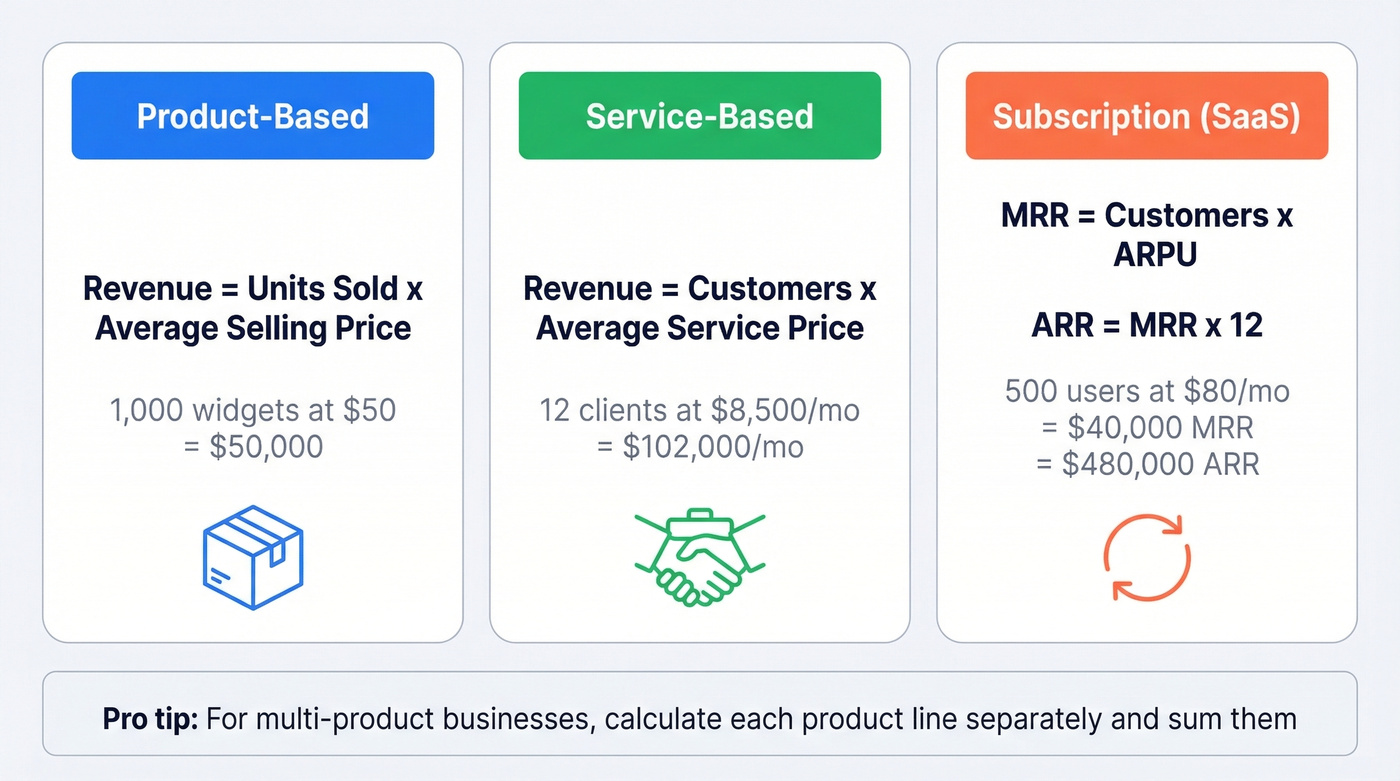
If you sell three products, calculate each separately and sum them. A company selling 1,000 widgets at $50 and 200 premium widgets at $150 has total product revenue of $50,000 + $30,000 = $80,000.
Service-Based Revenue
Revenue = Number of Customers x Average Service Price
A consulting firm with 12 active clients paying an average of $8,500/month generates $102,000 in monthly service revenue. For hourly billing, it's even simpler: billable hours x hourly rate.
Subscription Revenue (MRR & ARR)
MRR = Number of Customers x ARPU (Average Revenue Per User)
MRR breaks into five components: New MRR, Expansion MRR, Contraction MRR, Churn MRR, and Reactivation MRR. Tracking each separately tells you whether growth is coming from new logos or existing accounts - a distinction that matters enormously for forecasting.
Annual subscriptions must be divided by 12 before adding to MRR. A $12,000 annual contract is $1,000/month MRR, not $12,000. One-time setup fees don't count at all.
ARR (Annual Recurring Revenue) is typically MRR x 12, but definitions vary more than you'd expect. A review of 160+ public tech company SEC filings found at least four distinct calculation methods. Rubrik annualizes active subscription contracts assuming renewal. MongoDB annualizes the prior 90 days of actual usage and excludes professional services. If you're benchmarking your ARR against public comps, make sure you're comparing apples to apples.
Multi-Product Revenue Rollup
For businesses with multiple product lines, sum each line quarterly:
| Product | Q1 | Q2 | Q3 + Q4 |
|---|---|---|---|
| Core SaaS | $120K | $135K | $297K |
| Add-on Module | $30K | $34K | $79K |
| Pro Services | $45K | $40K | $98K |
| Total | $195K | $209K | $474K |
Annual total: $878K. Just make sure each line uses the same recognition method and time period.
How to Calculate Net Sales Revenue
Here's the correct formula:
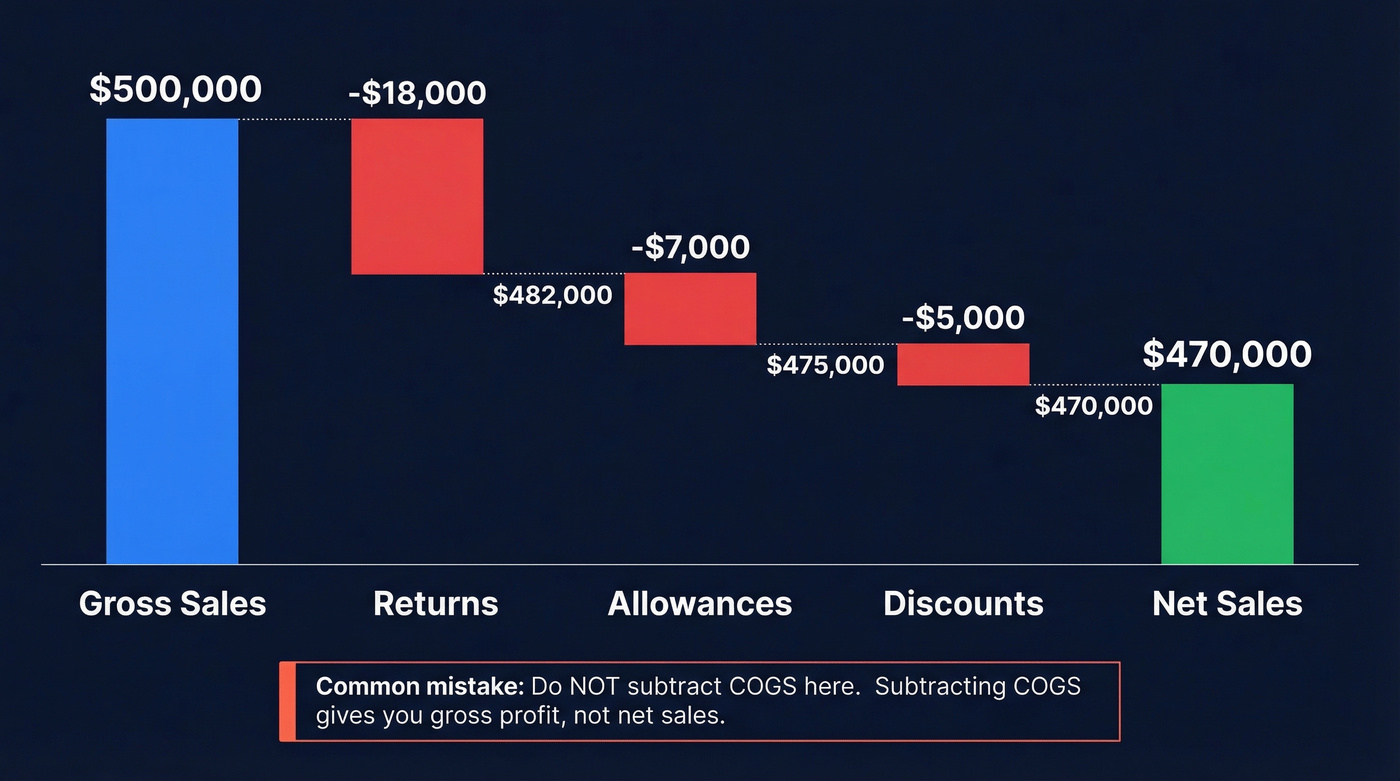
Net Sales = Gross Sales - Returns - Allowances - Discounts
Three deductions. Returns are products sent back. Allowances are price reductions for damaged or defective goods the customer keeps. Discounts are early-payment incentives like 2/10 net 30 terms.
A worked example: your company records $500,000 in gross sales. Customers return $18,000 in product. You issue $7,000 in allowances for a defective batch. Early-payment discounts total $5,000. Net sales = $500,000 - $18,000 - $7,000 - $5,000 = $470,000.
Here's the thing - a lot of guides get this wrong by subtracting COGS inside "net sales." Subtracting COGS gives you gross profit, not net sales. If you see a formula that mixes "production costs" or "other expenses" alongside returns and discounts, close that tab.


Your revenue formula is only as good as the pipeline feeding it. Bad contact data means bounced emails, missed deals, and a top line that never matches your forecast. Prospeo delivers 98% email accuracy with a 7-day refresh cycle - so every deal in your pipeline connects to a real buyer.
Stop forecasting revenue you'll never close. Fix the pipeline first.
Tricky Spots Most Guides Skip
Why "Net Sales" Is Missing from Filings
If you're trying to map textbook formulas to real filings, the labels can be frustrating. A thread in r/Accounting captures this confusion perfectly: a student couldn't find a line item called "net sales" on Apple's or Amazon's income statements and didn't know whether to use "Total Revenue" instead.
In practice, companies label the top line as "Revenue," "Total revenue," "Net sales," or "Net revenue." It's often the same concept - revenue net of returns and discounts, before operating expenses - but definitions vary by company. Always check the notes if you're doing serious analysis.
Cash vs. Accrual Accounting
The same transaction produces different revenue numbers depending on your accounting method:
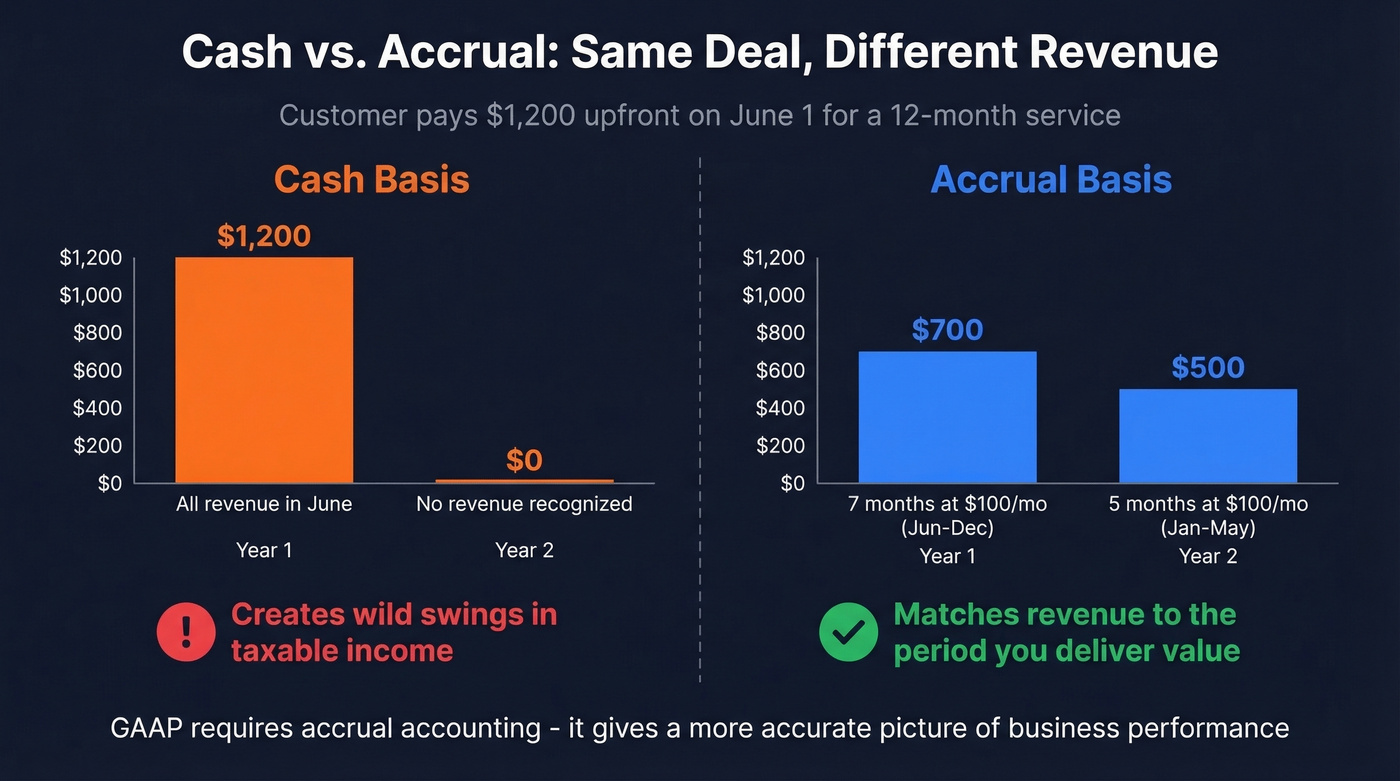
| Cash Basis | Accrual Basis | |
|---|---|---|
| Scenario | Customer pays $1,200 upfront on June 1 for annual service | Same transaction |
| Year 1 Revenue | $1,200 (all in June) | $700 (7 months x $100) |
| Year 2 Revenue | $0 | $500 (5 months x $100) |
Under cash basis, Year 2 can show a loss because expenses continue but no new revenue arrives for that contract - creating wild swings in taxable income. Scale it up: a $24,000 two-year software subscription paid upfront. Under accrual, you recognize $1,000/month for 24 months. Under cash, you'd book the entire $24,000 in month one. GAAP uses accrual accounting for a reason - it matches revenue to the period you actually deliver value.
For day-to-day decisions, don't let accounting method debates distract you from actually growing the number.
Revenue Recognition (ASC 606)
ASC 606 lays out five steps for recognizing revenue under GAAP:
- Identify the contract with the customer
- Identify performance obligations (what you promised to deliver)
- Determine the transaction price
- Allocate the price across obligations
- Recognize revenue when each obligation is satisfied
Revenue is recognized "over time" if the customer receives benefits as you perform, if the asset transfers as it's created, or if there's no alternative use plus an enforceable right to payment for work completed. Otherwise, it's recognized at a "point in time" - when control transfers via delivery, title, or acceptance.
An elevator installation contract illustrates the difference well: $5M price, $4M estimated cost, $1.5M elevator component. When the elevator arrives on-site with only 20% of remaining work done ($500K of $2.5M in non-elevator costs), the correct revenue recognition is $1.5M (elevator) + 20% x $3.5M (remaining revenue) = $2.2M. A naive percentage-of-completion approach would've booked $2.5M - overstating progress by $300K.
One more thing most guides skip: if you sell internationally, convert foreign-currency revenue at the exchange rate on the transaction date, not the reporting date.
7 Revenue Mistakes That Wreck Your Books
- Booking Stripe or Shopify deposits as sales. Those deposits are net of refunds, discounts, and processing fees. Break them out: gross sales, discounts, and refunds on separate P&L lines. Processing fees go in selling expenses.
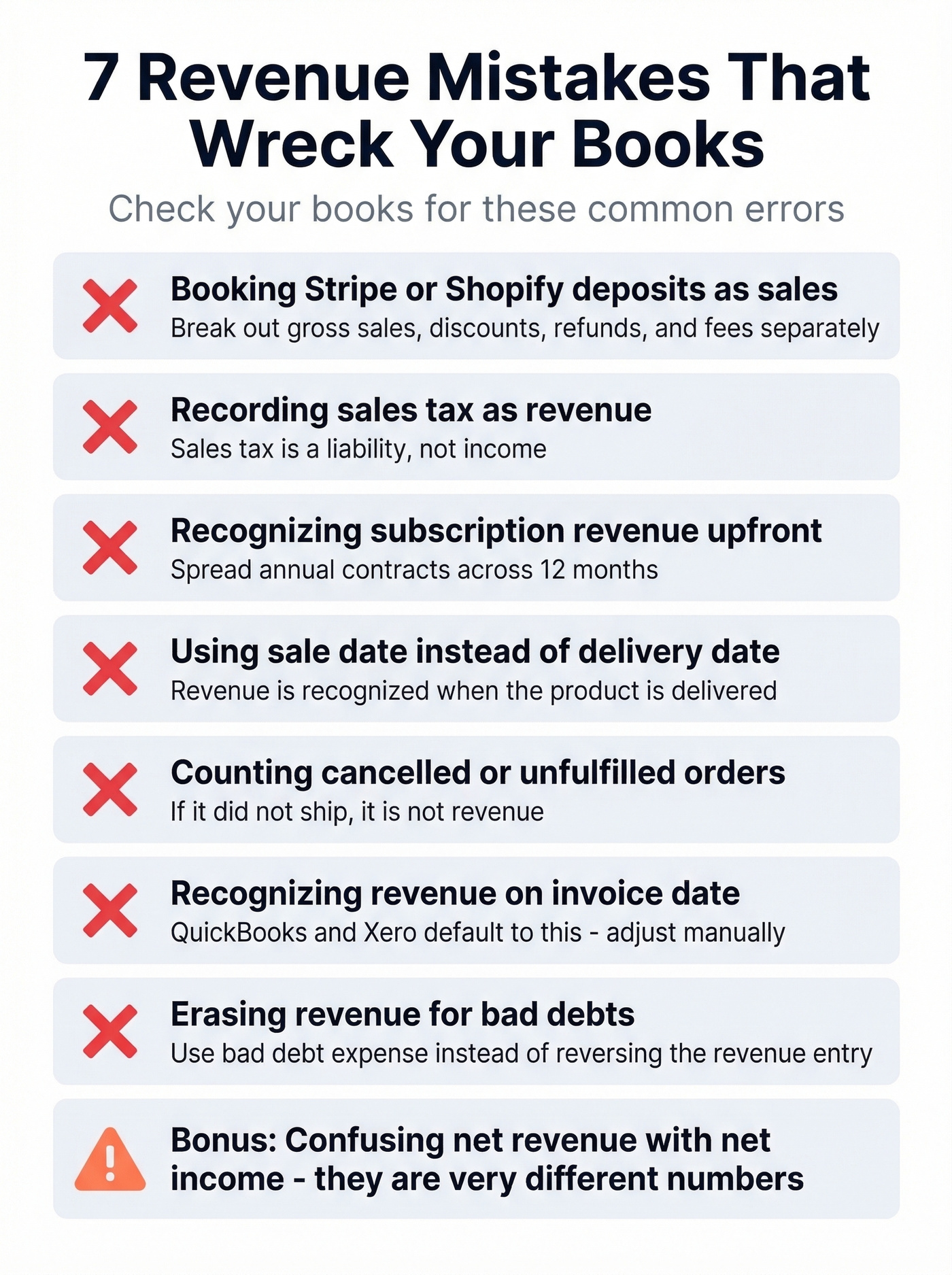
Recording sales tax as revenue. Sales tax collected is a liability, not income. Including it inflates your top line and creates a mess at tax time.
Recognizing subscription revenue upfront. Booking annual subscriptions in January instead of spreading $1,000/month over 12 months will overstate that month and quarter.
Using the sale date instead of the delivery date. For physical products, revenue is recognized when the product is delivered - not when the customer clicks "buy." Shopify's sale date and your warehouse's ship date aren't the same thing.
Counting cancelled or unfulfilled orders. If it didn't ship, it's not revenue. Base your numbers on fulfillment records, not order confirmations.
Recognizing on invoice date. QuickBooks and Xero both default to recognizing revenue when you create an invoice. If you invoice before delivering, you'll need adjusting entries.
Erasing revenue for bad debts. When a customer doesn't pay, the correct treatment is a bad debt expense - not reversing the original revenue entry. Revenue was earned; collection failed. Those are different problems.
And one meta-mistake worth flagging: confusing net revenue with net income. Net revenue (net sales) subtracts returns and discounts. Net income subtracts everything - COGS, operating expenses, taxes, interest. Even some bank explainers blur this line, which is exactly how teams end up blending "top line" and "bottom line."
Worked Examples in Spreadsheets
You don't need fancy software for this. Here's a template that works in Google Sheets or Excel.
Step 1 - Calculate gross revenue:
| Product | Units Sold | Price/Unit | Gross Revenue |
|---|---|---|---|
| Widget Pro | 1,200 | $85 | $102,000 |
| Widget Lite | 3,500 | $35 | $122,500 |
| Total | $224,500 |
Step 2 - Subtract deductions to get net sales:
| Product | Returns | Allowances | Discounts | Net Sales |
|---|---|---|---|---|
| Widget Pro | $3,400 | $1,200 | $2,040 | $95,360 |
| Widget Lite | $6,100 | $800 | $3,675 | $111,925 |
| Total | $9,500 | $2,000 | $5,715 | $207,285 |
Both Close and Salesflare offer free downloadable sales report templates if you want something more polished with pipeline tracking built in.
2026 SaaS Revenue Benchmarks
If you're running a SaaS company, here's where the market sits. The median revenue per employee for private SaaS is $129,724, based on a survey of 1,000+ companies. Bootstrapped companies consistently outperform equity-backed ones on this metric - $110,000 vs. $94,444 at the $1M-$3M ARR tier.
The latest Benchmarkit data puts median growth rate at 26%, net revenue retention at 101%, and the median New CAC Ratio at $2.00 in S&M spend per $1.00 of new ARR. Expansion ARR now accounts for 40% of total new ARR - up 5% year-over-year.
ARR per FTE scales with company size: $200K at the $50M-$100M ARR tier, $300K above $100M. If you're significantly below these numbers, the issue is usually headcount efficiency or pricing, not market conditions.
How to Grow Sales Revenue
Knowing how to calculate sales revenue is step one. Growing it is the actual job.
Optimize pricing. Many B2B companies underprice early and don't revisit pricing often enough. Even a 5% price increase on existing contracts drops straight to the top line with zero incremental cost.
Reduce churn. With 101% median NRR, a lot of SaaS companies grow revenue from existing customers before even counting new logos. If your NRR is below 95%, fixing churn will do more for revenue than any new logo campaign.
Expand existing accounts. Upsells and cross-sells usually convert better than brand-new cold deals. In our experience, the teams that build expansion into their CS motion - not just their sales motion - see the fastest revenue acceleration.
Improve lead quality and conversion. Revenue starts with pipeline. Pipeline starts with data. If your team's email bounce rate is high, you're leaving revenue on the table before reps even get to pitch. When Snyk rolled out Prospeo across 50 AEs, bounce rates dropped from 35-40% to under 5%, and AE-sourced pipeline jumped 180%. That's the kind of downstream revenue impact bad data quietly kills.
Sharpen your forecast. Revenue projections collapse when pipeline data is stale or incomplete. We've seen teams shave days off their forecast cycles just by running CRM enrichment that returns 50+ data points per contact at a 92% match rate - cleaner data in, fewer end-of-quarter surprises out.
That gap between deals closed and revenue recognized? It often starts with unqualified leads built on stale data. Prospeo's 300M+ verified profiles and 30+ filters - including buyer intent, funding, and headcount growth - help you fill your pipeline with prospects who actually convert.
Accurate revenue starts with accurate data. Try Prospeo free today.
FAQ
Is sales revenue the same as total revenue?
No. Sales revenue covers income from core operations only - products sold or services delivered. Total revenue adds non-operating income like interest, rental income, and asset sale gains. For most companies, sales revenue makes up 90%+ of total revenue.
Does sales revenue include sales tax?
No. Sales tax collected belongs in a sales tax payable liability account, not on your revenue line. Recording it as revenue overstates your top line and creates reconciliation problems when you remit to the state.
What's the difference between gross and net sales?
Gross sales is the total before any deductions. Net sales subtracts returns, allowances, and discounts - nothing else. COGS isn't part of this calculation; subtracting COGS gives you gross profit, a different metric entirely.
How do SaaS companies calculate sales revenue?
MRR x 12 gives you ARR. Exclude one-time fees like setup charges, and divide annual subscriptions by 12 before adding to MRR. Track the five MRR components - new, expansion, contraction, churn, and reactivation - separately for accurate forecasting. The SaaS CFO has a solid deep-dive on edge cases if you want to go further.
How can I improve pipeline data to grow revenue?
Start by auditing bounce rates. If more than 5% of outbound emails bounce, your contact data is costing you deals. Tools like Prospeo, ZoomInfo, and Apollo can keep your CRM clean - though accuracy, refresh cycles, and pricing vary significantly across providers. Skip anything that doesn't verify emails in real time.