

How to Coach Salespeople: The Playbook Your Training Vendor Won't Give You
It's Tuesday at 2pm. You've got a 1:1 with your mid-tier AE in ten minutes, and your entire plan is "walk me through your pipeline." Meanwhile, on r/sales, a new manager just posted about getting stomped by a top rep in a role play - wondering if they're even cut out for this.
Both of you are stuck in the same trap: confusing deal inspection with coaching. If you want to learn how to coach salespeople without turning every 1:1 into a pipeline audit, this playbook covers the frameworks, templates, and scorecards that actually move numbers.
The short version: Use a named framework (GROW is the simplest), run 30-minute 10/10/10 1:1s, and review at least one call per week with a scorecard. That's 80% of what separates great sales coaches from deal auditors.
Why Coaching Matters More Than Training Alone
ICF research shows the average company can expect a return of about 7x the initial investment in coaching. When coaching is combined with training, productivity jumps up to 86% compared to just 22% with training alone.
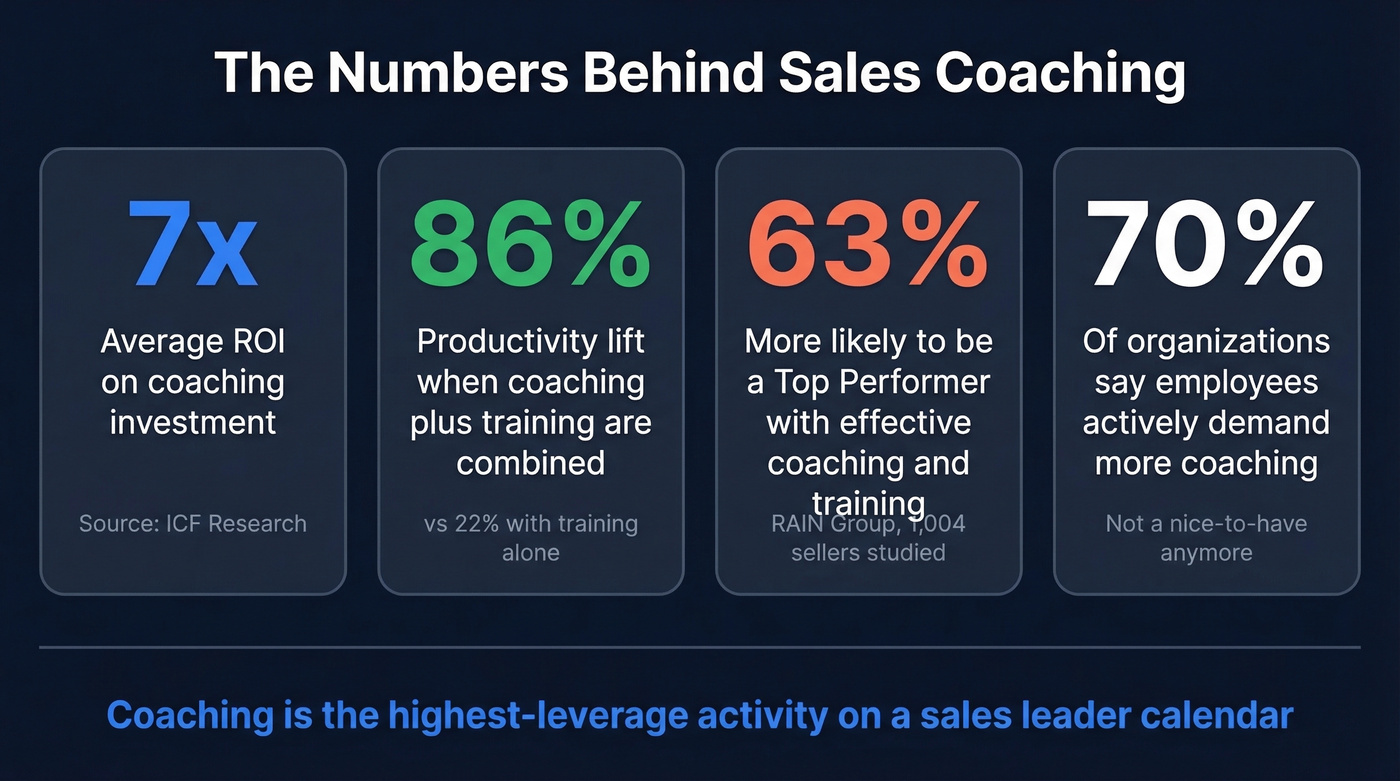
A RAIN Group study of 1,004 sellers and sales managers found reps are 63% more likely to be a Top Performer when they have an effective manager, regular coaching, and effective training. And 70% of organizations report employees actively demand more frequent coaching. This isn't a nice-to-have. It's the highest-leverage activity on a sales leader's calendar, and the data says start here if you want consistent performers.
Coaching vs. Telling
Most managers think they're coaching when they're actually telling people what to do. Keith Rosen draws a useful line: a consultant solves the problem for you, a trainer teaches a new skill, and a coach helps you apply that skill on the job. If your 1:1s are 80% you talking and 20% the rep nodding, you're consulting.
The fix is a ratio. Aim for 20% pipeline inspection, 80% coaching. Most managers have it backwards. Flip that dynamic - you ask questions, the rep does the thinking.
Three Frameworks That Work
GROW (Best for Most Managers)
Goal, Reality, Options, Way Forward. Two questions that work every time: "What does closing this C-level deal look like in the next two weeks?" and "What's actually standing between you and that outcome right now?" The Options and Way Forward steps force the rep to generate their own solutions, which is the whole point. We've seen managers adopt GROW in a single afternoon and immediately improve the quality of their 1:1s - it's that straightforward.
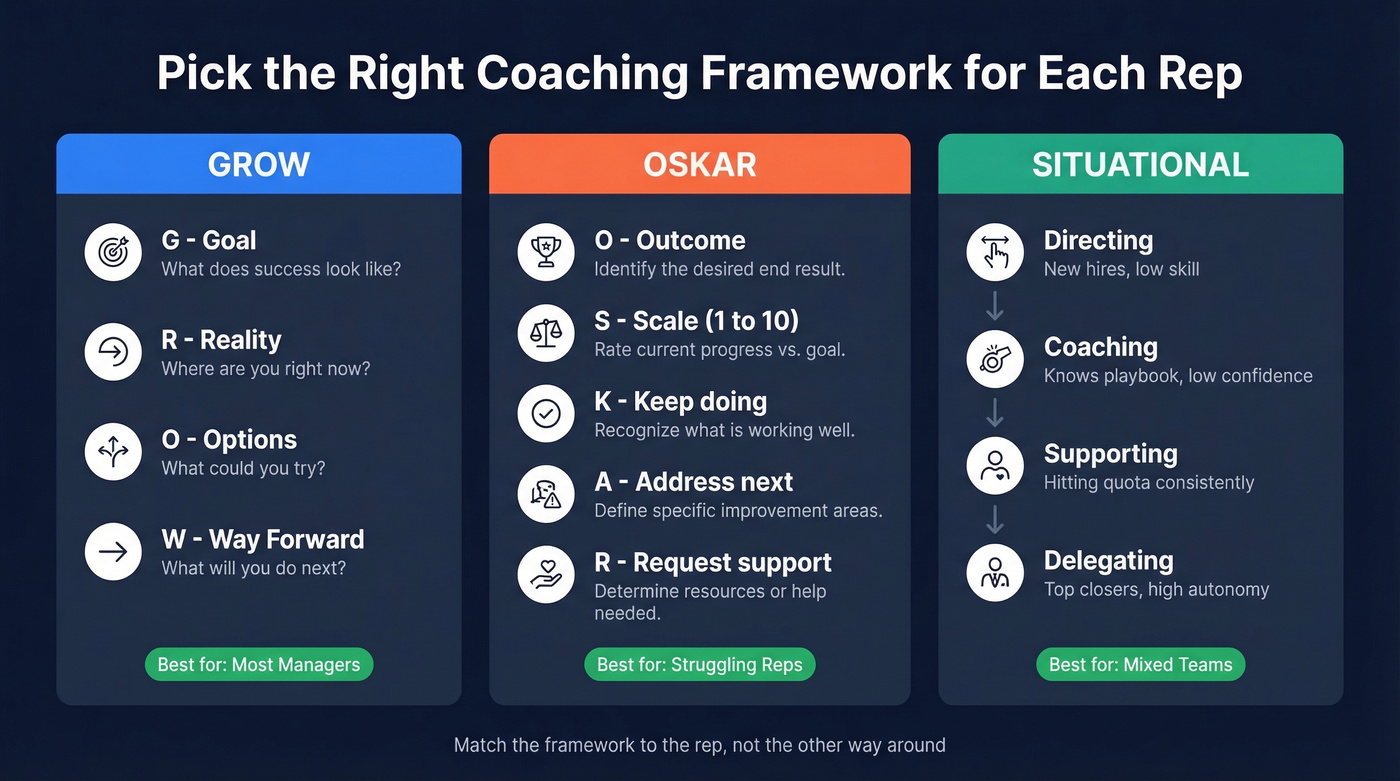
OSKAR (Best for Struggling Reps)
Outcome, Scale, Keep, Address, Request. The magic is the scaling question: "On a scale of 1-10, where are you on hitting this quarter's number?" Whatever they say, follow with "What would move you one point higher?" It turns a vague performance gap into a specific next step. OSKAR works especially well for reps who shut down when they feel criticized, because it starts from their self-assessment rather than yours.
Situational Leadership (Best for Mixed Teams)
Match your style to the rep's development stage. New hire who doesn't know the product? Directing. Knows the playbook but lacks confidence? Coaching. Hitting quota consistently? Supporting. Your top closer? Delegating.
The mistake most managers make is coaching everyone the same way - and I've watched it flatten entire teams. A senior AE who's been closing enterprise deals for six years doesn't need the same conversation as someone three months off onboarding. Choosing your approach based on where each rep sits on the development curve is one of the most underrated things you can do as a leader.
The 30-Minute 1:1 Template
Use the 10/10/10 structure. Thirty minutes, three blocks, everything that matters.
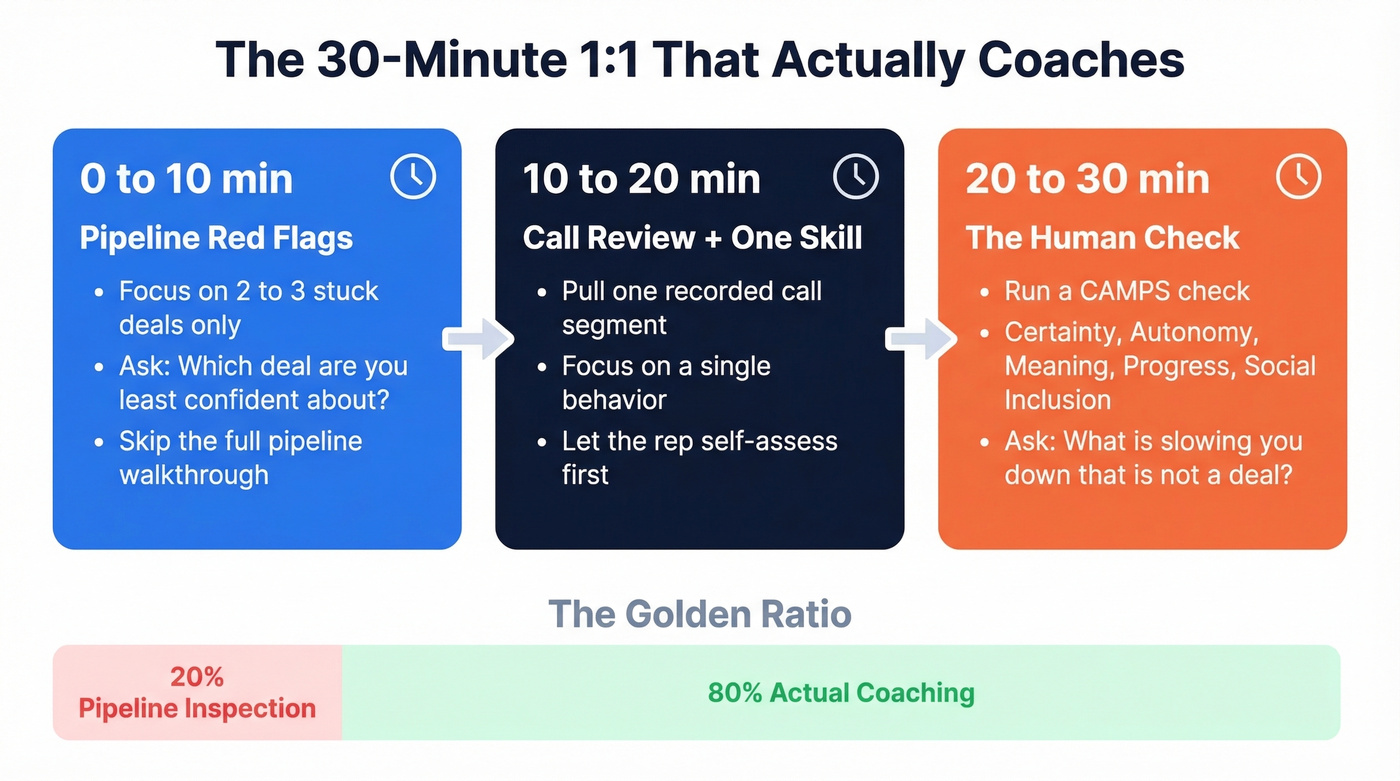
First 10 minutes - Pipeline red flags only. Don't review every deal. Ask about the two or three that are stuck or suspiciously optimistic: "Which deal are you least confident about? What needs to happen this week for it to move?"
Next 10 minutes - Call review + one skill. Pull one recorded call. Listen to a short segment together. Focus on a single behavior, not five. More on this below.
Final 10 minutes - The human check. This is where most managers skip. Run a quick CAMPS check across five dimensions: Certainty, Autonomy, Meaning, Progress, and Social Inclusion. One question covers it: "What's the biggest thing slowing you down right now that isn't a deal?"

Your 10/10/10 coaching sessions fall apart when reps waste hours hunting for contact data instead of selling. Prospeo gives every AE on your team 300M+ verified profiles with 98% email accuracy - so your 1:1s focus on skills, not lead sourcing. Teams using Prospeo book 35% more meetings than Apollo users.
Stop coaching reps through bad data. Give them contacts that connect.
How to Run Call Reviews
Here's a 25-point scorecard you can pilot this week:
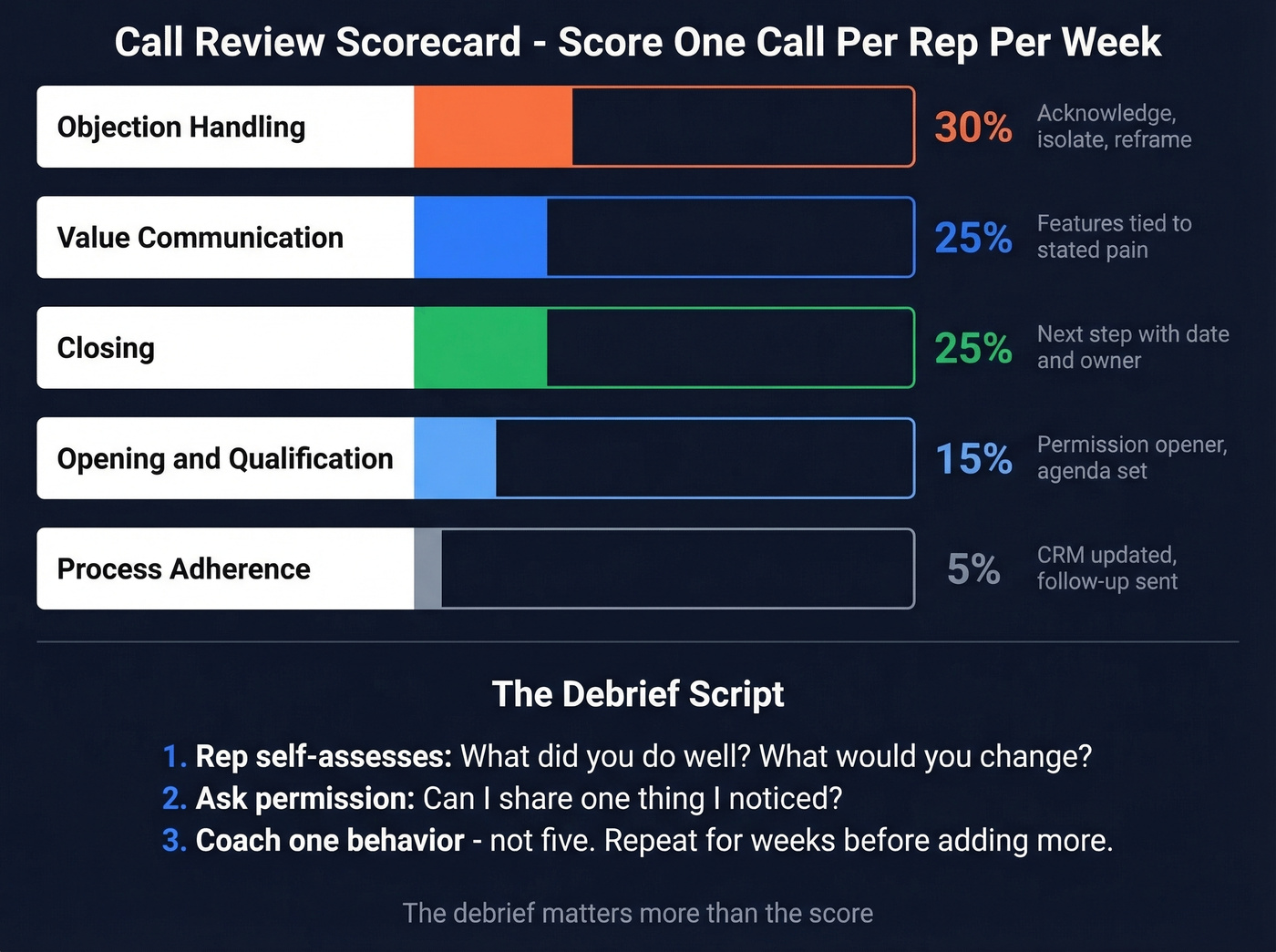
| Category | Weight | What Excellent Looks Like |
|---|---|---|
| Opening / Qualification | 15% | Permission opener, agenda set |
| Value Communication | 25% | Features tied to stated pain |
| Objection Handling | 30% | Acknowledge, isolate, reframe |
| Closing | 25% | Next step with date and owner |
| Process Adherence | 5% | CRM updated, follow-up scheduled |
The debrief matters more than the score. Let the rep self-assess first: "What did you do well? What would you change?" Then ask permission to coach - "Can I share one thing I noticed?" This isn't soft. It's how you get reps to internalize feedback instead of getting defensive. The HBR Feedback Fallacy is a useful reminder here: blanket criticism and praise don't reliably create improvement. Coaching works better when you build on strengths and get specific about what to repeat.
Role-Play Scenarios to Run This Week
Rotate roles every round: seller, buyer, observer. The observer's feedback is often the most valuable because they're not emotionally invested.
Objection Handling - Prospect says "we're happy with our current vendor." Starter: "I hear that a lot - what made you take this call?" Watch for discounting too quickly instead of digging into the real objection.
Discovery - First call, no intel beyond the company name. Starter: "Help me understand what prompted you to look at this now." Watch for talking more than asking.
Here's the thing: the next two scenarios are where most teams fall apart.
Negotiation - Prospect asks for 20% off. Starter: "I can work with you on that - what can you give me in return?" Watch for caving without getting a concession. Getting to Power - Champion says "I'll run it up the chain." Starter: "Would it help if I joined that conversation to answer technical questions?" If your reps aren't asking to be in the room, they're losing deals they'll never know about.
Common Coaching Mistakes
The biggest mistake is pipeline inspection disguised as coaching. If your 1:1 is all deal stages and close dates, enforce the 20/80 rule.
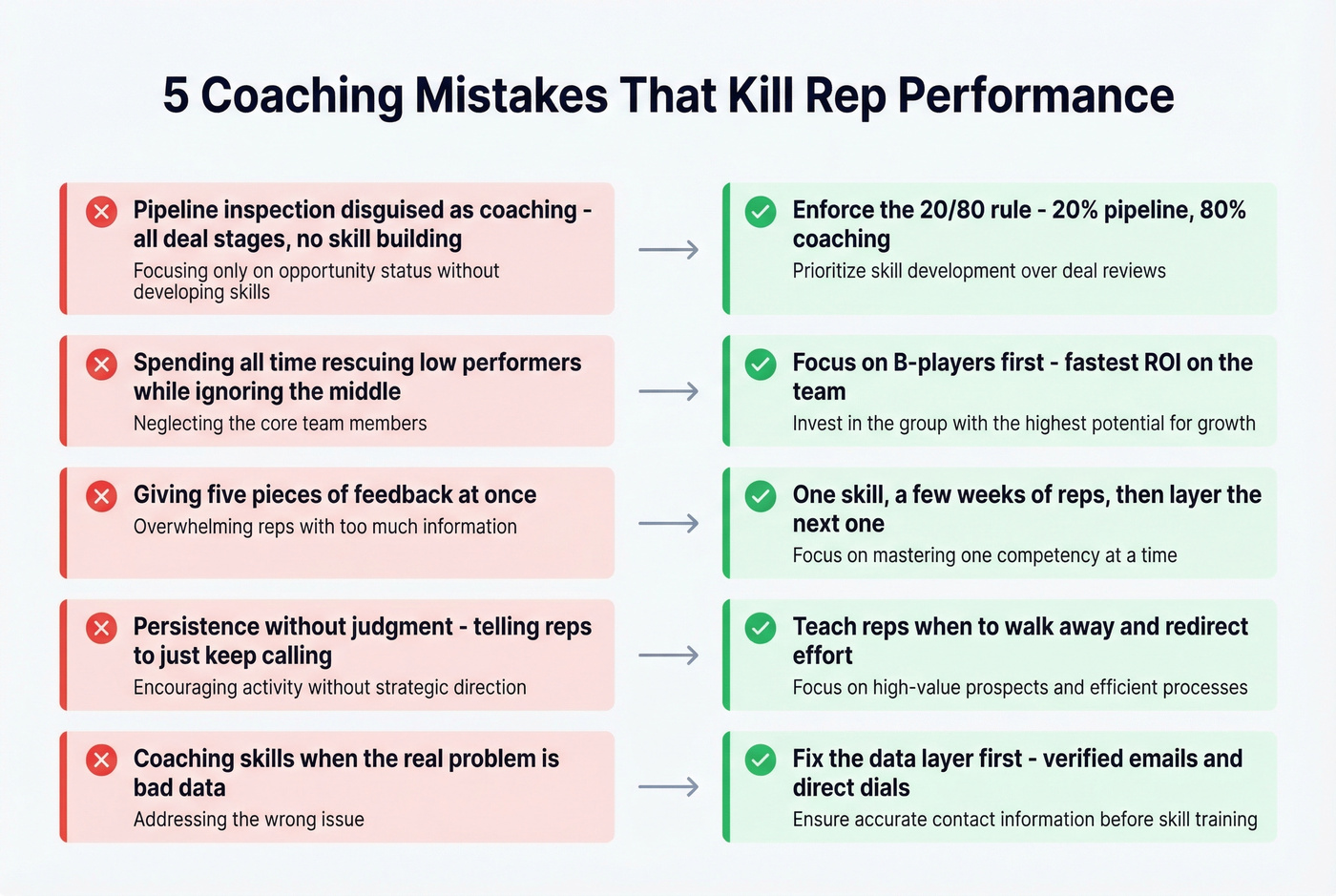
The second is spending all your time rescuing low performers while ignoring the middle of the team. The fastest ROI usually comes from moving your B-players up - not running endless rehab on reps who aren't responding. In our experience, flipping that ratio is the single fastest way to move a team's number.
Giving five pieces of feedback at once is another killer. One skill, a few weeks of repetition, then move on. Constrain the scope so the rep can actually build muscle memory before you layer on the next behavior.
A thread on r/sales describes a manager telling a rep to "keep calling" after a clear loss - the prospect said they felt "chased." Persistence without judgment isn't coaching; it's harassment. Teach reps when to walk away.
And stop coaching skills when the real problem is bad data. If your rep's connect rate is low, coaching their opener won't help if they're calling wrong numbers. Snyk had this exact problem - 35-40% bounce rates meant AEs were wasting hours on dead contacts. After switching to Prospeo's verified emails, bounces dropped under 5%, AE-sourced pipeline jumped 180%, and coaching improvements actually showed up in the numbers.
Sales Coaching Tools Worth Considering
Let's be honest: most teams don't need a $40K coaching platform. They need clean data and a manager who shows up to 1:1s prepared. But if you're scaling past 10 reps, dedicated tools earn their keep.
| Tool | What It Does | Price Range (2026) |
|---|---|---|
| Gong | Call recording + AI analysis | $120-250/user/mo + $5K-50K platform fee |
| Prospeo | Verified emails + direct dials | Free tier; paid from ~$0.01/email |
| Chorus (ZoomInfo) | Call intelligence, bundled | ~$15K-40K+/yr |
| SalesLoft | Coaching + engagement | $125-165/user/mo |
| Jiminny | Call recording + coaching | From $85/user/mo |
Skip Chorus if you don't already use ZoomInfo - the bundled pricing only makes sense if you're deep in their ecosystem. For teams under 20 reps, Gong or Jiminny paired with a solid data layer covers everything you need.
The best tool stack in the world won't help if you don't coach reps consistently. Technology amplifies a coaching habit. It doesn't replace one.
You can run perfect role plays and nail every call review - but none of it matters if your reps are calling wrong numbers and bouncing emails. Prospeo delivers 125M+ verified mobiles with a 30% pickup rate and emails at $0.01 each. That's how B-players become quota crushers.
Coach the skill gap, not the data gap. Start with 75 free emails.
FAQ
How often should you coach salespeople?
Weekly 1:1s at minimum. In Coaching Salespeople into Sales Champions, Keith Rosen recommends daily or weekly coaching - not monthly or quarterly. The 10/10/10 format takes 30 minutes. There's no excuse to skip it.
What's the difference between sales coaching and sales training?
Training introduces new skills. Coaching ensures those skills get applied on real calls with real prospects. One without the other delivers only 22% of the productivity lift you'd get from combining them. Training without coaching is expensive shelf-ware.
Can you coach salespeople if you weren't a top rep?
Yes. Michael Jordan's coaches weren't better players than him. Coaching is about making sellers better, not outperforming them. Focus on removing obstacles and asking better questions than your reps ask themselves.
What should new managers focus on first?
Start with GROW, commit to weekly 1:1s using the 10/10/10 structure, and review one call per rep per week. New managers often try to fix everything at once - pick one skill per rep and drill it until it sticks before moving on.
How does bad data undermine coaching?
Even well-coached reps underperform when 30%+ of their contacts bounce or go to voicemail. You can't coach your way out of a garbage list. Fix the data first, then coaching improvements actually show up in pipeline metrics instead of getting buried by bad contact info.