

How to Cold Call: Scripts, Framework & Tips for 2026
Your first week on the floor. A spreadsheet with 200 names, no script, and half the phone numbers ring straight to a fax machine. Your manager says "just be yourself" and walks away.
That's not onboarding. That's abandonment.
If you're learning how to cold call, here's the uncomfortable truth: 42% of salespeople say prospecting is the hardest part of their job, and most of that difficulty comes from bad process, not bad prospects. The average cold call success rate sits at 2.3%, which sounds brutal until you realize top performers convert 15% of conversations into booked meetings. And 49% of buyers actually prefer a phone call over any other first touch. The gap between 2.3% and 15% isn't talent - it's frameworks, data quality, and execution discipline.
The Whole Article in Five Bullets
Before you read another word:
- One framework, not twenty scripts. Learn the Who → Why → What structure. Everything else is a variation.
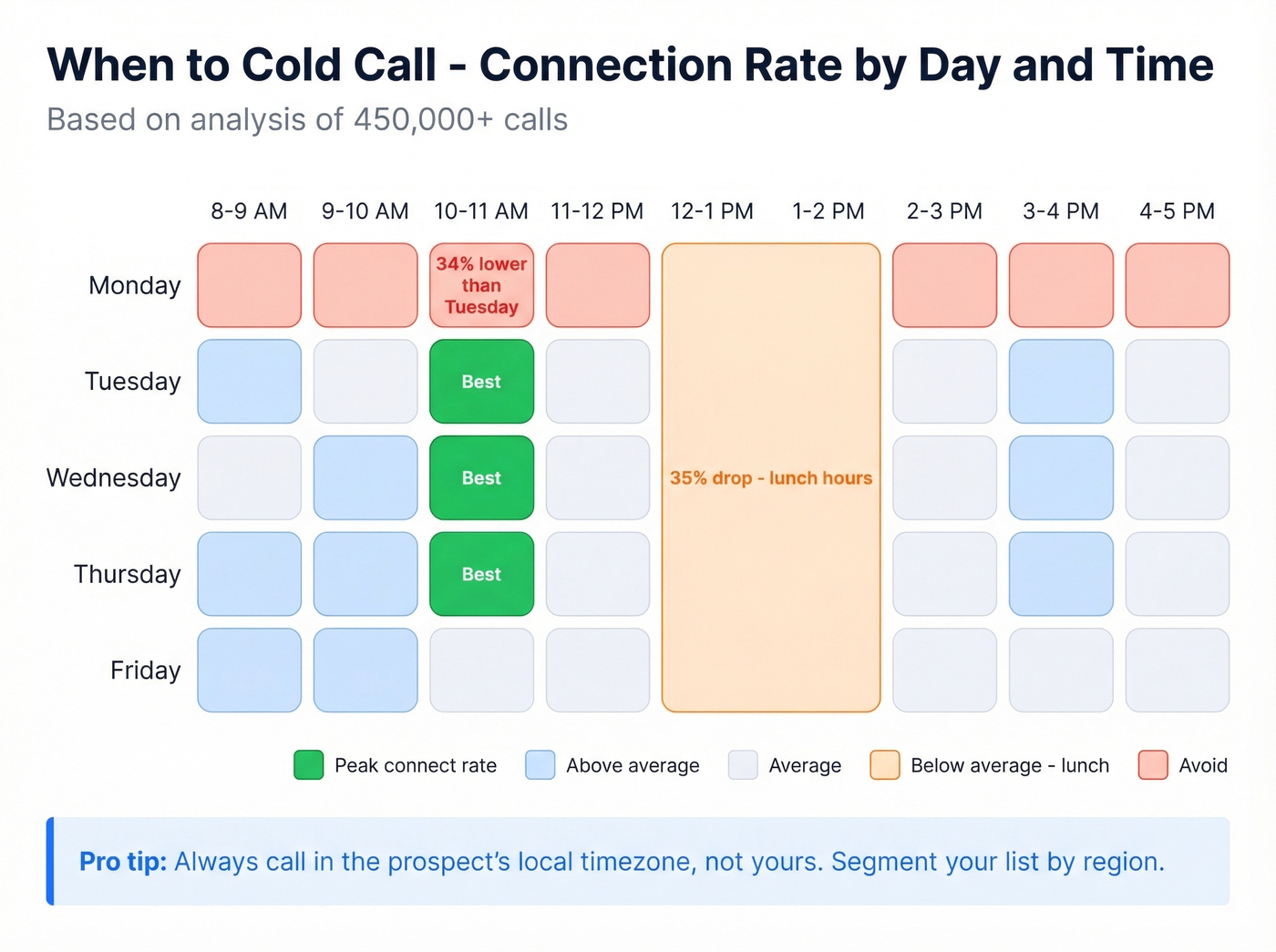
- Call Tuesday through Thursday, 10-11 AM in the prospect's local timezone. Mondays are dead.
- Verified direct dials. Stale numbers kill connect rates before you open your mouth. Use a provider with a 7-day refresh cycle - the industry average is about 6 weeks.
- A 3-step objection process. Listen, clarify, respond with value. Memorize the process, not the rebuttals.
- Log everything immediately. CRM notes within 60 seconds of hanging up. Follow-up email within the hour.
Cold Calling by the Numbers
Most SDR managers throw around stats without context. Here's the data that actually matters, organized so you can benchmark yourself honestly.
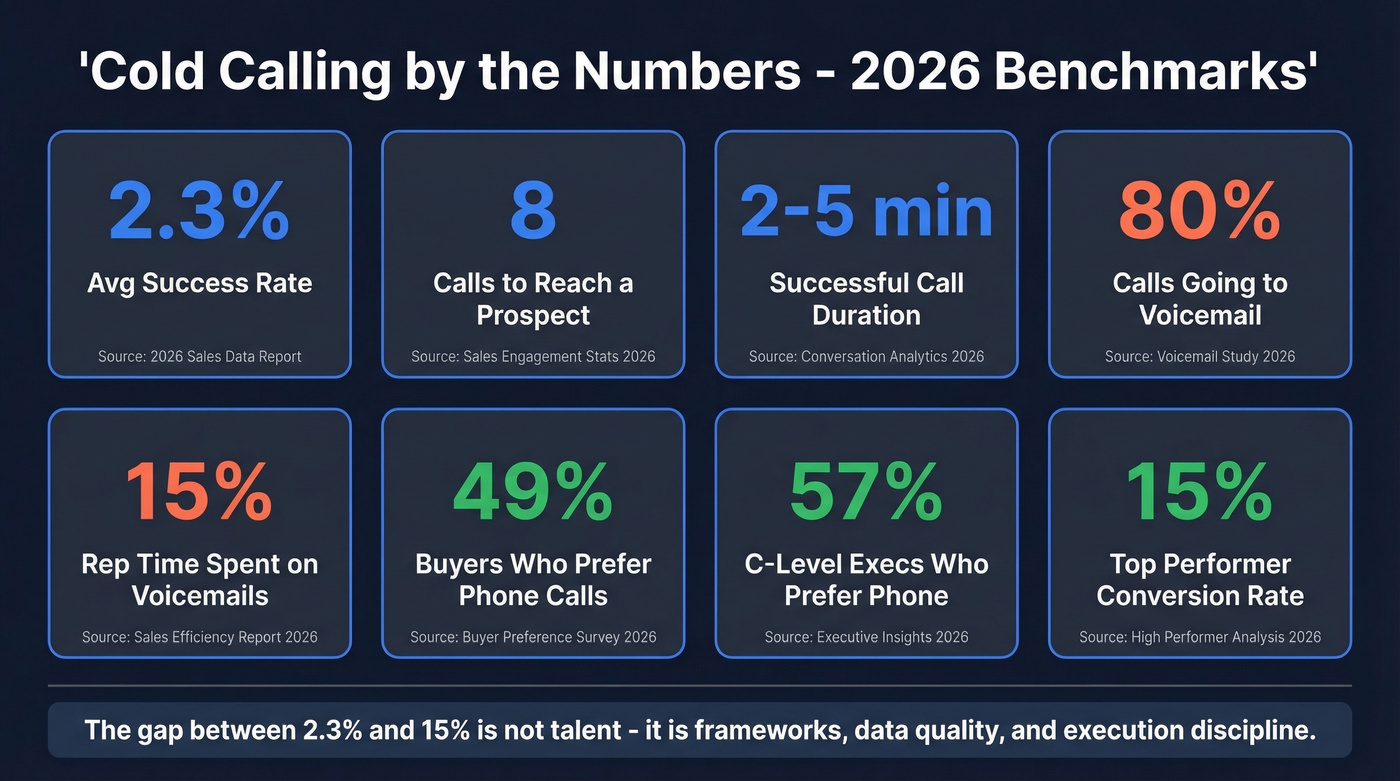
| Metric | Number | Source |
|---|---|---|
| Avg success rate | 2.3% | Cognism |
| Attempts to reach | 8 calls | Cognism |
| Call duration (successful) | 2-5 min | HubSpot via EBQ |
| Calls to voicemail | 80% | Ringlead via EBQ |
| Rep time on voicemails | 15% | Ringlead via EBQ |
| Buyers who prefer calls | 49% | Cognism |
| C-level who prefer phone | 57% | Cognism |
| Top performer conversion | 15% of conversations | Sopro |
Two numbers jump out. First, around 80% of your dials go to voicemail - so you need a voicemail script ready before you pick up the phone. Second, 57% of C-level executives prefer phone over email or social. The people you're most afraid to call are the ones most likely to pick up and engage.
Before You Dial
The difference between a 2% and a 10% connect rate usually isn't the opener. It's what happens before the call.
Research the Prospect
Spend 60-90 seconds per contact. Check their company's recent news, their role, and any trigger events - new funding, leadership changes, job postings that signal a problem you solve. You don't need a dossier. You need one sentence of relevance. 81% of decision-makers engage with cold outreach when it's tailored to their company or context, so that 60-90 seconds of research is the difference between a hang-up and a conversation.
Call at the Right Time
A HubSpot analysis of 450,000 calls found that Tuesday through Thursday, 10-11 AM yields roughly 30% higher connection rates. Mondays see 34% lower connect rates than Tuesdays. The 12-2 PM window shows a 35% drop in answer rates - people are at lunch or in their post-lunch fog. Segment your list by timezone. Calling a West Coast VP at 7 AM their time because it's 10 AM yours is a wasted dial.
Fix Your Data First
Here's the thing: if your connect rate is below 5%, the problem isn't your opener - it's your numbers. The norm for B2B cold calling is 3-8% connect rate depending on list quality and dialer setup. Stale data wastes entire call blocks. We've watched teams double their connect rate overnight just by switching to a provider with weekly data refresh instead of the typical 6-week cycle. By the time most providers update their records, a fifth of your numbers are already dead.
Build Your Call Block
Block 2-3 hours of uninterrupted dialing time. No Slack, no email, no "quick check" on anything. In a lot of SDR teams, 200+ dials per day with a parallel dialer outperforms 50 manual dials with deeper research. Volume matters - but only when the numbers are real.
The 3-Part Cold Call Framework
Stop memorizing scripts. Start memorizing this framework. Scripts are training wheels; the structure is what survives a live call.
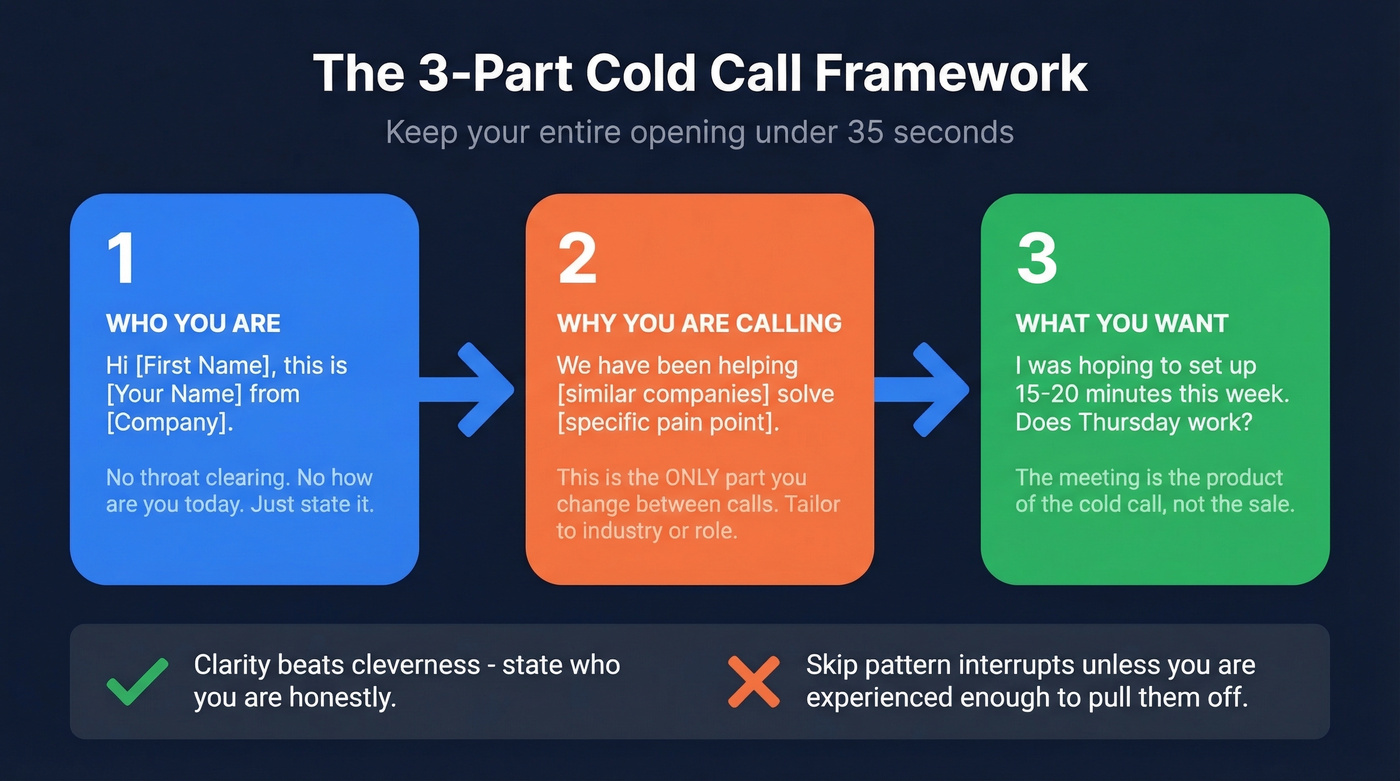
Connor Murray popularized a 3-part value statement that's become the standard for a reason - it's simple enough to internalize and flexible enough to adapt by persona.
Who you are → Why you're calling → What you want.
Keep the entire opening under 35 seconds. The only piece you change between calls is the "why" - tailor it to the prospect's industry or role. Everything else stays the same.
"Hi [First Name], this is [Your Name] from [Company]. The reason I'm calling is that we've been helping [similar companies/role] solve [specific pain point], and I wanted to see if that's something on your radar too. I was actually just hoping to set up 15 to 20 minutes this week to walk through how we're doing it. Does Thursday afternoon work?"
No throat-clearing. No "how are you today?" No asking permission to pitch. You state who you are, give them a reason to care, and ask for the meeting. The meeting is the product of the cold call - not the sale.
Pattern Interrupts vs. Clarity
Some trainers recommend dropping your company name entirely or opening with a disorienting question to break the prospect's autopilot. The theory is that a "pattern interrupt" buys you an extra few seconds of attention. In practice, the assumptive opener works better for most reps because it builds trust immediately - you're not hiding who you are or why you're calling. If you're an experienced rep who can pull off a pattern interrupt without sounding gimmicky, go for it. For everyone else, clarity beats cleverness.
Vocal Delivery Matters More Than Words
Your vocal delivery carries more persuasive weight on the phone than your actual words. Slow down - most reps talk 20-30% faster than they realize when adrenaline kicks in. Smile while you dial; it changes your vocal tone in ways the prospect can hear. Match the prospect's energy within the first few seconds: if they answer calmly, don't barrel in at full speed.
Stand up during your call blocks. It opens your diaphragm and projects confidence. A great script delivered in a monotone, rushed voice will lose to a mediocre script delivered with warmth and conviction every single time.
Copy/Paste Cold Call Scripts
The framework above is your skeleton. These scripts handle the specific situations that come up on every call block.
Opening the Call
Use an assumptive opener. "Hi Bob, this is Sarah from Acme" works better than "Is this Bob?" - the identity-confirmation question triggers defensiveness because it signals a sales call before you've said a word.
Skip "Did I catch you at a good time?" too. It gives the prospect an easy exit and signals that your call isn't important enough to warrant their time. Instead:
"Hi [Name], this is [Your Name] from [Company]. I know you're busy, so I'll be brief."
Then go straight into your value statement.
Getting Past the Gatekeeper
The direct transfer ask is the simplest approach:
"Would you mind transferring me to [Decision Maker]? Their direct number, email, or extension would also be helpful."
But the rapport-first approach works better because it treats the gatekeeper like a human, not an obstacle:
"I'd feel much better if I knew your name before I asked for a favor. [Pause.] What's the best way to get 5 minutes with [Decision Maker]?"
Voicemail Script
Around 80% of your calls land here. Have this memorized:
"Hi [Name], this is [Your Name] from [Company]. I'm calling because we've been helping [similar companies] with [specific outcome]. I'd love to chat briefly - my number is [number]. Again, that's [number]. Looking forward to connecting."
Keep it under 20 seconds. Repeat your number twice.
Handling "I Don't Have Time"
"Totally understand - I'll plan on calling back [specific day/time] unless there's a more convenient time for you?"
Or the more assertive version:
"Give me two minutes to explain what we do, and if it's not for you, I won't call again."
Handling "Send Me an Email"
This is almost always a brush-off. Don't comply - pivot:
"Happy to send something over. Quick question though - our pricing is based on the needs and size of the team, so I'd need to understand a bit more about your setup first. What does your current process for [pain point] look like?"
You've turned a dismissal into a discovery question. Now you're in a conversation.
Handling "We Already Use [Competitor]"
"That's great - most of our best customers actually switched from [competitor]. Quick question: how are you handling [specific pain point they're likely experiencing]?"
You're not attacking their choice. You're opening a conversation about gaps.

You read the stats: 80% of dials go to voicemail and stale numbers kill connect rates before you even open your mouth. Prospeo gives you 125M+ verified mobile numbers refreshed every 7 days - not the 6-week-old data most providers sell. Teams using Prospeo's direct dials see a 30% pickup rate across all regions.
Stop burning call blocks on dead numbers. Start connecting.
Objection Handling System
Scripts handle the first 30 seconds. Objection handling determines whether you get the next 3 minutes.
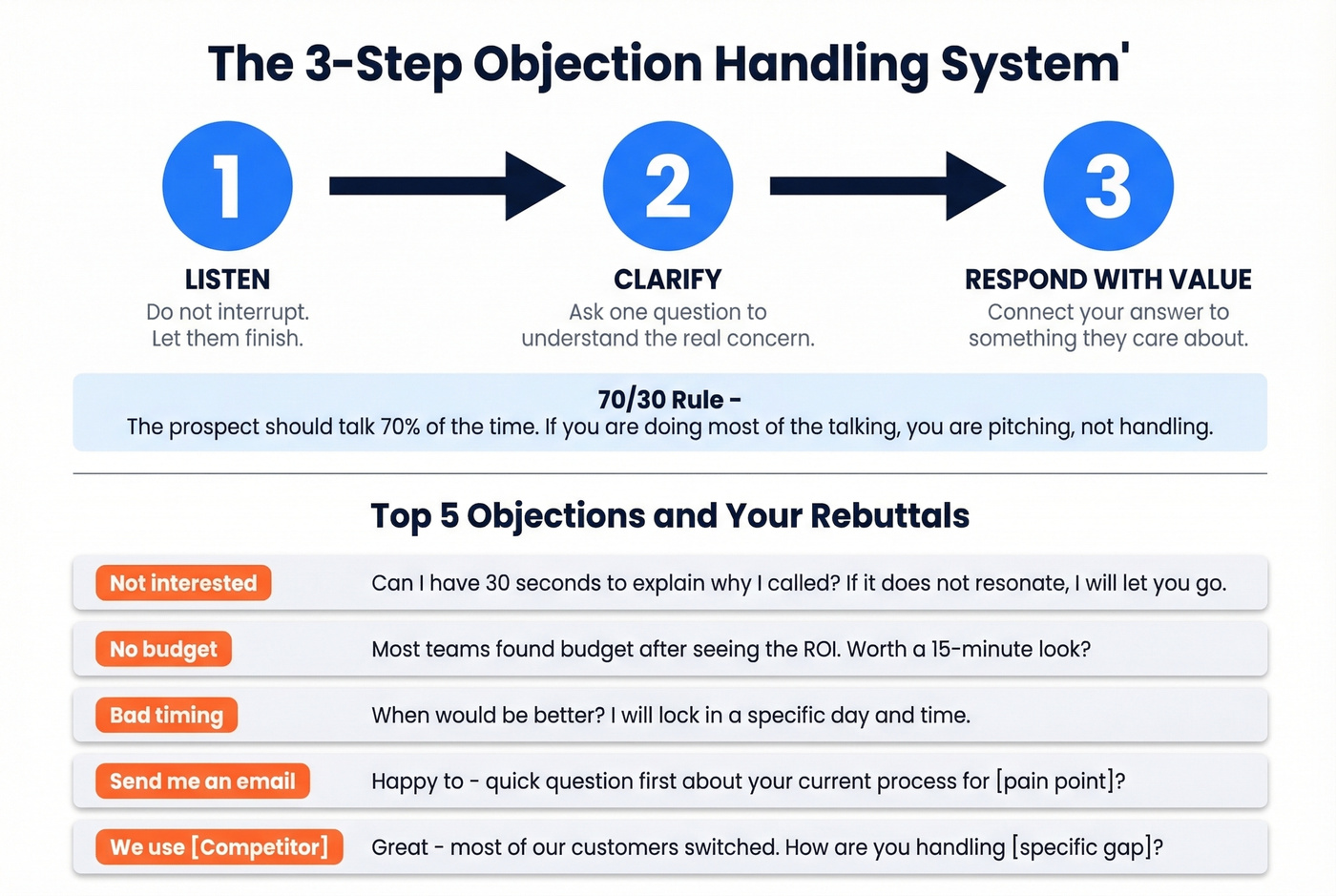
"I'm not interested" shows up as the default pushback roughly 60% of the time, so you need a system, not just clever lines. The framework is three steps: Listen → Clarify → Respond with Value. Don't interrupt. Don't argue. Let the prospect finish, ask one clarifying question, then connect your response to something they actually care about.
The 70/30 rule matters here: the prospect should be talking 70% of the time. If you're doing most of the talking during an objection, you're pitching, not handling.
Morgan J. Ingram's "30 seconds" script is the best all-purpose rebuttal we've seen in practice:
"I totally get it. Can I have just 30 seconds to explain why I called? If it doesn't resonate, I'll let you go. Does that sound fair?"
Here are word-for-word rebuttals for the five objections you'll hear most:
"Not interested." "Totally fair. Most people say that before they hear how we helped [similar company] cut [metric] by [X%]. Can I share that in 30 seconds?"
"No budget." "I hear you. Most teams we work with didn't have budget allocated either - they found it after seeing the ROI. Worth a 15-minute look?"
"Bad timing." "When would be better? I'll put time on the calendar now so it doesn't slip."
"Need to talk to my team." "Makes sense - who else would be involved? I can send a brief they can review before we all connect."
"Call me next quarter." "Happy to. Before I go - what's changing next quarter that makes it better timing? I want to make sure I come back with the right info."
Five Mistakes That Kill Your Numbers
One HubSpot practitioner logged 11,519 cold calls and booked 335 meetings - a conversion rate well above average. His biggest lesson? Every mistake below is a pattern, not a one-off.
Pitching too early. Your first call isn't a demo. Be curious, not clever. Open with relevance, ask a smart question, and let the prospect talk. The meeting is the goal - not the sale.
Talking too much. Aim for a 40/60 talk-to-listen ratio. If you're speaking more than 40% of the call, you're monologuing. Prospects buy when they feel heard, not when they feel lectured.
Calling bad numbers. Stale data wastes entire call blocks. If you're dialing 200 numbers and connecting on 3, your list is the problem. We've seen teams double their connect rate overnight just by switching to a provider with weekly data refresh.
No voicemail strategy. Reps spend 15% of their selling time leaving voicemails, and most of those voicemails are rambling, unrehearsed, and forgettable. Script it. Practice it. Keep it under 20 seconds.
No follow-up system. Log CRM notes within 60 seconds of hanging up. Send a follow-up email within the hour. If you booked a meeting, send the agenda immediately. The call is step one - not the finish line.
After the Call
The 60 seconds after you hang up matter as much as the call itself.
CRM notes immediately. Use a 1-10 self-scoring system: rate the call quality, note key objections, and tag next steps. If you wait until end of day, you'll forget half of it.
Follow-up email within 1 hour. Reference something specific from the conversation. "Great chatting about your [pain point] - here's the brief I mentioned" beats a generic template every time. If you need a starting point, keep a few follow-up email options ready.
If you booked a meeting, send a strong agenda right away. Confirm the calendar invite live on the call. Book same-week whenever possible - no-show rates climb the further out you schedule.
Remember the buying committee. Gartner puts a typical B2B buying group at around 7 stakeholders, and in many deals it can be 10+. You're not just selling to the person you called. Ask who else should be in the room.
Cold Calling Compliance in 2026
Compliance isn't optional, and the penalties are steep enough to kill a startup.
The basics:
- Federal calling hours: 8 AM-9 PM in the prospect's local timezone
- Scrub against the National DNC registry at least every 31 days
- TCPA penalties: $500 per violation, $1,500 if willful. DNC violations can hit $50,120 per call.
- PEWC (prior express written consent) is required for automated or prerecorded marketing calls to cell phones
- EBR (established business relationship) exempts live calls from DNC for 18 months after a transaction, 3 months after an inquiry - but it's not a substitute for PEWC on autodialed marketing
What changed in 2025-2026 (still in force):
- TCPA litigation surged 95% year-over-year - enforcement is accelerating, not slowing down.
- The FCC ruled that AI-generated voices count as "artificial or prerecorded" under TCPA - prior express written consent required.
- Consent revocation rules took effect in 2025: consumers can revoke consent by any reasonable method.
- State mini-TCPAs keep expanding - Texas SB 140, Virginia SB 1339, and more are now active.
Let's be blunt: assume two-party consent for call recording and always disclose. Regulation is getting stricter, not looser.
Your Cold Calling Tech Stack
You need four tools to cold call well. Don't overcomplicate this.
| Tool Type | What to Look For | Example |
|---|---|---|
| Data provider | Verified direct dials, weekly refresh | Prospeo - 98% email accuracy, 125M+ verified mobiles, 7-day refresh. Free tier available; paid is credit-based at ~$0.01/email. |
| Parallel dialer | Multi-line, CRM sync | Orum (~$150-300/user/mo) |
| CRM | Activity logging, pipeline tracking | HubSpot (free tier) or Salesforce (~$25-300/user/mo) |
| Call recording | Conversation intelligence | Gong-style (~$100-150/user/mo) |
If you're building this out from scratch, start with a simple cold calling system and add tools only when the process is stable. I'll share a hot take from our team: if your average deal size is under $10k, you don't need a $300/month conversation intelligence tool. Record calls in your dialer, review the ones that booked meetings, and invest the savings in better data. The single highest-ROI upgrade for most SDR teams isn't a fancier dialer or AI coaching - it's verified phone numbers that someone actually picks up. The consensus on r/sales backs this up: data quality threads consistently outrank tool recommendation threads in engagement.
If you're evaluating options, a broader list of SDR tools can help you compare stacks without overbuying.
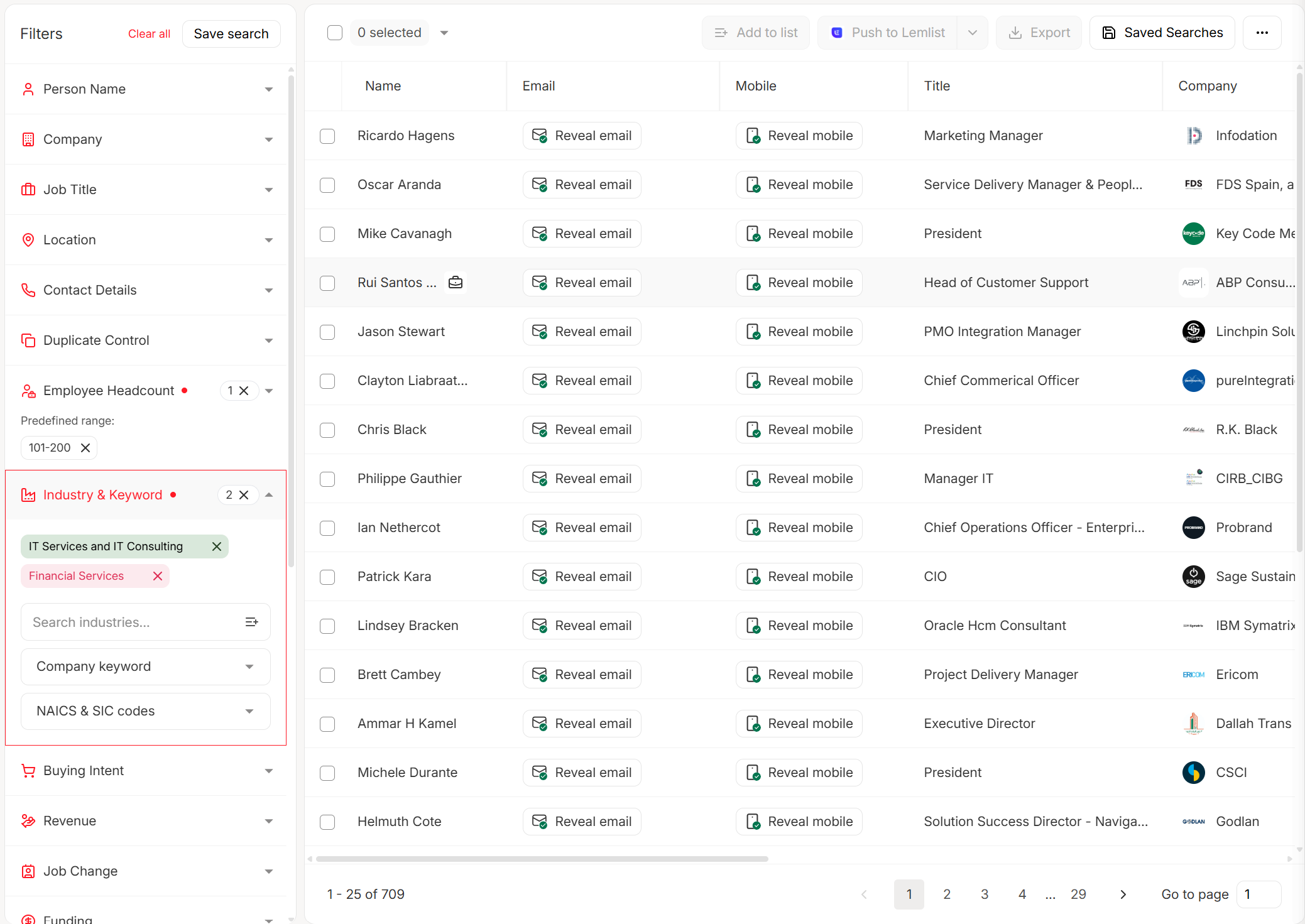
The gap between a 2% and 15% cold call conversion rate isn't your script - it's whether a real person picks up. Prospeo's B2B database lets you filter by job title, department, and company size with 30+ filters, then delivers verified direct dials at $0.01 per contact. No contracts, no sales calls, no fax machines.
Build a call list that actually connects - in under five minutes.
FAQ
What's a good cold call success rate?
The average is 2.3%; top performers hit 15% of conversations booked. If you're consistently above 5% dial-to-conversation, your data and timing are solid - shift focus to conversation-to-meeting conversion next.
How many dials should I make per day?
Most teams target 80-200 dials depending on dialer type. Don't obsess over raw volume - aim for 8-15 meaningful conversations per day. Parallel dialers push you toward the higher end; manual dialing keeps you closer to 80.
Is cold calling still effective in 2026?
Yes. 49% of buyers prefer a phone call as a first touch, and 57% of C-level executives prefer phone over any other channel. The channel isn't dead - bad execution and stale data are what kill results.
When's the best time to cold call?
Tuesday through Thursday, 10-11 AM in the prospect's local timezone. Avoid the 12-2 PM window - answer rates drop roughly 35%. Segment your list by timezone to hit every contact during their peak window.
How do I get verified phone numbers for cold calling?
Use a B2B data platform that verifies mobile numbers and refreshes data weekly. Skip providers that only update every 4-6 weeks - by then, too many numbers have gone stale to maintain a healthy connect rate.