

How to End a Cold Call Email So People Actually Reply
You spent 20 minutes researching a prospect, wrote a sharp opening line, nailed the value prop - and then closed with "Let me know if you'd like to chat." That's where you lost the reply. Cold email reply rates dropped to 5.8% in 2024, down 15% from the year before. The closing is the most undercooked part of most outbound sequences, and it's costing teams meetings every single week.
Knowing how to end a cold call email - whether it's a pure cold send or a follow-up after a dial - is the difference between a booked meeting and silence.
What the Data Says
Here's the short version across two large analyses (Gong + Boomerang):
- CTA type: Interest CTA ("Would this be worth exploring?") - not a calendar link
- Sign-off: "Thanks in advance" beats "Best" by 14.5 percentage points
- Total email length: Under 200 words, 6-8 sentences
- One ask. Never two.
Use an Interest CTA, Not a Calendar Link
Gong Labs analyzed 304,174 emails and tested three CTA types: Specific ("How's Thursday at 3?"), Open-ended ("Can we find time to connect?"), and Interest ("Would this be worth exploring?"). For cold outreach, the Interest CTA won decisively.
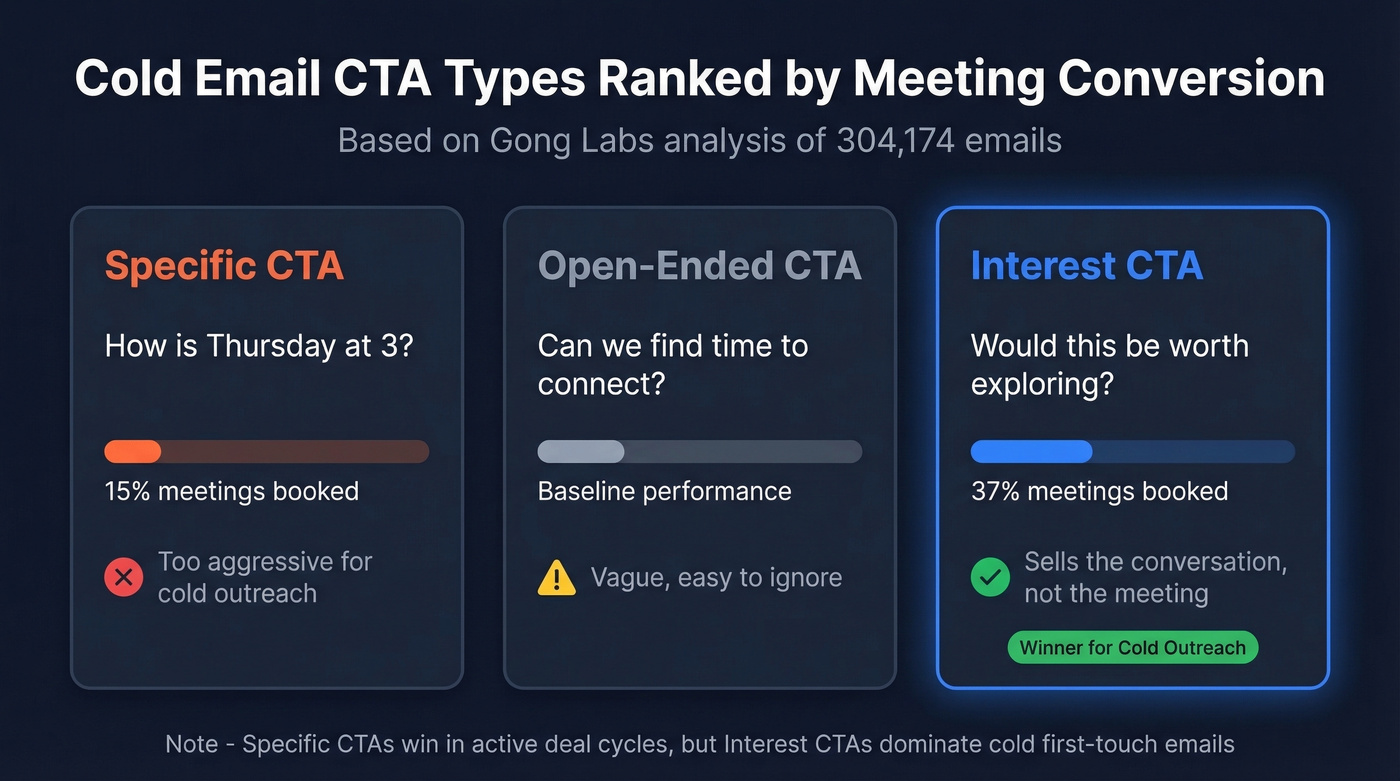
Here's the thing: in a cold email, you're selling the conversation, not the meeting. A calendar link in email one is like proposing on a first date. An Interest CTA lowers the commitment threshold - they're saying "yes, tell me more," not "yes, I'll block 30 minutes." One SDR tool on r/SaaS who booked 176 meetings in a month summarized the approach as: keep the ask light and aim to start a conversation.
The exception: once you're in an active deal cycle, switch to a Specific CTA. Gong's data shows it more than doubles meetings booked - from 15% to 37%. But that's deal stage, not cold stage. Don't confuse the two.
We've seen reps double reply rates by changing nothing but the last two sentences of their emails. Most teams overthink subject lines and under-think closings. The close carries more weight than the open.
Pick a Sign-Off That Gets Replies
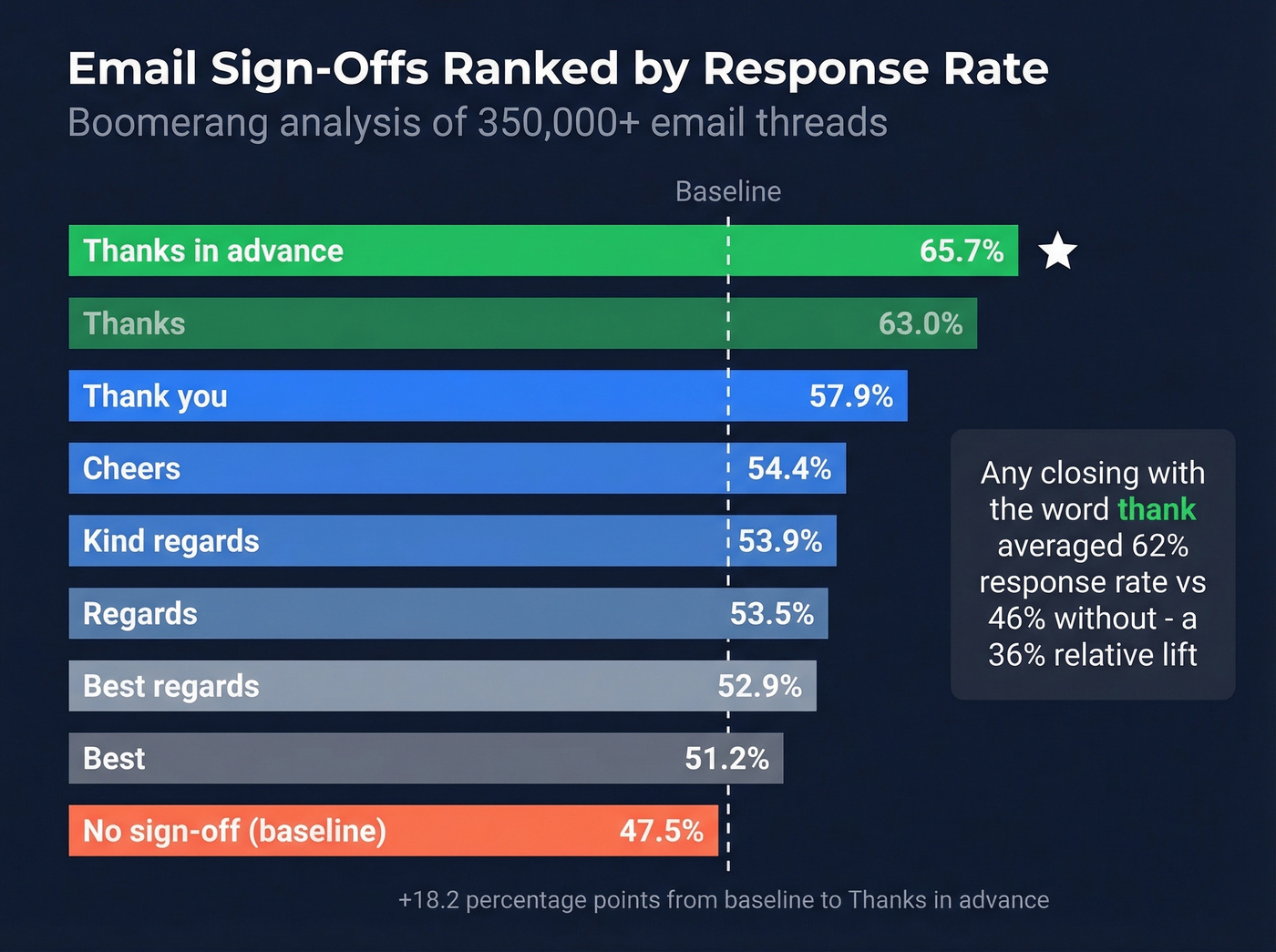
Boomerang analyzed 350,000+ email threads and ranked sign-offs by response rate. Gratitude wins, and it isn't close.
| Sign-Off | Response Rate |
|---|---|
| Thanks in advance | 65.7% |
| Thanks | 63.0% |
| Thank you | 57.9% |
| Cheers | 54.4% |
| Kind regards | 53.9% |
| Regards | 53.5% |
| Best regards | 52.9% |
| Best | 51.2% |
| No sign-off (baseline) | 47.5% |
Any closing containing "thank" averaged a 62% response rate versus 46% without - a 36% relative lift. "Thanks in advance" works because it presupposes a response. It subtly frames the reader as someone who's going to help.
"Best" is the default for a reason: it's safe. But safe doesn't get replies. Switch to "Thanks in advance" and you're outperforming baseline by 18.2 percentage points.

You just optimized your closing line. Now make sure it lands. 35% of teams lose replies to bad data, not bad copy. Prospeo's 98% email accuracy means your Interest CTAs reach real inboxes - not dead ends.
Don't let a bounced email waste your best closing line.
The Post-Cold-Call Email Ending
Your SDR just cold-called a prospect who said "send me an email." This isn't a cold email anymore - it's a warm follow-up, and the closing needs to reflect that conversation you already had. Restate value in one line and close with a single soft CTA.
As we discussed, [specific thing they mentioned] is exactly where [your product] helps teams like [their company]. I've attached the [case study / one-pager] I mentioned.
Worth a 15-minute look next week?
Thanks in advance, [Name]
Conversation reference, proof, one ask, gratitude sign-off. That's the formula for every post-call follow-up. Skip this format if you didn't actually talk to the person - referencing a call that didn't happen is a fast way to burn trust.
Closing Lines: Use This, Not That
| Don't Write This | Write This Instead | Why |
|---|---|---|
| "Let me know if you'd like to set up a 30-minute call to discuss how our platform can help you achieve your goals." | "Would it be worth exploring how [specific outcome] could work for [their company]?" | Interest CTA, specific, low commitment |
| "Are you free Tuesday at 2pm?" | "Based on what you mentioned about [pain point], open to 15 minutes next week?" | References their world, not your calendar |
| "Thoughts?" | "Your team is heading into Q3 planning - would it make sense to see this before budgets lock?" | Timeline hooks pull 10.01% reply rates versus 4.39% for problem-based hooks |
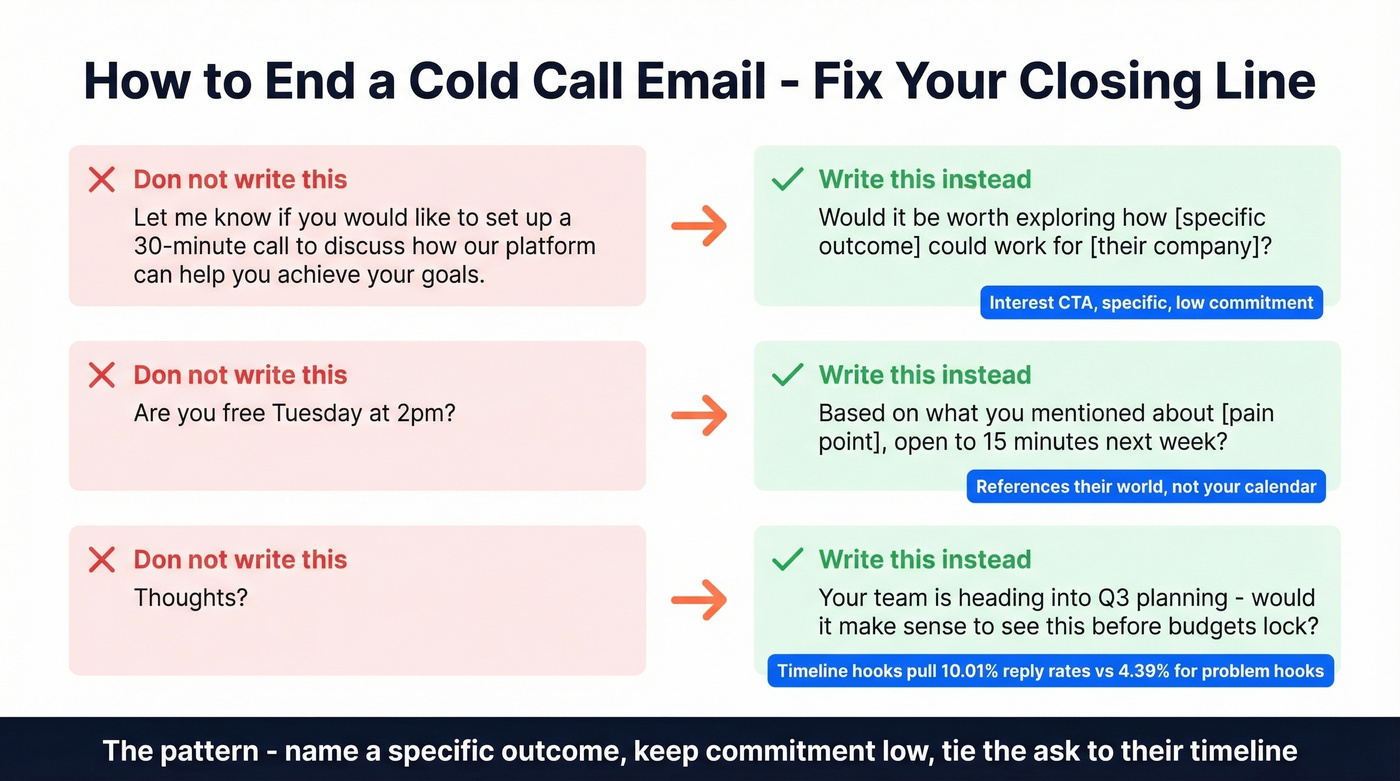
The pattern is clear: every strong closing names a specific outcome, keeps commitment low, and gives the prospect a reason tied to their timeline. That last example works because tying the ask to an approaching deadline makes inaction feel riskier than replying - and that's the psychological lever you want.
What Your Signature Must Include
Your closing line is irrelevant if the email never arrives - or lands you a fine. CAN-SPAM covers B2B email, with penalties up to $53,088 per violation.
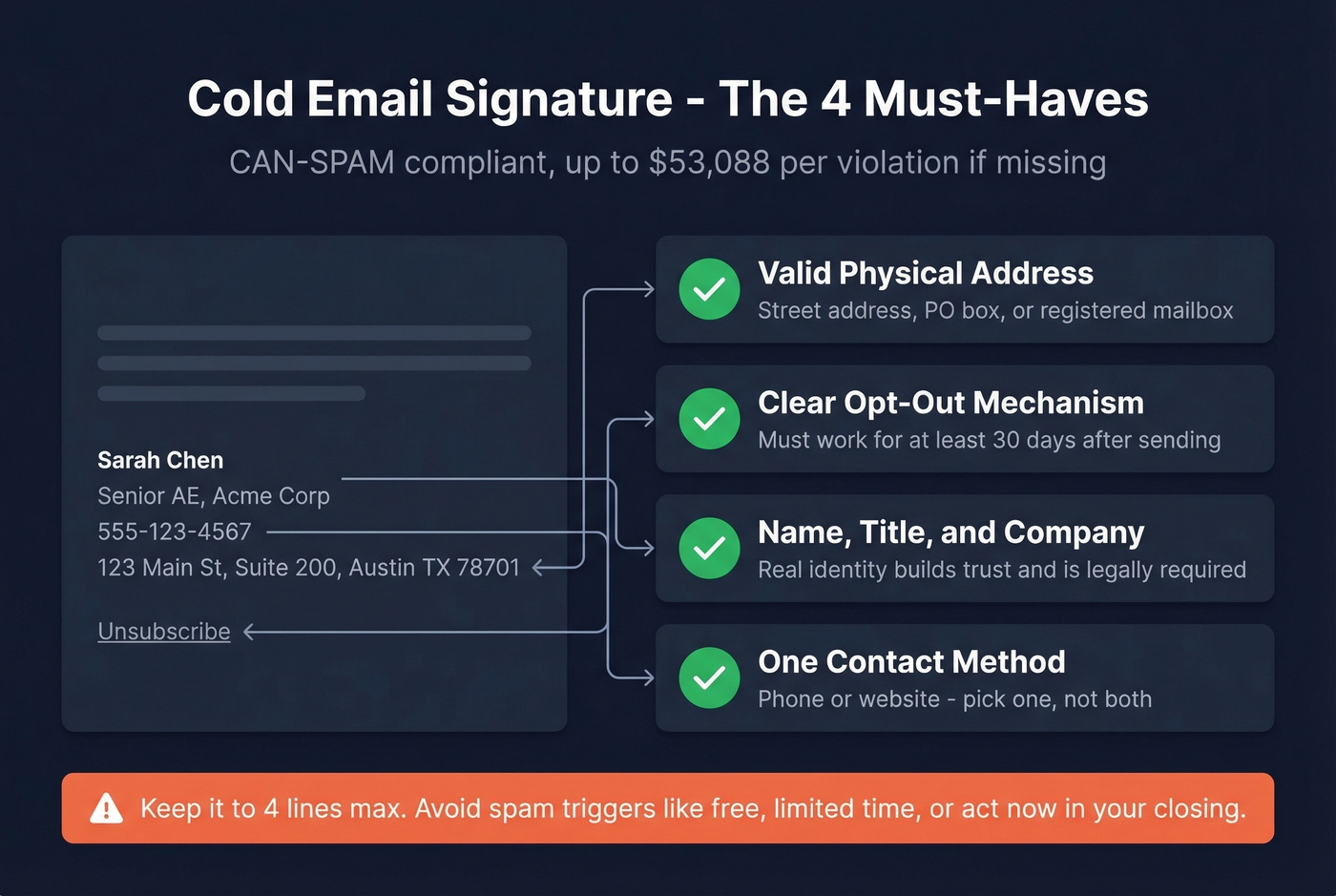
Every cold email signature needs:
- Valid physical postal address - a street address, PO box, or registered mailbox
- Clear opt-out mechanism that works for at least 30 days
- Your name, title, and company
- One contact method - phone or website, not both
Keep it to four lines. Avoid spam trigger words in your closing like "free," "limited time," or "act now" - they hurt email deliverability as much as a missing unsubscribe link. And none of it matters if the email bounces. In our experience, bounce rates above 3-5% signal a list problem, not a copy problem. Prospeo verifies emails with 98% accuracy before you send, so your carefully crafted closing actually reaches a real inbox.
Your post-call follow-up deserves better than a 35% bounce rate. Prospeo verifies every email through a 5-step process - catch-all handling, spam-trap removal, honeypot filtering - so your carefully crafted sign-off actually reaches the prospect who said "send me an email." At ~$0.01/email, bad data is no longer an excuse.
Verify your list before you hit send. 75 free emails, no card required.
FAQ
How long should a cold email be?
A 16.5M-email study found 6-8 sentences under 200 words hit a 6.9% reply rate. Your closing takes 1-2 of those sentences, so keep the body tight and give the CTA room to breathe.
Should I include a P.S. line?
A P.S. works as a secondary hook - a relevant stat or mutual connection. But it should never contain a second CTA. One ask per email, always. Multiple asks split attention and tank reply rates.
What's the best CTA for a follow-up after a cold call?
Reference the conversation, restate one specific value point, and close with a soft Interest CTA like "Worth a 15-minute look next week?" Gong's 304K-email study shows Interest CTAs outperform calendar-link CTAs in early-stage outreach by a wide margin. Let's be honest - if someone told you to "send me an email," they're giving you a shot, not committing to a demo. Match that energy.
How do I make sure my cold emails reach inboxes?
Track your bounce rate. Anything above 3-5% means your list needs cleaning, not your copy. Verify emails before you send, keep bounce rates under 4%, and your closing lines will actually get read.