

How to Generate Consistent Pipeline in 2026: The Math, Cadence, and System Nobody Shows You
It's Monday morning. You open your CRM, check weighted pipeline against this quarter's number, and the ratio stares back at you: 0.76x. Not 4x. Not even 2x. You don't have a pipeline - you have a prayer.
Here's the thing: if you're trying to figure out how to generate consistent pipeline, the answer isn't more effort. The average B2B deal now involves 13 decision-makers, 80% of buyer interactions happen digitally, and the median conversion rate across B2B sits at a brutal 2.9%. You need a system that produces predictable pipeline regardless of whether you had a good week or a bad one.
The Three Things You Actually Need
Pipeline consistency is a math and systems problem. Three things make it work:
Pipeline math you calculate weekly. Coverage ratio, velocity, stage conversion - every week, not once a quarter. Teams that track pipeline velocity weekly see 34% revenue growth. Teams that track it ad-hoc see 11%.
A repeatable operating cadence. Same meetings, same dashboards, same hygiene rituals. The boring stuff that compounds into a sustainable sales pipeline.
Clean data feeding your outbound channel. Every bounced email, every wrong number, every stale contact is a leak in your system. Below: the formulas, the benchmarks, and a 30-day implementation plan. No platitudes about "building relationships." Just the operating system.
Why Your Pipeline Keeps Breaking
Most pipeline problems aren't about effort. They're structural. Here are the failure modes we see over and over - and the warning signals that tell you which one is killing your number.
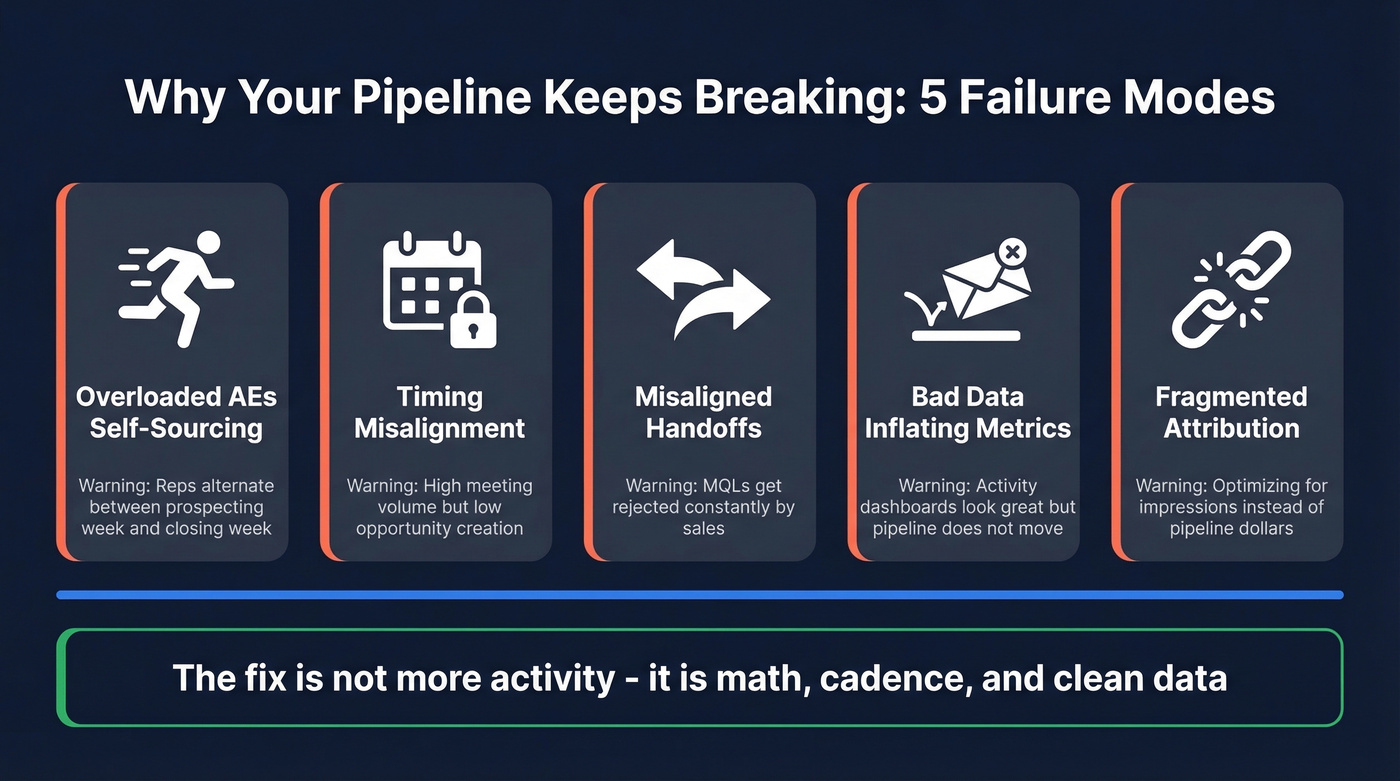
Overloaded AEs self-sourcing with no support. An enterprise AE with one shared BDR across three reps, zero inbound leads, and a book of existing accounts to manage isn't going to build predictable pipeline. They'll lurch between prospecting sprints and deal management, doing neither well. It feels like running twice as fast to stay in the same place. If your reps alternate between "pipeline week" and "closing week" instead of running both in parallel, this is you.
Timing misalignment in enterprise. When your target accounts are locked into multi-year vendor contracts, activity volume doesn't matter. You can book 20 meetings a month and generate zero real pipeline because nobody's in-cycle. The giveaway? High meeting volume with low opportunity creation.
Misaligned handoffs between marketing and sales. No shared definition of "qualified." No SLA on follow-up speed. Marketing celebrates MQL volume while sales rejects a big chunk of what comes over. When MQLs get rejected constantly, the problem isn't lead quality - it's that nobody agreed on what "qualified" means before the handoff. Slow lead routing compounds the damage: a lead fills out a demo request at 10 a.m. and doesn't hear from a rep until the next day. By then they've booked a call with your competitor.
Bad data inflating activity metrics. Your SDR sent 150 emails yesterday. Thirty-one bounced. By Thursday, your domain reputation degrades and inbox placement drops. The activity dashboard looks great. The pipeline doesn't move.
Fragmented attribution hiding what works. Marketing can't tell which campaigns drive revenue because data lives in five disconnected tools, so they optimize for impressions and MQL volume - vanity metrics - instead of sales-accepted opportunities and pipeline dollars. Stop measuring impressions. The metrics that predict revenue are pipeline velocity, weighted coverage, and stage conversion rates.
If you're nodding at more than one of these, the fix isn't "more activity." It's the math and cadence system below.
Pipeline Math That Predicts Revenue
Coverage Ratio: Weighted vs. Unweighted
Total pipeline is a vanity metric. A $2M pipeline with 80% of deals stuck in discovery is worth roughly $200-300K in reality. You need weighted coverage.
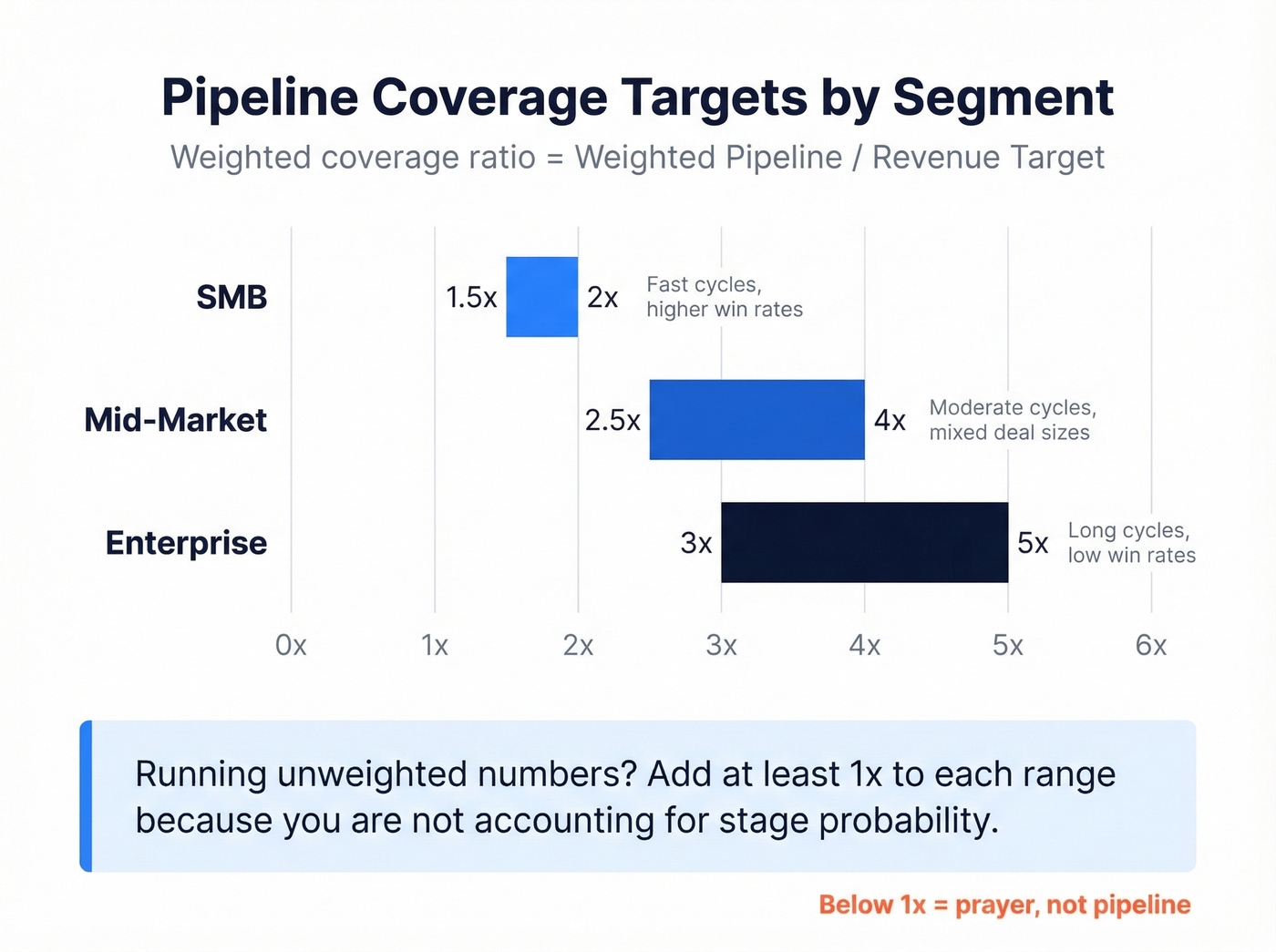
To calculate it, divide your weighted pipeline by your revenue target. Assign probabilities based on your historical conversion at each stage. If you don't have your own data yet, start here:
- Discovery: 10-15%
- Demo completed: ~30%
- Proposal sent: ~50%
- Negotiation: up to 80%
- Verbal commit: 90-95%
Unweighted coverage is simpler - total pipeline divided by sales target - but requires higher multiples to be meaningful. If your win rate is 25% and your quarterly target is $400K, you need $1.6M in pipeline. That's 4x coverage.
What "good" looks like varies by segment. SMB teams with fast cycles can operate at 1.5-2x weighted coverage. Mid-market needs 2.5-4x. Enterprise, with long cycles and low win rates, often needs 3-5x. Running unweighted numbers? Add at least 1x to each range because you're not accounting for stage probability.
Pipeline Velocity Formula
Velocity tells you how fast pipeline converts to revenue:
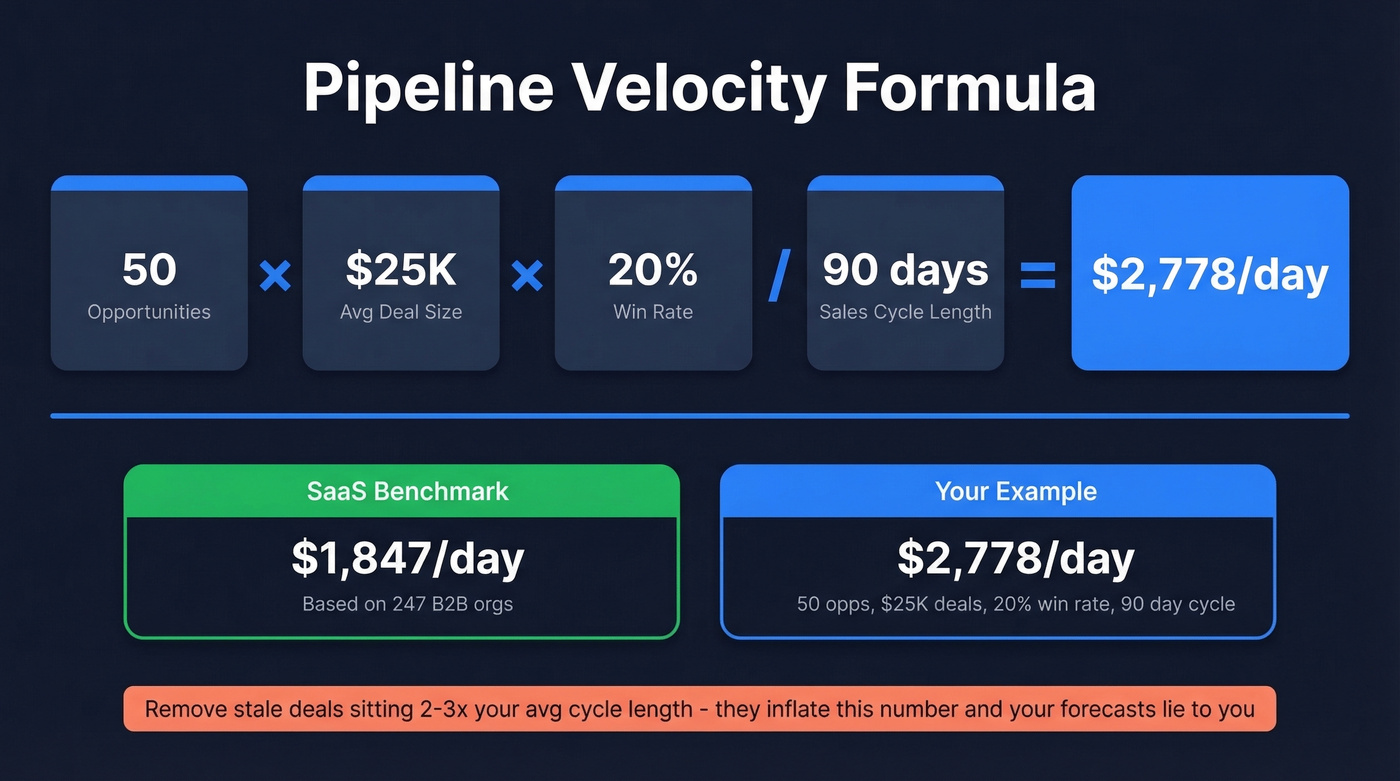
(Number of Opportunities x Average Deal Size x Win Rate) / Sales Cycle Length
Worked example: 50 opportunities x $25K average deal x 20% win rate / 90-day cycle = $2,778 per day.
Here's a benchmark from a FirstPageSage study of 247 B2B organizations - SaaS & Tech is the most commonly benchmarked segment:
| Metric | SaaS & Tech Benchmark |
|---|---|
| Velocity | $1,847/day |
| Median Deal | $12,400 |
| Win Rate | 22% |
| Sales Cycle | 67 days |
One hygiene rule that matters more than any formula: remove stale opportunities that haven't progressed in 2-3x your average sales cycle. A deal sitting untouched for 200 days in a 90-day cycle isn't pipeline. It's fiction. And it's inflating your velocity calculation, which means your forecasts are lying to you.
Stage-by-Stage Conversion Benchmarks
Two credible sources, wildly different numbers. That's the point - your numbers will land somewhere in between depending on how you define each stage.
| Stage | FirstPageSage (B2B SaaS) | MarketJoy (B2B Avg) |
|---|---|---|
| Lead to MQL | 39% | 22% |
| MQL to SQL | 38% | 15% |
| SQL to Opportunity | 42% | 11% |
| SQL to Closed Won | 37% | 7%* |
MarketJoy measures Opportunity to Closed Won (7%), while FirstPageSage measures SQL to Closed Won (37%). The stage definitions differ.
Both sources agree on the biggest drop-off: MQL to SQL. That's where marketing passes leads that sales doesn't consider ready. If you fix one conversion point, fix that one.
Weekly Operating System for Predictable Pipeline
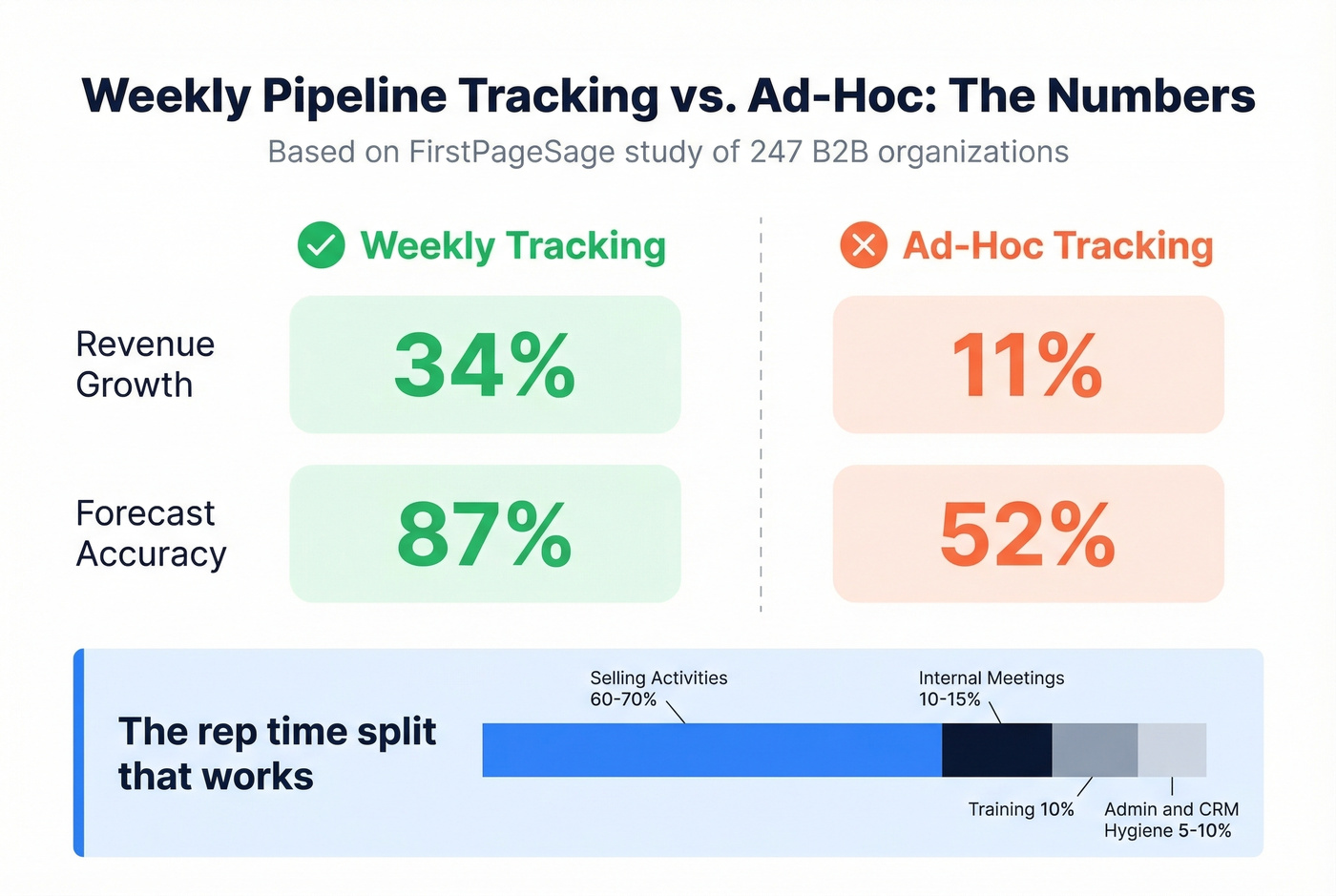
The same FirstPageSage study found that teams tracking pipeline velocity weekly saw 34% revenue growth and 87% forecast accuracy. Teams doing it ad-hoc? 11% growth and 52% accuracy. Weekly cadence isn't optional.
Let's be honest: most teams already know this. They just don't do it because the weekly review feels like overhead when deals are on fire. It's not overhead. It's the reason some teams always seem to have pipeline while yours lurches from drought to flood.
Based on Demandbase's operational cadence framework, reps should spend 60-70% of their week on selling activities - calls, emails, demos, proposals. If your reps are spending less than half their week selling, you have a process problem, not a pipeline problem. Internal meetings (weekly pipeline review, forecast call, deal strategy) should take 10-15% and run tight. Training and enablement get roughly 10%, and admin plus CRM hygiene fills the remaining 5-10%.
The weekly pipeline review is the heartbeat. Every rep walks through their top 10 deals: what moved, what's stuck, what needs to be killed. The forecast call rolls those up into a number the leadership team can trust. In our experience, the teams that hit 87% forecast accuracy aren't doing anything fancy - they just never skip the weekly review.
One caveat: cadence has to match your motion. An SMB team closing deals in 14 days needs daily pipeline check-ins, not weekly. An enterprise team with 9-month cycles might do biweekly deep dives with weekly lightweight updates. Build a cadence that matches your sales cycle, not someone else's.

You just read that 31 bounced emails out of 150 kills your domain reputation and stalls pipeline. Prospeo's 5-step verification delivers 98% email accuracy with a 7-day refresh cycle - so the contacts feeding your weekly cadence are never stale. At $0.01 per email, cleaning up your data costs less than one lost deal.
Stop leaking pipeline through bad data. Start with 75 free verified emails.
Generating Pipeline Across Channels
Outbound: The New Rules
The outbound playbook from 2022 is dead. Google and Microsoft's authentication requirements (SPF, DKIM, DMARC) mean unauthenticated senders get filtered before the inbox. Multi-domain rotation is table stakes. Sending limits have dropped to 25-40 emails per mailbox per day. If you're blasting 100+ from a single domain, you're already in spam.
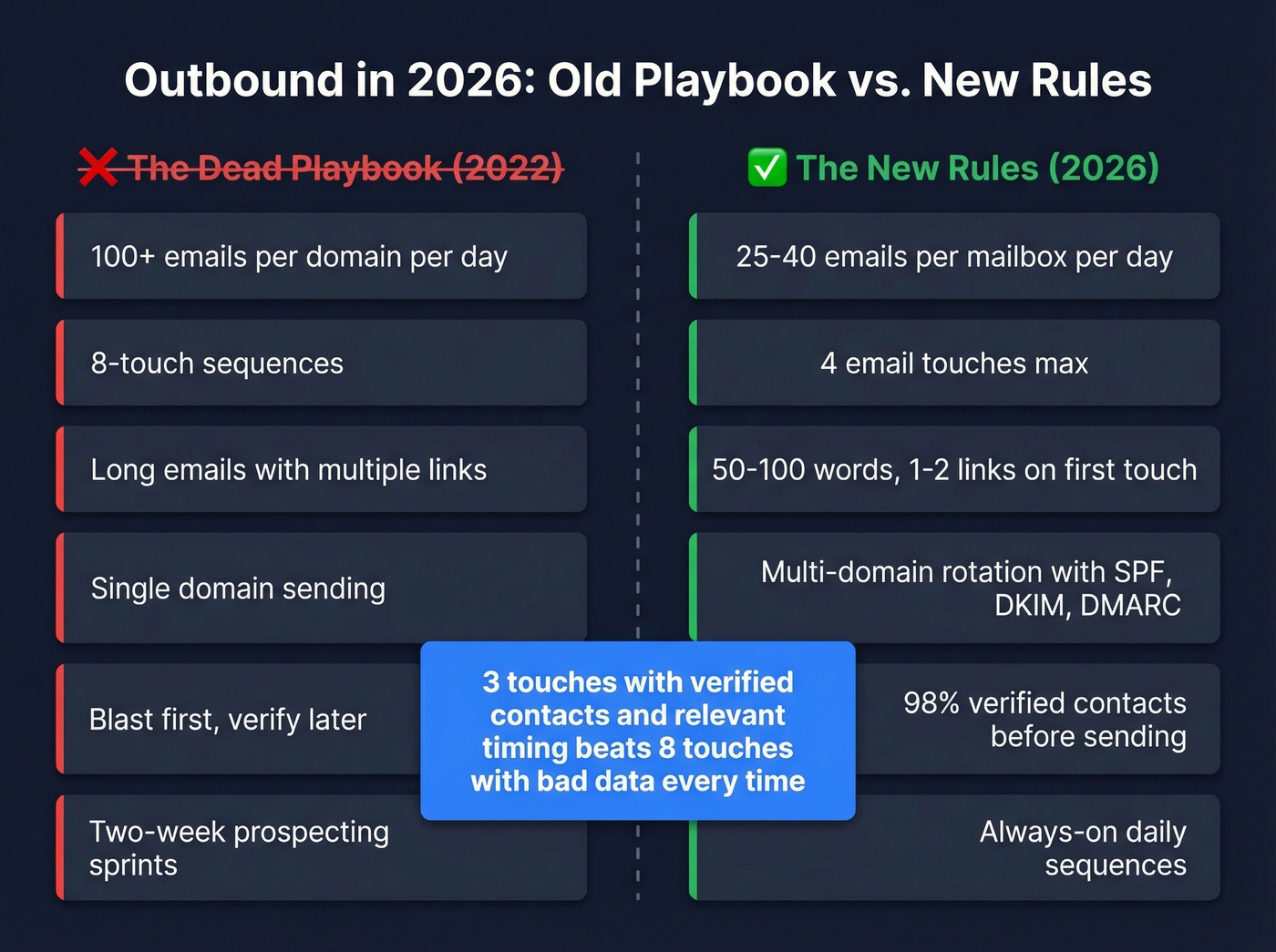
The tactical shift: shorter sequences, tighter targeting, multiple channels. Keep sequences to 4 email touches max. Keep emails to 50-100 words. Limit links to 1-2 on first touch.
The old "8 touches to get a reply" stat is misleading. Three touches with verified contacts and relevant timing beats eight touches with bad data every time. The goal is always-on pipeline generation - a system that produces opportunities every week, not a burst of activity followed by silence.
Channel conversion rates reinforce why multi-channel matters: referral traffic converts at 2.9%, organic at 2.6%, and email at 2.4%. No single channel is dominant. Consistency comes from running multiple channels in parallel.
When you're limited to 30 emails per mailbox per day, every send needs to reach a real inbox. Prospeo's Email Finder returns 98% accurate addresses - you only pay for valid ones. That math matters when your daily send capacity is capped.
Inbound: Real but Slow
One agency owner who shared their playbook on r/Entrepreneur put it bluntly: their inbound system took roughly three years to bear fruit at a level they could rely on. That's not unusual. Content compounds, but it compounds slowly - blog minimum once a week, SEO-optimized, consistently for 12-36 months before it becomes a reliable pipeline source.
If you need pipeline this quarter, you need outbound. If you need pipeline next year, start publishing now. Both channels should run in parallel - the mistake is treating them as either/or. For service businesses, don't sleep on directories. That same operator reports Clutch generating 5-10 leads per month. Not glamorous, but consistent and nearly free once your profile is optimized.
Building an Always-On Pipeline Engine
The biggest mistake teams make is treating pipeline generation as a project with a start and end date.
An always-on system runs continuously - outbound sequences, content publishing, paid retargeting, and event follow-ups all operating on overlapping schedules so there's never a gap in top-of-funnel activity. Your SDRs run sequences every day, not in two-week sprints. Your content team publishes on a fixed calendar. Your paid campaigns retarget website visitors and engaged prospects without pausing between quarters. When one channel dips, the others compensate. That's how you build the kind of predictable pipeline B2B teams actually trust for forecasting.
Skip this approach if you're a founder-led team with one rep and no marketing support - you'll spread yourself too thin. Pick outbound as your primary channel, get it working, then layer in a second channel once pipeline from the first is stable.
Data Quality: The Chain Reaction That Kills Outbound
Bad data leads to high bounce rates, which degrade your domain reputation, which sends your emails to spam, which kills outbound, which collapses pipeline. It happens faster than you'd think. We've seen this pattern dozens of times: an SDR's activity metrics look fine while their pipeline chart tells a completely different story.
Buyers are 70% through their purchasing process before they engage a seller. The window where your outbound actually reaches someone in-market is narrow. You can't afford to waste it on bounced emails and wrong numbers.
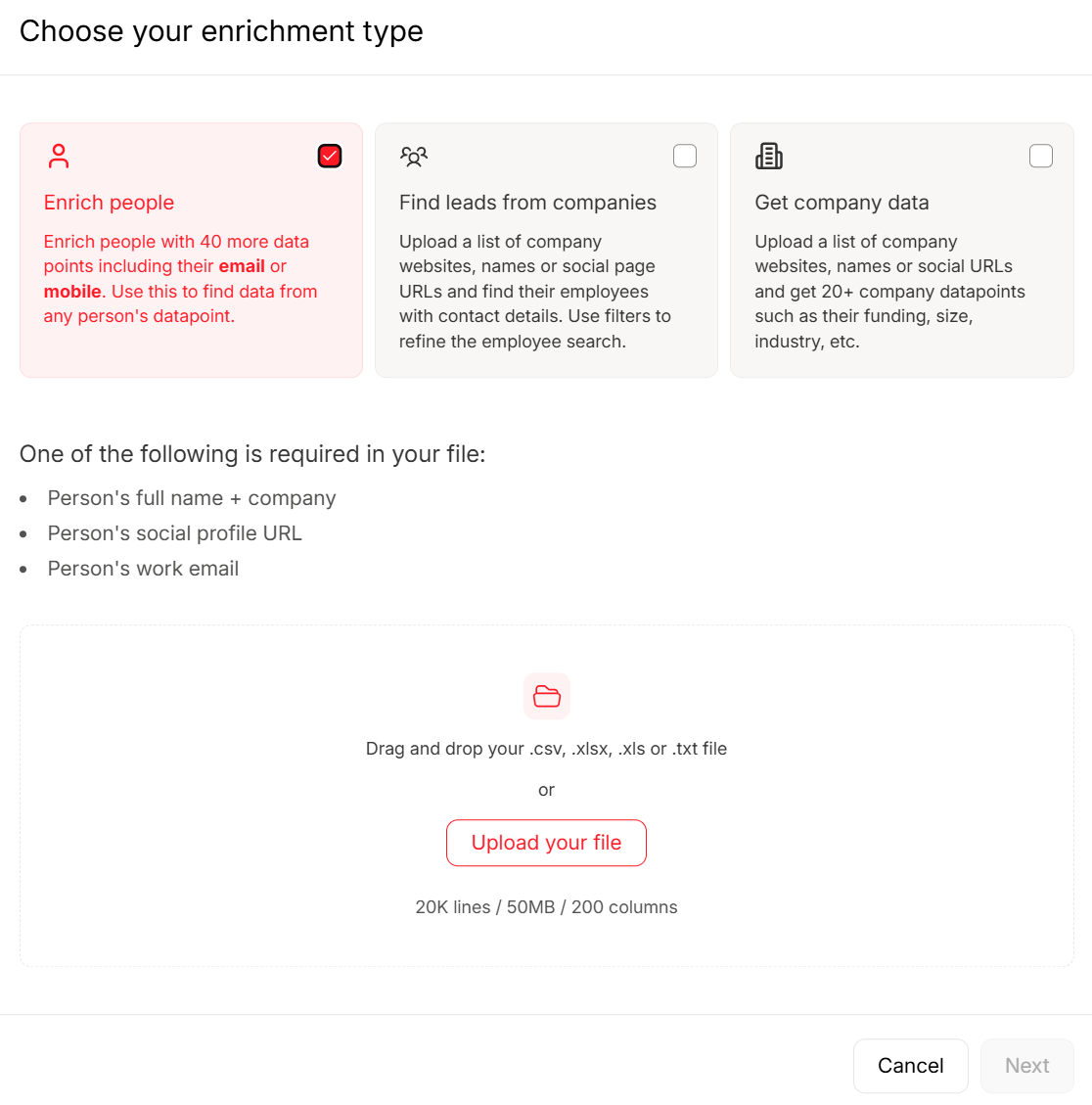
Prospeo solves this at the source. Its 5-step verification process - including catch-all handling, spam-trap removal, and honeypot filtering - delivers 98% email accuracy across 300M+ professional profiles refreshed every 7 days. The industry average refresh cycle is 6 weeks, which means most databases are serving you contacts who changed jobs a month ago. One customer, Meritt, went from a 35% bounce rate to under 4% after switching, and their pipeline tripled from $100K to $300K per week. That's not a marginal improvement - that's the difference between a broken outbound engine and a working one.
Consistent pipeline requires reaching real decision-makers, not bouncing off outdated contacts. Prospeo gives you 300M+ profiles with 30+ filters - buyer intent, job changes, headcount growth, technographics - so your coverage ratio reflects actual opportunities, not fiction sitting in your CRM.
Build the 4x weighted coverage your quota demands with data that connects.
Your First 30 Days
Week 1: Diagnose. Calculate your current weighted coverage ratio and pipeline velocity using the formulas above. Run a bounce rate check on your last 1,000 outbound emails. If it's above 5%, your data is the problem.
Week 2: Build the cadence. Set up a weekly pipeline review - 30 minutes, every rep, top 10 deals. Kill stale opportunities that haven't progressed in 2-3x your average cycle. You'll lose pipeline on paper. You'll gain forecast accuracy in reality.
Week 3: Fix outbound. Verify your contact list before loading it into your sequencer. Set up proper authentication (SPF, DKIM, DMARC). Cap sends at 30 per mailbox per day. Write shorter emails. Cut your sequence to 4 touches. Add at least one non-email channel to every sequence.
Week 4: Measure and adjust. Compare your stage conversion rates against the benchmarks in this article. Find your biggest drop-off point. That's where you focus next month. If MQL to SQL is your weakest link, the problem is qualification criteria, not lead volume. By the end of this 30-day sprint, you'll have the foundation for always-on pipeline generation that compounds quarter over quarter.
The teams that generate consistent pipeline aren't doing anything exotic. They calculate coverage every Monday, kill stale deals every Friday, and never send an email to an unverified address. That's the system. Now go build it.
FAQ
What's a good pipeline coverage ratio?
SMB teams should target 1.5-2x weighted coverage; mid-market needs 2.5-4x; enterprise typically requires 3-5x. If you're using unweighted pipeline, add at least 1x to each range because you're not accounting for stage probability.
How often should I review pipeline?
Weekly, without exception. Teams tracking pipeline velocity weekly see 34% revenue growth and 87% forecast accuracy, compared to 11% growth and 52% accuracy for ad-hoc trackers. A standing 30-minute meeting beats a quarterly deep dive every time.
Why isn't my outbound generating pipeline?
Most likely a data quality or deliverability issue. If your bounce rate exceeds 5%, your domain reputation degrades with every send. Verify contacts before sequencing them - 98% accuracy with a 7-day refresh cycle means you're reaching people at their current company, not their last one.
How long does inbound take to produce reliable pipeline?
Expect 12-36 months of consistent weekly publishing before inbound becomes a dependable source. It compounds over time, but it's not a quick fix. Run outbound in parallel to cover near-term revenue needs while content matures.
What's the difference between pipeline generation and lead generation?
Lead generation fills the top of the funnel with names; pipeline generation moves qualified opportunities through stages toward revenue. You can generate thousands of leads and still have zero pipeline if qualification criteria, handoff processes, and nurture sequences are broken.