

How to Market SaaS: The 2026 Playbook With Real Numbers
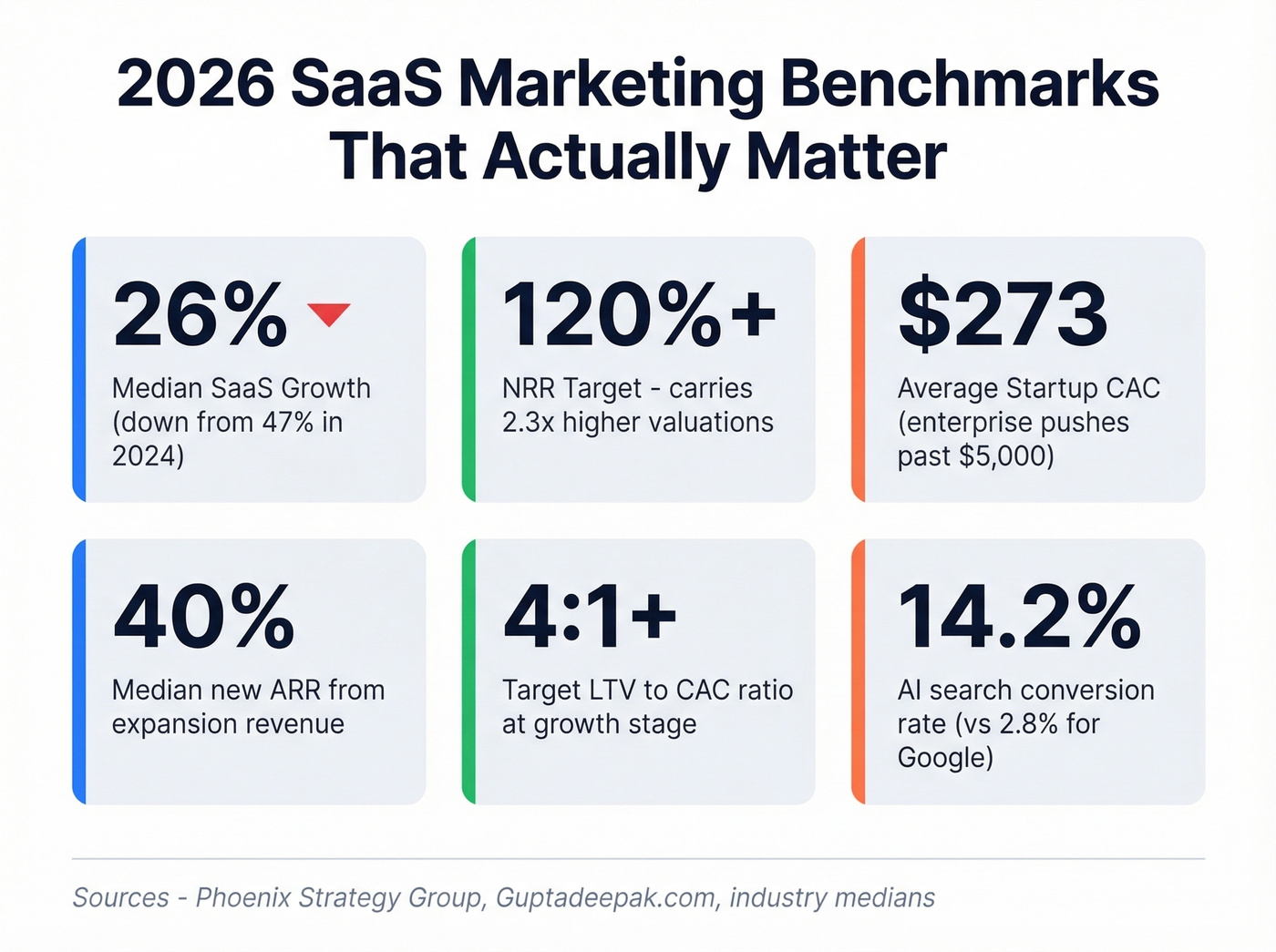
Your CEO said "figure out marketing," handed you a budget that's either too small or undefined, and now you're reading your fifteenth guide that says "do content marketing and SEO." None of them tell you how much to spend, what good looks like at your stage, or which channels to skip entirely. Median SaaS growth has dropped to 26% in 2026, down from 47% in 2024. The playbook that worked two years ago doesn't work now.
Let's build one that does - with real numbers attached.
Quick Version by Stage
Pre-PMF / under $1M ARR: Content + SEO, community (Reddit), free trial. That's it. Don't spread thin.
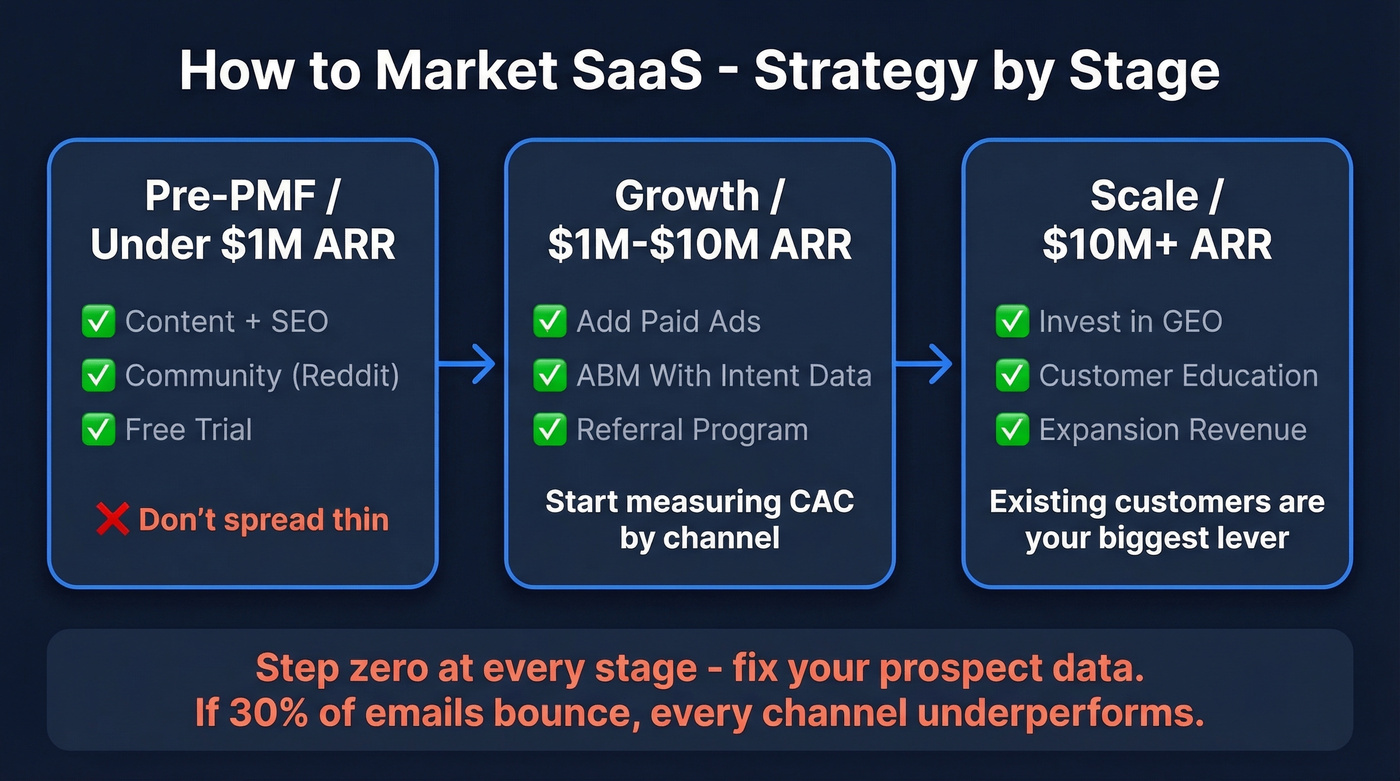
Growth / $1M-$10M ARR: Add paid ads, ABM with intent data, a referral program. Start measuring CAC by channel.
Scale / $10M+ ARR: Invest in GEO, customer education, expansion revenue. Your existing customers are your biggest growth lever.
One contrarian note before we go deeper: fix your data before you market. If 30% of your prospect emails bounce, every channel underperforms - paid, outbound, ABM, all of it.
Why SaaS Marketing Is Different
SaaS isn't like selling a physical product or even a one-time software license. The subscription model flips the economics: acquiring a new customer costs 5-25x more than retaining one. Your marketing org isn't just a pipeline machine - it's a retention engine, an expansion engine, and an education engine running simultaneously.
A few structural differences that change how you approach every channel:
- Dual audiences. You're selling to end users who'll live in the product and buyers who control the budget. Different messages, different content, different funnels.
- Longer sales cycles. Enterprise SaaS deals can take several months. Your marketing needs to nurture across that entire window, not just generate a lead and hand it off.
- Intangibility. Nobody can hold your product. Free trials, demos, and video walkthroughs do the heavy lifting that packaging does for physical goods.
- Tiered pricing complexity. You're selling three to five versions of the same product, each with different value props. Your marketing has to guide prospects to the right tier without overwhelming them.
These differences dictate which strategies work at which stage.
2026 SaaS Marketing Benchmarks
Most guides skip the numbers. They tell you to "optimize your funnel" without telling you what a good funnel looks like.
| Metric | Early (under $1M ARR) | Growth ($1M-$10M) | Scale ($10M+) |
|---|---|---|---|
| Annual growth | ~100% | 60-80% | 20-30% |
| CAC payback | under 12 months | under 8 months | 15-18 months (median) |
| LTV:CAC | 3:1 | 4:1+ | 3:1-5:1 |
| Monthly churn | 3-5% | under 3% | under 2% |
| Demo-to-close | 15-20% | 25%+ | 20-25% |
| MQL-to-SQL | 10-15% | 20%+ | 15-20% |
| NRR | 100%+ | 110%+ | 110-120%+ |
| ACV | ~$12K | ~$35K | $50K-$300K |
Top performers with 120%+ NRR carry 2.3x higher valuations. That's not a vanity metric - it's the single number investors care about most after $10M ARR.
Average B2B SaaS CAC runs about $273 for startups, but the range is massive. Enterprise-motion CAC averages $1,200+ across all stages, and complex deals push past $5,000. Referrals come in around $150 CAC; LinkedIn Ads regularly exceed $2,000. CAC payback also scales with deal size: contracts under $5K typically pay back in about 8 months, while deals above $50K can take up to 24 months.
The median SaaS company gets roughly 40% of new ARR from expansion revenue, and that number climbs above 50% for companies past $50M ARR. If you're not marketing to your install base, you're ignoring your largest revenue source.
Bookmark this table. You'll reference it every quarter.
How Much to Spend
The most common question we hear from SaaS marketers: "What percentage of revenue should go to marketing?"
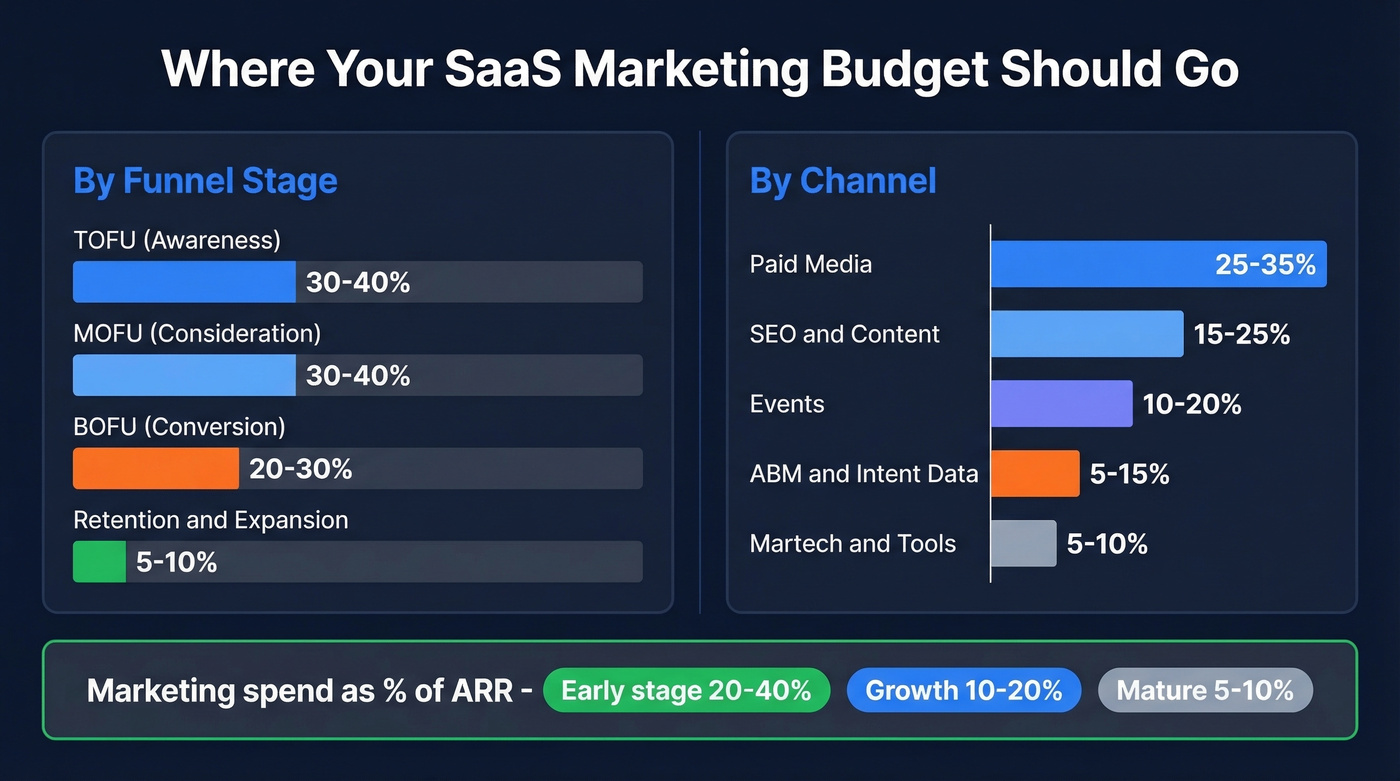
| Stage | Marketing as % of ARR |
|---|---|
| Early-stage | 20-40% |
| Growth | 10-20% |
| Mature | 5-10% |
Venture-backed startups spend up to 58% more on marketing as a share of revenue compared to bootstrapped peers. That's not necessarily smarter - it's a different risk profile with different burn tolerance.
Where that budget goes matters more than the total. Expect 45-55% of your marketing budget to go to people - internal team plus contractors. The remainder splits across channels. Here's a funnel-based allocation framework:
- TOFU (awareness): 30-40%
- MOFU (consideration): 30-40%
- BOFU (conversion): 20-30%
- Retention/expansion: 5-10%
And by channel:
| Channel | % of Budget |
|---|---|
| Paid media | 25-35% |
| SEO & content | 15-25% |
| Events | 10-20% |
| Martech/tools | 5-10% |
| ABM & intent data | 5-15% |
High-growth B2B SaaS companies split roughly 55% demand generation / 45% lead capture. When you're spending less than $20K/quarter, prioritize high-intent lead gen. Between $20K-$100K, allocate 30% to demand gen. Above $100K, run both engines with separate KPIs.

You just read that every SaaS channel underperforms when prospect data is bad. Prospeo gives you 300M+ profiles with 98% email accuracy, 125M+ verified mobiles, and intent data across 15,000 topics - so your paid, ABM, and outbound campaigns hit real buyers. At $0.01 per email, your CAC drops before you optimize a single ad.
Fix your data layer first. Every SaaS marketing channel gets better.
Strategies That Actually Work
Content Marketing + SEO
Start here at every stage. It's the only channel that compounds.
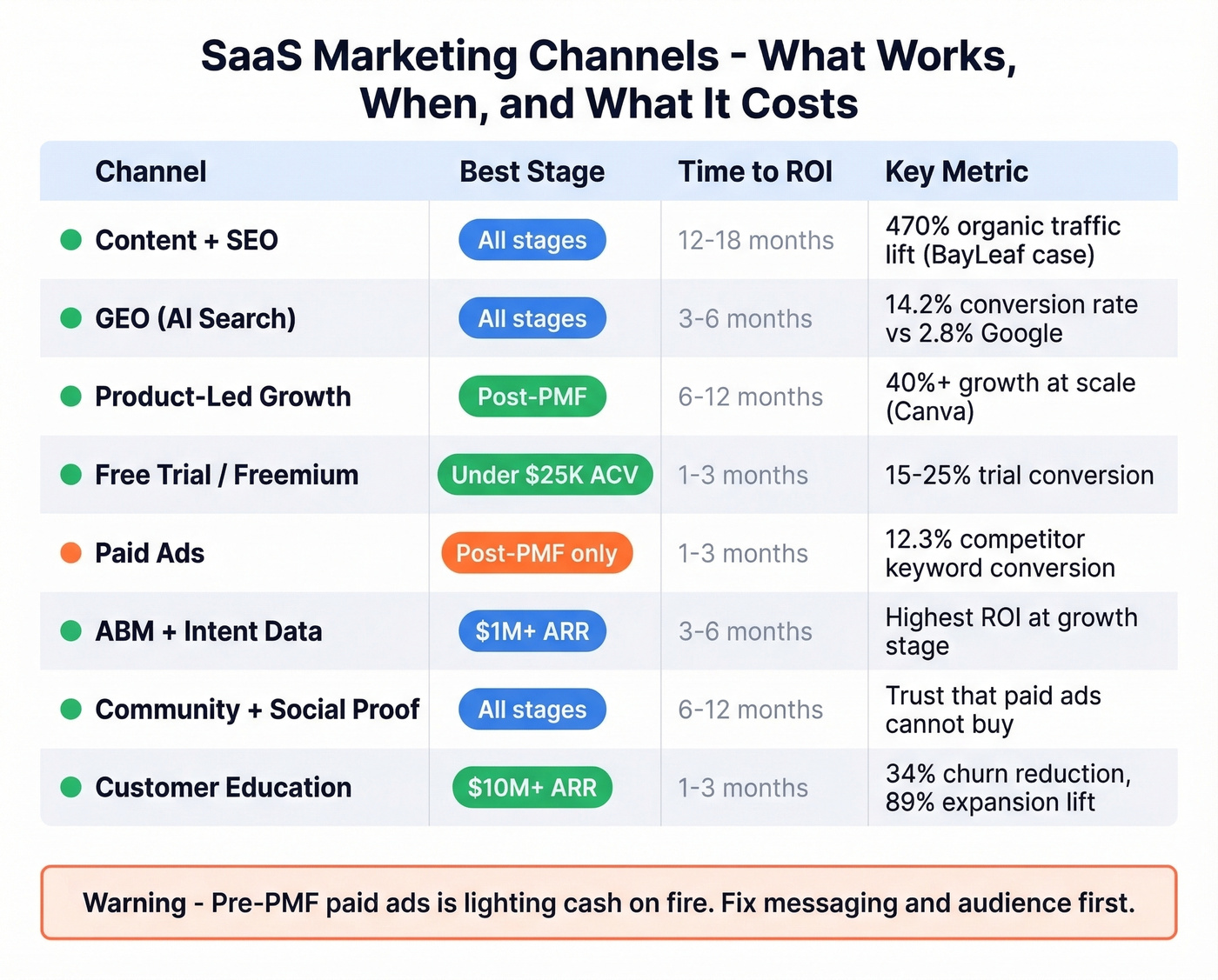
Agency BayLeaf Digital ran a campaign for MeazureUp that doubled SQLs and boosted organic traffic by 470%. That's not an overnight result - it's 12-18 months of consistent execution on bottom-funnel content. Cognism pulled off something similar, growing from 6K to 35K monthly organic visits and racking up 4M+ impressions by doubling down on category-specific content. The key is writing for buyers, not for traffic. A post ranking for "how to evaluate [your category]" will outperform a generic thought leadership piece every time.
Generative Engine Optimization
This is the strategy most 2026 guides still underweight. ChatGPT processes 1B+ daily queries. In 2025, AI-referred sessions jumped 527% between January and May. Here's the number that should change your content strategy: AI search traffic converts at 14.2% vs Google's 2.8%.
Tactical GEO checklist:
- Put the direct answer in the first 40-60 words of every page
- Target 8-10 credible citations per 1,000 words
- Include expert quotes and specific statistics - AI models love citing these
- Structure content with clear H2/H3 hierarchy and schema markup
For monitoring, tools like Otterly, Profound, and GenRankEngine are emerging. The consensus on r/b2bmarketing is that GenRankEngine is the most actionable for debugging why you're not showing up.
Product-Led Growth
PLG isn't just "offer a free plan." It's a multi-layer framework spanning your GTM motion through activation, retention, and expansion. Canva runs 260M monthly active users and $3.5B ARR with 40%+ growth. Figma crossed $1B ARR. Both succeeded because they nailed activation milestones - the specific moments where a user realizes the product is indispensable.
Map those milestones for your product, build self-serve onboarding around them, and trigger usage-based nudges when users stall.
Free Trials and Freemium
Use this if: You have a self-serve product where users can reach value without a sales call. Remove credit card requirements to reduce signup friction.
Skip this if: Your ACV is above $25K and your product requires implementation. A "free trial" of enterprise software that needs a 3-week setup is just a bad demo.
Conversion benchmarks: 3-5% for freemium, 15-25% for time-limited free trials. List pricing and benefits clearly so prospects can self-qualify on ROI.
Paid Ads (Only After PMF)
Here's the thing: if you're pre-PMF and spending on paid ads, you're lighting cash on fire. The audience isn't defined, the messaging isn't proven, and you'll optimize toward vanity metrics.
After PMF, paid becomes powerful. Competitor-keyword Google Ads convert at 12.3% vs 3.1% for generic terms. One agency case study showed Google Performance Max cutting lead costs by half while tripling lead quality. Minimum viable budget: $5K-$10K/month. Below that, you won't generate enough data to optimize.
Demand Gen vs Lead Gen
Gated whitepapers and MQL-chasing are 2019 tactics. High-growth companies run a 55/45 split between demand creation and lead capture, and combining both lifts close rates by up to 43%. Demand gen builds the audience that eventually converts. Lead gen captures the ones ready now. You need both - just don't confuse them in your reporting.
Account-Based Marketing
For growth-stage and above, ABM programs powered by intent signals are the highest-ROI play. Layer buyer intent data - which companies are actively researching your category - with job role and company growth filters to build tightly targeted account lists. The difference between spraying emails and landing meetings comes down to whether you're reaching accounts that are actually in-market.
Community, Video, and Social Proof
These three channels share a common trait: they build trust that paid ads can't buy.
- Reddit: Piggyback on Reddit's organic traffic. Answer questions in your category's subreddits. It's free, it builds credibility, and Reddit threads rank in Google.
- Video: 66% of customers prefer watching a video to reading about a product. Product demos, customer stories, and "how we built this" content all perform.
- Reviews: G2 and Capterra pages are trust accelerators. Actively solicit reviews from happy customers - these pages rank for high-intent keywords you'd otherwise need to pay for.
Customer Education and Retention
A founder on r/SaaS shared results that stopped me cold. They implemented weekly 30-minute "power user" workshops - nothing fancy, just a product lead walking through advanced features. Churn dropped 34%, feature adoption jumped 2.7x, expansion revenue climbed 89%, and NPS went from 42 to 68. Total time investment: about 3 hours per week, with sessions recorded for on-demand access.
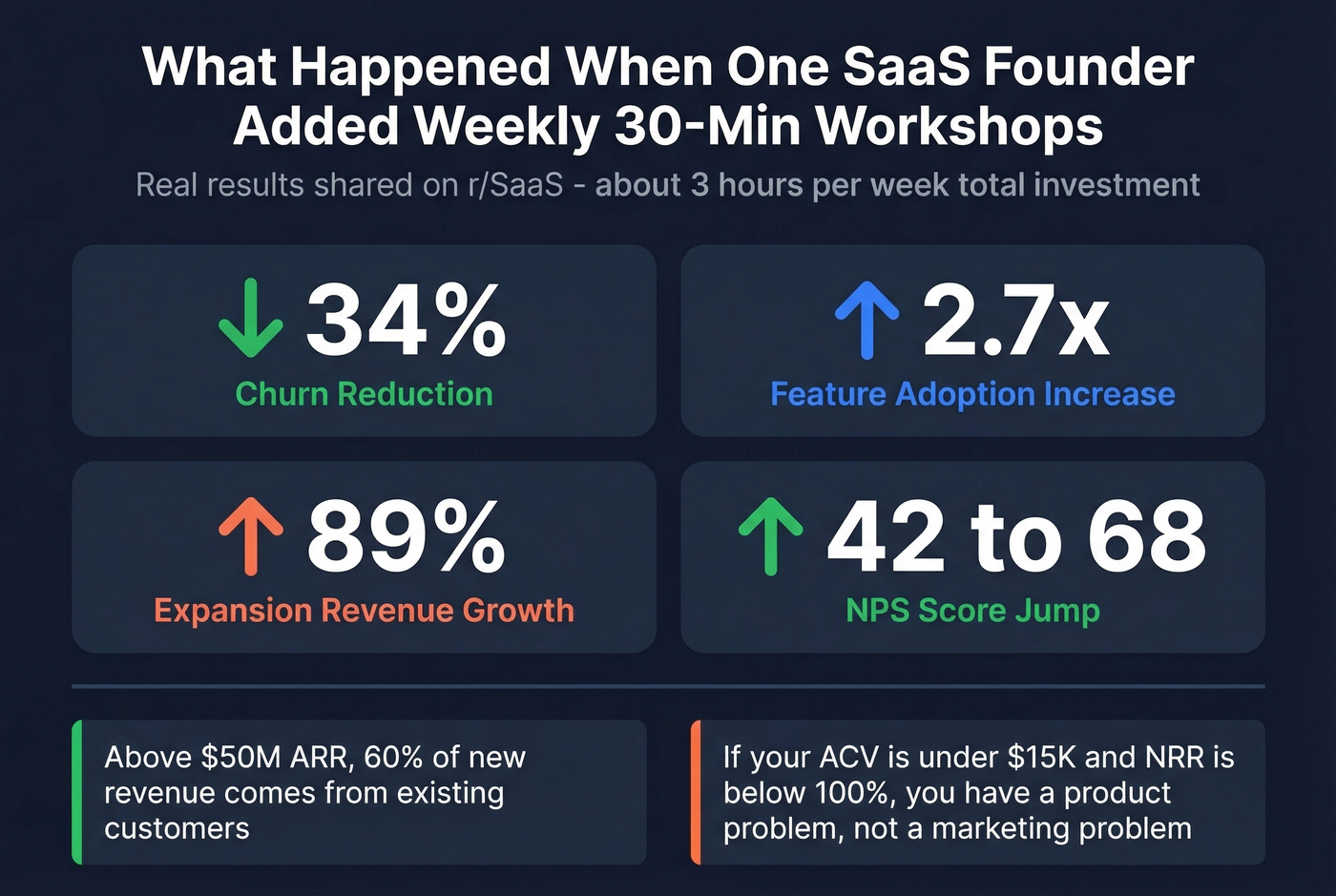
For companies above $50M ARR, 60% of new revenue comes from existing customers. Marketing to your install base isn't a nice-to-have - it's your primary growth engine at scale.
Hot take: If your ACV is under $15K and your NRR is below 100%, you don't have a marketing problem. You have a product problem. No amount of top-of-funnel spend fixes negative net revenue retention.
Fix Your Data Before You Market
The biggest SaaS marketing mistake in 2026 isn't choosing the wrong channel - it's running every channel on dirty data. When 30% of your prospect emails bounce, your domain reputation tanks, your deliverability craters, and every dollar you spend on outbound, ABM, and paid retargeting underperforms. We've seen teams triple their pipeline just by cleaning up the data layer.

No marketing strategy survives bad data. Fix this first.
ABM and intent data just showed up in your budget allocation. Prospeo tracks 15,000 buyer intent topics via Bombora, layered with 30+ filters like technographics, funding, and headcount growth - so you reach in-market accounts, not cold lists. Teams book 26% more meetings vs ZoomInfo and 35% more vs Apollo.
Stop marketing to companies that aren't buying. Target intent signals now.
Metrics That Matter
If you're not measuring these monthly, you're guessing:
- CAC: What it costs to acquire a customer. Track by channel - referrals at ~$150 vs LinkedIn Ads at $2,000+ tells you where to double down.
- LTV:CAC: Target 3:1 minimum, 4:1+ at growth stage. Below 3:1, you're spending more than customers are worth.
- Monthly churn: 3-5% early, under 3% at growth stage. Every point of churn compounds against you.
- MRR and NRR: MRR is your baseline. NRR tells you whether existing customers are growing or shrinking. Top performers hit 120%+.
- Pipeline velocity: How fast deals move through your funnel. Slow velocity means your MOFU content or sales enablement is broken.
- CAC payback: Median is 15-18 months. Elite teams get under 12. If yours is above 24, your unit economics don't work.
Tie every metric back to the benchmarks table above. Know where you stand relative to your stage, and optimize the metric that's furthest from target.
Common Mistakes
Spreading across too many channels before mastering one. Pick two channels, get them working, then expand. We've watched teams run SEO, paid, events, ABM, and social simultaneously with a three-person marketing team. Nothing gets done well.
Running paid ads before PMF. You're optimizing toward a product that hasn't proven it can retain users. Stop.
Ignoring retention and expansion. New logo acquisition is sexy. Expansion revenue pays the bills. Budget accordingly.
Using unverified prospect data. If your outbound list hasn't been verified recently, you're damaging your domain. A quick accuracy check against your current provider will tell you everything you need to know.
Treating sales and marketing as separate silos. Aligning both teams around shared pipeline targets - not just MQL handoffs - separates companies that scale from those that stall. When marketing knows which accounts sales is working, and sales trusts the leads marketing delivers, close rates climb.
FAQ
What's the best strategy for startups?
Content + SEO and community engagement compound over time and cost almost nothing beyond labor, making them ideal for early-stage SaaS companies under $1M ARR. Add paid ads only after you've confirmed product-market fit and can measure CAC reliably.
How much should a SaaS company spend on marketing?
Early-stage companies should allocate 20-40% of ARR, growth-stage 10-20%, and mature companies 5-10%. Venture-backed startups spend up to 58% more than bootstrapped peers, reflecting higher burn tolerance rather than superior strategy.
What's a good CAC for B2B SaaS?
Startup CAC averages roughly $273, but enterprise-motion CAC runs $1,200+. The more important metric is CAC payback - target under 18 months. Referral channels deliver ~$150 CAC while LinkedIn Ads regularly exceed $2,000.
How do I improve trial-to-paid conversion?
Remove credit card requirements, map clear activation milestones, and trigger usage-based nudges when users stall. Expect 3-5% conversion for freemium models and 15-25% for time-limited trials. Products that reach an "aha moment" within the first session convert at the high end.
How do I build a prospect list without bad data?
Use a verified B2B database with real-time email verification and a refresh cycle measured in days, not weeks. Prospeo refreshes every 7 days with 98% email accuracy - compared to the 6-week industry average - and offers a free tier (75 emails/month) to test before committing.