

How to Sell Technology Solutions in 2026: The Tactical Playbook
You gave the killer demo. The champion loved it. Then - radio silence for three weeks, followed by a polite email saying they're "going in a different direction."
The deal didn't die because your product was wrong. It died because you pitched features to the wrong people about the wrong things.
Here's the thing about selling technology solutions in 2026: buyers spend just 17% of their total purchase time meeting with vendors, and 74% have done most of their research before you ever get a call. The math is brutal - you get a tiny window with a crowded room of stakeholders, and most reps waste it talking about themselves. We've watched this pattern play out across hundreds of deals in our network, and the fix is almost always the same: stop selling your product and start selling the outcome your buyer's committee needs to agree on.
This is the tactical playbook that changes how you approach those deals.
The Quick Version
Most tech deals die from stakeholder misalignment, not product gaps. This playbook covers six moves: map the buying committee, run structured discovery, translate features into outcomes by persona, build a CFO-ready business case, run a POC that converts, and dodge the mistakes that kill deals silently.
If you only change one thing after reading this, map every stakeholder before your next demo. It's the single highest-leverage activity in complex technology sales.

You just learned to map 10+ stakeholders per deal. Now you need verified contact data for every one of them. Prospeo gives you 30+ filters to find decision-makers by job title, department, buyer intent, and company size - with 98% email accuracy and 125M+ verified mobile numbers so your multi-threading actually connects.
Stop selling to 15% of the room. Reach the full buying committee.
Six Steps to Closing Technology Deals
1. Map the Buying Committee First
The average B2B purchase now involves 13 stakeholders. If you're only talking to your champion and their boss, you're selling to about 15% of the room.
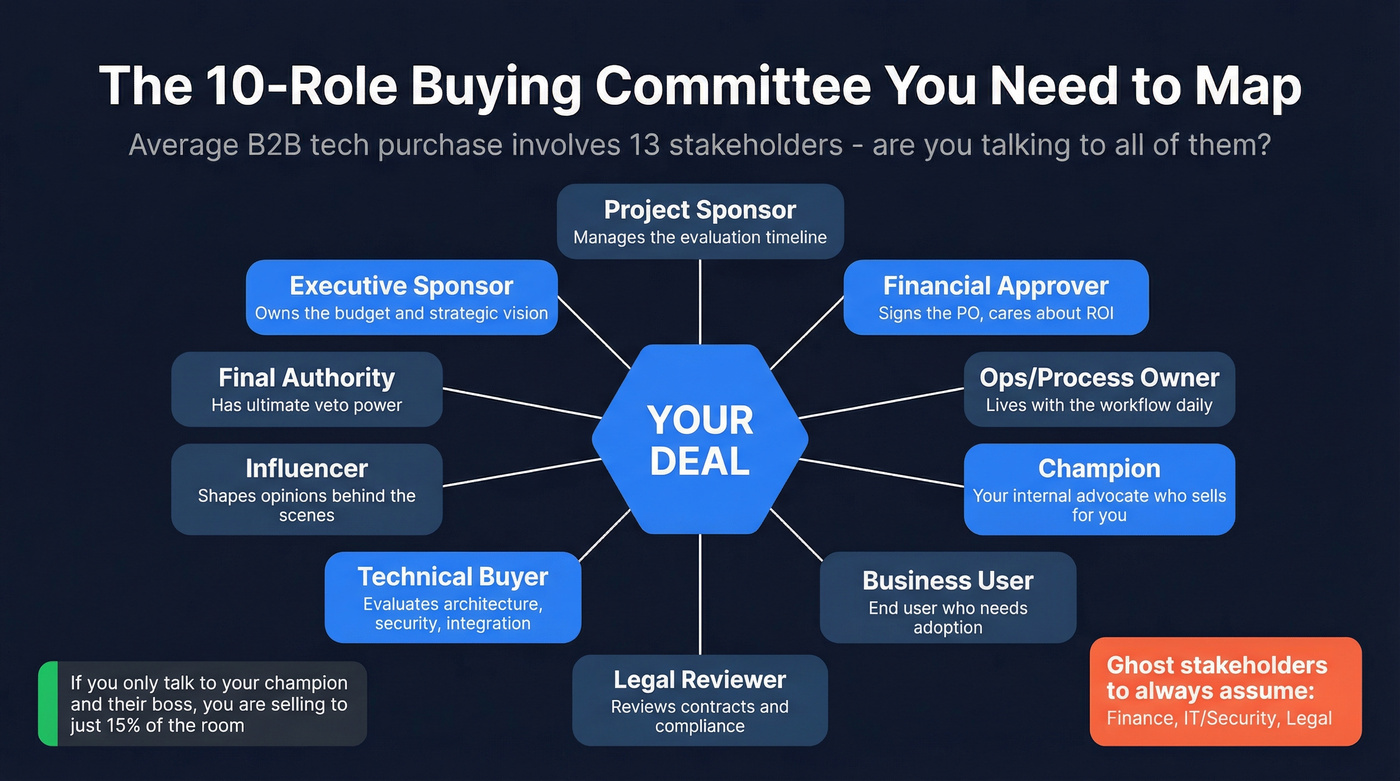
Most reps know they should multi-thread. Few do it systematically. Start by mapping these 10 roles for every deal: project sponsor, champion, executive sponsor, financial approver, technical buyer, ops/process owner, business user, legal reviewer, influencer, and final authority. Not every deal has all ten, but assuming fewer is how deals stall in week six when someone from procurement suddenly appears with a spreadsheet full of questions nobody prepped for.
Then hunt for ghost stakeholders. Assume Finance, IT/Security, and Legal will get involved - because they almost always do. Ask your champion two questions: "Who else will feel the impact of this decision?" and "Who could slow this down if they're surprised late?" These surface blockers before they become deal-killers.
And book the decision meeting at kickoff, not at the end of the evaluation. That one move alone compresses timelines by weeks.
2. Run Discovery That Qualifies
"Just listen more" is terrible advice without structure. Listening without a discovery framework is like driving without a map - you'll cover ground, but you won't get anywhere useful.
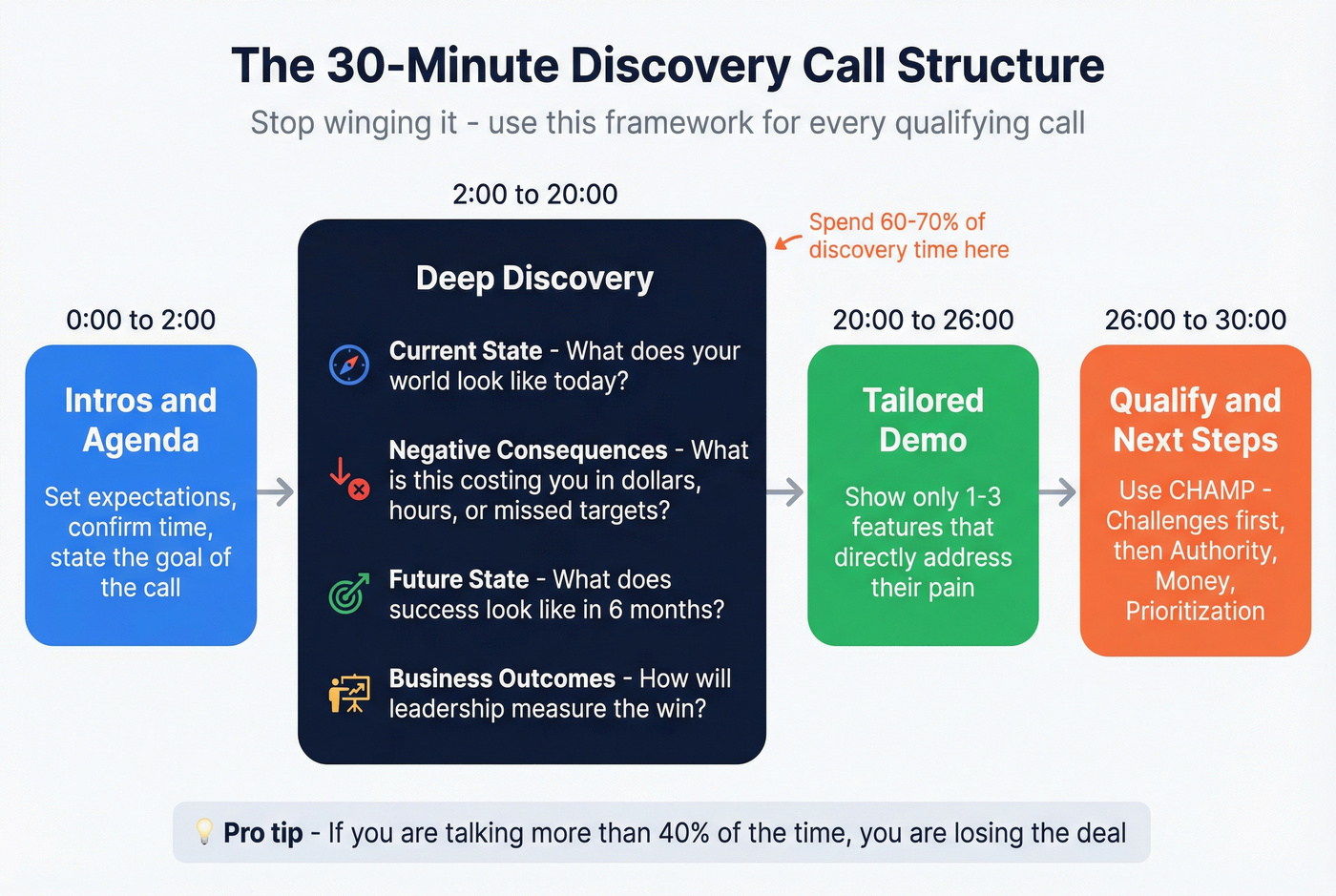
Use this 30-minute structure:
- 2 minutes - intros and agenda
- 18 minutes - deep discovery covering current state, negative consequences, future state, and business outcomes
- 6 minutes - tailored demo showing only the 1-3 features that address what they told you
- 4 minutes - qualification and next steps
Spend 60-70% of discovery time on current state and negative consequences. What's broken today? Who's impacted? What does it cost in dollars, hours, or missed targets? If there's no real pain, the deal is weak - and you should know that now, not three months into a pilot that goes nowhere. For qualification, CHAMP beats BANT for technology sales because it front-loads pain instead of budget, which is often undefined in tech evaluations anyway.
3. Translate Features Into Outcomes
The secret to selling technology products isn't talking about technology. Nobody buys a platform. They buy shorter sales cycles, fewer security incidents, faster time-to-revenue.
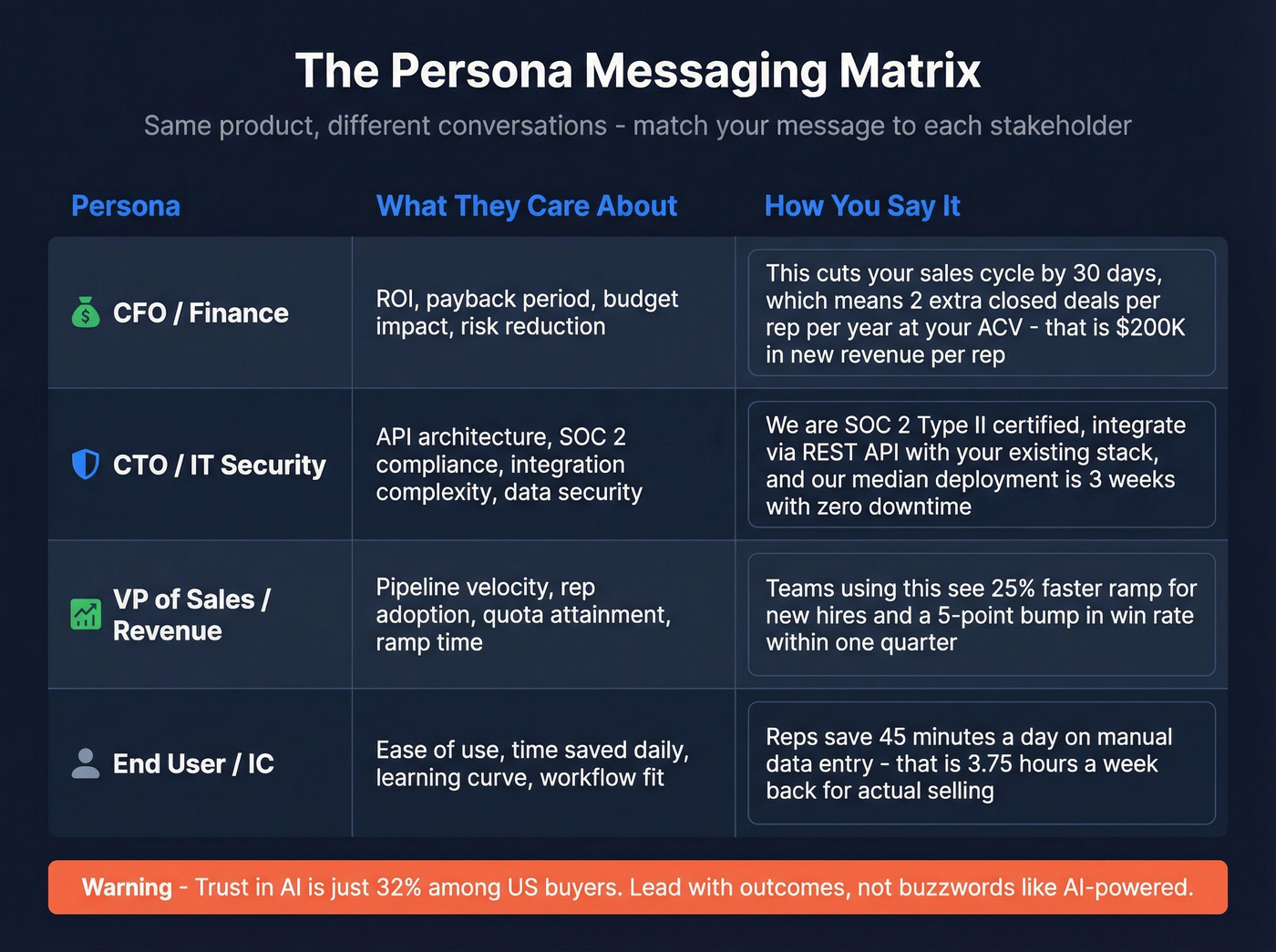
Build a Messaging Matrix mapping each persona to specific value propositions and proof points. Your CFO cares about ROI and budget impact. Your CTO cares about API architecture and security posture. Your VP of Sales cares about pipeline velocity and rep adoption. These are different conversations, and treating them as one is why demos fall flat.
Don't lead with jargon. Trust in AI sits at just 32% among American buyers, so "AI-powered" triggers more skepticism than excitement right now. Use the StoryBrand approach: your customer is the hero, you're the guide. Frame every capability around their outcome, not your architecture.
4. Build a CFO-Ready Business Case
No ROI model, no deal. That's the reality for anything above $50k ACV.
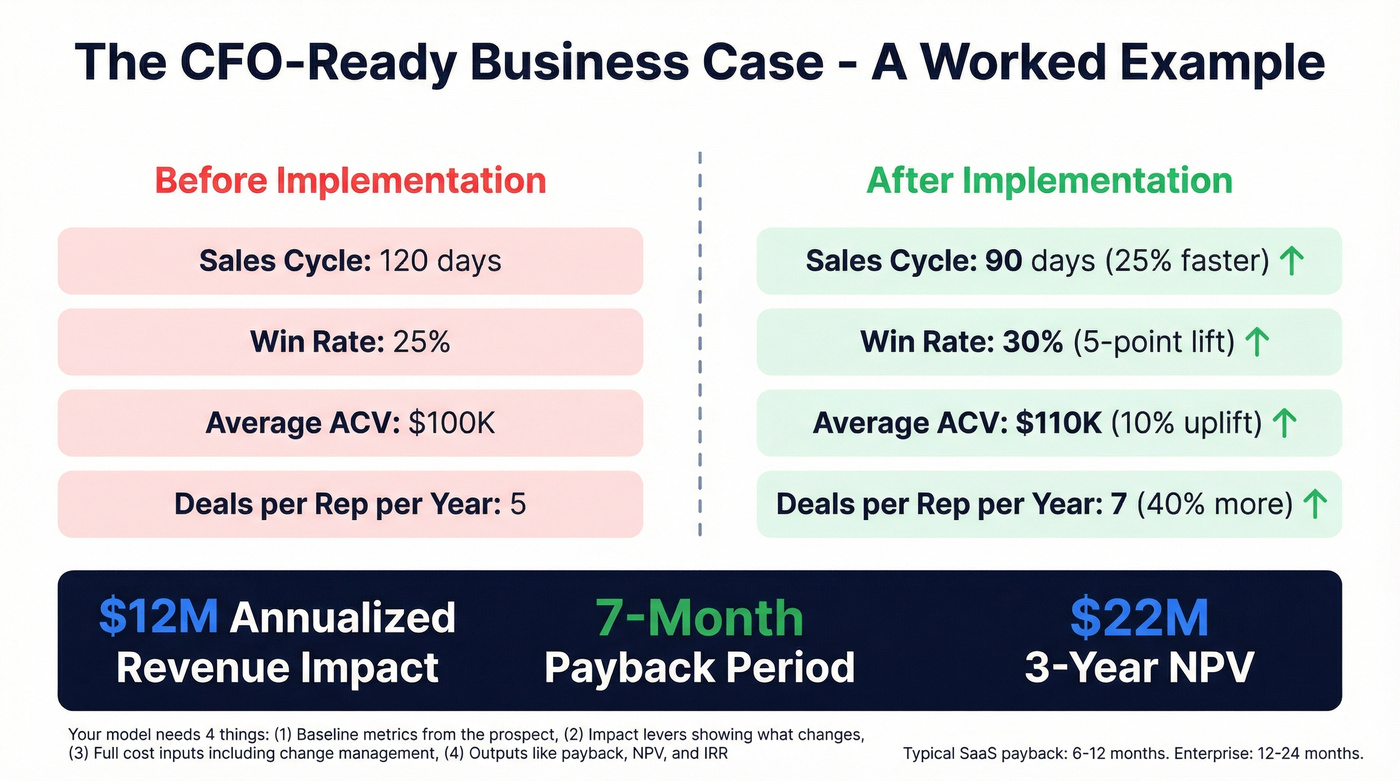
Here's a worked example we've seen close deals:
Baseline: 120-day sales cycle, 25% win rate, $100K ACV, 5 deals per rep per year.
After implementation: 90-day cycle, 30% win rate, 10% ACV lift, 7 deals per rep per year.
Result: $12M in annualized revenue impact with a 7-month payback and $22M in 3-year NPV.
Those are the numbers that get a CFO to sign. Your model needs four things: baseline metrics documented with the prospect's own data, impact levers showing what changes and by how much, cost inputs covering license through change management, and outputs like payback period, NPV, and IRR. For benchmarks, SaaS payback periods of 6-12 months are typical, and enterprise platforms can stretch to 12-24 months if the NPV is compelling enough.
5. Run a POC That Converts
Let's be clear about terminology, because getting it confused costs deals. A demo showcases features. A POC proves feasibility - "can I make this work in my environment?" A POV proves business value - "is this worth the investment?"
A strong pilot plan needs five components: objectives and success criteria, timelines and milestones, roles on both sides, risks and mitigation, and a decision meeting date set before the pilot starts. Keep pilots between 30 and 90 days. Anything longer loses urgency and becomes shelfware.
Here's a conversion tactic worth stealing: structure a 15-month agreement with a 3-month paid opt-out period. The prospect gets a low-risk entry point, you get commitment. One SaaS CEO reported converting 14 out of 15 pilots using this structure. The endowment effect is real - once people build something with your tool, they don't want to give it up.
6. Avoid the Mistakes That Kill Deals
In our experience reviewing stalled pipelines, the same patterns sink deals over and over:
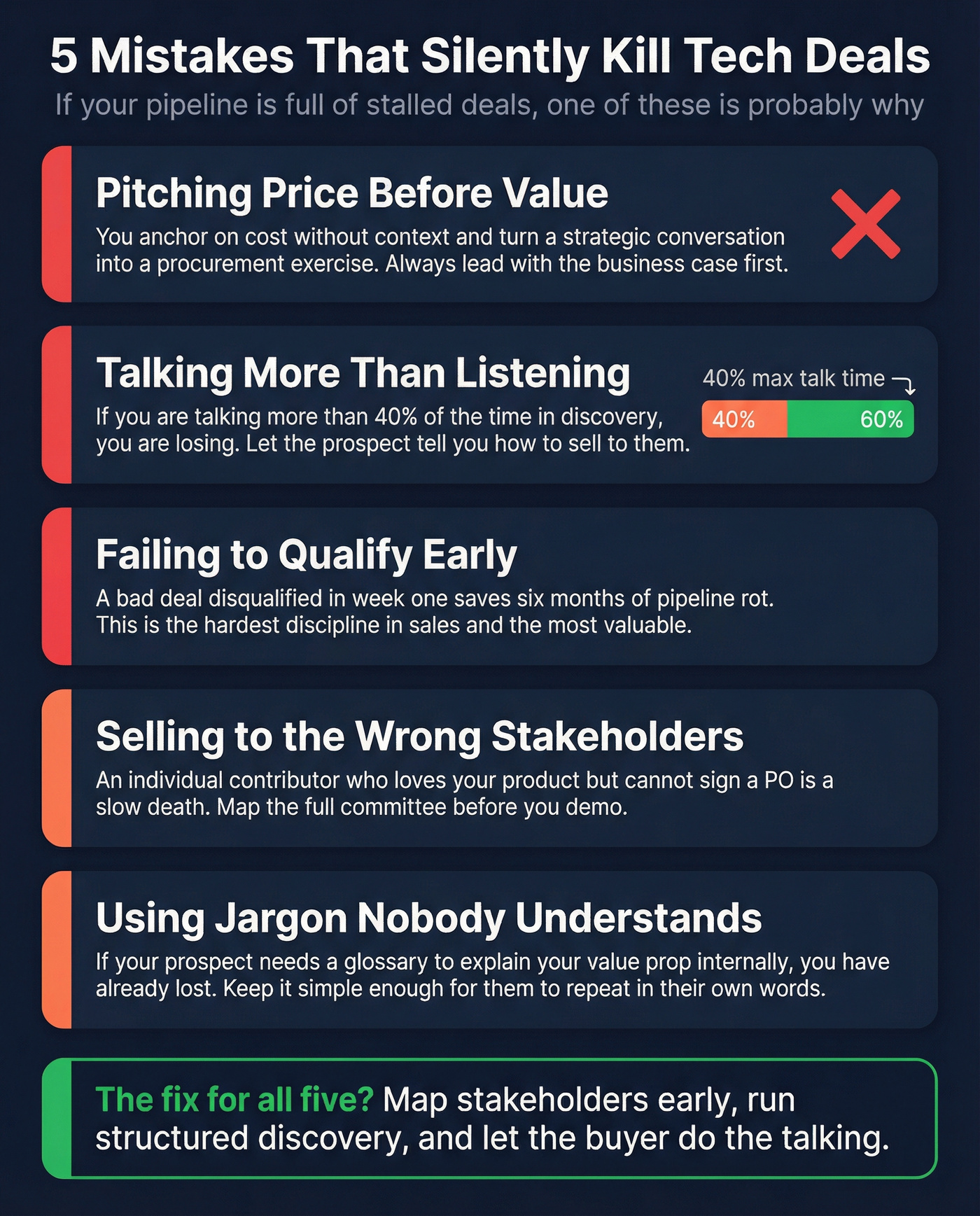
Pitching price before value. Lead with the business case, not the cost. The moment you anchor on price without context, you've turned a strategic conversation into a procurement exercise.
Talking more than listening. If you're talking more than 40% of the time in discovery, you're losing.
Failing to qualify early. A bad deal disqualified in week one saves six months of pipeline rot. This is the hardest discipline in sales, and the most valuable.
Selling to the wrong stakeholders. An individual contributor who loves your product but can't sign a PO is a slow death.
Using inaccessible jargon. If your prospect needs a glossary, you've already lost. The Reddit consensus on r/sales backs this up - threads about "why my deal stalled" almost always trace back to the buyer not understanding the value prop well enough to sell it internally.
Bad contact data kills deals before they even start. You send hundreds of emails, a chunk bounce, and the replies you do get are from people who can't buy. Verify your list before sending a single message - Prospeo's 5-step verification process catches bad emails before they tank your domain reputation, including catch-all handling, spam-trap removal, and honeypot filtering.
Start With the Right Data
You can master every framework in this playbook, but none of it matters if you can't reach the 13 stakeholders who'll decide your deal. Map the committee first, find verified contacts for every role, then run the playbook. That's the difference between a pipeline full of stalled deals and one that actually closes.
Skip the six-step process if your average deal closes under $15k. Send a great cold email, nail the demo, and close in two calls. This playbook is for the $50k+ deals where buying committees, business cases, and POCs are the difference between a signed contract and a "maybe next quarter" that never comes back.
Building a CFO-ready business case means nothing if your outreach never lands. Teams using Prospeo book 26% more meetings than ZoomInfo users and 35% more than Apollo - because 98% accurate emails and a 30% mobile pickup rate mean your carefully crafted value props actually reach the right persona.
Great messaging deserves data that delivers it. Start free today.