

How to Turn a Lead Into a Prospect: The Qualification Playbook
You ran a webinar last month. 500 registrations. Sales cherry-picks 30 names they recognize and ignores the rest. Three weeks later, 470 leads have gone completely cold. 79% of marketing leads never convert into sales - and it's almost never because the leads were bad. It's because nobody built the process to qualify them.
Here's the take most "lead conversion" articles won't give you: knowing how to turn a lead into a prospect isn't a marketing problem. It's a definition problem and a data problem. Fix those two things, and the conversion mechanics almost handle themselves.
Lead vs. Prospect - What Actually Changes
A lead is anyone who's raised their hand - downloaded your whitepaper, filled out a form, showed up on a webinar registration list. No proof of fit, no buying intent, no confirmation they're even the right person.
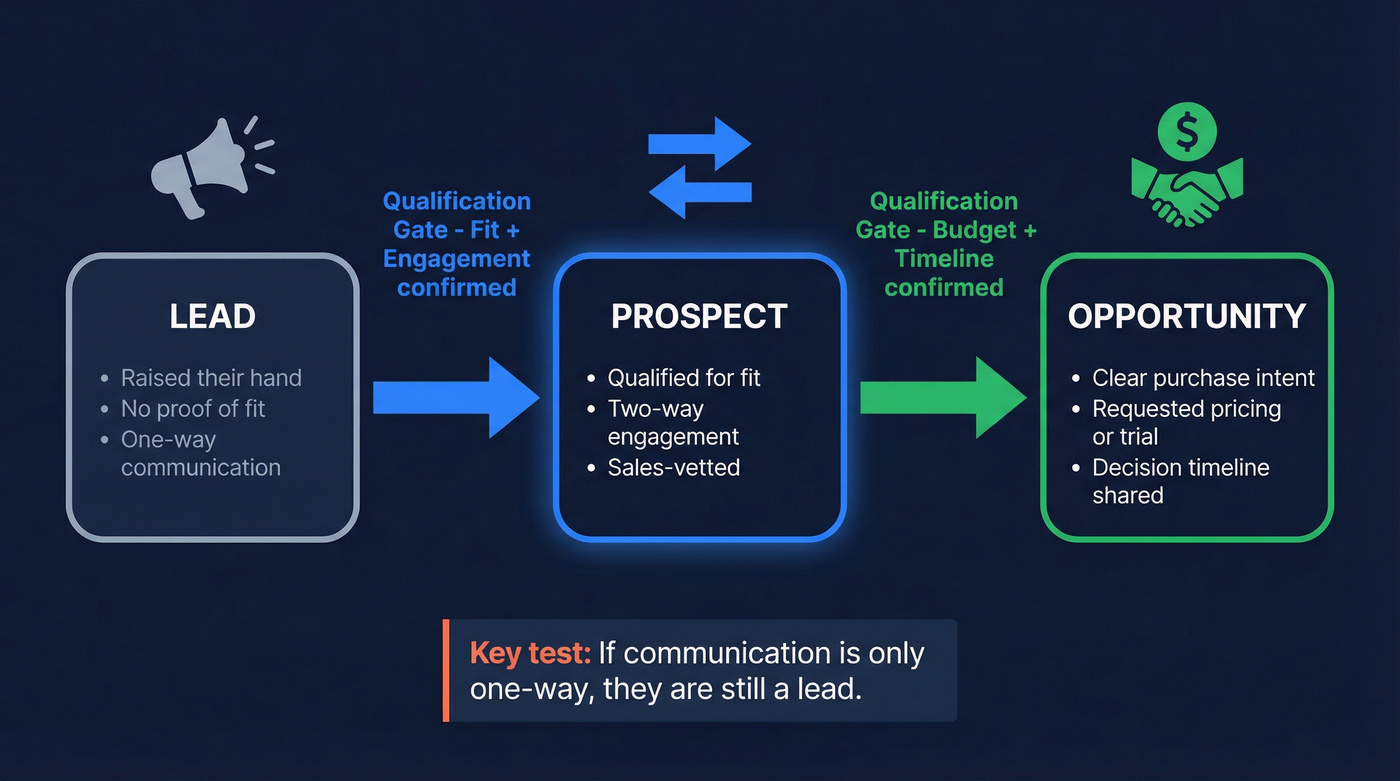
A prospect is a lead that's been qualified. Salesforce defines the boundary clearly: a prospect has been assessed for interest level, budget, authority, and timeline. They've moved from "name in a spreadsheet" to "someone worth a sales conversation." A qualified lead has met marketing criteria like a score threshold, while a prospect has been vetted by sales for genuine fit and intent - that distinction matters more than most teams realize.
Crunchbase offers a useful mental model: a lead represents one-way communication - you've reached out, they haven't meaningfully responded. A prospect represents two-way communication - they've engaged, you've confirmed fit. That's the simplest heuristic to carry around.
The full hierarchy runs lead, prospect, opportunity. A lead shows interest. A prospect is qualified for fit and engagement. An opportunity has clear purchase intent - they've requested pricing, started a trial, or shared a decision timeline. Each transition is a qualification gate, not a time-based progression.
The one-way / two-way test: If communication is only flowing in one direction, they're still a lead. The moment they engage back and you've confirmed basic fit, they've crossed into prospect territory.
Why Your Team Can't Agree
Most sales-marketing friction around leads and prospects comes from teams running different operating models without realizing it.
There are two dominant frameworks. The lead-first model is marketing-driven: marketing generates leads, qualifies them into prospects via scoring and criteria like BANT, then hands prospects to sales. The prospect-first model flips it - sales identifies ICP-fit contacts they're actively engaging as prospects, and "leads" are prospects who've shown clear buying intent.
Neither is wrong. But running both simultaneously in the same org is a disaster. Poor marketing-sales alignment can cause up to 10% annual revenue decline, while aligned organizations grow 27% faster year-over-year. Pick one model, document it, and make sure every SDR, AE, and marketing manager uses the same vocabulary.
Three Levels of Qualification
Adobe's three-level model is the most practical framework we've seen for structuring the lead-to-prospect transition. A lead needs to pass all three levels before earning "prospect" status.
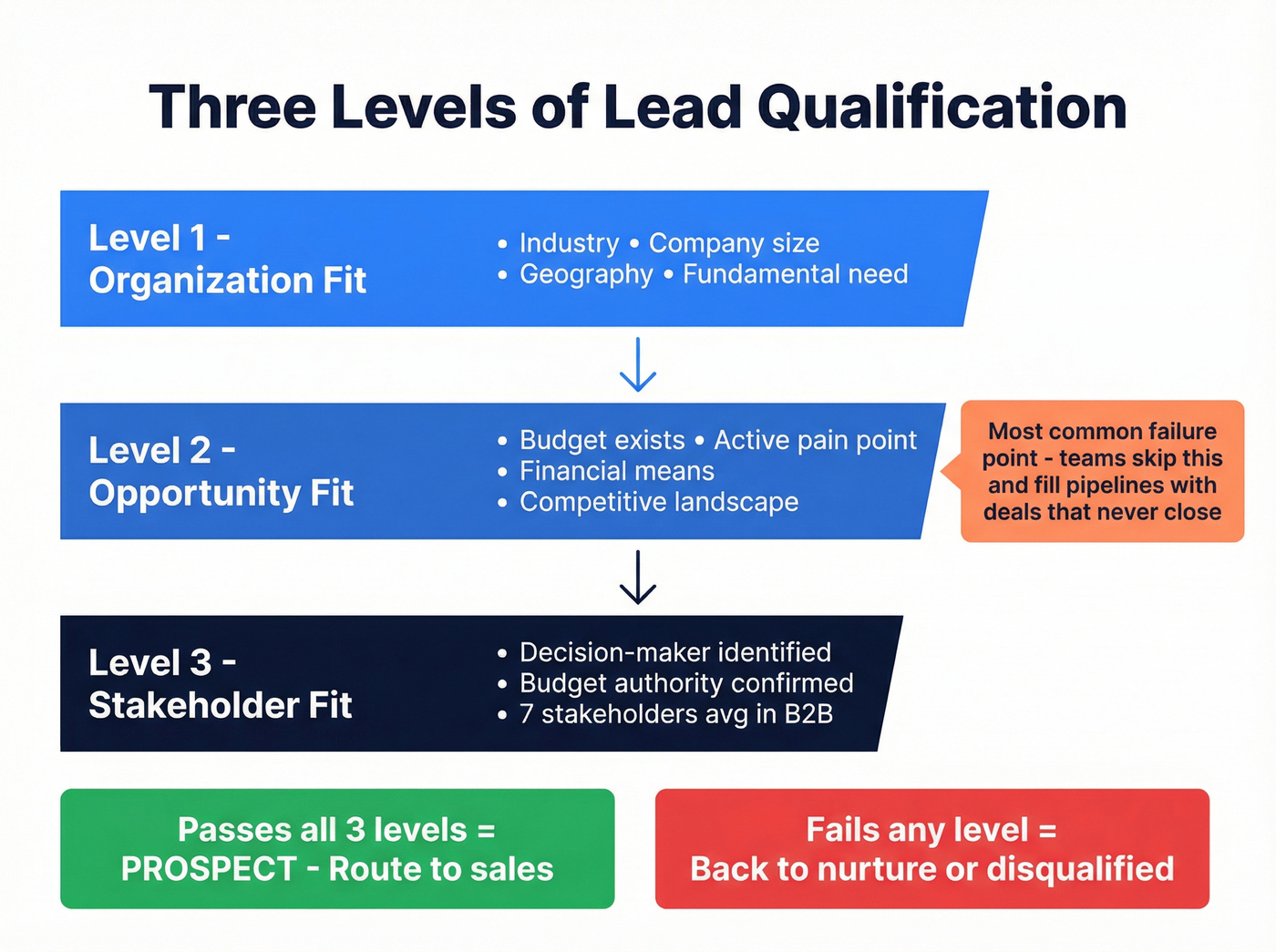
Level 1 - Organization fit. Does this company match your ICP? Check industry, company size, geography, and whether they have the fundamental need your product addresses.
Level 2 - Opportunity fit. Is there a real opportunity here? This goes beyond fit into whether the company can and wants to use your solution - financial means, current pain, competitive landscape. We've tested this across mid-market teams, and skipping Level 2 is the single biggest reason pipelines fill with deals that never close. Teams get excited about a perfect ICP match and rush to demo without confirming there's an actual budget or active problem to solve.
Level 3 - Stakeholder fit. Are you talking to the right person? B2B buying decisions now involve roughly 7 stakeholders on average. I've watched teams waste entire quarters qualifying companies that were a perfect fit - except nobody in the thread had budget authority. Confirming you've reached a decision-maker or champion is non-negotiable.
A lead that clears all three levels is a prospect. One that fails at any level goes back to nurture or gets disqualified entirely.
Pick a Framework
Once you've got the three-level structure, you need a framework to operationalize it:
| Framework | Best For | Deal Complexity | Time Investment |
|---|---|---|---|
| BANT | Transactional, <30-day cycles | Low | Low |
| CHAMP | Mid-market, consultative | Medium | Medium |
| MEDDIC | Enterprise, $50K+ deals | High | High |
| GPCT | Long-cycle, strategic | High | Medium-High |
BANT is overrated for anything beyond simple transactional sales. It's fast, but it breaks down in complex deals with multi-stakeholder buying committees and long evaluation periods. For sales cycles longer than 30 days, start with CHAMP or GPCT. We've run both across mid-market teams - CHAMP wins for speed, GPCT wins for strategic alignment. Selling six-figure enterprise deals? MEDDIC is worth the training investment.
Here's the thing: if your average deal size is under $10K, you don't need a qualification framework at all. You need a faster follow-up process and a simple yes/no checklist. Frameworks are for deals complex enough to justify the overhead.

Qualification frameworks only work when the data underneath them is accurate. Prospeo enriches every lead with 50+ data points - verified emails at 98% accuracy, direct dials, job titles, firmographics - all refreshed every 7 days. Stop scoring leads with stale data.
Fix the data problem and the qualification handles itself.
Build a Lead Scoring Model
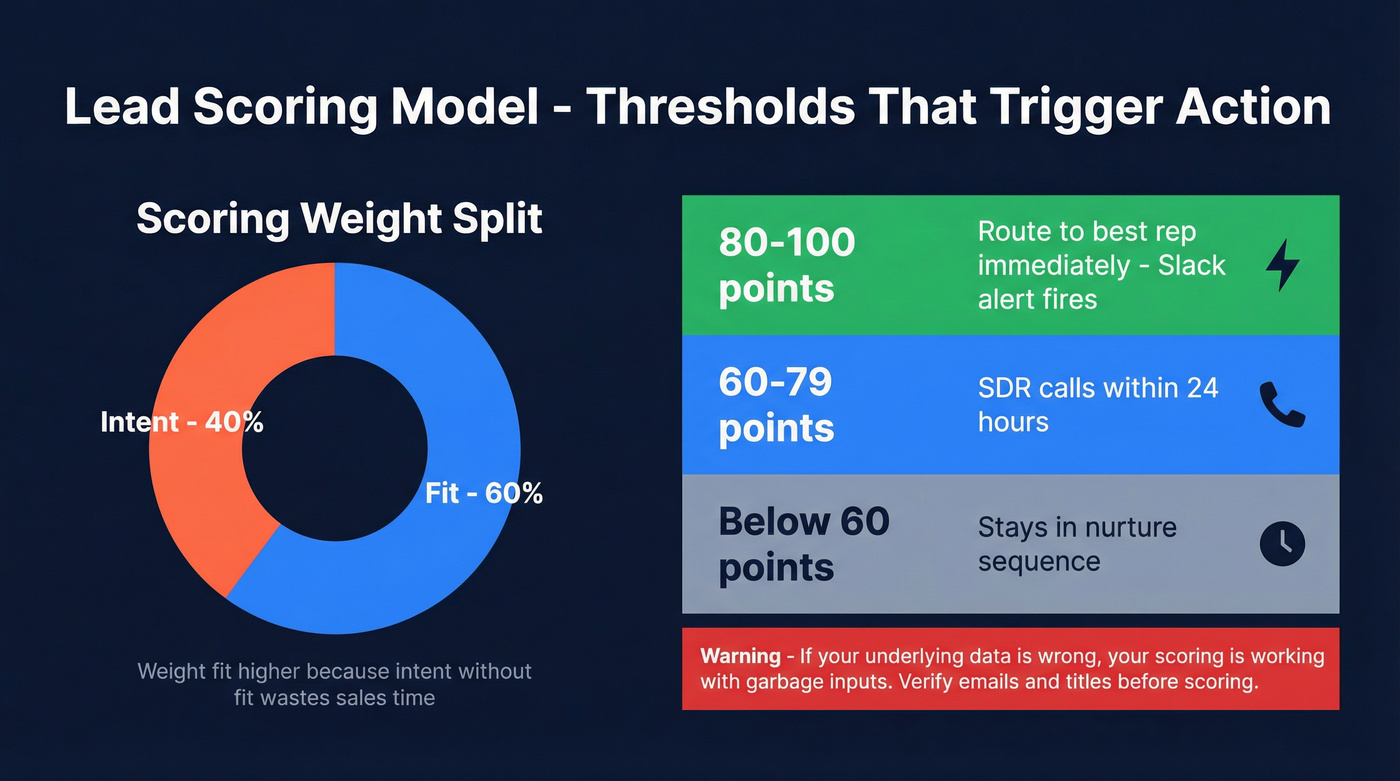
Frameworks tell you what to ask. Scoring tells you who to ask first. The most effective models use a 60/40 split - 60% weighted toward fit and 40% toward intent.
| Action / Attribute | Points | Category |
|---|---|---|
| Requested demo | +100 | Intent |
| Visited pricing page | +25 | Intent |
| Webinar registration | +30 | Intent |
| Opened 3+ emails | +15 | Intent |
| VP/Director title | +20 | Fit |
| Target industry | +10 | Fit |
| Revenue > $50M | +15 | Fit |
| 30+ days inactive | -20 | Decay |
Set operational thresholds that trigger specific actions. 80-100 points: route to your best rep with a Slack alert. 60-79: SDR calls within 24 hours. Below 60: stays in nurture. The MQL threshold should be driven by sales capacity - if your team can handle 50 qualified leads per week, set the bar so roughly 50 leads cross it.
Here's where most scoring models break down: the underlying data is wrong. If the title field says "Manager" but they're actually a VP, or the email bounces on first send, your scoring is working with garbage inputs. Prospeo enriches CRM records with 50+ data points per contact - verified emails at 98% accuracy, verified mobile numbers, and firmographic data, all refreshed every 7 days. Scoring models only work when the data underneath them is real.
Five Mistakes That Kill the Transition
1. Never making contact. Only 27% of generated leads are ever contacted by sales. The other 73% sit there. If your CRM has thousands of untouched leads, this is your entire problem - not lead quality, not messaging, not pricing.
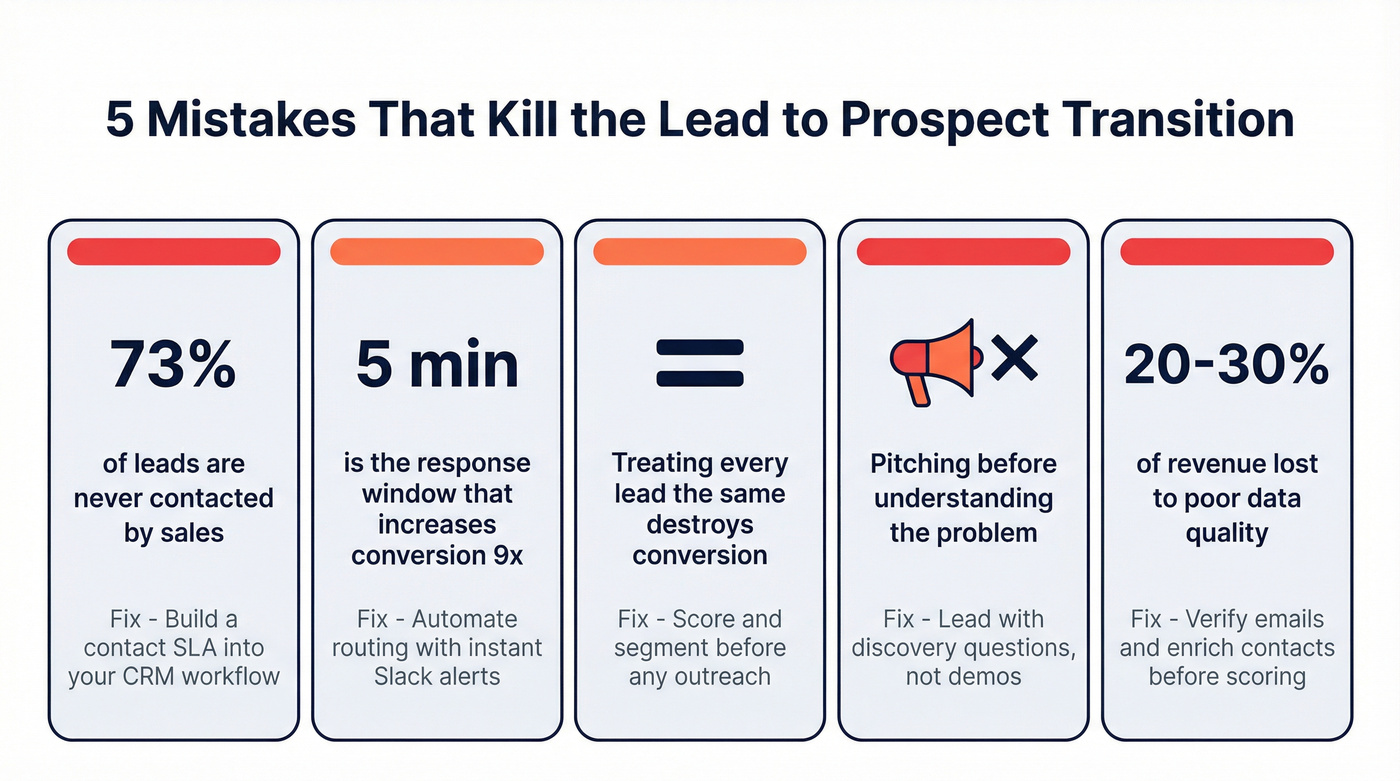
2. Responding too slowly. Responding within the first 5 minutes increases conversion by up to 9x. Wait longer than 24 hours and you've lost 60%+ of your conversion potential. Five minutes. That's it.
3. Treating every lead the same. The webinar attendee who asked three questions gets the same email as the person who registered and never showed up. Without a qualification framework, this is inevitable.
4. Selling before understanding. The consensus on r/sales is blunt about this: if you pitch before you understand the problem, you deserve to lose the deal. Build understanding first. The sale follows.
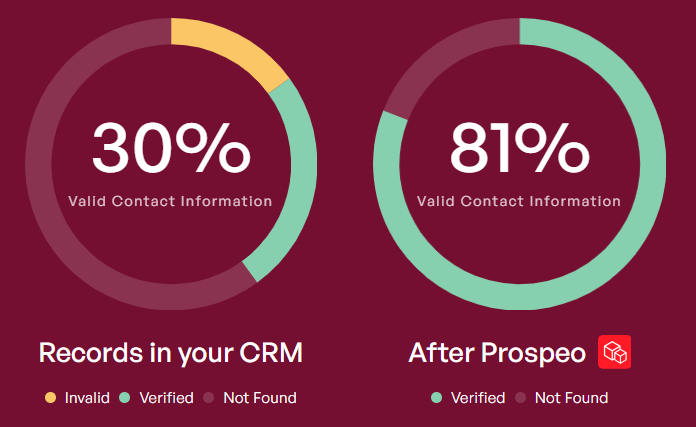
5. Bad data torpedoing the process. Your SDR spends 45 minutes researching a lead, crafts a personalized email, hits send - and it bounces. Poor data quality costs companies 20-30% of annual revenue. Verify every lead before it enters a scoring workflow. If the email bounces or the title is wrong, the lead should never get scored in the first place.
Discovery Questions That Qualify
The right questions do the qualification work for you. Group them by what they reveal:
Need and urgency:
- "What challenge are you hoping to solve right now?" - Confirms active need, not theoretical interest.
- "Why now? What changed?" - The single most powerful qualification question. If there's no trigger event, there's no urgency.
- "If you didn't solve this, could you live with it?" - The ultimate urgency test. If the answer is yes, they're not a prospect yet.
Process and authority:
- "How are you handling this problem today?" - Reveals current process and switching costs.
- "Who else is involved in this decision?" - Maps the buying committee early.
- "What would prevent you from moving forward?" - Surfaces objections before they become deal-killers.
One creative tactic from an r/sales thread: for enterprise deals with long cycles, track which accounts your competitors' sales reps are connecting with. If a target account is already being educated by a competitor, they're in-market - and you can enter the conversation with a sharper pitch.
The Nurturing Cadence
Not every lead qualifies on first contact. It takes 6-8 touchpoints to engage a B2B buyer, and nurtured leads generate 50% more sales-ready opportunities at 33% lower cost. Yet only about 35% of B2B marketers have an established nurturing strategy - embarrassing for an industry that spends billions on lead generation.
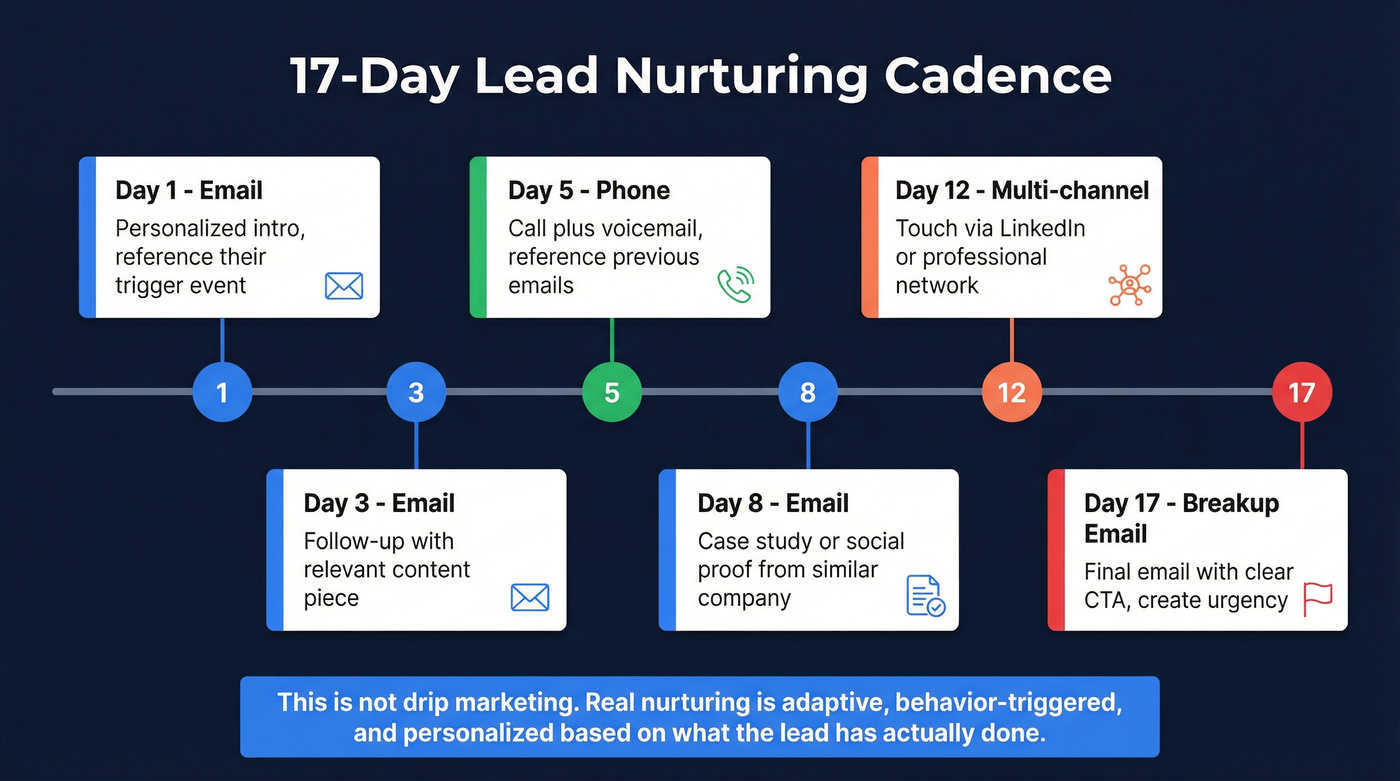
| Day | Channel | Action |
|---|---|---|
| 1 | Personalized intro, reference trigger | |
| 3 | Follow-up with relevant content | |
| 5 | Phone | Call + voicemail |
| 8 | Case study or social proof | |
| 12 | Multi-channel | Touch via professional network |
| 17 | Breakup email with clear CTA |
The key distinction: this isn't drip marketing. Drip is fixed-schedule, one-size-fits-all. Real nurturing is adaptive - behavior-triggered, multi-channel, and personalized based on what the lead has actually done. A well-designed nurture sequence is often what finally moves a lead to prospect status weeks after the initial touchpoint.
2026 Conversion Benchmarks
Let's put numbers on what "good" looks like. First Page Sage's benchmarks provide the clearest stage-by-stage data available:
| Industry | Lead to MQL | MQL to SQL | SQL to Opp |
|---|---|---|---|
| B2B SaaS | 39% | 38% | 42% |
| Cybersecurity | 24% | 40% | 43% |
| Manufacturing | 26% | 41% | 46% |
The Lead-to-MQL conversion maps roughly to the lead-to-prospect transition. If you're in B2B SaaS and fewer than 30% of your leads are becoming qualified prospects, your qualification process needs work - not your lead generation. Look, I've seen teams pour six figures into top-of-funnel campaigns when the real problem was a 15-minute response time gap. Fix the process before you buy more leads.
Skip the benchmarks entirely if you're pre-Series A with fewer than 500 leads per month. Your sample size is too small for percentages to mean anything. Focus on speed-to-contact and qualification rigor instead.
Stakeholder fit is the qualification gate where most teams fail. Prospeo's 300M+ profile database with 30+ filters lets you confirm you're reaching decision-makers - not gatekeepers - before a single rep picks up the phone. At $0.01 per email, bad-fit leads cost you nothing to verify.
Turn 470 cold leads into qualified prospects with verified contact data.
FAQ
What's the difference between a qualified lead and a prospect?
An MQL has hit a marketing-defined scoring threshold - it's behavioral and automated. A prospect has been qualified by sales for fit, authority, and genuine intent. Many MQLs don't survive the prospect gate because a score isn't a conversation. In short, a qualified lead met your system's criteria; a prospect met a human's judgment.
How long should it take to qualify a lead?
First contact should happen within 5 minutes of an inbound lead arriving. Full qualification takes 2-3 touches for transactional deals and 5-8 for enterprise. If a lead isn't qualified or disqualified within three weeks, your process has a gap.
What tools help automate lead qualification?
You need three layers: a CRM with lead scoring like HubSpot or Salesforce, a data enrichment platform like Prospeo to verify contact data and fill firmographic gaps, and an intent data layer to flag in-market accounts. Scoring and routing happen in your CRM; data quality happens upstream.
Can you convert cold leads into prospects?
Yes - roughly 50% of qualified leads aren't ready to buy on first contact but will convert with proper nurturing. A 6-8 touch cadence mixing email, phone, and social outreach re-engages cold leads effectively. The key is pairing persistent follow-up with enriched data so you're reaching the right person at a verified address, not blasting stale records.