


7 Best Hubforce Alternatives in 2026
You're building digital sales rooms for deals with six to ten stakeholders, but your current tool isn't cutting it - or you're evaluating Hubforce and want to see what else is out there. We went looking for a solid side-by-side comparison of Hubforce alternatives and came up mostly empty. So we built one. Seven options, real pricing, and honest guidance on which fits your workflow.
Our Picks (TL;DR)
- Trumpet - Strong free plan and the #1 digital sales room on G2. Start at £0.
- Prospeo - Pair with any DSR to find verified emails and mobiles for every stakeholder. Free tier: 75 emails/mo.
- Dock - Best for post-sale workspaces. Free plan; paid from $350/mo.
- Aligned - Straightforward pricing at $29/seat/mo, unlimited rooms.
What Is Hubforce?
Hubforce is an AI-powered buyer enablement platform that lets you spin up branded digital sales rooms - they call them "hubs" - in under a minute. The AI hub builder pulls from your website or existing content, generates a room, and tracks real-time engagement analytics: who viewed what, when, how long they spent per asset, and what they downloaded. It also surfaces AI-driven follow-up recommendations based on buyer behavior. Beyond sales, Hubforce positions hubs for onboarding, investor pitching, and training.
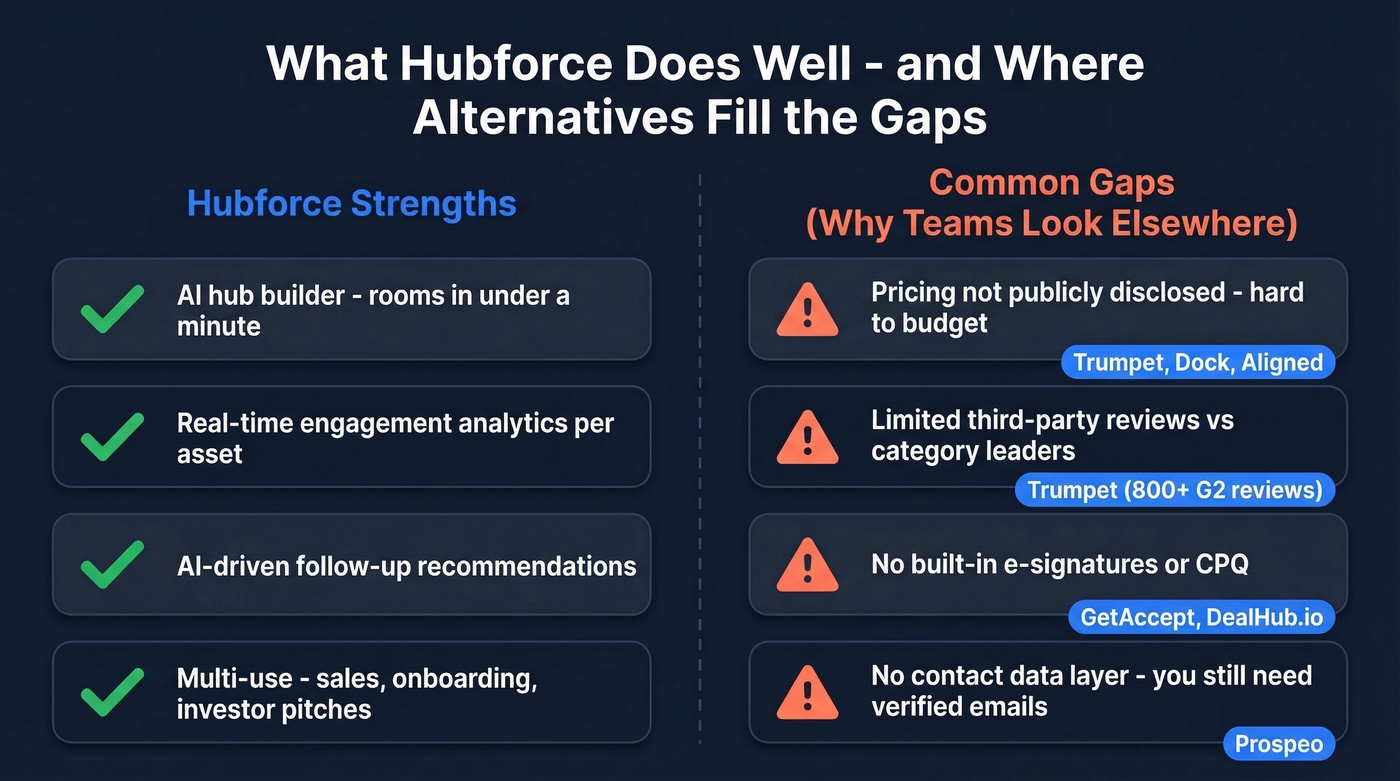
Public pricing is thin. You get 5 free hubs with no credit card required. Beyond that, paid tiers aren't disclosed - expect somewhere in the $30-$150/user/month range based on category norms. Hubforce also has limited third-party review coverage compared to category leaders, which makes independent benchmarking tough.

The average B2B deal has 6-10 stakeholders, but most teams only have verified contact data for a fraction of them. Prospeo gives you 98% accurate emails and 125M+ verified mobiles so every decision-maker gets invited to your deal room - not just the ones you already know.
Stop sending deal room invites that bounce. Start with verified data.
Best Hubforce Alternatives Compared
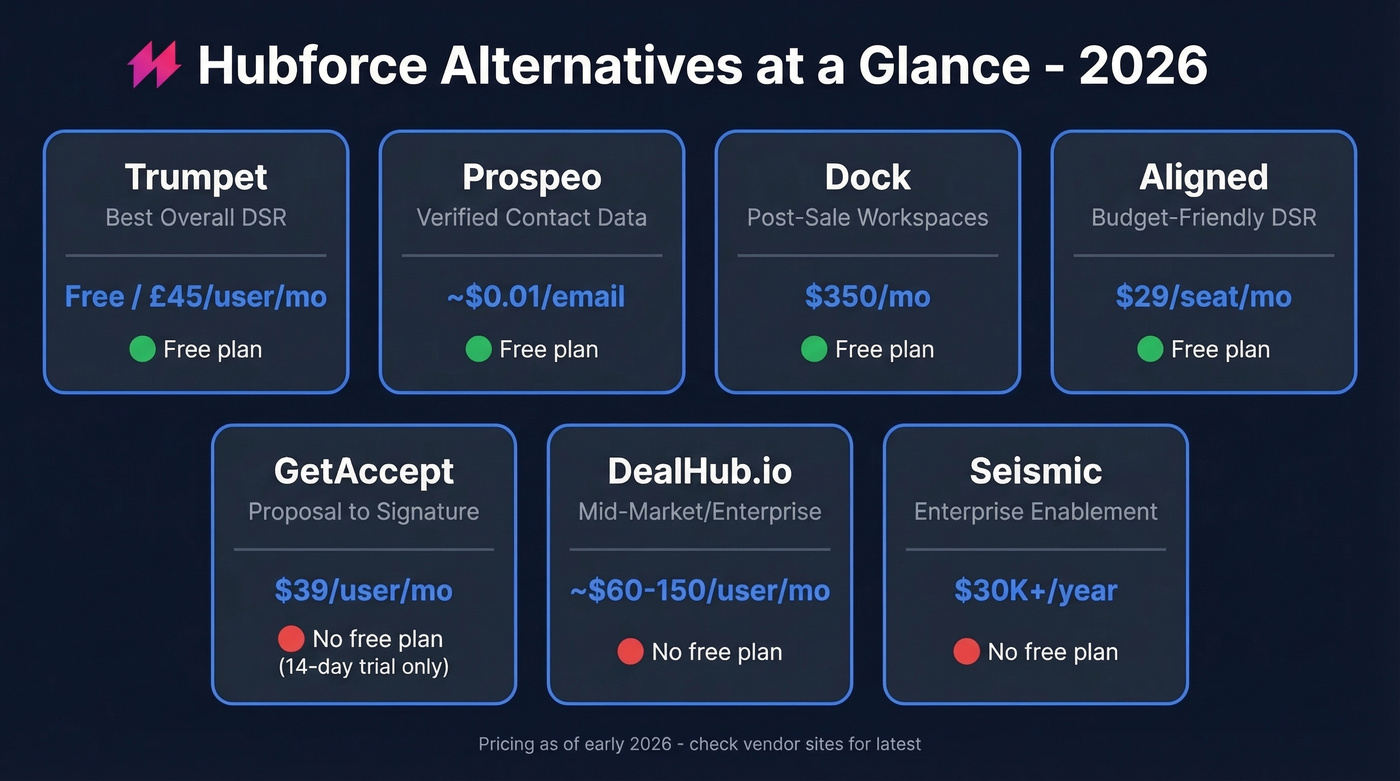
| Tool | Best For | Starting Price | Free Plan? | Key Differentiator |
|---|---|---|---|---|
| Trumpet | Best overall DSR | £0 (paid from £45/user/mo) | Yes (10 Pods) | #1 on G2, 800+ reviews |
| Prospeo | Verified contact data | ~$0.01/email | Yes (75 emails/mo) | 98% email accuracy, 125M+ mobiles |
| Dock | Post-sale workspaces | $350/mo (5 users) | Yes (50 workspaces) | Mid-deal through renewals |
| Aligned | Budget-friendly DSR | $29/seat/mo | Yes | Unlimited rooms on paid |
| GetAccept | Proposal-to-signature | $39/user/mo | 14-day trial | E-signatures inside the room |
| DealHub.io | Mid-market/enterprise | ~$60-$150/user/mo | No | CPQ + deal rooms + subscriptions |
| Seismic | Enterprise enablement | ~$30K+/year | No | Full enablement suite |
Trumpet
Trumpet is the #1 digital sales room on G2 globally with 800+ reviews, and the free tier is genuinely usable - 10 free Pods per account, unlimited users, mutual action plans, and basic analytics included at £0. That's not a trial. It's a real free plan.
Pro runs £45/user/mo (capped at 5 users), Scale hits £100/user/mo for growing teams, and Elite goes to £160/user/mo with SSO, white labelling, and custom domains. CRM integrations are included on Pro and above. If you want a battle-tested deal room with transparent pricing and a path from free to enterprise, start here. Trumpet is strongest during the deal cycle itself - if you care more about onboarding, renewals, and expansion workspaces, Dock is the better fit.
Prospeo
Here's the thing nobody in the DSR conversation talks about: modern B2B deals involve six to ten stakeholders, but most teams only have verified contact data for two or three of them. You're building a beautiful room and inviting half the buying committee.
Prospeo isn't a digital sales room - it's the data layer that sits upstream of every room you build. With 98% email accuracy across 143M+ verified emails and 125M+ verified mobile numbers with a 30% pickup rate, you can find and verify every stakeholder before you send the first invite. The 7-day data refresh cycle means you're not working with stale records from six weeks ago. Free tier gives you 75 emails and 100 Chrome extension credits per month, with paid plans starting at roughly $0.01 per email and no contracts.
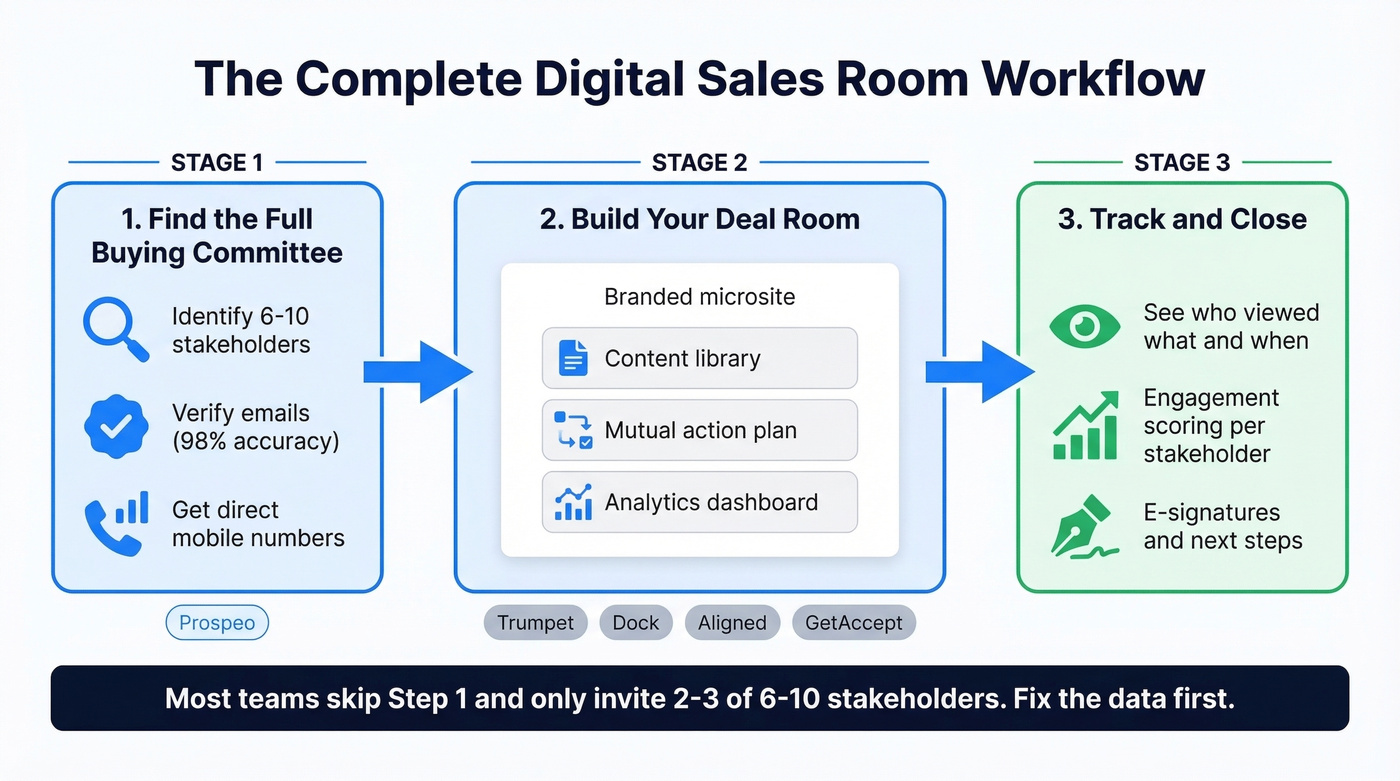
The workflow is simple: identify missing committee members using 30+ search filters (including buyer intent data powered by Bombora), verify their emails and direct dials, then invite the full group into your deal room. Teams using this approach report bounce rates under 4% - critical when your room invites are the first touchpoint. Pair it with Trumpet, Dock, or any other room on this list.
Dock
Dock is the tool CS teams actually want to use alongside sales. Where most DSRs end at the signature, Dock's workspaces extend through onboarding, renewals, and expansion - making it a top pick for teams that care about the full customer lifecycle, not just closing.
The free plan includes 50 workspaces. Standard runs $350/mo for 5 users, Premium hits $1,000/mo for 10 users, and extra seats are $50/user/mo. Only internal team members get charged - external collaborators are free. The catch: initial setup takes longer than you'd expect, and the template library can feel limited compared to Trumpet's.

Aligned
The pitch is dead simple: $29/seat/mo for unlimited rooms. No per-room caps, no usage metering. Aligned does the core DSR job without overcomplicating things, and a free tier is available if you want to test it first. For teams that just need a shared deal space with clean fundamentals, this is the obvious budget pick. Skip it if you need post-sale workspace features - that's Dock's territory.
GetAccept
GetAccept bakes e-signatures directly into the deal room, so you don't need a separate DocuSign or PandaDoc subscription.
Deal rooms start at $39/user/mo, contract rooms at $49/user/mo, with a 14-day free trial. Integrations cover HubSpot, Salesforce, MS Dynamics, and Pipedrive. If your bottleneck is proposal-to-signature rather than content sharing, GetAccept solves it in one tool. Skip it if you want a free plan or need rooms that live beyond the signature - GetAccept is built for closing, not onboarding.
DealHub.io
DealHub.io bundles CPQ, deal rooms, and subscription management into one platform. It's aimed at mid-market and enterprise teams who need quoting and deal rooms under one roof. Pricing is custom - expect $60-$150/user/month and annual contracts. If you just want a shared workspace without the CPQ layer, this is overkill.
Seismic
Seismic is a full enterprise enablement suite - content management, training, coaching, and deal rooms rolled into one. Budget $30,000-$100,000+/year. If you just need digital sales rooms, this is massive overkill. It's the right move only if you're already investing in a complete enablement stack and want deal rooms as a feature, not a standalone product. Seismic's site has more on their full platform.
No matter which Hubforce alternative you pick, your deal room is only as good as the contacts inside it. Prospeo's 7-day data refresh and 30+ search filters - including buyer intent signals - let you map the full buying committee before you build the room.
Fill every seat in the deal room with verified contacts at $0.01 each.
How to Choose the Right Tool
The DSR market is projected to hit $7.9B by 2031, which means the tool landscape will only get noisier. Here's what actually matters when picking among these Hubforce alternatives.
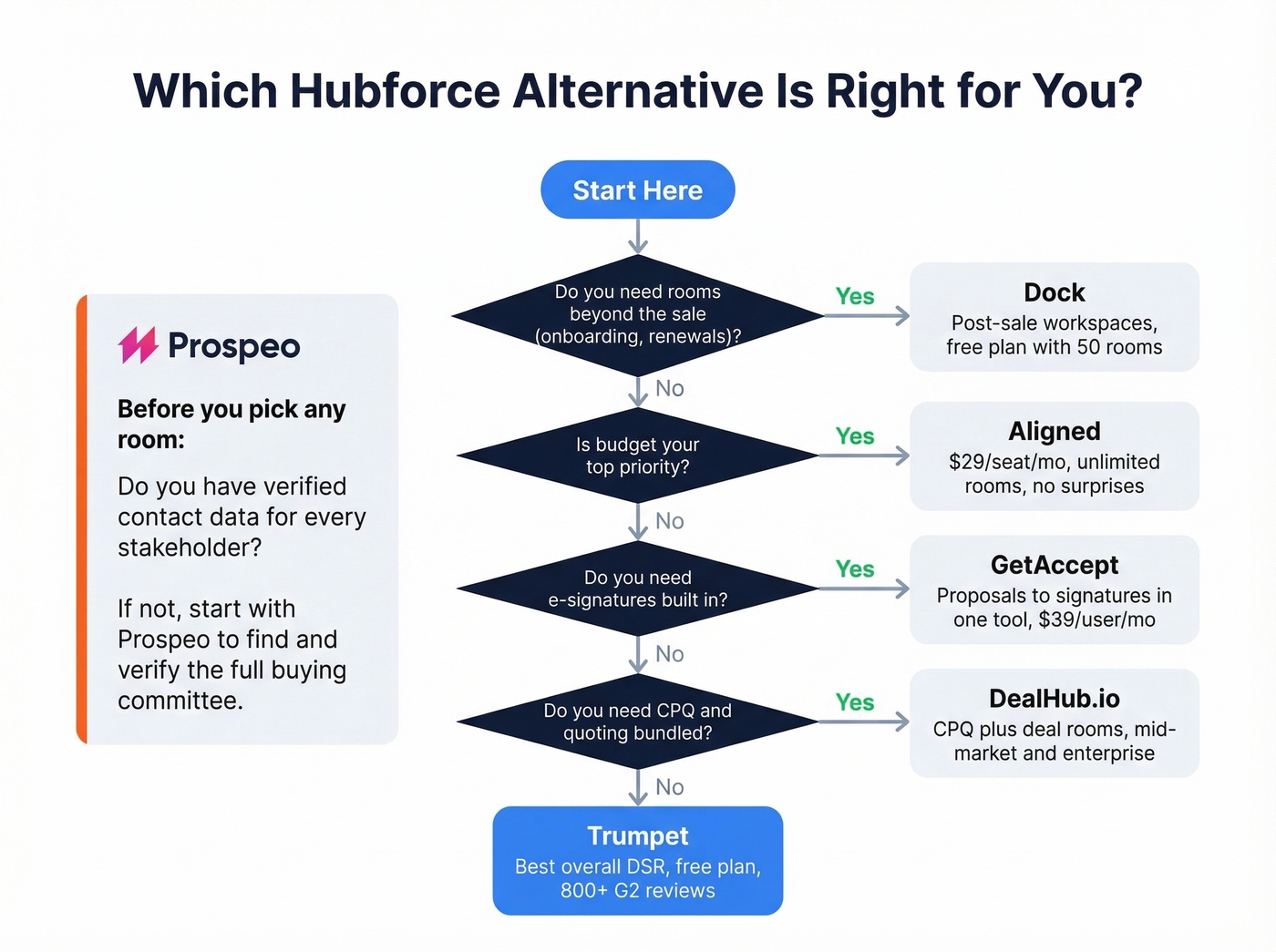
Setup speed kills adoption. If the builder isn't fast, reps won't use it. Hubforce's "less than a minute" AI builder addresses this well. Make sure whatever you pick does too - we've seen teams buy a DSR tool and watch it collect dust because reps found room creation tedious.
Pricing transparency is a trust signal. If a vendor hides pricing behind "book a demo," that tells you who they're optimizing for. Trumpet and Dock publish pricing openly, and Aligned's $29/seat pricing is widely published.
Let's be honest about something most DSR comparisons ignore: the best digital sales room in the world fails if three of your seven stakeholders never get invited. Most teams obsess over room design and ignore whether they even have verified contact data for the full buying committee. Fix the data first, then pick the room. If you're rebuilding your prospecting motion, start with sales prospecting techniques that consistently surface the full committee.
FAQ
Is Hubforce free?
Hubforce offers 5 free hubs with no credit card required. Paid pricing isn't publicly available - expect $30-$150/user/month based on DSR category norms. For transparent pricing, look at Trumpet (free + £45/user/mo) or Dock (free + $350/mo).
What's a digital sales room?
A secure, branded microsite created per deal where sellers centralize content, track buyer engagement via analytics dashboards, and collaborate with buying committees through mutual action plans. It replaces scattered email attachments with a single shared workspace showing exactly who's engaging and when.
How do I reach every stakeholder in a deal room?
Use a verified data tool to find emails and mobile numbers for the stakeholders you're missing before you build the room. Prospeo's 98% email accuracy and 125M+ verified mobiles mean invites actually land. The free tier (75 emails/month) is enough to test the workflow on a few live deals.
Which Hubforce alternative has the best free plan?
Trumpet offers 10 free Pods with unlimited users and mutual action plans - no trial expiration. Dock gives you 50 free workspaces. Aligned also has a free tier. For contact data, Prospeo's free plan includes 75 verified emails and 100 Chrome extension credits monthly.